
Do Brain Training Games Actually Work
Most commercial brain-training games successfully improve your performance on the specific digital puzzles you practice, but extensive evidence shows they do not broadly prevent cognitive decline or boost general everyday intelligence. However, highly specific, adaptive speed-of-processing exercises have recently demonstrated a unique potential to reduce long-term dementia risk in older adults. Ultimately, the scientific consensus maintains that building a "cognitive reserve" through physical exercise, challenging real-world learning, and cardiovascular health remains the most effective strategy for protecting the aging brain.
The Allure and the Reality of Brain Games
As global populations age and life expectancies increase, the fear of cognitive decline and neurodegenerative diseases like Alzheimer's has grown in tandem 12. In response to these widespread anxieties, a multi-billion dollar digital industry emerged in the early 2010s, promising an enticingly simple solution: play a few puzzles on a smartphone for fifteen minutes a day, and you can "wire your brain" to stay sharp, delay memory loss, and stave off dementia 13.
The concept was rooted in a legitimate neuroscientific principle known as neuroplasticity - the brain's lifelong ability to reorganize itself by forming new neural connections in response to learning and experience 45. Software developers gamified established laboratory cognitive tests, wrapped them in engaging user interfaces, and marketed them directly to consumers as daily mental workouts 56. However, as the user base for these applications swelled into the tens of millions, the broader scientific community began to realize that the marketing claims had vastly outpaced the available clinical evidence.
The Dueling Scientific Consensus Statements
The tension between commercial promises and scientific reality reached a boiling point in late 2014. The Stanford Center on Longevity and the Berlin Max Planck Institute for Human Development gathered over 70 of the world's leading cognitive psychologists and neuroscientists to issue a definitive consensus statement 17.
The signatories strongly objected to the claim that software-based brain games offered a scientifically grounded avenue to reverse or reduce cognitive decline 8. The experts noted that while advertising frequently touted games as being "designed by neuroscientists" and backed by solid research, the cited studies were often only tangentially related to the games themselves, relied on very small sample sizes, or exaggerated the implications of the findings 18. The consensus concluded that the "promise of a magic bullet" distracted the public from the best evidence available: that cognitive health in old age reflects the long-term effects of a healthy, physically active, and socially engaged lifestyle 18.
The debate, however, was far from settled. Several months later, an international group of 133 scientists and practitioners countered with their own open letter, arguing that the literature was, in fact, replete with demonstrations showing the benefits of brain training for a wide variety of cognitive and everyday activities 7. This schism highlighted a critical problem in the field: researchers were fundamentally disagreeing on how to interpret the data, what constituted a "real world" benefit, and what types of cognitive gains actually mattered to patients.
The Lumosity Settlement and Regulatory Crackdown
This academic pushback soon translated into severe regulatory action, permanently altering the landscape of the brain-training industry. In 2016, the United States Federal Trade Commission (FTC) filed a complaint against Lumos Labs, the creators of the highly popular "Lumosity" program, which boasted 70 million users worldwide .
Lumosity's advertising campaigns cast an incredibly wide net. The company claimed that training with their games could delay memory decline, protect against Alzheimer's disease, improve academic and athletic performance, and even reduce the cognitive impairments associated with stroke, post-traumatic stress disorder (PTSD), attention-deficit hyperactivity disorder (ADHD), Turner syndrome, and the "chemofog" experienced by children undergoing chemotherapy 349.
The FTC determined that the company lacked the competent and reliable scientific evidence required to substantiate these sweeping health claims 34. The investigation also revealed deceptive marketing practices; the company had failed to disclose that many of its glowing consumer testimonials were actively solicited through contests offering prizes like iPads and free trips 39.
The resulting legal settlement imposed a $50 million judgment against the company (which was suspended after a $2 million payment due to the company's financial condition) and strictly prohibited Lumosity from making future claims about cognitive impairment or dementia without robust human clinical testing 34910. The case served as a watershed moment, forcing the brain-training industry to recalibrate its marketing and forcing curious consumers to look closer at what the underlying science actually supports.
The Core Debate: Near Transfer vs. Far Transfer
To understand why brain games generally fail to deliver on their grandest promises, one must examine the psychological concept of "transfer of training." The fundamental premise of cognitive training is that practicing a specific task will enhance a domain-general cognitive mechanism, such as working memory or processing speed. The hope is that this enhanced mechanism will, in turn as a by-product, improve a person's performance on entirely unpracticed tasks that rely on that same underlying cognitive skill 711.
Defining the Limits of Human Learning
Cognitive scientists categorize this generalization into two distinct types: "near transfer" and "far transfer."
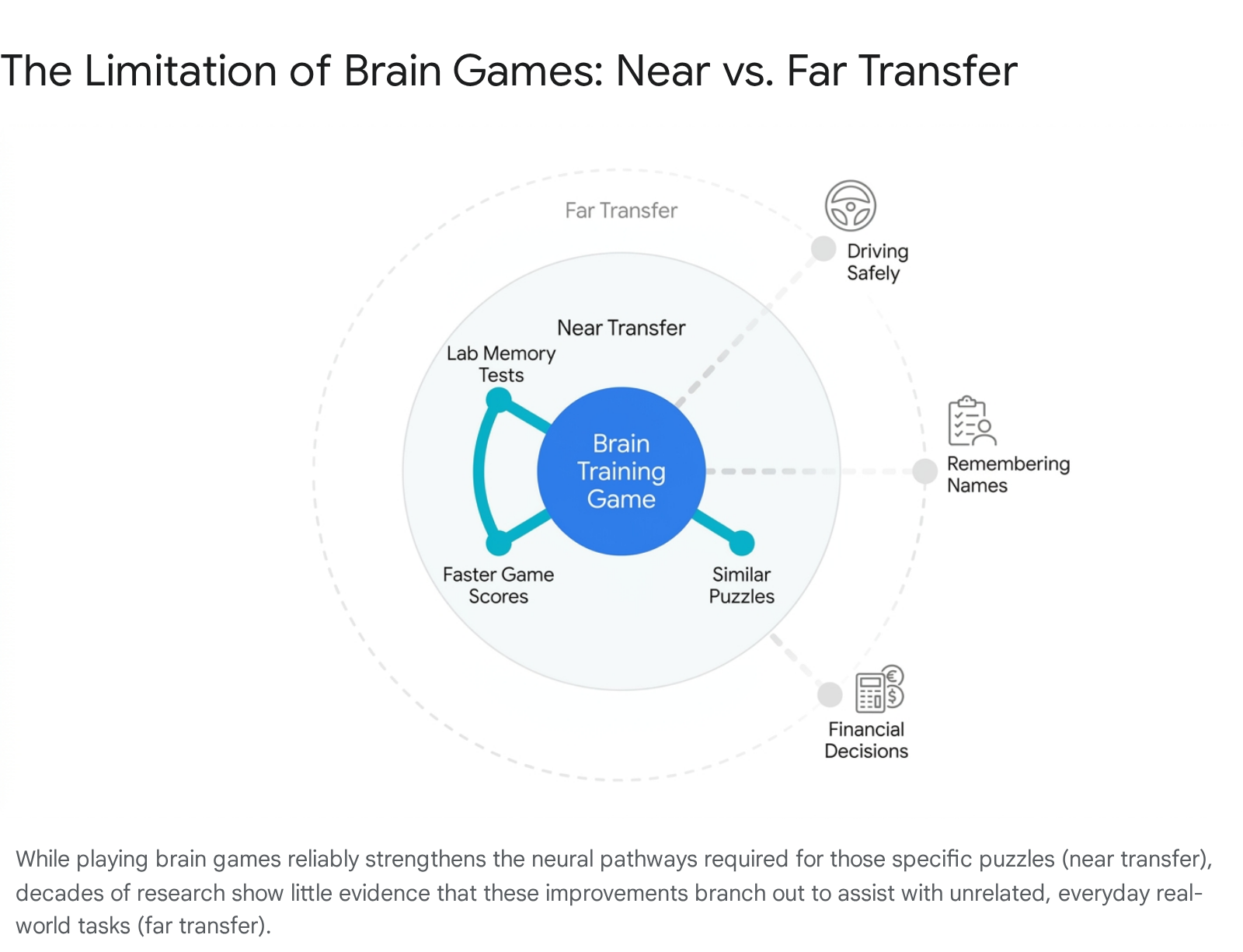
Extensive research, including massive systematic reviews, confirms that the human brain is highly efficient at near transfer. If a person spends weeks practicing a computerized game that requires them to memorize spatial sequences, they will undeniably become significantly faster and more accurate at that specific game, and they will likely improve on very similar spatial memory tests administered in a laboratory setting 17111213.
The fundamental problem arises with far transfer. The ultimate goal of a commercial brain game is not to make the user a world-class digital puzzle solver; it is to induce broad training effects that translate into tangible real-world benefits, such as remembering where the car keys are, making sharper financial decisions, navigating a busy intersection, or retaining functional independence in old age 5712.
| Concept | Scientific Definition | Example in Brain Training | Current Scientific Evidence |
|---|---|---|---|
| Near Transfer | Improvement in tasks that are identical, structurally similar, or closely related to the trained task. | Practicing a computerized "N-back" memory game improves scores on a different digital memory sequencing test. | Extensive and Strong. Users reliably and consistently get better at the specific mechanics and games they practice 71113. |
| Far Transfer | Improvement in broadly different cognitive domains, generalized intelligence, or real-world everyday functioning. | Practicing a computerized "N-back" memory game improves a person's ability to focus during a noisy conversation or navigate a new city. | Weak to Non-existent. There is little to no evidence supporting broad cognitive generalization across healthy populations 71113. |
A comprehensive 2016 review by Simons et al., which analyzed the literature most frequently cited by brain-training companies, found no compelling evidence that brain training enhances performance on distantly related tasks or improves everyday cognitive performance 7. Second-order meta-analyses - studies that pool the results of multiple other meta-analyses to examine the overarching data - have even suggested that the lack of far-transfer is a fundamental, invariant characteristic of human cognition. Domain-specific skills simply do not readily generalize across unrelated domains 1113.
This reality has proven incredibly frustrating for clinical scientists attempting to build therapies. Even when a digital intervention seems to successfully engage the targeted neural mechanisms in a controlled laboratory, the benefits rarely cross over into the messy, unpredictable reality of daily living 712.
Methodological Flaws in Brain Training Research
If far transfer is exceptionally rare, why do some academic studies and company white papers claim to show significant real-world improvements? The answer largely lies in flawed and inconsistent research methodologies.
When independent researchers audit the literature supporting commercial brain games, they consistently find major shortcomings in experimental design. One of the most prevalent and damaging issues is the use of "passive" control groups 7. In many early studies, the intervention group would play a highly stimulating brain game for several weeks, while the control group did absolutely nothing, often simply placed on a waitlist. If the intervention group scored higher on a subsequent cognitive test, researchers attributed it entirely to the game's mechanics.
However, passive controls fail to account for a multitude of confounding variables. They do not control for the placebo effect, test-retest familiarity, increases in general motivation, or the psychological boost of simply interacting with researchers on a weekly basis 713. When researchers design more rigorous trials using heavily matched "active" control groups - for example, having one group play an intensive, adaptive working-memory game while the control group plays a non-adaptive trivia game, watches educational videos, or completes digital crossword puzzles - the generalized cognitive advantages of the "brain training" intervention frequently vanish 71415. Furthermore, issues like lack of preregistration, small sample sizes, and researchers selectively reporting only the successful metrics have historically inflated the perceived efficacy of these digital interventions 7.
What the Evidence Shows Across Different Populations
To settle the debate over efficacy and cut through the noise of individual, potentially flawed studies, the medical community relies on systematic reviews and meta-analyses. These massive reviews aggregate data from thousands of participants across dozens of randomized controlled trials (RCTs). Over the last several years, these large-scale reviews have painted a consistent, albeit heavily caveated, picture regarding computerized cognitive training (CCT).
Findings for Healthy Older Adults
The Cochrane Collaboration, widely considered the international gold standard for evidence-based medicine, has published extensive reviews evaluating CCT in healthy older populations.
A 2020 Cochrane review looking at healthy adults aged 65 and older examined eight trials encompassing 1,183 participants. The researchers found that completing 12 weeks of CCT may lead to slightly better overall cognitive function and slight improvements in episodic memory immediately following the training period, compared to doing no activities 1516. However, the researchers emphasized that the overall quality of the evidence was low. Crucially, they found absolutely no evidence that any of these modest benefits persisted 12 months after the intervention ended 15.
Similarly, an earlier 2019 Cochrane review focusing on midlife adults (defined as 40 to 65 years of age) attempted to determine if early intervention could build cognitive reserve. The review identified a large study of 6,742 participants but noted a severely high dropout rate, leading to an assessment of low-quality evidence 17. The authors concluded they were unable to determine if CCT is effective for maintaining global cognitive function in midlife, recommending that future studies follow participants much longer to assess clinically important outcomes 17.
Findings for Mild Cognitive Impairment (MCI)
For older adults who are already experiencing mild cognitive impairment (MCI) - a condition characterized by noticeable cognitive decline that does not yet interfere with daily functioning, but serves as a common precursor to clinical dementia - the evidence for brain games is similarly underwhelming.
A Cochrane review specific to the MCI population analyzed data from 660 participants and found that current evidence does not allow scientists to determine whether CCT prevents clinical dementia or meaningfully improves cognitive function over the long term 1819. The review noted that while some individual studies reported large effect sizes, the overall literature was plagued by small sample sizes, short study durations, and massive inconsistencies in how training was administered 19. Because of the very low quality of the evidence, the authors were highly uncertain about the effects of CCT on speed of processing, verbal fluency, or executive function in the MCI population 1619.
| Target Population | Intervention Type | Key Findings from Major Meta-Analyses | Quality of Evidence |
|---|---|---|---|
| Healthy Adults (Age 65+) | Computerized Cognitive Training (CCT) | Slight, short-term improvements in episodic memory and global cognition immediately post-training. No evidence of benefits persisting 12 months later 1516. | Low to Very Low |
| Healthy Midlife Adults (Age 40-65) | Computerized Cognitive Training (CCT) | Insufficient data to determine effectiveness for maintaining global cognitive function due to high trial attrition rates 17. | Low |
| Mild Cognitive Impairment (MCI) | Computerized Cognitive Training (CCT) | Cannot determine if CCT prevents clinical dementia or improves cognitive function. Studies plagued by short durations and small samples 1819. | Very Low |
Incremental Efficacy and Specific App Successes
Despite these broad, cautionary conclusions, it is important to note that the scientific community does not view brain training as entirely useless, provided expectations are accurately calibrated. A 2025 meta-analysis published in the Journal of Pharmacy and Bioallied Sciences, which reviewed 16 high-quality RCTs, concluded that brain training games do produce statistically significant improvements in processing speed and working memory in healthy individuals from their baseline measurements 2023.
Other analyses show that cognitive-based training for healthy older adults can moderately improve executive function, provided the training is exceptionally intensive - occurring three or more times per week for a total of at least 24 sessions 21.
Furthermore, some specific commercial applications have demonstrated intriguing physiological results. For instance, the app BrainHQ, developed by Posit Science, was utilized in a clinical trial at McGill University involving healthy adults over 65 2522. The study, known as INHANCE, utilized rare PET scan technology to track chemical changes in the brain. Researchers found that adults who used the speed-based BrainHQ exercises daily for 10 weeks showed enhanced cholinergic function - a chemical system vital for attention, memory, and decision-making that typically degrades with age 22. The lead researchers noted that the training restored cholinergic health to levels typically seen in individuals ten years younger, marking a significant physiological, rather than just behavioral, milestone 22.
Other non-traditional platforms, such as the 3D multiple object tracking (MOT) software NeuroTracker, originally designed for athletes and military personnel, have shown success in improving working memory, biological motion perception, and real-time decision-making in high-stress environments, though its transfer to broad, everyday cognitive tasks remains debated 23.
The Exception: The ACTIVE Study and Speed of Processing
While the broad consensus urges deep skepticism regarding commercial brain games preventing cognitive decline, one specific, highly targeted intervention has recently disrupted the field and forced researchers to re-evaluate the potential of clinical cognitive software.
The Advanced Cognitive Training for Independent and Vital Elderly (ACTIVE) study stands as one of the largest, longest, and most rigorous randomized controlled trials ever conducted on cognitive aging. Funded by the National Institutes of Health, researchers began enrolling 2,832 healthy older adults (with an average age of 74) in 1998. Participants were divided into four groups: a no-contact control group, a memory training group, a reasoning training group, and a "speed of processing" training group 24252627. The interventions consisted of 10 training sessions lasting 60 to 75 minutes each, spread over six weeks, with some participants receiving additional "booster" sessions one and three years later 2527.
While early analyses over the first decade showed that participants maintained improvements in their specifically trained tasks, a landmark 2026 publication revealed unprecedented long-term data. By linking 2,021 of the original ACTIVE participants to two decades of Medicare claims data, researchers were able to track actual, real-world clinical diagnoses of Alzheimer's disease and related dementias (ADRD) 25262829.
A 25% Reduction in Dementia Risk
The 20-year follow-up yielded a staggering result that bucked the trend of previous cognitive training failures: participants who received the speed-of-processing training, and specifically those who completed the additional booster sessions, were 25% less likely to be diagnosed with dementia over the subsequent two decades compared to the control group 25273031.
To put the raw data in perspective: over the 20-year period, 48.7% of the control group received a Medicare claim for dementia. In stark contrast, only 39.8% of the participants who completed the speed training alongside the booster sessions developed the disease 26.
Crucially, the participants randomized to the memory training and reasoning training arms did not show a statistically significant reduction in dementia risk 26283132.
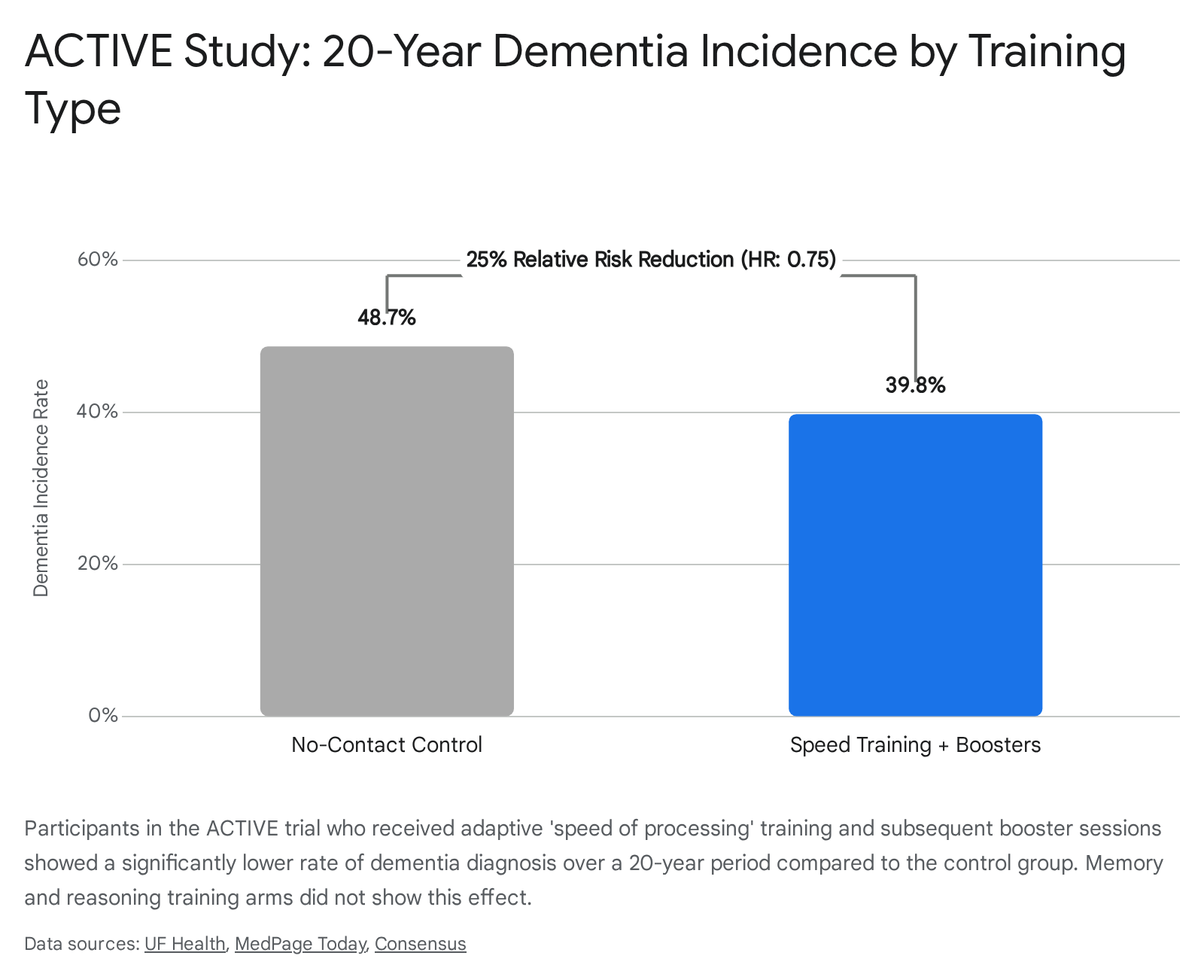
This differential outcome proved that not all "brain training" is created equal, and lumping all cognitive exercises into a single category obscures highly effective, targeted interventions.
Why Did Speed Training Succeed Where Memory Training Failed?
The success of the ACTIVE study's speed-training arm - while standard memory games failed - highlights a critical nuance in cognitive neuroscience. Researchers hypothesize that the difference lies fundamentally in the mechanism of learning being deployed.
Memory and reasoning training generally rely on explicit strategies. These interventions teach people specific, conscious mnemonic devices, categorization methods, or logical steps to solve puzzles 31. Speed of processing training, conversely, relies on implicit learning. The specific task used in the ACTIVE study - often referred to as the Useful Field of View test - requires users to quickly identify an object in the center of a screen while simultaneously locating a peripheral target, all while the screen flashes for milliseconds and becomes increasingly cluttered with visual distractions 272829.
Because the speed training was highly adaptive - meaning the software constantly increased the speed and difficulty the exact moment the user improved - it forced the brain to process raw visual information faster and aggressively expand its dual-attention capacities 262829. Researchers suggest this intensive, subconscious, sensory-level processing leads to much broader neural activation across the brain than simply practicing conscious memory tricks. This broad activation appears to build a more durable, structural buffer against the physical neurodegeneration associated with Alzheimer's disease 2631.
The Global Consensus: Building Cognitive Reserve
While the ACTIVE study provides a remarkably promising lead for the future of highly targeted, clinical software, the broader medical consensus remains unchanged for the general public: commercial brain-training apps should not be viewed as the primary defense against cognitive decline. Instead, leading health organizations advocate for building "cognitive reserve."
Cognitive reserve theory posits that individuals who engage in a lifetime of complex, stimulating physical and mental activities build a denser, more robust network of neural connections. When age-related changes or the early pathologies of Alzheimer's begin to physically damage the brain tissue, a dense cognitive reserve allows the brain to "reroute" signals and compensate for the damage, actively delaying the outward clinical symptoms of dementia for years 33343536.
To build this reserve, evidence overwhelmingly points to holistic lifestyle interventions over seated, screen-based games.
The Underappreciated Power of Physical Exercise
Perhaps counterintuitively, the most effective "brain training" currently known to science involves moving the body, not sitting at a desk. Clinical guidelines consistently rank physical exercise above cognitive training for maintaining brain health 243738.
Aerobic exercise - such as brisk walking, swimming, or cycling - increases blood flow to the brain and has been shown to physically modulate peripheral levels of brain-derived neurotrophic factor (BDNF). BDNF is a crucial protein responsible for the survival, growth, and maintenance of neurons 3944. Randomized controlled trials have demonstrated that resistance training, especially when combined with cognitive challenges, significantly increases BDNF and improves overall executive function in healthy older adults 2439. Furthermore, maintaining midlife aerobic fitness is associated with a significantly reduced risk of mild cognitive impairment and visibly increased gray and white matter volume on brain scans 44.
Real-World Cognitive Engagement Outperforms Apps
When it comes to challenging the mind, the unpredictable complexity of the real world far outpaces the structured, controlled confines of digital apps.
Longitudinal studies, such as the Sydney Memory and Ageing Study, show that individuals who engage in complex, unstructured mental activities - such as learning a new language, taking up digital photography, or practicing a musical instrument - are significantly less likely to develop mild cognitive impairment 3536. In the renowned Synapse Project, researchers found that older adults assigned to highly challenging, novel activities (like learning digital photography) showed significant gains in memory and processing speed compared to those assigned to low-challenge activities (like doing familiar crosswords or watching documentaries) 6. Brain scans revealed that those engaged in the high-challenge projects physically increased their neural efficiency 6.
Even traditional, analog board games provide profound benefits. A 20-year French study involving over 3,600 older adults found that regular board game players (playing games like chess) experienced a 15% reduction in the risk of developing dementia and reduced rates of depression compared to non-players 3236.
The key to these activities is that they inherently demand multimodal brain engagement. Learning a language requires memory, auditory processing, vocal motor control, and emotional social interaction simultaneously. It forces the brain to adapt to novel, unpredictable challenges. A digital puzzle, by contrast, quickly becomes a predictable, isolated routine. As the Alzheimer's Association advises, once an activity becomes easy and you figure out the underlying strategy, it ceases to build cognitive reserve; it is time to move on and add a new, uncomfortable challenge 635.
The Shift Toward Multimodal Interventions
Recognizing that no single intervention is a silver bullet, modern neurological research and clinical guidelines have shifted heavily toward multimodal strategies.
The World Health Organization (WHO) updated guidelines explicitly state that people can reduce their risk of dementia by getting regular exercise, quitting smoking, avoiding harmful alcohol use, managing their weight, and maintaining healthy blood pressure, cholesterol, and blood sugar levels 3840. The WHO acknowledges that cognitive training "may be offered" to older adults to reduce the risk of cognitive decline, but it carries a much weaker recommendation than cardiovascular and metabolic management 37.
Pioneering clinical trials reflect this holistic reality. The J-MINT PRIME Tamba trial in Japan recently evaluated an 18-month program for at-risk older adults that combined weekly physical exercise, nutritional counseling, rigorous management of vascular risks (like hypertension and diabetes), and cognitive training 41. The trial successfully demonstrated significant improvements in executive function, processing speed, and global cognitive composite scores compared to a control group 41. Similarly, the European Academy of Neurology's 2025 Helsinki Congress guidelines heavily emphasize that the future of neurodegenerative disease management relies on personalized, multidisciplinary care pathways that integrate lifestyle modifications alongside emerging pharmacological therapies 48424344.
Bottom line
The vast majority of commercial brain-training games will reliably improve your ability to play those specific games, but there is little high-quality evidence they will make you smarter, improve your daily functioning, or prevent neurodegenerative disease. The notable exception is highly adaptive speed-of-processing training, which long-term data suggests can meaningfully reduce dementia risk when paired with sustained booster sessions. Ultimately, for the general public, the most scientifically validated way to protect the aging brain is not found in an app store, but through a multifaceted lifestyle approach that includes regular aerobic exercise, the lifelong learning of complex real-world skills, a heart-healthy diet, and sustained social engagement.