
Wigner's Friend Paradox and Limits of Quantum Mechanics
The Measurement Problem and the Heisenberg Cut
The conceptual foundation of quantum mechanics rests upon two distinct and seemingly incompatible modes of physical evolution. The first mode is the deterministic, continuous, and reversible time evolution of a closed physical system, governed by the linear Schrödinger equation. The second mode is the non-deterministic, discontinuous, and irreversible reduction of the state vector - colloquially known as "wave-function collapse" - that occurs precisely at the moment a measurement is performed, governed by the Born rule 12. The boundary dividing these two regimes is termed the Heisenberg cut, yet standard quantum theory lacks a precise, physical definition of where this cut should be placed, or what physical properties a system must possess to trigger a measurement collapse 34.
To probe this ambiguous boundary, physicist Eugene Wigner proposed a foundational thought experiment in 1961 that placed an intelligent observer inside the quantum system itself. By nesting one observer within the isolated laboratory of another, Wigner highlighted a fundamental logical tension between unitary evolution and the measurement postulate 23. While initially treated as a philosophical intuition pump regarding the role of consciousness in physical reality, the "Wigner's friend" scenario has undergone a massive theoretical revival in recent years.
Modern physicists have combined Wigner's original nested-observer premise with elements of Bell's theorem, Hardy's paradox, and Greenberger - Horne - Zeilinger (GHZ) contextuality to construct "Extended Wigner's Friend Scenarios" (EWFS).
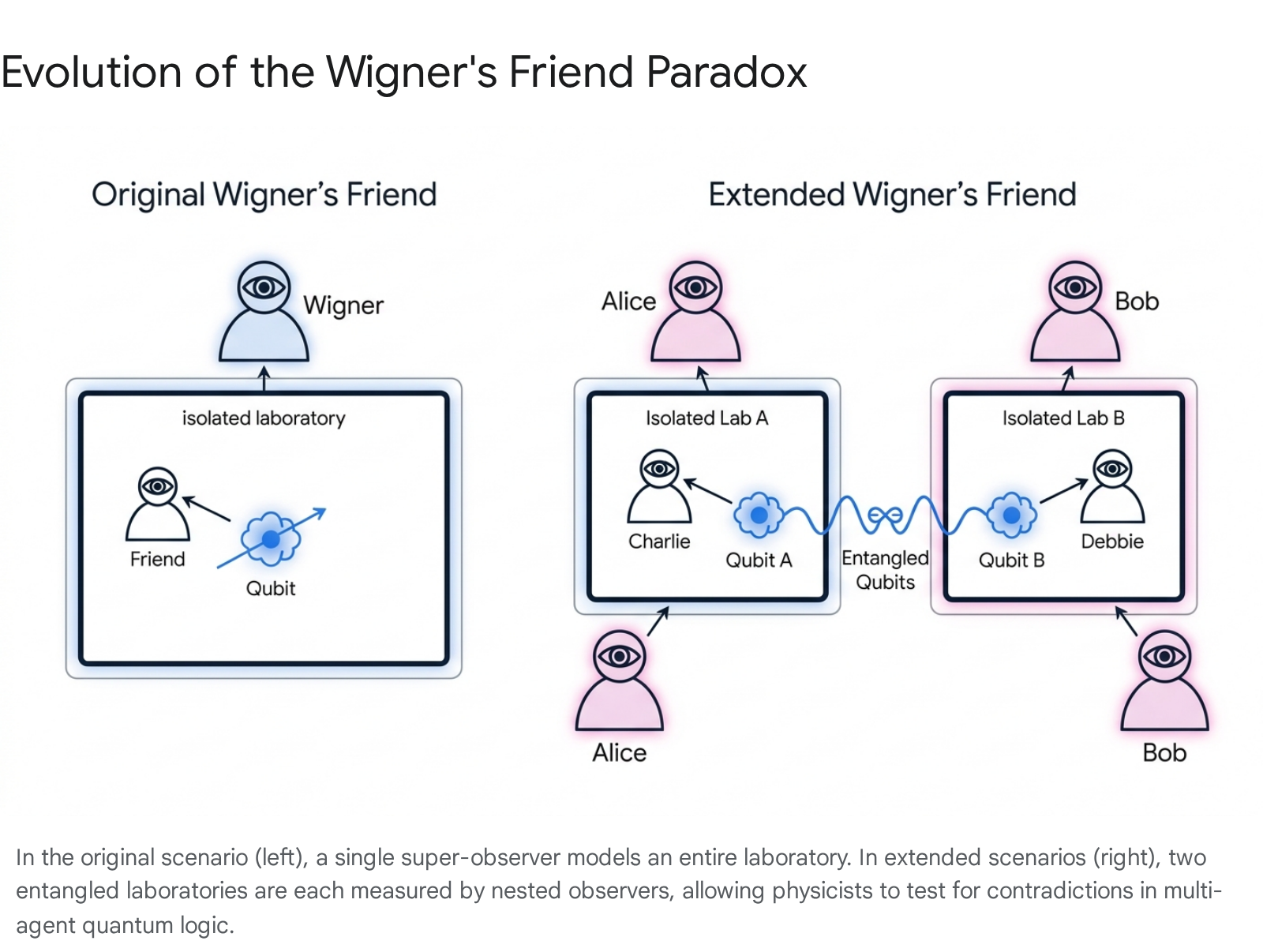
These advanced frameworks have yielded rigorous no-go theorems mathematically demonstrating that quantum mechanics cannot consistently describe the use of itself by multiple embedded agents 245. The paradox has consequently evolved from a metaphysical curiosity into a quantifiable test of the absolute limits of quantum mechanics, forcing a fundamental re-evaluation of objectivity, local agency, and the universal applicability of quantum rules.
The Original 1961 Thought Experiment
The original paradox involves an indirect observation of a quantum measurement. Although popularized by Eugene Wigner in his 1961 article "Remarks on the Mind-Body Question," the earliest written formulation of the problem appeared in a 1956 draft of Hugh Everett's doctoral thesis 26. Both physicists recognized that introducing a secondary observer exposes contradictions lurking in the naive application of quantum theory to multi-agent systems.
The scenario requires two primary agents: the observer inside an isolated laboratory, known as the Friend ($F$), and the super-observer stationed completely outside the laboratory, known as Wigner ($W$) 2.
State Assignments and the Logical Contradiction
The experimental protocol begins with a physical system, such as a photon or a single qubit ($S$), prepared in a coherent superposition of two orthogonal states, such as $|0\rangle_S$ and $|1\rangle_S$. Wigner's friend $F$ is sealed inside a perfectly isolated laboratory and is tasked with measuring the qubit in the computational basis ${|0\rangle_S, |1\rangle_S}$ 37.
From the internal perspective of the friend $F$, the measurement constitutes a standard quantum observation. Following the Copenhagen interpretation, the state vector of the qubit collapses upon interaction with the friend's measurement apparatus. The friend perceives a single, definite outcome - either a $0$ or a $1$ - and records this result in their memory 27. For the friend, reality now contains an absolute, definite fact regarding the state of the qubit.
Meanwhile, Wigner $W$ models the scenario from outside the laboratory. Because the laboratory is defined as a perfectly closed system, no information or radiation regarding the measurement outcome escapes to the external environment. Relying on the assumption that quantum mechanics is universally valid at all macroscopic scales, Wigner describes the entire laboratory - comprising the qubit, the macroscopic measurement apparatus, and the friend's cognitive state - as a single, complex quantum system undergoing purely linear time evolution 18.
When $W$ models the scenario, he does not apply the collapse postulate because, from his reference frame, no measurement has interacted with the external environment. Instead, he models the interaction between $F$ and the qubit as a unitary entangling operation. Consequently, Wigner assigns an entangled macroscopic superposition state to the joint system of the laboratory 2:
$|\Psi\rangle_{lab} = \frac{1}{\sqrt{2}} \left( |0\rangle_S \otimes |\text{Friend sees } 0\rangle_F + |1\rangle_S \otimes |\text{Friend sees } 1\rangle_F \right)$
The paradox emerges from the logically conflicting assignments of reality. The friend asserts that a definite outcome has occurred and that the system is in a collapsed state. Conversely, Wigner asserts that the friend and the system remain in a macroscopic superposition 78. This is not merely a disagreement over unknown information; Wigner can, in principle, verify his assignment by performing a highly complex interference measurement on the entire laboratory. By doing so, Wigner can prove that coherence was maintained and that a definite outcome had not objectively occurred prior to his measurement 109.
Wigner's Resolution and the Role of Consciousness
Wigner's own resolution to the paradox in 1961 relied on the controversial premise that the equations of motion of quantum mechanics cease to be linear when a conscious being is involved. He argued that the "faculty of introspection" and human consciousness form a physical demarcation line that forces an absolute wave-function collapse 2610. In his view, the friend's conscious awareness of the result definitively collapses the superposition into a statistical mixture, meaning Wigner's assignment of a pure entangled state is factually incorrect. Wigner posited that avoiding this conclusion would make solipsism the only logical alternative - a philosophical stance he found unacceptable 613.
However, Wigner's "consciousness causes collapse" interpretation was heavily criticized by contemporaries like Abner Shimony and Hilary Putnam. Wigner eventually discarded the interpretation entirely in the 1970s and 1980s, influenced by H. Dieter Zeh's work on quantum decoherence, which demonstrated how macroscopic quantum phenomena naturally suppress interference without requiring conscious intervention 1311.
Modern theoretical treatments strictly dismiss the requirement for human consciousness. In contemporary quantum information theory, an "observer" or a "friend" is defined functionally as any physical system capable of recording and reversibly storing information about another quantum system - such as a quantum computer, a simple particle detector, or an algorithmic artificial intelligence 1512. Consequently, the paradox is now understood as a structural and informational inconsistency within the theory itself: standard quantum mechanics yields contradictory descriptions of a single physical event depending solely on the placement of the Heisenberg cut by differing observers 3.
The Frauchiger-Renner Paradox
In 2016, physicists Daniela Frauchiger and Renato Renner circulated a preprint (published in Nature Communications in 2018) that fundamentally altered the discourse surrounding Wigner's friend. By combining Wigner's original setup with Hardy's paradox - a scenario involving entangled particles and counterfactual reasoning without Bell inequalities - they created an Extended Wigner's Friend Scenario (EWFS). They demonstrated that quantum theory cannot be consistently used to model physical systems that are themselves agents utilizing quantum theory 2413.
The Four-Agent Experimental Protocol
The Frauchiger-Renner (FR) gedankenexperiment involves four intelligent agents: two friends inside separate, perfectly isolated laboratories ($\bar{F}$ and $F$), and two super-observers stationed outside those respective laboratories ($\bar{W}$ and $W$) 414. The experimental timeline proceeds through a sequence of explicitly defined unitary operations and measurements, executed as follows:
| Experimental Time | Acting Agent | Action Performed | Resulting State or Information |
|---|---|---|---|
| $n:00$ | Friend $\bar{F}$ | Measures a quantum random number generator (system $R$) prepared in state $\sqrt{1/3} | \text{heads}\rangle_R + \sqrt{2/3} |
| $n:00$ (Cont.) | Friend $\bar{F}$ | Prepares a spin-1/2 particle (system $S$) based on outcome $r$ and routes it to laboratory $L$. | If $r=\text{heads}$, $S = |
| $n:10$ | Friend $F$ | Receives system $S$ and measures its spin in the basis ${ | \downarrow\rangle, |
| $n:20$ | Super-observer $\bar{W}$ | Performs a highly complex interference measurement on the entire laboratory $\bar{L}$ (including $\bar{F}$). | Announces outcome $\bar{w} \in {\text{ok}, \text{fail}}$. The 'ok' outcome corresponds to projection onto $\sqrt{1/2}( |
| $n:30$ | Super-observer $W$ | Performs an interference measurement on the entire laboratory $L$ (including $F$). | Announces outcome $w \in {\text{ok}, \text{fail}}$. The 'ok' outcome corresponds to projection onto $\sqrt{1/2}( |
| $n:40$ | All Agents | The experiment halts and agents compare global outcomes. | Paradox triggers if both super-observers announce ok. |
The agents are modeled as fully rational entities aware of the entire experimental protocol, the initial state preparations, and the mathematical rules of quantum mechanics.
The Three Core Assumptions
The FR theorem rests on three seemingly natural assumptions that physicists traditionally take for granted when reasoning about quantum systems 21415:
- Assumption (Q) - Universal validity of quantum theory: If standard quantum mechanics assigns a probability of $1$ to a proposition, an agent can assert that proposition with absolute certainty. This requires that quantum mechanics scales up reliably to macroscopic observers.
- Assumption (C) - Consistency: If agent A uses quantum mechanics to predict that agent B is certain of a fact, then agent A must also be certain of that fact. Different agents' predictions, derived using the same physical laws, cannot contradict one another.
- Assumption (S) - Single outcomes: From the perspective of an agent who carries out a measurement, that measurement has one and only one definite outcome.
The Emergence of the Logical Contradiction
By strictly applying these three assumptions, Frauchiger and Renner show that a chain of transitive logical inferences leads to a strict contradiction. In approximately 1/12 of the experimental runs, the quantum formalism dictates that both super-observers ($\bar{W}$ and $W$) will independently obtain the "ok" measurement outcome 16.
However, if the embedded agents use standard quantum mechanics to reason about the knowledge of the other agents based on their own localized measurement outcomes, a paradoxical inference chain forms. If $\bar{F}$ gets tails, she knows $F$ has a 50/50 chance of seeing $+1/2$ or $-1/2$. Because the agents can model each other, $\bar{W}$ can deduce that if he observes $\bar{w} = \text{ok}$, then $W$ must absolutely observe $w = \text{fail}$.
When both $\bar{W}$ and $W$ observe "ok" in the same run, the logical chain completely collapses. It becomes possible for one agent to observe a specific measurement outcome while correctly deducing that another agent has used standard quantum theory to predict the exact opposite outcome with 100% certainty 41421. Frauchiger and Renner summarize this as a proof that quantum theory cannot consistently describe the use of itself by multiple embedded agents.
The Temporal Rubicon and Critiques of Counterfactual Reasoning
The FR theorem has faced intense scrutiny regarding the legitimacy of chaining knowledge inferences across differing, physically incompatible measurement bases. A notable critique by theoretical computer scientist Scott Aaronson frames the FR paradox as a "Wigner's-friendification" of Hardy's paradox 913.
Aaronson rejects an unstated assumption implicit in the FR theorem's logic: the idea that agents can transitively chain together statements of certainty involving superposed observers measuring each other's brains, as if those measurements did not alter the physical reality of the knowledge 922. When super-observer $\bar{W}$ performs a measurement on the isolated laboratory containing $\bar{F}$, $\bar{W}$ is not merely checking a passive record. Because the measurement is in an interference basis (analogous to the ${|+\rangle, |-\rangle}$ basis), it constitutes a "violent measurement" - a massive unitary transformation (specifically, a Hadamard operation) on the quantum state of the friend's macroscopic brain and memory 39.
Aaronson argues that the physical act of this interference measurement totally scrambles the branching structure of the wave-function, thereby invalidating any logical inferences that relied on the friend's prior, un-scrambled state of knowledge. In quantum mechanics, statements of certainty are strictly conditional on specific measurements being made; counterfactual reasoning regarding "what the friend knew before their brain was Hadamarded" cannot be logically chained to subsequent outcomes in an incompatible basis. As Aaronson notes, "measure or measure not: there is no if you hadn't measured" 1322.
Brukner's Theorem and Observer-Independent Facts
Concurrent with the Frauchiger-Renner publication, physicist Časlav Brukner published a related no-go theorem utilizing an EWFS constructed analogously to a Bell-inequality test 1718. Brukner's setup simplifies the logical inference problem by pairing two super-observers (Alice and Bob) with two nested friends (Charlie and Debbie) who share an entangled photon pair.
Brukner's mathematical framework is designed explicitly to test the proposition that observations made by different, spatially separated agents can be combined into a single, objective reality. Brukner derived an inequality that establishes a contradiction between four foundational assumptions 171819:
- Universal validity of quantum theory: Quantum predictions hold at any scale, up to and including macroscopic objects as large as an observer, their laboratory, and their memory.
- Locality: The measurement settings chosen by one super-observer have no causal influence on the outcomes of a distant super-observer or their embedded friend.
- Freedom of choice: The choice of measurement settings by the super-observers is statistically independent of the rest of the experiment and the initial state preparation.
- Observer-independent facts: One can jointly assign definitive truth values to the propositions about the observed outcomes of different observers, allowing their records to coexist within a single, shared logical framework.
Brukner demonstrates that standard quantum mechanics predicts a violation of the derived inequality 1819. The profound implication of Brukner's theorem is that humanity may be forced to abandon Assumption 4. If locality and freedom of choice are fiercely maintained to avoid superdeterminism or faster-than-light signaling, the theorem suggests that macroscopic facts are strictly relational.
In this view, an observation is an event relative only to the specific observer who made it. Observers reside in distinct informational "bubbles." While agents can sometimes verify the state assignments of another bubble if they condition their predictions on all available information, there is no overarching "view from nowhere" that can consistently unify the subjective facts of all isolated agents into a singular objective history 20.
The Local Friendliness No-Go Theorem
Building directly upon Brukner's foundation, a highly influential 2020 paper by Bong, Utreras-Alarcón, Ghafari, Cavalcanti, Wiseman, and colleagues introduced a rigorous constraint on quantum reality known as the "Local Friendliness" (LF) no-go theorem. The LF theorem seeks to establish bounds that are mathematically stronger than those of Bell's theorem by utilizing substantially weaker metaphysical assumptions 212223.
Bell's theorem demonstrates that the predictions of quantum mechanics are incompatible with "Local Causality," an assumption that intrinsically bundles the concept of spatial locality with the assumption of classical realism (the notion that physical properties exist independently of measurement) 22. The LF theorem effectively unbundles these concepts, replacing Bell's Local Causality with two independent assumptions 212230:
- Absoluteness of Observed Events (AOE): An observed event is a real, singular event and is not relative to anything or anyone. If any observer in the universe sees an outcome, that outcome exists absolutely and must be consistent across all reference frames.
- Local Agency (LA) / Possibilistic Local Agency (PLA): Causes can only have effects within their future light cone. An intervention (a free choice of measurement setting by a super-observer) cannot causally influence events outside its causal future.
By applying these two assumptions to an EWFS where super-observers can randomly choose either to open the isolated laboratory (asking the friend what they saw, extracting classical information) or to perform a coherent interference measurement on the entire laboratory, the authors derive a set of Local Friendliness inequalities 2130. Quantum mechanics robustly predicts that these LF inequalities will be violated.
If an experiment successfully and definitively violates the LF inequalities, science faces a radical philosophical fork in the road: we must either surrender Local Agency (accepting true, faster-than-light physical influences) or surrender the Absoluteness of Observed Events 2330. Surrendering AOE fundamentally challenges the scientific method's reliance on intersubjective agreement, suggesting that different observers can physically exist in empirically incompatible realities.
Experimental Implementations and the Branch Factor
The theoretical frameworks of Brukner and LF have driven a massive wave of recent experimental implementations, notably supported by collaborative funding efforts like the Austrian Science Fund (FWF) Special Research Programme "BeyondC," which unites experimental groups in Vienna and Innsbruck 2425. In 2019, Proietti et al. successfully tested Brukner's scenario using a six-photon entangled system, reporting a clear violation of the observer-independent fact inequalities 1026. Similarly, Bong et al. implemented a "proof-of-principle" photonic experiment in 2020 that violated the LF inequalities 21. Subsequent tests on multi-qubit superconducting quantum computers have observed LF violations with increasing system complexity, scaling a metric called the "branch factor" up to 16.0 35.
These experiments, however, are subject to a severe conceptual critique: they rely on single photons or elementary superconducting qubits playing the role of the conscious "friend." Prominent physicists and philosophers of physics, such as Lev Vaidman and Tim Maudlin, argue that equating a microscopic particle's binary path state to an "observation" is categorically absurd. They maintain that a true observer must be a complex, macroscopic system capable of irreversible thermodynamic recording, memory formation, and temporal orientation 2.
Thoughtful Local Friendliness and Artificial Intelligence
To address the critique that photons are not observers, Wiseman, Cavalcanti, and Rieffel (2023) proposed a modified "Thoughtful Local Friendliness" theorem. They argue that to satisfy the philosophical weight of the paradox, an observer must possess genuine cognitive capabilities. Because performing an interference measurement on a biological human brain - reversing its thermodynamic evolution without killing the subject - is physically implausible, they propose an experiment utilizing a hypothetical Artificial General Intelligence running on a massive, fault-tolerant universal quantum computer 12.
Dubbed "QUALL-E," this highly advanced quantum AI algorithm would possess human-level thought, experience a measurement outcome, store it coherently in its quantum memory registers, and then be subjected to a unitary reversal by an external super-observer 12. While currently technologically impossible, this framework formalizes the ultimate endpoint of the Wigner's Friend research program: experimentally testing whether an entity demonstrably capable of "thought" can be maintained in a coherent quantum superposition, thereby settling the assumption of the universal validity of quantum mechanics at all scales of complexity.
Contextuality and the GHZ-FR Paradox
While early EWFS iterations relied heavily on nonlocal correlations (such as Bell inequalities or Hardy paradoxes requiring spatial separation), theoretical research from 2023 and 2024 has clarified the underlying mathematical machinery driving these inconsistencies. Walleghem, Wagner, and colleagues have proven that nonlocality is not a strictly necessary ingredient for generating a Wigner's friend paradox 3637.
By introducing the "GHZ-FR paradox," they established that contextuality - the property that quantum measurement outcomes depend fundamentally on which mutually commuting observables are measured alongside them - is the true engine of the logical inconsistency 3637.
Commutation Irrelevance
The GHZ-FR paradox utilizes a strongly contextual scenario (akin to the Mermin-Peres magic square) executed on a single physical system, effectively stripping away the complex spatial separation requirements of Brukner and LF 38. To derive the contradiction, the authors rely on a novel metaphysical assumption termed "Commutation Irrelevance."
Commutation Irrelevance posits that any unitary process performed between two measurements does not alter the correlations between their outcomes, provided that the unitary operation commutes with at least one of the two measurements - even if the outcomes of the two measurements are not jointly observable to any single agent 3827. If one accepts the completeness of quantum theory (meaning there are no deeper hidden variables), Commutation Irrelevance seems natural. However, violating this assumption implies that contextuality alone is sufficient to break the consistency of multi-agent quantum modeling 38.
Classical Analogs and Restriction A
Furthermore, researchers have challenged the presumption that the Wigner's friend paradox is exclusively a quantum mechanical phenomenon. Studies published in 2024 demonstrated that the core structural implications of the paradox regarding the absoluteness of observations can be replicated using classical thought experiments that involve the physical duplication or memory erasure of classical agents 35.
These classical analogs suggest that the paradox arises from a broader conceptual hurdle termed "Restriction A." Restriction A posits that a physical theory cannot intrinsically provide a consistent, probabilistic description of the observations of all agents simultaneously when those agents are subjected to extreme protocols of isolation, duplication, or amnesia 5. This links Wigner's friend to broader philosophical and cosmological puzzles, such as the Boltzmann brain problem and anthropic reasoning, suggesting the paradox tests the boundaries of self-referential logic as much as it tests quantum mechanics itself 5.
Implications for Interpretations of Quantum Mechanics
The strength of the extended Wigner's friend no-go theorems lies in their mathematical neutrality: the theorems do not dictate which foundational assumption is false, only that any viable, logically consistent interpretation of quantum mechanics must explicitly reject at least one 1415. The paradox effectively forces the various interpretations of quantum mechanics to declare their ontological commitments.
| Quantum Interpretation | Core Resolution to the Paradox | Foundational Assumption Rejected |
|---|---|---|
| Copenhagen / Neo-Copenhagen | Denies that the quantum state is an objective property of the world. State vectors merely represent the observer's available information. | Rejects Consistency (C) or Absoluteness of Observed Events (AOE). Facts are strictly relative to the specific observer 16. |
| QBism & Relational QM (RQM) | Radically perspectival. Any physical system can be an observer, and measurement states are valid only relative to the system observing them. | Rejects Absoluteness of Observed Events (AOE). Wigner and Friend inhabit different, equally valid informational "bubbles" 220. |
| Many-Worlds (Everettian) | All possible outcomes of a quantum measurement are physically realized in distinct, non-communicating branches of the universal wave-function. | Rejects Single Outcomes (S). The friend perceives a single outcome subjectively, but objectively, all branches persist 2621. |
| Bohmian Mechanics (Pilot-Wave) | Reinstates deterministic realism via hidden variables (particle trajectories guided by a wave-function). The universe has a single objective configuration at all times. | Rejects Universal Validity (Q) as naively applied to isolated subsystems. Requires global non-local context for correct prediction 12829. |
| Objective Collapse (GRW/Penrose) | Modifies the Schrödinger equation. Physical wave-function collapse occurs spontaneously at objective macroscopic thresholds (e.g., mass, gravity, complexity). | Rejects Universal Validity (Q). The super-observer cannot perform the unitary interference measurement because the macroscopic friend triggers a real, irreversible collapse 4626. |
Perspectivalism and Relational Approaches
The most straightforward resolution accepted by a growing cohort of quantum information theorists - including advocates of Quantum Bayesianism (QBism) and Carlo Rovelli's Relational Quantum Mechanics (RQM) - is to wholly abandon the absoluteness of observed events. In RQM, developed in 1996, the state that the friend assigns to the spin is valid relative only to the friend, while the entangled superposition Wigner assigns is valid relative only to Wigner. Neither state description is objectively "truer" than the other. The FR and LF paradoxes are viewed not as crises, but as definitive mathematical proofs that a shared, singular, and objective macroscopic reality is an illusion 216.
Realist and Non-Collapse Approaches
Interpretations that seek to preserve an objective, singular reality face severe conceptual challenges when confronted with the paradox. The Many-Worlds interpretation sidesteps the logical contradictions by rejecting the assumption of single outcomes. In this view, Wigner's interference measurement does not invalidate the friend's observation; it simply manipulates the global wave-function such that branches containing different outcomes for the friend are mathematically recombined 26.
Bohmian mechanics, a deterministic pilot-wave theory, defends against the FR contradiction by noting that the wave-function alone is an incomplete description of the physical state; actual, definite particle positions exist at all times 12. Proponents of Bohmian mechanics argue that the FR contradiction arises because the inner agents naively apply the standard Born rule to isolated subsystems, ignoring the fact that Bohmian mechanics is inherently non-local. In a Bohmian universe, an agent cannot be certain of a prediction without full knowledge of the global pilot-wave configuration. Furthermore, in Bohmian mechanics, the time-ordering of the measurements by $W$ and $\bar{W}$ fundamentally alters the trajectories of the particles, breaking the symmetry required for the FR paradox to hold 12829.
Objective Collapse Theories
Theories such as the Ghirardi - Rimini - Weber (GRW) model or Roger Penrose's gravity-induced state reduction posit that standard quantum mechanics is simply not universally applicable. At a certain threshold of mass, gravitational self-energy, or structural complexity, an unknown physical mechanism forces a non-linear collapse 26. In these physical collapse models, Wigner's core assumption - that he can treat the friend's laboratory unitarily - is fundamentally wrong. The highly macroscopic, complex nature of the friend's biological brain and measuring apparatus guarantees an irreversible, objective thermodynamic collapse long before Wigner can perform his interference measurement. This definitively breaks the paradox by rendering the experimental protocol physically impossible to execute 626.
Conclusion
The Wigner's Friend paradox has transitioned from a mid-20th-century historical curiosity to the very epicenter of modern experimental metaphysics. By pushing the mathematical formalism of quantum mechanics to its logical extremes through Extended Wigner's Friend Scenarios, physicists have rigorously proven that our deepest classical intuitions regarding reality, causality, and objectivity cannot peacefully coexist within a universally valid quantum framework.
The recent battery of no-go theorems formulated by Frauchiger, Renner, Brukner, and Bong demonstrates that standard quantum theory mathematically prohibits the existence of an objective "view from nowhere." If quantum mechanics accurately describes the physical behavior of conscious agents or complex artificial intelligences, then we are logically compelled to accept that observational facts are intrinsically relational, or that fundamental causal agency operates outside the local bounds of special relativity. As experimental capabilities with quantum computers and superconducting qubits advance closer toward the realization of massive, coherent informational agents, the Wigner's friend paradox ceases to be merely a debate over how to interpret quantum mechanics. Instead, it stands as a definitive, testable boundary condition on the nature of physical reality itself.