
Topological Insulators
Topological insulators represent a distinct and revolutionary phase of quantum matter characterized by a fundamentally insulating bulk interior and highly conductive, topologically protected surface or edge states. Unlike conventional states of matter, which are classified by spontaneously broken symmetries under the traditional Landau-Ginzburg paradigm, topological insulators are defined by the global topological invariants of their electronic band structures 12. Within these materials, electron transport along the boundary is strictly protected against backscattering from non-magnetic impurities, provided that specific discrete symmetries - primarily time-reversal symmetry - remain intact 13. Since their initial theoretical prediction and subsequent experimental confirmation in the mid-to-late 2000s, topological insulators have fundamentally altered condensed matter physics. They have bridged abstract mathematical topology with practical materials science, opening novel pathways for next-generation spintronics, fault-tolerant quantum computing, and advanced catalytic systems 445.
Theoretical Foundations and Historical Context
The conceptual foundation of topological states of matter began with the discovery of the Integer Quantum Hall Effect (IQHE) in 1980, where a two-dimensional electron gas subjected to a strong perpendicular magnetic field exhibited quantized Hall conductance. This quantization was later elegantly explained by David Thouless and collaborators using the concept of the Chern number, a topological invariant integrated over the momentum-space Brillouin zone 67.
The Quantum Spin Hall Effect
While the IQHE requires a strong external magnetic field that explicitly breaks time-reversal symmetry ($\mathcal{T}$), theoretical physicists sought to determine whether topologically protected states could exist in the absence of an external magnetic field. In 1988, F.D. Haldane proposed a model on a honeycomb lattice that achieved a topological state without a net macroscopic magnetic field, yet it still required local time-reversal symmetry breaking 78.
The critical breakthrough occurred in 2005 when Charles Kane and Eugene Mele theoretically demonstrated that a modified graphene lattice with strong intrinsic spin-orbit coupling could host a new topological phase - the Quantum Spin Hall (QSH) state - that strictly preserved time-reversal symmetry 89. In the Kane-Mele model, the system acts as two superposed copies of the Haldane model, one for spin-up electrons and one for spin-down electrons, experiencing opposite effective magnetic fields induced by the spin-orbit interaction 8. This results in helical edge states where the direction of propagation is intrinsically locked to the electron's spin orientation.
Transition from Two to Three Dimensions
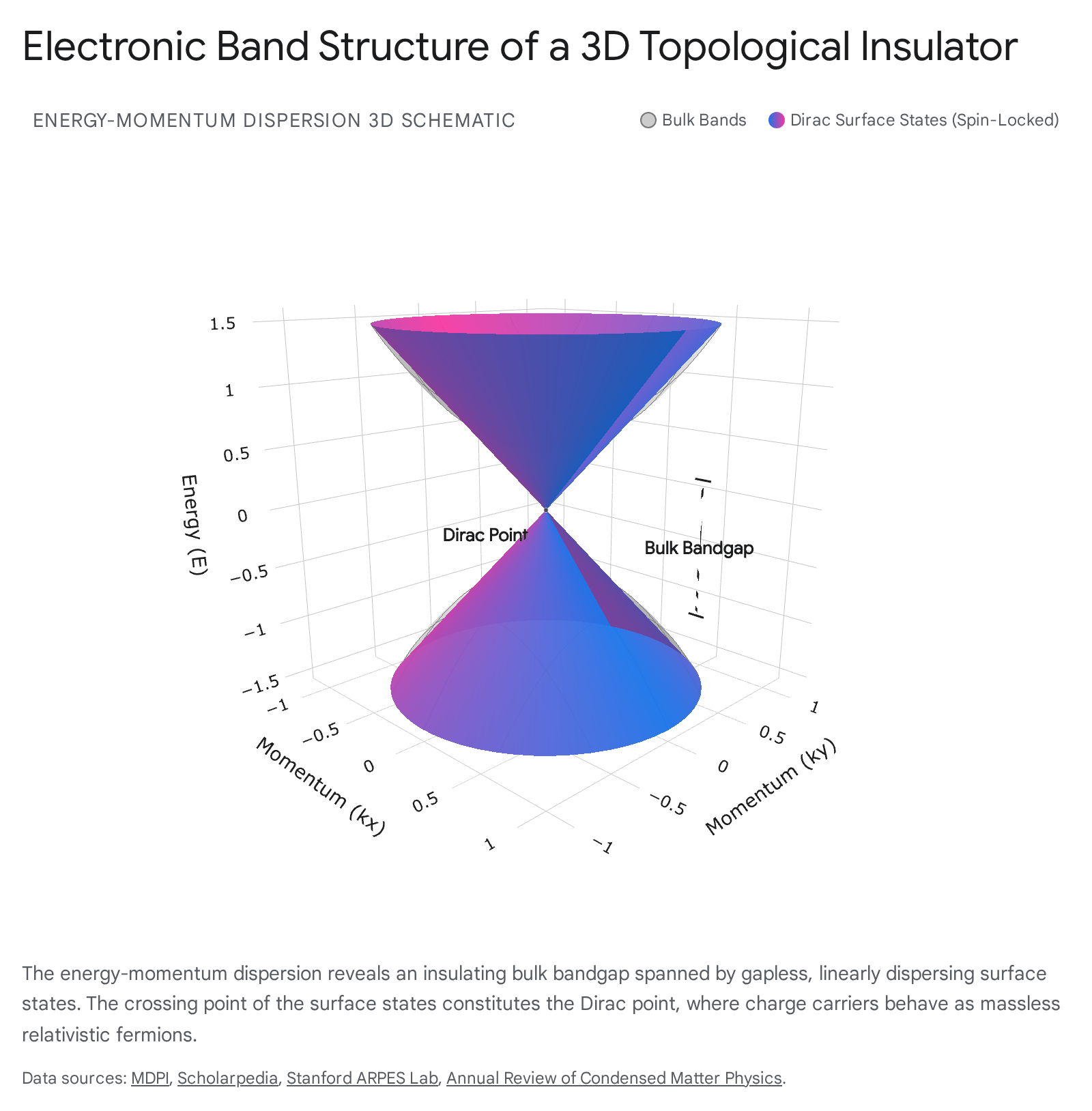
While the initial proposals focused on two-dimensional electron gases, the framework was soon generalized to three spatial dimensions by several independent theoretical groups. The 3D topological insulator was predicted as a novel state of matter that could not be reduced to stacked layers of 2D QSH systems 610. Instead of 1D edge modes, a 3D topological insulator hosts 2D metallic surface states characterized by a linear, Dirac-like energy-momentum dispersion. The first experimental realization of a 3D topological insulator occurred in the bismuth-antimony alloy Bi$_{1-x}$Sb$_x$, swiftly followed by the discovery of simpler, larger-bandgap topological insulators in the tetradymite family, primarily Bi$_2$Se$_3$ and Bi$_2$Te$_3$ 1112.
Physical Mechanisms of Topological Band Structures
The transition from a trivial band insulator to a topological insulator is governed by relativistic quantum mechanics, most notably the spin-orbit interaction and the resulting phenomenon of band inversion. To rigorously understand the origin of topologically protected surface states, one must examine the behavior of electron wavefunctions within momentum space.
Spin-Orbit Coupling and Band Inversion
The fundamental mechanism responsible for driving a material into a topological phase is band inversion, which is precipitated by unusually strong spin-orbit coupling. Spin-orbit coupling mathematically manifests as a momentum-dependent effective magnetic field that couples directly to the intrinsic spin of the electron. In crystalline structures lacking certain spatial inversions or containing heavy atomic elements, the crystalline electric field $\nabla V$ is perceived by relativistic, fast-moving electrons as a magnetic field in their rest frame. This generates a term in the Hamiltonian proportional to $\sigma \cdot (\mathbf{k} \times \nabla V)$, where $\sigma$ represents the Pauli spin matrices and $\mathbf{k}$ represents the crystalline momentum 8.
In conventional semiconductor insulators, the conduction band minimum is predominantly formed from higher-energy, spherically symmetric $s$-orbitals, while the valence band maximum is formed from lower-energy, directional $p$-orbitals. However, in materials containing heavy elements such as bismuth, tellurium, and mercury, the relativistic spin-orbit interactions are so intense that they perturb the energy levels sufficiently to invert this typical energetic ordering 913.
In the classic 2D topological insulator candidate mercury telluride (HgTe), when grown as a quantum well between cadmium telluride (CdTe) barriers beyond a critical thickness of $d_c = 6.5$ nm, the $p$-orbital-dominated valence band is pushed higher in energy than the $s$-orbital-dominated conduction band 13. When a material possessing an inverted band structure is placed physically adjacent to a trivial insulator (such as a vacuum or an ordinary semiconductor), the bulk energy gap must mathematically pass through zero at the interface to continuously connect the inverted and normal band structures. This necessary gap closure manifests as gapless metallic states bound to the physical surface or edge of the topological material 213.
Time-Reversal Symmetry and Kramers' Theorem
The defining characteristic of standard topological insulators is their strict preservation of time-reversal symmetry ($\mathcal{T}$). Under the time-reversal operation, the momentum vector $\mathbf{k}$ transitions to $-\mathbf{k}$, and the spin state $\sigma$ transitions to $-\sigma$. According to Kramers' theorem, in any time-reversal-invariant quantum system composed of half-integer spin particles (fermions), all energy eigenstates must be at least doubly degenerate 1214.
In the momentum space of a crystal lattice, there are specific points known as Time-Reversal Invariant Momenta (TRIM) where $\mathbf{k}$ and $-\mathbf{k}$ are separated by a reciprocal lattice vector, effectively making them the exact same physical state. At these TRIM points, Kramers degeneracy mandates that the states must cross. On the physical boundary of a topological insulator, these crossing states span the bulk bandgap, exhibiting a linear energy-momentum dispersion analogous to massless relativistic Dirac fermions 312.
Spin-Momentum Locking and Topological Protection
Because of the underlying $\mathcal{T}$-symmetry governing the surface states, the spin of the electron is strictly constrained to be orthogonal to its momentum, a robust phenomenon known as spin-momentum locking 11516. Consequently, an electron traveling in a specific direction with an "up" spin cannot scatter backward into the opposite direction unless its spin is simultaneously flipped to "down".
In the absence of magnetic impurities, which are required to break time-reversal symmetry and provide a mechanism for spin-flipping, simple non-magnetic disorder, crystalline defects, or surface distortions cannot induce this reversal 1713. Thus, the conducting surface states are "topologically protected" from direct backscattering. This protection forbids the "U-turns" typical of electron scattering in trivial metals, allowing for near-dissipationless transport and exceptionally high carrier mobilities 27.
Mathematical Classification and the Tenfold Way
The identification of topological materials relies heavily on rigorous mathematical classification schemes rather than localized geometric descriptions or macroscopic shape. Unlike classical crystalline order, which is described thoroughly by the 230 space groups and lattice symmetries, topological phases are classified by the Altland-Zirnbauer (AZ) "tenfold way." This mathematical framework categorizes quantum systems based entirely on fundamental, non-spatial discrete symmetries 171820.
The Ten Generic Symmetry Classes
The AZ tenfold way categorizes single-particle Hamiltonians into ten distinct symmetry classes depending on the presence or absence of three fundamental discrete symmetries. A complete list of Hamiltonians possessing no unitarily realized symmetries can be constructed by analyzing behavior under: 1. Time-Reversal Symmetry ($\mathcal{T}$): Represented by an antiunitary operator. For systems with spinless particles or integer spin, $\mathcal{T}^2 = +1$. For systems with half-integer spin (like electrons in topological insulators), Kramers' theorem applies and $\mathcal{T}^2 = -1$ 2019. 2. Particle-Hole (or Charge Conjugation) Symmetry ($\mathcal{P}$ or $\mathcal{C}$): Also an antiunitary operator with a square of $+1$ or $-1$. This symmetry is critical in describing the Bogoliubov-de Gennes (BdG) Hamiltonians required for modeling superconductors, where particle and hole excitations are intrinsically linked 201920. 3. Chiral (or Sublattice) Symmetry ($\mathcal{S}$): A unitary operator formed mathematically by the product of $\mathcal{T}$ and $\mathcal{P}$ (i.e., $\mathcal{S} = \mathcal{T} \cdot \mathcal{P}$). It anti-commutes with the Hamiltonian. In condensed matter physics, a natural realization of chiral symmetry is a bipartite lattice where sites in one sublattice only couple to sites in the other 171920.
Combining these three symmetries yields exactly ten unique classes, which map elegantly to Élie Cartan's classification scheme of symmetric spaces. If a Hamiltonian possesses no symmetries whatsoever, it falls into Class A. If it possesses only time-reversal symmetry with $\mathcal{T}^2 = -1$ (the standard case for spin-orbit coupled electronic systems with Kramers degeneracy), it falls into Class AII, known as the Symplectic class 14201920.
The Periodic Table of Topological Phases
The topological invariants corresponding to these ten symmetry classes vary systematically across different spatial dimensions. This profound mathematical structure is famously termed the "Periodic table of topological insulators and superconductors." The allowed invariants for a given symmetry class and spatial dimension ($d$) dictate whether the material can host a topological phase, and if so, whether that phase is characterized by an integer ($\mathbb{Z}$) or a binary ($\mathbb{Z}_2$) topological invariant 142021.
| Cartan Name | Symmetry Class | $\mathcal{T}^2$ | $\mathcal{P}^2$ | $\mathcal{S}^2$ | Dimension 1 | Dimension 2 | Dimension 3 |
|---|---|---|---|---|---|---|---|
| A | Unitary | $0$ | $0$ | $0$ | $0$ | $\mathbb{Z}$ | $0$ |
| AIII | Chiral Unitary | $0$ | $0$ | $1$ | $\mathbb{Z}$ | $0$ | $\mathbb{Z}$ |
| AI | Orthogonal | $+1$ | $0$ | $0$ | $0$ | $0$ | $0$ |
| BDI | Chiral Orthogonal | $+1$ | $+1$ | $1$ | $\mathbb{Z}$ | $0$ | $0$ |
| D | BdG (Spinless) | $0$ | $+1$ | $0$ | $\mathbb{Z}_2$ | $\mathbb{Z}$ | $0$ |
| DIII | BdG (Spinless, $\mathcal{T}$) | $-1$ | $+1$ | $1$ | $\mathbb{Z}_2$ | $\mathbb{Z}_2$ | $\mathbb{Z}$ |
| AII | Symplectic (Standard TI) | $-1$ | $0$ | $0$ | $0$ | $\mathbb{Z}_2$ | $\mathbb{Z}_2$ |
| CII | Chiral Symplectic | $-1$ | $-1$ | $1$ | $\mathbb{Z}$ | $0$ | $\mathbb{Z}_2$ |
| C | BdG (Spinful) | $0$ | $-1$ | $0$ | $0$ | $\mathbb{Z}$ | $0$ |
| CI | BdG (Spinful, $\mathcal{T}$) | $+1$ | $-1$ | $1$ | $0$ | $0$ | $\mathbb{Z}$ |
Table 1: The Periodic Table of Topological Phases from d=1 to 3. Standard time-reversal invariant topological insulators belong to Class AII, exhibiting a $\mathbb{Z}_2$ invariant in both two and three dimensions 2021. Note: A value of $0$ indicates no symmetry is present, or no topological phase exists for that class and dimension.
Dimensional Reduction and the Bott Clock
The underlying mathematics of this periodic table is governed by Bott periodicity, a profound theorem in algebraic topology. The topological classification shifts systematically across dimensions, repeating modulo 8 for real symmetry classes (those involving antiunitary symmetries like $\mathcal{T}$ and $\mathcal{P}$) and modulo 2 for complex classes 2020.
This periodicity allows physicists to utilize the concept of "dimensional reduction." By mapping the Hamiltonian of a $d$-dimensional system to a reflection matrix in $(d-1)$ dimensions, researchers can relate the robust invariants of a 3D system to its lower-dimensional reflections, preserving the topological core across varying material geometries. For example, moving from a 3D bulk to a 2D surface is equivalent to moving one step against the "Bott clock," systematically predicting which symmetries will protect boundary modes in lower dimensions 20.
Dimensional Manifestations of Topology
The observable physical properties of a topological insulator depend fundamentally on the dimensionality of the host material. The hierarchy scales from highly localized one-dimensional chains to complex three-dimensional bulk solids, with each dimension hosting uniquely constrained boundary states.
One-Dimensional Topological Insulators
Though bulk three-dimensional and sheet-like two-dimensional topological insulators were theoretically predicted and experimentally confirmed in the late 2000s, purely one-dimensional variants proved elusive for many years. In a 1D topological insulator, the bulk behaves as an insulating wire, while the endpoints function as isolated, zero-dimensional topological boundary charges.
In 2024, an international research team led by Tohoku University conclusively identified tellurium (Te) helix chains as a true 1D topological insulator. Because traditional crystal cleavage techniques often destroy the fragile endpoints of 1D chains, the researchers utilized advanced gas-cluster ion-beam (GCIB) systems to modify the Te surfaces with sub-nanometer precision without causing structural damage. Subsequent mapping using micro-focused angle-resolved photoemission spectroscopy (ARPES) confirmed the presence of distinct, topologically protected fractional charges localized strictly at the endpoints of the chains. These 0D boundary states are viewed as highly promising hosts for fault-tolerant qubits in next-generation quantum computing architectures 22.
Two-Dimensional Topological Insulators
A two-dimensional topological insulator is fundamentally synonymous with the Quantum Spin Hall (QSH) state. Envisioned theoretically by the Kane-Mele model, a 2D topological insulator features an insulating 2D bulk sheet surrounded by 1D conducting edge states 189.
Due to the $\mathbb{Z}_2$ topological protection and spin-momentum locking, electrons moving clockwise along the 1D perimeter inherently possess one spin polarization, while electrons moving counter-clockwise possess the opposite spin. This "helical" edge state effectively operates as two superposed, spin-segregated quantum Hall states without the need for an external, time-reversal-breaking magnetic field 189. Early experimental confirmations occurred in CdTe/HgTe/CdTe quantum wells. In these systems, the band inversion is highly dependent on the thickness of the HgTe layer. When fine-tuned beyond a critical thickness, the material enters the inverted regime, and the transport measurements exhibit quantized conductance characteristic of the QSH phase 91013.
Three-Dimensional Topological Insulators
Expanding the paradigm to three spatial dimensions, the 1D edge states transition into two-dimensional conducting surface states enveloping the 3D crystal 1323. A 3D topological insulator is mathematically characterized by a set of four $\mathbb{Z}_2$ invariants, denoted conventionally as $(\nu_0; \nu_1, \nu_2, \nu_3)$.
If the primary topological invariant $\nu_0 = 1$, the material is classified as a "strong" 3D topological insulator. A strong TI possesses an odd number of Dirac cones on its surfaces, and its metallic surface states are exceptionally robust against non-magnetic disorder and localization 1223. The first widely recognized generation of strong 3D TIs included the alloy Bi$_{1-x}$Sb$_x$, which exhibited a complex invariant structure of $(1;111)$ 1012. Subsequent generations quickly identified Bi$_2$Se$_3$ and Bi$_2$Te$_3$ as prototypical strong TIs with a simpler invariant structure of $(1;000)$, presenting a single, highly isolated Dirac cone at the $\Gamma$ point of the surface Brillouin zone 1112.
Conversely, if $\nu_0 = 0$ but one or more of the other invariants equal $1$ (e.g., an invariant set of $(0;111)$), the system is classified as a "weak" topological insulator. A weak TI can be conceptualized as a stacked, anisotropic series of 2D QSH layers. These materials host an even number of Dirac cones on their side surfaces. Because the net Berry phase of an even number of Dirac cones is an integer multiple of $2\pi$, the surface states lack the robust topological protection of strong TIs and can theoretically annihilate or gap out in the presence of strong disorder, making them far more fragile for device applications 61023.
Higher-Order Topological Insulators (HOTIs)
Recent theoretical and experimental advancements have uncovered a profound extension to the conventional topological paradigm: Higher-Order Topological Insulators (HOTIs). While standard $d$-dimensional topological insulators feature robust gapless states on their $(d-1)$-dimensional boundaries, HOTIs are characterized by gapless states on boundaries of dimension $(d-2)$ or lower 2425.
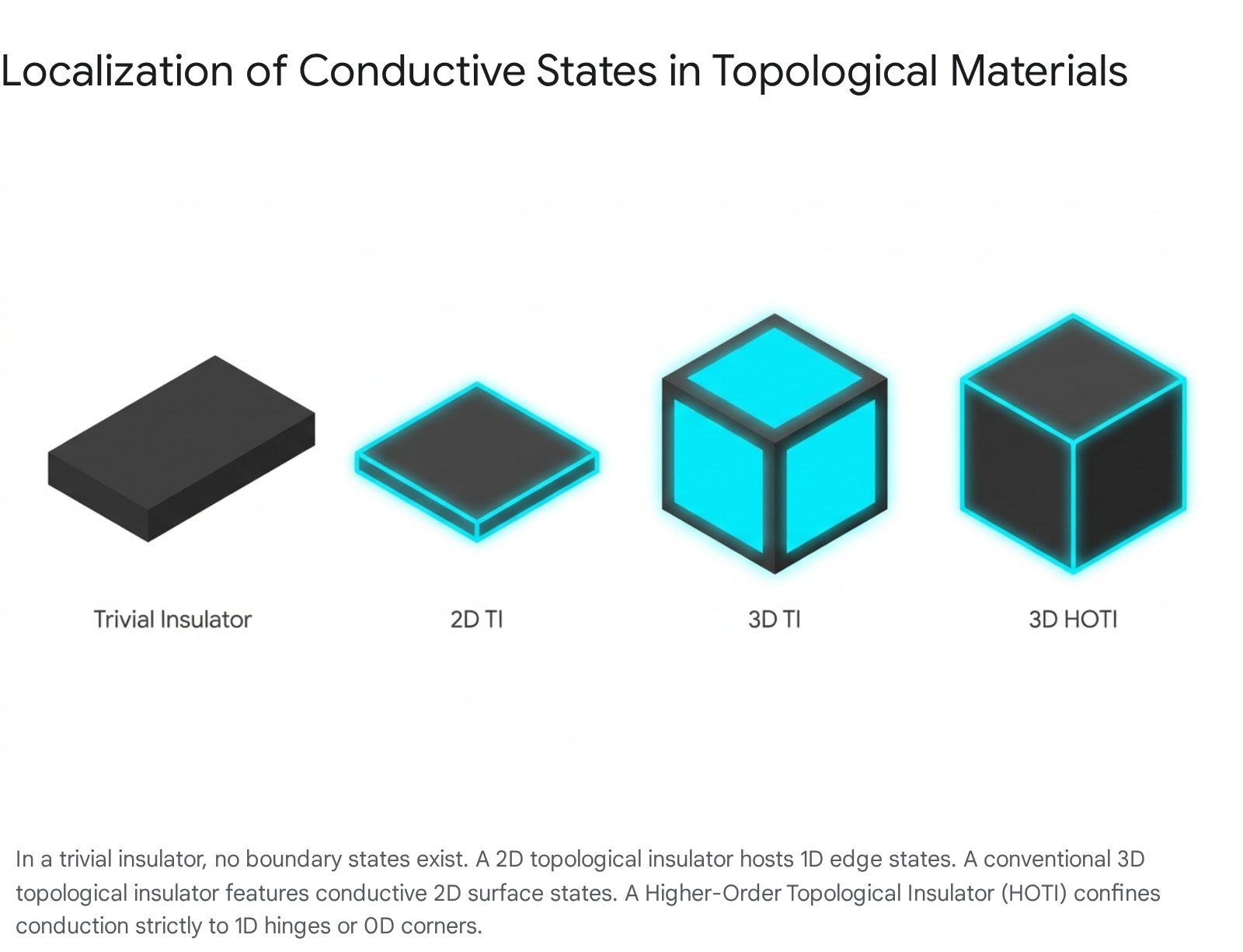
For example, a standard 3D TI conducts along its 2D surfaces. A second-order 3D HOTI exhibits an insulating 3D bulk and fully insulating 2D surfaces, but features topologically protected 1D states strictly along the 1D hinges where the surfaces meet 2425. A third-order 3D HOTI would localize states only at its 0D corners.
By late 2024 and early 2025, experimental evidence highlighted the metal bismuth bromide (Bi$_4$Br$_4$) as a primary candidate for demonstrating these 1D hinge states. Because these states represent a minute fraction of the overall material volume, detecting them is exceedingly difficult. Researchers utilized the magneto-optic Kerr effect - measuring tiny changes in the polarization of light reflected from the surface - to observe anomalous reflection signatures native only to HOTIs 2426. Breakthroughs in mid-2025 further identified "hybrid-order" topological insulators capable of simultaneously hosting multiple orders of boundary states (e.g., both 2D surface states and 1D hinge states residing in different band gaps) within a single 3D crystal, greatly expanding the taxonomy of topological matter 29.
Materials Science, Synthesis, and the Bulk Conduction Challenge
The transition of topological insulators from pure mathematical models to experimental reality requires highly precise materials science. While the physics dictates that these materials must possess an insulating bulk, the reality of crystal growth introduces significant complexities that often mask the topological signatures.
The Problem of Intrinsic Bulk Defects
The primary materials science bottleneck in the field of topological insulators is bulk residual conductivity. In naturally occurring and laboratory-synthesized topological crystals, the bulk frequently behaves as a metal rather than an insulator 2311.
This is most heavily documented in Bi$_2$Se$_3$, the prototypical 3D topological insulator. Bi$_2$Se$_3$ features a relatively large bulk bandgap of approximately 0.3 eV and a highly desirable single Dirac cone at the $\Gamma$ point. However, during standard bulk synthesis via techniques like the self-flux method or Bridgman growth, intrinsic structural defects - specifically selenium vacancies and native anti-site defects - form unavoidably 111527. These missing selenium atoms act as electron donors, injecting free charge carriers into the bulk. This results in unintended n-type degenerate semiconductor behavior, shifting the Fermi level up to 200 meV deep into the bulk conduction band. Consequently, in transport measurements, this vast sea of bulk conducting electrons completely overwhelms the delicate electrical signals produced by the topological surface states 3111527.
Mitigation and Synthesis Strategies
To effectively utilize the physics of the surface states for device applications, researchers have developed several dominant strategies to suppress this bulk conductivity and return the Fermi level to the topological bandgap:
- Counter-Doping: One widely utilized method involves introducing external dopants into the bulk mixture during crystal growth. Elements such as calcium, tin, or lead are added to act as hole donors, compensating for the electron-donating selenium vacancies and pulling the Fermi level back down into the bulk bandgap. However, this approach is imperfect; the physical presence of dopant atoms introduces additional structural disorder and scattering centers, which generally decreases the carrier mobility of the surface states 1115.
- Electrostatic Gating: For nanoscale device physics, researchers frequently exfoliate ultra-thin flakes of topological materials and apply strong electrostatic gates to artificially tune the Fermi level into the gap. While effective for fundamental physics experiments, this approach is fundamentally limited to microscopic footprints and is not scalable for bulk applications 15.
- Ultra-High Vacuum Molecular Beam Epitaxy (MBE): The most robust and scalable method for producing pristine topological materials involves growing thin films layer-by-layer using Molecular Beam Epitaxy under ultra-high vacuum (UHV) conditions 315. By precisely controlling the atomic flux, researchers can drastically minimize vacancies. In optimally grown Bi$_2$Te$_3$ and Bi$_2$Se$_3$ thin films synthesized entirely in situ, researchers have achieved true bulk insulating behavior with the Fermi level situated deep in the bandgap, without the need for counter-doping. This pristine environment allows for extraordinary surface charge mobilities, with experimental observations reaching up to 4,600 cm$^2$/Vs 15.
Experiments evaluating the environmental stability of these materials have consistently demonstrated the fundamental premise of topological protection. When MBE-grown Bi$_2$Se$_3$ films are exposed to atmospheric air, vacuum cycling, and moisture, the carrier density of the bulk states fluctuates drastically. However, the surface carrier concentration and the fundamental Dirac dispersion remain remarkably robust and nearly constant, proving the surface states' immunity to non-magnetic environmental disorder 3.
Advanced Characterization Techniques
Proving that a material is a topological insulator requires techniques that can resolve both the energy and momentum of electrons. The workhorse technique for the field is Angle-Resolved Photoemission Spectroscopy (ARPES). ARPES utilizes high-energy photons to eject electrons from a crystal surface; by measuring the kinetic energy and emission angle of these photoelectrons, physicists can directly map the band structure in momentum space, providing definitive visual proof of the gapless Dirac cones and bulk bandgaps 1611. Furthermore, Scanning Tunneling Microscopy and Spectroscopy (STM/STS) are utilized to examine the local density of states at the atomic level, confirming that topological boundary modes remain robust even in the presence of surface step-edges and point defects 1311. Additionally, bulk transport is often analyzed through Shubnikov-de Haas (SdH) quantum oscillations at cryogenic temperatures, which help differentiate the scattering times and mobilities of bulk versus surface carriers 2731.
| Material | Dimensionality / Class | Topological Features | Primary Synthesis Challenge | Common Applications |
|---|---|---|---|---|
| Te Helix Chains | 1D | Zero-dimensional boundary charges at endpoints. | Cleavage destroys fragile endpoints; requires ion-beam processing. | Fault-tolerant qubits 22. |
| HgTe / CdTe | 2D (Quantum Well) | Helical 1D edge states; Quantum Spin Hall effect. | Requires extremely precise thickness tuning ($d_c = 6.5$ nm). | Fundamental physics, low-power interconnects 913. |
| Bi$_2$Se$_3$ / Bi$_2$Te$_3$ | 3D (Strong TI) | 2D Dirac cone surface states; Bulk gap ~0.3 eV. | Se/Te vacancies cause massive bulk n-type conductivity. | Spintronics, topological catalysis 112728. |
| Bi$_4$Br$_4$ | 3D (HOTI) | 1D conductive hinge states; insulating bulk and surfaces. | Extremely difficult to isolate hinge signal from bulk noise. | Room-temperature quantum networks 2426. |
Table 2: Characteristics and material science profiles of benchmark topological insulators across different dimensional classes.
High-Throughput Discovery and Widespread Topology
For over a decade following the initial discoveries in Bi-based alloys, identifying new topological materials was a slow, heuristic process akin to "searching for needles in a haystack," requiring deep chemical intuition and labor-intensive first-principles calculations for every candidate 5.
This paradigm changed drastically following the development of Topological Quantum Chemistry (TQC), a comprehensive theoretical framework that combines standard band theory with the full crystallographic unitary symmetries of all 230 space groups. By defining the allowed momentum-space band crossings based purely on spatial symmetry, TQC provided a systematic diagnostic tool 52930.
Using high-throughput computational modeling deployed on supercomputers, physicists systematically analyzed the electronic structures of all 96,196 recorded crystals in the Inorganic Crystal Structure Database (ICSD). In a landmark realization, researchers discovered that topological electronic states are not esoteric anomalies but rather a ubiquitous feature of nature. The data revealed that over half of all known 3D crystalline materials in nature harbor some form of band topology, and nearly 90% possess topological states positioned away from the Fermi level 29. Though these states are dormant in ground-state transport measurements, they can be accessed via electrostatic gating, chemical doping, or photoexcitation.
The integration of artificial intelligence has further accelerated this pipeline. By 2025, reinforcement fine-tuned generative models and conditional active learning algorithms were being utilized by institutions such as the Chinese Academy of Sciences to predict and computationally generate tens of thousands of entirely new, dynamically stable topological insulators. This computational revolution has shifted the bottleneck from material discovery to experimental synthesis and device integration 3132.
Exotic Quantum States and Emergent Phenomena
As the catalog of topological materials has expanded, physicists have moved beyond simple non-interacting single-particle models to investigate the intersection of topology with strong electron correlations, magnetism, and dynamic driving forces. These interactions yield entirely new quantum phenomena 313334.
Topological Excitonic Insulators
One of the most consequential breakthroughs in quantum many-body physics occurred in late 2025 with the unambiguous realization of an intrinsic "topological excitonic insulator" in a 3D bulk material, Ta$_2$Pd$_3$Te$_5$ 33. For decades, excitonic insulators - states where electrons and holes spontaneously bind into neutral quasi-particles (excitons) and condense into a collective macroscopic quantum state - were sought predominantly in heavily engineered two-dimensional limits.
However, in Ta$_2$Pd$_3$Te$_5$, researchers discovered that strong many-body correlation directly drives an excitonic transition that simultaneously generates a symmetry-protected topological order. This marked the first observation of a bulk 3D material where correlation and topology undergo a simultaneous phase transition to form a tunable Bose-Einstein condensate. The ability to tune these excitonic condensates via an external magnetic field provides a critical bridge between strongly correlated systems and topological physics, opening new avenues for quantum emergence at low temperatures 33.
Magnetic and Moiré Topological Architectures
Breaking the time-reversal symmetry inherent to standard topological insulators yields distinct quantum phenomena, most notably the Quantum Anomalous Hall (QAH) effect 1. Typically, this is achieved by introducing magnetic dopants (such as manganese or chromium) directly into the bulk of a topological insulator. The presence of magnetism opens a mass gap at the Dirac point of the surface states, causing them to lose their linear dispersion and allowing for dissipationless chiral edge transport without a magnetic field 1.
However, random doping often introduces severe structural disorder. In 2025, an international consortium mapping exotic states produced groundbreaking results by utilizing heterostructures. They stacked 2D van der Waals magnetic insulators (such as FeCl$_2$ or FeBr$_2$) directly onto the surface of Bi$_2$Se$_3$ topological insulators 35. Because the crystal lattices of the two layers are slightly mismatched, the interface forms a "moiré superlattice" - a delicate, nanoscale interference pattern. This magnetic moiré potential fundamentally reshapes the spatial movement of electrons crossing the boundary, creating replicated Dirac cones and periodic energy gaps. This architectural approach allows for the highly tuned, periodic manipulation of topological electrons without the detrimental effects of bulk doping, creating a pristine platform for exploring quantum geometry 35.
Momentum-Band Topology and Floquet Dynamics
A recent theoretical and experimental leap redefines the arena in which topology occurs. Traditional topological invariants are calculated in energy-momentum space for static systems. However, researchers have introduced the concept of "momentum-band topology" using periodically driven, or Floquet, systems 36.
By creating an acoustic parity-time (PT)-symmetric Floquet lattice utilizing time-periodic modulation of gain and loss, physicists documented the formation of topological momentum gaps. These gaps are characterized by quantized Berry phases defined not across the standard Brillouin zone, but across the "energy Brillouin zone." This dynamic modulation generates temporally localized boundary modes, demonstrating that topological phases can be driven entirely by external dynamic modulation over time rather than static spatial boundaries or crystal structures 36.
Technological Translation and Device Applications
Topological insulators present several intrinsic properties - most notably spin-momentum locking, protection against backscattering, and ultra-high mobility - that make them intensely attractive for real-world device engineering. The transition from fundamental research to practical engineering is heavily funded by major international initiatives, including the European Union's Horizon Europe framework, the Chinese Academy of Sciences, and Japanese national institutions like RIKEN 313738.
Advanced Spintronics and SOT-MRAM
Spintronics is a paradigm that utilizes the intrinsic spin degree of freedom of an electron, rather than simply its fundamental charge, to process and store information. In conventional electronics, manipulating magnetic states requires bulky external magnetic fields or high-density charge currents that produce excessive Joule heating. Topological insulators bypass this limitation via the Spin-Orbit Torque (SOT) effect 39.
When a standard charge current passes through the surface of a 3D topological insulator, the physical constraint of spin-momentum locking forces a net accumulation of spin polarization at the edges. This highly efficient, pure spin current can be injected into an adjacent ferromagnetic layer (such as Cobalt or NiFe) to exert an overwhelming torque on the ferromagnet's local magnetization. This allows for the flipping of magnetic domains with significantly less energy than is required by traditional heavy-metal layers (like Platinum or Tantalum) 43940.
Spintronic prototypes have advanced rapidly. In 2024 and 2025, physicists successfully developed spin-valve devices and spin-torque oscillators based on an "anomalous Hall torque," demonstrating that spin orientation can be transferred from a topological conductor directly to a ferromagnet. This paves the way for ultra-fast SOT-MRAM (Spin-Orbit Torque Magnetic Random Access Memory) devices characterized by near-zero latency, non-volatility, and high radiation hardness - attributes uniquely suited for IoT edge computing and energy-efficient data centers 39414243. Furthermore, theoretical proposals for "Topological Dirac spin-gapless materials" promise new chiral edge states where all carriers share a uniform spin polarization without relying on explicit spin-orbit interactions, potentially integrating seamlessly into emerging graphene-based logic architectures 428.
Topological Quantum Computing
Topological insulators, particularly when physically coupled with standard $s$-wave superconductors, serve as the requisite substrate for realizing topological superconductivity. Due to the superconducting proximity effect, the gapless Dirac surface states of the topological insulator acquire a superconducting pairing gap. Inside magnetic vortex cores or at the physical boundaries of these engineered heterostructures, the theoretical excitations manifest as Majorana zero modes - unique non-Abelian quasi-particles that act identically as their own antiparticles 11444.
Because a Majorana zero mode is essentially "half" of an electron state spatially separated from its partner, local environmental noise or thermal charge fluctuations cannot easily collapse the quantum state. This non-Abelian statistical behavior forms the backbone of topological quantum computing, which aims to construct fundamentally fault-tolerant qubits that do not require massive overhead for error correction. Significant commercial milestones were met in 2025, notably Microsoft's unveiling of the Majorana 1 processor, which utilized these topological principles to massively enhance hardware reliability 454651. Concurrently, researchers at RIKEN have theoretically mapped how the electromagnetic multipole response of these Majorana fermions can be uniquely isolated, facilitating the read-out of their otherwise electrically neutral quantum states 44.
Topological Quantum Batteries
Quantum batteries represent a highly experimental paradigm in energy storage, designed to store and transfer energy via quantum phenomena such as superposition, entanglement, and coherence rather than classical chemical reactions 4748. Historically, their feasibility was heavily hampered by inevitable dissipation and decoherence when exposed to an open environment.
In late 2025, physicists theorized the "topological quantum battery," exploiting the topology of specifically designed photonic waveguides interfaced with two-level atoms 4748. The topological features of the waveguide ensure dissipation immunity during long-distance energy transfer. Remarkably, theoretical models proved that under specific conditions of topological protection, environmental dissipation - normally the primary enemy of quantum systems - can actually be harnessed to momentarily enhance the charging power of the battery. This counterintuitive breakthrough bypasses strict classical thermodynamic limits, paving the way for instantaneous, highly efficient nanoscale energy storage for distributed quantum networks 4748.
Topological Catalysis
Beyond solid-state electronics and quantum information, the principles of band topology have recently crossed into surface chemistry and catalysis. In topological crystalline insulators (TCIs) such as SnTe or SnSe, the robust topological surface states are protected by spatial mirror-symmetry rather than time-reversal symmetry 4. Because high-mobility surface electrons strongly alter the local density of states near the Fermi level, they drastically influence intermediate adsorption energies during chemical reactions on the material's surface.
In recent electrocatalysis experiments utilizing Bi$_2$Se$_3$ and TCIs, researchers were able to definitively separate the catalytic impact of topological surface states from the impacts of trivial bulk states and dangling bonds. With the topological states highly active, the electroreduction of $CO_2$ to liquid fuels (such as formic acid) reached a remarkable 90% Faradaic efficiency. However, when magnetic fields were applied or structural symmetries broken to suppress the topological surface states, the catalytic efficiency deteriorated sharply. These results offer the first definitive proof of "topological catalysis," demonstrating that topological band structures can directly engineer and lower the activation barriers of critical chemical processes, offering a new paradigm for designing high-performance, symmetry-driven industrial catalysts 44950.
Conclusion
Topological insulators have forced a complete reevaluation of the phases of matter, replacing macroscopic symmetry-breaking with momentum-space topology as the ultimate arbiter of physical properties. Though significant materials science hurdles - namely bulk defect conduction and precise synthesis at scale - persist, advanced epitaxial growth techniques, high-throughput computational modeling, and the discovery of new symmetry classifications like Higher-Order Topological Insulators continue to mature the field rapidly. By guaranteeing scattering-free surface conduction, enforcing strict spin polarization, and enabling exotic excitations like Majorana fermions, topological materials are no longer mere mathematical or theoretical anomalies. They serve as the foundational substrates for next-generation quantum technologies, ultra-low-power non-volatile logic architectures, and high-efficiency catalytic and energy systems, defining a new frontier in modern physics and engineering.