
TikTok Algorithm Mechanics in 2026
The operational mechanisms governing the TikTok recommendation algorithm have undergone foundational restructuring between late 2025 and early 2026. Driven by a complex intersection of corporate divestitures, regulatory enforcement actions, and the maturation of social commerce infrastructures, the platform has transitioned from a pure interest-graph discovery engine into a multi-tiered, follower-gated recommendation system. This evolution fundamentally alters how content reaches audiences, requiring a complete recalibration of digital strategy. This report details the technical architecture, content delivery phases, engagement signal weights, regional variations, and search optimization parameters that define the TikTok algorithm in 2026.
The Recommendation Architecture
At its technical core, the TikTok recommendation engine is powered by an advanced machine learning framework known as Monolith. Designed specifically to process highly dynamic and exceptionally sparse data - such as billions of categorical user interactions, rapid micro-trend cycles, and ephemeral content - the Monolith system solves the latent challenges that have historically constrained traditional recommendation models 123.
Traditional recommendation architectures typically rely on dense embedding tables, which often suffer from severe data collisions when processing sparse, rapidly changing variables at a global scale. The Monolith system circumvents this limitation by utilizing a collisionless embedding table built upon a Cuckoo HashMap 1. This structural choice ensures that specific embeddings for user behavior and content features remain unique, distinct, and highly accurate. By preventing data collisions, the system eliminates the quality degradation that typically occurs when multiple sparse signals overwrite one another in the server's memory allocation 14.
Furthermore, the architecture utilizes sparsity-aware factorization machines and real-time online training paradigms 2. Instead of relying on daily, hourly, or batched updates to refresh user profiles, the Monolith system updates its predictive models in real time based on immediate user feedback 12. This mechanism addresses "concept drift" - the rapid, unpredictable shift in user preferences that occurs minute-by-minute as individuals scroll through the For You Page 14. As a user interacts with content, their predictive profile is updated within milliseconds, allowing the system to serve highly relevant sequential videos 23.
United States Algorithmic Divergence
In late 2025 and early 2026, a significant divergence in this global architecture occurred due to strict regulatory mandates in the United States. Following prolonged legislative pressure and an executive order, TikTok's US operations were restructured under a divestiture agreement 545. A consortium of American investors, notably including Oracle, acquired a 65% to 80% ownership stake in the US entity, leaving ByteDance with a minority equity position of less than 20% 46.
This corporate restructuring necessitated a parallel technical restructuring. To satisfy national security requirements, Oracle assumed the role of independent security provider and was tasked with replicating and retraining the recommendation algorithm specifically for the US market 45. ByteDance was entirely excluded from the new US-based security committee and lost all access to American user data and algorithmic decision-making 4.
Consequently, the recommendation engine serving the platform's 170 million US users now operates as an isolated, localized instance of the algorithm 49. Because this localized system was retrained exclusively on US behavioral data rather than the global dataset, distribution patterns within the United States have begun to diverge from international metrics 46. Early data from 2026 indicates that this retrained algorithm heavily favors localized cultural trends and imposes stricter penalties on inauthentic engagement patterns, resulting in a noticeable drop in organic reach for new creators attempting to scale via legacy tactics 46.
Follower-First Content Distribution
The most consequential operational change to TikTok's content distribution in 2026 is the implementation of the "follower-first" testing model 5678910111213. Prior to this architectural shift, TikTok operated almost entirely on an interest graph. The system would push new content to small test pools of users based solely on predicted behavioral affinity, completely disregarding whether those users followed the creator 91013.
As of early 2026, existing followers serve as the mandatory algorithmic gatekeepers for nearly all organic reach 6101213. When a creator uploads a video, the system now restricts initial distribution primarily to the creator's existing follower base for the first 24 to 72 hours 689101214. The algorithm actively measures the engagement velocity within this specific cohort to determine if the content qualifies for wider distribution on the broader For You Page 781013.
This fundamental restructuring eliminates the passive benefit of maintaining a large but unengaged audience. Accounts with massive numbers of inactive, disengaged, or purchased followers suffer severe distribution penalties, as their new uploads systematically fail the initial follower-testing phase 1114. Conversely, micro-creators with highly responsive, niche-specific audiences can rapidly clear the engagement thresholds required to trigger broader algorithmic expansion 1114.
Distribution Funnel Phases
The updated distribution model operates as a rigid, four-phase expansion funnel.
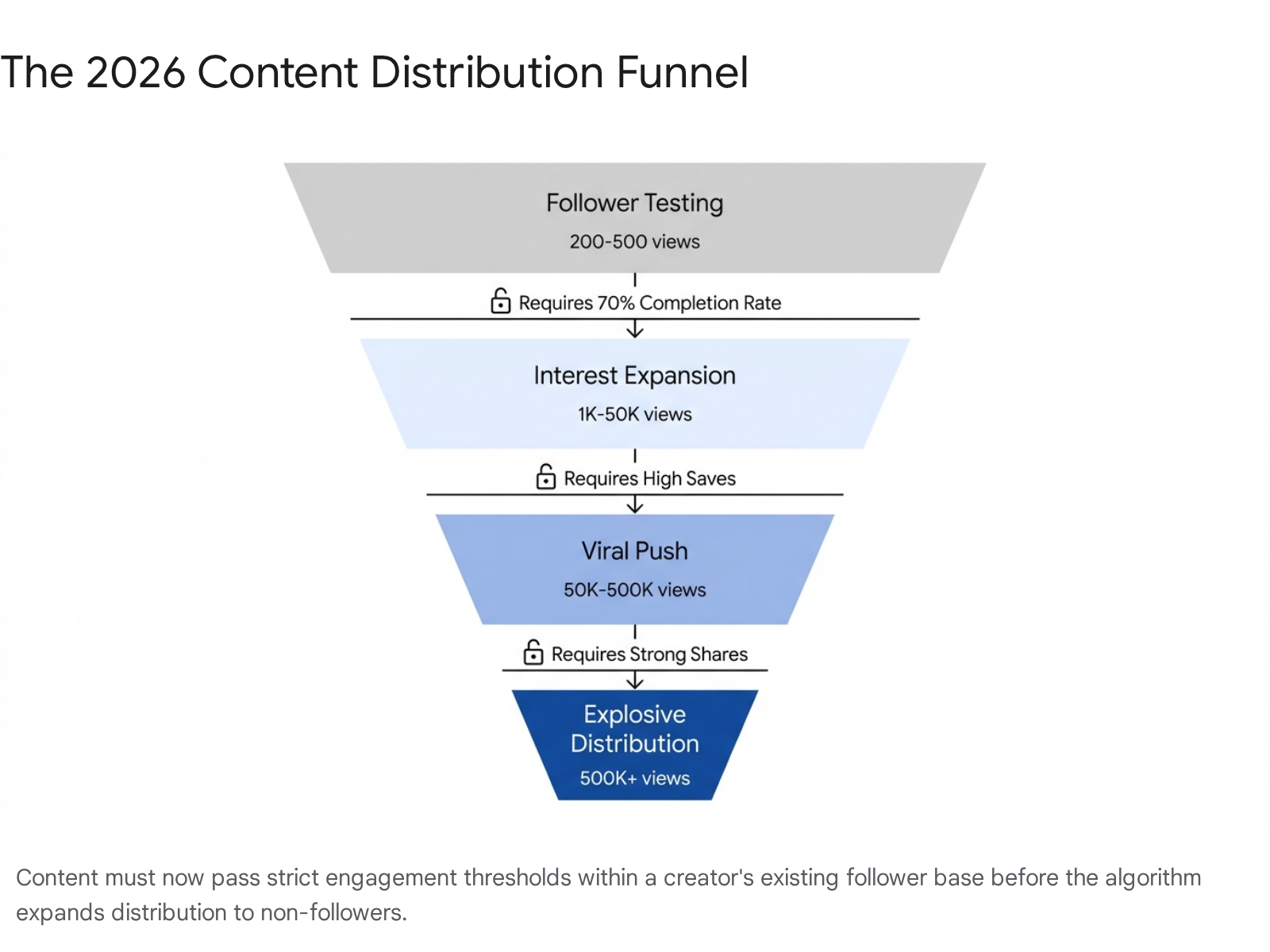
Content must clear specific mathematical engagement thresholds to proceed to subsequent tiers 91113. Failure at any stage halts distribution entirely.
| Distribution Phase | Estimated View Range | Algorithmic Mechanism | Advancement Criteria |
|---|---|---|---|
| Wave 1: Follower Test | 200 - 500 views | Content is served exclusively to a sample of active followers. | High completion rate, saves, and shares. Failure to meet baseline results in stalled distribution ("200-view jail"). |
| Wave 2: Interest Expansion | 1,000 - 50,000 views | Content is pushed to non-followers who share behavioral overlapping characteristics with the initial engaged cohort. | Performance is benchmarked against average engagement metrics for similar content within the specific niche. |
| Wave 3: Viral Push | 50,000 - 500,000 views | Content enters the primary For You Page at scale. | Share rate and save rate become the dominant signals, overriding simple completion metrics. |
| Wave 4: Explosive Distribution | 500,000+ views | Content clears all niche benchmarks and is pushed aggressively across broader demographic lines and geographic regions. | Sustained engagement velocity across diverse audience clusters. |
Data indicates that the overwhelming majority of content published in 2026 fails to pass Wave 1 1115. The algorithm interprets a lack of interest from a creator's own audience as a definitive indicator of low content quality, resulting in immediate algorithmic suppression 111416.
Interaction Signals and Engagement Weights
The TikTok algorithm does not treat all forms of engagement equally. In 2026, the hierarchy of user interactions has been significantly recalibrated to prioritize durable attention and high-intent actions over passive vanity metrics 6717. The system continuously analyzes micro-behaviors to calculate the overall value of a viewing session.
The Watch Time and Completion Rate Floor
Watch time and video completion rates remain the single most dominant ranking factors, accounting for approximately 40% to 50% of the algorithm's distribution weight 4918. However, the mathematical threshold required to trigger a viral push has increased dramatically. While a ~50% completion rate was generally sufficient in 2024, platform data in 2026 indicates that content must now achieve an approximate 70% completion rate to consistently graduate past the initial follower-testing phase 5691012131419.
Furthermore, the algorithm evaluates "Qualified Views," which are defined explicitly as viewing sessions that exceed five seconds 616. Videos that suffer a mass audience drop-off within the first three seconds are heavily penalized, signaling to the system that the content is misleading or unengaging 61618. To clear the 70% floor, successful content structures rely on complex hooks and deliberate pacing that reset viewer attention every three to five seconds through visual pattern interruptions 5111820.
The algorithm calculates total session time rather than simple view percentages. For example, a 60-second video with an 80% completion rate yields 48 seconds of watch time per user, providing a far stronger algorithmic signal than a 15-second video that is watched only once 421. Consequently, the algorithm has shifted to reward longer short-form content - specifically videos ranging from 60 to 180 seconds - provided they can maintain the necessary retention 4716.
Saves and Shares
Likes and comments have been definitively algorithmically deprioritized 79111222. In 2026, the system treats "Saves" and "Shares" as the highest-quality interaction signals, applying substantial multipliers to these actions during the ranking process 791012131823.
The technical rationale behind this shift is rooted in user intent. A "Like" is a low-friction, passive action that does not definitively indicate high user satisfaction or sustained interest 57. Tapping a heart requires minimal cognitive effort. Conversely, a "Save" signals a definitive intent to return to the content later, indicating high utility, educational value, or profound resonance 722. A "Share" is viewed as the ultimate endorsement, as it explicitly brings other users into the application or extends a viewing session, directly aligning with the platform's goal of maximizing total user engagement time 722. If a video generates high watch time but fails to convert viewers into savers or sharers, its distribution will typically plateau in the second wave of the algorithmic funnel 711.
| Ranking Signal | Estimated Algorithmic Weighting | Strategic Implication |
|---|---|---|
| Watch Time & Completion Rate | Highest (40% - 50%) | Videos must retain ~70% of viewers to the end. Three-second hooks are mandatory. |
| Saves & Shares | Very High (25% - 35%) | Content must provide direct utility, education, or conversational value to prompt distribution. |
| Re-watches & Loops | High | Indicates exceptional density of information or entertainment value; highly rewarded. |
| Comments | Moderate (15% - 20%) | Valued primarily if they trigger threaded discussions or prompt video replies. |
| Likes | Low | Viewed as baseline interactions; insufficient for achieving viral scaling. |
Posting Velocity and Temporal Optimization
Due to the introduction of the follower-first distribution shift, the precise timing of content publication has become a critical operational variable 47121418. The algorithm evaluates early engagement velocity - specifically the interactions that occur within the first 60 minutes after posting - to determine if a video warrants subsequent expansion 47121418.
Publishing content when a creator's specific follower base is inactive effectively neutralizes the video's potential. Without an immediate influx of highly engaged viewers to satisfy the initial follower-testing phase, the video will fail to generate the necessary signal velocity to break out of the test pool, regardless of the underlying content quality 712.
While creators are encouraged to rely on their proprietary analytics to determine optimal localized timing, aggregated platform data reveals distinct macro-patterns regarding peak engagement windows.
| Day of the Week | Optimal Posting Windows (EST) | Audience Behavior Context |
|---|---|---|
| Monday | 6:00 AM, 10:00 AM, 1:00 PM | Early risers before work schedules; peak lunch-break scrolling. |
| Tuesday | 9:00 AM, 1:00 PM, 4:00 PM | High engagement day; users settle into standardized weekday routines. |
| Wednesday | 7:00 AM, 2:00 PM - 5:00 PM, 11:00 PM | Midweek focus window; strong afternoon and late-night activity. |
| Thursday | 9:00 AM, 12:00 PM, 7:00 PM | Midday breaks and early evening wind-down drive high engagement. |
| Friday | 5:00 AM, 1:00 PM, 3:00 PM | Afternoon posts perform well; engagement drops significantly on Friday evenings. |
| Saturday | 11:00 AM, 7:00 PM, 8:00 PM | Top-performing day for overall engagement; evening hours generate peak traffic. |
| Sunday | 7:00 AM, 9:00 AM, 1:00 PM | Morning posts outperform; Sunday at 9:00 AM is the single highest-engagement slot globally. |
Data aggregated from 2026 platform analytics indicating peak distribution likelihood. 12
TikTok Search Engine Optimization
TikTok has successfully completed its transition from a passive entertainment feed into a primary search engine, fundamentally altering information discovery paradigms, particularly for younger demographics. In 2026, an estimated 49% of all US consumers utilize TikTok as a search engine, with 64% of Generation Z reporting it as their primary search utility, often preferring it over Google for informational queries, product reviews, and localized recommendations 99132324.
This massive shift in user behavior has forced the algorithm to weight search intent and semantic relevance heavily when processing content 252926. TikTok Search Engine Optimization (SEO) is no longer a peripheral tactic; it is a primary driver of sustained, long-tail content distribution 92425263132. The algorithm utilizes advanced computer vision and natural language processing to scan and index multiple layers of content, mapping videos directly to specific search queries 20.
The algorithmic indexing process evaluates three primary semantic layers:
- Audio Transcription: TikTok's voice recognition software transcribes spoken audio in real time. Keywords spoken clearly within the first three to five seconds of a video carry the strongest search signal, functioning algorithmically in a manner similar to an H1 tag on a traditional HTML web page 37131619202325.
- On-Screen Text Overlays: Text added using TikTok's native in-app editor is indexed and weighted heavily. Because on-screen text provides immediate visual context, the algorithm prioritizes it above standard caption keywords, utilizing optical character recognition to categorize the video's core subject matter 913161920232529.
- Captions and Longtail Keywords: With a 2,000-character caption limit, creators are incentivized to utilize natural language phrasing to target specific longtail keywords (e.g., "how to build a morning routine for ADHD" rather than relying on generic tags like "#morningroutine"). The algorithm actively penalizes "hashtag stuffing" - the practice of using dozens of broad, unrelated hashtags - and instead rewards the use of three to five highly specific, intent-driven hashtags that accurately reflect the video's contents 3492023242527.
Videos optimized for search exhibit fundamentally different distribution curves compared to standard viral content. While trend-based videos experience sharp, unpredictable spikes followed by rapid decay, search-optimized content generates steady, compounding views over months or years as users actively query the targeted terms 623242526.
| Ranking Environment | Primary Algorithmic Goal | Dominant Ranking Signals | Content Strategy |
|---|---|---|---|
| For You Page (FYP) | Maximize immediate entertainment and retention. | Completion rate, re-watches, and rapid engagement velocity. | Trend participation, high-emotion storytelling, pattern interrupts. |
| Search Results | Provide highly relevant answers to specific user queries. | Semantic keyword matching, total saves, and sustained watch time. | Direct, educational problem-solving, structured tutorials, clear audio. |
Account Trust Scoring and Content Eligibility
Algorithmic moderation on TikTok has become increasingly automated, relying on complex heuristics to determine content eligibility. This has led to widespread creator concerns regarding "shadowbanning." Officially, TikTok maintains that it does not utilize a punitive feature called a shadowban 2734. However, the operational reality of the 2026 algorithmic architecture is that the platform aggressively limits the distribution of content from accounts it detects as risky, unverified, or non-compliant 15273435.
The Account Warm-Up Phase
Newly created accounts enter the TikTok ecosystem with a baseline "trust score" of zero. During the initial 48 to 72 hours, the platform categorizes the account as "unverified" and strictly monitors its behavior to filter out automated bots, click farms, and inauthentic coordinated networks 15342837.
If a new user immediately posts multiple videos, utilizes a VPN, or engages in rapid-fire bulk following upon account creation, the algorithm instantly flags the account as spam, restricting its content distribution to near zero 1528. To build algorithmic trust, new accounts must demonstrate normalized, human-like behavior over several days. This includes watching videos to completion, scrolling at average speeds, liking content selectively within a specific niche, and leaving genuine comments 1528. Only after establishing a pattern of authentic interaction will the algorithm begin to distribute the account's uploads to the standard testing pools 15.
The Creator Health Rating (CHR)
In January 2026, TikTok overhauled its moderation infrastructure, replacing its opaque binary strike system with the Creator Health Rating (CHR) 2930.
The CHR is a transparent, 0-to-1,000-point scoring system accessible within the account settings that reflects the policy compliance and overall standing of a creator's profile 2930313233. During the global rollout, all accounts were initialized with a base score of 200 points, regardless of prior violation history 293031. The updated system utilizes variable-weight penalties based on the severity of community guideline violations 2931. For instance, failing to label benign AI-generated content may cost an account 20 to 40 points, whereas posting deepfakes, engaging in severe nudity, or promoting prohibited products can result in massive deductions of 100 points or more per instance 2933.
| CHR Point Range | Account Status Tier | Algorithmic & Feature Implications |
|---|---|---|
| 200 - 1,000 Points | Healthy (Green) | Standard algorithmic distribution; full feature access. Points can be actively earned via compliant posting and passing policy quizzes. |
| 151 - 199 Points | Needs Improvement (Orange) | Algorithmic reach may be throttled; account is flagged for closer moderation scrutiny. Creators must exercise caution. |
| 1 - 150 Points | Unhealthy (Red) | Severe milestone restrictions applied at 150, 100, and 50 points. E-commerce, live-streaming, and monetization permissions suspended. |
| 0 Points | Deactivation Risk | Permanent ban from TikTok Shop and monetization programs; highly probable account termination. |
Unlike previous models, the CHR allows creators to actively rehabilitate their algorithmic standing over time. Points can be restored by posting consistently compliant content, successfully appealing moderation errors, completing internal policy education quizzes, and fulfilling e-commerce orders without dispute 2930. However, dropping below the critical threshold of 150 points results in immediate milestone enforcements, which frequently include the revocation of TikTok Shop affiliate capabilities and live-streaming access, regardless of the creator's follower count 293032.
Algorithmic Integration with TikTok Shop
TikTok Shop has evolved from a supplementary integration into the central commercial pillar of the platform's global operations. The algorithmic promotion of commercial content has fundamentally reshaped the digital retail landscape. In 2024, TikTok Shop generated an estimated $33.2 billion in global Gross Merchandise Value (GMV) 943444546. This figure effectively doubled to $66 billion in 2025, and current industry projections forecast it reaching an unprecedented $112.2 billion by the end of 2026 434446. In the US market alone, GMV grew 108% year-over-year, tracking toward $15.82 billion 43.
To support this massive infrastructure, which now includes over 15 million active sellers globally and an affiliate network exceeding 7 million creators, the algorithm has been explicitly tuned to favor content that utilizes native commerce features 918434446.
If a video successfully utilizes a native product anchor link - transforming the upload into a "Shoppable Video" - and manages to maintain a high completion rate, the recommendation engine provides an artificial visibility boost, distributing the content significantly wider than standard, non-commercial videos 1646. Shoppable videos currently account for nearly 60% of all platform sales 43. When executed correctly, they offer a conversion rate between 5% and 8%, significantly outperforming traditional e-commerce benchmarks by eliminating the friction between product discovery and checkout 4346.
| Year | Global Gross Merchandise Value (GMV) | US Market Gross Merchandise Value (GMV) |
|---|---|---|
| 2023 | $11.9 Billion | ~$1 Billion |
| 2024 | $33.2 Billion | $9.0 Billion |
| 2025 | $66.0 Billion | $15.8 Billion |
| 2026 (Projected) | $112.2 Billion | >$20.0 Billion |
Data aggregated from internal corporate disclosures, eMarketer social commerce estimates, and industry tracking analysis. 943444546
Douyin Comparison: The Future of Commerce
Despite the rapid global growth of TikTok Shop, the algorithm dictating commerce on the international TikTok application remains distinctly different from its Chinese sister app, Douyin. Both platforms are owned by ByteDance and share foundational technology, but they operate as entirely separate applications with isolated codebases, regulatory environments, and consumer behaviors 34495051.
The most profound difference lies in their respective approaches to algorithmic commerce. Douyin's e-commerce ecosystem is vastly more mature, having generated approximately $294 billion in GMV in 2024 34.
| Platform Feature | TikTok (Global/US 2026) | Douyin (China 2026) |
|---|---|---|
| Primary Commerce Driver | In-feed short-form shoppable videos via creator affiliates. | Mega-influencer livestream commerce and native in-app brand stores. |
| Consumer Psychology | Impulse buying driven by entertainment and viral trends. | Intent-driven shopping with high baseline trust in the platform's fulfillment. |
| Search Integration | Growing search utility, but primarily focused on informational queries. | Deep e-commerce search integration, predicting purchases based on vast historical data. |
| Algorithm Priority | Entertainment and watch time remain the primary drivers. | Frictionless commerce; the algorithm actively pushes users toward integrated storefronts. |
While Douyin relies heavily on sophisticated, high-production livestreaming operations and established in-app brand stores, Western TikTok users still primarily utilize the platform for entertainment 34495051. Consequently, live commerce on the global version of TikTok has required a much longer consumer education curve . For international brands operating on TikTok in 2026, organic short-form product storytelling remains the most effective conversion tool. The algorithm actively rewards creators who seamlessly weave product demonstrations into authentic narratives, while penalizing overtly broadcasted, hard-sell advertisements that disrupt the entertainment experience 18314649.
European Union Regulatory Constraints
The concept of a singular, universally standardized TikTok algorithm is obsolete in 2026. Data privacy laws, antitrust legislation, and national security measures have forced ByteDance to deeply balkanize its infrastructure to comply with regional regulations.
Nowhere is this more evident than in Europe, where the algorithm is heavily constrained by the Digital Services Act (DSA). In February 2026, the European Commission released formal preliminary findings declaring TikTok's core algorithmic design to be in breach of the DSA due to its "addictive design" features 3536373839. The investigation specifically cited the infinite scroll, auto-play capabilities, push notifications, and the highly personalized recommender system as mechanisms that intentionally shift users' brains into "autopilot mode," fostering compulsive behavior and reducing self-control 35373839.
The Commission's findings concluded that TikTok failed to conduct an adequate risk assessment regarding how these features harm the physical and mental well-being of its users, particularly minors 35363738. Furthermore, existing risk mitigation tools - such as voluntary screentime management prompts and parent controls - were deemed easily bypassed and fundamentally ineffective 353637.
As a result, the platform faces the imminent threat of a non-compliance decision that could trigger massive financial penalties, reaching up to 6% of the company's total worldwide annual turnover 35363739. To comply with EU regulators, TikTok is being forced to alter its underlying service architecture. The mandated changes include implementing mandatory algorithmic circuit-breakers, such as hard stops on infinite scrolling, enforced screen-time breaks during night hours, and potentially granting European users the explicit option to disable algorithmic personalization entirely 353637.
This regulatory pressure means that a growth strategy highly effective in the US or Asia - where the algorithm prioritizes total retention and endless watch time - may run directly counter to the throttled distribution limits and circuit-breakers imposed within the European Union.
Strategic Optimization for Creators and Brands
Navigating the TikTok algorithm in 2026 requires abandoning the pursuit of random, low-effort virality. The transition to a follower-first distribution model, coupled with stringent search optimization criteria and aggressive commerce integration, necessitates a highly disciplined, data-driven operational approach 8202631.
- Optimize for the 70% Completion Floor: Content must be ruthlessly edited to remove any dead space. Because the algorithm rewards absolute watch time volume, transitioning toward longer short-form content (60 to 180 seconds) is highly beneficial, provided the script utilizes continuous visual resets and narrative tension to keep viewers engaged past the critical 70% threshold 479111620.
- Cultivate Topic Authority and Niche Consistency: The algorithm categorizes accounts with a high degree of specificity. Creators who post across multiple, unrelated topics suffer significant distribution penalties - up to a 45% drop in reach - because the system cannot confidently map their content to a reliable user cluster 469192126. Maintaining strict consistency in subject matter allows the algorithm to quickly build an accurate profile of the target audience, resulting in higher pass rates during the follower-testing phase 62126.
- Prioritize Community Management: Because early engagement from existing followers dictates whether a video reaches the broader FYP, community management is a direct, measurable ranking factor. Replying to comments promptly, executing "video replies" to user questions, and fostering a space where users inherently want to "Save" and "Share" content are operational imperatives for triggering algorithmic expansion 479202257.
- Leverage AI Carefully: While the platform embraces technical innovation, audiences in 2026 suffer from severe "AI fatigue" regarding overly polished, synthetic content 549. The algorithm actively deprioritizes low-quality, fully AI-generated videos in favor of authentic, human-led experiences, assigning heavy point penalties to unlabeled deepfakes 54929. However, AI should be heavily utilized on the backend for scripting, ideation, and editing workflows to maintain the posting consistency required to feed the algorithm's data demands 5918.
By aligning content strategies with the platform's architectural shift toward search utility, commercial integration, and follower-gated testing, brands and creators can secure durable, high-converting distribution in the highly competitive 2026 digital ecosystem.