
Synesthesia and Multisensory Perception
Foundations and Diagnostic Criteria
Synesthesia is an involuntary, neurodevelopmental perceptual phenomenon wherein the stimulation of one sensory or cognitive pathway automatically and reliably elicits an additional, unprompted experience in a secondary pathway 123. In academic literature, the trigger stimulus is formally termed the "inducer," while the resulting secondary experience is termed the "concurrent" 14. Although descriptions of the phenomenon trace back to ancient Greek philosophy and a German medical thesis published in 1812 - subsequently popularized by Francis Galton's investigations in 1880 - synesthesia has only recently transitioned from a medical curiosity to a central paradigm in cognitive neuroscience 4. Far from being a mere sensory anomaly, synesthesia provides a unique window into the mechanics of multisensory integration, the neurobiology of individual differences, and the generation of conscious experience.
Current epidemiological analyses estimate the global prevalence of synesthesia to reside between 4% and 5% of the general population 567. However, prevalence figures are highly dependent upon the rigorousness of diagnostic criteria, and studies utilizing broad inclusion metrics suggest higher occurrences, particularly when accounting for less salient or localized variants of the condition 678. Synesthetic experiences are highly idiosyncratic; the specific inducer-concurrent mappings vary substantially from person to person 44. Within the individual, however, these mappings exhibit profound longitudinal stability 29.
Behavioral Diagnostics: The Consistency Standard
The contemporary gold standard for diagnosing synesthesia relies heavily on temporal consistency metrics. Behavioral assessment tools, most notably the Synesthesia Battery developed by Eagleman and colleagues, gauge the reliability of inducer-concurrent associations across multiple testing sessions 101112. In a typical grapheme-color consistency evaluation, a participant is presented with a randomized sequence of graphemes and instructed to select the corresponding concurrent color from an expansive digital palette.
Researchers compute the consistency score by measuring the Euclidean distance between the selected hues in the CIELUV or sRGB color space 1315. A distance threshold of 135 or lower is generally accepted as the boundary demarcating genuine synesthesia, as it indicates a level of precision that neurotypical associative memory cannot reliably replicate 131514. Non-synesthetes relying on conscious memory recall demonstrate significantly higher variance, often scoring between 20% and 35% on internal consistency, whereas true synesthetes exhibit 80% to 100% consistency across extended intervals 12.
Limitations of Objective Consistency Tests
Despite its utility in standardizing research cohorts, the strict application of consistency testing as a primary inclusion criterion has drawn significant methodological scrutiny 1516. A fundamental critique centers on circularity: if consistency is required for an individual to be classified as a synesthete, consistency will inevitably emerge as the defining neurocognitive signature of the trait, potentially excluding valid atypical phenotypes 1617.
Longitudinal developmental studies compound these concerns, demonstrating that while synesthetic associations emerge early in childhood, they may not permanently solidify until adolescence 1215. Enforcing rigid consistency thresholds on pediatric cohorts often yields false negative diagnoses 15. Furthermore, recent psychophysical research has identified a cohort of "inconsistent synesthetes" - individuals who self-report involuntary cross-modal experiences but fail strict color-space distance cutoffs. Crucially, when subjected to objective measures of synesthetic behavior, such as the Synesthetic Stroop task or the Synesthetic Color Palette protocol, these inconsistent individuals demonstrate interference effects identical to those of highly consistent synesthetes 1617. Consequently, there is an ongoing shift toward validating self-report methodologies alongside consistency metrics to capture the full neurodevelopmental spectrum of the trait 817.
Typology and Manifestations
Synesthesia encompasses a vast array of phenotypic manifestations, theoretically capable of bridging any combination of sensory modalities or conceptual frameworks 1. Statistical cluster analyses applied to large self-reported databases reveal that synesthesia types are not independently distributed; rather, they coalesce into discrete groupings, indicating that possessing one form of synesthesia significantly increases the probability of expressing others 1118. Factor analyses suggest a "snowball effect," wherein the overall neurodevelopmental propensity toward cross-modal integration manifests across multiple distinct domains simultaneously 18.
Modalities and Variations
While dozens of synesthetic typologies have been documented, visually expressed concurrents are overwhelmingly the most common 119. Synesthetes are further sub-categorized by how they experience the concurrent: "projectors" perceive the concurrent localized in external space (e.g., a color hovering over a printed letter), whereas "associators" experience the concurrent internally within the "mind's eye" 420.
| Synesthesia Category | Inducer → Concurrent | Estimated Prevalence (Within Synesthetes) | Core Characteristics and Phenotype |
|---|---|---|---|
| Grapheme-Color | Letters/Numbers → Colors | 64% - 86% | The most extensively studied variant. Highly stable alphanumeric associations that influence reading speed, mnemonic strategies, and visual search capabilities 1721. |
| Chromesthesia | Sounds/Music → Colors | 15% - 41% | Auditory tones, timbres, or voices elicit visual colors, shapes, or textures. Demonstrates exceptionally high prevalence among professional musicians 1724. |
| Spatial-Sequence | Time/Numbers → Spatial Location | 15% - 50% | Days, months, or numerical sequences occupy fixed, involuntary, three-dimensional spatial maps around the individual's body 1722. |
| Lexical-Gustatory | Words/Sounds → Taste | 1% - 15% | Specific phonemes or words evoke complex gustatory, olfactory, and tactile sensations on the tongue or in the mouth 71323. |
| Mirror-Touch | Observed Touch → Somatosensory | < 1% | Viewing another individual experiencing a tactile sensation elicits an involuntary, identical sensation on the observer's own body 1710. |
Synesthesia in Logographic Languages
The vast majority of early synesthesia research centered on Western, alphabetic scripts 2425. However, the study of logographic writing systems - such as Chinese (Hanzi) and Japanese (Kanji) - has provided unparalleled insight into the psycholinguistic mechanisms governing inducer-concurrent mapping 2426. Unlike alphabetic graphemes, logographic characters are highly complex morphological units that simultaneously encode pronunciation, semantic meaning, and historical etymology through constituent sub-components known as radicals 2527.
Research involving native Mandarin and Japanese speakers reveals that synesthetic coloring in logographic languages is systematic, rule-based, and heavily reliant on top-down linguistic processing 2527. Color Similarity Indexes (quantified via negative-transformed z-scores in the CIE Lab* space) demonstrate that synesthetic colors cluster based on shared character properties 27. Specifically, characters that share identical pronunciation, semantic radicals (components indicating meaning), or phonetic radicals (components indicating sound) evoke highly similar synesthetic colors 27.
Furthermore, a distinct "regularity effect" dictates color assignment. When a phonetic radical dictates the pronunciation of the entire compound character in which it is embedded, the synesthetic color of the radical heavily dominates the overall color of the character 27. The meaning of the character also exerts a powerful influence; for instance, Japanese synesthetes assign colors to abstract Kanji characters based on semantic antonym pairings, and characters representing concrete entities with intrinsic real-world hues (e.g., blood, cherry blossoms) overwhelmingly elicit corresponding synesthetic colors 2028. These findings confirm that synesthesia is not merely a low-level visual shape-recognition anomaly, but a complex phenomenon occurring post-lexical access, deeply intertwined with the brain's semantic and phonological networks 2202528.
Neurobiological Models of Synesthesia
Identifying the precise neurobiological architecture of synesthetic perception remains highly contested. The core scientific question is whether the phenomenon is driven by anomalous structural pathways (hardware) or altered inhibitory neurotransmission along typical pathways (software). Three primary models currently dominate the discourse 293031.
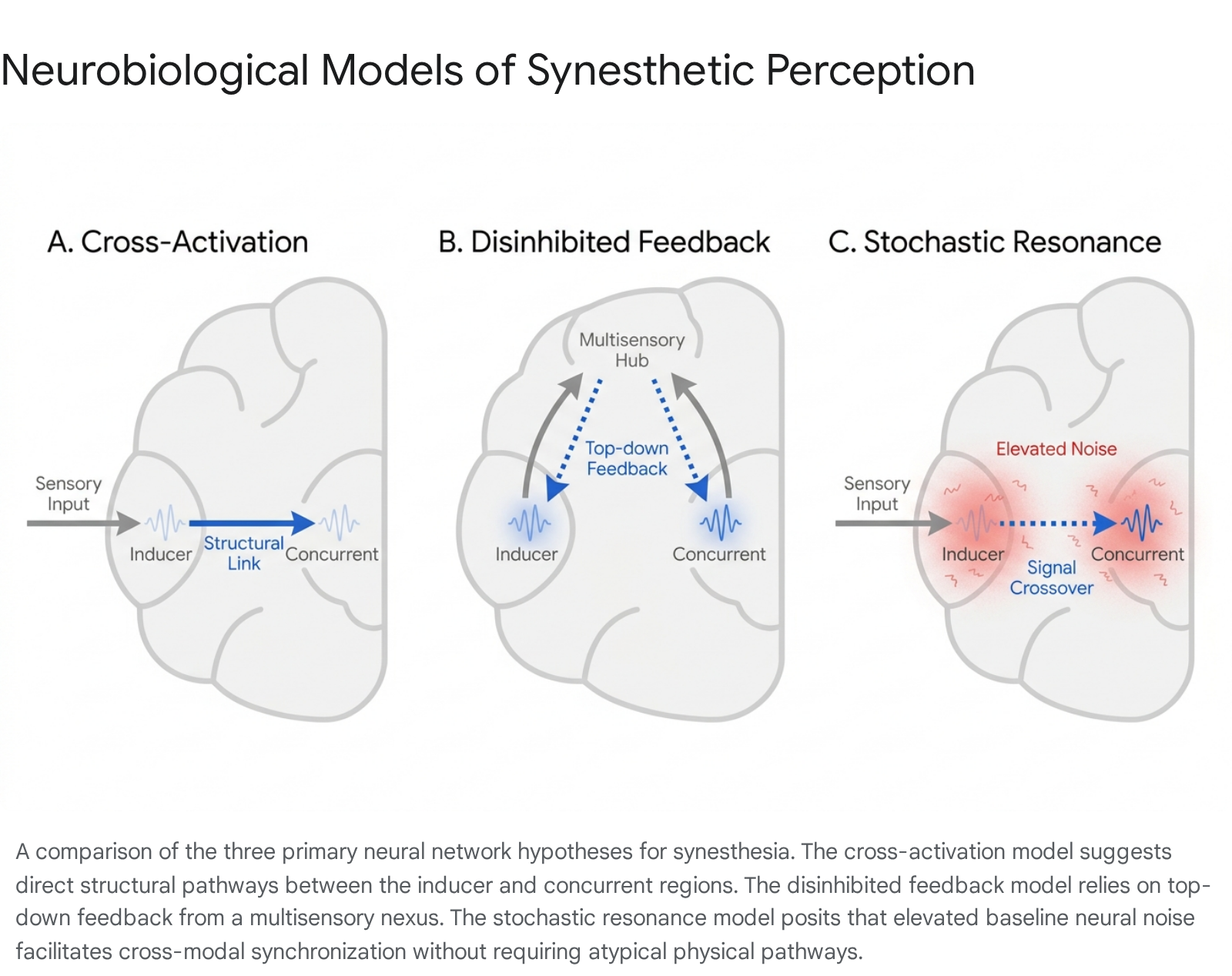
The Cross-Activation Theory
Pioneered by Ramachandran and Hubbard, the direct cross-activation model - sometimes termed the neural pruning hypothesis - posits that synesthesia arises from abnormal structural connectivity between adjacent sensory-specific cortical regions 29323633. The theory was inspired by the anatomical proximity of the Visual Word Form Area (VWFA), which processes graphemes in the fusiform gyrus, and the hV4 region, which is specialized for color processing 323834.
According to this framework, all neurotypical human infants are born with extensive, widespread synaptic connections across diverse cortical regions 329. During normal early childhood development, an experience-dependent process known as synaptic pruning eliminates redundant or extraneous cross-modal connections, leading to heightened cortical specialization 329. The cross-activation theory asserts that synesthetes possess a genetic variation that results in insufficient pruning 142429. Consequently, the neonatal structural links between regions like the VWFA and V4 persist into adulthood. When a grapheme is processed, the signal physically bleeds across these retained horizontal pathways, directly and automatically activating the adjacent color processing area in a strictly bottom-up manner 323536.
The Disinhibited Feedback Theory
In direct contrast to cross-activation, the disinhibited feedback model contends that synesthetic brains possess the same foundational anatomical architecture as non-synesthetic brains 24293236. In neurotypical perception, sensory information propagates upward through hierarchical cortical networks from primary sensory cortices to higher-order multisensory convergence zones - or "nexuses" - such as the temporo-parietal-occipital junction or the intraparietal sulcus (IPS) 323835. Top-down feedback signals from these multimodal hubs back to primary sensory areas are usually tightly regulated by inhibitory neurotransmitters (like GABA) to prevent sensory interference 24.
The disinhibited feedback theory proposes that in synesthetes, this top-down inhibition is severely diminished 242937. When an inducer is processed and reaches the multisensory nexus, the lack of inhibitory gating causes the signal to leak backward down into a secondary, unrelated sensory pathway 303637. Dynamic Causal Modeling (DCM) of fMRI data has provided support for this theory, demonstrating unusual feedback loop activation from parietal convergence areas to visual cortices during synesthetic experiences 363738.
Global Hyperconnectivity and Stochastic Resonance
While early research fixated on localized areas like the fusiform gyrus, advancing network-level analyses have shifted focus toward a "global hyperconnectivity" model 213940. Utilizing surface-based morphometry and graph-theoretical network analyses, researchers have observed a globally altered structural network topology in synesthetes 3340. This architecture is characterized by reduced small-worldness, increased clustering, increased degree centrality, and heightened intra- and inter-modular connectivity across widespread cortical regions 21333940. Under this paradigm, specific synesthetic manifestations (like grapheme-color associations) are merely localized phenotypic symptoms of an entirely hyperconnected brain network 334041.
Attempting to unify structural and functional perspectives, Lalwani and Brang (2019) proposed the Stochastic Resonance Model 293031. This theory posits that synesthetes operate with inherently higher levels of baseline neural noise within their sensory cortices 2930. Stochastic resonance is a phenomenon whereby the addition of random noise to a nonlinear system enhances the detection of weak signals. In the synesthetic brain, elevated neural noise interacts with pre-existing, latent multisensory pathways (which are dormant in neurotypical brains), pushing subliminal cross-modal signals above the threshold of conscious awareness 3031. This model effectively accounts for the broader phenotype observed in synesthetes, including generalized cortical hyperexcitability and enhanced perceptual sensitivity 30.
Structural and Functional Neuroimaging Methodologies
Historically, the neuroimaging literature surrounding synesthesia has been beset by conflicting data. Extensive reviews of early functional magnetic resonance imaging (fMRI), voxel-based morphometry (VBM), and diffusion tensor imaging (DTI) studies noted an alarming lack of consistency 42. Many early studies lacked sufficient statistical power - often relying on sample sizes of fewer than 20 individuals - and yielded no common anatomical regions of significance, leading some skeptics to argue that the neural signature of synesthesia might exist entirely outside the resolution of standard imaging techniques 4243.
However, the advent of high-resolution multimodal imaging and large-scale data consortia has drastically improved diagnostic clarity. Recent investigations utilizing the Human Connectome Project (HCP) multimodal parcellation framework have bypassed the limitations of traditional univariate voxel-based approaches 434445. By reducing data dimensionality through anatomically informed cortical parcellations, machine learning classifiers have successfully identified highly predictive structural biomarkers distinguishing synesthetes from controls 4445.
Resting-state fMRI and electroencephalography (EEG) data consistently reveal widespread connectome shifts, including less hub-based connectivity and heightened alpha and beta frequency band synchronization between the superior parietal lobe and visual areas 24454647. Notably, structural analyses within the HCP framework have isolated variations in intracortical myelin as a primary predictive biomarker of synesthesia, an architectural difference that strongly supports neurodevelopmental models of atypical maturation and pruning 4445. Furthermore, DTI metrics tracking white matter integrity have confirmed enhanced fractional anisotropy (FA) in tracts bridging auditory and visual hubs (e.g., the inferior fronto-occipital fasciculus), affirming that structural mutations undergird cross-modal interaction 245354.
Genetic Architecture and Heritability
Synesthesia exhibits robust familial aggregation, indicating a strong hereditary component. Early genetic theories incorrectly surmised that synesthesia followed a simple X-linked dominant inheritance pattern, a hypothesis fueled by early observations of gender imbalances (higher prevalence in females) and a lack of documented male-to-male transmission 1448. Subsequent multigenerational pedigrees decisively refuted this, demonstrating clear male-to-male transmission and shifting the consensus toward a highly complex, multifactorial model 48.
Twin Studies and the Autism Overlap
Classical twin studies are instrumental in untangling the relative contributions of genotype and environment. Analyses of large population twin cohorts (e.g., Taylor et al.) estimate the heritability of individual differences in synesthesia to be approximately 46%, driven by additive genetic factors 649. The remaining 54% of variance is attributed entirely to non-shared environmental factors - unique developmental perturbations occurring in utero or during early infancy - with virtually no influence derived from shared familial environments 649.
A pivotal revelation from these twin registries is the profound genetic correlation between synesthesia and Autism Spectrum Disorder (ASD). Synesthesia is significantly more prevalent among individuals diagnosed with ASD than in the general population 64950. The covariance between the two conditions is driven almost entirely (over 70%) by shared genetic architecture 64849. This overlap is anchored specifically in non-social autistic traits - namely, restricted and repetitive behaviors, intense attention to detail (RRBI-D), and atypical sensory sensitivities 648. This convergence implies that synesthesia and autism may be diverse phenotypic manifestations of similar underlying neurodevelopmental mechanisms related to neural hyperconnectivity and altered perceptual processing 649.
Molecular Genetics: Axonogenesis and Locus Heterogeneity
Modern molecular genetics, particularly whole-exome sequencing (WES), characterizes synesthesia as an oligogenic trait subject to profound locus heterogeneity 1448. This indicates that primary mutations predispose an individual to the condition, but secondary mutations across diverse genetic loci are required for phenotypic expression 1448.
A landmark genetic mapping study conducted by the Max Planck Institute examined three independent, multigenerational families expressing sound-color synesthesia 4. The WES analysis identified 37 rare candidate genes associated with the condition 4. Strikingly, none of the specific genetic variants were shared across all three families, confirming extreme genetic heterogeneity 448. However, a biological pathway analysis revealed that these disparate genes function within shared neurodevelopmental networks 4. Six of the identified genes - COL4A1, ITGA2, MYO10, ROBO3, SLC9A6, and SLIT2 - are critically involved in axonogenesis 448. Axonogenesis is the process by which nascent neurons project axons to form intricate synaptic wiring architectures during fetal and infant brain development 448. Mutations in these specific pathways provide a compelling molecular mechanism for the cross-activation theory, explaining exactly how the neonatal brain fails to prune redundant sensory connections, resulting in lifelong hyperconnectivity 448.
Differentiation from Acquired and Pharmacological States
While synesthesia is primarily a congenital trait, synesthetic-like states can be acquired through severe brain injury, sensory deprivation (e.g., blindness leading to cross-modal reassignment), or the ingestion of pharmacological agents 515253. Comparing developmental synesthesia to these acquired states provides critical boundaries for understanding its etiology.
Serotonergic Hallucinogens
Psychedelic compounds operating as serotonin (5-HT2A) receptor agonists - most notably psilocybin, LSD, ayahuasca, and mescaline - are highly capable of inducing transient auditory-visual synesthesia in neurotypical subjects 525462. Some studies indicate that over 50% of subjects under the influence of potent serotonergic psychedelics experience forms of sound-to-color crossover 54. However, the phenomenology of drug-induced synesthesia drastically differs from genuine developmental synesthesia 515255.
Developmental synesthesia is characterized by rigid, automatic, and highly consistent inducer-concurrent pairings (e.g., the key of C Minor is always deep purple) 155. Conversely, drug-induced synesthesia is highly fluid and context-dependent; a single auditory tone may elicit entirely different visual geometries or colors upon repetition depending on the subject's emotional valence or the time elapsed since dosing 545556. Furthermore, drug-induced concurrents involve intense, complex pseudo-hallucinations (form constants, fractals), whereas genuine synesthetic concurrents are usually simple, stable colors or forms 515556. These vast phenomenological divides indicate disparate neural substrates: congenital synesthesia is rooted in persistent structural morphology (white matter hyperconnectivity), whereas pharmacological synesthesia stems from transient functional shifts, specifically global network disinhibition driven by serotonin saturation 515256.
Psychopathology and Reality Testing
Synesthesia is distinct from the hallucinations and delusions characteristic of psychopathological disorders such as schizophrenia 45766. Although both involve altered perception, synesthetes consistently maintain intact reality testing 5758. A synesthete intrinsically understands that their concurrent color experiences do not exist in the external physical environment; they are recognized as internal, subjective overlays 45759.
Recent paradigms implementing predictive coding and perceptual inference models successfully separate the two phenomena based on how the brain weighs prior beliefs versus incoming sensory evidence 57. In empirical studies, schizophrenia patients display an overreliance on immediate sensory evidence and suffer perceptual deficits when sensory input is ambiguous 5766. Synesthetes, in stark contrast, rely heavily on high-precision, long-term internal priors (the fixed rules of their synesthetic associations) to construct their perceptual reality 57. Therefore, synesthetic concurrents are properly classified as veridical, structured perceptual experiences rather than pathological hallucinations 45859.
Philosophical Implications: Qualia and the Binding Problem
Because synesthesia occupies the threshold between sensory mechanics and subjective awareness, it holds immense value for the fields of cognitive science and the philosophy of mind. It serves as a natural laboratory for investigating the "Hard Problem of Consciousness" and the mechanisms of multisensory integration 26070.
Exploring Qualia
In the philosophy of mind, "qualia" (singular: quale) are defined as the instances of subjective, qualitative, first-person experience - the ineffable "redness" of a red apple, or the sharp sting of a headache 6061. Philosophers such as Frank Jackson and Thomas Nagel have argued that qualia possess non-physical, intrinsic properties that cannot be entirely reduced to functional neural computation 60. The debate over qualia frequently hinges on whether they are epiphenomenal (byproducts with no causal power) or central to the architecture of consciousness 60.
Synesthetes experience what philosophers term "second-order secondary properties" 258. When a grapheme-color synesthete views a black printed letter "A," they subjectively experience the quale of the color red, despite the complete absence of red wavelengths of light hitting the retina 258. This demonstrates that the generation of qualia can be entirely decoupled from external physical stimuli and relies solely on internal neural configurations 2. The synesthetic phenomenon challenges pure functionalist views of the mind - which argue that experience is just information processing - and lends support to neuroscientific structuralism. It suggests that specific, complex structural networks in the brain inherently generate specific qualia; because the synesthete has an altered structural network, they experience a fundamentally different phenomenal reality 262.
The Multisensory Binding Problem
Cognitive psychology continuously seeks to solve the "binding problem": the precise mechanism by which the brain integrates disparate sensory features (color, shape, auditory tone, spatial location) - all processed in isolated cortical regions - into a unified, coherent perception of a single object 706364.
Synesthesia provides critical insights into this integration process. Theories suggest that synesthesia represents a state of "hyperbinding," where the threshold for associating cross-modal cues in multisensory nexuses (like the intraparietal sulcus) is unusually low 3870. This trait appears to be an extreme manifestation of universal "cross-modal correspondences" present in all humans 6365. The well-documented "Bouba/Kiki" effect, wherein neurotypical individuals universally associate the nonsense sound "Bouba" with rounded visual shapes and "Kiki" with angular shapes, highlights an innate human capacity for cross-sensory matching 6365. Synesthesia research underscores that multisensory integration is not solely reliant on spatiotemporal coincidence (things happening at the same time and place), but is deeply constrained by semantic meaning, cognitive context, and complex neural architecture 636465.
Cognitive Profiles and the Creativity Hypothesis
The structural hyperconnectivity characteristic of the synesthetic brain confers a distinct cognitive profile. Extensive behavioral studies indicate that synesthetes consistently outperform non-synesthetes on tasks involving episodic memory, processing speed, visual pattern recognition, and visuospatial mental imagery (e.g., mental rotation tasks) 126677. The highly enriched, multisensory encoding of information naturally facilitates superior mnemonic retention 236677.
Culturally, synesthesia is deeply intertwined with concepts of artistic genius and enhanced creativity 7879. Biographical analyses reveal a high prevalence of synesthesia among celebrated artists, musicians (e.g., Lady Gaga, Miles Davis), and painters (e.g., David Hockney, Wassily Kandinsky) 667967. Empirical studies confirm that synesthetes gravitate toward creative professions and spend significantly more time engaged in the visual and performing arts compared to the general population 667868.
However, the scientific correlation between synesthesia and raw creative capacity requires careful delineation 6668. Psychometric evaluations of creativity typically divide the construct into convergent thinking (locating a single, correct associative answer) and divergent thinking (generating multiple novel, unconventional solutions) 66. While synesthetes often score significantly higher on convergent associative tasks, such as the Remote Associates Test, they do not universally outperform controls on broad divergent thinking assessments like the Alternate Uses Task 6668.
Researchers conclude that synesthetes possess enriched "bottom-up" access to a vast, interconnected semantic and sensory network, naturally supplying them with novel associations 6668. However, this structural advantage does not automatically grant the "top-down" cognitive flexibility required to utilize those associations adaptively in all creative contexts 68. Thus, while synesthesia provides an extraordinary internal palette that strongly drives a psychological affinity for the arts, it is a structural capacity that correlates with artistic vocation, rather than a direct causative mechanism for divergent creative genius 667868.