
Substack algorithm discovery and growth mechanics
Platform Scale and Market Economics
Over the past several years, the independent publishing platform Substack has transitioned from a specialized email newsletter delivery tool into a comprehensive, algorithmically driven digital media ecosystem. As of early 2026, the platform hosts over 50 million active subscriptions, with more than 5 million of those categorized as paid subscriptions 12. This represents a significant acceleration in consumer willingness to pay directly for independent writing, with paid subscriptions more than doubling from the 2 million recorded in 2024 2.
The platform's growth trajectory has elevated it to the status of a primary digital media distributor. In late 2025, Substack reported 47.6 million unique monthly website visitors across desktop and mobile platforms, representing a 65.85% year-over-year traffic increase 12. Gross writer revenue reached $450 million in 2025, an increase from $370 million in 2024 and $300 million in 2023 23. This generated approximately $45 million in direct corporate revenue for Substack via its standard 10% commission structure 2. Following a $100 million Series C funding round in mid-2025, the company achieved a $1.1 billion valuation, crossing the threshold into unicorn status while reportedly reaching positive cash flow in the first quarter of 2025 23.
This scale is sustained by a growing professionalization of the platform's creator base. Nearly 100,000 publications currently earn revenue globally, with more than 17,000 writers actively generating recurring income from at least one paying subscriber 12. However, the economic distribution remains heavily concentrated. A small cohort of top earners accounts for nearly 10% of the platform's total gross merchandise value, with more than 50 creators earning over $1 million annually 3. The underlying infrastructure driving this expansion relies heavily on an increasingly sophisticated discovery engine designed to maximize ecosystem retention and paid subscriber conversion.
| Metric Category | Late 2024 / Early 2025 Figure | Late 2025 / Early 2026 Figure | Growth Indicator |
|---|---|---|---|
| Active Subscriptions | ~35 Million | >50 Million | Accelerating mainstream platform adoption 25. |
| Paid Subscriptions | 2 Million | >5 Million | 150% increase in paid tier adoption across audiences 2. |
| Monetizing Publications | 50,000 (May 2025) | ~100,000 (April 2026) | 100% increase in creator commercialization 2. |
| Monthly Unique Visitors | ~28.7 Million (Sept 2024) | 47.6 Million (Sept 2025) | 65.85% year-over-year organic traffic growth 2. |
| Writer Gross Revenue | $370 Million | $450 Million | 21.6% year-over-year aggregate revenue growth 2. |
Legacy Media Migration and Institutional Shifts
The expansion of the platform has coincided with a structural shift in the traditional journalism and media industries. Facing declining organic reach on conventional social media and a broader erosion of trust in algorithmically curated news feeds, a significant volume of journalists and commentators has migrated to the platform 16. Roughly 30% of Substack writers come from journalism backgrounds, which has helped establish the platform's credibility in high-value categories such as news, technology, and politics 2. High-profile migrations have included figures such as Taylor Lorenz, Matt Taibbi, and Heather Cox Richardson, whose independent publications rival the circulation of major legacy newspapers 45.
Traditional media institutions are also experimenting with the platform to capture niche audiences without cannibalizing their core subscription bases. Publishers such as The Economist and Vox Media have launched specific newsletters or partnered with independent creators to leverage the direct audience relationships that the platform fosters 67. This dynamic underscores a broader "paradigm shift" wherein parasocial audience relationships and perceived authenticity often outweigh institutional brand recognition 67. However, media analysts express caution regarding "Substack Entrapment Theory," noting that as legacy publications increasingly rely on third-party subscription platforms, they risk ceding the crucial intermediary space between publisher and reader directly to the technology provider 67.
Recommendation System Architecture
Substack's most significant operational pivot has been the continuous engineering of its discovery algorithm. Unlike traditional social media platforms that optimize primarily for time-on-site to serve advertising impressions, Substack's algorithm is engineered to predict and maximize paid conversion probabilities 111213. Because the platform's business model depends exclusively on a revenue share of creator subscriptions, the recommendation system is structurally aligned to connect readers with writers they are statistically most likely to pay 1112.
Transition to Sequential Modeling
In late 2025, Substack's Head of Machine Learning, Mike Cohen, published a technical overview detailing a fundamental architectural shift in the platform's recommendation engine. Substack migrated its retrieval tasks away from traditional static models to an architecture known as "sequential modeling" 11121415.
Prior to this transition, Substack relied on a "two-tower" neural network architecture, a standard industry approach for deep learning recommendation models 121589. Under the two-tower system, a user's entire history of clicks, follows, and subscriptions was compressed into a single, static vector profile known as the user tower. This vector was then matched mathematically against a vectorized profile of content, known as the item tower 129. While this model was highly effective at matching general, long-term preferences, it failed to capture evolving user intent or the contextual nuances of a specific, immediate reading session 128.
The transition to sequential modeling addressed this limitation by processing interaction histories as a dynamic temporal sequence. Rather than averaging a user's past behavior into a static profile, the new architecture evaluates the immediate trajectory of reading momentum 1114158.
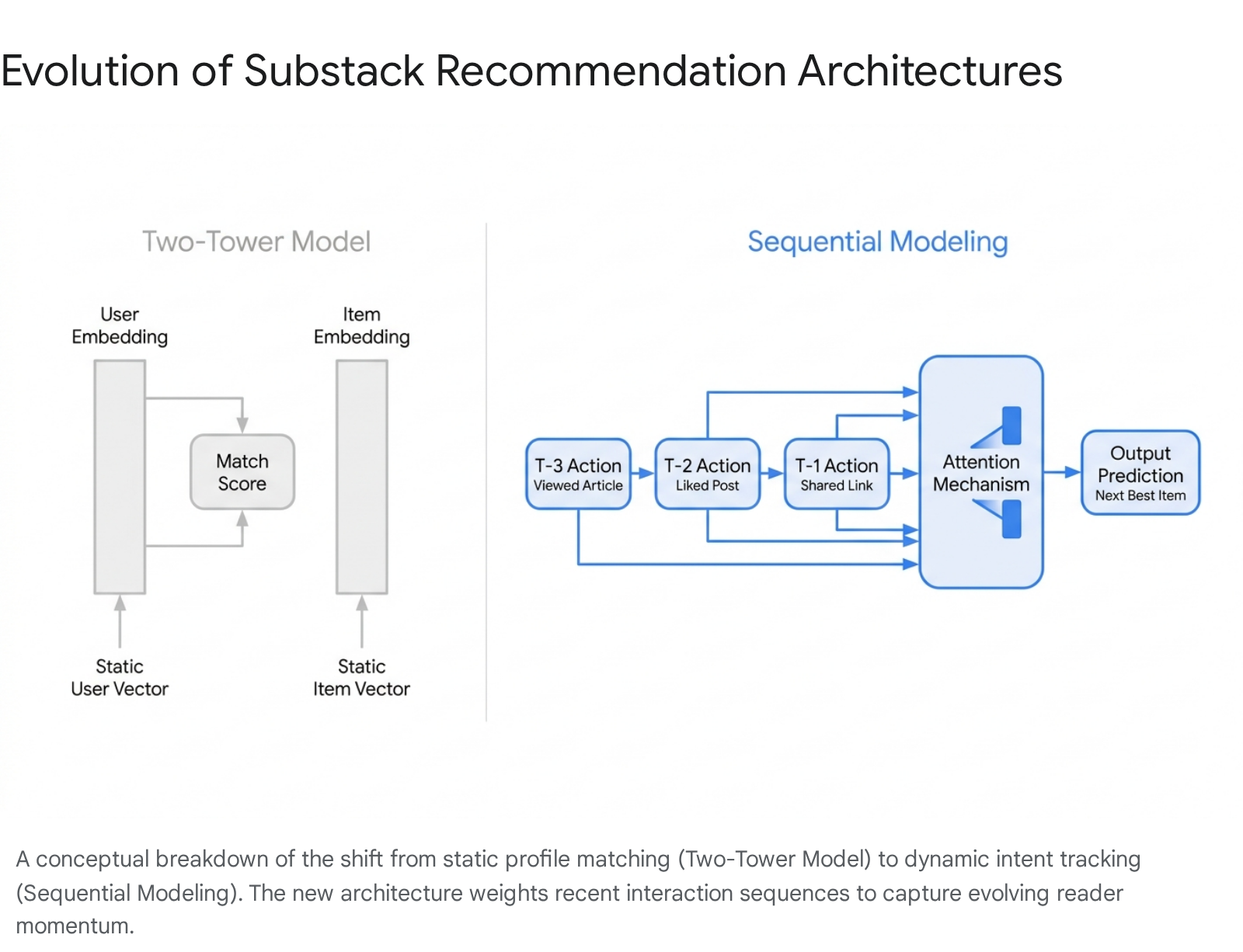
If a reader typically consumes finance publications but suddenly begins engaging with artificial intelligence content in a single session, the sequential model prioritizes the emerging interest. The algorithm dynamically serves high-quality AI content before the user's momentum dissipates, moving beyond asking "what does this user usually like?" to "what is the natural next step for this user right now?" 1112148.
Attention Mechanisms and Intent Tracking
At a computational level, this sequential architecture relies heavily on attention mechanisms. These are mathematical operations originally developed for natural language processing, such as the Transformer architecture, that function similarly to kernel smoothing in classical statistics 1291810. By applying learned similarity metrics, the algorithm evaluates an entire sequence of recent actions simultaneously, dynamically weighting the importance of specific past interactions based on proximity and relevance 918.
Consequently, the algorithm actively categorizes the specific type of user engagement based on its historical correlation with paid conversions. Surface-level interactions, such as a "like" on a short-form post, are treated as weak signals. A detailed comment is assigned greater weight within the sequence 12. Click-through events to a full publication are heavily weighted, and a free subscription operates as the ultimate validation node in the temporal sequence 12. Because the algorithm processes multi-step context, content that successfully acts as a bridge between an initial click and a final subscription is algorithmically favored and distributed more widely to adjacent audience clusters 1215.
Native Growth Flywheels and Network Effects
The integration of sequential modeling into internal platform surfaces has engineered a self-reinforcing network effect. Substack's architecture operates as a "growth flywheel" - a mechanic widely utilized in product-led growth to describe ecosystems where existing user behavior automatically generates new user acquisition, compounding over time 20212223.
A prominent case study illustrating this mechanic is the growth of Lenny Rachitsky's publication, which scaled from a basic independent newsletter to over one million subscribers and $2 million in annual recurring revenue by 2024 2425. Rather than relying heavily on paid acquisition or external social media funnels, the publication leveraged the platform's internal community features to trigger a compounding loop. Data analysis of this specific publication revealed that the native Substack recommendation engine drove 78% of all new free subscribers and 11% of all paid conversions, demonstrating the overwhelming power of the internal network once algorithmic momentum is achieved 1111.
The Audience Overlap Engine
The core of Substack's native growth engine is the Recommendations feature, which allows creators to publicly endorse other newsletters within the ecosystem. When a user subscribes to a publication, they are immediately prompted to subscribe to that author's recommended publications in a frictionless, one-click interface 2011.
From an algorithmic perspective, this acts as an "Audience Overlap Engine" 12. When a reader subscribes to two distinct publications, the algorithm explicitly maps an intersection between those audiences 12. As this mathematical graph deepens across millions of interactions, the recommendation system becomes highly adept at identifying hidden affinities between seemingly unrelated niches. By 2025, network-driven discovery accounted for roughly 60% of overall platform growth, effectively reducing Substack's corporate customer acquisition cost to zero while acting as the primary top-of-funnel pipeline for established creators 27.
Discoverability Through Substack Notes
Substack Notes, launched as a short-form social feed analogous to traditional micro-blogging platforms, acts as another critical discovery mechanism 6202728. While initial utilization treated Notes as a standard broadcast tool, the underlying sequential algorithm processes Notes engagement differently from legacy social media.
Rather than prioritizing viral outrage or absolute engagement volume, the Notes algorithm prioritizes "strategic restacking with perspective" 12. When a writer shares another creator's Note and adds their own substantive commentary, the sequential model interprets this action as a bridge being built between two distinct audience pools 12. If that bridge results in a downstream subscription, the algorithm heavily rewards both creators with wider feed distribution 12.
However, the system contains built-in saturation penalties. If a small, reciprocal group of creators repeatedly restacks only each other's content, the algorithm interprets this as a closed loop and suppresses distribution 12. This forces creators to constantly seek genuine, novel intersections to maintain growth, preventing the formation of artificial engagement pods that offer no actual value to readers 12.
Ecosystem Dependency and Algorithmic Signal
A critical corollary of this entire algorithmic framework is that the discovery system structurally favors writers who embed their complete operational lifecycle within the Substack ecosystem 11. Because sequential modeling requires dense, continuous data points to accurately predict momentum, it relies entirely on having complete visibility into the user journey 11.
Writers who publish on Substack but conduct their audience-building and promotion on external platforms - such as LinkedIn, Instagram, or personal websites - provide the recommendation engine with fragmented data 1128. Conversely, writers who utilize native features by commenting, recommending peers, and posting on Substack Notes generate a rich signal chain 11. Substack's Head of Data explicitly noted that the system excels because the platform controls the full interaction lifecycle. Consequently, external growth strategies are implicitly penalized by the algorithm due to a fundamental lack of predictive data 11.
Traffic Attribution and Data Analytics
As the algorithm matured, Substack introduced sophisticated analytics tools designed to help creators monitor ecosystem traffic and differentiate it from external acquisition. In late 2024 and 2025, the platform deployed an updated "Growth Sources" dashboard, transitioning away from opaque traffic measurements toward more granular attribution modeling 152912.
This dashboard categorizes user acquisition and traffic flow with much higher precision. Rather than aggregating all app-based traffic into a single metric, the system tracks specific attribution pathways, providing insight into algorithmic performance versus direct marketing efforts.
| Traffic Source Category | Technical Definition within Substack Analytics | Strategic Implication for Creators |
|---|---|---|
| Substack Onboarding | Readers who subscribe via the algorithmic recommendations presented immediately during initial account creation. | Highly dependent on broad platform categorization and overall ecosystem popularity 12. |
| Substack Network | Traffic and subscriptions generated directly via the internal recommendation system between writers. | The strongest indicator of successful cross-pollination and algorithmic "audience overlap" 11212. |
| Substack Trackbacks | Readers arriving via a hyperlink embedded in another author's post, comment, or sidebar. | Reflects manual, editorial curation by peers rather than purely algorithmic sorting 12. |
| Substack Other | Readers arriving via profile pages, direct messages, or generic inbox navigation. | Captures general platform engagement and overall app retention 12. |
| Direct to App | Users opening an external link that redirects directly into the native Substack application. | Indicates strong off-platform conversion to the native mobile environment 512. |
The enhanced tracking system also integrated timestamp markers to align subscriber spikes with specific publishing events, allowing creators to map exact posts to conversion outcomes 512. However, enterprise marketing analysts note that the platform still lacks advanced marketing automation features common to standard business-to-business software. The platform currently does not offer out-of-the-box A/B testing for subject lines, deep behavioral segmentation beyond basic tags, or advanced lead scoring systems 129.
Subscriber Conversion Dynamics
While algorithmic discovery and network effects drive the acquisition of free subscribers, the ultimate metric for creator sustainability - and platform revenue - is the conversion of free readers into paid subscribers. This transition remains a high-friction event requiring specific strategic alignment.
Industry Conversion Benchmarks
Comprehensive data analysis from late 2025 and early 2026 indicates that the global average paid subscriber conversion rate across the entirety of Substack is approximately 3% 212. While promotional literature occasionally cites 5% to 10% as a benchmark for high-performing publications, longitudinal analysis confirms the 3% median represents the statistical norm for established newsletters 12. Furthermore, subscribers acquired specifically through Substack Notes tend to convert at a slightly lower rate of 2% to 3%, likely because they represent casual, top-of-funnel browsers rather than high-intent searchers 12.
Conversion rates are highly dependent on content categorization and audience specificity:
| Content Category / Audience Type | Average Conversion Rate | Rationale and Context |
|---|---|---|
| General Audience / Broad Commentary | 1% - 2% | General news, culture, and lifestyle content face immense competition and lower perceived direct utility, suppressing willingness-to-pay 2. |
| Platform Median (All Publications) | ~3% | The statistical average across the 100,000+ monetizing publications globally 212. |
| Specialized and Niche Content | 4% - 10% | Highly specialized analysis offers distinct utility to dedicated communities, creating a clearer value proposition 2. |
| Technology, Business, and Finance | ~8% | High performance is driven by professional audiences expensing subscriptions or seeking direct career/financial advantages 2. |
Substack users exhibit extraordinarily high engagement compared to standard email marketing benchmarks, which serves as a leading indicator for eventual conversion. The average email open rate on Substack sits between 40% and 45%, significantly outperforming the broader email industry standard of approximately 21.5% 12331. Click-through rates often hover around 20% 3. Because the platform enforces opt-in delivery and routinely purges inactive accounts, algorithmic deliverability remains highly robust 1213.
Conversion Strategy Optimization
Creators who proactively shift their strategic focus from top-of-funnel acquisition to bottom-of-funnel conversion engineering frequently report outsized financial gains. Growth data indicates that treating Substack solely as a distribution mechanism without a deliberate paywall strategy yields minimal returns 33.
A documented case study involving the publication "Backstage Pass" illustrates this dynamic. After 14 months of following standard growth advice - publishing consistently and participating in platform social features - the publication amassed over 1,000 free subscribers but yielded a conversion rate of only 0.5% 3334. By pivoting to a defined conversion strategy that utilized psychological triggers and specifically gated high-value, actionable intelligence behind hard paywalls, the publication's conversion rate increased to 14.5% within six months 34. This indicates that while the algorithm provides the audience, the creator must actively architect the monetization funnel. Due to the baseline 2% to 3% conversion reality, experts increasingly advise creators to diversify income through external digital products, consulting, or sponsorships alongside paid subscriptions 35.
International Market Expansion
Historically dominated by the United States market, Substack has aggressively pursued global expansion to unlock new audience cohorts. As of 2026, 41% of Substack creators are based outside of North America 2. Traffic data reveals that while the US remains the primary driver, the United Kingdom, Canada, Australia, and India represent the next largest audience segments 36. Despite this geographic spread, the platform maintains a heavy English-language skew, with approximately 87% of all publications published in English 36.
To capture non-English markets and improve localized conversion rates, Substack initiated a major currency and payment localization update in 2024. The platform rolled out native pricing support for 13 global currencies and integrated regional payment portals such as iDEAL, Bancontact, Sofort, and SEPA direct debit specifically tailored for European users 271415.
The introduction of localized payment infrastructure dramatically reduced checkout friction. Internal reporting demonstrated an 85% relative lift in paid conversion rates in markets where localized pricing and alternative payment methods were introduced 1415. Consequently, European publishers collectively earn over $90 million annually on the platform, validating the viability of the subscription media model outside of the American market 239. To further penetrate distinct cultural markets, Substack has increasingly relied on a "local-hero strategy" in nations like Germany and Brazil, proactively recruiting prominent regional journalists to act as anchor tenants that organically draw localized audiences into the broader ecosystem 27.
Epistemic Environments and Content Ecology
Substack's growth has broader structural implications for the digital media landscape, influencing both the economics of independent publishing and the sociological environment in which information is consumed.
The algorithmic architecture designed to optimize paid conversions carries inherent sociological side-effects. Research into recommendation systems indicates that algorithms optimizing for subscription conversion naturally build highly homophilic clusters - groups that share and reinforce identical perspectives 40. Because the sequential model tracks momentum and intent, it excels at serving content that confirms a user's pre-existing worldview 4041.
Academic research into "echo chambers" on subscription platforms notes that when an article seamlessly aligns with a user's existing beliefs, the probability of both engagement and financial conversion spikes 404116. This dynamic - where the machine leans into reader signals until it becomes a "flattering echo" - has raised concerns regarding "Narrative Coherence Bias" and the potential degradation of epistemic diversity in public discourse 404116. The Ad Fontes Media Bias Chart, which analyzes the reliability and bias of news publishers, evaluated numerous high-profile Substacks in late 2025. The analysis found that none of the evaluated Substack publications fell within their minimally biased "green box," primarily because the platform's economic incentives heavily favor subjective analysis and opinion over neutral, resource-intensive news reporting 41744.
Furthermore, the migration of highly credentialed journalists and commentators from legacy media institutions to independent Substack operations fundamentally alters the editorial process 4174418. While the platform offers unprecedented editorial freedom - a feature particularly valuable to writers of color and marginalized voices seeking refuge from historically restrictive traditional newsrooms 19 - it simultaneously strips away institutional safeguards 1744. Legacy publications utilize layered editorial oversight, legal review, and fact-checking departments, whereas the Substack model relies almost exclusively on single-author analysis without formal peer review 1744.
Platform Lock-in and Creator Sovereignty
Substack positions itself as a sovereign alternative for creators, heavily promoting the fact that writers legally own their email lists and Stripe accounts and can export them at any time 11147. However, as the platform's algorithmic discovery mechanisms have matured, a new form of platform dependency has emerged.
The platform's fee structure remains a primary point of contention for top-tier creators. Substack takes a flat 10% commission on gross subscription revenue. Combined with Stripe's payment processing fees (typically 2.9% plus $0.30 per transaction, alongside an additional 0.5% to 0.7% for recurring billing logic instituted in 2024), creators frequently sacrifice between 13% and 16% of their gross earnings 348. For small to mid-sized creators, this performance-based pricing is highly advantageous, as it requires zero upfront capital 148. However, for creators generating substantial revenue, this fee structure equates to thousands of dollars lost per month compared to flat-fee, open-source, or sovereign alternatives like Ghost or Beehiiv 548. In 2025, nearly 3,000 creators reportedly migrated off the platform for financial reasons 648.
Substack's ultimate counterweight to this creator churn is the discovery engine itself. While writers can export their subscriber emails, they cannot export the algorithmic network effect 11147. Leaving Substack means immediately losing access to the internal Recommendations engine, Notes discoverability, and the sequential momentum tracking that drives up to 60% of new audience growth 112747. Thus, the 10% commission acts less as standard software-as-a-service rent, and more as an unavoidable access toll to a highly lucrative, exclusive, and algorithmically optimized reader ecosystem.