
Startup Founder Burnout and Mental Health
The intersection of entrepreneurial activity and psychological distress has emerged as a systemic crisis within the global innovation ecosystem. For decades, the dominant cultural narrative surrounding venture creation emphasized relentless labor, limitless physiological endurance, and an unyielding commitment to organizational growth. This paradigm, however, obscures a profound vulnerability among business founders. Recent empirical data, longitudinal psychiatric assessments, and economic analyses indicate that the demands of building scalable enterprises exact a severe toll on the cognitive and emotional well-being of entrepreneurs. The phenomenon of founder burnout is increasingly viewed not as an isolated consequence of poor time management, but as an occupational hazard deeply embedded in the structural incentives of venture capital, the mechanics of high-growth scaling, and the psychological profiles of those drawn to entrepreneurship.
The resulting mental health crisis presents a structural liability not only for individual founders but for the macroeconomic stability of the technology and business sectors. When cognitive endurance is compromised, the downstream effects manifest as strategic decision-making failures, organizational toxicity, and high rates of venture attrition. Understanding the founder burnout crisis requires a multidimensional analysis of psychological predispositions, the etiology of hustle culture, differential diagnostic criteria between burnout and clinical depression, the unique stressors of the venture life-cycle, and the complex power dynamics between founders and institutional investors.
Entrepreneurial Mental Health Baseline
The statistical baseline for mental health conditions among startup founders indicates a disproportionate vulnerability when compared to the general workforce. Psychological distress in entrepreneurship is highly prevalent, driven both by the environmental stressors of venture creation and the underlying psychological profiles of individuals who choose to become entrepreneurs.
Prevalence of Psychiatric Conditions
A landmark 2015 study, "Are Entrepreneurs Touched with Fire?", examined the co-occurrence of psychiatric conditions among entrepreneurs and found that 49 percent of founders reported experiencing at least one mental health condition in their lifetime, with 32 percent reporting two or more conditions 12. When family histories of mental illness were included, 72 percent of the surveyed entrepreneurs were either directly or indirectly affected by psychological conditions 1.
The comparative data between founders and traditional corporate employees highlights a stark divergence. Researchers have established that entrepreneurs are roughly 50 percent more likely to be affected by mental health issues than non-entrepreneurs 3. Specific psychiatric and psychological conditions are heavily overrepresented in the entrepreneurial cohort.
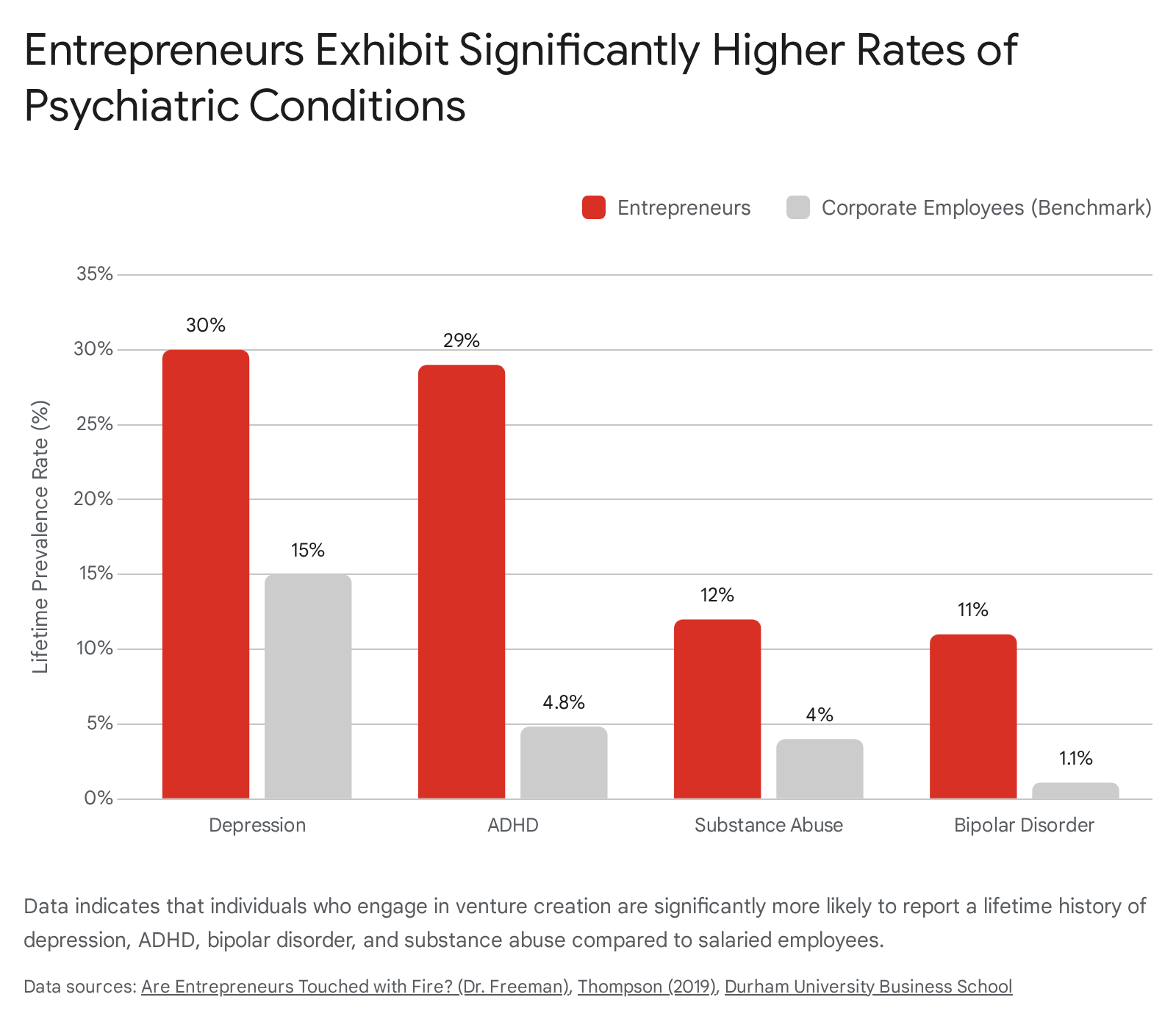
The data suggests a paradoxical relationship between entrepreneurial traits and psychological stability. The same attributes that drive venture creation - such as high energy, risk tolerance, creativity, and a capacity to operate in uncertain environments - are frequently correlated with strong emotional states and affective vulnerabilities 4. Traits such as sensation-seeking and impulsivity, which can be advantageous in early-stage venture development, simultaneously present long-term risks for psychological stability and interpersonal relationships 3.
It should be noted that the primary data regarding the 49 percent lifetime prevalence rate relies on self-reported survey methodologies, which inherently carry risks of selection bias and shared method variance 1. Furthermore, the study recruited from specific entrepreneurial networks, meaning the findings must be considered within those methodological constraints. Nonetheless, the directional magnitude of these findings has been corroborated by subsequent institutional reports across different geographic regions, confirming that founders face elevated risks 12.
Contemporary Burnout Statistics
Data collected between 2023 and 2025 demonstrates that baseline vulnerabilities have been severely exacerbated by post-pandemic macroeconomic shifts, including contracted venture funding and global inflation. A 2025 survey of tech founders revealed that 94 percent of respondents had experienced some form of mental health issue within the preceding twelve months 4.
Furthermore, 54 percent of founders reported experiencing full-scale occupational burnout within the past year, 75 percent suffered from acute anxiety, and 45 percent classified their current state of mental health as either "bad" or "very bad" 45. The pressure is severe enough that 49 percent of surveyed founders considered leaving their startup in the past year, and 21 percent have contemplated quitting entrepreneurship entirely 56.
Demographic variations exist within these stress responses. Female founders and entrepreneurs from minority backgrounds report higher instances of impostor syndrome (46 percent among women, compared to 43 percent among men) and are significantly more likely to battle persistent financial worries 49. Conversely, male founders report slightly higher rates of severe burnout (36 percent versus 31 percent for women) and clinical depression 3. The isolation inherent in the founder role exacerbates these risks universally, with 61 percent of founders reporting difficulty finding support from peers who understand their specific operational challenges, and 27 percent struggling with chronic loneliness 69.
The Etiology of Hustle Culture and Overwork
The widespread incidence of burnout within the startup ecosystem is largely driven by a systemic glorification of overwork, commonly referred to as "hustle culture." This sociological phenomenon dictates that venture success is directly proportional to extreme labor, promoting a myth of unlimited human capacity 78. Social conditioning within the tech and venture capital sectors reinforces the expectation that founders must endure 80-hour workweeks, sacrifice sleep, and forfeit work-life boundaries to demonstrate commitment to their enterprise 712.
The cultural allure of working without limits is reinforced by media representations and corporate narratives. Concepts of "unlimited potential" and "unlimited grind" benefit the economic systems surrounding startups by allowing investors and markets to demand ever-increasing effort while structural constraints go unchallenged 8. This programming begins early; cultural analyses, such as examinations of animated media highlighting characters who sacrifice all personal joy and rest for future payoffs, demonstrate how deeply ingrained the expectation of relentless striving is within modern society 8. For perfectionist founders, this creates a psychological environment where rest and self-compassion are viewed as optional luxuries rather than biological necessities 8.
Identity Fusion and the Founder Persona
A core driver of unsustainable behavior is the psychological mechanism of identity fusion. Many founders link their self-worth entirely to the performance and valuation of their company 914. When a startup succeeds, the founder's identity is affirmed; when the company faces inevitable market friction, the founder experiences it as a catastrophic personal failure 14. This blurring of boundaries between the individual and the corporate entity prevents founders from seeking help, as acknowledging mental fatigue is equated with admitting a lack of competence or leadership capability 6.
The pressure to maintain a stoic, visionary "founder persona" traps entrepreneurs in isolation. Founders frequently report feeling unable to disclose vulnerabilities to their teams to avoid triggering panic, while simultaneously hiding struggles from investors to prevent the withdrawal of capital or their own termination 615. Consequently, 73 percent of tech founders actively conceal their burnout, operating in a state of chronic stress while projecting an image of total control - a phenomenon that creates a vicious cycle of overwork and self-doubt 6.
Diminishing Returns of Cognitive Labor
Despite the cultural cachet of extreme hours, empirical research consistently demonstrates the diminishing marginal returns of cognitive labor. Stanford University research indicates that working beyond 50 hours per week precipitously degrades cognitive performance and decision-making quality 10. In an environment where strategic choices determine the survival or collapse of an enterprise, impaired executive function resulting from chronic fatigue is catastrophic.
Burnout severely limits working memory, creative problem-solving, and the capacity for long-term strategic planning 610. Exhausted founders frequently succumb to "decision fatigue," a psychological state wherein the quality of choices deteriorates after prolonged periods of continuous problem-solving 10. Under severe stress, the human brain shifts into a survival-oriented state that prioritizes short-term threat mitigation over long-term value creation 11. Data indicates that 72 percent of startup founders acknowledge that stress negatively impacts their decision-making, and 26 percent face legal or financial issues stemming directly from burnout-related mistakes, such as overlooked details or poor judgment calls made in a "fog of exhaustion" 6.
Clinical Distinctions Between Burnout and Depression
A critical challenge in addressing the founder mental health crisis is the clinical and operational distinction between occupational burnout and major depressive disorder (MDD). While the terms are frequently used interchangeably in entrepreneurial discourse, they represent distinct psychological phenomena with different etiologies, requiring divergent intervention strategies 1819.
Diagnostic Frameworks
The World Health Organization (WHO) classifies burnout in the 11th Revision of the International Classification of Diseases (ICD-11) explicitly as an occupational phenomenon, not a medical condition. It is defined as a syndrome conceptualized as resulting from chronic workplace stress that has not been successfully managed 12. It is characterized by three dimensions: feelings of energy depletion or exhaustion, increased mental distance from one's job or feelings of negativism or cynicism related to one's job, and reduced professional efficacy 1213.
In contrast, depression is a pervasive mental health disorder with complex biological, psychological, and social dimensions. According to the Diagnostic and Statistical Manual of Mental Disorders, Fifth Edition, Text Revision (DSM-5-TR), MDD requires the presence of at least five specific symptoms - such as depressed mood, diminished interest or pleasure (anhedonia), significant weight fluctuations, sleep disturbances, and recurrent thoughts of death - persisting for most of the day, nearly every day, for at least two weeks 14.
| Diagnostic Dimension | Occupational Burnout | Clinical Depression (MDD) |
|---|---|---|
| Origin Context | Situation-specific; tied directly to chronic workplace stressors, high demands, and professional environments 1819. | Context-free; can manifest regardless of environment, driven by genetic, biochemical, or broad psychosocial factors 1814. |
| Core Emotional State | Exhaustion, cynicism, frustration, and detachment or alienation specifically toward work responsibilities 1913. | Persistent sadness, deep hopelessness, excessive guilt, worthlessness, and anhedonia 191314. |
| Scope of Impact | Confined primarily to professional efficacy; individuals may still find joy in non-work activities 18. | Pervasive across all life domains; reduces interest in all areas of life 1819. |
| Physical Manifestations | Fatigue, sleep disturbances, headaches, and muscle tension linked directly to work stress 1813. | Fatigue, significant weight/appetite fluctuations, chronic pain, psychomotor agitation or retardation 1314. |
| Response to Intervention | Symptoms often improve with extended rest, boundary setting, and structural changes to the work environment 1819. | Symptoms rarely resolve with rest alone; typically requires clinical intervention (therapy, medication) 1819. |
Overlapping Symptoms and Misdiagnosis
Despite these structural distinctions, the phenomenological overlap between the two conditions is substantial. Both manifest through chronic fatigue, sleep disturbances, reduced motivation, difficulty concentrating, and irritability 18. Meta-analytic correlations reveal that exhaustion - the core dimension of burnout - is closely associated with depressive symptoms, suggesting a strong overlap between the two constructs 14.
In the entrepreneurial context, the boundary between situational occupational burnout and pervasive clinical depression frequently collapses. Because a founder's work environment is essentially inescapable, deeply tied to their identity, and constantly demanding, unresolved chronic burnout acts as a significant risk factor for the development of clinical depression 12. Misdiagnosing depression as simple burnout can lead to ineffective treatment strategies, as rest and boundary-setting alone are insufficient to treat severe depressive episodes, which may require pharmacological and psychotherapeutic intervention 19.
Venture Life-Cycle Stressors
Psychological stress in entrepreneurship is dynamic; it evolves in tandem with the maturity of the startup. The venture life-cycle is characterized by distinct phases of risk, funding constraints, and operational complexity, each generating specific psychological hazards for the founding team 215.
Early-Stage Survival Pressures
In the pre-seed and seed stages, the primary existential threat to the firm is the failure to achieve product-market fit before capital depletion. Data indicates that approximately 60 to 70 percent of companies that raise pre-seed or seed funding fail to secure a Series A round 16. Overall, approximately 90 to 95 percent of startups that receive early funding fail before reaching subsequent maturity stages 25.
During this phase, founders experience profound financial anxiety and role ambiguity. The failure metrics are heavily skewed toward strategic and market deficits: 42 percent of early-stage failures are attributed to a lack of market need, and 29 percent to running out of cash 1617. The psychological burden is characterized by the stress of constant iteration, the fear of total financial ruin, and the emotional volatility of attempting to secure validation from highly skeptical early adopters and investors. The sheer volume of operational tasks - product development, hiring, fundraising, and marketing - falls entirely on the shoulders of a small founding team, leading directly to initial exhaustion.
Scaling and Complexity Challenges
As a venture successfully navigates into the Series A and Series B stages, the attrition rate drops to approximately 20 to 30 percent, but the nature of the psychological stress shifts dramatically 16. Failures at these later stages are rarely due to initial product deficiencies; instead, they involve scaling problems, human resources mismanagement, and unit economic breakdowns 16.
The transition from an early-stage "builder" to a growth-stage "executive" requires founders to delegate, build hierarchical systems, and manage increasing investor oversight. If a founder fails to implement scalable operational procedures and continues to rely on direct micromanagement, decision-making bottlenecks rapidly induce severe cognitive overload 18. The stress at this stage is characterized by the pressure of managing larger teams, maintaining organizational culture, and delivering on the hyper-growth expectations set by venture capital valuations. Furthermore, managing the introduction of new executive hires and navigating shifting corporate culture often leads to "founder obsolescence" anxiety, where the original entrepreneur feels alienated from the organization they built.
Winding Down and Venture Dissolution
When strategic pivots fail and capital is exhausted, founders face the trauma of winding down the enterprise. The psychological impact of shutting down a startup is frequently compared to severe bereavement. Founders mourn the loss of their professional identity, their creative vision, and their perceived future 19.
The process of corporate dissolution involves complex, adversarial procedures - such as terminating employees, dealing with unsecured creditors, liquidating assets, and facing interrogations by receivers or boards - which compound the emotional damage 19. The cultural stigma surrounding failure leads many founders to withdraw socially, resulting in extreme isolation, severe depression, and occasionally post-traumatic stress symptoms 19. The loss of a daily operational routine creates a psychological void, and the guilt associated with disappointing employees and losing investor capital can have enduring impacts on a founder's long-term mental health.
Institutional Dynamics and Financial Pressures
The mental health of a startup founder is inextricably linked to the power dynamics and fiduciary relationships they hold with institutional investors and their Board of Directors. The expectation of aggressive, exponential growth often places venture capitalists and founders in adversarial psychological positions, particularly during macroeconomic downturns.
The Mechanics of Board Governance
While venture capitalists rely on portfolio theory - diversifying risk across dozens of companies with the expectation that one major success will offset numerous failures - the founder is entirely undiversified. All of the founder's financial, professional, and reputational equity is concentrated in a single entity. This asymmetry in risk profiling fundamentally alters how each party approaches company growth and survival.
Boards of Directors frequently push for rapid, high-burn scaling to capture market share, an approach that maximizes the chance of a "unicorn" outcome for the investor's fund, but simultaneously maximizes the risk of catastrophic failure for the founder's single asset 2021. Managing board expectations, particularly when independent directors rely heavily on established corporate norms rather than acknowledging disruptive realities, introduces a layer of political stress that distracts founders from core operations 2122.
Financing Contingencies and Dilution
If a company fails to meet aggressive growth targets and is forced to raise capital at a lower valuation - a financing event known as a "down round" or "cram-down" - the psychological toll on the founder is immense. Cram-down rounds fundamentally reduce the ownership stake of existing shareholders, often forcing founders to accept massive dilution or see their investment written down completely 3233.
Such rounds frequently trigger "pay-to-play" provisions, which require existing investors to contribute additional capital to maintain their voting rights and anti-dilution protections 3234. For founders, managing these highly contentious negotiations creates extreme friction between old and new investors. The combination of reduced autonomy, diluted ownership, and heightened operational crisis accelerates the trajectory toward total burnout, often leaving the founder feeling like an alienated employee within their own creation 3334.
The Impact of Industry Contractions and Tech Layoffs
Macroeconomic contractions deeply impact founder mental health. Between 2022 and 2024, the global technology sector experienced severe valuation corrections and the erasure of over 640,000 tech jobs 2324. Founders forced to execute mass layoffs experience profound psychological distress.
Executing layoffs carries immense guilt and "survivor's syndrome" for those remaining. The psychological toll of mass terminations is severe; research indicates that layoffs increase the odds of suicide among affected workers by two and a half times and elevate long-term mortality by 15 to 20 percent 2324. For founders, the burden of initiating these events, combined with the stress of managing a demoralized, anxious remaining workforce, leads to severe mental health deterioration 2526. Furthermore, corporate structures frequently abandon mental health support precisely when it is most needed; for instance, cost-cutting measures during economic downturns often target internal human resources and well-being departments, leaving leadership and staff to manage psychological trauma without structural support 23.
Macro-Environmental and Geographic Factors
The prevalence and severity of founder burnout are significantly modulated by macro-environmental factors, including regional cultural attitudes toward labor, the definition of success, and the presence or absence of state-sponsored social safety nets.
Work Culture and Stigma in Asia
In the Asian business ecosystem, the mental health challenges facing founders and employees are notably severe, driven by deeply entrenched cultural norms prioritizing extreme working hours and collective harmony. The Asian workforce reports symptoms of burnout at a rate of nearly one-third, significantly higher than the global average of one in four 2728. In regions like Southeast Asia, public health assessments estimate burnout prevalence among employees at nearly 63 percent 29.
For entrepreneurs in these markets, the situation is exacerbated by toxic workplace behaviors and rigid hierarchical structures. In India, for example, toxicity is cited as the primary driver in nearly 90 percent of burnout cases 28. The region also features some of the longest working hours globally; in Singapore, workers average 44 hours per week with minimal annual leave, creating an environment where overwork is structurally mandated 27. Furthermore, cultural attitudes in many Asian nations heavily stigmatize business failure. Unlike Western venture ecosystems where failure can be reframed as a valuable learning experience, failure in Asian business contexts often carries immense personal and familial shame, exacerbating depression and anxiety among founders 27.
Social Safety Nets in Europe Versus the United States
Conversely, the psychological baseline of entrepreneurs is influenced by the macroeconomic safety nets of their respective nations. Comparative analyses between European and American welfare systems demonstrate that robust social protections actively influence risk tolerance and entrepreneurial mental health 3031.
In the United States, the welfare system is highly fragmented, and essential services such as healthcare access are frequently tied directly to employment 3032. The failure of a business venture in the U.S. carries the secondary existential threat of losing health insurance and severe housing insecurity 30. In contrast, many European nations operate wage support programs, universal healthcare, and minimum-income benefits that buffer the individual against total destitution 3033.
Research indicates that a strong social safety net effectively acts as a psychological subsidy for entrepreneurs. When founders know they have a baseline of support - such as food security, healthcare, and unemployment benefits - if their venture fails, their baseline existential anxiety is reduced. This reduction in ambient stress allows for healthier risk-taking and more resilient psychological profiles 31. Data shows that expansions in social support programs, such as Medicaid or child health insurance, directly correlate with an increase in incorporated business ownership, proving that systemic economic security mitigates the psychological risks of entrepreneurship 31.
Interventions for Sustainable Entrepreneurship
The mental health of founders is not merely a clinical concern; it is a critical variable in corporate finance and economic productivity. The systemic failure to protect founder well-being results in massive capital destruction. Research indicates that 65 percent of startup failures are directly attributable to internal conflict or founder burnout 634.
When cognitive function deteriorates due to chronic exhaustion, the economic ripple effects are profound. Companies led by burned-out founders experience an average 37 percent drop in revenue and a 25 percent reduction in overall productivity 35. Furthermore, because leadership stress is highly contagious within an organization, founder burnout frequently triggers a toxic corporate culture, leading to a 42 percent increase in employee turnover and a 40 percent drop in innovation output 2435.
Addressing the founder burnout crisis requires moving beyond superficial wellness initiatives and implementing structural, evidence-based changes to how startups are built and governed.
Setting Operational Boundaries
The most effective intervention for preventing burnout is the strict implementation of work-life boundaries. The flexibility of entrepreneurship frequently becomes a trap, with 55 percent of founders reporting that their workload prevents them from pursuing hobbies, and 45 percent stating it damages personal relationships 6.
Research demonstrates that founders who actively establish and maintain boundaries around their off-hours experience dramatically different outcomes. Founders who establish strict work-life boundaries report low burnout rates of 45 percent, compared to just 6 percent among those who fail to set boundaries 6. Non-boundary-setters are nearly three times more likely to experience severe burnout 6. Operationalizing boundaries involves shifting schedules to align with natural circadian rhythms, strictly unplugging from digital communications during designated hours, and ensuring time for physical exercise and psychological detachment 7.
Cognitive Behavioral Coaching
Structured programs that focus on teaching self-awareness, emotional regulation, and cognitive behavioral techniques have proven highly effective for entrepreneurial populations. In studies evaluating coaching programs for early-stage founders, 80 percent of participants reported a decrease in depression and anxiety levels after integrating cognitive-behavioral tools 36. Furthermore, over 50 percent of participating founders reported improved confidence and quality in their strategic decision-making, and 70 percent noted a general reduction in self-reported stress 36. Integrating meditation, mindfulness, and dedicated psychological counseling provides founders with the resilience needed to manage the inherent volatility of venture creation without resorting to destructive coping mechanisms 91137.
Reengineering Investor Relations
Venture capital firms and boards of directors must actively dismantle the stigma surrounding mental health to protect their investments. Survey data indicates that 81 percent of founders believe VCs can help create a culture where entrepreneurs can look after their well-being, yet currently, only a fraction receive such support 6.
Investors who proactively signal support for mental health services and model vulnerability can create vital psychological safety 614. By explicitly discussing mental health during the onboarding process and separating the founder's intrinsic human value from the immediate financial metrics of the firm, investors can encourage early interventions 614. Supporting founders before human resource problems mutate into operational crises has been shown to yield up to a 20 percent improvement in venture performance, aligning moral imperatives with fiduciary duties 14. Furthermore, founders must implement rigorous systems delegation - creating standard operating procedures and clear escalation rules - to ensure the organization can function without the founder serving as the sole cognitive bottleneck 18.
Sustainable innovation requires a fundamental reconceptualization of how venture success is pursued. Acknowledging human physiological and cognitive limits is not a concession to weakness, but a requisite for durable strategic leadership. By implementing robust operational boundaries, fostering psychological safety within corporate governance, and decoupling personal identity from venture outcomes, the startup ecosystem can transition away from a model of capital extraction that relies on founder destruction.