Social media use and mental health outcomes in 2026
Epidemiological Context and Global Prevalence
By 2026, the global discourse surrounding digital environments and mental health has evolved from generalized public alarm to precise, mechanism-driven psychiatric epidemiology. The ubiquitous nature of social media platforms represents an unprecedented environmental exposure. With an estimated 5.42 billion users worldwide spending an average of two hours and twenty-one minutes daily on digital platforms, the integration of algorithmic media into daily life is total 1. The World Health Organization (WHO), in its seminal publications extending from the World Mental Health Report: Transforming Mental Health for All, has underscored the severity of the global landscape, noting that over one billion individuals live with mental health disorders 234. These conditions, predominantly anxiety and depressive disorders, account for one in six years lived with disability globally and exact an annual economic toll exceeding one trillion dollars in lost productivity and healthcare expenditures 35.
Concurrently, independent global tracking metrics reveal a stark demographic inversion in psychological well-being that closely mirrors the timeline of digital adoption. The 2025 and 2026 reports from Sapien Labs, measuring the Mental Health Quotient (MHQ) across 84 countries and millions of respondents, demonstrate that older adults (aged 55 and above) have maintained stable mental well-being scores, averaging a robust 101 out of 200 67. Conversely, successive younger generations report precipitous declines. Young adults aged 18 to 34 exhibit an average MHQ of merely 36, with 41% experiencing clinically significant mental health challenges 67. This pattern of diminishing psychological resilience with each younger age cohort holds true across the internet-enabled world, prompting researchers to investigate the specific role of the digital exposome.
Historically, establishing scientific consensus regarding the impact of social media was hindered by a heavy reliance on cross-sectional survey data, which struggled to disentangle correlation from causation. The simplistic "more is worse" monolithic model of screen time has subsequently been discarded by the academic community 8. In its place, contemporary research paradigms - leveraging genome-wide Mendelian randomization, large-scale randomized controlled trials (RCTs), and longitudinal cohort tracking - focus on the specific architecture of the platforms, the modality of user engagement, and the individual biological or psychological vulnerabilities of the user 9. This report systematically reviews the empirical evidence available in 2026 to delineate the complex, often bidirectional causal mechanisms linking social media use to mental health outcomes.
Engagement Modalities and Psychological Trajectories
A foundational shift in the study of digital environments involves the differentiation between usage typologies. Current epidemiological data consistently demonstrates that raw cumulative screen time is an inadequate predictor of psychological well-being. Instead, the specific nature of the digital interaction dictates subsequent developmental and emotional outcomes 1011.
Passive Consumption and the Displacement Hypothesis
The dichotomy between active use and passive use forms the basis of modern digital behavioral science. Passive social media use (SMU) is characterized by infinite scrolling, consuming auto-playing video feeds, and viewing content without direct interaction or content creation. A comprehensive 2024 meta-analysis encompassing 141 studies and approximately 145,000 participants found that passive SMU is consistently associated with greater depressive symptoms and elevated general psychological distress 1213.
The negative psychiatric sequelae of passive use are frequently explained through the displacement hypothesis. This theory posits that excessive time allocated to screen-based activities physically displaces critical offline health behaviors, notably physical movement, face-to-face interpersonal communication, and restorative sleep 14. Sleep disruption acts as a primary physiological mediator for psychological distress. According to a 2025 Pew Research Center report, 45% of adolescents acknowledge that social media negatively impacts their sleep duration and quality 11516. The exposure to blue light, combined with the cognitive arousal of consuming emotionally charged content, maintains the autonomic nervous system in an elevated state of alertness prior to rest, directly precipitating mood instability and diminished executive functioning 1015.
Active Participation and Social Comparison Theory
Active SMU involves posting original content, commenting, direct messaging, and actively curating digital profiles. The risk profile of active engagement is paradoxically complex. The aforementioned 2024 meta-analysis indicates that active use is significantly associated with greater online social support, eudaimonic well-being, and positive affect 1213. However, it concurrently correlates with heightened symptoms of anxiety 1213.
The anxiety associated with active posting is largely mediated by social comparison theory. Active users experience cognitive pressure to curate a flawless digital identity and subsequently anticipate algorithmic validation in the form of likes, shares, and comments 1517. Upward social comparison occurs when users consume highly curated, idealized representations of their peers or prominent influencers. This constant exposure is inextricably linked to body dissatisfaction, disordered eating tendencies, and depressive symptoms. Adolescent girls are particularly vulnerable, reporting significantly higher pressure to appear attractive and engage with appearance-focused content compared to adolescent boys 115.
Categorization of Digital Interactions
To summarize the divergent impacts of user behavior, the current academic consensus regarding engagement typologies is mapped in the structural comparison below.
| Engagement Typology | Behavioral Definition | Primary Psychiatric Associations | Mediating Mechanisms |
|---|---|---|---|
| Passive Use | Infinite scrolling, viewing without commenting, consuming auto-play feeds. | Depressive symptoms, clinical loneliness, life dissatisfaction, sleep disruption. | Upward social comparison, FOMO (Fear of Missing Out), physical displacement, autonomic arousal. |
| Active Use | Posting original content, commenting, aggressively curating public profiles. | Elevated anxiety, moderate increases in eudaimonic well-being and social support. | Anticipatory anxiety regarding peer validation, hyper-vigilance to quantitative engagement metrics. |
| Relational Use | Direct messaging (e.g., WhatsApp, Signal), closed peer group participation. | Increased life satisfaction, reduced feelings of isolation, enhanced peer connection. | Genuine social reciprocity, absence of algorithmic performance pressure or public metrics. |
Algorithmic Architecture and Neurocognitive Function
Beyond the behavior of the individual user, the fundamental engineering of social media platforms actively shapes cognitive processing. By 2026, researchers have systematically characterized modern digital environments as relying on "addictive algorithms and designs" (aADs) that deliberately exploit human neurobiology 18.
Variable Rewards and the Psychology of Doomscrolling
The phenomenon of "doomscrolling" - the compulsive, sustained consumption of negative, anxiety-provoking, or emotionally activating content - is facilitated by platform architectures designed to eliminate natural psychological stopping cues 19. Interface features such as the infinite scroll and algorithmic auto-play exploit the brain's innate negativity bias, an evolutionary mechanism that prioritizes threat detection 1920. Furthermore, these platforms operate on variable reward schedules. Because the delivery of highly stimulating or novel content is entirely unpredictable, it triggers repeated, intermittent dopaminergic responses, reinforcing the scrolling loop in a manner neurologically identical to slot machine mechanics 1919.
Longitudinal studies published between 2025 and 2026 demonstrate that heavy doomscrolling spikes systemic cortisol levels while simultaneously interfering with the prefrontal cortex, the neural region responsible for executive function, impulse control, and rational decision-making 1919. The constant barrage of threat-based information maintains the central nervous system in a chronic state of hyper-arousal. Moreover, the high-frequency consumption of short-form video content has been neurologically correlated with reduced theta brainwave activity in the frontal cortex, leading to diminished cognitive control, shortened attention spans, and profound decision fatigue 22.
The Differential Impact of Platform Typologies
The 2026 World Happiness Report provides critical epidemiological data distinguishing platforms by their degree of algorithmic intensity. The report concluded that applications prioritizing algorithmic, discovery-driven feeds and infinite scrolling (such as TikTok, Instagram, and X) are significantly more detrimental to population mental health than platforms designed primarily around explicit social connection and direct messaging (such as WhatsApp and Facebook Messenger) 21. Across a massive 17-country study in Latin America and parallel cohorts in the Middle East and North Africa, frequent use of passive, visual, influencer-dominated platforms consistently correlated with lower life satisfaction and higher rates of clinical depression 21. In contrast, relational messaging applications yielded neutral to highly positive well-being outcomes, reinforcing the premise that the architecture of the platform overrides the mere presence of digital communication 21.
Architectural Modifications and Engagement Metrics
In response to mounting public health pressure regarding platform toxicity, technology companies have experimented with modifying specific architectural elements. The most prominent example is the widespread implementation of hiding public engagement metrics, specifically "likes." The theoretical premise is that removing public scorecards mitigates the anticipatory anxiety and social comparison that drive psychological distress, theoretically leading to more authentic online interactions 2223.
However, the empirical results from these rollouts indicate a high degree of complexity. While proponents note that hiding metrics decreases the incentive for moral grandstanding and reduces acute performance anxiety 22, behavioral data suggests the impact may be superficial. A large-scale 2026 empirical study analyzing 154,122 posts on X (formerly Twitter) following the platform's shift to private likes found no detectable platform-level behavioral response in how users engaged with reputationally risky or polarizing content 24. While survey participants self-reported a greater theoretical willingness to engage without the pressure of public likes, this did not translate to systemic changes in actual platform dynamics, suggesting a persistent gap between user intention and the deeply entrenched habits governed by algorithmic discovery engines 24. Similarly, younger demographics report that aggressive safeguarding measures (such as hard-capping accounts at a PG-13 content level and aggressively hiding metrics) make the ecosystem feel artificial and restricted, potentially driving users to less regulated, alternative platforms 25.
Genomic Epidemiology and Mendelian Randomization
A persistent historical limitation of social media research has been the reliance on observational data, leaving findings highly vulnerable to confounding variables and the specific challenge of reverse causality. The core epidemiological question remained: do healthy individuals become depressed due to social media use, or do individuals with pre-existing depressive disorders utilize social media more heavily as a coping mechanism? To resolve this, 2025 and 2026 saw a paradigm shift toward Mendelian Randomization (MR) studies 2627.
Resolving Observational Confounding
Mendelian Randomization utilizes genetic variants - specifically single nucleotide polymorphisms (SNPs) - as instrumental variables to infer true causal relationships between an exposure and an outcome. Because genetic allocation occurs randomly at conception and cannot be altered by environmental factors or subsequent diseases, MR effectively simulates a natural randomized controlled trial, mitigating the effects of traditional confounding and reverse causality 262728.
Disentangling Directionality and Reverse Vulnerability
The application of bidirectional and multivariable MR to the digital exposome has generated highly nuanced findings that challenge monolithic narratives:
First, MR analyses have confirmed direct causal effects on specific neurodevelopmental traits. Genetic evidence demonstrates a direct causal relationship wherein genetically predicted increases in long-term mobile phone and television use significantly elevate the risk of Attention-Deficit/Hyperactivity Disorder (ADHD) and Autism Spectrum Disorder (ASD) traits 14.
Second, MR has elucidated the specific biological pathway connecting digital isolation to severe mental illness. Multivariable MR has established a robust causal pathway wherein clinical loneliness - often exacerbated by passive digital isolation - acts as a chronic psychosocial stressor that increases the risk of Severe Mental Illnesses (SMI), including Major Depressive Disorder (MDD), Bipolar Disorder (BD), and Schizophrenia (SCZ). Crucially, genetic data proves this mechanism is partially mediated by systemic pro-inflammatory cytokine signaling, specifically elevated levels of IL-1RA, IL-6Rα, and TNF-R2 29.
Third, regarding reverse causality, the findings force a recalibration of how digital addiction is viewed. While observational data heavily links raw screen time to depression, several bidirectional MR models have failed to find a unidirectional causal link from general digital device use to the onset of MDD, Alzheimer's Disease (AD), or Post-Traumatic Stress Disorder (PTSD) 1428. Instead, reverse MR models prove that a pre-existing genetic liability to major depression, clinical frailty, chronic pain (such as musculoskeletal pain), and primary insomnia causally drives an increase in subsequent screen time and social media dependency 14272830.
These advanced genetic epidemiology models enforce a paradigm of calibrated uncertainty. While manipulative platform design absolutely exacerbates vulnerabilities, excessive social media use must increasingly be viewed as an aggravating exposure that interacts with baseline genetic susceptibility, or as a compensatory coping mechanism for pre-existing physical and psychosocial distress, rather than acting as an isolated biological pathogen.
Experimental Deprivation and Efficacy of Abstinence
If Mendelian randomization maps the underlying genetic and biological baseline, experimental deprivation studies measure the immediate plasticity of the human psyche when the digital exposure is removed. Randomized Controlled Trials (RCTs) enforcing strict digital detoxes provide the most compelling evidence regarding the acute, reversible nature of social media-induced distress.
Clinical Trials of Digital Disconnection
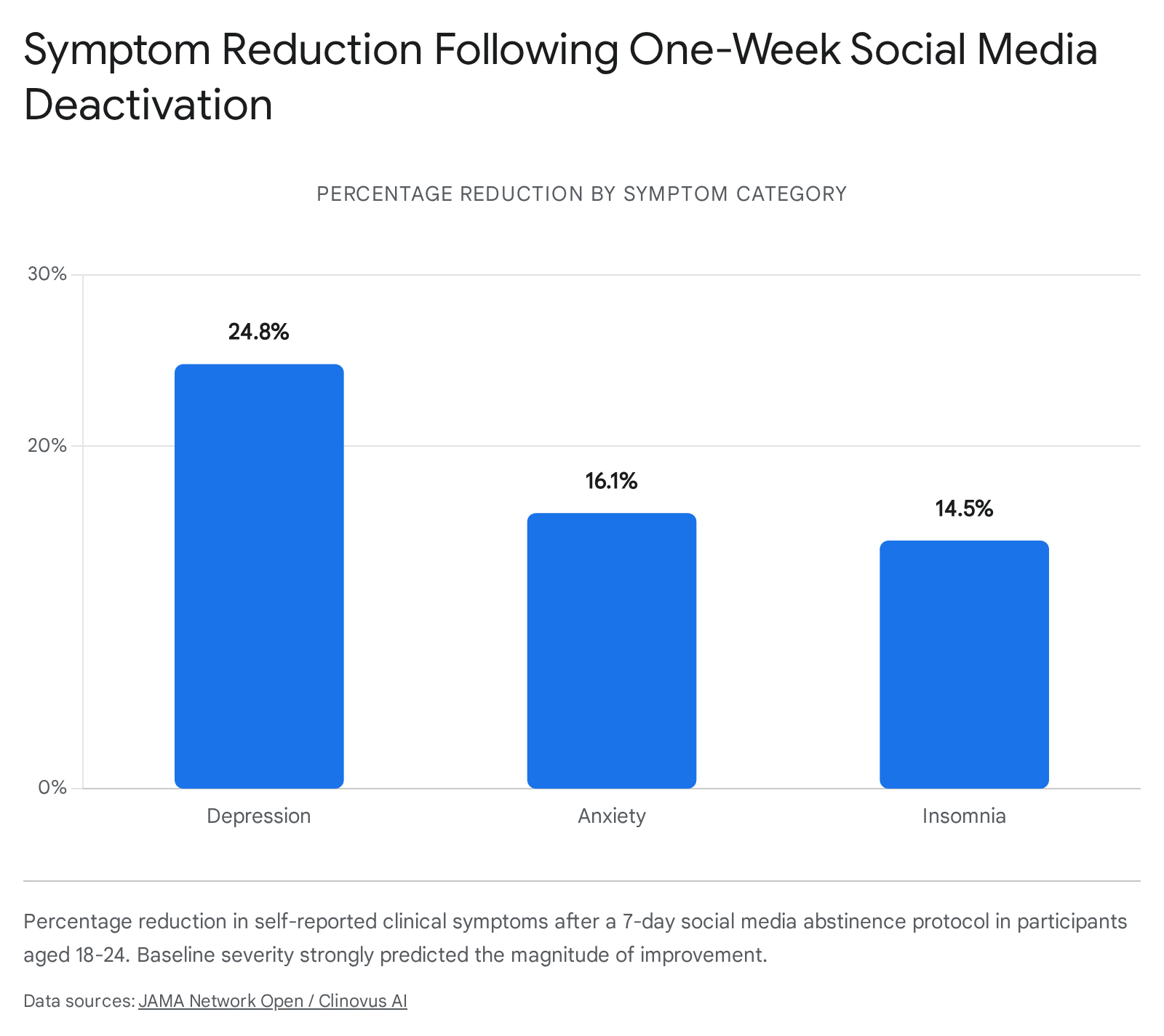
A landmark 2025 prospective cohort study published in JAMA Network Open tracked young adults (aged 18 to 24) who underwent a strict, one-week social media deactivation protocol. Within just seven days of abstinence, participants exhibited a profound 24.8% reduction in depressive symptoms, a 16.1% drop in clinical anxiety, and a 14.5% improvement in insomnia severity 31. These improvements were most pronounced in individuals who displayed the highest baseline levels of clinical distress, suggesting that prescribed digital disconnection serves as a highly efficacious, non-pharmacological therapeutic intervention in its own right 31.
Similarly, a massive experimental study conducted collaboratively by Northeastern University and Meta involving over 35,000 users found that deactivating Facebook or Instagram for a period of four to six weeks yielded improvements in emotional well-being that equated to roughly 15% to 22% of the effectiveness of established clinical interventions like ongoing Cognitive Behavioral Therapy (CBT) 32. Participants reported significant reductions in political polarization, decreased existential worry, and successfully reclaimed time for offline relationships and physical activity 3233.
Another recent 2025 RCT published in PNAS Nexus demonstrated that utilizing blocking software to enforce a partial digital detox not only improved self-reported mental health and well-being in over 70% of participants but also measurably reversed cognitive fatigue. Participants' performance on complex, sustained visual attention tasks improved to a degree equivalent to reversing ten years of natural age-related cognitive decline 34.
A Comparison of Methodological Effect Sizes
The evolution of methodologies in this field reveals stark differences in calculated effect sizes, highlighting the necessity of contextualizing the data source.
| Study Methodology | Primary Exposure Variable | Core Outcome Metric | Typical Effect Size / Finding | Epidemiological Interpretation |
|---|---|---|---|---|
| Observational / Cross-Sectional | High daily screen time (>3 hours) | Anxiety / Depression | High (e.g., r = 0.34 to 0.62) 35. | Demonstrates strong real-world correlations, but remains highly susceptible to unmeasured confounding and reverse causality. |
| Mendelian Randomization (MR) | Genetically instrumented device use | Major Depressive Disorder (MDD) | Null to Weak direct effect 14. | Suggests pre-existing depression causes higher screen time, or that causal effects are primarily mediated by secondary factors like loneliness. |
| Reduction / Abstinence RCTs | Platform Deactivation (1 - 6 weeks) | Depressive Symptoms | Moderate (Hedges' g = 0.25 - 0.28) 36. | Proves conclusively that removing the digital stimulus reliably, though moderately, alleviates acute psychological distress. |
Regional Vulnerabilities and Demographic Disparities
The psychiatric impacts of the digital exposome are not distributed homogeneously across populations; they are sharply moderated by age, gender, and regional socio-economic factors.
The Global South and Emerging Digital Economies
While the academic narrative has historically been shaped by North American and European datasets, comprehensive studies published in 2025 and 2026 highlight distinct, often severe phenomena in Sub-Saharan Africa, Latin America, and emerging Asian economies.
In Sub-Saharan Africa, digital adoption and smartphone penetration have accelerated rapidly. While this has successfully democratized access to health information, distance learning, and peer support, it has simultaneously triggered a surge in cybervictimization and digital addiction. A 2024 report highlighted a severe escalation in online child exploitation across the continent, compounded by a lack of harmonized legislative frameworks for digital safety and data protection 3738. Furthermore, macro-structural issues interact with personal technology use; state-mandated internet shutdowns during political crises (such as those observed in Senegal and Ethiopia) create abrupt, involuntary digital isolation, which severely compounds collective societal anxiety and psychological distress 37. Studies on university students across Cameroon, Nigeria, and South Africa indicate that smartphone addiction serves as a direct, powerful mediator linking general social media use to elevated rates of PTSD, depression, and anxiety 3942.
In India, a rigorous 2025 meta-analysis comparing domestic usage patterns to global baselines uncovered substantially stronger associations between problematic social media use and clinical depression. The study found correlation coefficients reaching r = 0.62 in Indian cohorts, compared to the global average of r = 0.27 35. Researchers attribute this outsized psychiatric impact in emerging digital economies to rapid technological penetration combined with intense cultural emphasis on academic achievement, upward social comparison, and the rapid erosion of traditional offline community structures 35.
Age and Gender Considerations
Adolescent females represent the most acutely vulnerable demographic to the harms of appearance-based, highly visual, and algorithmically driven platforms. Extensive survey data from 2025 indicates that one in four teenage girls report social media explicitly harms their mental health, compared to roughly one in seven boys 1. This disparity aligns seamlessly with clinical findings that female users face compounding pressures regarding body image curation, leading to significantly higher rates of body dysmorphia, appearance anxiety, and eating disorders 12325. Conversely, male adolescents exhibit slightly higher susceptibility to pathological online gaming and Internet Gaming Disorder profiles, which frequently intersect with, and are amplified by, broader social networking ecosystems 40.
Furthermore, digital addiction discourse heavily biases toward youth, frequently neglecting the older adult population. Recent longitudinal research reveals that excessive digital dependency in older populations - often utilized as an emotional substitute for a lack of real-world interpersonal reciprocity - is strongly correlated with accelerated cognitive decline, reduced hippocampal volume, and elevated dementia risks over a 13-year trajectory 18.
Social Media as a Clinical Delivery Ecosystem
In a striking public health duality, the exact same digital infrastructure that propagates psychological distress is increasingly being harnessed to deliver scalable psychiatric care. Because traditional mental health systems are severely under-resourced - leaving over 70% of individuals with mental disorders untreated globally due to cost, stigma, and access barriers 541 - social-media-based interventions have emerged as highly viable, low-barrier solutions.
Efficacy of Digital Mental Health Interventions
A rigorous 2025 meta-analysis published in the Journal of Medical Internet Research (JMIR) evaluated 17 Randomized Controlled Trials (encompassing 5,624 participants) that utilized standard social media applications to deliver clinical mental health interventions to the general population. The analysis concluded that these social-media-based programs are statistically effective, yielding a moderate overall effect size (ES = 0.32) 4142. Specifically, the interventions successfully reduced clinical anxiety (ES = 0.33), depression (ES = 0.31), and stress (ES = 0.69) 41.
The clinical efficacy of these digital interventions is highly dependent on specific design moderators. Interventions were significantly more successful when they incorporated active human guidance (ES = 1.35) rather than remaining purely self-guided, when they focused on social-oriented peer support rather than isolated cognitive tasks, and when they were deployed within predominantly female cohorts 4143. A separate meta-analysis comparing online digital RCTs to traditional in-person school-based RCTs for children and adolescents found that while in-person care yielded slightly larger effect sizes, the differences were not statistically significant, establishing digital delivery as a fully viable supplement for under-resourced communities 44.
Furthermore, social media platforms drastically outperform traditional medical methodologies in clinical trial recruitment. A 2025 study demonstrated that utilizing targeted social media advertising (such as Meta tracking pixels) increased monthly enrollment in depression clinical trials by 132% while reducing the cost per lead by 83% compared to traditional general practitioner referrals 45. This underscores a critical insight: social media platforms are fundamentally neutral distribution networks; when algorithmic optimization is deliberately subordinated to clinical design and patient outreach, they function as exceptionally potent public health tools.
Global Legislative Responses and Clinical Guidelines
The mounting, irrefutable epidemiological evidence has catalyzed aggressive policy shifts and regulatory interventions globally. The consensus among global health authorities is that relying on a purely individualistic approach to digital hygiene is fundamentally insufficient against billion-dollar algorithmic infrastructures; systemic, population-level regulation is required 46.
Age-Gating and Platform Restrictions
Legislative bodies have increasingly moved toward hard restrictions. In January 2026, the French National Assembly passed landmark legislation banning social media access for adolescents under the age of 15, mandating strict, technically verified age gating protocols 31. Australia executed a similar, highly publicized ban for users under 16, resulting in the immediate suspension of millions of accounts. However, early sociological assessments of the Australian ban indicate mixed enforcement success, with many adolescents migrating to unregulated platforms or utilizing VPNs to bypass restrictions 3147.
Other nations are pursuing algorithmic regulation rather than outright bans. Japan has initiated a governmental panel tasked with establishing mandatory age-based default filtering and algorithmic transparency ratings. This proposed system requires platforms to be independently audited based on their deployment of addictive designs, time limiters, and content filters, allowing parents and regulators to objectively compare platform risks 47.
Evolution of Pediatric Clinical Frameworks
In tandem with legislation, professional medical bodies have fundamentally overhauled their diagnostic and advisory guidelines. Organizations including the American Academy of Pediatrics (AAP) and regional authorities like the Hong Kong Department of Health have integrated the "Socio-ecological framework" into their 2026 clinical guidelines 484950.
This modern clinical model deliberately moves away from rigid, uniform screen-time limits, recognizing that digital integration is permanent. Instead, it trains pediatricians and mental health professionals to conduct nuanced "digital triage." Clinicians are instructed to evaluate the "5 Cs" (Child, Content, Calm, Crowding Out, and Communication) to establish highly personalized boundaries 48. This framework heavily favors the strict restriction of passive scrolling, the absolute elimination of bedtime device access to protect sleep architecture, and the promotion of relational, active use that supplements rather than replaces offline community engagement 4851.
Conclusions
The academic, clinical, and epidemiological consensus in 2026 decisively rejects the early framing of social media as an inherently benign technology, just as it rejects the simplistic moral panic that any screen time universally destroys neurological function. Social media operates as a potent, complex environmental exposure - a digital exposome - that interacts dynamically with an individual's neurobiology, offline social capital, and baseline psychological health.
First, the harm derived from social media is fundamentally an issue of architectural product design. Algorithmic feeds, infinite scrolling, and variable reward systems designed to maximize user engagement explicitly hijack the prefrontal cortex, sustain autonomic stress responses, and impair executive function. Passive consumption of idealized content is uniformly detrimental across populations, whereas relational, messaging-based use supports community resilience.
Second, the question of causality is highly complex but actionable. While advanced Mendelian randomization indicates that pre-existing psychological frailty and depression bidirectionally drive internet dependency as a coping mechanism, experimental RCTs prove definitively that enforcing platform abstinence rapidly reverses acute symptoms of anxiety, depression, and insomnia. Digital detoxes are highly viable, scientifically validated, non-pharmacological clinical interventions.
Third, structural safeguards are paramount. Relying on adolescent self-regulation against highly optimized algorithmic infrastructure represents a profound public health failure. The global legislative pivot toward age-based bans, default filtering, and the clinical shift toward socio-ecological frameworks represents the necessary maturation of global digital policy.
Ultimately, realizing the vast educational and communicative benefits of global connectivity while actively mitigating its psychological toxicity requires enforcing strict architectural boundaries on technology companies, reclaiming cognitive sovereignty through periodic digital disconnection, and aggressively integrating digital literacy into foundational psychiatric care.