
Scientific validity of personality type models
The Structural Nature of Human Variation
The scientific investigation of human personality is governed by the principles of psychometrics, the statistical field concerned with the objective measurement of latent psychological constructs. Within this discipline, a central and century-long debate has focused on the structural architecture of human variation. Researchers have historically divided personality models into two fundamentally incompatible paradigms: categorical typologies and continuous dimensional traits [82, 83]. Categorical typologies posit that individuals can be sorted into discrete, mutually exclusive psychological categories. This approach, heavily influenced by early psychoanalytic theory, ancient philosophies, and esoteric traditions, forms the foundation of highly popular commercial instruments such as the Myers-Briggs Type Indicator (MBTI) and the Enneagram system [23, 28]. Conversely, the dimensional approach asserts that personality characteristics do not exist in separate bins but rather occupy a continuous spectrum, much like physical attributes such as height or blood pressure [1, 56]. Under the dimensional paradigm, the vast majority of the human population falls near the statistical mean of any given trait, tapering off toward the extremes in a normal Gaussian distribution [19, 56].
To rigorously adjudicate between these two models, modern clinical scientists and psychometricians utilize taxometric procedures. Originally pioneered by Paul Meehl in the mid-twentieth century to investigate whether genetic liabilities for schizophrenia formed a discrete category (a "taxon"), taxometric analysis relies on complex mathematical procedures such as MAMBAC (Mean Above Minus Below A Cut) and MAXCOV (Maximum Covariance) [83, 86]. These methods do not simply assume the existence of categories or dimensions; rather, they examine patterns of covariance among indicators to determine whether the latent variable driving the behavior represents a difference in kind (categorical) or a difference in degree (dimensional) [86]. The integration of simulated comparison data and the Comparative Curve Fit Index (CCFI) has recently modernized this approach, allowing researchers to compare the relative fit of competing structural models with high precision [83, 86].
A comprehensive meta-analysis of taxometric research provides definitive insight into this structural debate. Examining 317 independent findings drawn from 183 peer-reviewed articles that utilized the comparative fit index, researchers sought to determine the underlying structure of both normal personality traits and psychopathology [82, 83, 84]. The results were unequivocal: empirical findings supporting dimensional models outnumbered those supporting taxonic models by a ratio of five to one [82, 83]. The meta-analysis revealed no systematic support for categorical structures across seventeen distinct psychological construct domains, concluding that individual differences in normal personality, response styles, and emotional dispositions are overwhelmingly dimensional [83, 85]. Furthermore, the study demonstrated that methodological rigor dictates these outcomes; studies utilizing the modern CCFI were 4.88 times more likely to generate dimensional findings than older, less rigorous methodologies, suggesting that many historical reports of discrete psychological types were statistical artifacts [83, 85]. The psychometric consensus asserts that human personality traits are latently continuous, indicating that assessment frameworks relying on rigid typologies inherently misrepresent the biological and psychological reality of human variation [83, 86].
Bimodal Distributions and Typological Artifacts
The Myers-Briggs Type Indicator represents the most globally recognized typological instrument, administered to an estimated two million individuals annually and utilized by a vast majority of Fortune 100 companies [57, 73, 76]. Based upon the unverified theoretical typologies proposed by Carl Jung in the 1920s, the MBTI classifies individuals into one of sixteen distinct personality profiles by forcing continuous traits into four binary dichotomies: Extraversion versus Introversion, Sensing versus Intuition, Thinking versus Feeling, and Judging versus Perceiving [25, 55, 99]. Despite its commercial success and cultural saturation, the instrument faces severe methodological criticism from the scientific community regarding its structural validity and reliability.
The fundamental psychometric flaw of the MBTI lies in its forced dichotomization of continuous variables. Empirical investigations into the distribution of MBTI scores reveal that they do not naturally cluster into bimodal distributions [18, 19, 20]. Proponents of typological theory historically cited early studies demonstrating bimodal curves to justify the division of humanity into distinct types. However, subsequent independent factor-analytic studies utilizing Item Response Theory (IRT) dismantled these claims [20, 21]. When researchers applied the BILOG IRT program to score a massive sample of over 12,000 individuals, they manipulated the number of quadrature points used in the mathematical estimation [18, 20, 21]. They discovered that previous reports of bimodal distributions were entirely artefactual, caused by limitations in the default methodology of the scoring software [19, 20]. When a highly rigorous array of fifty quadrature points was utilized, the resulting score distributions for all four MBTI dimensions became strongly center-weighted, forming standard normal bell curves [20, 21].
Because human traits aggregate around a central mean, the MBTI's application of an absolute median split introduces catastrophic measurement error. An individual scoring in the 51st percentile for Extraversion is categorized identically to someone in the 99th percentile, while an individual scoring in the 49th percentile receives an Introvert classification [56, 105]. The two individuals near the median are psychologically nearly identical, yet the categorical framework treats them as fundamentally opposed typologies while discarding valuable data regarding trait intensity and nuance [105].
This artificial categorization directly compromises the instrument's temporal stability. Test-retest reliability - the statistical property measuring whether an assessment yields consistent results when administered to the same individual multiple times - is critically low for the MBTI [73, 75]. Peer-reviewed studies demonstrate that between 39 percent and 76 percent of individuals receive a different four-letter MBTI classification when retested after an interval of merely five weeks [2, 57, 73, 74]. Individual dimension stability over longitudinal periods is similarly precarious, falling well below conventional psychometric standards [58, 76]. The scientific community interprets this frequent state-switching not as a reflection of rapidly shifting human personality, but as proof of a structurally flawed measurement tool [73]. By defining identity through a false dichotomy, the MBTI sacrifices the statistical reliability required to be considered a robust psychological construct [55, 75].
The Five-Factor Dimensional Paradigm
In direct contrast to the theoretically derived MBTI, the Five-Factor Model, widely known as the Big Five, emerged empirically from decades of rigorous factor-analytic research and lexical studies conducted across multiple languages and cultures [2, 4, 55]. This continuous-trait framework identifies five primary dimensions of personality: Openness to Experience, Conscientiousness, Extraversion, Agreeableness, and Neuroticism [1, 5, 55]. Unlike the categorical approach, the Big Five measures personality on a spectrum, providing percentile scores that capture the full range of human complexity and offering a resolution significantly finer than binary typing [1, 55].
The empirical superiority of the Big Five is evidenced by its exceptional construct validity and internal consistency. Its reliability coefficients (G-coefficients) typically range from 0.81 for the Openness dimension to 0.89 for the Extraversion dimension, indicating highly stable measurement over time [55]. Longitudinal studies confirm that Big Five scores remain consistent across intervals of years, establishing the framework as a reliable indicator of enduring psychological structures [5, 73, 74].
While the MBTI and the Big Five are theoretically opposed, they are not entirely disconnected. Psychometric mapping has revealed substantial correlations between specific MBTI dimensions and Big Five traits, illuminating both the overlapping constructs and the critical omissions within the Jungian framework.
| MBTI Dichotomy | Correlated Big Five Dimension | Correlation Strength | Latent Behavioral Concept |
|---|---|---|---|
| Extraversion (E) / Introversion (I) | Extraversion | Strong (r ≈ -0.74) | Sociability, assertiveness, and the pursuit of social stimulation. |
| Sensing (S) / Intuition (N) | Openness to Experience | Strong (r ≈ 0.72) | Intellectual curiosity, conceptual thinking, and artistic appreciation. |
| Thinking (T) / Feeling (F) | Agreeableness | Moderate (r ≈ 0.44) | Natural empathy, altruism, cooperation, and conflict resolution. |
| Judging (J) / Perceiving (P) | Conscientiousness | Moderate | Self-discipline, organization, planned behavior, and perseverance. |
Table 1: Correlational mapping of MBTI categorical dichotomies to Big Five continuous trait dimensions based on empirical validation studies [1, 54, 57, 76, 100].
This mapping exposes the most profound psychometric deficiency of the Myers-Briggs assessment: it entirely lacks an equivalent to the Big Five's Neuroticism dimension [3, 54, 55, 57, 76]. Neuroticism captures the continuum of emotional stability, stress reactivity, psychological resilience, and vulnerability to anxiety [1, 55]. In clinical and occupational psychology, Neuroticism is recognized as one of the most practically significant variables governing human behavior, serving as a primary predictor for mental health outcomes, relationship satisfaction, and job performance under critical pressure [54, 55, 57]. The MBTI completely ignores this vital domain of human variation, rendering it intrinsically incapable of predicting behavioral outcomes in complex, high-stress, or dynamic environments [54, 57, 76].
Predictive Validity and Occupational Outcomes
The ultimate test of a psychological instrument is its criterion-related predictive validity - its statistical capacity to forecast real-world behaviors and life outcomes. In this domain, the disparity between dimensional traits and categorical types is most pronounced. Meta-analyses encompassing tens of thousands of participants and spanning hundreds of independent studies confirm that Big Five traits function as robust, comprehensive predictors of academic achievement, organizational citizenship behavior, and long-term career success [4, 71, 75].
Within the realm of industrial and organizational psychology, Conscientiousness emerges as the single most powerful non-cognitive predictor of occupational performance across virtually all job categories and professional levels [1, 67, 69, 71]. Individuals exhibiting high Conscientiousness demonstrate elevated self-discipline, meticulous organization, and an intense drive for achievement, traits that directly translate into superior task execution regardless of the specific industry [1, 69, 70]. Meta-analytic findings indicate that while other traits are highly situation-dependent, the utility of Conscientiousness remains universal, showing consistent positive correlations with job performance criteria globally, from individualistic environments like the United States to collectivistic cultures such as those in East Asia [67, 70].
The remaining Big Five dimensions operate within the framework of trait activation theory, interacting heavily with specific situational characteristics and occupational demands to predict performance [71]. Extraversion functions as a highly valid predictor for roles requiring significant interpersonal interaction, social dominance, and assertiveness, such as executive management and corporate sales [2, 67, 69]. Agreeableness, which encompasses cooperation and interpersonal trust, strongly predicts success in customer service, teamwork-oriented environments, and roles requiring conflict de-escalation [1, 67, 69]. Openness to Experience correlates significantly with training adaptability, creative problem solving, and innovation, making it a critical predictor for environments undergoing rapid structural change [1, 2, 69]. Crucially, low Neuroticism (Emotional Stability) is the second most vital universal predictor after Conscientiousness, heavily dictating an employee's ability to maintain productivity and avoid counterproductive work behaviors under high cognitive or emotional load [67, 69, 71].
Conversely, the criterion-related predictive validity of the MBTI is severely lacking. Published meta-analyses regarding the MBTI's capacity to predict job performance are virtually nonexistent in rigorous academic literature [57, 76]. Early reviews by institutions such as the National Academy of Sciences concluded that there was insufficient evidence to justify the use of the MBTI in career counseling or performance prediction [104]. The minimal correlations occasionally observed between MBTI types and job satisfaction or learning styles are generally small, inconsistently replicated, and entirely confounded by the fact that the MBTI captures distorted fragments of the Big Five dimensions [57, 76]. Acknowledging these severe psychometric limitations, the publisher of the MBTI explicitly cautions against utilizing the instrument for hiring, employee selection, or high-stakes evaluation [57, 76]. Relying on an instrument with high measurement error and no metric for emotional stability introduces substantial statistical noise and arbitrary bias into organizational decision-making processes [54, 57].
Direct Comparison of Predictive Accuracy
Recent large-scale methodologies have sought to directly quantify the predictive gap between dimensional and categorical models. A comprehensive 2024 meta-analytic investigation by ClearerThinking evaluated the predictive accuracy of the Big Five, MBTI-style Jungian frameworks, and the Enneagram across over thirty distinct life outcomes, ranging from career promotion rates and job satisfaction to mental health and relationship stability [3, 56, 102, 106]. Utilizing a demographically diverse dataset that expanded to include over 24,000 global participants, the researchers mathematically isolated the predictive power of each framework [107].
The empirical findings demonstrated that the continuous-scale Big Five was approximately twice as accurate at predicting real-life outcomes as the categorical MBTI and Enneagram models [55, 56, 73, 102].
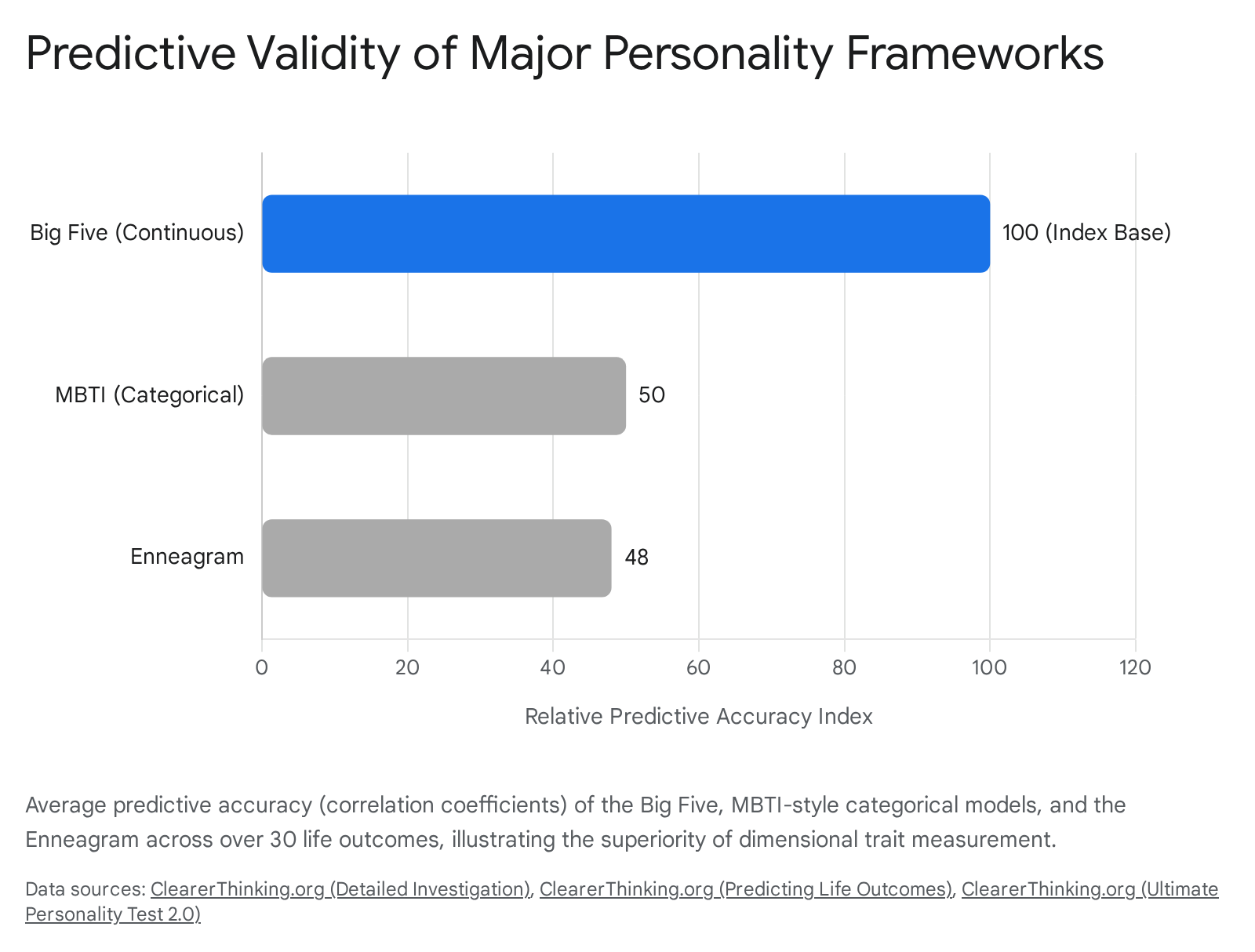
When researchers appended MBTI type classifications to existing Big Five datasets, the Jungian categories provided essentially zero incremental predictive validity; the Big Five had already captured all usable behavioral variance, alongside critical data that the MBTI ignored [54, 106].
The investigation identified two specific statistical mechanics responsible for the failure of typological models. The first mechanism is the "neuroticism penalty." By surgically removing the Neuroticism domain from the Big Five dataset, researchers observed a massive 22 percent drop in overall predictive accuracy [54, 56, 104]. This confirmed that the complete lack of a stress-reactivity dimension in the MBTI and Enneagram models cripples their utility in forecasting behavior under real-world pressures [3, 104].
The second mechanism is the "categorical penalty." To test the impact of arbitrary categorization, researchers converted the binary MBTI structure into a continuous trait scale, granting individuals numerical scores for Jungian traits. Predictably, the accuracy of the Jungian system improved substantially when untethered from discrete letter assignments [56, 102, 106]. Conversely, when the Big Five was forced into a rigid binary system - resembling the structure of the MBTI - its predictive accuracy degraded heavily [107]. This finding mathematically proves that dichotomizing continuous human traits directly destroys data integrity, introducing artificial noise that neutralizes a model's ability to forecast behavioral reality [56, 58, 102].
Psychometric Evaluation of the Enneagram
The Enneagram of Personality represents another highly prevalent typological framework, delineating humanity into nine interconnected personality archetypes. In contrast to the behavioral focus of modern psychometrics, the Enneagram evolved from esoteric philosophical traditions - primarily through the synthesis of concepts from figures such as George Gurdjieff, Oscar Ichazo, and Claudio Naranjo [66, 81]. The system focuses heavily on underlying unconscious motivations, core fears, and internal desires rather than observable traits, mapping individuals into three primary triads: the Heart/Hysteroid triad (Types 2, 3, 4) governing emotional experience; the Head/Schizoid triad (Types 5, 6, 7) governing analytical processing and fear; and the Gut/Body triad (Types 8, 9, 1) governing instinctual responses and anger [5, 36, 81].
Because of its psycho-spiritual origins and its focus on the subjective internal experience, the Enneagram was historically dismissed by empirical scientists [13]. However, the framework has recently been subjected to formal psychometric scrutiny. A landmark systematic review conducted by Hook et al. (2021) and published in the Journal of Clinical Psychology analyzed 104 independent studies to evaluate the reliability and validity of Enneagram assessments [28, 36, 77, 78].
The systematic review revealed highly mixed empirical support. Positive indicators of validity emerged from assessments utilizing rigorous forced-choice methodologies. The Riso-Hudson Enneagram Type Indicator (RHETI), refined over two decades using item response theory, demonstrated moderate internal consistency, with Cronbach's alpha values ranging from 0.56 to 0.82 across the nine scales, and a 30-day test-retest reliability of 0.83 [34, 77]. Furthermore, canonical correlation analyses confirmed that all nine RHETI typologies exhibit statistically significant associations with dimensions of the Big Five (specifically the NEO PI-R), indicating that the Enneagram captures recognizable facets of continuous trait psychology [36, 77, 79, 100]. For instance, Enneatype 8 (The Challenger) correlates heavily with extraversion and low agreeableness, while Enneatype 4 (The Individualist) correlates with high openness and neuroticism [36, 94].
Despite these correlations, the fundamental structural validity of the Enneagram model is highly contested [28, 38]. Factor-analytic studies consistently fail to replicate the nine-factor structure proposed by Enneagram theorists [28, 77, 80]. Extensive evaluations of specific tools, such as the Wagner Enneagram Personality Style Scales (WEPSS), have revealed poor factor structure, low internal consistency, and questionable methodology when attempting to correlate typologies with maladaptive schemas [80]. Additionally, there is a total absence of empirical evidence supporting the secondary, dynamic mechanisms of Enneagram theory, such as the influence of "wings" (adjacent types on the diagram) or the predictable pathways of "integration and disintegration" during periods of psychological stress or growth [28]. Like all typologies, the Enneagram suffers from taxometric failure; by forcing fluid internal motivations into nine rigid categories, it sacrifices predictive power and statistical coherence [82, 102].
Neurobiological Correlates and Clinical Utility
While psychometricians criticize the structural rigidity of popular typologies, emerging fields such as personality neuroscience seek to ground these psychological constructs in biological reality. Advancements in structural magnetic resonance imaging (sMRI), resting-state functional MRI (rsfMRI), and task-based fMRI (tb-fMRI) allow researchers to map self-reported personality traits to distinct neuroanatomical volumes and functional neural networks [30, 31, 32, 52, 96].
The continuous dimensions of the Big Five have proven particularly amenable to neurobiological mapping. Utilizing massive repositories such as the Human Connectome Project (n = 884) and the UK Biobank (n = 20,000), neuroscientists have successfully predicted Big Five profiles based purely on individual functional connectivity matrices [30, 32, 33]. Specific correlations validate the biological underpinnings of the model: Extraversion maps directly to the volume and connectivity of the medial orbitofrontal cortex, an area governing reward processing and dopaminergic function [30, 98]. Neuroticism is reliably associated with structural variances in the amygdala, insula, and regions managing threat detection and negative affect [30]. Agreeableness correlates with regions responsible for social cognition and mentalizing the intent of others [30]. Although large-scale studies occasionally note that simple demographic characteristics can rival rsfMRI features in predicting certain behavioral phenotypes in smaller samples, the structural-functional coupling of the brain heavily supports the existence of continuous, biological personality traits [32, 33].
Intriguingly, recent neuroimaging research has also explored the physiological correlates of the Enneagram. A pioneering study by Hook et al. (2019), published in Social Cognitive and Affective Neuroscience, utilized functional MRI on a diverse cohort to identify distinct neural activation patterns associated with self-selected Enneagram types [6, 13, 34, 35]. Researchers observed pronounced, statistically significant variations in three distinct brain networks that aligned conceptually with Enneagram theory: the Default Mode Network, associated with self-referential processing (highly active in Types 4, 5, and 9); the Salience Network, associated with threat detection (hyperactive in Types 1 and 6); and the Executive Control Network, governing goal-directed behavior (enhanced connectivity in Types 3 and 8) [13, 35]. The study utilized the Essential Enneagram Online (EEO) tool, developed at Stanford University, which eschews traditional item checklists in favor of comprehensive phenomenological descriptions, achieving a highly accurate self-selection rate [6, 10, 34].
These neurobiological findings support the Enneagram's growing utility in specific clinical contexts. Unlike the MBTI, which focuses on surface-level cognitive preferences, the Enneagram's focus on deep-seated fears makes it highly compatible with psychodynamic and cognitive-behavioral therapies (CBT) [36, 46]. Clinical literature indicates that the Enneagram is effective at identifying Cyclical Maladaptive Patterns (CMPs) - inflexible psychological routines that perpetuate emotional distress and dysfunctional relationships [36, 80]. While the framework completely lacks the predictive validity required for corporate talent assessment or academic forecasting, it serves as a powerful narrative heuristic for patients navigating trauma, exploring attachment theory, and developing emotional intelligence under professional supervision [13, 38, 39].
The Barnum Effect and Societal Saturation
The persistence and massive cultural saturation of scientifically flawed typologies, particularly the MBTI, require a sociological explanation. The phenomenon is primarily driven by the Barnum Effect (also known as the Forer Effect), a cognitive bias in which individuals accept highly generalized, vague, and universally positive personality descriptions as highly accurate depictions of their unique identity [23, 49, 53, 54].
A recent mixed-methods investigation analyzing the mechanisms of the Barnum Effect in the MBTI revealed profound cognitive vulnerabilities among users. The study found that an individual's pre-existing belief in the validity of personality tests positively predicted the intensity of the Barnum Effect, accounting for a massive 61 percent of the variance in their endorsement of vague descriptive statements [53]. The commercial success of the MBTI relies heavily on this bias; its language is explicitly designed to be affirming, completely devoid of negative traits or critical developmental feedback [54, 73]. By transforming complex psychological realities into flattering, easily digestible four-letter acronyms, the MBTI acts as an ideal "social lubricant," fostering instant connection and conversational engagement while demanding zero psychometric literacy from its users [23, 73, 103].
The Evolution of Typology in East Asia
The intersection of cognitive bias and cultural dynamics is currently most visible in East Asia, where the MBTI has achieved an unprecedented level of societal integration. The region has a deep historical affinity for typological categorization, previously manifested in the "blood type personality theory" (ketsueki-gata) [40, 42]. Originating in the 1920s with Japanese researcher Takeji Furukawa, and popularized in the 1970s by Masahiko Nomi, this pseudoscientific theory asserted that ABO blood groups dictated temperament [41, 42, 43]. Type A individuals were stereotyped as meticulous and anxious perfectionists; Type B as creative but selfish rule-breakers; Type O as optimistic, stubborn leaders; and Type AB as aloof and complex [41, 42, 43, 44]. Despite total dismissal by the global scientific community and repeated failures to establish any statistical correlation between blood antigens and behavior, the theory became deeply embedded in Japanese culture, influencing everything from dating compatibility to matchmaking services [40, 41, 42, 43].
In recent years, the MBTI has largely usurped the cultural real estate previously occupied by blood type astrology, perceived by the public as a more sophisticated and nuanced system [93]. In South Korea, the MBTI has become an omnipresent cultural force. A 2022 survey revealed that over 90 percent of South Koreans aged 19 to 28 had engaged with MBTI-style assessments [23, 89]. The four-letter acronyms serve as vital social currency, heavily utilized in online dating applications to filter potential partners, integrated into popular television programming, and even leveraged by political candidates during presidential campaigns to establish relatability [23, 89, 91, 93].
Simultaneously, the Japanese market has witnessed the explosive rise of "Character Code," an evolution of the MBTI framework optimized for Generation Z. Embraced by over two million Japanese teenagers, Character Code shifts the focus from deep internal processing to visual-based self-awareness, translating MBTI archetypes into aesthetic styles and outward atmospheres tailored for image-centric social media platforms like TikTok [90, 91, 92]. The Japanese marketing industry views this not merely as an assessment tool, but as a viral dialect for self-expression [90].
Professional Misapplication and Discrimination
While utilizing scientifically flawed typologies for entertainment or casual socialization is relatively benign, the deep cultural integration of the MBTI has resulted in severe ethical breaches within the professional sector. In South Korea and Japan, the uncritical acceptance of the MBTI has bled into corporate recruitment and human resources [23, 89].
Job seekers frequently report that employers demand MBTI classifications during formal interviews, and highly publicized incidents have revealed corporate job listings explicitly excluding certain MBTI types from applying [23, 89]. This practice, colloquially termed "MBTI harassment," mirrors the historical discrimination previously seen in Japan regarding blood types, known as "bura-hara" [42, 91]. From a legal and psychometric perspective, utilizing the MBTI for occupational screening is highly dangerous. Because the MBTI possesses an abysmal test-retest reliability - with up to 76 percent of candidates likely to receive a different classification upon retaking the exam - employers utilizing the test are essentially basing hiring decisions on statistical noise [54, 73, 75]. Furthermore, by ignoring emotional stability entirely, the MBTI fails to assess the most critical factor regarding an employee's capability to handle workplace stress [54, 76]. Organizational psychologists and institutions such as the American Psychological Association unequivocally recommend the utilization of the continuous-trait Big Five model, paired with cognitive ability assessments, for all legally defensible, empirically sound employment selection processes [54, 71, 73].
Conclusion
The evaluation of personality frameworks through the lens of modern psychometrics reveals a vast gulf between scientific validity and commercial popularity. Taxometric research conclusively demonstrates that human personality does not exist in discrete, categorical types; it varies along continuous dimensions [82, 83]. Consequently, the Five-Factor Model (Big Five) stands alone as the premier, empirically validated framework capable of reliably forecasting occupational performance, academic achievement, and longitudinal life outcomes [55, 67, 102]. Its continuous scaling preserves critical psychological variance, and its inclusion of the Neuroticism dimension allows for the accurate prediction of behavior under stress [54, 56].
Categorical typologies like the MBTI and the Enneagram suffer from intrinsic structural flaws. The MBTI's forced dichotomization destroys its test-retest reliability, and its omission of emotional stability nullifies its predictive power, rendering it scientifically useless for high-stakes decision-making and recruitment [54, 73, 75]. While the Enneagram displays intriguing correlations with specific neurobiological networks and offers significant clinical utility for exploring unconscious motivations in psychotherapy [13, 36], it similarly fails structural validation and cannot be utilized as an objective predictive metric [28, 80]. Ultimately, while typologies exploit cognitive biases to provide highly appealing, affirming language for social interaction and self-reflection [23, 53], the rigorous demands of behavioral science and organizational psychology require the continuous, empirical measurement of the Big Five.