
Scientific research on learned and innate charisma
Introduction and Psychometric Measurement
The conceptualization of charisma has undergone a profound transformation in recent decades, shifting from a mystical or theological endowment to a quantifiable psychological construct. Originally introduced into sociological discourse by Max Weber, charisma was traditionally defined as an extraordinary, innate quality that set individuals apart, rendering them capable of commanding profound loyalty and devotion. However, modern scientific inquiry across behavioral genetics, neurobiology, and organizational psychology has deconstructed this phenomenon. Contemporary empirical research indicates that charisma functions not as a monolithic, static trait, but rather as an interactive mechanism driven by specific neurological synchronizations, heritable personality baselines, and highly trainable behavioral tactics.
To transition the study of charisma from theoretical abstraction to empirical science, researchers have developed robust psychometric instruments designed to measure charismatic manifestations in varying contexts. Within the domain of organizational behavior, the Conger-Kanungo (C-K) Scale of Charismatic Leadership serves as the primary diagnostic tool 123. Based on the theoretical premise that charisma is an attribution made by followers observing specific behavioral cues, the C-K scale operationalizes charismatic leadership into five measurable dimensions.
| Psychometric Dimension | Operational Definition | Assessment Focus |
|---|---|---|
| Strategic Vision Articulation | Proposing inspiring future states and compelling organizational goals. | The ability to articulate the importance of work to team members and demonstrate strategic foresight 2. |
| Sensitivity to the Environment | Recognizing social, material, and cultural constraints or opportunities. | The capability to navigate external variables that could either facilitate or hinder the realization of organizational objectives 2. |
| Sensitivity to Followers' Needs | Demonstrating empathy, mutual respect, and understanding of capabilities. | Fostering personal concern for the needs and feelings of team members, optimizing engagement 2. |
| Personal Risk-Taking | Making personal sacrifices or enduring substantial risks. | The willingness to subordinate personal safety or career stability for the benefit of a shared vision 2. |
| Unconventional Behavior | Utilizing non-traditional methods to disrupt the status quo. | The deployment of extraordinary actions that signal a departure from established, normative administrative practices 2. |
While the C-K scale is optimized for hierarchical organizational settings, other researchers recognized the need to quantify charisma in mundane, interpersonal environments. Tskhay and Rule developed the General Charisma Inventory (GCI) to measure "everyday charisma" among individuals who lack formal leadership titles 456. Through exploratory and confirmatory factor analyses, the GCI distilled charisma down to a concise, six-item scale encompassing two primary factors: Influence and Affability 45.
| GCI Factor | Conceptual Meaning | Specific Scale Items |
|---|---|---|
| Influence | The perceived ability to guide others, command attention, and project authority. | 1. Has the ability to influence people. 2. Has a presence in a room. 3. Knows how to lead a group 456. |
| Affability | A pleasant, inviting disposition that fosters psychological comfort and approachability. | 4. Can get along with anyone. 5. Makes people feel comfortable. 6. Smiles at people often 456. |
The establishment of these validated metrics - both for formal leadership and everyday interactions - has provided the foundational architecture necessary to rigorously test whether charisma is biologically predetermined or environmentally acquired. By standardizing the measurement of charismatic traits, behavioral geneticists and neuroscientists have been able to map these specific psychometric outcomes against genetic markers and physiological states.
Behavioral Genetics and Heritability Studies
The debate regarding the innateness of charisma is heavily informed by classical behavioral genetics, which relies primarily on twin study methodologies to separate biological inheritance from environmental conditioning. By comparing monozygotic (identical) twins, who share virtually 100% of their segregating genetic material, with dizygotic (fraternal) twins, who share approximately 50%, researchers utilize statistical models to estimate the heritability of phenotypic traits.
Twin Studies and Personality Trait Variance
Extensive meta-analyses encompassing massive datasets - such as a comprehensive study of over 14.5 million twin pairs published in Nature Genetics - demonstrate that nearly all human psychological traits carry a heritable component 78. A fundamental rule in behavior genetics asserts that roughly half of the variation in human personality is attributable to genetic factors 910.
Specifically concerning the Five-Factor Model of personality, which underpins charismatic potential, studies consistently report moderate to high heritability estimates. Extraversion, a trait strongly correlated with charismatic emergence and social influence, demonstrates an estimated heritability of 53% to 54% 101112. Openness to experience exhibits a heritability of 57% to 61%, while neuroticism - which negatively correlates with charismatic effectiveness - shows heritability estimates between 41% and 48% 101112. Molecular genetic investigations using genome-wide complex trait analysis (GREML) have further identified significant genetic correlations between openness and neuroticism, suggesting that a shared underlying genetic architecture influences the personality profile conducive to charisma 13.
The Genetics of Leadership Role Occupancy
Moving beyond general personality traits to specific leadership outcomes, researchers have utilized data from the National Longitudinal Study of Adolescent Health to estimate the heritability of leadership role occupancy. This specific outcome - which serves as a highly reliable proxy for the manifestation of charismatic influence - demonstrates a heritability of approximately 24% 1415.
The finding that leadership is 24% heritable simultaneously confirms a biological basis for charisma while proving that the vast majority of the variance (76%) is dictated by environmental factors 1415.
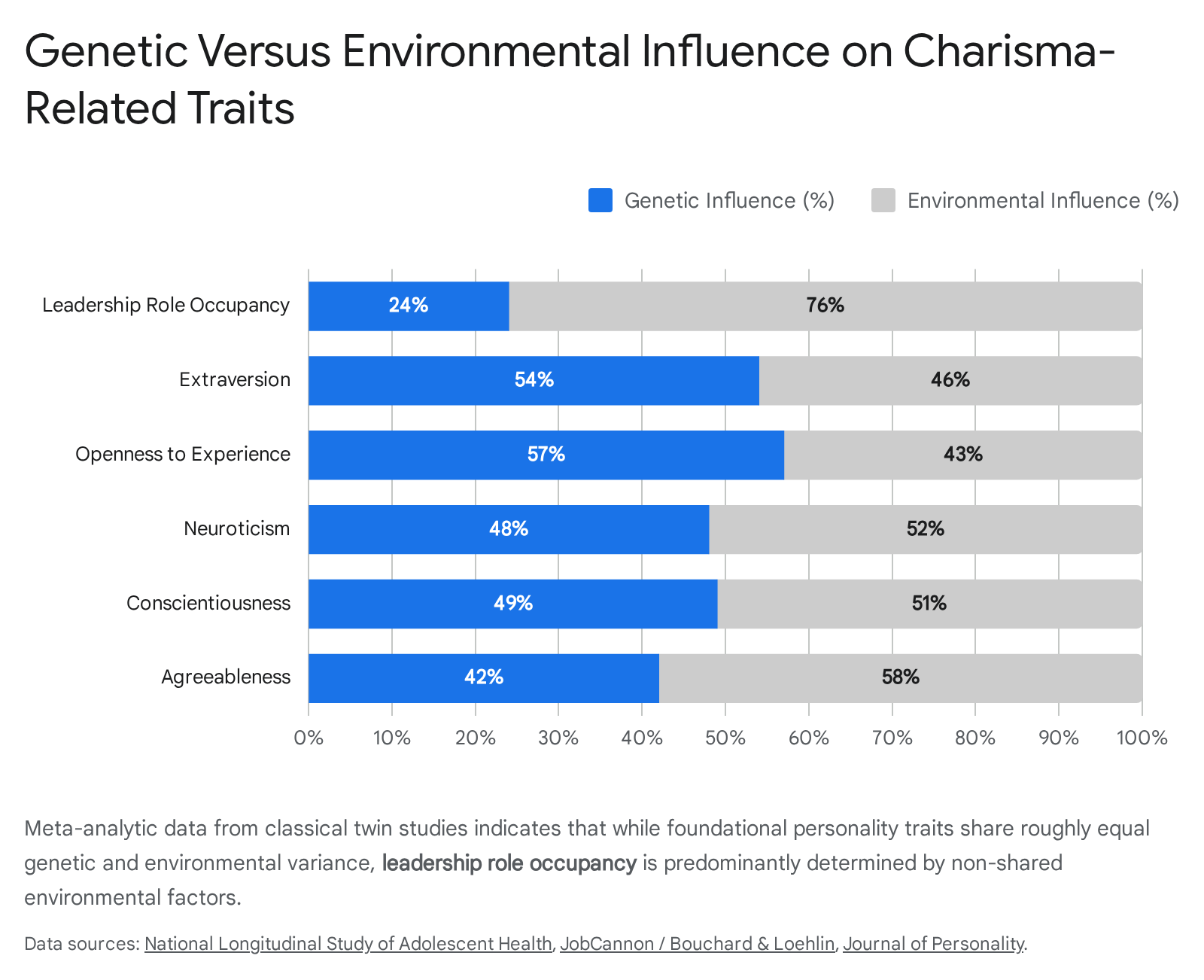
Structural equation modeling in behavioral genetics typically partitions this environmental variance into "shared" influences (e.g., family upbringing, socioeconomic status of the household) and "unshared" influences (e.g., unique individual experiences, specific training, peer groups). Studies indicate that shared environmental factors account for a negligible amount of the variance in leadership occupancy (approximately 10%), while unshared environmental factors dominate, accounting for roughly 66% of the variance 1115. This distribution strongly suggests that individual experiences, deliberate skill acquisition, and contextual learning are the primary engines of charismatic development.
Specific Genetic Markers and the Polygenic Framework
Despite the dominance of environmental factors, recent genomic mapping has attempted to isolate specific biological correlates. Genetic association analyses have successfully linked leadership role occupancy to rs4950, a single nucleotide polymorphism (SNP) situated on the neuronal acetylcholine receptor gene (CHRNB3) 1415. This association was cross-validated using an independent sample from the Framingham Heart Study 1415.
However, geneticists strongly advise against interpreting rs4950 as a deterministic "leadership gene." Complex socio-behavioral outcomes like charisma are inherently polygenic, meaning they are influenced by thousands of distinct genetic variants, each contributing microscopic effects that interact continuously with environmental stimuli 1014. A genetic predisposition provides a baseline capacity - perhaps a lower threshold for social anxiety or a higher intrinsic drive for novelty - but it does not guarantee the realization of charismatic influence absent the appropriate environmental conditioning.
Behavioral Modulation and Trainable Tactics
The empirical conclusion that charisma is overwhelmingly influenced by unshared environmental factors supports the proposition that it is a highly trainable construct. Rather than relying on innate magnetism, individuals can operationalize specific behavioral patterns that predictably elicit attributions of charisma from observers.
The Tripartite Framework of Charismatic Presentation
In applied organizational psychology and executive coaching, the theoretical mechanisms of charisma are frequently translated into actionable frameworks. The most extensively cited applied framework, developed by Olivia Fox Cabane, synthesizes cognitive-behavioral techniques to deconstruct charisma into three fundamental, controllable pillars: Presence, Power, and Warmth 161718.
| Charismatic Pillar | Psychological Mechanism | Behavioral Manifestation |
|---|---|---|
| Presence | The cognitive state of being entirely focused on the immediate interpersonal interaction 1618. | Sustained eye contact, active listening, and the suppression of cognitive distractions that cause micro-expression "leakage" 1617. |
| Power | The projected capacity to affect the environment and possess high competence or status 1618. | Expansive posture, reduced physical fidgeting, measured speech cadences, and lowering vocal intonation at the end of sentences 1617. |
| Warmth | The perception of benevolent intent, psychological safety, and approachability 1618. | Genuine smiles, empathetic mirroring, validating language, and projecting an environment akin to an intimate conversation 1617. |
The efficacy of this framework rests on the human brain's evolutionary imperative to rapidly assess other individuals. An observer unconsciously scans a counterpart to determine their capability to inflict harm or confer benefits (Power) and whether their intentions are benevolent or hostile (Warmth) 1617. The simultaneous projection of high power and high warmth creates the psychological friction that observers interpret as charisma. Crucially, the foundational element is Presence; if an individual projects power and warmth but appears cognitively distracted, the resulting incongruence in micro-expressions shatters trust and negates the charismatic effect 161718.
Acoustic Metrics and Vocal Pitch Modulation
Beyond broad psychological frameworks, biometric analyses provide precise data on the specific non-verbal cues that generate charismatic responses. Acoustic studies indicate that the rhythmic and tonal qualities of a speaker's voice are significantly more influential than the semantic content of their speech. Non-verbal communication functions as the fundamental "language of emotion," capable of bypassing cognitive filters to directly trigger physiological arousal in the listener 19.
Experimental designs examining public discourses have tested variations in vocal pitch against audience arousal (measured via electrodermal activity) and emotional valence (measured via facial expression recognition). The data demonstrates that speakers who utilize a medium-to-high frequency of pitch variations are perceived as substantially more attractive, effective, and persuasive 1920. Monotonous delivery, characterized by few pitch variations, induces sensory adaptation; the listener's auditory processing centers fatigue rapidly, leading to diminished autonomic arousal and higher self-reported feelings of sadness or disengagement 19. Furthermore, acoustic duration-based rhythm measures, particularly the variability of larger rhythmic elements (such as consonant duration), correlate positively with listener ratings of speaker charisma, regardless of the speaker's gender 21.
Kinesics and the Impact of Hand Gestures
Kinesic behavior - specifically the intensity and type of hand gestures - exerts an equally profound effect on charismatic perception. A comprehensive analysis conducted by researchers at the Sauder School of Business utilized multimodal artificial intelligence to track over 200,000 discrete hand movements across 2,184 TED Talks, comparing these kinetics against audience engagement metrics 2223.
The study revealed that while a higher frequency of hand movement generally boosts a speaker's impact, the categorization of the gesture is critical. Gestures classified as "illustrators" - movements that visually depict or mirror the spoken concept, thereby delivering information through simultaneous visual and verbal channels - dramatically increased audience comprehension and the perception of the speaker's competence 192223. In controlled experiments, identical scripts delivered with illustrative gestures caused participants to rate the speaker as significantly more clear and persuasive 2223. In contrast, "highlighters" (simple pointing) and random, non-contextual movements yielded little to no measurable impact 22. When acoustic and kinesic data are combined, the most potent physiological response in an audience - achieving peak autonomic arousal and positive valence - is generated by the specific combination of high vocal pitch variation coupled with medium-to-strong intensity illustrative gestures 1920.
Dissociating Charisma from Physical Attractiveness
A persistent confounding variable in charisma research is the "halo effect," a cognitive bias wherein baseline physical attractiveness influences observers to attribute unearned positive characteristics (such as intelligence or charm) to an individual 2425. While evolutionary psychology confirms that attractive individuals frequently benefit from increased attention and financial premiums, rigorous empirical models strictly differentiate static physical beauty from dynamic charisma 2424.
Researchers utilizing deep learning algorithms to evaluate "Celebrity Visual Potential" (CVP) across thousands of facial profiles have mapped the specific geometric configurations that evoke attributions of charisma. The data reveals that while averageness and symmetry are primary drivers of raw physical attractiveness, they are not the dominant factors in charismatic perception 24. Instead, charisma correlates with facial structures that signify specific personality traits. For example, high cheekbones and facial symmetry correlate positively with perceived competence, while "baby-facedness" correlates with warmth but negatively with dominance 24.
Crucially, behavioral execution routinely overrides these static anatomical baseline metrics. Validation studies for the General Charisma Inventory (GCI) demonstrate that individuals who score high in learned affability and influence are consistently rated as highly likable and persuasive, entirely independent of third-party ratings of their physical attractiveness 625.
Neurobiology and Physiological Synchronization
The deployment of these trainable charismatic behaviors triggers sophisticated neurological and physiological cascades in both the communicator and the audience. Social neuroscience provides objective evidence that charisma is an interactive biological phenomenon characterized by deep systemic synchronization between individuals.
Inter-Brain Synchrony (IBS) and Neural Coupling
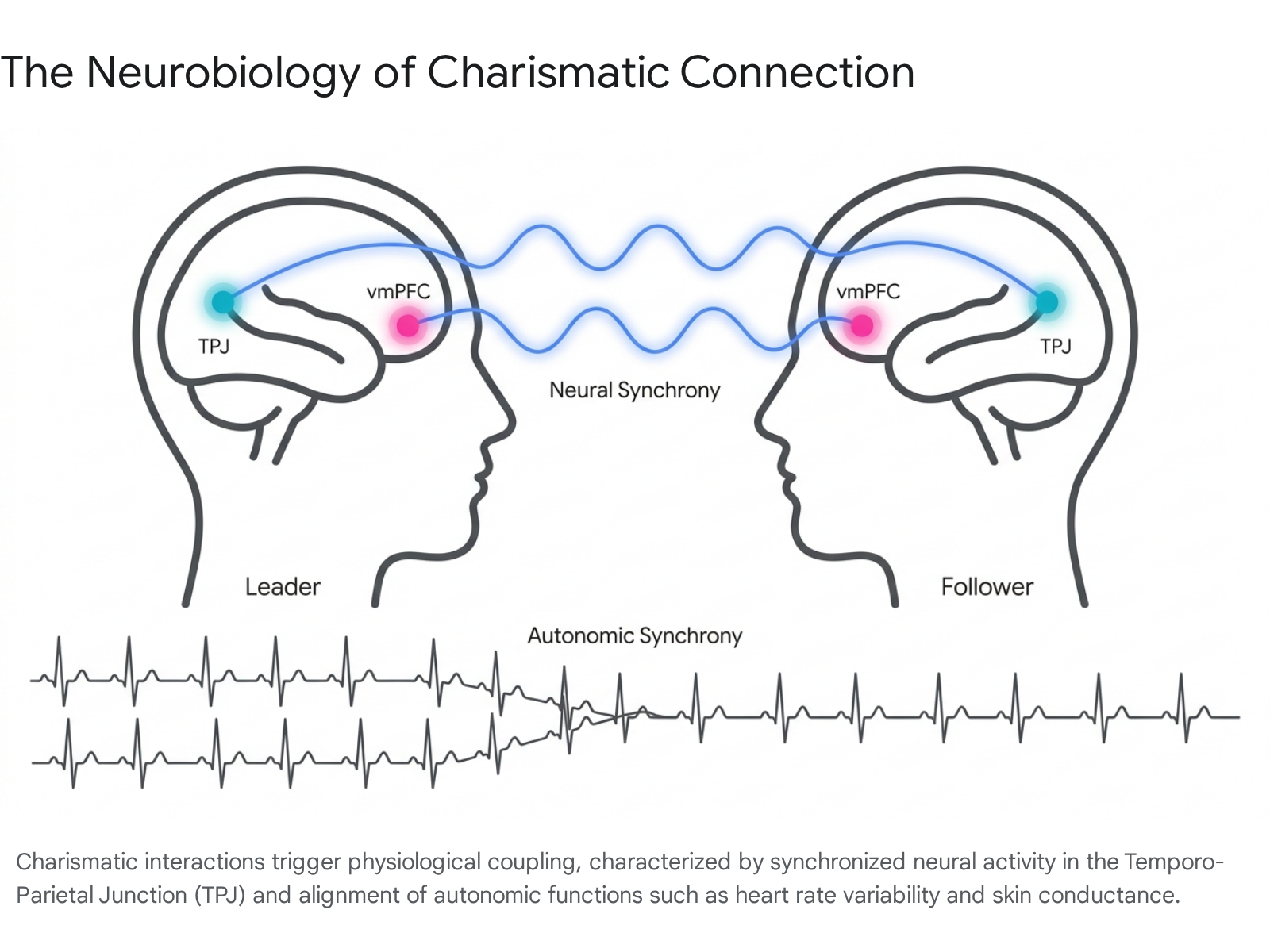
The most advanced metric for quantifying charismatic influence is interpersonal neural synchronization, or Inter-Brain Synchrony (IBS). Utilizing functional near-infrared spectroscopy (fNIRS) and electroencephalography (EEG) hyperscanning, neuroscientists can simultaneously monitor the cortical activity of multiple individuals engaged in naturalistic social interactions 262728.
Research involving leaderless group discussions reveals that emergent leaders - those exhibiting charismatic influence - achieve significantly higher neural synchronization with their followers than followers achieve with one another 26. This neural alignment is not an artifact of simply listening to the same audio; it is a profound cognitive coupling localized heavily in the left temporo-parietal junction (TPJ) and the medial prefrontal cortex, areas intrinsically linked to executive functioning, theory of mind, and social mentalizing 262729.
The data indicates that charismatic leaders effectively entrain the neural rhythms of their audience. Furthermore, this synchronization is driven by the qualitative nature of the interaction rather than the sheer volume of speech 26. During cooperative tasks, high inter-brain synchrony serves as a highly accurate biological marker of team cohesion, collective decision-making efficiency, and relational harmony 2728.
Autonomic Coupling: Heart Rate and Skin Conductance
Neurological synchronization is accompanied by intense autonomic physiological alignment. While conventional wisdom suggests that charisma and social attraction are mediated by overt physical mimicry - such as synchronized smiling, eye gazing, or mirroring postures - biometric research challenges this assumption. Studies tracking individuals during blind dates utilizing eye-tracking, electrocardiography, and skin conductance sensors found that overt behavioral mimicry did not reliably predict interpersonal attraction or the perception of a "click" 303134.
Instead, the true indicator of a deep charismatic or romantic connection is invisible, internal physiological coupling 3134. When individuals are engaged by a highly charismatic counterpart, their autonomic nervous systems harmonize; specifically, their heart rates synchronize. If the charismatic individual's heart rate accelerates or decelerates, the follower's heart rate reflexively mimics the trajectory 313432. This physiological alignment extends to electrodermal activity (skin conductance), indicating a shared state of psychological arousal 3134. During non-verbal cooperative tasks, this heart rate synchrony intensifies specifically when dyads navigate novel challenges or complex task-switching environments, serving as a physiological substrate for mutual adaptation 3337.
The Ventromedial Prefrontal Cortex and Motivation
The neuroanatomical epicenter for processing these charismatic signals is the ventromedial prefrontal cortex (vmPFC). The vmPFC operates as an integrative valuation hub, calculating the subjective value of social rewards and regulating affective responses 343536.
When a follower encounters charismatic stimuli, the vmPFC regulates communication with the amygdala (which handles raw affective arousal) and the dorsal anterior cingulate cortex (involved in threat salience) 3637. Highly charismatic nonverbal displays successfully trigger dual approach and avoidance motivational systems in the observer's brain 38. Neurologically, this manifests as balanced alpha-band frequency activation across both the left frontal cortical hemisphere (which drives approach motivation) and the right frontal cortical hemisphere (which regulates avoidance) 38. By maintaining this balanced activation, charismatic communication fosters an environment of high social reward while simultaneously suppressing the follower's natural defensive or threat-avoidance mechanisms, accelerating the establishment of deep interpersonal trust 363738.
Cross-Cultural Boundary Conditions
While the neurological mechanisms of social synchrony are universal to human biology, the external behavioral triggers that activate these systems are deeply culturally contingent. A behavior designed to project power and warmth in one society may be interpreted as aggressive or weak in another.
Insights from the GLOBE Project
The Global Leadership and Organizational Behavior Effectiveness (GLOBE) project represents the most exhaustive empirical study of cross-cultural leadership paradigms, analyzing data from over 62 distinct societies 4439. The primary conclusion of the GLOBE research is that while certain core traits - such as trustworthiness, dynamism, and foresight - are universally admired, the specific stylistic execution of charismatic and transformational leadership is profoundly localized 3940.
| Cultural Cluster | Preferred Leadership Paradigm | Charismatic Perception & Acceptance | Key Behavioral Indicators |
|---|---|---|---|
| Anglo / Western (e.g., USA, UK, Australia) | Charismatic / Value-Based | Highly Preferred 41 | Emphasizes individual autonomy, decisive assertiveness, visionary rhetoric, and disruptive innovation 4442. |
| Confucian Asia (e.g., Japan, China) | Team-Oriented / Paternalistic | Moderately Preferred | Values harmony, consensus decision-making, implicit communication, and pragmatic action over grand rhetoric 444249. |
| Middle East (e.g., Egypt, Turkey) | Self-Protective / Humane | Least Preferred 4041 | Prizes authoritarian stability, procedural conflict-avoidance, status consciousness, and family-orientation 443941. |
| Latin America (e.g., Argentina, Brazil) | Team-Oriented | Highly Preferred | Blends high power distance with intense emotional expression and collective decision-making processes 4041. |
Individualistic Versus Collectivist Manifestations
In individualistic, low-context cultures (predominantly Anglo/Western clusters), charismatic attribution is strongly tied to an individual's capacity to stand apart from the collective. Charismatic leaders in these environments are expected to project immense personal confidence, challenge existing paradigms, and articulate grand, sweeping visions 494351.
Conversely, in collectivist and high-context cultures (such as Confucian Asia), explicit individualism is viewed with skepticism. In Japan, for instance, charismatic effectiveness is demonstrated through extreme humility, team-oriented paternalism, and an indirect communication style that ensures group harmony and face-saving 4249. Direct, assertive, face-to-face feedback - a hallmark of Western charismatic transparency - can severely damage social bonds in these contexts 42.
The Middle Eastern cluster presents the most significant divergence from standard charismatic theory. Driven by high levels of uncertainty avoidance and institutional collectivism, societies within this cluster demonstrate the lowest preference globally for visionary, charismatic leadership 394041. Instead, they favor self-protective and autonomous styles that prioritize procedural stability and hierarchical authority over disruptive inspiration 394041. Consequently, importing Western charismatic tactics directly into these regions often fails to generate inter-brain synchrony, instead triggering cultural resistance and perceptions of instability 4142.
Organizational Outcomes and the Perils of Charisma
The scientific investigation of charisma culminates in analyzing its practical utility. Meta-analyses of organizational data reveal a complex picture regarding the effectiveness of charismatic leadership, highlighting clear benefits alongside severe structural risks.
Efficacy and Performance Metrics
Extensive meta-analytic reviews consistently indicate that charismatic leadership correlates positively with organizational effectiveness, subordinate satisfaction, and innovative behavior 444546. However, a critical distinction emerges depending on the level of analysis. The correlation between charismatic leadership and subordinate performance is exceptionally robust when measured at the group level (r = 0.49) 45. In contrast, the relationship weakens substantially when evaluating isolated, individual performance metrics (r = 0.31), particularly when researchers control for common method variance 45.
This divergence suggests that charisma functions primarily as a sociological catalyst that optimizes group dynamics - enhancing collective efficacy, team cohesion, and shared identity - rather than a mechanism that directly improves an individual's technical proficiency 45. Furthermore, charisma is most effective when paired with moderating structural variables. For example, charismatic leadership acts synergistically with high-performance work systems (HPWS) to elevate organizational creativity 44. Charisma also requires complementary psychological traits to be sustainable; leaders who exhibit high charisma coupled with high humility generate significantly greater subordinate satisfaction and perceived effectiveness than those relying on charisma alone 47.
The Dark Side: Hubris and the Awestruck Effect
Despite its utility in driving group cohesion, charisma carries profound inherent risks. When divorced from humility and ethical constraints, high charisma frequently correlates with narcissism, Machiavellianism, and authoritarianism 4849.
The intense neurological and physiological synchronization that characterizes charismatic influence can induce what researchers term the "awestruck effect" 48. Under extreme charismatic influence, followers' autonomic systems align so closely with the leader that they often suppress their own emotional expressions and experience a reduction in critical, independent cognitive processing 48. Independent, hyper-charismatic leaders who foster this dynamic tend to centralize attention entirely on themselves, inadvertently degrading horizontal collaboration among team members and replacing sustainable organizational culture with a fragile personality cult 48. In political environments, this charismatic authority is frequently weaponized during periods of crisis, allowing leaders to bypass institutional checks and fundamentally restructure power dynamics 51.
Conclusion
The contemporary science of charisma thoroughly dismantles the archaic notion of personal magnetism as an unalterable, divine gift. While behavioral genetics confirm a heritable baseline for leadership emergence - rooted in the polygenic transmission of foundational personality traits like extraversion and openness - genetic predispositions account for roughly a quarter of the variance in actualized charismatic influence. The overwhelming majority of charisma is determined by unshared environmental factors, rendering it a highly trainable and operationalized construct.
Empirically, charisma functions as an optimized system of behavioral signaling. By deploying specific, controllable tactics - such as maintaining intense psychological presence, executing illustrative kinesic gestures, and utilizing medium-to-high vocal pitch variations - individuals can predictably elicit attributions of power and warmth. When deployed effectively, these signals bypass conscious cognitive filters to trigger profound neurobiological responses, physically aligning the inter-brain synchrony and autonomic rhythms of the speaker and the audience. However, the efficacy of these biological mechanisms is heavily regulated by cultural boundary conditions, requiring significant adaptation across varying societal norms. Ultimately, while charisma remains one of the most potent tools for driving collective human performance, its capacity to override critical thinking demands that it be tempered by humility, ethical grounding, and institutional safeguards.