
Scientific research on human moral development and behavior change
Early Childhood and the Acquisition of Morality
The scientific inquiry into how humans learn right from wrong has evolved from philosophical speculation into a rigorous, multidisciplinary field bridging developmental psychology, cognitive neuroscience, and cross-cultural sociology. Historically, the study of moral development was dominated by stage theories derived from Western, educated, industrialized, rich, and democratic (WEIRD) populations, emphasizing the progressive mastery of abstract reasoning and universal justice 123. Contemporary research, however, reveals that moral acquisition is a deeply constructivist process, shaped simultaneously by innate neurobiological predispositions, deeply ingrained cultural scripts, and active socialization 45.
Constructivist Approaches to Moral Learning
Rather than viewing infants as blank slates or fully pre-programmed moral agents, the constructivist approach posits that key constituents of morality emerge during the first four years of life through reciprocal interactions with the environment. Developmental acquisitions involve both genetic and environmental factors, effectively eschewing the outdated dichotomy between innate and learned characteristics 4. Early moral reasoning encompasses processes related to fairness, property rights, and welfare, which develop slowly but persistently as children grapple with social interactions and peer object disputes 5.
Although toddlers exhibit early orientations toward helping others and a rudimentary grasp of social equality, the explicit judgment of acts as morally right or wrong solidifies later in childhood. This expansion correlates with the maturation of cognitive capacities for theory of mind and abstract reasoning 46. The constructivist view differs fundamentally from pure socialization models; it does not frame moral development merely as compliance with community norms, but rather as an active process of conceptual development resulting from the child's interaction with the physical and social world 4.
Relational Socialization and Environmental Influences
Moral learning is deeply embedded in caregiving environments. Research utilizing frameworks such as the trauma/Thriving-Emotions-Morality (tTEM) model indicates that early nurturance promotes positive emotional development, which serves as the scaffolding for moral proclivities in adulthood 7. Care-based norms - standards regarding actions that might harm others - are established early on, and disruptions in these formative relationships can yield lasting impacts on moral trajectories 8.
A functional integration of empathy and moral thinking dictates that early socialization requires an active, relational engagement where identity and moral boundaries are co-constituted 4. Studies utilizing the Affective Neuroscience Personality Scales and the Moral Foundations Questionnaire reveal a mediated link between adverse childhood experiences (ACEs) and subsequent moral foundations. Specifically, supportive caregiving practices foster positive personality traits that positively predict both binding (e.g., loyalty, authority) and individualizing (e.g., care, fairness) moral foundations in later life 7.
Cross-Cultural Frameworks of Moral Development
While the neurobiological hardware of moral reasoning is universally human, the nomological network of moral values varies profoundly across cultural contexts. For decades, moral psychology relied heavily on models constructed in Western contexts, which inherently prioritized individualistic metrics of justice, fairness, and personal rights 12. Expanding the scope of inquiry to non-Western populations reveals pluralistic moralities where social harmony, interdependence, and collective welfare are prioritized.
Limitations of Western Individualistic Models
In individualistic Western societies, moral identity is often viewed through the lens of individual autonomy. In contrast, many Eastern and Global South cultures conceptualize a highly moral person as societally oriented 1. Theories such as Moral Foundations Theory (MFT) demonstrate that while foundational concerns like Care, Fairness, Loyalty, Authority, and Purity appear globally, their structural weighting differs. Recent large-scale empirical efforts to refine MFT, involving data from 25 populations, have identified Equality and Proportionality as distinct moral foundations, further illustrating how the conceptual network of morality varies depending on the cultural context 9. Concerns regarding spiritual degradation, interpersonal harmony, and loyalty to social groups heavily dictate the definition of the moral domain in societies within Asia, Africa, and South America 29.
| Ethical Framework | Cultural Origin | Primary Moral Focus | Concept of the Self | Key Principles and Application |
|---|---|---|---|---|
| Western Individualism | Europe / North America | Individual rights, justice, autonomy | Independent, self-contained | Fairness, harm reduction, personal liberty; enforced via positive legalism 121011 |
| Confucian Ethics | East Asia | Social harmony, moral governance | Interdependent, relationally defined | Ren (humaneness), li (propriety), filial piety; moral flexibility 10121314 |
| Ubuntu Philosophy | Sub-Saharan Africa | Collective well-being, interconnectedness | "A person is a person through other persons" | Mutual aid, human dignity, healing over punishment; restorative justice 111516 |
Relational Ethics in Ubuntu Philosophy
Non-Western frameworks such as Ubuntu operationalize moral development not as the achievement of isolated personal reasoning, but as the realization of communal responsibility 10. Ubuntu ethics, rooted in Sub-Saharan African philosophy, is encapsulated by the aphorism "I am because we are" (Umuntu ngumuntu ngabantu). In this paradigm, an individual's humanity is realized exclusively through social relationships. Moral development is equated with the pursuit of virtue for the sake of collective well-being, prioritizing restorative justice, forgiveness, and mutual aid over punitive measures 1516.
This framework views human beings as having intrinsic worth explicitly because of their innate capacity to grow morally and participate in the community 16. The application of Ubuntu is evident in African Indigenous Justice Systems, such as the Gacaca courts in post-genocide Rwanda, which emphasize communal healing and reintegration over Western models of retributive justice 11. Ubuntu provides a philosophical foundation for policies that emphasize inclusivity and equity, suggesting frameworks that support the right to development as a moral and social imperative 10.
Moral Cultivation in Confucian Thought
Confucian thought provides a stage-based model of moral cultivation centered on social relations. Personal cultivation requires blurring the boundaries between self and others 13. The Confucian concepts of ren (humaneness), li (ritual propriety), and yi (righteousness) prescribe a developmental path where morality begins with filial piety within the family and expands outward to the broader society 1013.
Psychological models adapting Confucian ethics, such as Ma's multi-stage theory of moral development, suggest that Chinese moral acquisition moves from basic orientations (love and being loved) toward altruistic acts directed at the wider society to maintain stability 17. In the Confucian framework, the highest stages of moral development require immense flexibility and situational attunement. Textual analyses of the Analects indicate that while flexibility is an exemplary ethical approach, it is inaccessible to novices; rigid adherence to rules and norms is recognized as a necessary developmental stepping stone for those still cultivating their moral capacity 12. Consequently, in close relationships, Confucian norms may prioritize interpersonal benevolence over absolute egalitarian fairness, creating distinct cross-cultural variations in moral judgments 13.
Indigenous Perspectives and Developmental Pathways
Indigenous theories of human development conceptualize moral acquisition through relational and cyclical worldviews, starkly contrasting the linear, cause-and-effect thinking predominant in mainstream Western society 1818. Scoping reviews of Indigenous human development theories highlight three primary domains - identity, relationships, and spirituality - embedded within a distinctly non-linear, often cyclical trajectory resembling the earth's seasons 18.
Empirical research on Aboriginal and Torres Strait Islander children in Australia, such as the Footprints in Time (Longitudinal Study of Indigenous Children, LSIC) project, provides concrete evidence of these dynamics. The LSIC dataset, tracking over 1,700 children across 15 years, indicates that early connections to culture, Indigenous language, and engagement in traditional practices (e.g., learning arts, participating in ceremonies) serve as powerful protective factors 1920. Children who participated in cultural activities consistently demonstrated stronger social and emotional well-being, higher resilience, and a deeper sense of belonging into adolescence 1920.
However, the moral socialization of Indigenous children is frequently complicated by historical and intergenerational trauma. The legacy of colonization and federal policies disrupted tribal lands, cultural practices, and family structures, interrupting the natural transmission of traditional child-rearing practices 18. Today, the "Indigenist Ecological Systems Model" is used to understand these dynamics. Studies demonstrate that caregivers' "cultural connectedness" - their consciousness of tribal history, cultural pride, and valuing of traditional practices - acts as a significant buffer, protecting Indigenous children from the negative effects of stress and reinforcing the role of culturally embedded morality as an active coping mechanism 21. Despite the richness of this data, Indigenous children remain vastly underrepresented in developmental science; a recent audit of major journals over 20 years found that only 0.5% of articles focused on Indigenous child development 2122.
Neurobiological Mechanisms of Moral Reasoning
The capacity to evaluate moral dilemmas and guide behavior is orchestrated by a distributed, domain-global neural network. Moral decision-making requires the continuous integration of rapid affective processing and slower, deliberative cognitive control 232425.
The Dual-Process Theory of Moral Cognition
At the center of moral neuroscience is the dual-process theory, which posits that human moral judgment arises from the competition and collaboration between two distinct cognitive subsystems: an intuitive, emotionally driven system and a deliberate, rational system 242627.
Neuroimaging and lesion studies have extensively mapped these functions. The ventromedial prefrontal cortex (vmPFC) and the amygdala are critical for generating rapid, emotionally grounded intuitions, particularly in situations involving personal harm 272829. The vmPFC is responsible for representing the subjective value of an action and triggering appropriate emotional responses to information about harmful intentions 30. Conversely, the dorsolateral prefrontal cortex (dlPFC) and the anterior cingulate cortex (ACC) are implicated in abstract reasoning, working memory, conflict monitoring, and cognitive control 242527.
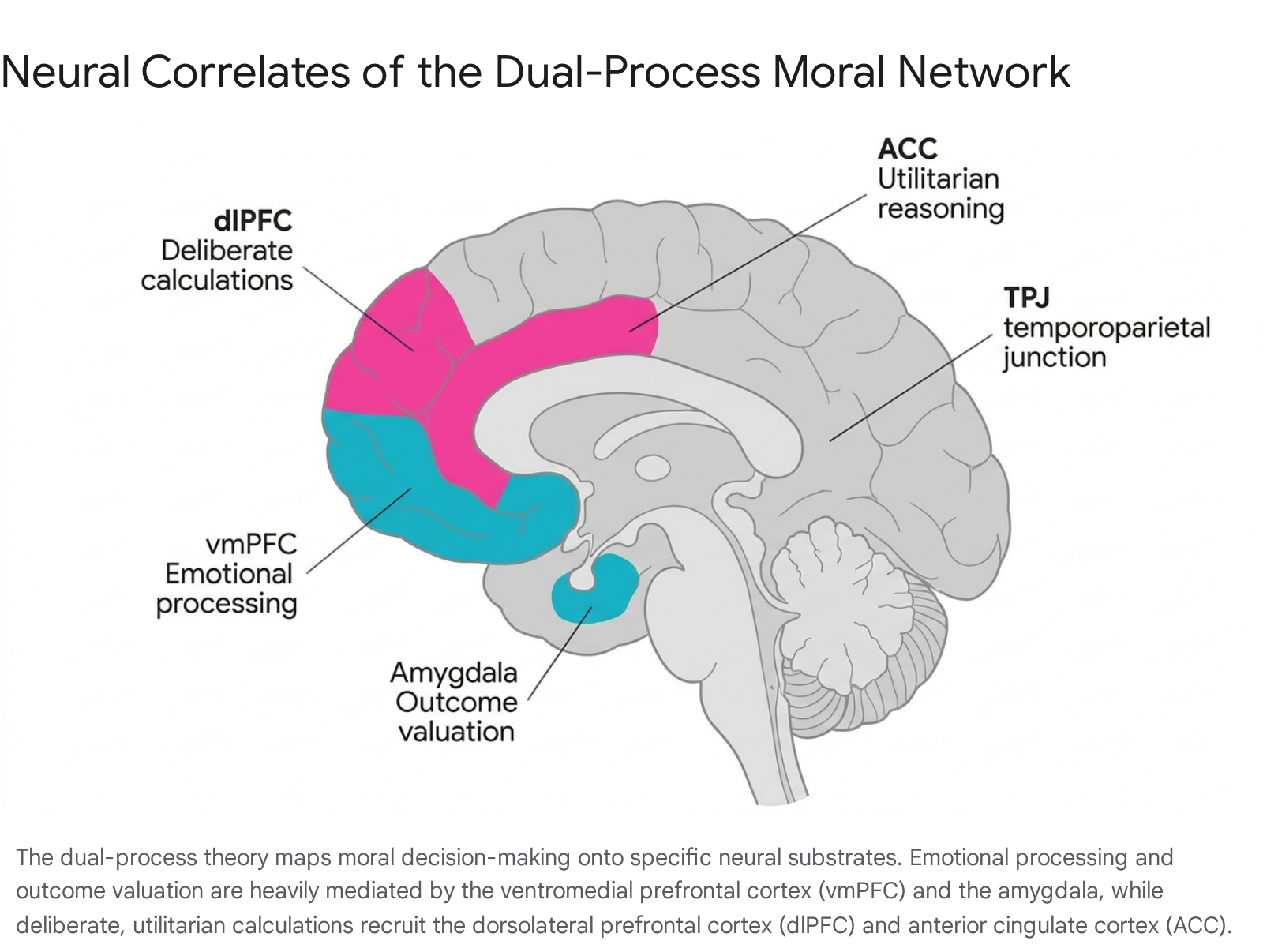
When individuals encounter high-conflict personal moral dilemmas - such as the classic "footbridge" scenario where saving five lives requires actively pushing one person to their death - the prospect of causing direct harm elicits a strong aversive emotional response mediated by the vmPFC and amygdala, typically resulting in a deontological judgment (the refusal to push) 262831. However, if an individual decides to maximize the greater good (a utilitarian judgment), functional magnetic resonance imaging (fMRI) demonstrates increased activation in the dlPFC and ACC, indicating that cognitive control is overriding the initial emotional aversion 2427.
Lesion Studies and Psychopathy
Research involving individuals with localized brain damage provides compelling support for the dual-process model. Patients with damage to the ventromedial prefrontal cortex (VMPFC) routinely exhibit deficits in real-life decision-making despite performing normally on standard cognitive assessments, including Kohlberg's tests of moral reasoning 2528. When presented with moral dilemmas, VMPFC patients are significantly more likely to make utilitarian judgments in harmful situations, as the emotional system that would normally generate an aversive response to harm has been impaired 2831. Furthermore, these patients judge attempted (but incomplete) harm as less blameworthy than accidental harm, suggesting an inability to properly weigh harmful intentions .
Similarly, investigations into psychopathy highlight functional and structural impairments in the moral brain. Psychopathic individuals routinely demonstrate reduced amygdala volume and decreased amygdala activation in socio-moral contexts. This deficit in stimulus-reinforcement learning prevents normal moral socialization, leading to persistent antisocial and rule-breaking behavior 232529.
Lifespan Maturation of the Moral Brain
The neural mechanisms utilized in moral judgment are not static; they change significantly over development. Regions associated with social and affective processing undergo extensive developmental shifts from adolescence into adulthood 3233.
| Brain Region | Primary Moral Function | Developmental Trajectory |
|---|---|---|
| Amygdala | Generates rapid emotional aversions to harm, associates actions with distress cues. | Early maturation; heavily involved in initial stimulus-reinforcement learning 2930. |
| Ventromedial Prefrontal Cortex (vmPFC) | Represents subjective value; integrates emotional input with outcome assessment. | Undergoes age-dependent functional changes; increased gray matter correlates with post-conventional reasoning 30. |
| Dorsolateral Prefrontal Cortex (dlPFC) | Enables cognitive control, working memory, and deliberate utilitarian calculation. | Matures later in adolescence/adulthood; activity modulates to override emotional intuitions 2425. |
| Temporoparietal Junction (TPJ) | Facilitates "theory of mind" (ToM); infers beliefs, intentions, and mental states of others. | Continues to mature into adulthood; positive correlation between age and hemodynamic activity during moral judgments 3234. |
The Temporoparietal Junction (TPJ) is highly instrumental in "theory of mind" (ToM) - the ability to attribute mental states and intentions to others 3234. As individuals age, hemodynamic activity in the TPJ and the posterior cingulate cortex (PCC) exhibits a positive correlation with age during evaluations of moral severity 32. This suggests that while adolescents rely heavily on foundational emotional responses, adults integrate more sophisticated mentalizing processes, allowing them to better differentiate between intentional and accidental harm 323536. Consequently, adults generally display stronger functional connectivity between the prefrontal cortex and the amygdala, equipping them to make reasoned judgments that holistically integrate the mental states of others with the outcomes of their actions 36.
Critiques and Dynamical Systems Perspectives
While the dual-process theory is highly influential, it is subject to academic debate. Some researchers challenge the strict modularity implied by early iterations of the theory, questioning the "fast and slow" temporal assumptions based on reaction times 31. Recent dynamical systems perspectives propose that characteristically deontological and utilitarian judgments emerge from flexibly forming dynamic brain networks rather than isolated, context-invariant regions 37. In this view, both intuitive and deliberative responses may come to mind quickly, relying on complex computations of model-based values and theory of mind, with prefrontal networks adjudicating between them based on task demands and learned reinforcement 631.
Transformations in Adult Moral Frameworks
A central question in developmental psychology is whether moral reasoning, once solidified in late adolescence, can meaningfully change in adulthood. Longitudinal evidence indicates that adult morality is characterized by a complex interplay of rank-order stability and mean-level change, highly susceptible to environmental, societal, and neurobiological influences 383940.
Longitudinal Personality and Value Shifts
Adult moral development shares pathways with broader personality maturation. Longitudinal studies demonstrate that as individuals progress from early adulthood into mid-life, they tend to exhibit mean-level increases in conscientiousness, agreeableness, and "mature values" (e.g., collective concern and horizontal collectivism), alongside decreases in unmitigated self-interest and materialism 383941. While rank-order stability (an individual's comparative moral disposition relative to their peers) remains high, young adulthood in particular presents a critical window for moral restructuring 3941.
Furthermore, distinct generational divides illustrate the shifting nature of moral frameworks over time. Large-scale surveys indicate that younger adults frequently recast morality as a matter of personal preference and self-expression, whereas older cohorts approach moral questions through traditional lenses emphasizing restraint and shared community norms. This generational friction is particularly pronounced among women regarding specific behaviors; for instance, younger women are significantly more likely than older women to view open sexual relationships and abortion as morally permissible, highlighting the continuous evolution of societal ethical consensus 42.
Impact of Major Life Events and Trauma
Adult moral frameworks are heavily influenced by the occurrence and timing of major life events (MLEs). The perception and appraisal of major life events - whether an event is viewed as an unmanageable disruption or a challenge - directly impacts subsequent mental health and aversive well-being comparisons 4344. The "age-normativity" of these events plays a crucial role; life events experienced at non-normative times (e.g., severe illness in early adulthood) lack social scripts and institutional support. This unpredictability disrupts a person's worldview, forcing adaptations in their moral and social expectations and heightening awareness of age-related change (AARC) 4546.
Trauma introduces profound perturbations to adult moral cognition. Childhood adversity, particularly physical and emotional neglect, significantly alters adult moral decision-making. Individuals with histories of early trauma often exhibit altered emotional processing and reward evaluation 47. Data from clinical populations, such as patients with bipolar disorder, indicates that childhood physical neglect predicts a more utilitarian style of moral decision-making in adulthood. This tendency may serve as a protective mechanism, utilizing abstract calculation to distance the individual from overwhelming affective responses 47.
In adulthood, severe occupational or personal trauma can precipitate "moral injury" - a profound psychosocial and spiritual disruption stemming from exposure to potentially morally injurious events (PMIEs), such as witnessing atrocities or experiencing institutional betrayal 48. Unlike PTSD, which is primarily anchored in fear and threat responses, moral injury centers on transgressive acts and violations of deeply held moral expectations 4849. Individuals suffering from moral injury experience intense secondary symptoms such as guilt, shame, loss of meaning, and a persistent inability to forgive themselves, effectively stalling or regressing their moral development 49.
Macro-Societal Influences on Moral Frameworks
Adult moral frameworks are not merely internal psychological constructs; they fluctuate in response to macro-environmental pressures. Large-scale societal events can induce shifts between moral ideologies, a phenomenon observed during periods of intense socioeconomic instability.
A massive longitudinal analysis of textual data (encompassing over 459 million data points) from social media during the Great Recession demonstrated the malleability of collective morality. As economic stress and unemployment increased, public moral discourse shifted heavily toward values of authority and hierarchy, and away from fairness and equality. Conversely, as market conditions improved and unemployment fell, the public reversed this association, leaning back on fairness. This indicates that personal moral dispositions fluctuate to preserve cultural-social unity, redefining what morality means in times of societal upheaval 50.
Seasonal Fluctuations in Moral Values
Beyond singular economic events, empirical evidence suggests a persistent, cyclical seasonality to human moral values. Analyses of over 230,000 questionnaire responses across a decade revealed a biannual seasonal cycle in the endorsement of "binding" moral values (loyalty, authority, purity).
These binding values are endorsed more strongly in the spring and autumn compared to the summer and winter 5152.
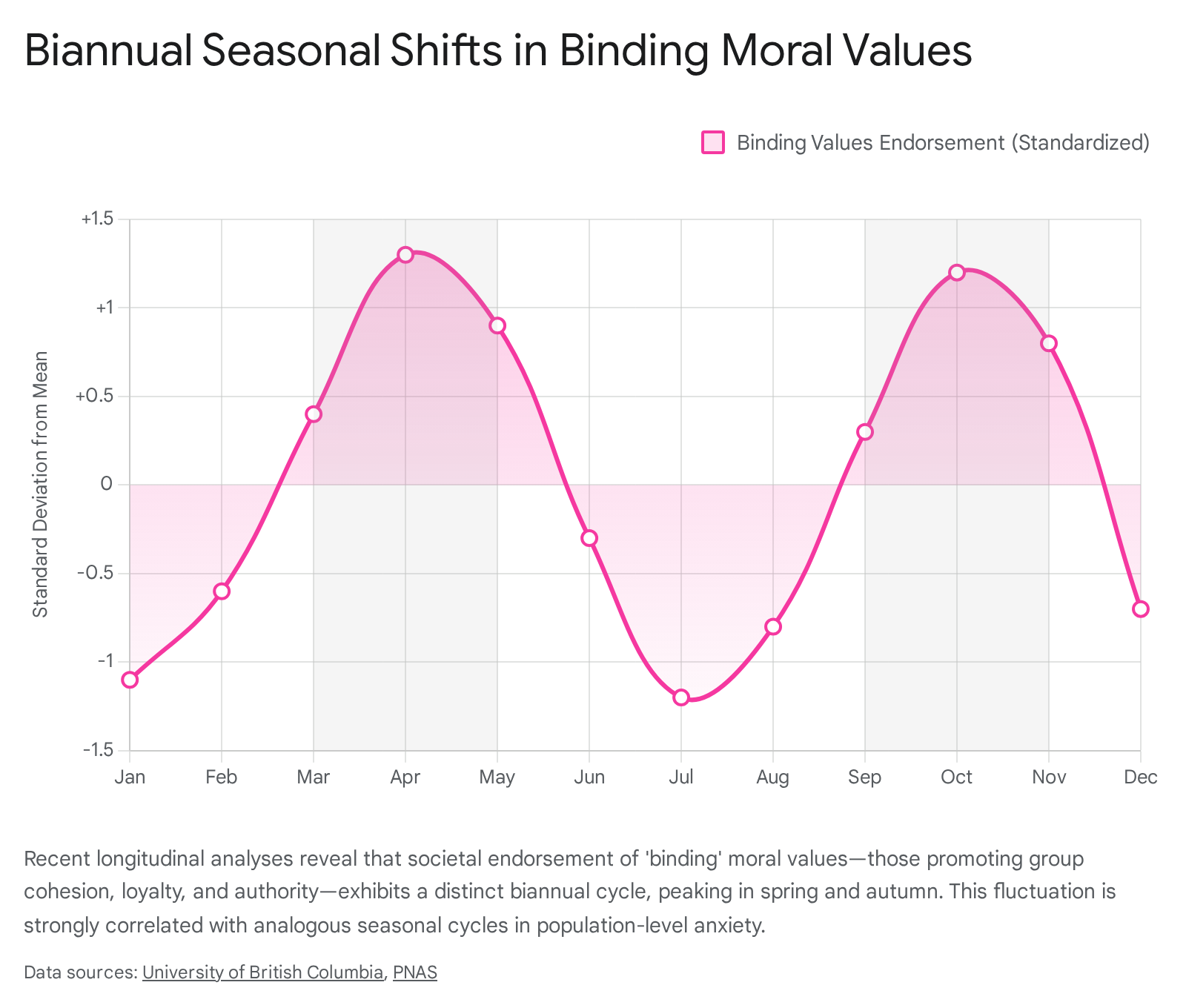
Individualizing values, such as care and fairness, do not show this seasonal variation. This phenomenon appears closely tied to analogous seasonal cycles in population-level anxiety; heightened anxiety drives populations to seek the comfort and predictability of group norms and traditions 5153. Furthermore, the summer decrease in the endorsement of binding values was found to be more pronounced in regions with greater seasonal climate extremity 5154. Such fluctuations indicate that adult morality is dynamically responsive to ecological and affective environments.
Neuroplasticity and Targeted Moral Interventions
Given that adult moral frameworks are subject to environmental fluctuation, can adults intentionally change their moral reasoning, and can targeted interventions facilitate this change? The scientific consensus is increasingly affirmative, supported by both neurobiological discoveries and clinical outcomes.
Neurobiological Capacity for Adult Change
Adult behavioral flexibility and learning are governed by continuous neuroplasticity. Recent research into the striatum - a deep brain region involved in linking actions to outcomes and evaluating effort - highlights the role of the Smoothened developmental signaling pathway in adult learning 55. The coordination of dopamine (which reinforces behavior) and acetylcholine (which signals when neurons are ready to change) dictates how strongly behaviors are learned and how flexibly they can be adjusted over time. These mechanisms prove that the adult brain retains the neurochemical architecture necessary to overhaul ingrained behavioral and moral scripts 55.
Consequently, theories of "moral mindsets" suggest that ethical motivations fluctuate internally. While stress or trauma might trigger a self-protective "safety" mindset that inhibits empathetic connection, practices like targeted reflection, meditation, and immersion in relationally safe environments can biologically down-regulate defensive neural circuitry. This physiological regulation allows the adult to shift back to a mindset of prosocial engagement and ethical abstraction 56.
Efficacy of Clinical and Digital Interventions
Empirical trials confirm that structured interventions can significantly alter adult moral reasoning and ethical behavior across various demographics.
In populations with acute vulnerabilities, such as adults suffering from schizophrenia with a history of repetitive violence, targeted therapies have shown significant success. The Moral Reasoning Development Intervention (MRDI), tested via randomized controlled trials in acute psychiatric settings, has proven highly effective. This intervention integrates moral reasoning, anger management, and ethical perspective-taking. Compared to treatment-as-usual, MRDI participants showed significantly improved ethical valuation and decision-making styles, alongside marked decreases in physical aggression and hostility 57.
The digital landscape also offers novel methodologies for moral cultivation. Scoping reviews of digital interventions, including serious games and virtual reality (VR) simulations, show promising results in enhancing sociomoral reasoning. By placing individuals in immersive, interactive scenarios where they must actively exercise ethical decision-making, these technologies move beyond theoretical rule-learning into active moral rehearsal 5859. However, researchers urge caution regarding conversational artificial intelligence (CAI) in therapeutic settings. Studies utilizing large language models for peer counseling reveal risks of "deceptive empathy," poor contextual adaptation, and a lack of genuine relational capacity, emphasizing that ethical clinical intervention cannot be fully reduced to language generation 60.
In clinical and professional settings, interventions like Guided Group Reflection (GGR) foster enhanced self-awareness and ethical reasoning. By providing structured dialogue regarding ethical dilemmas faced by medical practitioners, participants report increased emotional resilience, deeper peer collaboration, and a strengthened professional moral identity 61. When risks are intolerable, structured ethical frameworks based on autonomy, non-maleficence, beneficence, and justice provide clinicians with justifiable processes for intervention, ensuring that safety protocols respect adult decision-making capacity 62.
Volitional Personality Change and Higher Education
Adults who are intrinsically motivated to change their personality traits and moral dispositions can successfully do so through Volitional Personality Change (VPC) interventions. By setting self-directed goals and implementing concrete new behaviors, adults generate lasting shifts in personality traits relevant to morality 63.
Emerging adulthood remains a highly plastic period for such interventions. College course-based interventions utilizing the Self-Determination Theory (SDT) framework - focusing on autonomy, competence, and relatable moral exemplars - have been shown to successfully increase students' "beyond-the-self" purpose and holistic character development. Unlike interventions that demand emulation of distant, extraordinary moral saints, programs that utilize relatable exemplars significantly increase moral engagement, proving the efficacy of structured moral education in shaping the ethical frameworks of young adults 6465.