
Scientific research on the benefits and risks of optimism
Optimism, traditionally conceptualized as a general expectancy that future outcomes will be positive, has evolved from a philosophical disposition into a rigorously quantified construct in the behavioral and neural sciences. While popular culture often equates positive thinking with guaranteed success, physical health, and psychological well-being, contemporary psychological science paints a far more nuanced picture. Empirical data indicates that while adaptive optimism serves as a neurobiological buffer against stress and a catalyst for psychological resilience, unrestrained or "blind" positive thinking can paradoxically impede goal attainment, foster emotional exhaustion, and lead to catastrophic financial and personal decision-making.
Understanding the science of optimism requires a multidisciplinary analysis of its neurobiological mechanisms, its theoretical evolution, the behavioral methodologies that dictate when positive thinking succeeds or fails, the clinical threshold where positivity becomes toxic, and the cross-cultural variations that challenge historically Western-centric psychological models.
Theoretical Frameworks and Cognitive Models
The psychological measurement and conceptualization of optimism gained significant empirical traction in the latter half of the twentieth century, moving away from subjective self-help narratives toward testable cognitive models. The most prominent of these frameworks focuses on how individuals process adversity, envision their future, and assess their own agency.
Learned Optimism and Explanatory Styles
Pioneered by Martin E.P. Seligman, the theory of "Learned Optimism" emerged as a direct counterpoint to his foundational research on "learned helplessness." In classical conditioning experiments, subjects repeatedly exposed to uncontrollable negative events eventually ceased attempting to escape them, manifesting a profound sense of helplessness [82, 83, 84]. However, researchers observed that a distinct subset of individuals consistently resisted helpless conditioning, maintaining proactive behavior despite repeated failures. This resilience was traced to cognitive "explanatory styles" - the habitual ways individuals narrativize the causes of negative events [83, 85].
The explanatory style dictates cognitive processing across three primary dimensions: permanence, pervasiveness, and personalization [83]. Pessimistic individuals tend to interpret adversity as permanent (long-lasting or immutable), pervasive (affecting all areas of life, not just the specific event), and personal (internalizing blame and assuming inherent personal deficits) [82, 83]. Conversely, adaptive optimists utilize an explanatory style that views setbacks as temporary, specific to a particular context, and influenced by external or situational factors rather than inherent flaws [82, 83, 84].
To operationalize this, Seligman and colleagues developed the Attributional Style Questionnaire (ASQ) and later frameworks such as the ABCDE model (Adversity, Belief, Consequences, Disputation, Energization) to facilitate cognitive restructuring. In this clinical application, patients are taught to identify a negative event (Adversity), recognize their automatic interpretation (Belief), observe the emotional outcome (Consequences), actively challenge the negative belief with evidence (Disputation), and experience the resulting shift in mood and motivation (Energization) [83]. Longitudinal clinical studies demonstrate that shifting one's explanatory style through these targeted cognitive behavioral techniques yields lower incidences of clinical depression, enhanced intrinsic motivation, and greater occupational success [83, 84, 86].
Agency and Societal Progress
Seligman subsequently expanded his theories into a tripartite model of agency, which posits that human progress and optimism rely on three distinct components: self-efficacy (the belief in one's ability to execute actions), future-mindedness or optimism (the expectation of favorable outcomes), and imagination (the capacity to envision alternative futures) [29]. Data from the Midlife in the United States (MIDUS) national longitudinal study (N = 2,717) demonstrated that these three subscales of agency uniquely and positively predicted effort, persistence, and perceived life progress [29]. Notably, however, longitudinal tracking across three timepoints (1994 - 2014) indicated a declining trend in societal scores of agency, self-efficacy, and perceived progress, suggesting that environmental and sociocultural stressors may actively erode baseline dispositional optimism over time [29].
Critiques of the Positive Psychology Paradigm
Despite its vast clinical application, the traditional positive psychology paradigm has faced rigorous scholarly critique, marking the transition into what researchers term the "third wave" of positive psychology [30]. Researchers such as Richard Lazarus have long argued against the rigid dichotomy of "positive" and "negative" emotions, suggesting that the pressure to constantly cultivate positive states oversimplifies the depth of human emotional experience [28]. Negative emotions such as anxiety, anger, and defensive pessimism often serve critical adaptive functions, alerting individuals to genuine threats and mobilizing preparatory behaviors [21, 28].
Furthermore, critics argue that the institutionalization of positive psychology often functions as a decontextualized, neoliberal ideology that places the burden of happiness entirely on individual cognition. This framework potentially ignores systemic, socioeconomic, and cultural factors that drive human distress, treating symptoms of inequality as failures of individual optimism [27, 30]. Epistemological critiques also note that constructs like "goal-setting" and "motivation" within the learned optimism framework sometimes rely on circular reasoning, where psychological concepts are of dubious explanatory value when detached from the material realities of a subject's environment [26].
Neurobiological Foundations of Optimistic Cognition
The capacity to maintain a positive outlook is structurally and functionally grounded in specific neural architectures. Advanced neuroimaging techniques, including functional magnetic resonance imaging (fMRI), magnetoencephalography (MEG), and diffusion tensor imaging (DTI), have identified discrete brain networks and white matter pathways that govern future simulation, emotional regulation, and cognitive flexibility.
The Default Mode Network and Future Simulation
The Default Mode Network (DMN) - a large-scale brain network comprising the medial prefrontal cortex (mPFC), posterior cingulate cortex (PCC), angular gyrus, and medial temporal lobe - is heavily implicated in self-referential thought, autobiographical memory, and the simulation of future events [11, 12, 36, 37]. The DMN traditionally activates during wakeful rest and introspection, and deactivates during externally focused, attention-demanding tasks [12, 36].
fMRI studies reveal that the DMN is highly active when individuals engage in spontaneous positive future cognition and hypothetical scenario generation, allowing humans to construct optimistic expectations and navigate complex social interactions [11, 36]. However, cognitive health and adaptive optimism depend not merely on DMN activation, but on the dynamic functional connectivity and flexibility between the DMN and task-positive networks, such as the Central Executive Network (CEN) and the Dorsal Attention Network (DAN) [12, 36, 40].
A highly anticorrelated relationship between the DMN and the DAN is frequently proposed as a primary biomarker of cognitive health and emotional resilience [36, 40]. MEG studies investigating resting-state activity reveal that individuals exhibiting robust anti-correlations between these regions demonstrate higher peak frequencies of alpha and beta rhythms, indicating superior intrinsic processing, emotional stability, and cognitive flexibility [40]. Conversely, in clinical pathologies such as Major Depressive Disorder (MDD) - characterized by profound pessimism and rumination - fMRI analyses repeatedly demonstrate hyperconnectivity within the subgenual anterior cingulate cortex (sgACC) and the mPFC [12, 63, 67]. This inability to decouple regions of the DMN traps the individual in a state of maladaptive, repetitive negative self-referential thinking, underscoring that pessimism is physically encoded in network rigidity [12, 66, 67].
| Network System | Primary Associated Functions | Role in Optimism and Resilience | Neural Dysfunction in Pessimism / MDD |
|---|---|---|---|
| Default Mode Network (DMN) | Self-referential thought, future simulation, episodic memory recall [11, 36]. | Generates hypothetical positive scenarios; facilitates long-term goal ideation [11]. | Hyperconnectivity with sgACC; inability to disengage from negative rumination [12, 63]. |
| Central Executive Network (CEN) | Goal-directed cognition, working memory, executive function [36, 38]. | Translates optimistic simulations into actionable plans and focused effort [36]. | Hypoconnectivity with DMN; inability to shift focus away from internal distress toward external tasks [67]. |
| Dorsal Attention Network (DAN) | Top-down attention control, orientation to external stimuli [36, 40]. | Maintains attention on environmental cues required for goal realization [40]. | Reduced anticorrelation with DMN; impaired cognitive flexibility [40, 64]. |
Subcortical Mechanisms and Inhibitory Control
The translation of optimistic thought into emotional resilience relies heavily on subcortical-cortical communication. The amygdala, primarily responsible for encoding threat, fear, and emotional salience, operates in a regulatory feedback loop with the rostral anterior cingulate cortex (rACC) and the prefrontal cortex [87, 88, 89, 90].
When optimistic individuals are prompted to imagine positive future scenarios, fMRI studies demonstrate significant synchronous activation in the rACC and the amygdala, effectively suppressing the processing of pessimistic or threatening information [87, 88].
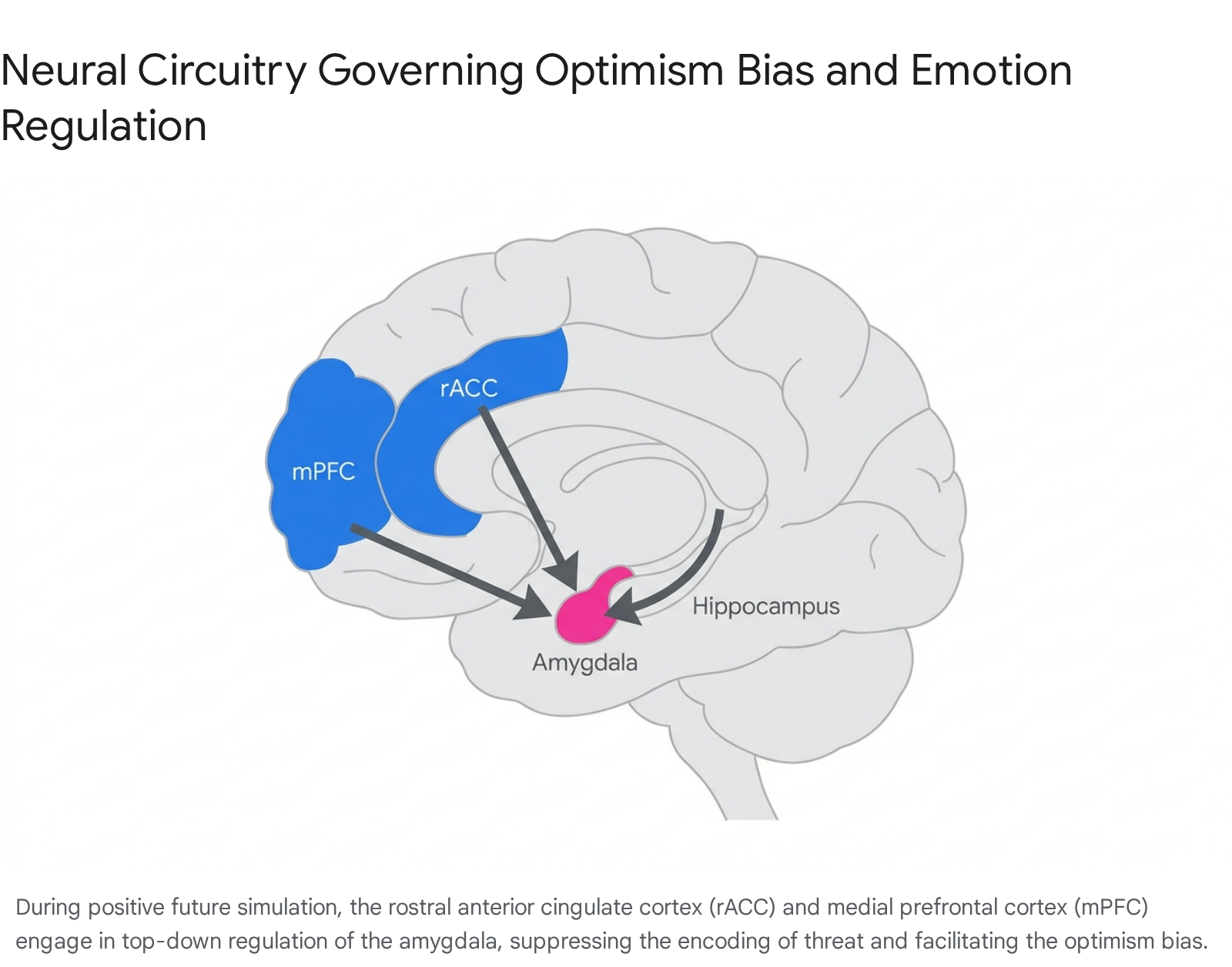
This robust rACC-amygdala coupling provides a biomechanical explanation for the widely documented "optimism bias," wherein approximately 80% of individuals systematically overestimate the probability of favorable outcomes and underestimate their susceptibility to negative events [87]. Interestingly, genetic factors modulate this circuitry; carriers of the 5-HTTLPR short allele exhibit a significantly greater buffering effect of positive illusions against depression when situated in supportive environments, demonstrating a complex gene-environment-neurobiology interaction [87].
The power of optimistic expectation is most starkly visualized in the neurobiology of placebo analgesia. When an individual expects a treatment to yield a positive outcome, the brain releases endogenous opioids that bind to receptors in the pain matrix. Brain imaging during placebo responses reveals decreased activity in pain-associated regions like the thalamus and primary somatosensory cortex, alongside functional connectivity modulation between the dorsolateral prefrontal cortex (DLPFC), rACC, periaqueductal gray (PAG), and amygdala [89, 90, 91]. This confirms that optimistic belief literally alters the ascending and descending neurochemical pathways of physical sensation.
Microstructural Integrity and White Matter Tracts
The structural foundation for these functional networks is measurable via Diffusion Tensor Imaging (DTI), a noninvasive neuroimaging method that assesses white matter integrity by mapping the diffusion of water molecules along axonal pathways [72, 73, 76]. White matter tracts enable high-speed communication between distant gray matter regions, and their degradation is strongly correlated with psychiatric and cognitive disorders.
The most commonly used metric in DTI is fractional anisotropy (FA). High FA values indicate highly organized, efficient neural signaling, whereas reduced FA points to myelin breakdown and axonal damage [73, 74]. DTI studies routinely indicate that depressive symptomology, lack of motivation, and severe pessimism are accompanied by significantly reduced FA in critical fronto-limbic pathways, primarily the uncinate fasciculus and the cingulum bundle [73, 76]. These pathways are critical for connecting emotion-regulating prefrontal regions with the amygdala and hippocampus.
In neurodegenerative conditions such as Alzheimer's disease (AD) and in post-stroke patients, the deterioration of these white matter pathways correlates tightly with the onset of profound cognitive and emotional deficits [72, 74]. Advanced dMRI techniques, including Neurite Orientation Dispersion and Density Imaging (NODDI), have further isolated specific metrics like Neurite Density Index (NDI), proving highly sensitive to the earliest microstructural declines that inhibit a brain's ability to maintain cognitive optimism and emotional regulation [72, 75]. Therefore, the psychological phenomenon of optimism is physically constrained by the microstructural health of the brain's white matter wiring.
Behavioral Methodologies and Goal Attainment
While neurobiology establishes the hardware for optimism, behavioral psychology studies how positive thinking is practically deployed. The most substantial challenge to the popular efficacy of pure positive thinking stems from the realization that blind optimism can actively undermine motivation and goal attainment.
Fantasy Realization Theory and the Perils of Positive Imagery
Developed by psychologist Gabriele Oettingen, Fantasy Realization Theory delineates the distinct outcomes associated with different modes of future-oriented thought [51, 68, 69]. Oettingen's empirical studies consistently reveal an inverse relationship between the vividness of free-flowing positive future fantasies and actual behavioral success [51, 68].
In a foundational 1991 longitudinal study involving obese women enrolled in a weight-reduction program, researchers parsed the difference between realistic positive expectations and ungrounded positive fantasies. The results were highly counterintuitive to prevailing self-help dogma: women who reported the most vivid positive fantasies about their future weight loss ultimately lost significantly less weight (approximately 24 pounds less over a two-year period) than those who harbored more realistic, less fantastical expectations [51, 79].
These deleterious effects of "blind" positive fantasy have been replicated across numerous domains. University students instructed to vividly imagine working in their "dream jobs" without considering the steps to achieve them subsequently applied for fewer roles, received fewer job offers, and accepted lower starting salaries [68, 77]. Similarly, patients recovering from hip-replacement surgery who engaged heavily in positive visualization regarding their recovery showed slower rehabilitation progress, as evaluated by physical therapists, compared to patients who acknowledged the painful realities of physical therapy [51, 71].
The underlying psychological and neurological mechanism behind this failure is that the human brain struggles to differentiate between a vividly imagined fantasy and actual lived reality. Positive visualization induces a premature sense of accomplishment, triggering a state of physiological relaxation (measured via lowered systolic blood pressure and decreased physical energization) that saps the motivational energy required to pursue the goal [46, 68, 78, 80]. The brain assumes the goal has already been achieved, reducing the mobilization of effort.
Mental Contrasting with Implementation Intentions (MCII)
To counteract the lethargic effects of indulging in positive fantasies, Oettingen and Peter Gollwitzer developed a synergistic self-regulatory strategy known as Mental Contrasting with Implementation Intentions (MCII), colloquially branded as the "WOOP" method (Wish, Outcome, Obstacle, Plan) [51, 68, 81].
Mental contrasting fundamentally alters cognitive processing by demanding realism. An individual must first visualize a highly desired, feasible future (the Wish and the Outcome), but must immediately juxtapose this positive imagery with the specific, internal or external realities that stand in the way of its achievement (the Obstacle) [68, 71, 79, 81]. This cognitive friction creates a strong psychological association between the desired future and the present reality, activating expectations of success and mobilizing physiological energy [70, 71].
Once the obstacle is identified, the individual integrates an implementation intention (the Plan). Implementation intentions are specific "if-then" cognitive links designed to automate behavior (e.g., "If [specific obstacle arises], then I will [execute specific behavior]") [70, 95].
| Mode of Future Thought | Cognitive Process | Typical Behavioral and Physiological Outcome |
|---|---|---|
| Indulging (Wishful Thinking) | Visualizing a desired future state without considering realistic obstacles or pathways [68, 71]. | Low physiological arousal; poor goal attainment due to lack of preparatory effort and premature relaxation [46, 68]. |
| Dwelling (Rumination) | Focusing exclusively on present negative reality without identifying a desired future [68]. | Stagnation; failure to initiate goal-directed behavior; associated with depressive symptomology [68, 77]. |
| Mental Contrasting (WOOP) | Visualizing the desired future, immediately followed by acknowledging reality-based obstacles and creating an "if-then" plan [51, 68]. | High physiological arousal; enhanced self-regulation, increased effort, and significantly higher success rates across domains [46, 71, 95]. |
Empirical Efficacy of MCII Across Domains
Extensive meta-analytic evidence confirms the efficacy of MCII over isolated positive thinking. A systematic review and meta-analysis of health-behavior change found that mental contrasting yields a reliable, moderate effect size in facilitating goal attainment (adjusted Hedges' g = 0.28 to 0.38) [92]. When implementation intentions are added, the effect on behavior change becomes even more robust (Cohen's d ≈ 0.65 in some reviews of implementation intentions) [51, 70].
The utility of MCII has been demonstrated in highly diverse applications: * Academic and Professional Performance: Disadvantaged middle school children taught MCII significantly improved their report card grades, attendance, and behavioral conduct compared to control groups [69]. * Health and Habit Formation: Participants utilizing WOOP strategies showed a 30% improvement in dietary habits and were twice as physically active as control groups receiving standard health information [54]. * Sleep Hygiene: In randomized trials targeting "bedtime procrastination" (the phenomenon of unnecessarily delaying sleep despite knowing its negative consequences), participants engaging in daily MCII interventions reported significantly reduced bedtime discrepancy and increased positive affect compared to those relying on standard positive-thinking interventions [94, 95, 96].
The Clinical Threshold of Toxic Positivity
While adaptive optimism and mental contrasting facilitate resilience, the pursuit of positivity becomes detrimental when it crosses into the realm of "toxic positivity." This clinical and cultural phenomenon is defined as the excessive, rigid promotion of a positive outlook that actively dismisses, minimizes, or invalidates genuine negative emotional experiences [23, 25, 97].
Psychological Harm and Emotional Suppression
Toxic positivity operates on the erroneous cognitive assumption that optimism alone can resolve all difficulties, leading individuals to deny the reality of complex emotional stressors [23, 97]. Clinical evidence heavily suggests that seeking to remain perpetually positive, regardless of the context, severely damages emotional adaptability and psychological well-being [22, 23].
When individuals internalize the demand to remain constantly upbeat, they engage in chronic emotional suppression. Studies link this suppression to increased psychological distress, the exacerbation of anxiety, heightened rumination, and the development of psychosomatic disorders [23, 97, 99]. Furthermore, the relentless pursuit of happiness often creates a paradoxical effect; correlational studies reveal that individuals who place an unusually high value on appearing happy are more likely to report clinical depressive symptoms, lower emotional well-being, and a profound sense of isolation [22, 23]. This relates closely to "alexithymia," an inability to identify and express emotions, which is exacerbated when negative affect is consistently shamed or ignored by one's environment [23, 97].
Occupational and Social Consequences
Toxic positivity is particularly destructive in occupational environments, where corporate cultures often demand "good vibes only" or frame valid systemic complaints as individual attitude problems [25, 98, 99]. This dynamic forces employees to engage in "surface acting" - displaying emotions they do not genuinely feel in order to comply with cultural expectations.
Systematic reviews confirm that surface acting is a robust, independent predictor of emotional exhaustion, the core dimension of occupational burnout [97, 98, 101]. By invalidating employee concerns under the guise of maintaining morale, organizations inadvertently erode psychological safety, decrease job satisfaction, and hinder the identification of legitimate operational flaws [98, 101]. The pressure to project positivity forces employees to downplay issues rather than address them, ultimately leading to sharp declines in organizational performance and high turnover intentions [101].
In the digital sphere, social media platforms amplify this dynamic by fostering unrealistic happiness standards. Exposure to heavily curated, hyper-positive content distorts reality, contributing to diminished self-esteem, loneliness, and the rise of maladaptive behaviors such as "sad-fishing" - seeking emotional validation online due to a lack of genuine, empathetic support in real life [97, 100].
Economic and Financial Implications of Optimism
The psychological biases inherent in optimism extend predictably into behavioral economics and personal finance, where the line between adaptive hope and dangerous delusion becomes quantifiable.
Cognitive Calibration in Financial Forecasting
While mild to moderate dispositional optimism is associated with better savings behaviors - particularly among lower-income demographics where optimism buffers against financial despair and encourages forward planning - extreme optimism is recognized as a profound hazard to financial well-being [31, 32].
A 2023 quantitative study published in Sage Journals concluded that unrealistically optimistic financial expectations directly lead to excessive levels of consumption, higher debt accumulation, and insufficient long-term savings [31]. Highly optimistic individuals exhibit an "illusion of control," leading to excessive business entries and subsequent failures; the data notes that optimists consistently overestimate their chances of starting a successful business despite overwhelming market odds [31].
The research underscores the necessity of cognitive calibration. Individuals scoring highest in cognitive assessments experienced a 22% increase in the probability of maintaining "financial realism" and a 35% decrease in the probability of engaging in "extreme optimism" [31]. In investment arenas, the lack of cognitive restraint is stark: nearly two-thirds of retail investors make impulsive investment decisions based on highly emotional, blindly optimistic states, with generation Z investors particularly prone to disregarding rational market analysis in favor of hopeful speculation [31].
Financial Stress and Mental Health Sequelae
When blind financial optimism meets macroeconomic reality, the resulting psychological crash is profound. Financial stress, termed "stressflation" in recent literature, is a primary driver of modern anxiety and depression, highlighting the danger of using positive thinking to avoid pragmatic financial planning [33, 35].
According to a 2025 psychological health report by Northwestern Mutual, 69% of Americans report that personal financial uncertainty contributes directly to feeling depressed, while 41% experience chronic physical symptoms - such as pain and insomnia - linked directly to financial distress [33]. The inability to maintain financial stability often triggers profound identity crises, particularly when job loss removes a sense of mission and purpose [33]. Reports indicate that over half of individuals suffering from financial anxiety lose significant sleep, which fundamentally degrades cognitive function and further worsens their financial decision-making capacity [34, 35]. In this domain, defensive pessimism - anticipating financial hurdles and planning accordingly - is far superior to uncalibrated optimism.
Cross-Cultural Variances in Optimism Measurement
A significant, historically unaddressed limitation in the science of optimism is that the foundational literature relies almost exclusively on WEIRD (Western, Educated, Industrialized, Rich, and Democratic) populations [2, 3, 18]. The implicit assumption that psychological constructs like optimism hold identical meanings and functional outcomes across distinct cultural and ecological contexts is being actively challenged by recent psychometric and anthropological research.
Psychometric Precision and the LOT-R
The Life Orientation Test-Revised (LOT-R) remains the primary instrument used globally to measure dispositional optimism [55, 59]. Historically, data derived from the LOT-R relied on Classical Test Theory (CTT), which processes responses as imprecise ordinal scores. This methodology frequently fails to account for how different cultures interpret the severity or meaning of survey items, leading to potential cultural misinterpretations and biases in cross-cultural research [1, 55].
Recent studies utilizing advanced Rasch methodology have sought to correct this by validating the LOT-R across diverse, non-Western populations, including large cohorts in Germany, Ghana, India, and New Zealand [55]. By transforming ordinal data into highly precise interval data, the Rasch model demonstrated that while the internal structural validity of the optimism construct holds globally, the threshold at which different cultures endorse optimistic statements varies significantly [55]. This highlights that cross-cultural psychology must utilize culturally calibrated measurement tools to avoid imposing Western emotional baselines onto diverse populations.
Latin American Paradigms: Simpatía and Familismo
In Latin American cultures, optimism and positive affect are deeply intertwined with collectivist social scripts, contrasting sharply with Western individualism. Two primary constructs dictate this expression: Simpatía and Familismo [41, 42, 45].
Simpatía is a culturally mandated tendency to prefer, cultivate, and express high levels of warmth and emotional positivity while actively avoiding conflict and overt negativity [42, 43, 44]. Psychometric evaluations of the Simpatía Scale reveal two distinct factors: positivity/warmth and negativity/conflict avoidance [42, 44]. While this promotes intense social cohesion and convivial collectivism, studies suggest it can lead to the suppression of negative emotions. For example, depressive symptoms are sometimes stigmatized within Latino communities as personal weaknesses or failures of simpatía, causing individuals to suffer in silence rather than seek clinical interventions [41].
Similarly, Familismo emphasizes profound interdependence, loyalty, and mutual support within the family unit, positioning family well-being above individual aspiration [41, 45]. This construct acts as a powerful protective factor and is frequently cited as a driver of the "Immigrant Paradox" - the phenomenon wherein Latin American immigrants often report significantly lower rates of psychiatric and mood disorders than US-born citizens [41, 45]. Familismo provides a shared, communal reservoir of resilience and emotional buffering that highly individualistic, Western-style optimism lacks [45].
Sub-Saharan Africa and "Cheerful Discontent"
In Sub-Saharan Africa, the traditional Western correlation between material resource wealth, life satisfaction, and optimism frequently breaks down. Extensive research analyzing Gallup World Poll microdata (2013 - 2024) across 39 Sub-Saharan countries reveals a phenomenon characterized by economists and sociologists as "cheerful discontent" [16].
In these regions, the Positive Affect-Life Evaluation (PA-LE) balance behaves differently than in Western nations. Individuals frequently report exceptionally high levels of positive affect (daily emotional happiness, laughter, and optimism) alongside notably low levels of overall life evaluation (satisfaction with economic and structural realities) [16]. This disconnect highlights how optimism functions in resource-constrained environments. Rather than relying on individualistic, goal-oriented future achievement (the Western model), optimism in Sub-Saharan Africa is sustained through strong social ties, civic engagement, and satisfaction with one's immediate community, which act as powerful psychological buffers against daily structural hardships [16, 18].
Furthermore, Western diagnostic frameworks often misinterpret optimism and resilience in these populations. For instance, psychotrauma and PTSD are frequently interpreted through communal, spiritual, and ancestral frameworks rather than rigid DSM-5 medical diagnoses. This allows for shared cultural expressions of distress and subsequent healing that bypass individual pessimism, mobilizing community resources in ways that Western psychology frequently fails to capture [19]. Criticisms have also been leveled at Western publications, such as The Economist, for pushing narratives of "Afro-optimism" based purely on macroeconomic indicators while entirely ignoring these deep, culturally specific psychosocial frameworks [17].
Middle Eastern and Islamic Perspectives
In Middle Eastern and broader Islamic populations, optimism is inextricably linked to theology and spiritual practice. The Islamic psychological perspective does not advocate for blind positivity or the denial of suffering; rather, optimism is ontologically rooted in Tawakkul (reliance on and trust in God) and the belief in divine benevolence [6, 8, 10].
Islamic optimism operates on the fundamental premise that hardship is an inevitable, purposeful component of human existence, encapsulated in the Quranic assertion that "with hardship, there is ease" [8]. This framework necessitates Sabr (perseverance and patience during adversity), paired inextricably with Shukr (gratitude for existing blessings) [9, 10]. In this paradigm, positive thinking involves self-compassion and giving others the benefit of the doubt, framed as avoiding the arrogance of suspicion and backbiting [7].
Recent clinical studies integrating Positive Psychology Interventions (PPIs) within Muslim populations have found that incorporating these spiritual principles significantly enhances mental health outcomes and resilience. This culturally specific optimism is highly effective precisely because it is grounded not in the Western illusion of absolute personal control over the future, but in a resilient, patient surrender to a higher purpose [6, 10].
Synthesizing the Science of Positive Thinking
The comprehensive science of optimism decisively dispels the notion that positive thinking is a universal panacea. At a neurobiological level, the brain's ability to simulate a positive future and suppress threat through the DMN and prefrontal-amygdala circuitry is a vital evolutionary adaptation that fosters physical health and emotional resilience. Yet, behavioral science and clinical psychology prove that when this positive visualization is not grounded in reality - when it ignores pragmatic obstacles, lacks implementation intentions, or invalidates genuine negative emotion - it metamorphoses into toxic positivity, financial ruin, and behavioral paralysis.
The empirical data unequivocally supports a highly calibrated, dialectic approach: the most successful and psychologically healthy individuals are those who maintain a hopeful, resilient disposition regarding the future, but aggressively engage in mental contrasting and realistic planning to navigate the inevitable adversities of the present.