
Scientific process lessons from the LK-99 superconductivity claim
The Pursuit of Ambient-Temperature Superconductivity
The search for a room-temperature, ambient-pressure superconductor represents one of the most enduring and high-stakes pursuits in condensed matter physics and materials science. Since the initial discovery of superconductivity in mercury at 4.15 K in 1911, the phenomenon has been characterized by zero electrical resistance and the complete expulsion of magnetic fields, known as the Meissner effect 1. Realizing these properties at ambient conditions would enable transformative technological advancements, including lossless electrical power grids, highly efficient magnetic levitation transportation systems, and ultra-fast computing architectures operating without thermal dissipation 123. Historically, superconductivity has only been observed at cryogenic temperatures or under extreme pressures exceeding 170 gigapascals, rendering practical, widespread commercial applications largely unfeasible 22.
Against this historical backdrop, the scientific community and the general public were unexpectedly mobilized in July 2023. A research team from the Quantum Energy Research Centre and Korea University in South Korea, primarily led by Sukbae Lee and Ji-Hoon Kim, released preprints on the arXiv repository asserting the discovery of an ambient-pressure, room-temperature superconductor 23. The material in question was identified as a copper-doped lead oxyapatite, subsequently designated as LK-99 or PCPOSOS 2. The chemical formula for the compound was reported as $\text{Pb}_{10-x}\text{Cu}_x(\text{PO}_4)_6\text{O}$, with the copper substitution ratio falling between 0.9 and 1.1 456.
The authors claimed that LK-99 demonstrated a superconducting critical transition temperature ($T_c$) of up to 400 K (127 °C) at standard atmospheric pressure 2. To support their assertion, the research team provided voltage-current measurements showing sharp resistance drops, alongside video documentation depicting a small fragment of the material partially levitating above a permanent magnet - a behavior they interpreted as macroscopic quantum magnetic levitation 249. This announcement triggered a massive, decentralized, and highly publicized global verification effort. Within a matter of weeks, independent laboratories worldwide systematically deconstructed the original claims, determining that the anomalous behaviors of LK-99 were the result of ordinary chemical impurities and structural artifacts rather than superconductivity 12. The rapid lifecycle of the LK-99 hypothesis serves as a profound case study in the modern scientific method, highlighting the complexities of experimental interpretation, the epistemic risks of the preprint ecosystem, and the robust self-correcting mechanisms inherent in global physics research.
Initial Experimental Claims and Methodological Evidence
The foundational preprints for LK-99 outlined a relatively straightforward solid-state synthesis process utilizing commonly available precursors. The methodology required reacting lanarkite ($\text{Pb}_2(\text{SO}_4)\text{O}$) with copper phosphide ($\text{Cu}_3\text{P}$) in a high-temperature furnace 27. The accessibility and simplicity of this synthesis protocol were primary drivers of the intense global response. Unlike discoveries requiring multi-billion-dollar particle accelerators or highly specialized diamond anvil cells, the LK-99 synthesis could be attempted by conventional university chemistry laboratories and even amateur hobbyists, democratizing the replication effort and fueling intense public speculation 2118.
Lee, Kim, and their collaborators relied on several distinct experimental observations to argue for the presence of room-temperature superconductivity. First, they reported targeted electrical transport measurements demonstrating a sharp, discontinuous drop in electrical resistivity as the material was cooled. This transition occurred at temperatures ranging from 105 °C (378 K) to 127 °C (400 K), which the authors characterized as the material crossing its superconducting critical temperature threshold 14. Furthermore, the team generated voltage-current graphs intended to show that below this critical temperature, the voltage remained at exactly zero irrespective of the applied current, adhering to the expected behavior of a zero-resistance state 9.
Second, the authors presented evidence of magnetic anomalies. The most widely disseminated piece of evidence was video footage showing a fragment of LK-99 resting on a magnet with one edge elevated. The Korean team described this phenomenon as "partial levitation," claiming it was a direct manifestation of the Meissner effect, wherein a superconductor expels applied magnetic fields and pins magnetic flux lines to achieve stable levitation 29. Third, the original researchers cited thermodynamic observations, specifically a lambda-like transition in the specific heat capacity of the material, which frequently indicates a major phase change such as the onset of superconductivity 2. Taken together, these data points presented a compelling, albeit superficial, profile of a potential high-temperature superconductor.
Theoretical Modeling and Density Functional Theory
In the immediate aftermath of the preprint publication, early computational modeling provided what was widely - and erroneously - interpreted as theoretical validation of the Korean team's claims. On July 31, 2023, Sinéad Griffin of the Lawrence Berkeley National Laboratory published a theoretical analysis utilizing Density Functional Theory (DFT) to model the electronic structure of the proposed copper-substituted lead apatite 213. The calculations suggested that the substitution of copper atoms into the lead lattice introduced highly correlated, isolated "flat bands" near the Fermi level 2313. In the study of strongly correlated electron systems, particularly in the context of high-temperature cuprate superconductors, flat energy bands can facilitate significant electron-electron interactions and strong electron-phonon coupling, which are recognized theoretical pathways to superconductivity 13149.
The public and the media rapidly assimilated this computational paper as independent confirmation of superconductivity, fueling further speculation and stock market volatility 316. However, the broader condensed matter physics community quickly mobilized to provide necessary theoretical context. Physicists emphasized that while flat bands are an intriguing feature, they are not exclusive to superconductors and more frequently result in a structural lattice instability or the formation of a Mott insulator 14917. A Mott insulator occurs when the strong electrostatic repulsion between highly localized electrons halts electrical conduction entirely, locking the material into an insulating state despite conventional band theory predicting metallic behavior 149.
Subsequent, more rigorous DFT and DFT+U calculations by multiple independent research groups confirmed the insulating nature of the material. Advanced simulations revealed that doping copper into the lead apatite structure heavily disrupts its symmetry, causing a distortion from a higher-symmetry phase to a triclinic P1 symmetry characterized by a highly localized $\text{CuO}_4$ square coordination 910. Because the copper ions reside in a $d^9$ configuration with an isolated, $S=1/2$ localized charge, the resulting state functions similarly to an isolated color center 149. To achieve correlated electron behavior that yields emergent macroscopic phenomena like superconductivity, electron-electron interactions must be precisely balanced with the kinetic energy of the electrons. In LK-99, the states are too isolated to allow for conduction channels, leading to a wide-bandgap insulator 149. Consequently, known mechanisms for superconductivity, which inherently require the material to possess a metallic baseline, were theoretically excluded 14917.
Further investigations utilizing Topological Data Analysis (TDA) combined with Density Functional Perturbation Theory (DFPT) yielded similar conclusions. By mapping void spaces, conduction pathways, and structural motifs, researchers determined that LK-99 lacks the distinctive topological features indicative of superconducting conduction channels 19. The topological descriptors for the material displayed high persistent entropy characteristic of disordered insulators rather than crystalline superconductors, alongside very weak electron-phonon coupling ($\lambda \approx 0.45$) that would predict a critical temperature of less than 10 K 19.
Structural Transitions and the Chemical Impurity Mechanism
The definitive refutation of the LK-99 superconductivity claim emerged from extensive experimental replication efforts in August and September 2023. Dozens of academic laboratories systematically traced the purported superconducting observations to mundane artifacts generated by the synthesis process. The most critical breakthrough was the identification of a significant copper(I) sulfide ($\text{Cu}_2\text{S}$) impurity within the polycrystalline LK-99 samples 124. The original solid-state synthesis route, which relies on reacting copper phosphide with lead sulfate, naturally produces $\text{Cu}_2\text{S}$ as an unintended byproduct 12.
A dedicated study by researchers at the Chinese Academy of Sciences (CAS) Institute of Physics, led by Shilin Zhu and Jianlin Luo, isolated the exact physical mechanisms driving the anomalous data 145. The CAS team synthesized samples of LK-99 with varying concentrations of the $\text{Cu}_2\text{S}$ impurity, as well as pure $\text{Cu}_2\text{S}$ samples, and subjected them to rigorous transport and magnetic property analysis 45. They demonstrated that $\text{Cu}_2\text{S}$ undergoes a well-documented, first-order structural phase transition from a high-temperature hexagonal structure to a low-temperature monoclinic structure 456. Crucially, this structural transition occurs precisely at temperatures near 385 K (112 °C) to 400 K (127 °C) 46.
During this first-order phase transition, the electrical resistivity of $\text{Cu}_2\text{S}$ drops sharply by three to four orders of magnitude 46. The South Korean researchers had detected this chemically driven, massive reduction in resistivity and erroneously interpreted it as the material crossing a superconducting critical temperature 145. The CAS study noted a distinct thermal hysteresis behavior in both resistivity and magnetic susceptibility measurements, which is an explicit hallmark of a first-order structural transition and fundamentally incompatible with a second-order superconducting phase transition 56.
In experiments where the $\text{Cu}_2\text{S}$ impurity was actively removed using an ammonia solution ($\text{NH}_3\cdot\text{H}_2\text{O}$), the sharp resistivity drops at 385 K completely vanished 20. Furthermore, when independent teams successfully synthesized phase-pure single crystals of LK-99 - most notably researchers at the Max Planck Institute - the resulting material was characterized as highly insulating, purple, and translucent 2111. Four-probe resistivity measurements on these purer samples revealed resistances in the millions of ohms, showing band gap insulator behavior spanning from 25.2 $\Omega\cdot$m at 325 K up to $2.3 \times 10^5 \Omega\cdot$m at 215 K 111213. These results provided solid, reproducible evidence that LK-99, in its pure form, completely lacks zero-resistance capabilities.
Magnetic Artifacts and Shape Anisotropy
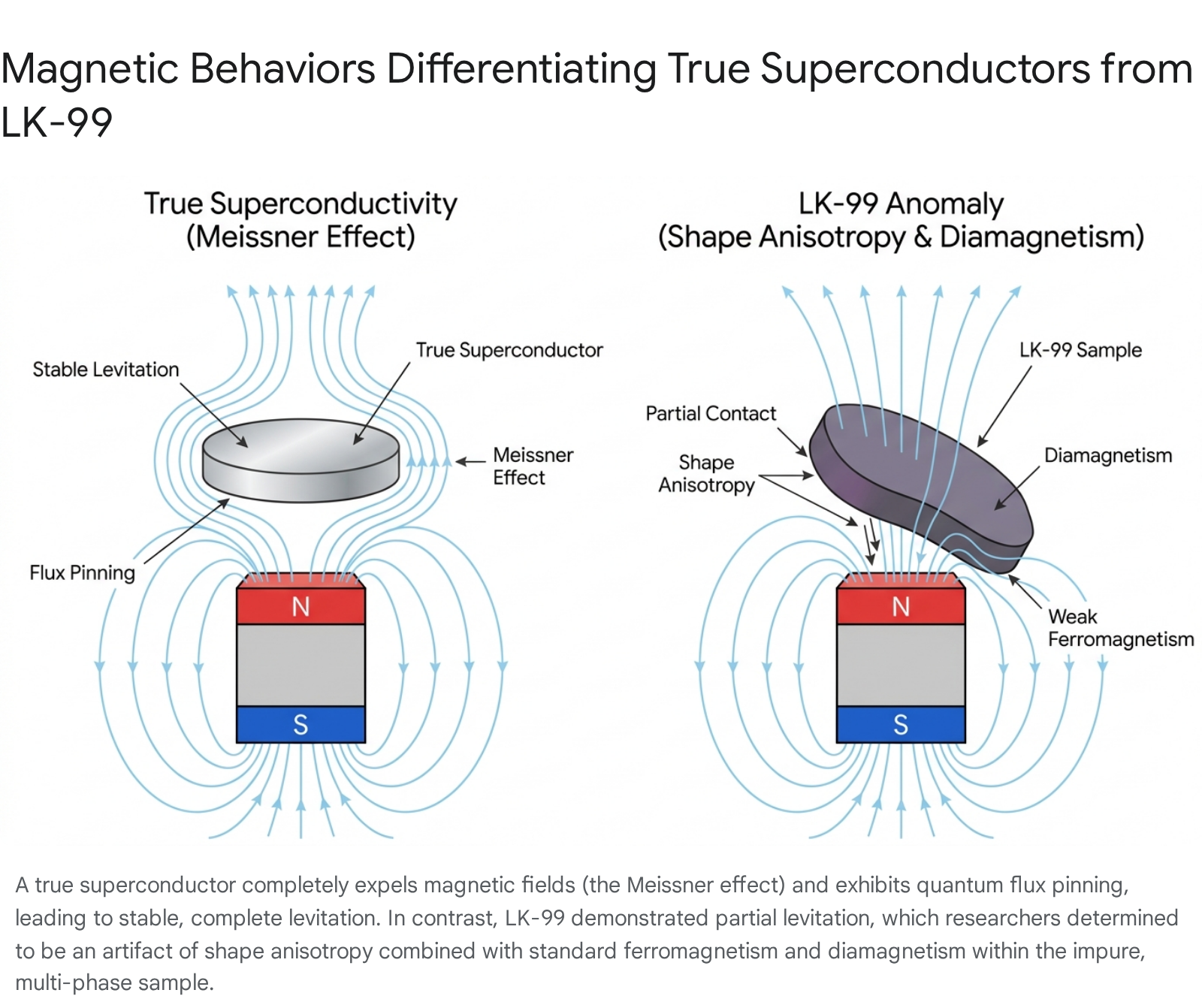
The visual evidence of magnetic levitation, which had served as the primary catalyst for public enthusiasm, was similarly deconstructed and explained through conventional physical interactions. True quantum magnetic levitation relies on the Meissner effect, wherein the material behaves as a perfect diamagnet, completely expelling applied magnetic fields. This expulsion is coupled with quantum flux pinning, which locks the superconductor uniformly in space above or below a magnetic field, restricting its movement entirely 9. The behavior exhibited by the LK-99 fragments, where one distinct edge remained in physical contact with the magnet while the other tilted upward, was fundamentally inconsistent with flux pinning dynamics 9.
Subsequent high-precision magnetic analyses, including evaluations utilizing Superconducting Quantum Interference Device (SQUID) magnetometers, revealed that the magnetic response of the LK-99 fragments was an artifact of multiple competing magnetic forces. The synthesized material was determined to contain minor impurities of iron and other ferromagnetic elements, introducing a weak but definitive soft ferromagnetic component to the sample 921. Additionally, the base lead apatite material exhibited standard non-superconductive diamagnetism, meaning it naturally repelled magnetic fields to a small degree 29.
When these weak diamagnetic and soft ferromagnetic forces were combined with the pronounced shape anisotropy - the irregular, asymmetrical physical geometry - of the small, brittle fragments, they were entirely sufficient to cause the sample to tilt and partially repel the magnet. This specific combination of mundane magnetic properties created a highly convincing illusion of partial levitation that mimicked superconducting behaviors without requiring any macroscopic quantum effects 925.
Dynamical Instability in Crystal Lattices
Further undermining the viability of LK-99, rigorous investigations into the atomic structure highlighted profound dynamical instabilities. Research by Sun-Woo Kim and Bartomeu Monserrat, published in npj Computational Materials, analyzed the dynamical stability of the specific copper-doped structures proposed in the original preprints 2627. Dynamical stability refers to the tendency of constituent atoms within a lattice to return to their equilibrium positions after being displaced by atomic vibrations (phonons) 26.
Calculations revealed that LK-99 is dynamically unstable at the harmonic level, meaning its phonon dispersion curves exhibit imaginary frequencies at absolute zero (0 K) 2627. In practical terms, this signifies that the high-symmetry atomic lattice originally modeled by researchers is fundamentally unstable and will spontaneously distort into lower-symmetry structural configurations 2627. While more sophisticated anharmonic models demonstrated that thermal energy might temporarily stabilize the material at room temperature through rapid atomic vibrations, the underlying harmonic instability strongly suggests the presence of temperature-driven phase transitions rather than a stable conducting state 26. Because the flat energy bands associated with theoretical superconductivity rely on the preservation of precise lattice symmetries, the spontaneous symmetry breaking inherent in the material's unstable ground state destroys the conditions necessary for high-temperature superconductivity 28.
Institutional Responses and the Arbitration of Consensus
The resolution of the LK-99 controversy provides a highly transparent view of how modern scientific institutions navigate and arbitrate unverified claims in the digital era. While preprints and social media accelerated the initial spread of the hypothesis, established scientific organizations acted rapidly to restore consensus and enforce methodological rigor.
In South Korea, the Korean Society of Superconductivity and Cryogenics (KSSC) recognized the immense socio-economic implications of the claims and swiftly established a formal verification committee on August 2, 2023 2729. Comprising leading condensed matter physicists and materials scientists from Seoul National University, Sungkyunkwan University, and Pohang University of Science and Technology, the committee objectively evaluated the arXiv preprints and the limited public data available at the time 237. The KSSC committee quickly issued statements expressing deep skepticism, determining that the data did not sufficiently support the existence of a room-temperature superconductor 237. Over the subsequent months, the committee facilitated domestic replication efforts and requested raw data and physical samples from the Quantum Energy Research Centre, ultimately issuing a final report in December 2023 that formally refuted the LK-99 hypothesis based on exhaustive domestic and international testing.
The global consensus was subsequently formalized at major academic conferences. At the American Physical Society (APS) March Meeting in 2024, held in Minneapolis, multiple scientific sessions were dedicated to emerging superconductors and the explicit deconstruction of the LK-99 phenomenon 14. Presentations by research groups, including one led by Thacien Habamahoro from the University of Houston, systematically detailed their replications of the LK-99 anomalies 14. The researchers publicly presented conclusive data proving that the phenomena were strictly associated with the structural transition of the $\text{Cu}_2\text{S}$ impurity, firmly cementing the academic closure of the episode 14.
Historical Analogies in High-Stakes Physics
The rapid ascent and subsequent collapse of the LK-99 hypothesis is not an isolated occurrence within the history of physics. The discipline is marked by a recurring pattern where claims of paradigm-shifting, Nobel-caliber discoveries fail under the weight of rigorous independent replication. This cycle is often driven by what researchers term the "natural selection of bad science" - a systemic pressure wherein the intense competition for funding, career advancement, and prestige incentivizes the rapid publication of spectacular, highly novel results, sometimes at the expense of methodical alternative hypothesis testing 1615.
Two specific historical analogues provide essential context for understanding the dynamics of the LK-99 episode: the 1989 Cold Fusion controversy and the 2014 BICEP2 gravitational wave announcement.
On March 23, 1989, electrochemists Martin Fleischmann and Stanley Pons held a press conference to announce they had achieved nuclear fusion at room temperature 161734. Utilizing a simple tabletop electrochemical cell equipped with a palladium electrode submerged in heavy water (deuterium oxide), the researchers claimed to observe excess heat that defied chemical explanations 161734. Bypassing the traditional peer-review process, the announcement sparked a global frenzy. However, replication efforts quickly faltered. The global physics community noted the fatal absence of necessary nuclear byproducts - specifically, the high volumes of neutron emissions required to validate true deuterium fusion - eventually categorizing the episode as pathological science 161718.
More recently, in March 2014, the BICEP2 collaboration announced the detection of primordial gravitational waves via the BICEP2 telescope located at the South Pole 192021. Led by physicists Jamie Bock and Chao-Lin Kuo, the team claimed to have observed a specific "curly" pattern of polarized light known as B-mode polarization in the cosmic microwave background (CMB) 192122. This signal was interpreted as direct evidence of cosmic inflation occurring fractions of a second after the Big Bang, with an energy scale approaching $2 \times 10^{16}$ GeV and a tensor-to-scalar ratio of $r = 0.20$ 2021. Claiming a statistical significance in excess of $5\sigma$, the discovery was heralded as definitively Nobel-worthy 40. However, a subsequent joint analysis incorporating high-resolution, multi-frequency data from the European Space Agency's Planck space telescope revealed that the entirety of the observed B-mode signal could be attributed to a local artifact: polarized galactic dust within the Milky Way galaxy 1940.
The defining contrast between the LK-99 phenomenon and these historical precedents lies primarily in the velocity of the scientific community's self-correction mechanisms.
| Historical Phenomenon | Year of Announcement | Mechanism of Initial Dissemination | Primary Confounding Artifact | Resolution Timeframe |
|---|---|---|---|---|
| Cold Fusion | 1989 | Press Conference prior to peer review | Methodological errors in calorimetry; absence of neutron emissions | Months to years (persisted extensively as pathological science) 1734 |
| BICEP2 Gravitational Waves | 2014 | Press Conference & ArXiv Preprint | Polarized galactic dust within the Milky Way mimicking CMB signals | ~10 months (dependent on the release of Planck satellite data) 1940 |
| LK-99 Superconductivity | 2023 | ArXiv Preprints & Viral Social Media Videos | $\text{Cu}_2\text{S}$ phase transition & shape anisotropy mimicking Meissner effect | ~4 to 5 weeks 12 |
As detailed in the comparison, the LK-99 hypothesis was effectively falsified within a single month. This historically unprecedented timeline was facilitated by the open-access nature of preprint servers, the physical simplicity of the solid-state synthesis enabling parallel replication across dozens of laboratories, and the immediate global connectivity of the modern scientific community 228.
Epistemic Lessons for the Modern Scientific Process
The Dual Nature of the Preprint Ecosystem
The LK-99 episode functions as an extreme stress test for the modern open science communication infrastructure. Platforms like arXiv have successfully democratized access to research data, allowing emerging findings to bypass the often months-long delays inherent in the traditional peer-review pipeline. However, this absence of a primary gatekeeper means that flawed methodologies and misinterpreted data - such as failing to account for the well-known structural phase transitions of highly common precursor impurities - can reach the global public instantaneously 341.
Nevertheless, the LK-99 case demonstrated that the preprint model ultimately operates as a highly efficient, massively parallelized peer-review apparatus. Rather than relying on the isolated assessments of two or three anonymous referees over several months, the preprint model subjected the LK-99 claims to the immediate, concurrent scrutiny of thousands of domain experts across the globe 123. These experts rapidly generated targeted experiments, synthesized varying compounds, and published their definitive refutations as new preprints in real time. This dynamic suggests that while open-access preprints inherently amplify the risk of initial misinformation spreading to the public, they simultaneously and vastly optimize the speed and rigor of scientific self-correction.
The Illusion of "Smoking Gun Look-Alikes"
A paramount epistemic takeaway from the LK-99 controversy is the persistent danger of "smoking gun look-alikes" in experimental physics 16. Because advanced physics often relies on proxy measurements to infer unobservable quantum states, researchers are highly vulnerable to confirmation bias when anomalies align with their hypotheses. For superconductivity, an immediate drop to zero electrical resistance and macroscopic magnetic expulsion serve as the definitive "smoking guns."
The South Korean team genuinely observed a massive, sharp resistance drop and instances of partial magnetic repulsion. In a vacuum, these observations closely mimic superconducting behavior. However, as painstakingly demonstrated by the $\text{Cu}_2\text{S}$ phase transition and the soft ferromagnetism analyses, the natural world frequently provides ordinary, macroscopic mechanisms that flawlessly emulate highly sought-after extraordinary phenomena 149. The failure of the LK-99 preprints was not necessarily rooted in data fabrication or deliberate deceit, but rather in a systemic failure of rigorous experimental isolation and an absence of hostile, skeptical alternative hypothesis testing 91617.
The Public Hype Cycle and Science Communication
LK-99 starkly illuminated the increasingly volatile intersection between highly specialized scientific research and digital mass media. The phenomenon tracked perfectly alongside a classic "Hype Cycle" framework 41. The dissemination of the initial preprints and viral videos artificially inflated public expectations, triggering erratic investment behavior in technology and materials stocks, and giving rise to a subculture of amateur DIY replication streams broadcast on platforms like Twitch and social media 1141.
Furthermore, the public's rapid consumption of theoretical papers - such as the DFT analysis identifying flat bands - highlighted a fundamental vulnerability in broad scientific literacy. Within the professional physics community, a theoretical paper proposing a potential mechanism for a phenomenon is universally understood as exploratory context requiring empirical validation. To the lay public, lacking a foundational understanding of calibrated uncertainty, computational modeling was misconstrued as independent, definitive validation of the overarching claim 31617. This divergence emphasizes a pressing need for a paradigm shift in science communication - one that prioritizes the methodical, iterative, and inherently skeptical nature of the scientific process over the sensationalism of isolated, unverified breakthroughs.
Ultimately, the LK-99 episode is less a narrative of scientific failure than a resounding validation of the resilience and efficiency of the scientific method. While the claims of an ambient-pressure, room-temperature superconductor were proven to be an illusion created by mundane impurities and magnetic artifacts, the global scientific community mobilized with unprecedented speed and rigor to restore empirical truth.