
Scientific evidence and demography of longevity hotspots
The concept of longevity hotspots, colloquially recognized in popular media as "Blue Zones," refers to geographically and culturally defined populations that purportedly exhibit exceptional rates of longevity. The foundational premise is that these regions produce an unusually high prevalence of centenarians and supercentenarians, alongside notable extensions in healthspan - the period of life spent free of chronic, age-related disease. The term itself originated in the early 2000s from the demographic work of researchers Michel Poulain and Gianni Pes. During an analysis of extreme male longevity in the mountainous regions of Sardinia, Italy, the researchers used a blue marker to designate the geographic boundaries of the survival anomaly on a map, thereby coining the phrase 1.
The concept was subsequently popularized and systematically expanded by explorer and journalist Dan Buettner, in collaboration with teams of researchers and demographers under the auspices of the National Geographic Society. This expanded framework identified five primary longevity hotspots: the Nuoro and Ogliastra provinces of Sardinia, Italy; the prefecture of Okinawa, Japan; the Nicoya Peninsula in Costa Rica; the island of Ikaria, Greece; and the Seventh-day Adventist community in Loma Linda, California 23.
Over the ensuing decades, the research surrounding these communities transitioned from isolated biodemographic inquiry into a global commercial wellness framework. Observations of the varied cultural practices in these regions were distilled into a standardized lifestyle methodology, advocating for primarily plant-based diets, constant low-intensity natural movement, structured stress reduction, and deep community integration 45. However, comprehensive demographic, epidemiological, and anthropological analyses reveal a significant divergence between the heavily marketed lifestyle prescriptions and the complex, transient, and occasionally flawed historical realities of the regions themselves.
Demographic Validation and the Record Integrity Debate
The core assumption underlying all research into exceptional longevity regions is that the underlying age records are accurate. However, historical demography has consistently demonstrated that self-reported claims of extreme age are frequently subject to exaggeration, estimation, and clerical error. In recent years, a fierce epistemological debate has emerged within the gerontological community regarding the validity of the extreme age records underpinning the identified longevity hotspots.
The Fraud and Error Hypothesis
A critical reassessment of supercentenarian records by demographer Saul Justin Newman has fundamentally challenged the integrity of extreme old-age demographic data. Newman's research, which garnered the 2024 Ig Nobel Prize in Demography, argues that patterns of remarkable longevity are heavily contaminated by clerical errors, historical lack of vital registration, and pension fraud 56.
Through an analysis of global supercentenarian databases and regional socioeconomic indicators, Newman identified paradoxical correlations: the highest rates of achieving extreme old age statistically correlate with regional indicators of deprivation. Specifically, regions designated as longevity hotspots, such as Sardinia, Okinawa, and Ikaria, historically ranked among the poorest, least educated, and highest-crime regions of their respective nations, often characterized by shorter overall average national lifespans 79.
According to this hypothesis, areas lacking robust, historical centralized vital registration systems are highly prone to producing anomalous age records. Newman points out that the introduction of standardized birth certificates in specific states within the United States coincided with a dramatic 69% to 82% decline in the number of recorded supercentenarians 98. Furthermore, statistical analyses of supercentenarian birthdates reveal a frequent clustering on days divisible by five - a recognized statistical anomaly known as "age heaping," which is highly indicative of age estimation, systemic clerical error, or active fraud 98.
In contexts marked by material deprivation, the financial pressure to continue collecting state pensions for deceased relatives creates a perverse incentive to obscure mortality. Audits have historically uncovered significant instances of pension fraud in several of the designated countries; for example, a past audit in Greece indicated that a large percentage of centenarian pension recipients were deceased, and a 2010 national review in Japan uncovered hundreds of missing centenarians, including cases where relatives had hidden deceased elders to retain financial benefits 91011. Newman posits that the striking concentration of supercentenarians in these specific geographic zones may actually reflect the historical absence of birth certificates and the prevalence of uncorrected administrative errors rather than genuine biological longevity 98.
Biodemographic Verification Protocols
In response to these systemic critiques, leading gerontological demographers - including original researchers Gianni Pes and Steven N. Austad - have published comprehensive rebuttals affirming the validity of the localized demographic data. Writing in The Gerontologist in late 2025, Austad and Pes acknowledge that while self-reported age exaggeration is a historical constant, modern biodemography employs rigorous, multi-source validation protocols precisely to eliminate such errors 141512.
The validation of ages in the original designated hotspots did not rely on self-reporting or singular administrative documents. Instead, researchers cross-checked civil status databases, handwritten church records, military registries, and electoral rolls to construct a complete genealogical reconstruction of village inhabitants. For the Sardinian mountain regions, researchers utilized civil birth and death records dating back to 1866, combined with church baptismal records from the 17th century onward 815. Any cases that could not be conclusively validated across multiple independent historical sources were systematically excluded from the longevity datasets 15.
Furthermore, demographer Kenneth W. Wachter provided a targeted rebuttal to Newman's claims regarding Italian records. Wachter noted that a uniform civil registration system was established in Italy in the 1860s, following Italian unification. Births were recorded chronologically in bound volumes by educated civil status officers. The specific types of decade-shifting clerical errors hypothesized by Newman - such as individuals being recorded ten years prior to their actual birth - are mathematically and administratively incompatible with the sequential, bound-volume registration systems utilized for the verified Italian supercentenarian cohorts 1314.
The prevailing scientific consensus suggests a nuanced reality: while broader, unverified national supercentenarian databases are undoubtedly clouded by data errors and administrative fraud, the foundational observations of specific regional survival probabilities - particularly the verified survival rates from age 80 to 100 in areas like the Sardinian mountains - are based on robust, heavily triangulated demographic evidence 121520.
Transience of Longevity Anomalies
A critical finding in modern demographic research is that geographic longevity anomalies are not permanent fixtures. They are highly dependent on specific cohort effects, historical timelines, and shifting environmental variables. As these previously isolated regions undergo economic development, urbanization, out-migration, and nutritional transitions, their longevity advantages are rapidly diminishing or disappearing entirely. The ephemeral nature of these regions indicates that exceptional survival is tied to a fragile historical ecology rather than an intrinsic, indelible regional trait.
Cohort Shifts in the Nicoya Peninsula
The Nicoya Peninsula in north-western Costa Rica was initially identified as a longevity hotspot based on data showing that its population exhibited an overall mortality rate approximately 20% lower than the Costa Rican national average 16. Early epidemiological studies indicated that elderly Nicoyans possessed distinct biological advantages, including longer telomeres (acting as molecular markers of reduced stress), lower rates of cardiovascular disease, and favorable biomarkers such as higher dehydroepiandrosterone sulfate (DHEAS) levels 1718. Furthermore, the region's drinking water is notably high in calcium, which was hypothesized to offer protection against cardiovascular disease and age-related osteoporosis 16.
However, recent extensive demographic modeling has revealed that the Nicoyan longevity advantage is disappearing. Utilizing a nationwide survival-time database of 550,000 adult Costa Ricans tracked continuously from 1990 to 2020, researchers determined that the survival advantage is strictly confined to earlier birth cohorts 1920. The geographic footprint of the hotspot has also condensed, shrinking to a much smaller corridor near the towns of Hojancha and Sámara 19.
The data demonstrates a severe generational divergence. Nicoyan males born in the 1900 to 1910 decade exhibited a remarkable median remaining life span at age 60 of 26.2 years - 8.5 years longer than contemporaneous Japanese men and 6.6 years longer than average Costa Rican men 20. However, this advantage steadily deteriorated over subsequent decades. While Nicoyan males born in 1905 had a 33% lower adult mortality rate compared to the rest of Costa Rica, those born in 1935 had only a 4% lower rate. Most strikingly, Nicoyan males born in 1945 actually exhibit a 10% higher mortality rate than the national average 1920.
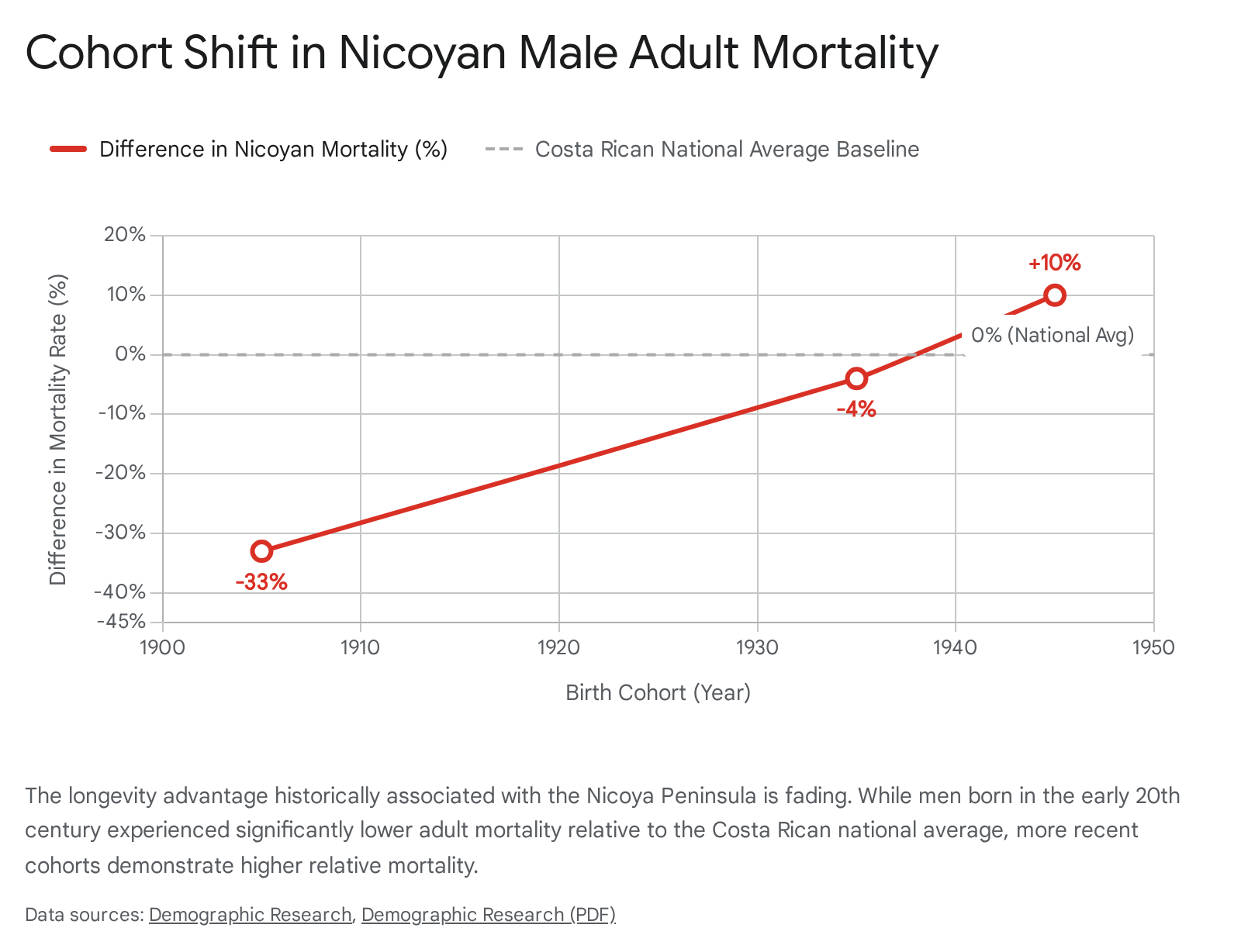
This generational shift clearly establishes that surviving Nicoyan males born before 1930 represent an exceptional, historically isolated cohort whose longevity traits are not being replicated by younger generations operating in a modernized environmental and nutritional landscape 19.
The Okinawa Mortality Convergence
Okinawa was long heralded as the prefecture with the highest life expectancy in Japan, boasting exceptionally low rates of cardiovascular disease, stroke, and hormone-dependent cancers among its elderly population 2627. During the late 20th century, the island's population consistently exhibited the highest survival metrics nationwide; in 1980, Okinawan men possessed the highest average life expectancy of all 47 Japanese prefectures 21.
However, the demographic reality shifted drastically at the turn of the century. By the year 2000, the historic longevity advantage of Okinawan males over the Japanese mainland was entirely erased 29. In the 2002 rankings, Okinawan male life expectancy plummeted to 26th place - an event widely publicized in the region as the "Shock 26" - and by 2020, it had fallen further to 36th place 2122. Okinawan women, who held the top prefectural spot until 2005, dropped to 7th place by 2020 21.
This severe convergence with, and subsequent drop below, the national average is driven by distinct cohort dynamics. The population of Okinawa is sharply divided between those born before World War II and those born after. Older generations experienced a highly favorable mortality pattern, while younger generations exhibit mortality levels definitively higher than their mainland counterparts 2332. Epidemiological analysis suggests that this decline is linked to the long-term cohort effects of low birthweight. Okinawa experienced a low birthweight rate 20% higher than mainland Japan in the post-war period. As this specific post-war cohort reached middle age, they exhibited heightened susceptibility to non-communicable diseases 29. This biological vulnerability, compounded by the rapid introduction of Westernized diets, fast food, and decreased physical activity, led to a reversal in mortality ratios for ischemic heart disease and cerebrovascular disease among younger Okinawans 212924.
Furthermore, the demographic structure of Okinawa was uniquely shaped by massive out-migration. Facing economic hardship, extreme poverty, and the replacement of traditional land allocation systems, a significant portion of the population emigrated prior to World War II. By 1940, approximately one in ten Okinawans had emigrated, primarily to Hawaii and South America 2725. This large-scale, predominantly male out-migration altered the demographic base, leaving a specific survival cohort that skewered subsequent extreme longevity statistics.
Localized Persistence in Sardinia
While Sardinia is frequently cited in popular literature as a generalized longevity island, the demographic advantage is highly localized and does not apply to the broader region. When evaluating the island as a whole, Sardinia does not lead national life expectancy statistics. In a 2025 evaluation of Italian regions, Sardinia ranked 14th with an average overall life expectancy of 80.4 years, trailing significantly behind northern regions such as Trentino-Alto Adige (82.2 years) and Lombardy (81.3 years) 3526.
The true demographic anomaly in Sardinia is confined primarily to men living in the mountainous, historically isolated inland municipalities of the Ogliastra and Barbagia regions 2728. The specific advantage is not universally lower mortality across all life stages, but rather a distinct survival probability from age 80 to 100. Due to lower mortality among 80- to 99-year-old men in these specific mountain areas, the Sardinian longevity zone exhibits an unusual 1:1 ratio of male to female centenarians. This stands in stark contrast to the standard 1:4 or 1:5 male-to-female ratios observed in mainland Italy and other low-mortality countries globally 115.
| Region | Scope of Longevity | Recent Longevity Trajectory vs. National Average | Primary Drivers of Demographic Change |
|---|---|---|---|
| Okinawa, Japan | Prefecture-wide (historically) | Declined (Males fell from 1st to 36th among 47 prefectures by 2020) 21 | Generational dietary shifts; westernization of food supply; post-war low birthweight cohorts 212924. |
| Nicoya, Costa Rica | Specific cantons | Disappearing (Cohorts born after 1945 exhibit higher mortality than national average) 20 | Cohort shift; modernization reducing historical environmental and lifestyle isolation 19. |
| Sardinia, Italy | Mountain municipalities (Ogliastra/Barbagia) | Localized advantage persists for older cohorts; Island overall ranks 14th in Italy 1535 | Nutrition transition altering traditional pastoralist diets; economic development 352829. |
Dietary Patterns and Anthropological Realities
Perhaps the most significant divergence between the popular narrative of longevity hotspots and rigorous anthropological literature lies in dietary epidemiology. The commercial framework heavily promotes a strict nutritional regimen, stipulating that longevity diets are historically 95-100% plant-based. These guidelines advocate a "retreat from meat" (limiting consumption to rare occasions), a reduction in dairy, and the elimination of eggs, heavily emphasizing legumes, whole grains, and vegetables 530.
However, ethnographic, historical, and nutritional analyses of the actual populations reveal diets that were largely dictated by subsistence agriculture, geographic isolation, and pastoralism. Rather than adhering to an intentional vegan or near-vegan philosophy, these populations consumed diets that frequently featured substantial quantities of animal fats, dairy, and protein, adapting opportunistically to their harsh local environments 31.
Pastoralist Nutrition in Sardinia
The dietary realities of the Sardinian mountain populations directly contradict the low-fat, low-dairy, plant-based narrative. The highest concentrations of centenarians in Sardinia are found not among lowland agricultural farmers cultivating vegetables, but among mountain pastoralists, specifically shepherds engaged in sheep and goat rearing 2831.
Because the local economy revolved around pastoralism, animal-sourced foods were dominant. Historical dietary surveys from the pre-WWII era indicate that dairy constituted roughly 26% of the food consumed by weight in shepherd households 32. This intake included significant daily consumption of full-fat, unprocessed sheep and goat milk, alongside specialized traditional cheeses such as casu axedu (an acidic goat/sheep milk curd), ricotta, and pecorino 2733. Sheep and goat milk possess distinct nutritional profiles compared to cow's milk, offering higher levels of specific beneficial fatty acids and calcium, which may have contributed to skeletal density and metabolic health 33.
Furthermore, historical records demonstrate that shepherds consumed a higher volume of meat - primarily mutton and pork - than farmers in the plains, and routinely utilized lard as a primary culinary fat 283334. Recent physiological studies on the Sardinian oldest-old indicate that moderate consumption of animal-derived protein is highly correlated with improved physical functionality and delayed muscle loss at advanced ages 3133.
The nutritional landscape of Sardinia shifted significantly during the "nutrition transition" of the 1950s. While this modernization introduced more fresh fruits and olive oil to the region, it also brought refined carbohydrates, dried pasta, and sweets, alongside a decrease in the consumption of lard and legumes 282934. Researchers hypothesize that the specific cohorts who achieved exceptional longevity benefited from a unique historical intersection: they built robust physical foundations on a calorie-dense, high-protein pastoral diet during their developmental years, and subsequently gained access to a wider variety of plant nutrients during the mid-century transition, all while avoiding modern ultra-processed foods 2829.
The Historical Okinawan Pork Culture
The commercial characterization of the traditional Okinawan diet portrays it as overwhelmingly plant-forward, dominated by sweet potatoes, tofu, and seaweed, with meat functioning merely as a rare, ceremonial condiment 30. While it is historically accurate that the sweet potato - introduced from China - formed the caloric base of the diet for commoners, portraying the population as functionally vegetarian ignores the profound cultural and nutritional significance of pork in Okinawan history.
Pork was historically such an integral component of the Okinawan diet that the region was colloquially recognized as the "Island of Pork" 45. Pigs were introduced from Fujian, China, in the 15th century. As diplomatic ties between the Ryukyuan court and the Ming dynasty deepened, the consumption of pork became deeply embedded in the local culture 46. The cultivation of sweet potatoes symbiotically supported large-scale pig farming, as the vegetative parts of the plant were utilized for feed 46. Prior to the devastation of World War II, Okinawa possessed the highest number of pigs in Japan, reaching a livestock population of 140,000 in 1938 46.
While extreme poverty meant that commoners could not consume meat every day, pork and lard were foundational to the cuisine and were heavily consumed during frequent village festivals, weddings, funerals, and the lunar New Year 4647. Lard served as the primary cooking fat, and the entire animal - including fat-rich skin, ears, stomach, and organs - was consumed. Traditional food-based remedies also relied heavily on pork offal 45. Following post-war economic recovery, the per capita consumption of pork in Okinawa rebounded dramatically; by 1979, Okinawans consumed 7.9 kg of pork per person annually, exceeding the Japanese national average by 50% 35. The extremely low meat consumption figures frequently cited by proponents of the plant-based longevity narrative (e.g., 3 grams a day) rely almost entirely on data from the immediate post-WWII era - a period characterized by catastrophic infrastructure decimation, the slaughter of livestock, and severe starvation - rather than representing an intentional, lifelong cultural baseline 4635.
Mediterranean Adherence and Risk Factors in Ikaria
The Greek island of Ikaria presents an exceedingly complex epidemiological picture that challenges simple lifestyle prescriptions. While the population traditionally adhered to a variation of the Mediterranean diet (rich in olive oil, legumes, and homegrown vegetables) and engaged in high physical activity and routine midday naps 3637, they also exhibited behaviors conventionally associated with high mortality.
Data from the IKARIA study, a population-based health and nutrition survey tracking permanent inhabitants aged 65 to 100, revealed a startlingly high prevalence of cardiovascular risk factors. Among the elderly participants, hypertension was diagnosed in 70.4%, diabetes in 19.7%, and hyperlipidemia in 12.7% 38. Most notably, while smoking is universally recognized as a primary driver of reduced lifespan and cardiovascular disease, the study found that 99% of the elderly male participants reported having been smokers at some point in their lives, alongside 32% of the women 37.
The ability of this population to reach advanced ages despite staggering rates of historical smoking and active hypertension suggests that exceptional longevity in Ikaria cannot be attributed solely to pristine behavioral choices. Instead, researchers hypothesize that longevity in this environment is heavily influenced by genetic isolation, highly protective environmental factors, or complex interactions between moderate Mediterranean dietary adherence and rigorous stress reduction protocols that successfully buffer against traditional risk factors 3739.
The Seventh-day Adventist Exception in Loma Linda
Among the five canonical longevity hotspots, Loma Linda, California, represents a distinct demographic and methodological outlier. Unlike the geographically and historically isolated populations of Okinawa, Sardinia, and Ikaria, Loma Linda's longevity anomaly is tied strictly to a religious cohort: the Seventh-day Adventists 40.
The longevity of this specific group is rigorously documented through the Adventist Health Studies (including the Adventist Mortality Study, AHS-1, and AHS-2), which are large-scale, prospective epidemiological studies involving tens of thousands of participants tracked over decades 404142. The doctrines of the Seventh-day Adventist Church explicitly encourage a vegetarian diet and strictly mandate abstinence from alcohol and tobacco 4041. Research confirms that Adventist men live approximately 7.3 years longer, and women 4.4 years longer, than the average Californian 40. Within this cohort, those adhering to vegetarian diets exhibit lower risks of obesity, hypertension, diabetes, and cardiovascular disease compared to non-vegetarian Adventists 4042.
Loma Linda is the only identified hotspot where the commercial "Plant Slant" and "no meat" guidelines accurately reflect the historical and ongoing practices of the population 540. However, critics point out that Loma Linda's status as a geographic longevity zone is inherently complicated. It is a highly self-selecting community that attracts educated, health-conscious, and financially stable retirees from across the country who actively migrate to the area to participate in a strict religious and medical ecosystem, rather than an indigenous population bound to a specific natural environment 56.
Commercialization and Public Health Interventions
The narrative surrounding exceptional longevity regions has fundamentally shifted in recent years, moving from an exercise in anthropological and ethnographic observation to the deployment of corporate health interventions. In 2020, Adventist Health - a major health care system affiliated with the Seventh-day Adventist Church - acquired Blue Zones LLC 4358.
This acquisition merged the Adventist institutional focus on preventive wellness with a recognized commercial brand, aiming to transform community health across the United States through civic interventions. These interventions target public policy, urban design (referred to in corporate literature as the "Life Radius"), and local food environments, rather than relying solely on individual behavioral change 5859. Subsequent projects have been launched in dozens of communities across North America, promoting the integration of the distilled lifestyle habits into civic infrastructure 60.
However, this commercialization has drawn scrutiny from the scientific and epidemiological communities. While the prescribed habits - such as increasing baseline physical activity, fostering social connections, and reducing smoking rates - are rooted in universally accepted, evidence-based public health principles, the specific claim that the exact branded formula produces measurable civic longevity is largely unverified by external, peer-reviewed literature 43. Evidence of success in towns adopting the framework (such as Albert Lea, Minnesota) primarily stems from internal corporate case studies citing short-term metrics like increased downtown foot traffic, reductions in adult smoking, or drops in Body Mass Index (BMI), rather than independent, longitudinal epidemiological tracking of extended lifespans or mortality reductions 4358.
The synthesis of diverse, historically contingent cultures into a standardized, marketable lifestyle brand risks obscuring the complex biological, genetic, dietary, and socio-economic variables that actually govern human aging.
Conclusion
The scientific reality of geographic longevity hotspots is characterized by profound complexity, marked by transient historical conditions rather than permanent environmental magic.
While claims of widespread administrative fraud and age misreporting highlight genuine, systemic vulnerabilities in global supercentenarian datasets, rigorous biodemographic validation confirms that pockets of exceptional longevity did exist, particularly among early 20th-century cohorts in regions like Sardinia, Okinawa, and Nicoya. However, these longevity advantages are ephemeral. As these isolated regions modernize, integrate into global food systems, and undergo economic transitions, their distinct mortality advantages are vanishing rapidly. This demographic convergence proves that localized longevity is not an inherent, indelible property of the geography, but a fragile convergence of historical lifestyle, subsistence diet, and physical environment that is easily disrupted.
Furthermore, the assertion that the longest-lived human populations universally adhered to strict, low-fat, near-vegan diets is an epidemiological misconception. With the exception of the religious cohort in Loma Linda, traditional longevity diets were highly opportunistic and heavily reliant on pastoralism. Populations in Sardinia and Okinawa frequently relied on high-fat dairy, pork, and lard as vital, culturally significant sources of calories and protein.
Ultimately, the empirical science supports the conclusion that environments fostering continuous natural movement, deep social integration, and the consumption of whole, unprocessed foods - whether plant or animal-based - provide a robust foundation for healthy aging. The mythology lies in the belief that these diverse, complex historical lifeways can be perfectly distilled into a rigid consumer checklist, or that the geographic zones themselves offer a permanent immunity to the realities of modern aging and biological decline.