
Science of food disgust and cultural taboos
Biological Foundations of Food Rejection
Evolutionary Origins and the Behavioral Immune System
The human dietary framework is defined by the biological reality of omnivory. Because humans require a broad spectrum of nutrients, they must forage and consume a diverse array of plant and animal matter. This flexibility, while evolutionarily advantageous, introduces the persistent and potentially lethal risk of ingesting pathogens, parasites, and toxins. To manage this biological vulnerability, organisms evolved dual defensive architectures: a reactive physiological immune system that neutralizes pathogens post-infection, and a proactive psychological mechanism known as the behavioral immune system 123.
The behavioral immune system operates as a suite of cognitive, affective, and behavioral processes designed to detect perceptual cues of contamination and elicit immediate avoidance behaviors before a pathogen can enter the body 345. Unlike the physiological immune system, which is metabolically expensive to activate, the behavioral immune system is organized around a "smoke detector" principle. It is evolutionarily calibrated to be hypersensitive, routinely producing false positive reactions 567. The evolutionary logic dictates that the cost of failing to detect a deadly pathogen is fatal, whereas the cost of a false positive - rejecting a perfectly safe food item - merely results in a missed caloric opportunity 67.
Within the context of food consumption, the behavioral immune system is the foundational driver of aversions to rotting organic matter, feces, vomit, and certain animal vectors. These stimuli represent high-density environments for infectious diseases. Early hominids who exhibited intense avoidance reactions to such stimuli possessed a survival advantage, embedding this reactivity into human evolutionary biology 128. Cross-cultural psychological research indicates that these core elicitors of pathogen avoidance trigger near-universal aversive responses, suggesting a shared biological baseline 123.
However, the specific environmental conditions in which a population develops heavily calibrate the sensitivity of this system. Studies analyzing the behavioral immune system across diverse geopolitical regions demonstrate that historical and contemporary pathogen prevalence directly influences local cultural formations, a concept known as evoked culture 48. Populations residing in regions with historically high pathogen loads frequently exhibit more rigid dietary rules, stronger traditional aversions to novel foods, and higher baseline levels of disgust sensitivity 458. This calibration was notably observable during the COVID-19 pandemic, where researchers documented real-time increases in germ aversion, perceived infectability, and general disgust sensitivity across global populations in response to the heightened environmental threat 38.
Psychological Taxonomy of Food Rejection
While the terms are often used interchangeably in colloquial discourse, the biological and psychological rejection of food is formally divided into distinct affective categories. Foundational research in food psychology establishes a taxonomy of food rejection based on the primary motivation for the avoidance behavior 1091011. The critical divergence lies between sensory-based rejection and ideational rejection.
"Distaste" represents a purely sensory-driven rejection mechanism. It occurs when an individual rejects a food substance based on its physical properties - specifically its taste, smell, or texture 1010. This mechanism is biologically hardwired to detect alkaloids and other compounds that signal toxicity, which are often perceived as bitter, or spoilage, which is often perceived as sour 1010. Crucially, distasteful items do not inherently possess contamination properties. If a bitter substance is diluted within a large volume of acceptable food to the point where it can no longer be tasted, the food remains psychologically acceptable to the consumer 9.
"Disgust," by contrast, is an ideational rejection. It is triggered not strictly by the immediate sensory properties of the food, but by the conceptual knowledge of what the substance is or where it originated 109. Core disgust is formally defined as the fear of oral incorporation of an offensive object 111213. Unlike distaste, disgusting substances possess a powerful psychological contamination property governed by the principle of contagion. If a universally disgusting item - such as a sterilized insect or a sterilized worm - briefly contacts an otherwise acceptable food item, the entire food is rendered permanently inedible in the mind of the consumer, regardless of the objective lack of physical risk 91214.
This ideational characteristic dictates that disgust must be culturally learned. While infants exhibit innate distaste responses to bitter flavors, often demonstrating a reflexive "gape," they do not exhibit core disgust. Young children will frequently attempt to consume feces, insects, or inanimate objects until they are socialized to understand the origin and cultural meaning of the substances 917. The development of food selection is largely an acquisition of local aversions, a process of learning what not to eat through observing conspecifics and internalizing mimetic food habits 917.
| Rejection Category | Primary Motivation | Nature of the Stimulus | Contamination Property | Typical Elicitors |
|---|---|---|---|---|
| Distaste | Sensory (dislike of taste, smell, or texture) | Physical properties | None | Bitter vegetables, sour liquids, extreme spice |
| Danger | Anticipation of bodily harm or illness | Toxic or allergenic potential | Minimal | Poisonous plants, known allergens |
| Disgust | Ideational (knowledge of origin or nature) | Animal products, body fluids, decay | Strong | Feces, worms, rotting meat, insects |
| Inappropriate | Ideational (classification as non-food) | Inorganic or purely botanical items | None | Sand, paper, grass, wood |
This taxonomy highlights that disgust is predominantly associated with items of animal origin 91013. Because humans share a close biological proximity to other animals, animal pathogens are significantly more likely to be zoonotic and pose a direct infection risk compared to plant pathogens 1318. Consequently, natural selection has equipped humans with an intrinsic ambivalence toward meat, privileging it as the primary target for acquired conditioned aversions and cultural taboos 18.
The Deviance Hypothesis and Norm Violation
Contemporary research into the psychology of food rejection challenges the assumption that all disgust is rooted exclusively in pathogen avoidance. The "Deviance Hypothesis" argues that because humans heavily internalize their culture's specific parameters regarding what constitutes food, significant deviations from these norms trigger an intuitive rejection response that is phenomenologically identical to disgust 1415.
When consumers are presented with novel sustainable foods - such as cultivated meat grown in a bioreactor or vertically farmed produce - they frequently report feelings of disgust, citing fears of disease or extreme un-naturalness 141516. However, these self-reported concerns are often post-hoc rationalizations for a deeper psychological friction: the violation of internalized social norms 1415. Because adherence to social norms is critical for human social survival, behaviors or objects that breach established boundaries elicit an automatic defensive reflex 14. Disgusted consumers, attempting to make rational sense of their intuitive revulsion, assign standard danger labels to the novel food, masking the true socio-normative root of their aversion 15.
Neurobiology of Nausea and Disgust
Gastrointestinal Pathways and the Emetic Reflex
The visceral sensation of disgust, frequently accompanied by nausea and a gag reflex, is mediated by intricate neural circuitry spanning the peripheral and central nervous systems. The physiological response to nauseogenic stimuli begins in the gastrointestinal tract, where visceral mechanoreceptors and enteroendocrine cells (such as enterochromaffin cells) detect toxins, inflammatory agents, and extreme distension 171819. Upon detecting noxious agents, these cells synthesize and release neurotransmitters, primarily serotonin, which directly stimulate the sensory terminals of the vagus nerve (cranial nerve X) 1719.
The vagus nerve serves as the primary sensory conduit for nausea, relaying signals from the gut to the brainstem. Concurrently, nauseogenic molecules circulating in the blood and cerebrospinal fluid are detected by the area postrema, a sensory circumventricular organ located on the floor of the fourth ventricle. Because the area postrema lacks a complete blood-brain barrier, it functions as a highly sensitive chemoreceptor trigger zone 171819. Both vagal afferents and the area postrema project these threat signals to the nucleus tractus solitarius (NTS) in the medulla oblongata 17182021.
Operating as the central coordinating hub for emesis, the NTS integrates inputs from the gastrointestinal tract, the vestibular system (responsible for motion sickness), and the limbic system 1819. To initiate the physical rejection of food, the NTS sends efferent signals to the dorsal motor nucleus of the vagus (DMV) and the ventral respiratory group. This sequence triggers the complex mechanical events of retching and vomiting, including esophageal sphincter relaxation, gastric relaxation, and retrograde contraction of the small intestine 18192021.
Cortical Representation and the Anterior Insula
As the nociceptive and nauseogenic signals ascend from the brainstem to the cerebral cortex, the subjective, conscious experience of disgust is generated.
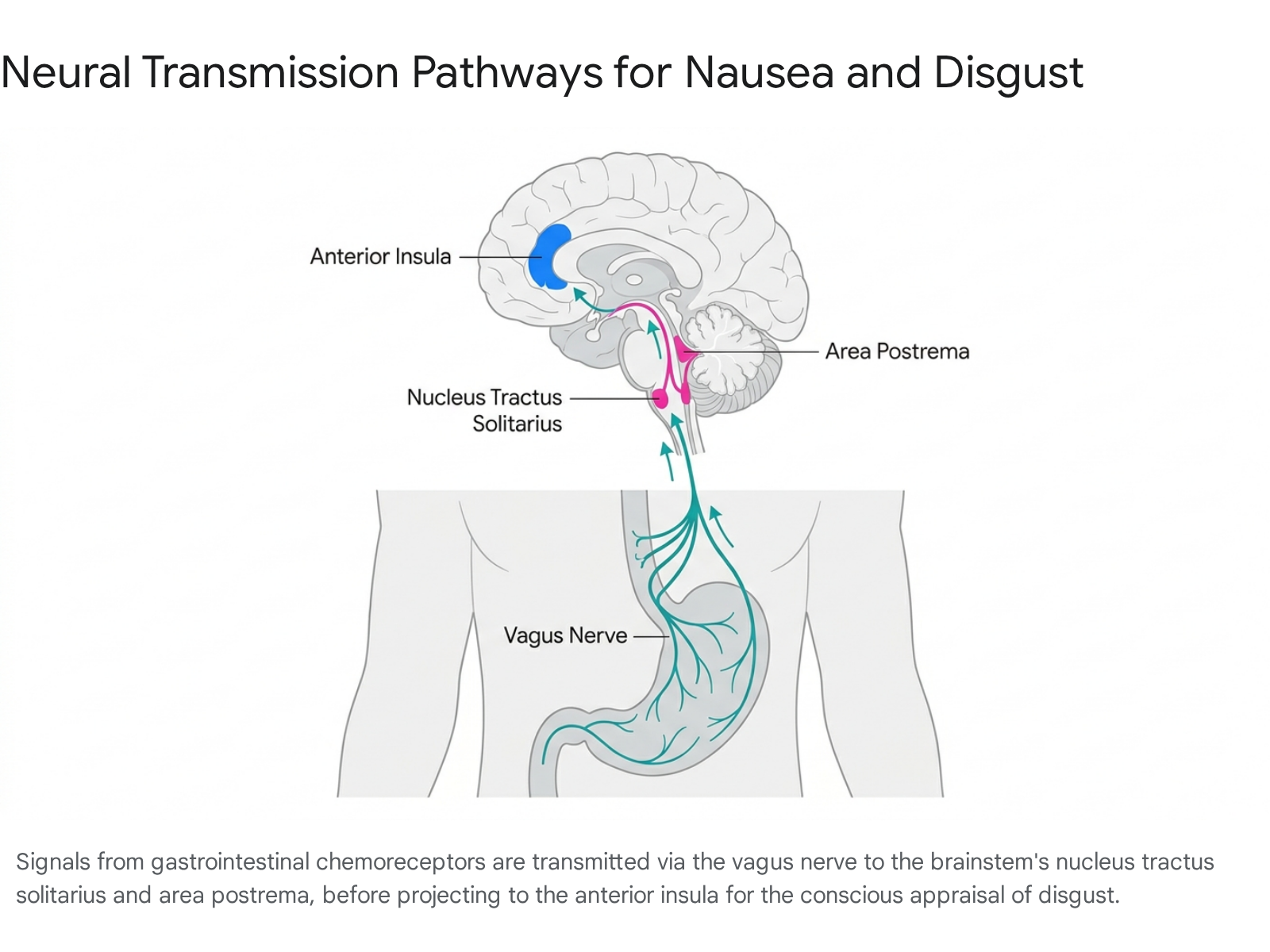
Extensive neuroimaging research utilizing functional magnetic resonance imaging (fMRI) consistently implicates the anterior insula and the adjacent frontal operculum as the core cortical regions responsible for processing disgust 22232425.
The anterior insula exhibits remarkable multimodal reactivity. It activates not only during the direct physiological experience of a disgusting taste or smell but also when an individual merely observes the disgusted facial expressions of another person, or when they cognitively imagine a disgusting scenario 262728. This overlapping neural substrate suggests the presence of a mirror neuron system dedicated to emotion, which facilitates affective empathy and the rapid social transmission of food aversions without requiring the observer to endure firsthand toxic exposure 2628.
Recent predictive modeling demonstrates that the conscious appraisal of disgust relies on a widely distributed neurofunctional network. The intensity of an individual's trait disgust propensity modulates neural activity not only in the anterior, middle, and posterior insula, but also in the caudate, putamen, thalamus, and hippocampus 33293036. This mapping indicates that memory, spatial context (mediated by the hippocampus), and reward-aversion evaluation (mediated by the striatum) are deeply integrated into the generation of subjective disgust 33.
Distaste Expression versus Canonical Disgust
The physical manifestation of food rejection diverges based on the specific elicitor, reflecting the split between sensory distaste and ideational disgust. Facial electromyography and imaging studies distinguish between the "distaste" expression and the "canonical disgust" expression 222331.
The basic distaste reaction is characterized by a mouth gape and tongue extrusion, an archaic mammalian reflex intended to physically expel noxious contents from the oral cavity 2231. In contrast, the canonical disgust expression is characterized by a nose wrinkle and upper lip curl, an adaptation intended to restrict olfactory intake of aerosolized pathogens or decay 2231. Neurologically, observing the canonical disgust face activates the anterior insula and broader networks linked to social cognition, including the medial prefrontal cortex and superior temporal sulcus. Conversely, observing the basic distaste gape primarily activates striate and extrastriate visual regions, confirming that core ideational disgust uniquely recruits higher-order socio-emotional processing 2223.
It is also critical to distinguish the neurobiology of normative food disgust from clinical pathologies such as Avoidant/Restrictive Food Intake Disorder (ARFID). While individuals with the sensory sensitivity phenotype of ARFID frequently describe normative foods as "disgusting," their neurobiological profile diverges from core disgust. Individuals with ARFID do not exhibit hyperactivation in the anterior insula when presented with food cues; instead, they exhibit hyperactivation in the anterior cingulate cortex (ACC) and sensory association cortices. This points to a mechanism driven by multisensory hyper-reactivity and attentional conflict, rather than the core pathogen-avoidance circuitry of the insula 32.
Cultural Development and Maintenance of Food Taboos
Anthropological Frameworks
Within the discipline of anthropology, dietary taboos serve as a vital prism through which to analyze social organization, cosmological order, and ecological adaptation 3334. Foundational anthropologists, including Franz Boas and Bronisław Malinowski, recognized that food practices are integral to kinship and cultural meaning. As the field evolved, structuralist and materialist paradigms offered divergent explanations for why certain foods become universally tabooed within a society 3334.
Materialist anthropologists argue that food taboos invariably possess a rational, ecological justification tied to subsistence strategies 3435. Marvin Harris famously advanced the thesis that the strict religious prohibition against consuming pork in Judaism and Islam originated from severe ecological shifts in the Middle East. As forests declined, the natural habitat for pigs vanished. Pigs, which lack sweat glands and cannot digest cellulose like ruminant cattle, require significant shade and water, making them direct competitors with humans for grain and water resources 35. Keeping pigs in hot, confined environments rendered them ecologically inefficient and unsanitary, prompting a material necessity that was subsequently codified into a rigid religious taboo 35.
Cosmological and Symbolic Functions
Conversely, structuralist and symbolic perspectives argue that food taboos are fundamentally mechanisms of classification and cosmic order 363738. Taboos socialize the biological emotion of disgust, directing it toward specific items to enforce group identity and delineate social boundaries 3539.
Among the Coastal Endenese of Eastern Indonesia, strict dietary avoidances are enforced to maintain cosmological balance. Marine animals such as sharks and dolphins are avoided by specific family clans because ancestral legends establish a direct kinship with these creatures; consuming them would symbolically equate to cannibalism 36. Violations of these taboos, known locally as piré, are believed to disrupt the continuum between land and sea, resulting in severe etiological consequences such as chronic illness or skin infections, enforced by the fear of supernatural punishment 3646.
Religious food taboos also frequently undergo a process of visceralization, where abstract rules are translated into profound biological reactions to police out-groups. A study of an Indonesian village bifurcated into Catholic and Islamic populations demonstrated how intergroup conflict amplified dietary disgust. To express solidarity with their religious identity, Catholic youths deliberately began consuming dog meat, a practice previously avoided. In response, Muslim villagers began to exhibit profound physical disgust - including visible gagging - at the sight of Catholics eating pork or dog, despite older generations of Muslims having consumed pork in community rituals in the recent past 35. Disgust in this instance functions not merely as an internal physiological reaction to a pathogen, but as a learned, performative boundary marker that physicalizes social divisions 35.
Maternal and Postpartum Dietary Restrictions
Food taboos are frequently weaponized or deployed as protective mechanisms during vulnerable physiological states, particularly pregnancy and lactation. In many cultures, these periods are viewed as times of heightened spiritual and physical vulnerability, prompting the enforcement of strict dietary prohibitions aimed at protecting the mother and fetus 464041.
Anthropological field studies in mainland Tanzania and the Kat River Valley in South Africa document extensive maternal food taboos. Pregnant women in these regions are commonly prohibited from eating nutrient-dense items such as eggs, fish, and certain meats, based on cultural beliefs that consuming these items will cause difficult labor, fetal deformities, or behavioral abnormalities in the child 4041. Similarly, among the Coastal Endenese, the institution of mujó imposes strict prohibitions on pregnant women consuming specific marine species like red snapper and surgeonfish to prevent miscarriages 36.
In Asian contexts, dietary taboos surrounding pregnancy and the postpartum period are heavily influenced by the philosophical framework of traditional medicine, specifically the balance of yin and yang and body fluid theory 42. While these practices are internally logical within their respective cultural frameworks and are intended to support maternal health, they paradoxically exacerbate nutritional vulnerability. By systematically denying pregnant and lactating women access to essential proteins, iron, and micronutrients during periods of peak biological demand, these taboos frequently contribute to maternal malnutrition and compromised fetal development 46414243.
The Moralization of Meat
The human capacity for disgust is unique in its ability to be co-opted to police moral boundaries. In a process defined as "moralization," the feeling of revulsion is projected onto objects or behaviors that a culture deems inappropriate or unethical 44455346. Because the brain had already evolved a robust neural circuit for rejecting physically harmful substances, it leveraged this existing architecture through evolutionary preadaptation to reject socially harmful behaviors 444547.
Meat is consistently the primary target of food moralization globally. The transition of meat from a neutral dietary choice to a moral issue involves a "push-pull" psychological model 56. Push factors drive individuals toward moralizing meat consumption; these include profound emotional disgust responses and "moral piggybacking," a cognitive process where eating animals is equated to universally recognized immoral acts, such as murder or unnecessary harm 56. Pull factors resist moralization; these include the desire for social conformity and the perceived tastiness of the food 56.
When a food is successfully moralized, the individual experiences a retrospective biological disgust response toward it. Individuals who initially abstain from eating meat purely for ethical or environmental reasons frequently develop a visceral, physical disgust toward meat over time, perceiving it not merely as unethical, but as a biological contaminant 4457. The moral principle becomes interwoven with the biological reflex, demonstrating that disgusting items are more likely to be judged as immoral, and immoral items are highly likely to be perceived as physically disgusting 44.
Cross-Cultural Case Studies in Disgust and Acceptance
Entomophagy and Western Neophobia
The consumption of edible insects (entomophagy) provides a definitive illustration of how cultural framing overrides objective nutritional utility. Edible insects are routinely consumed by approximately two billion people globally, predominantly across Africa, Asia, and Latin America, where they are valued as a highly sustainable, protein-dense food source 584849. Mexico alone features over 450 identified edible insect species, and populations in China demonstrate significantly higher willingness to consume insect-based foods, driven by a tradition spanning over 3,000 years 4850.
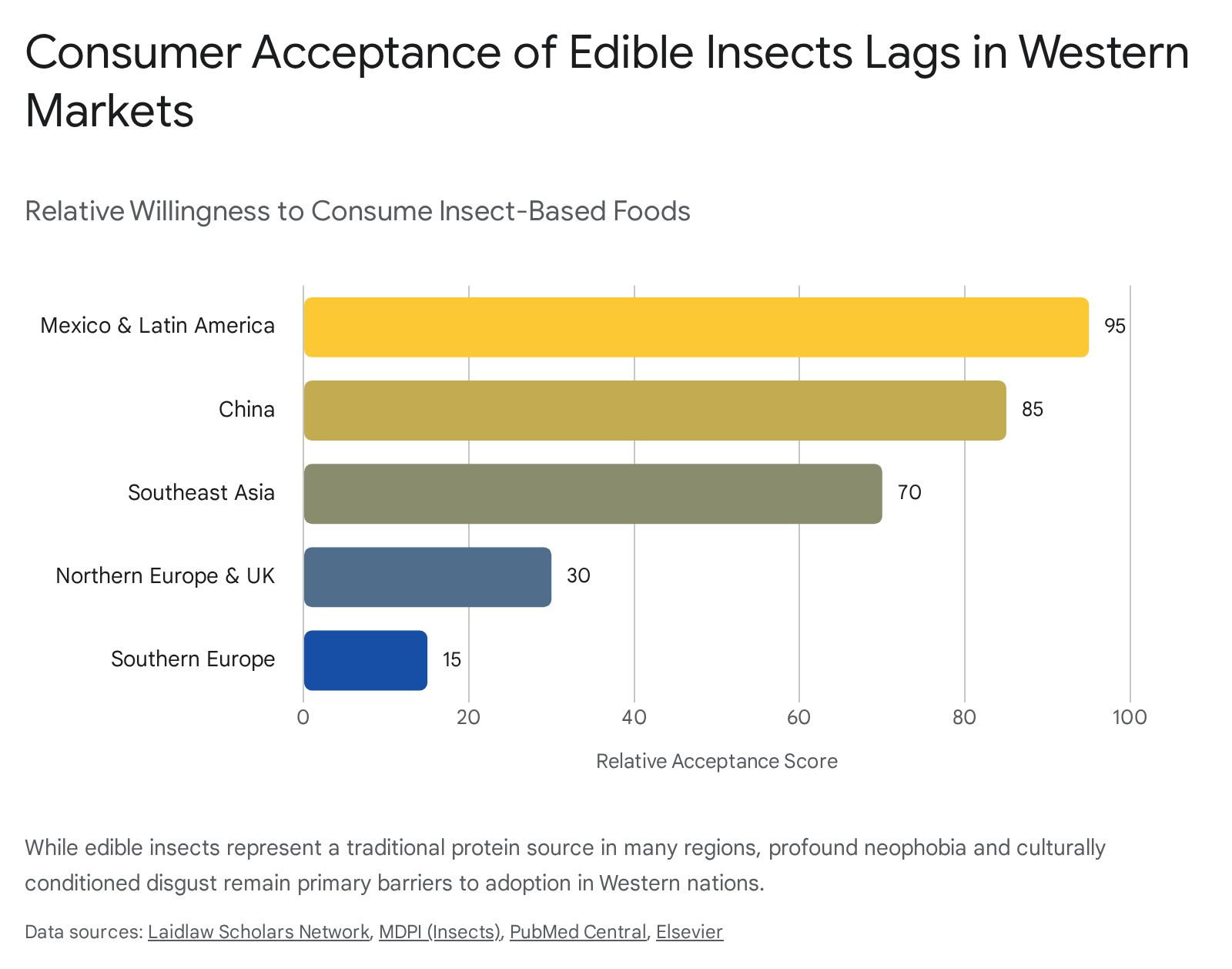
In stark contrast, insect consumption in Western societies encounters profound psychological resistance, primarily driven by core disgust and food neophobia (the fear of novel foods) 58485051. This aversion is heavily conditioned by historical narratives. During the colonial era, European settlers encountered indigenous populations practicing entomophagy and systematically devalued the practice as primitive and unsophisticated, establishing lasting cultural hierarchies regarding diet 58.
This historical marginalization intersects powerfully with the behavioral immune system. Because Western urban environments typically classify insects strictly as pests and pathogen vectors, the conceptual category of "insect" is irrevocably tied to contamination 585052. Consequently, efforts to introduce insect proteins to Western consumers frequently fail because they treat the rejection as a rational information deficit, assuming that educating the public on the environmental sustainability or protein content of insects will overcome the aversion 144853.
Because core disgust is ideational, logical arguments regarding sustainability cannot easily override the contamination reflex. The primary reason cited for unwillingness to consume whole insects across diverse demographics remains visual appearance and the perception of un-naturalness 165254. However, processing insects into invisible powders mitigates visual triggers and significantly increases acceptance rates. In a cross-cultural evaluation involving 13 countries, the willingness to consume insect-based products was highly variable but generally improved when the insect component was visually disguised within familiar food matrices 55.
Chemical Processing and Fermentation
Fermentation presents a complex intersection of biology and culture, as the process inherently mimics the early stages of decay - a primary elicitor of pathogen avoidance 15657. Consequently, fermented products often elicit intense initial disgust from cultural outsiders, while being highly prized by the communities that developed them.
The traditional Icelandic dish hákarl exemplifies extreme food processing necessitated by ecological constraint. Early Nordic settlers faced harsh Arctic environments with limited resources 6970. The indigenous Greenland shark offered an abundant caloric source, but its fresh flesh is lethally toxic due to extreme concentrations of urea and trimethylamine N-oxide (TMAO), biological adaptations required for survival in freezing deep waters 697071. To render the meat edible, Icelanders developed a method of burying and pressing the shark for months, allowing complex bacterial communities - dominated by Firmicutes, Bacilli, and Clostridia - to enzymatically break down the toxins 58. The resulting product is highly alkaline and releases massive amounts of trimethylamine, generating a volatile chemical profile dominated by ammonia and sulfurous compounds 7158.
To an uninitiated consumer, the pungent odor triggers an immediate, violent disgust reflex, as the behavioral immune system interprets the chemical profile as dangerous decay 6971. However, within Icelandic culture, the mastery over a toxic resource has elevated hákarl to a symbol of historical resilience and group identity, ritually consumed during midwinter festivals such as Þorrablót 69707359.
Similarly, the durian fruit commands a USD 25 billion global market, driven predominantly by demand in Southeast Asia, where it is revered for its complex flavor profile and custard-like texture 757677. Yet, its extreme volatility - producing an odor frequently compared to sewage or rotting onions - triggers severe distaste and pathogen-avoidance alarms in unaccustomed Western consumers 7577. Mainstream acceptance in non-native markets is slow, largely restricted by odor sensitivities that trigger biological disgust mechanisms, necessitating expensive frozen and odor-mitigated supply chains to facilitate global trade 75777879.
In European contexts, general consumer perception of mainstream fermented foods (such as yogurt or sourdough) is positive and linked to perceived health benefits 56. However, the European DOMINO project survey revealed that acceptance drops significantly for novel or unfamiliar fermented products (such as tempeh, miso, or plant-based fermented meat substitutes), indicating that cultural familiarity is a strict prerequisite for overriding the baseline biological skepticism of fermented flavor profiles 56.
Blood and Organ Meats
The variable consumption of animal blood and organ meats further illustrates the arbitrary nature of cultural disgust boundaries. From a strictly nutritional standpoint, animal blood is a highly efficient source of protein and iron, utilized globally in traditional preparations 6061. In the United Kingdom and France, blood sausage (black pudding or boudin noir) is a standard culinary item, and in the Philippines, dinuguan (pork blood stew) and betamax (grilled coagulated blood cubes) are popular dietary staples 618283.
However, in many other cultures, blood is comprehensively tabooed. In Eastern Mediterranean and Middle Eastern cultures, strict religious prohibitions rooted in Judaism and Islam explicitly forbid the consumption of blood, establishing an ideological framework where blood is viewed as a severe spiritual and physical contaminant 3560. Even in Greece, where ancient culinary traditions routinely included blood-based dishes like hematites (blood sausages), modern consumption is largely viewed with distrust and aversion, save for highly localized exceptions where specific historical influences preserved the practice 60.
In the contemporary Global North, the utilization of offal (organ meats) is remarkably low compared to the Global South 61. Despite the historical ubiquity of offal consumption, modern Western diets have progressively marginalized these items, shifting them from standard fare to objects of disgust 1761. This shift demonstrates how evolving socio-economic paradigms construct new disgust triggers; as muscular cuts of meat became widely affordable, organ meats were stigmatized as "poverty food," eventually transitioning from merely undesirable to actively disgusting 17. However, mimetic desirability can reverse this trend. As high-end culinary institutions begin to feature specific organ meats, the social modeling alters the perception, slowly eroding the disgust barrier for affluent consumers 17.
Sustainable Proteins and Cultivated Meat
As the global population expands, the development of sustainable protein alternatives has become imperative. However, consumer acceptance of these products highlights the complex interplay between environmental logic and intuitive disgust.
| Protein Alternative | Primary Consumer Driver | Primary Barrier / Disgust Trigger | Regional Acceptance Nuances |
|---|---|---|---|
| Plant-Based Meat | Environmental sustainability, perceived health benefits | Price premiums, textural discrepancies | High general intent; specific resistance in some Asian markets focused on hygiene |
| Cultivated (Lab) Meat | Animal welfare, reduced ecological footprint | Perception of severe un-naturalness, distrust of biotechnology | Strong resistance from consumers prioritizing "purity" as a moral foundation |
| Edible Insects | High protein density, extreme resource efficiency | Core pathogen disgust, food neophobia, unappealing visual cues | High traditional acceptance in Asia/Latin America; severe psychological rejection in Western markets |
Surveys conducted across Southeast Asia reveal that consumption intent is highest for plant-based alternatives, followed by cultured meat, with insect-based products ranking lowest 1684. The primary barrier to cultured meat is the perception of "un-naturalness." As the Deviance Hypothesis outlines, consumers intuitively reject foods that violate internalized norms regarding the origin of food. Because cultivated meat violates the fundamental conceptual category of how meat is produced, it triggers a normative deviance alarm that mimics core pathogen disgust 141516.
Addressing these aversions requires nuanced communication strategies. For consumers who heavily prioritize "purity" as a moral foundation, the perceived un-naturalness of lab-grown meat creates an almost insurmountable disgust barrier, regardless of arguments regarding animal welfare 62. Overcoming these aversions will likely depend less on logical persuasion and more on gradual cultural normalization. As novel foods achieve price parity and become visually and culturally familiar, the perception of normative deviance will subside, eventually neutralizing the culturally constructed disgust response 141584.