
Rising perfectionism and its effects on achievement and anxiety
Multidimensional Frameworks of Perfectionism
Perfectionism is a complex, multidimensional personality trait characterized by the relentless pursuit of flawlessness, the setting of excessively high performance standards, and a tendency toward overly critical self-evaluations 12. Historically, perfectionism was treated as a unidimensional construct, colloquially understood as a mere desire to excel or a rigorous attention to detail. However, modern psychological science recognizes that perfectionism encompasses various cognitive, behavioral, and interpersonal dimensions that dictate how expectations are formed and how failures are internalized 235.
The most widely adopted framework for understanding this trait is the Multidimensional Perfectionism Scale (MPS) developed by Hewitt and Flett, which delineates perfectionism into three primary dimensions based on the origin and direction of perfectionistic expectations 3456:
- Self-Oriented Perfectionism (SOP) involves imposing exacting standards upon oneself. Individuals high in SOP are intensely self-critical when these internal standards are not met and often tie their core self-worth directly to their achievements 237. SOP is frequently rooted in early childhood experiences where love and acceptance were perceived as conditional upon performance 28.
- Socially Prescribed Perfectionism (SPP) reflects the belief that others hold unrealistic expectations of the individual and will evaluate them harshly if these standards are not achieved 237. SPP involves a chronic fear of negative evaluation and is heavily associated with feelings of inadequacy, pressure, and the perception that one must be flawless to secure social approval or belonging 3910.
- Other-Oriented Perfectionism (OOP) entails projecting unrealistic standards of perfection onto others. Individuals high in OOP become highly critical, hostile, or dismissive when peers, subordinates, or family members fail to meet their exacting expectations, which frequently leads to interpersonal friction and low-trust environments 23713.
The Adaptiveness Debate
Beyond the directionality of expectations, researchers heavily differentiate between the motivational aspects of the trait, categorizing them as perfectionistic strivings versus perfectionistic concerns 111213. Perfectionistic strivings, sometimes termed adaptive perfectionism, relate to the setting of high personal standards and a strong achievement orientation. Evidence suggests that individuals exhibiting adaptive perfectionism derive satisfaction from the pursuit of excellence, utilize task-oriented coping strategies when faced with setbacks, and maintain the psychological flexibility to adjust their standards based on situational demands 1141815.
Conversely, perfectionistic concerns, or maladaptive perfectionism, are driven by an intense fear of failure, chronic doubts about actions, and distress over the discrepancy between performance and expectations 11121617. Maladaptive perfectionists frequently engage in emotion-oriented or avoidance-based coping strategies, such as procrastination, due to the paralyzing anxiety that their output will not be flawless 141818.
To clarify these theoretical distinctions, Table 1 contrasts the characteristics and common outcomes associated with adaptive versus maladaptive perfectionism in the psychological literature.
| Trait Dimension | Adaptive Perfectionism (Strivings) | Maladaptive Perfectionism (Concerns) |
|---|---|---|
| Core Motivation | Pursuit of excellence and personal growth. | Fear of failure and negative evaluation. |
| Cognitive Style | Flexible standards; acceptance of minor flaws. | "All-or-nothing" thinking; excessive self-criticism. |
| Response to Failure | Disappointment followed by rapid recovery and task-oriented coping. | Rumination, shame, and emotion-oriented or avoidance-based coping. |
| Self-Worth | Independent of immediate performance outcomes. | Highly contingent on flawless achievement and external validation. |
| Psychological Outcomes | Higher self-efficacy, positive affect, and life satisfaction. | Elevated risk for anxiety, depression, burnout, and somatic distress. |
It is crucial to note that the binary classification of perfectionism as purely "adaptive" or "maladaptive" remains heavily debated among clinical psychologists. Many researchers, including the architects of the MPS, argue that while high standards are not inherently pathological, the rigid need to be perfect is rarely adaptive. Longitudinal research indicates that even perfectionistic strivings can devolve into clinical distress when individuals face sustained pressure, repeated failures, or unavoidable life stressors, supporting a specific vulnerability hypothesis 13192021.
Longitudinal Cohort Trends
Over the past three decades, empirical data demonstrates a pronounced and linear escalation in perfectionistic traits among young populations, signifying a profound cultural shift in how modern generations evaluate themselves and their peers.
In a landmark cross-temporal meta-analysis encompassing 41,641 college students from the United States, Canada, and the United Kingdom between 1989 and 2016, researchers established that modern youth are significantly more burdened by perfectionism than prior generations 72223. Controlling for gender and cross-country variances, the analysis revealed that self-oriented perfectionism increased by 10%, other-oriented perfectionism increased by 16%, and socially prescribed perfectionism surged by 33% 723.
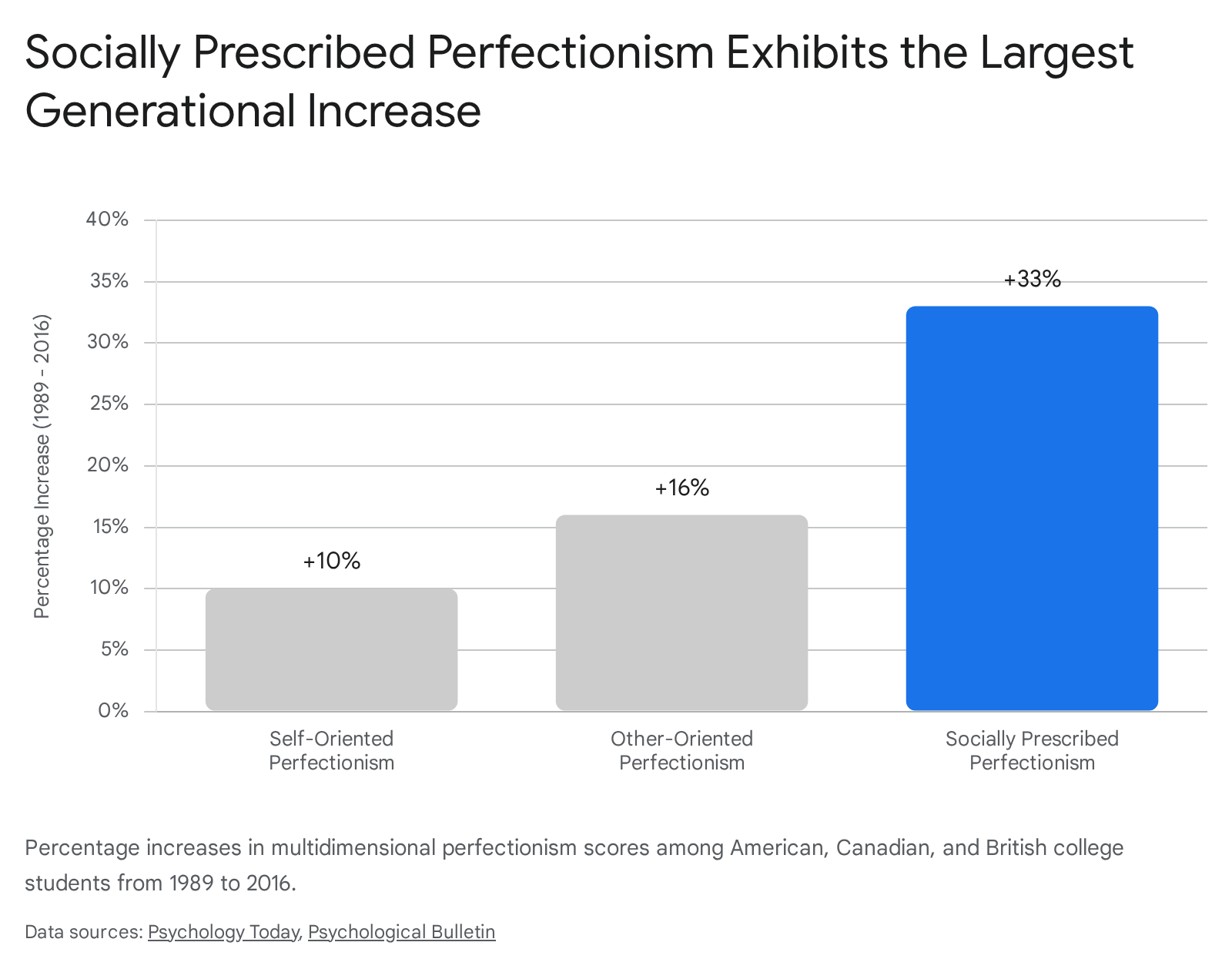
This data indicates not only that recent generations are demanding more of themselves and others, but crucially, that they perceive their environments and peer groups to be increasingly demanding and critical of them 923.
Trajectories in the Post-Pandemic Era
Recent updates analyzing data through 2024 suggest these trends have not plateaued but are rising exponentially, particularly concerning corollaries of perfectionism such as doubts about actions and concern over mistakes 9. Furthermore, the COVID-19 pandemic acted as an accelerant for perfectionistic distress. Longitudinal studies tracking adolescents and emerging adults before and during government-mandated lockdowns observed that individuals with high baseline perfectionistic strivings experienced more severe psychological distress, perceived stress, and emotional exhaustion during the crisis 242526.
The erosion of psychological safety during the pandemic intensified the internal demands of perfectionists, as they struggled to maintain pre-pandemic levels of achievement in profoundly disrupted environments 2425. Post-pandemic workplace evaluations confirm this entrenched culture; a 2025 national study involving 1,728 professionals found that 93% of respondents struggled with perfectionism, with 59% noting it significantly increased their risk of occupational burnout 13.
Societal and Cultural Catalysts
The epidemiological rise in perfectionism cannot be attributed solely to shifting biological or individual factors; rather, it is symptomatic of broader macroeconomic, cultural, and technological transformations that have fundamentally altered the environment in which modern populations mature.
Meritocracy and Hustle Culture
Over the past four decades, educational and professional environments have been heavily influenced by neoliberal governance and an intense emphasis on competitive individualism 2327. The modern achievement culture operates on the premise of meritocracy, dictating that relentless effort and flawless execution are the sole pathways to social mobility, economic security, and personal worth 7928.
This paradigm has birthed the phenomenon of hustle culture, a societal narrative that glorifies overwork, blurs the boundaries between professional and personal life, and frames exhaustion as a metric of dedication 8282934. Hustle culture propagates the myth that human capacity is limitless, incentivizing young adults to relentlessly optimize their productivity at the expense of psychological resilience and rest 2829. The systemic scarcity of secure employment and the hyper-competitiveness of university admissions mean that students increasingly view minor academic setbacks not as learning opportunities, but as catastrophic failures that threaten their future viability 73031. Consequently, perfectionism emerges as a maladaptive coping mechanism - a psychological shield utilized to navigate high-stakes environments and to establish a sense of safety, connection, and worth 730.
Parental Expectations and Criticism
The transmission of perfectionism is heavily influenced by the family unit. Research analyzing multi-generational cohorts indicates a robust correlation between shifting parenting styles and the rise of socially prescribed perfectionism 937. In a meta-analysis of nearly 24,000 college students across 84 studies, researchers observed a linear increase in both parental expectations and parental criticism from 1989 to 2019 93732. Modern parents, anxious about their children's prospects in an increasingly stratified economy, frequently adopt highly involved parenting styles characterized by conditional approval.
These elevated parental expectations are readily internalized by children. When youth perceive parental love or approval as contingent upon academic or extracurricular perfection, they develop a fragile, performance-based sense of self-esteem 2832. Data indicates that perceived parental expectations exert an even larger impact on the development of self-oriented and other-oriented perfectionism than overt parental criticism, suggesting that the subtle pressure to excel can be just as psychologically taxing as direct reprimand 32.
Social Media and Upward Comparison
Digital environments and social media platforms have fundamentally altered the mechanics of social comparison, exposing young people to an inescapable barrage of curated, idealized, and often algorithmically enhanced realities 283334. The Norwegian LifeOnSoMe study highlighted that adolescents who heavily engage in self-presentation and upward social comparison online exhibit significantly higher levels of perfectionism and vulnerability to eating disorders 33.
Social media acts as a catalyst for socially prescribed perfectionism by quantifying social approval through metrics such as likes, followers, and engagement rates 3334. In this digital environment, users are not merely comparing themselves to their immediate physical peers, but to a globalized standard of curated physical beauty, professional success, and lifestyle optimization 3334. The constant visibility of perfection fosters a chronic sense of inadequacy, triggering the self-critical cognitive loops characteristic of maladaptive perfectionists who believe they must constantly perform to earn their place in the social hierarchy 92833.
Cross-Cultural Variances in Perfectionism
While much of the foundational research on multidimensional perfectionism relies on Western samples, cross-cultural studies reveal that the etiology, expression, and psychological impact of perfectionism vary significantly across cultural and geographical contexts 27353637.
East Asian Examination Cultures
East Asian cultures, particularly those in China, South Korea, and Japan, present a unique environment for the cultivation of perfectionism due to a complex interplay of collectivist social structures and highly standardized, high-stakes examination systems 27383940. In nations utilizing national college entrance examinations, such as China's Gaokao and South Korea's Suneung, a single test score can determine a student's lifelong academic and professional trajectory 2740. This framework institutionalizes socially prescribed perfectionism, as the pressure to execute flawlessly is derived not merely from internal motivation, but from explicit state and societal infrastructure 2740. Research among Korean high school students demonstrates a significant positive correlation between socially prescribed perfectionism, other-oriented perfectionism, and severe test anxiety 3941.
Cognitive Styles and Acculturation
East Asian cognitive and relational frameworks differ substantially from Western individualism. Western cultures often favor analytic cognitive styles and dispositional attributions, locating the drive for success within the individual 3637. In contrast, East Asian cultures frequently utilize holistic cognitive styles and situationist folk psychologies, placing greater emphasis on contextual factors, familial duty, and adherence to group norms 3637. Furthermore, cross-cultural comparisons of positive self-feelings using the Implicit Associations Test for Self-Esteem (IATSE) show no fundamental cultural difference in true self-enhancement motivations, yet East Asian populations consistently report higher explicit self-criticism, reflecting cultural norms of modesty and self-negation rather than inherent psychological deficits 3842.
When international students from these collectivist frameworks enter Western educational systems, they frequently experience profound acculturative stress 3538. Western pedagogies often prioritize independent conjecture, self-expression, and process-oriented learning over the rote accuracy and rigid methodologies prioritized in Eastern examination cultures 38. This disconnect exacerbates perfectionistic distress, as students find their internalized standards of flawless execution unrecognized by institutions that reward differing cultural metrics of success, ultimately leading to institutional alienation 38.
Perfectionism and Achievement Outcomes
A recurring debate in educational and occupational psychology is whether perfectionism, despite its psychological toll, acts as an effective driver of objective achievement. The evidence presents a nuanced picture, suggesting that while specific facets of perfectionism correlate with high performance, the overall efficiency and sustainability of perfectionism as a motivational tool are highly questionable 11320.
Perfectionistic strivings show positive, albeit modest, correlations with self-regulated learning, conscientiousness, and academic efficacy 63943. Students and professionals who set high personal standards without overwhelming concern for mistakes tend to engage in task-oriented coping, demonstrate high motivation, and recover more quickly from setbacks 11844. In youth sports and academics, individuals adopting a mastery-approach orientation - focusing on personal growth and effort rather than avoiding failure - exhibit lower trait anxiety and more sustainable performance trajectories compared to those with mastery-avoidance goals 1112.
However, the assumption that perfectionism is a prerequisite for exceptional achievement is contradicted by empirical meta-analyses. Studies comparing perfectionists to non-perfectionists reveal that perfectionism frequently has a negligible or statistically insignificant impact on long-term job performance and academic grades 135. When inspecting zero-order correlations within minority ethnic groups, for instance, research shows virtually no significant relationship between perfectionism measures and self-reported college grade point averages 35. The marginal gains derived from meticulousness are frequently offset by the paralyzing behavioral consequences of maladaptive perfectionism, such as chronic procrastination, risk aversion, and diminished creative problem-solving 142151.
Academic and Occupational Burnout
In educational and workplace environments, perfectionism is intimately linked to the epidemic of burnout. The compulsion to over-prepare and overwork in pursuit of an unattainable ideal rapidly depletes cognitive and emotional resources, precipitating emotional exhaustion 245. Table 2 illustrates the global prevalence and demographic distribution of academic burnout, heavily driven by academic pressure and perfectionistic concerns.
| Demographic / Region | Burnout Prevalence | Key Contributing Factors |
|---|---|---|
| Global Average (University) | 31.4% to 35.0% | Heavy workload, academic pressure, emotional exhaustion. |
| United States | 52.0% | High-stakes testing, meritocratic pressures, financial stress. |
| Female Students | 62.0% | Elevated socially prescribed expectations, higher baseline anxiety. |
| Medical / STEM Students | 44.5% to 50.7% | Rigorous curricula, intense competition, fear of negative evaluation. |
| First-Generation Students | +28.0% relative risk | Lack of systemic support, higher perceived familial expectations. |
Burnout is generally characterized by emotional exhaustion, cynicism, and a sense of reduced personal efficacy 435346. When exhaustion inevitably degrades a perfectionist's performance, the resulting discrepancy between actual output and their perfectionistic standards triggers severe anxiety, which further impairs their coping mechanisms 4143. The ensuing cognitive dissonance frequently results in cynicism and academic disengagement as the individual psychologically withdraws from the environment to protect a fragile, performance-based self-esteem 245.
Psychopathology and Global Mental Health
The data unequivocally indicates that whatever marginal benefits perfectionism offers to achievement are vastly eclipsed by its role as a primary driver of modern psychological distress. Perfectionism operates as a transdiagnostic vulnerability factor - a core cognitive architecture that significantly increases the risk for a wide spectrum of psychopathology, including generalized anxiety disorder (GAD), major depressive disorder (MDD), obsessive-compulsive disorder (OCD), and eating disorders 1819314748.
Global Youth Mental Health Declines
The generational surge in perfectionism tightly correlates with alarming data regarding global youth mental health. According to the World Health Organization (WHO) and the Global Burden of Disease (GBD) 2021 study, the incidence of depression and related Disability-Adjusted Life Years (DALYs) among individuals under the age of 30 increased by over 50% from 1990 to 2021 495051. In 2021, the global prevalence of anxiety and depressive disorders reached 359.2 million and 332.4 million cases, respectively, disproportionately affecting younger populations 50.
Longitudinal data confirms a steady deterioration in the mental well-being of adolescents and emerging adults across multiple developed nations 52. Research from the National Bureau of Economic Research in 2025 indicated a stark shift in despair rates; historically, psychological distress followed a U-shaped curve peaking in midlife, but modern data shows despair rates among young adults aged 18 to 24 have surpassed those of prime-age adults, driven heavily by societal pressures and internalized inadequacy 53. Perfectionistic concerns heavily mediate this distress. The chronic activation of the sympathetic nervous system caused by the persistent fear of failure leads to severe somatic symptoms, including insomnia, physical tension, and psychosomatic illnesses 162134.
The Perfectionism Social Disconnection Model
To fully comprehend how perfectionism drives severe distress, including hopelessness and suicide ideation, clinical psychologists utilize the Perfectionism Social Disconnection Model (PSDM) 545556.
The PSDM posits that the core danger of perfectionism lies not just in the internal pressure to succeed, but in the profound interpersonal alienation it generates. Perfectionists driven by socially prescribed demands typically exhibit a hypersensitivity to criticism, hostility, and a defensive, distant posture in relationships 35556. Because they believe that acceptance is entirely conditional upon flawless performance, they engage in perfectionistic self-presentation, actively hiding their flaws, avoiding vulnerability, and refusing to seek help even when in acute distress 24854.
This behavior fosters a dual layer of social disconnection. Objectively, their hostility and need to project superiority can alienate peers, leading to actual social isolation 956. Subjectively, even when surrounded by peers, perfectionists experience deep loneliness and anti-mattering - the feeling of being insignificant or marginalized - because they believe that any validation they receive is directed at their flawless persona rather than their authentic self 105457. This profound interpersonal hopelessness fully mediates the relationship between perfectionism and suicidal ideation, illustrating that the ultimate toll of perfectionism is relational starvation 5758.
Intervention Strategies and Limitations
Given the widespread psychological damage inflicted by maladaptive perfectionism, psychological and educational interventions are critical. The clinical literature strongly supports the efficacy of Cognitive-Behavioral Therapy (CBT) and third-wave behavioral approaches, such as Mindfulness-Based Cognitive Therapy (MBCT) and Compassion-Focused Therapy (CFT), in treating perfectionistic tendencies 818195159.
CBT focuses on helping individuals identify and restructure cognitive distortions central to perfectionism, such as all-or-nothing thinking, catastrophizing, and disqualifying the positive 51. By challenging the irrational belief that minor errors equate to total failure, therapists help clients develop psychological flexibility and adopt a good enough paradigm 1851. However, the most transformative antidote to maladaptive perfectionism appears to be the cultivation of self-compassion. Research consistently demonstrates that self-compassion fully mediates the relationship between perfectionism and psychological distress 815. When individuals learn to treat themselves with kindness during moments of failure and recognize imperfection as a shared human experience, the toxic cycle of shame and burnout is disrupted 81551.
Challenges in School-Based Interventions
Despite clinical successes, translating these interventions into universal school and workplace environments presents significant challenges. Universal school-based interventions aimed at reducing perfectionism often yield mixed, insignificant, or paradoxically negative results 606162. A major hurdle is that students with high baseline levels of self-critical perfectionism are highly resistant to treatment; their perfectionism causes them to view the intervention itself as another domain in which they must perform perfectly, and they frequently refuse to engage in vulnerability for fear of appearing flawed to their peers 486062. Furthermore, some studies indicate that unstructured awareness programs can unintentionally increase perfectionistic strivings by drawing excessive attention to performance standards 61.
Consequently, experts argue that combating the perfectionism epidemic requires more than individual psychological treatment; it necessitates systemic cultural reform 1363. Educational institutions and corporate organizations must actively dismantle the architectures of hustle culture by cultivating environments characterized by psychological safety 1063. Leaders and educators must shift away from outcome-based praise, which rewards only the final metric, and pivot toward effort-based feedback, openly normalizing failure as an integral component of the learning and innovation process 10111219. Disentangling human worth from flawless execution is an essential prerequisite for reversing the escalating trajectory of perfectionism-driven anxiety.