
Results of the IIT and GNWT adversarial collaboration
The quest to identify the physical origins of subjective experience stands as one of the most profound and historically intractable challenges in modern science. Historically relegated to the domains of philosophy, theology, and abstract metaphysics, the "hard problem of consciousness" - the question of why complex physical processing in the brain is accompanied by an internal, qualitative, subjective experience - has in recent decades transitioned into a rigorous, heavily funded empirical pursuit. The maturation of neuroimaging technologies, sophisticated computational neuroscience, and large-scale data analysis has catalyzed the proliferation of scientific theories attempting to map the precise neural correlates of consciousness (NCC). However, progress in the field has long been severely fragmented by methodological silos, confirmation bias, and isolated experimental designs, with rival theoretical camps producing divergent lines of evidence that rarely intersect on common empirical ground.
To systematically overcome this impasse, the consciousness research community has increasingly turned toward the framework of adversarial collaborations. The most ambitious and highly scrutinized of these efforts to date is the Cogitate Consortium, an unprecedented, globally distributed scientific initiative designed to force a direct, empirical confrontation between the two most dominant theoretical frameworks in the field: Integrated Information Theory (IIT) and Global Neuronal Workspace Theory (GNWT). By establishing pre-registered, theory-neutral experimental protocols, the consortium aimed to rigorously test conflicting predictions regarding the neuroanatomical locus, temporal dynamics, and functional connectivity underlying conscious awareness. Yet, the culmination of this massive effort has generated as much controversy as it has clarity. Beyond the immense methodological complexities of isolating pure phenomenal consciousness from the cognitive machinery of task reporting, the neuroscientific community has been fractured by fierce debates over the epistemological limits of these theories. This friction climaxed in highly publicized accusations of pseudoscience, threatening to plunge the field into a "consciousness winter." This exhaustive report provides a granular analysis of the IIT-GNWT adversarial collaboration, dissecting the foundational theories, the empirical methodology, the deeply mixed nature of the findings, the critical necessity of the "no-report" paradigm, and the profound scientific and sociological fallout that continues to reverberate through the global academic community.
Foundational Premises: Two Divergent Paradigms of Experience
To fully grasp the magnitude and specific targets of the Cogitate Consortium's undertaking, one must first clearly delineate the foundational architectures of the two theories placed under the empirical microscope. IIT and GNWT do not merely differ in their anatomical predictions regarding where consciousness happens; they operate on fundamentally distinct philosophical, biological, and epistemological definitions of what consciousness actually is, and what specific aspects of cognition require explanation.
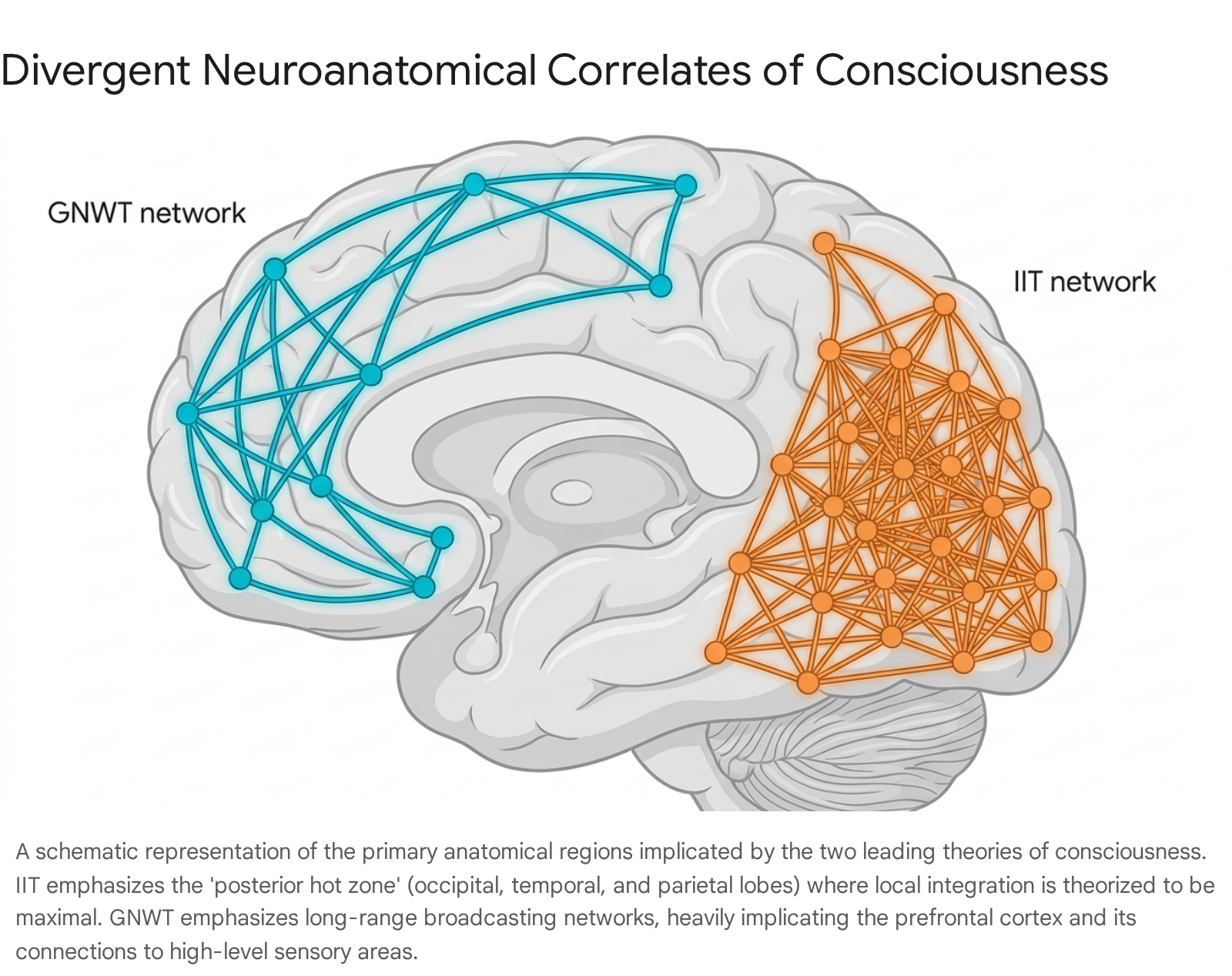
Global Neuronal Workspace Theory (GNWT)
Originally proposed by cognitive scientist Bernard Baars in 1988 and heavily developed mathematically and neurobiologically over the last two decades by Stanislas Dehaene, Jean-Pierre Changeux, and others, Global Neuronal Workspace Theory approaches consciousness primarily as an evolved computational architecture 11. GNWT is fundamentally a theory of access consciousness - it seeks to explain how specific pieces of sensory or cognitive information become globally available to various highly specialized, but otherwise isolated, cognitive subsystems such as working memory, language comprehension, and motor control 123.
The core premise of GNWT is that the human brain contains a multitude of specialized, unconscious processors (for example, localized visual edge detectors or auditory frequency analyzers) operating in parallel. A sensory stimulus remains unconscious as long as its processing is confined to these local, modular networks 1. Consciousness arises only when this localized information crosses a specific energetic threshold and triggers a non-linear, widespread "ignition" across the brain 14. During this ignition phase, information is broadcasted across a "global workspace" comprising a densely interconnected network of long-range pyramidal neurons. This global broadcasting requires the active participation and synchronization of higher-order associative areas, most notably the prefrontal cortex (PFC) and the posterior parietal cortex (PPC) 356.
According to GNWT, conscious perception is not a continuous, unbroken stream of awareness, but rather a sequence of discrete, metastable snapshots. The theory specifically predicts that conscious access involves a late, phasic burst of neural activity (the aforementioned ignition) occurring approximately 300 to 500 milliseconds after stimulus onset 45. Following this initial ignition, GNWT posits a period of activity-silent maintenance in working memory, where the information is held without continuous high-level firing, potentially followed by another discrete ignition event at the stimulus offset if the subject becomes consciously aware of its disappearance 45. In essence, GNWT posits that the subjective feeling of awareness is synonymous with the global availability and mobilization of information.
Integrated Information Theory (IIT)
In stark contrast to GNWT's functionalist and computational approach, Integrated Information Theory, initially formulated by neuroscientist Giulio Tononi in 2004 and championed by Christof Koch, is a "consciousness-first" paradigm. Rather than starting with physical brain mechanisms and asking how they might computationally produce subjective experience, IIT begins with phenomenological axioms - the indubitable, subjective properties of experience itself 78911. IIT asserts that every conscious experience fundamentally possesses five axiomatic properties: it is intrinsic (existing for itself), specific (composed of particular qualities), unitary or integrated (cannot be subdivided into independent experiences), definite (has distinct borders), and structured 912.
From these phenomenological axioms, IIT mathematically derives physical postulates. It claims that for any physical system to support consciousness, its underlying causal structure must perfectly map onto these experiential properties. The degree of consciousness present in a system is rigorously quantified by a mathematical metric known as $\Phi$ (Phi), which measures the system's "maximally irreducible cause-effect structure" 91110. If a physical system can be mathematically partitioned into completely independent parts without losing any information about its past or future states, its $\Phi$ is zero, and it is entirely unconscious. Conversely, the higher the $\Phi$, the richer and more unified the subjective conscious experience 111214.
Neurobiologically, IIT does not look for long-range broadcasting hubs, but rather for regions of the brain that possess the optimal cytoarchitecture for maximum local integration and differentiation. The theory predicts that the physical substrate of consciousness resides not in the long-range, sparse connections of the prefrontal cortex, but rather in the dense, grid-like, topographically organized networks of the posterior cortex - a region IIT explicitly terms the "posterior hot zone," encompassing the occipital, temporal, and parietal areas 345. Crucially, IIT does not equate consciousness with cognitive access, working memory, or behavioral reportability; it focuses exclusively on phenomenal consciousness - the raw, qualitative "what it is like" to experience a specific state 12. Furthermore, IIT hypothesizes that conscious experience strictly correlates with sustained, continuous neural synchronization within this posterior hot zone for the entire duration of the perceived experience, a direct temporal contradiction to GNWT's prediction of brief, intermittent ignitions 45.
The Cogitate Consortium: Adversarial Testing on a Global Scale
The historical tendency in consciousness science has been for theorists to design highly specific experiments that inherently favor the parameters of their own models, leading to a sprawling, often contradictory literature of disconnected findings. The Cogitate Consortium (Collaboration On GNW and IIT: Testing Alternative Theories of Experience) was formed specifically to shatter these methodological silos through an adversarial collaboration - an approach pioneered by Nobel laureate Daniel Kahneman 61116.
The consortium represents an extraordinary feat of cross-border scientific coordination and international diversity. Funded generously by the Templeton World Charity Foundation, it is a massive, globally distributed apparatus involving leading laboratories and researchers across three continents. Key participating institutions span the United States (including Yale School of Medicine, Harvard Medical School, NYU Grossman School of Medicine, and the University of Wisconsin - Madison), the United Kingdom (University of Birmingham, University of Oxford, Newcastle University, and University College London), Germany (Max Planck Institute for Empirical Aesthetics in Frankfurt), Israel (Tel Aviv University), China (Peking University, Beijing Language and Culture University), and the Netherlands (Donders Institute at Radboud University) 6121319. This geographic and institutional diversity ensured that the experimental protocols were executed independently by theory-neutral researchers, preventing any single theoretical faction from subtly influencing data collection, preprocessing, or interpretation 619.
To rigorously arbitrate between IIT and GNWT, the consortium required proponents of both theories to agree, in advance, to a pre-registered set of predictions and the specific statistical criteria that would constitute a "pass" or "fail" for their respective models 14. The primary study tested 256 human subjects - an exceptionally robust sample size for this specialized domain - utilizing a highly sensitive, tri-modal neuroimaging approach. This methodology combined functional magnetic resonance imaging (fMRI) for high spatial resolution, magnetoencephalography (MEG) for high temporal resolution, and intracranial electroencephalography (iEEG) for direct, fine-grained cortical measurements in epilepsy patients 46.
Pre-registered Predictions and Empirical Outcomes
The experimental design required subjects to view a series of suprathreshold visual stimuli (images of faces, objects, letters, and false fonts) for variable durations. The consortium tested three core predictions relating to the anatomical location, temporal maintenance, and functional connectivity of the neural correlates of conscious content. The comparative breakdown of these predictions and the actual empirical findings, initially released via preprint in 2023 and formally published in the April 2025 issue of Nature, are detailed in the table below 4714.
| Dimension | Integrated Information Theory (IIT) | Global Neuronal Workspace Theory (GNWT) | Actual Findings from the 2023/2025 Study |
|---|---|---|---|
| Prediction #1: Decoding of Conscious Content (Anatomical Focus) | Conscious content is maximally decodable in the posterior "hot zone" (occipital/temporal regions) independent of task relevance. Adding Prefrontal Cortex (PFC) data will not improve decoding accuracy. | Conscious content must be decodable in the Prefrontal Cortex (PFC), as global broadcasting to this executive area is necessary for conscious access. | IIT Supported: Robust, task-independent decoding of content (category and orientation) was found in the posterior cortex; adding PFC data did not improve, and sometimes decreased, accuracy. GNWT Mixed: Category information was successfully decoded in the PFC, supporting the theory. However, orientation data was not reliably decodable in the PFC across the higher spatial resolution modalities (fMRI, iEEG), challenging the theory. |
| Prediction #2: Maintenance of Content Over Time (Temporal Focus) | Neural activity in the posterior cortex will be actively sustained for the entire duration the stimulus is consciously perceived. | The PFC will exhibit brief phasic "ignitions" (~0.3 - 0.5s) at stimulus onset and offset, with an activity-silent working memory state in between. | IIT Supported: Activation and representation of the conscious content were sustained continuously in the posterior cortex throughout the stimulus duration. GNWT Challenged: While an onset ignition was observed, it occurred earlier than predicted. Crucially, researchers failed to find the predicted late phasic ignition at stimulus offset in the PFC across modalities. |
| Prediction #3: Interareal Communication (Connectivity Focus) | Sustained, short-range synchronization within the posterior cortex (e.g., between lower-level V1/V2 and high-level category-selective areas) during the experience. | Phasic, long-range synchronization (specifically in gamma/beta frequencies) between high-level sensory areas and the PFC. | IIT Challenged: The predicted sustained, short-range synchronization in the posterior cortex was completely absent; connectivity was only transient, directly challenging IIT's mechanism for continuous integration. GNWT Mixed: The pre-registered primary analyses failed to show support. However, exploratory amplitude-based metrics showed PFC connectivity matching GNWT's predicted timing and gamma spectral composition. |
Correcting the Media Narrative: The Absence of a Definitive Victor
When the initial results of the Cogitate Consortium were revealed in June 2023, popular science media and the broader public discourse aggressively framed the adversarial collaboration as a gladiatorial contest, frequently rushing to declare one theory the undisputed winner 212223. A prevalent media misconception was that IIT decisively "defeated" GNWT because more of IIT's explicitly pre-registered predictions (two out of three) passed the designated statistical thresholds, compared to GNWT's overall failure to meet its strict pre-registered criteria 722. This narrative was further fueled by the contemporaneous resolution of a famous 25-year-old wager between philosopher David Chalmers and neuroscientist Christof Koch. Chalmers won the bet - and a case of fine wine - because no single, definitive "consciousness spot" had been discovered in the brain by 2023, an event that media outlets conflated with the Cogitate findings to suggest neuroscientific defeat 21.
A rigorous scientific analysis of the Cogitate findings reveals a far more nuanced, complex reality: the study resulted in fundamentally mixed findings where neither theory was perfectly validated, and neither was definitively falsified 51623. As the consortium authors, including co-senior authors Lucia Melloni, Liad Mudrik, and Michael Pitts, have stressed, both theories suffered significant empirical "bruises" 2215.
While IIT successfully predicted the sustained anatomical locus of decoding in the posterior hot zone, it critically failed its interareal communication prediction. The striking lack of sustained, short-range synchronization within the posterior cortex strikes at the very heart of IIT's mechanism for how information is continuously "integrated" to form a unified experience 4. Conversely, while GNWT was severely challenged by the absence of an offset ignition and inconsistent orientation decoding in the PFC, it found partial vindication. The data demonstrated that portions of the PFC (the middle frontal gyrus and inferior frontal gyrus) were visually responsive and actively involved in category decoding, and showed specific long-range connectivity patterns in exploratory analyses that align with GNWT principles 423.
The authentic scientific takeaway is not a binary win-loss record. Rather, the empirical data suggests that both theories may be capturing different, yet equally necessary, facets of the conscious process. It points toward a potential synthetic model where IIT accurately describes the initial phenomenal integration and continuous representation of content in the posterior cortex, while GNWT accurately describes the subsequent broadcasting, mobilization, and cognitive access of that content via the prefrontal cortex 23.
Methodological Imperative: The Criticality of the "No-Report" Paradigm
A pivotal methodological component of the Cogitate Consortium's experimental design - and a central debate in modern consciousness research - is the deployment and interpretation of the "no-report" paradigm. To understand the profound necessity of this approach, one must dissect the conceptual distinction between phenomenal consciousness and access consciousness, originally formalized by philosopher Ned Block in 1995 21617.
Phenomenal consciousness refers to the raw, qualitative, subjective "what it is like" to perceive a stimulus - the intrinsic redness of red, or the specific auditory tone of a musical note. Access consciousness refers to the availability of that phenomenal information to the brain's broader cognitive systems for reasoning, memory retention, and, crucially, verbal or motor reporting (e.g., pressing a button to indicate that the color red was seen) 21617.
For decades, standard consciousness experiments relied heavily on active report paradigms: a stimulus was flashed near the threshold of perception, and the subject actively reported whether they saw it or not. However, comparing brain activity during "seen" versus "unseen" trials in a report paradigm introduces a massive, systemic confound 1627. The neural activity observed does not merely reflect the pure phenomenal experience of seeing; it is heavily contaminated by post-perceptual cognitive processing. These cascading processes include holding the information in working memory, making a binary decision about what was seen, planning a specific motor action, and physically executing the button press 162718.
Because the prefrontal cortex is the primary engine of executive function, working memory, and motor planning, active report paradigms reliably elicit massive PFC activation. Proponents of IIT and other sensory-centric theories argue that GNWT's reliance on the PFC as a core generator of consciousness is largely an artifact of this task-based confound. They argue that the PFC is lighting up because the subject is reporting the experience, not because the PFC is generating the phenomenal experience itself 1619.
Isolating Phenomenal Experience
To strip away these cognitive and motor confounds, researchers utilize the no-report paradigm. In these sophisticated designs, participants are presented with visible stimuli but are not required to make any explicit perceptual judgments or motor responses related directly to the stimulus in question. Instead, their conscious awareness is either inferred through passive physiological indicators (such as pupil dilation or optokinetic nystagmus eye movements), or the experiment leverages a contrastive approach where neural activity during task-relevant and task-irrelevant trials are carefully compared 162032.
The no-report paradigm serves as the ultimate stress test for the prefrontal cortex's role in generating consciousness. When the requirement to report is successfully removed, several classical electrophysiological signatures previously championed as definitive Neural Correlates of Consciousness - most notably the late, broad P3b event-related potential - dramatically shrink or disappear entirely, suggesting they reflect post-perceptual processing rather than awareness 17271832. Similarly, fMRI activation in the frontal lobe is largely diminished in strict no-report conditions, while activity in the posterior occipital and parietal lobes remains robust and decodable 1621. This provides powerful evidence for IIT's assertion that the posterior hot zone is the true seat of phenomenal experience, while the fronto-parietal workspace is an auxiliary system recruited subsequently for cognitive access 161932.
Deepening the Analysis of Experimental Limitations
However, the no-report paradigm is not a flawless methodological panacea. By eliminating explicit behavioral reports, researchers introduce a severe epistemological vulnerability into the experimental design: it becomes exceedingly difficult to definitively prove that a subject actually experienced a conscious percept at the exact moment the data was recorded 2021.
In the absence of a required report, a subject may be staring directly at a visual stimulus, yet entirely fail to consciously register it due to inattentional blindness, mind-wandering, or simple fatigue 17. If researchers assume the subject was conscious, they risk fundamentally mislabeling the data. Conversely, the paradigm risks overestimating the NCC by capturing deeply unconscious sensory processing; just because the early visual cortex processes a photon trajectory does not mean the subject had a unified phenomenal experience of light 2021. Furthermore, critics note that even in passive, no-report setups, participants may engage in spontaneous, internal cognitive processing - such as silent self-reporting or internal semantic categorization. Therefore, any subtle PFC activity that remains might still be related to covert cognitive access rather than the pure generation of phenomenal consciousness 116. The Cogitate Consortium navigated these treacherous waters by using highly nuanced, balanced reporting paradigms and supraliminal task designs (where stimuli are highly visible but irrelevant to a secondary "distractor" task), but the inherent tension between isolating pure experience and verifying its existence remains a fundamental, unresolved limit of human consciousness research 20.
The Epistemological Gap: The Intractability of Calculating $\Phi$
While GNWT faces significant methodological challenges regarding the isolation of reporting artifacts from true awareness, IIT faces a far deeper, almost existential obstacle: the profound epistemological gap between measuring physical neural activity and calculating its core mathematical construct, $\Phi$ (Phi) 1122.
IIT is lauded for being a mathematically elegant and formally rigorous theory, positing that consciousness is absolutely identical to the geometry of a system's integrated conceptual information. However, translating this high-level mathematical formalism into empirical neurobiology is fraught with staggering technical and conceptual difficulty. Calculating the true $\Phi$ of a system requires unfolding the complete causal powers of that system - assessing how every possible state of every single node in the network constrains the past and future states of every other node, across all possible partitions of the system 781135.
For a highly simplified, theoretical system consisting of a few interconnected logic gates, computing $\Phi$ is mathematically trivial. For the human brain, which contains an estimated 86 billion neurons and hundreds of trillions of synaptic connections, computing $\Phi$ precisely is fundamentally and computationally intractable. It would require vastly more time and processing power than currently exists in the known universe, facing an insurmountable combinatoric explosion 2236.
Consequently, researchers attempting to test IIT using fMRI, MEG, or iEEG data - as the Cogitate Consortium did - cannot actually measure $\Phi$. Instead, they are forced to rely on macro-scale proxy measurements, such as algorithmic complexity, geometric integrated information, the Perturbational Complexity Index (PCI) used in sleep and coma studies, or surrogate markers of spatial integration and temporal sustained activity 142223.
This reliance creates a vast epistemological chasm. An fMRI BOLD (Blood-Oxygen-Level-Dependent) signal measures the slow, hemodynamic proxy of metabolic demand in populations of millions of neurons; an iEEG electrode measures local field potentials. Neither instrument directly measures the highly abstract, multidimensional, mathematically irreducible cause-effect structure dictated by IIT's foundational axioms 82224.
Critics argue that because true $\Phi$ cannot be empirically calculated for a living biological brain, the core identity claim of IIT remains entirely untestable 1435. When empirical proxy measures broadly align with IIT's general predictions (such as activity in the posterior cortex), proponents claim validation; however, critics fiercely argue that these proxies merely capture generic brain complexity, anatomical connectivity, or generalized arousal. They argue that almost any viable, complex neurobiological theory would predict these patterns, meaning these proxy tests fail to specifically validate IIT's unique, highly specific formulation of causal integration 1423. This epistemological leap - from observing macro-scale cortical hemodynamics to definitively inferring the presence of an irreducible, abstract mathematical geometry - formed the intellectual kindling for the unprecedented controversy that would soon engulf the field.
The Scientific Fallout: The "Pseudoscience" Letter and Community Backlash
The mounting tensions surrounding IIT's mathematical intractability, combined with the intense media spotlight generated by the Templeton-funded adversarial collaborations, culminated in one of the most polarizing and structurally damaging events in the recent history of neuroscience. On September 16, 2023, an open preprint letter signed by 124 scholars - including highly prominent neuroscientists, psychologists, and philosophers of mind such as Stephen Fleming, Hakwan Lau, Patricia Churchland, Joseph LeDoux, and Daniel Dennett - was uploaded to the PsyArXiv repository 39404142. The letter shocked the academic community by unequivocally labeling Integrated Information Theory as "pseudoscience" 214043. This letter was subsequently peer-reviewed and formally published in the highly prestigious journal Nature Neuroscience in March 2025 under the title "What makes a theory of consciousness unscientific?" 71425.
The Core Indictments of the Open Letter
The authors of the letter (writing under the collective group authorship moniker "IIT-Concerned") articulated several distinct, severe criticisms aimed at demoting IIT's scientific status and warning the broader public.
First, they attacked the epistemological gap directly. They argued that because the core mathematical claims regarding $\Phi$ are computationally intractable for complex systems, the theory is untestable and unfalsifiable "even in principle" 142340. They contended that the empirical tests conducted by the Cogitate Consortium - while skillfully executed - merely evaluated idiosyncratic, hand-picked auxiliary predictions (like the anatomical location of the posterior hot zone) rather than the core mathematical tenets of the theory itself 234043. Thus, presenting IIT as an "empirically tested" theory was, in their view, misleading.
Second, the signatories expressed deep, foundational concern over the theory's panpsychist implications. Because IIT defines consciousness as a property of any physical system with irreducible integrated information, the theory theoretically attributes a degree of consciousness to remarkably simple, non-biological architectures. Opponents seized on the mathematical corollary that a completely inactive grid of connected logic gates could be conscious (even more so than a human, depending on the architecture), or that cerebral organoids cultivated in a petri dish, early-stage human fetuses, or even simple plants might possess subjective experience 1435404345. The letter's authors characterized these implications as unscientific, "magicalist," and a severe departure from standard scientific materialism 3540.
Third, and perhaps most pressingly, the letter cited the immense clinical, ethical, and societal dangers of IIT's rising prominence. As artificial intelligence models (such as LLMs) become increasingly sophisticated, the question of machine sentience requires rigorous, scientifically grounded metrics. If IIT were accepted as the dominant paradigm, policymakers might erroneously assign moral weight to unconscious AI systems, simple algorithms, or biological organoids simply because they exhibit complex feed-forward and feedback loops 14394126. The authors felt a moral imperative to protect the public and regulatory bodies from what they viewed as "scientific misinformation" amplified by a credulous popular press that frequently hailed IIT as the "most promising" theory of consciousness 14233927.
The Backlash: Defining the Boundaries of Science
The publication of the "pseudoscience" letter sparked an immediate, ferocious, and highly public uproar across the global scientific community. Far from unifying researchers against a rogue theory, the letter dramatically polarized the field. An anonymized public survey of consciousness researchers revealed that only a small minority (8%) fully endorsed the "pseudoscience" label, while a significant portion (20%) completely rejected it, with the majority falling somewhere in the middle, uncomfortable with the inflammatory rhetoric 7.
Leading figures, including many researchers who do not even subscribe to IIT, rushed to condemn the letter's aggressive, non-academic tactics. Anil Seth, director of the Centre for Consciousness Science at the University of Sussex, labeled the attack "inflammatory," while neurophilosopher Erik Hoel characterized it as a historical step backward that threatened to trigger a catastrophic "consciousness winter," effectively setting the entire field back by decades 2145.
The backlash, formalized in a series of academic replies in Nature Neuroscience (including pieces by Tononi, Koch, Gomez-Marin, and Seth), coalesced around several key counter-arguments 72648. Firstly, defenders argued that the weaponization of the term "pseudoscience" was a disproportionate, "nuclear" response to a standard academic disagreement 414528. By the strict definitions of the philosophy of science, a theory that explicitly states its physical assumptions, engages in large-scale pre-registered adversarial collaborations, subjects itself to falsifiable empirical tests (even if testing auxiliary hypotheses), and publishes extensively in peer-reviewed journals cannot logically be classified alongside astrology, homeopathy, or alchemy 82951.
Secondly, critics of the letter pointed out a stark double standard in the attack. While IIT certainly cannot perfectly measure $\Phi$ in a human brain, GNWT similarly struggles to perfectly define the physical boundaries of the "global workspace," or precisely quantify the energetic threshold required for "ignition," or explain exactly how global broadcasting generates the subjective feeling of qualia. The epistemological gaps in IIT are a function of the sheer difficulty of the "hard problem," not evidence of intentional charlatanism 414528.
Finally, the backlash highlighted the deeply troubling sociology of the attack. Researchers like Alex Gomez-Marin and Christof Koch argued that the letter was fundamentally an attempt at ideological gatekeeping by strict computational functionalists 4829. IIT inherently threatens the dominant materialist paradigm because its foundational axioms entertain ideas highly adjacent to panpsychism, dual-aspect monism, and substrate independence 295152. The backlash strongly suggested that the 124 signatories were attempting to solve a difficult philosophical demarcation problem through public defamation, utilizing an appeal to authority to politically crush a theory they found philosophically distasteful, thereby severely damaging the credibility of the entire field in the eyes of the broader scientific community and the public 9414828.
Conclusion: Synthesizing the Future of Consciousness Research
The Cogitate Consortium's massive adversarial testing of Integrated Information Theory and Global Neuronal Workspace Theory represents a monumental milestone in the history of neuroscience. It definitively proved that highly abstract, seemingly incompatible theories of consciousness can be subjected to rigorous, theory-neutral, cross-border empirical evaluation.
However, the deeply mixed results of the 2023/2025 Nature studies - where IIT's predictions regarding anatomical location were supported but its continuous connectivity mechanisms were challenged, and GNWT's prefrontal focus was partially validated but its temporal ignition predictions failed - demonstrate that the precise neural correlates of consciousness remain stubbornly elusive. The empirical data strongly suggests that future models must transcend the binary, competitive tribalism of current theories. It is increasingly likely that phenomenal consciousness relies heavily on the dense local integration within the posterior cortex (as IIT suggests), while the cognitive access, memory retention, and reporting of that consciousness require the global broadcasting architectures of the fronto-parietal network (as GNWT maintains). The continued refinement of the "no-report" and supraliminal paradigms will be absolutely essential in finally disentangling these distinct neurological processes.
Yet, as the bitter "pseudoscience" controversy vividly illustrates, the study of consciousness is not merely a technical or anatomical challenge; it is a profound philosophical battleground. The epistemological gap between observing physical macro-scale brain states and deducing the abstract geometric structure of subjective experience remains vast. Bridging this gap will require not only more sensitive intracranial neuroimaging and advanced computational proxies for constructs like $\Phi$, but also a renewed sociological commitment to open scientific inquiry. Progress in unlocking the deepest mystery of the human mind relies on maintaining a rigorous yet pluralistic landscape where ambitious, paradigm-challenging theories are tested in the crucible of adversarial collaboration, rather than dismissed through ideological consensus and public defamation.