
Resilience as a trait skill or socioeconomic condition
Introduction
The scientific conceptualization of resilience has undergone a profound evolution over the past century. Initially rooted in early twentieth-century psychoanalytic theories that emphasized the resolution of internal conflicts to avoid harmful defense mechanisms, the study of resilience formally coalesced around the observation of children who maintained healthy developmental trajectories despite facing severe adversity 1. These early longitudinal studies sought to identify the intrinsic qualities of the "invulnerable child," shifting the focus of psychology from pathology and vulnerability to adaptation and strength 23. Today, the American Psychological Association defines resilience as the process and outcome of successfully adapting to difficult or challenging life experiences, particularly through mental, emotional, and behavioral flexibility and the adjustment to external and internal demands 456.
However, modern research reveals that resilience is not a monolithic construct. A rigorous debate persists across psychology, neurobiology, sociology, and public health regarding its fundamental nature. Contemporary researchers seek to determine whether resilience is an innate, static personality trait distributed unevenly across populations, a teachable cognitive and behavioral skill cultivated through targeted interventions, or an emergent property of socioeconomic conditions dictated by environmental affordances and structural equity 178.
The current scientific consensus suggests that resilience cannot be confined to a single paradigm. Instead, it operates as a multidimensional, dynamic process influenced by genetic predispositions, neuroplasticity, psychological training, and the broader social determinants of health 178. This report synthesizes contemporary research to comprehensively examine resilience across three primary domains: as an individual trait rooted in biology and personality, as an acquired skill fostered through psychological intervention, and as a socioeconomic condition shaped by structural environments and cultural frameworks.
Resilience as an Individual Trait
The earliest formal models of resilience conceptualized it primarily as an individual trait. Pioneering longitudinal studies, such as those conducted by Emmy Werner and Ruth Smith in Kauai, Hawaii, tracked children raised in impoverished and dysfunctional environments 12. Researchers observed that a subset of these children grew into healthy, high-functioning adults, prompting an investigation into specific individual characteristics. While the field has largely moved away from viewing resilience strictly as a static personality trait, the focus on protective cognitive and behavioral dispositions remains a cornerstone of resilience research.
Personality Constructs and the Locus of Control
Trait resilience encompasses stable psychological characteristics that buffer individuals against the deleterious effects of stress. Key constructs include hardiness, which is defined as the ability to handle unexpected changes with a sense of meaning and personal control, dispositional optimism, self-efficacy, and a strong sense of coherence 910.
Central to the trait-based paradigm is the concept of the "locus of control," a psychological construct introduced by Julian Rotter in the 1950s 101112. Locus of control describes the degree to which individuals believe they have agency over the outcomes in their lives. The literature consistently demonstrates that an internal locus of control - the belief that events are primarily the result of one's own actions, decisions, and efforts - is strongly correlated with higher psychological resilience, better academic and occupational outcomes, and lower levels of anxiety and depression 1112121314. Conversely, an external locus of control, where individuals attribute outcomes to fate, luck, or powerful external forces, is often associated with higher psychological distress, lower educational attainment, and a sense of helplessness during crises 101213.
| Locus of Control Orientation | Defining Characteristics | Impact on Resilience and Adaptation |
|---|---|---|
| Internal Locus of Control | Belief that outcomes are dictated by personal actions, decisions, and abilities. | Associated with proactive problem-solving, higher self-efficacy, effective emotional regulation, and an increased capacity to navigate adversity 11121213. |
| External Locus of Control | Belief that outcomes are dictated by external forces, luck, chance, or systemic powers. | Associated with higher susceptibility to stress-induced anxiety, passive coping mechanisms, and an increased risk of long-term psychological dysfunction 101213. |
Recent empirical studies highlight that self-control acts as a mediating variable between locus of control and health outcomes. Individuals with an internal locus of control generally exhibit higher trait self-control, allowing them to override automatic impulses and work toward long-term recovery goals following adversity 11. While internal locus of control may compensate for background disadvantage regarding the avoidance of short-term economic inactivity, researchers note that it does not provide absolute protection against long-term structural disadvantages 14.
Neurobiological Foundations of the Resilient Phenotype
The trait perspective is heavily substantiated by neurobiological research, which posits that resilience has distinct genetic, structural, and biochemical underpinnings. Resilience is not merely the absence of a pathological stress response; it is an active, adaptive biological process involving complex interacting networks within the brain 81516.
At the systemic level, resilient phenotypes are characterized by highly efficient regulation of the hypothalamic-pituitary-adrenal (HPA) axis. Resilience involves active biological adaptations, including strong prefrontal-amygdala connectivity for top-down emotional control, which facilitates the cognitive regulation of fear and anxiety 816. Furthermore, structural variations in the brain's reward circuitry - specifically the ventral tegmental area (VTA) and the nucleus accumbens (NAc) - play a pivotal role in modulating reward and motivation, counteracting stress-induced anhedonia. For instance, the expression of specific proteins, such as beta-catenin in the NAc, has been shown to mediate anxiolytic effects and promote stress resilience 8. Recent research also indicates that neurogenesis within the habenula may be critical for buffering stress responses 8.
Neuroplasticity and Epigenetic Factors
The biological capacity for resilience is further mediated by neuroplasticity, the nervous system's ability to adapt its activity, connectivity, or morphology in response to environmental demands. Adult Hippocampal Neurogenesis (AHN) is identified as a pillar of brain plasticity that modulates stress responses and behavioral adaptations 8. While severe early-life stress can reduce neurogenesis, interventions such as environmental enrichment or physical exercise can stimulate neurotrophic factors - including Brain-Derived Neurotrophic Factor (BDNF), fibroblast growth factor 2 (FGF-2), vascular endothelial growth factor (VEGF), and insulin-like growth factor 1 (IGF-1) - promoting cellular proliferation and resilience 817. Additionally, neuropeptides such as oxytocin and dopamine innervation play protective roles against the suppressive effects of stress hormones on hippocampal plasticity 8.
The intersection of genetics and environment - epigenetics - further complicates the trait paradigm. Early-life stress (ELS) can cause lasting changes in brain structure and function, including the DNA methylation of genes associated with glucocorticoid receptors, which correlates with premature cellular aging and depressive symptoms 817. Conversely, moderate stress during early developmental stages can foster a sense of mastery, effectively inoculating the individual against future stressors 816. Furthermore, research indicates that stress-induced epigenetic changes can be transmitted intergenerationally, meaning that the biological baseline for resilience may be influenced by the trauma or adaptation of an individual's ancestors, necessitating a multigenerational lens when studying susceptibility 818.
Resilience as an Acquired Skill
While biological and personality traits establish a baseline capacity for adaptation, contemporary psychology heavily emphasizes that resilience is a dynamic process and a modifiable skill. The proposition that resilience can be taught, learned, and practiced forms the foundation of modern positive psychology, shifting the focus from static traits to actionable cognitive and behavioral strategies 156.
Psychological Interventions and Skill-Building
The skill-based paradigm argues that the cognitive processes governing adaptation - such as emotional regulation, cognitive reframing, problem-solving, and interpersonal communication - can be acquired through deliberate, structured training 11920. Psychological interventions designed to build resilience generally fall into specific therapeutic categories: Cognitive Behavioral Therapy (CBT), Mindfulness-Based Interventions, Acceptance and Commitment Therapy (ACT), and various multimodal approaches 62122.
CBT-based resilience training operates on the premise that modifying maladaptive cognitive processes into more adaptive patterns will produce healthier emotional and behavioral responses to stress. By challenging catastrophic thinking, reducing cognitive distortions, and teaching active problem-solving strategies, these interventions enhance an individual's cognitive flexibility 2123. Conversely, mindfulness and ACT-based interventions focus on present-moment awareness and the acceptance of a full range of emotions. This approach prevents the unhealthy suppression of negative feelings and aligns behaviors with personal values, facilitating a better adjustment to stressful conditions 1921.
The Penn Resilience Program
One of the most extensively researched skill-building frameworks is the Penn Resilience Program (PRP), developed by researchers Martin Seligman, Karen Reivich, and Jane Gillham at the University of Pennsylvania 2425. Initially designed for middle school students to prevent depression and anxiety, the PRP is an evidence-based, cognitive-behavioral group intervention that teaches adolescents to think more realistically and flexibly about the problems they encounter in daily life 242526.
The curriculum emphasizes identifying goals, gathering information, and slowing down the problem-solving process. It utilizes role-playing exercises to teach assertiveness, negotiation, decision-making, and relaxation techniques 202526. Over a series of more than 20 controlled studies involving thousands of students globally, systematic reviews and meta-analyses of the PRP indicate that it significantly reduces depressive symptoms, with positive effects enduring for at least one to two years post-intervention 24252627.
| Intervention Approach | Core Methodologies | Primary Resilience Outcomes |
|---|---|---|
| Cognitive Behavioral Therapy (CBT) | Cognitive restructuring, challenging maladaptive thoughts, active problem-solving. | Increased cognitive flexibility, reduced depressive symptoms, improved active coping mechanisms 2123. |
| Mindfulness and ACT | Present-moment awareness, emotional acceptance, value-driven action. | Enhanced emotional regulation, reduction in psychological distress, improved psychological flexibility 1921. |
| Penn Resilience Program (PRP) | Group-based CBT tailored for adolescents; role-playing assertiveness and negotiation. | Significant prevention and reduction of depressive and anxiety symptoms; improved peer relationships 202427. |
| Multimodal / Occupational | Psychoeducation, stress inoculation, combination of CBT and mindfulness. | Enhanced protective factors (self-compassion, hope), varying degrees of workplace performance improvement 1921. |
Military and Occupational Resilience Training
The success of programs like the PRP led to the adaptation of resilience training for adult and high-stress populations, most notably the United States Army. Initiated by researchers like Martin Seligman, the Comprehensive Soldier Fitness (CSF) program aims to provide holistic training across five key domains: physical, emotional, social, spiritual, and family 2528. The program utilizes the Global Assessment Tool (GAT) to measure psychological fitness and identify soldiers requiring targeted interventions 28.
Army units utilizing Master Resiliency Trainers have reported improvements in GAT scores over time, and comparative studies among Navy recruits demonstrated that resilience training resulted in significantly fewer individuals being separated from military service for psychological reasons 28. Similar multimodal resilience interventions have been applied to other high-stress occupations, including healthcare workers, first responders, and corporate employees, aiming to reduce burnout, post-traumatic stress disorder, and absenteeism 629.
Efficacy and Limitations of Resilience Training
Despite the proliferation of resilience training programs, the clinical evidence regarding their long-term, real-world efficacy remains complex and occasionally contradictory. While meta-analyses confirm that interventions - particularly those based on CBT and mindfulness - yield small to moderate positive effects on psychological adaptation and the reduction of short-term depressive symptoms, the generalizability of these skills to novel stressors is frequently questioned 19212729.
Researchers note that while participants often report higher short-term self-compassion and improved problem-solving abilities immediately following an intervention, they frequently fail to utilize these skills spontaneously when faced with unexpected, unfamiliar crises outside the training environment 19. For instance, a study of military trainees found that groups who received psychological skills training exhibited stress responses indistinguishable from control groups during actual high-stress simulations 19. This discrepancy suggests that while resilience skills can be taught in controlled environments, the actual deployment of these skills requires an environmental context that supports their use, indicating the limits of purely individualistic training 1931.
Resilience as a Socioeconomic Condition
The most significant contemporary shift in the scientific understanding of resilience is the movement away from individual-centric models toward ecological and systemic frameworks. Researchers increasingly argue that defining resilience purely as a biological trait or a cognitive skill places an undue burden on the individual, ignoring the profound, often overriding impact of structural inequality, poverty, and social determinants of health 303132.
The Social-Ecological Model of Resilience
Michael Ungar, a prominent researcher and founder of the Resilience Research Centre, fundamentally challenged the individualistic paradigm by introducing the Social-Ecological Model of Resilience. Ungar defines resilience not merely as an individual's intrinsic capacity to bounce back, but as a negotiated process between individuals and their environments 33. Specifically, resilience is the capacity of individuals to navigate their way to the psychological, social, cultural, and physical resources that sustain their well-being, coupled with their capacity to negotiate for these resources to be provided in culturally meaningful ways 33.
According to Ungar, resilience is governed by four ecological principles: 1. Decentrality: The primary antecedents of positive development are located in the environment (the mesosystem, exosystem, and macrosystem) rather than solely within the individual child or adult. 2. Complexity: Resilience is the result of complex interactions between individual traits and the capacity of the physical and social ecology to facilitate protective processes. 3. Atypicality: Under severe stress or danger, non-normative or seemingly maladaptive coping strategies may act as valid expressions of resilience. 4. Cultural Relativity: The benchmarks of successful adaptation are locally negotiated and culturally determined rather than universally standard 23.
This framework positions resilience as dependent on institutional agility and community support. It implies that a child's resilience is highly contingent upon distal and proximal factors, including access to safe housing, well-resourced schools, and economic stability, shifting the analytical focus from psychological invulnerability to systemic resource allocation 334.
Socioeconomic Status and Fundamental Cause Theory
Empirical evidence heavily supports the socioeconomic model of resilience. Research applying the Fundamental Cause Theory (FCT) demonstrates that resources such as money, education, and social connections are flexible assets that individuals use to navigate challenges and protect against adverse health outcomes 31.
During the COVID-19 pandemic, researchers investigated factors that enabled older adults to identify positive life changes or "silver linings" amidst the crisis. While prepandemic trait resilience initially appeared to correlate with positive adaptation, demographic adjustments revealed a stark reality: when controlling for income and educational attainment, individual trait resilience was no longer a statistically significant predictor of positive change 31. Instead, socioeconomic status overwhelmingly dictated adaptive capacity. Older adults with a bachelor's degree or higher had 4.7 times higher odds of reporting positive changes compared to those without a high school degree 31.
Similarly, subsequent post-pandemic studies confirmed that higher education, income, private insurance, and marriage were the strongest predictors of self-reported resilience across diverse populations, underscoring that the ability to recover from hardship is structurally determined rather than purely characterological 3536.
Policy Interventions as Resilience Multipliers
Because resilience is highly socially determined, researchers highlight that macroeconomic and redistributive public policies act as massive systemic buffers. Policies that aim to reduce income inequality play a crucial role in strengthening family resilience by providing the material resources necessary for stability 32.
Analyses of specific redistributive mechanisms - such as Medicaid expansion, the Earned Income Tax Credit (EITC), childcare subsidies, and Temporary Assistance for Needy Families (TANF) - demonstrate that these programs not only materially support under-resourced families but actively promote mental health and development 32. By directly reducing financial strain, these policies alleviate chronic stress, creating a stable environment where individual psychological resilience can emerge and flourish. Consequently, government policies are increasingly viewed by researchers not just as economic tools, but as primary determinants of community resilience 32.
Critiques of the Individual Resilience Paradigm
The elevation of resilience as a socioeconomic condition has generated sharp critiques against traditional psychological approaches that isolate the individual from their environmental context. Sociologists, critical theorists, and public health scholars argue that an uncritical application of the individual resilience paradigm can be actively harmful, particularly to marginalized populations 3037.
Toxic Positivity and Emotional Suppression
At the interpersonal level, the commercialization of resilience has given rise to the phenomenon of "toxic positivity" - the excessive and ineffective overgeneralization of a happy, optimistic state across all situations. Toxic positivity invalidates authentic emotional experiences by treating negative emotions as undesirable, weak, or indicative of a lack of resilience 373839.
Psychological studies demonstrate that prioritizing continuous optimism while dismissing genuine distress forces individuals into emotional suppression 3738. Over time, this emotional dissonance exacerbates stress, anxiety, and feelings of isolation, actively impeding the development of genuine emotional resilience 223738. Researchers argue that true psychological resilience requires confronting, processing, and learning from difficult experiences, rather than avoiding them through a mandated facade of constant happiness 53740.
Victim-Blaming and the Scar Tissue Metaphor
At the systemic level, the "resilience as treatment" paradigm is heavily critiqued as a neoliberal technique of governance. By demanding the construction of "resilient subjects," this paradigm normalizes structural harm and places the onus for survival on the oppressed rather than addressing the institutions responsible for the trauma 30. When marginalized populations facing structural racism, severe poverty, or systemic discrimination are instructed to simply "build resilience," the framework inherently blames the victim for negative health outcomes, obfuscating the impact of social inequities 3040.
To counter this, critical health scholars have proposed re-contextualizing resilience through the "scar tissue" metaphor. Under this metaphor, resilience is an adverse event - a signifier that an individual has been exposed to a noxious, traumatogenic stimulus 30. Just as physical scarring is a biological response to injury that results in the loss of normal tissue function, psychological resilience can manifest as dysfunction.
For example, the "Superwoman Schema" adopted by many Black women as a coping mechanism against gendered racism requires the continuous suppression of emotion and the refusal of support. While this schema allows for survival in hostile environments, it mimics the rigidity of fibrosed tissue, preventing the expression of the full range of human emotion and significantly increasing the risk of stress-related illnesses 30. Consequently, researchers advocate moving away from individualistic models toward a "liberation health framework" that emphasizes healing from structural violence and dismantling racist and classist policies, rather than forcing individuals to continuously adapt to toxic conditions 30.
Cross-Cultural and Global South Frameworks
The critique of Western, Eurocentric models of individual resilience has paved the way for cross-cultural frameworks that recognize resilience as an inherently collective, communal, and ecologically embedded phenomenon. Research originating from Indigenous populations and the Global South heavily emphasizes relational worldview models over individualistic autonomy 414243.
The Ubuntu Philosophy
In African contexts, resilience is deeply intertwined with the philosophy of Ubuntu, encapsulated by the maxim "I am because we are." Ubuntu emphasizes communalism, relational interdependence, and shared humanity 4445. Unlike Western psychological models that prioritize individual cognitive autonomy and internal loci of control, Ubuntu posits that human existence and emotional well-being are fundamentally rooted in collective identity 4546.
Within clinical social work and academic networks, Ubuntu operates as a powerful decolonizing framework. It fosters emotional resilience through extensive social support networks, shared rituals, and community storytelling, counteracting the isolation often felt in highly competitive environments 444547. Mental health interventions grounded in Ubuntu incorporate principles such as ujima (collective responsibility) and ubulungiswa (social justice), shifting the burden of psychological well-being from the individual to the community. This ensures that systemic barriers, such as poverty and discrimination, are addressed collectively rather than requiring the individual to overcome them in isolation 4548.
Indigenous Relational Worldviews
Similarly, Indigenous scholarship conceptualizes resilience through a relational, place-based worldview. Frameworks such as the Indigenist Vulnerability and Resilience Health Framework and the Indigenous Household Resilience Scale (IHRS) evaluate resilience through collective metrics 43. These models identify core systemic factors that drive resilience: cultural continuity (the maintenance and intergenerational transfer of customary laws, language, and rituals), community engagement (collective decision-making, food sharing, and shared resource management), and an inseparable spiritual and physical connection to the land 43.
| Resilience Paradigm | Core Locus of Adaptation | Primary Mechanisms of Resilience |
|---|---|---|
| Western / Individualistic | The Individual (Mind and Behavior) | Cognitive flexibility, emotional regulation, internal locus of control, personal hardiness 41213. |
| Ubuntu Philosophy | The Community (Relational Interdependence) | Collective responsibility (ujima), shared healing, community storytelling, social justice 444546. |
| Indigenous Frameworks | The Environment and Collective Ancestry | Cultural continuity, connection to land, intergenerational knowledge transfer, community cohesion 4349. |
In the context of climate change adaptation, Indigenous Knowledge (IK) systems provide profound systemic resilience. Studies show that Indigenous communities utilize shared spiritual practices, conservation taboos, and communal action to predict, prepare for, and recover from severe environmental shocks. This localized, ecologically embedded knowledge is increasingly recognized as vital for sustainable planetary health, shifting the academic narrative from individual survival to community "survivance" 434950.
Evolutionary Resilience in the Global South
In the Global South, rapid urbanization, severe climate change impacts, and informal development present unique challenges that test the limits of standardized resilience planning 515253. In cities like Belo Horizonte (Brazil), Yaoundé (Cameroon), and Chennai (India), formalized, top-down urban planning often fails due to limited institutional capacity and deep socio-spatial inequalities 5153.
In these environments, resilience is framed as "negotiated resilience" - a grassroots, evolutionary process. Informality is not viewed merely as a problem to be eradicated, but as a dynamic dialogue that strengthens an urban society's capacity to adapt 525354. Through community-based systems mapping and collective learning, local actors identify vulnerabilities related to heavy rainfall, disease outbreaks, and housing conditions. Intersectoral collaboration between civil society and local governments acts as the primary mechanism for mitigating these risks, demonstrating that resilience in the Global South is an inherently collective, spatial, and political endeavor 515355.
Institutional Capacity and Health Systems Resilience
The recognition of resilience as a systemic condition is reflected in macro-level global health policy. In the wake of the COVID-19 pandemic and the escalation of climate-driven disasters, international organizations such as the World Health Organization (WHO) have pivoted toward frameworks that prioritize comprehensive Health Systems Resilience.
The World Health Organization Directives
Public health shocks have vividly demonstrated that individual resilience is entirely insufficient without resilient infrastructure. The WHO defines health systems resilience as the capacity of national health architectures to effectively prevent, prepare for, detect, adapt to, respond to, and recover from public health threats, all while ensuring the continuous maintenance of quality essential and routine health services .
The WHO's strategic focus, outlined in the Thirteenth General Programme of Work (GPW13) and evaluated in mid-term assessments for 2024 - 2025, sets ambitious "Triple Billion" targets. These goals track systemic resilience by measuring macro-level public health outcomes: the number of people newly covered by essential health services without facing catastrophic financial hardship, the number of people better protected from health emergencies through stronger preparedness and surveillance, and the population enjoying overall better health and well-being through the reduction of environmental risk factors 565758.
Metrics of Systemic Progress and Vulnerability
The data from these global assessments indicates that while significant progress has been made - with an estimated 431 million more people accessing essential health services without catastrophic spending and 637 million more people better protected from health emergencies - the vulnerability of global health systems remains a critical challenge 565758.
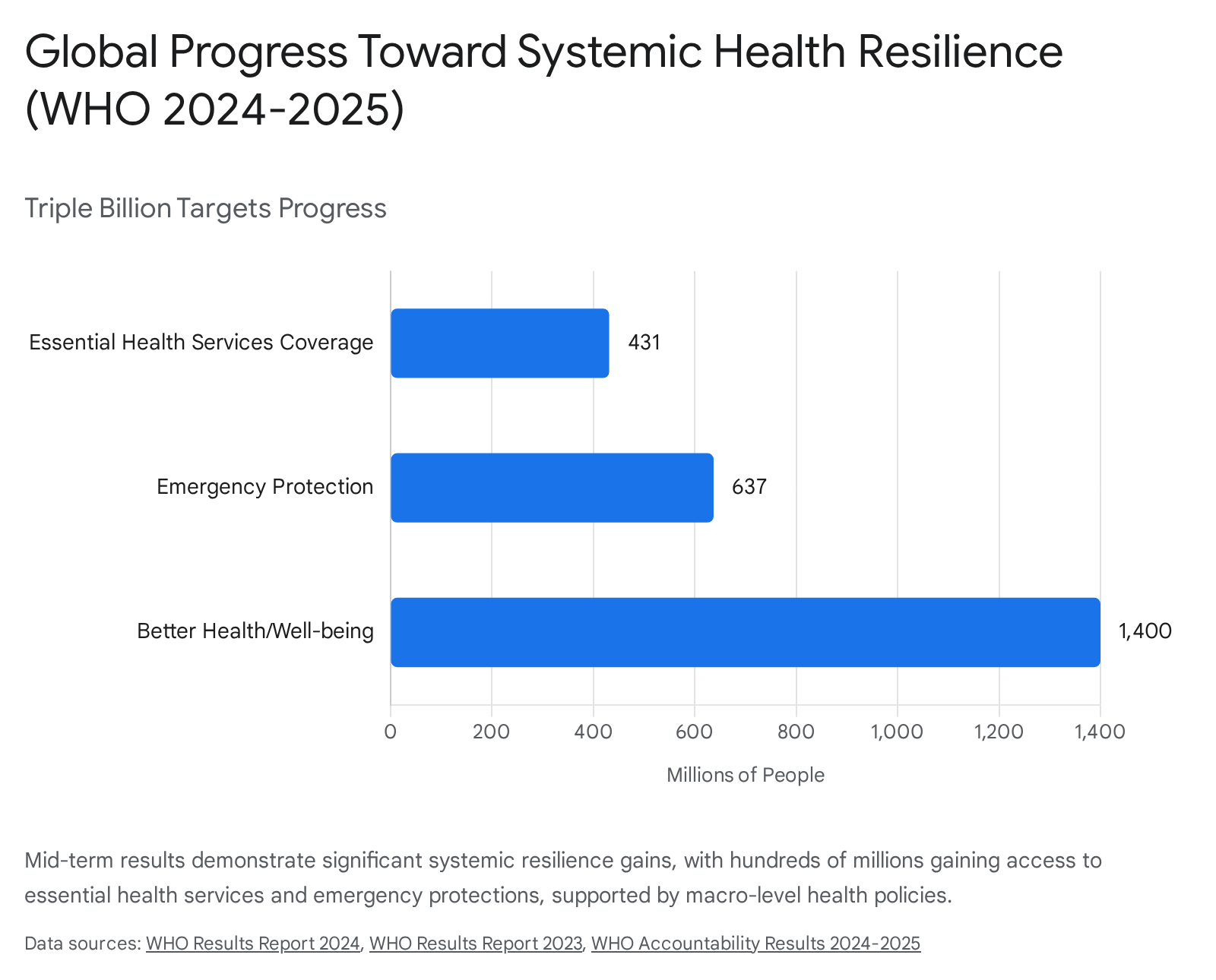
These achievements are driven by investments in the healthcare workforce, increased access to vital therapies, and structural reforms to international health regulations 5658.
However, the WHO acknowledges that progress is constrained by growing global financial uncertainties, persistent health workforce shortages, and the exacerbating effects of conflict and climate change 565758. The integration of emergency management with universal health coverage underscores the reality that societal resilience is fundamentally an issue of sustainable financing, equitable governance, and institutional capacity, rather than merely the aggregate psychological strength of a population 5758.
Conclusion
The scientific inquiry into human resilience reveals that it is a highly complex, multidimensional construct that cannot be reduced to a single paradigm. Defining resilience exclusively as an innate biological or personality trait risks determinism and ignores the reality that characteristics like the locus of control and neuroplasticity are heavily mediated by environmental feedback. Treating resilience solely as a teachable psychological skill offers valuable tools for cognitive adaptation - evidenced by the success of cognitive-behavioral interventions - but often fails to acknowledge that individual coping mechanisms cannot substitute for basic material needs or override systemic crises.
Ultimately, conceptualizing resilience primarily as a socioeconomic and environmental condition provides the most comprehensive and evidence-based framework. Whether viewed through the lens of the Social-Ecological Model, the African philosophy of Ubuntu, Indigenous relational frameworks, or the WHO's public health architectures, the data is unequivocal: resilience is a heavily negotiated, systemic process. The capacity of an individual to bounce back from adversity is inextricably linked to the resources, structural equity, and support systems provided by their community and society. Consequently, advancing human resilience requires a concerted shift away from placing the onus of adaptation entirely on the individual, moving instead toward the implementation of systemic, redistributive, and culturally responsive policies that eradicate the root causes of structural harm.