
Research on Silence and Cognitive Rest
The continuous escalation of environmental noise, digital connectivity, and socioeconomic demands has fundamentally altered the baseline of human cognitive experience. Throughout most of human history, periods of waking rest and environmental silence were unavoidable default states. In contemporary society, these states have become rare, often pathologized as unproductive, or actively avoided due to psychological discomfort. However, extensive research across neurobiology, psychology, and anthropology demonstrates that silence and stillness are not merely the cessation of activity. Rather, they are highly organized, active neurological and psychological states that are biologically necessary for neural regeneration, memory consolidation, and autonomic nervous system regulation. As modern infrastructure systematically displaces undirected time, understanding the mechanisms of silence becomes crucial for mitigating the widespread cognitive fatigue and physiological stress characterizing the modern era.
The Neurobiology of Silence and Intrinsic Neural Networks
The human brain does not enter a dormant state in the absence of external stimuli or goal-directed tasks. Instead, periods of silence and cognitive rest trigger a reallocation of neural energy, activating specific networks designed for internal processing and physiological maintenance.
The Default Mode Network and Spontaneous Cognition
The Default Mode Network (DMN) is a distributed system of brain regions, primarily including the medial prefrontal cortex, the posterior cingulate cortex, and the inferior parietal lobule, that exhibits high levels of activity during task-free periods of wakeful rest 122. First formally identified by Marcus Raichle in 2001, the DMN represents the brain's intrinsic baseline activity when decoupled from immediate external demands 24.
The DMN is located towards the heteromodal end of the principal gradient of intrinsic connectivity, maximally separated from the sensory-motor cortex, allowing it to generate cognitive states independent of the external physical environment 3. When active, this network facilitates self-referential cognition, autobiographical memory consolidation, the distillation of diverse sensory features into cohesive experiences, and the projection of future scenarios 143. This intrinsic organization is essential for maintaining a coherent sense of identity and emotional regulation 16.
During silence, the DMN engages in "memory reconsolidation," a continuous background process that integrates recent experiences into long-term storage, allowing individuals to extract new meaning from past events and break repetitive thought patterns 26. Furthermore, the DMN is highly interconnected with the amygdala, a subcortical structure crucial for emotional processing; the activation of the DMN during rest provides the necessary space for the amygdala to down-regulate, mitigating baseline anxiety and reactive emotional states 16.
The maturation of the DMN is a critical component of childhood brain development. Studies indicate that early environmental factors, particularly stress, abuse, or neglect, lead to significant alterations in DMN functionality, which can heavily impact cognitive and emotional processes through adolescence and adulthood 1. Dysfunction within this network is frequently implicated in various neuropsychiatric conditions, highlighting its role in psychological homeostasis 17.
Network Interplay: Salience, Executive Control, and the DMN
The brain operates through dynamic interactions between the DMN and other large-scale networks, primarily the Salience Network (SN) and the Frontoparietal Control Network (or Central Executive Network) 134. The Salience Network detects and directs neural resources toward salient environmental stimuli, effectively acting as a switch between the internally focused DMN and the externally focused executive networks 14.
Continuous digital consumption, such as scrolling through social media or consuming rapid-fire video content, forces the Salience Network to remain hyper-active, continuously orienting attention toward novel external stimuli 45. This constant external engagement prevents the DMN from activating fully. Because the brain cannot efficiently operate the DMN and the executive/salience networks simultaneously, screen-based "breaks" fail to provide genuine cognitive rest. Passive content consumption maintains task-relevant neural engagement, effectively blocking the memory consolidation and creative synthesis processes that require the undirected state of the DMN 24.
Hippocampal Neurogenesis and Auditory Deprivation
Auditory silence exerts a profound physical impact on brain structure, particularly within the hippocampus - a brain region critical for episodic memory formation, spatial navigation, and learning 6789. A foundational 2013 study led by regenerative biologist Imke Kirste at Duke University investigated the effects of various auditory environments on adult hippocampal neurogenesis in mice 6810.
The experimental design exposed different groups of mice to ambient lab noise, white noise, pup calls (an ethologically relevant stimulus), Mozart's piano sonata KV 448, and near-total silence (below 20 decibels) for two hours per day 81015. The silence condition was originally intended to serve as a baseline control 67. However, researchers discovered that while several auditory stimuli temporarily increased precursor cell proliferation (assessed 24 hours later via BrdU labeling), only the two-hour silence exposure resulted in the long-term survival and differentiation of these cells into mature, functional neurons 71015.
The underlying mechanism suggests that the unnatural absence of auditory input operates as an acute environmental anomaly. In the absence of sound, the brain attempts to produce internal representations of sound, elevating alertness and activating precursor cells to meet anticipated cognitive demands 61011. These findings provide definitive biological evidence that structured periods of profound silence can physically regenerate brain tissue in a manner that continuous ambient noise or organized audio cannot replicate.
Autonomic Nervous System Regulation and the Polyvagal Theory
Beyond cortical network activation and neurogenesis, silence plays a vital regulatory role in the autonomic nervous system (ANS) 912. Environmental noise, particularly in urban settings, operates as a continuous, low-grade stressor. This chronic acoustic stimulation activates the brain's stress pathways, leading to the continuous excretion of adrenaline and cortisol 91314. Elevated cortisol levels correspond to stiffer blood vessels, increased resting heart rates, disrupted sleep architecture, and impaired cognitive performance 9131415.
According to the Polyvagal Theory, silence interacts uniquely with the autonomic nervous system depending on whether it is experienced as an internal state ("inner silence") or a purely environmental condition ("outer silence") 1216. Inner silence - a cultivated state of cognitive stillness absent of distracting mental chatter - enhances the activity of the ventral vagus nerve, which suppresses sympathetic nervous system activity (the fight-or-flight response) and favors parasympathetic dominance (rest-and-digest) 1216.
A 2006 study by physician Luciano Bernardi demonstrated the acute physiological sensitivity to silence. In trials measuring cardiovascular and respiratory responses to music, researchers utilized two-minute silent pauses between tracks as a control. The data revealed that these brief periods of silence lowered blood pressure and heart rate more effectively than listening to music specifically designed to be "relaxing" 78111322. The contrast between auditory stimulation and sudden silence appeared to intensify the parasympathetic relaxation response 22.
However, sudden outer silence in the absence of internal stillness can paradoxically induce a heightened state of alertness, triggering sympathetic nervous system activation, as evolutionary biology primes humans to perceive sudden environmental quiet as a signal of predation or danger 1216. The panic frequently reported by individuals experiencing anechoic chambers (environments with zero acoustic reflection) exemplifies this phenomenon, as the brain struggles to orient itself without the spatial mapping provided by ambient reverberation 916. Cultivating the physiological benefits of silence therefore requires the deliberate integration of environmental quiet with psychological training or natural environments to prevent the vagal brake removal associated with threat detection 1216.
The Attention Economy and the Eradication of Undirected Time
The biological requirement for cognitive rest is increasingly in direct conflict with modern economic infrastructure. The "attention economy" describes an ecosystem where human focus is treated as a highly lucrative, extractable commodity, driving the design of digital platforms to maximize user engagement and systematically eradicate periods of undirected time 17181920.
Macroeconomic Implications of Attention Extraction
The economic valuation of human attention is immense. Digital advertising, which relies explicitly on capturing and sustaining user focus, exceeded $500 billion globally in 2023, accounting for more than 70% of total ad expenditures 21. Companies such as Google and Meta dominate this space, building billion-dollar empires on behavioral prediction and sustained engagement 1921.
Sociologist Shoshana Zuboff categorizes this system as "surveillance capitalism," wherein user experience is continuously extracted to feed machine learning algorithms that refine the ability to capture future attention 19. To maximize platform retention, these systems utilize variable reward schedules and frictionless feeds designed to hijack the brain's dopaminergic reward pathways, creating compulsion loops that disrupt self-awareness and intentionality 1719.
The macroeconomic consequences of this model extend beyond platform revenues. The French Directorate General of the Treasury estimated that the negative externalities of the attention economy - specifically reduced productivity, cognitive decline, and mental health crises - could reduce GDP by 1.4 to 2.3 percentage points annually by the year 2060 18. In the short term, the direct effects of digital overload lower GDP by an estimated 0.6 percentage points, translating to billions in lost economic potential due to inefficiency and cognitive fatigue 1718.
Screen Time Trends and the Cognitive Crisis
Empirical data regarding screen time underscores the scale at which digital stimulation has replaced silent, resting states. Following a brief decline after the cessation of pandemic lockdowns, screen time resumed a steep upward trajectory, reaching parity with pandemic-era peaks by 2024 and 2025 22. Globally, the average internet user aged 16 and older spends nearly 6 hours and 45 minutes consuming online media daily 2223.
The saturation is highly stratified by age. According to 2023 - 2024 data, American teenagers average 8 hours and 39 minutes of entertainment screen time daily, while Generation Z (ages roughly 13 - 28) averages up to 9 hours of digital consumption per day 2224.
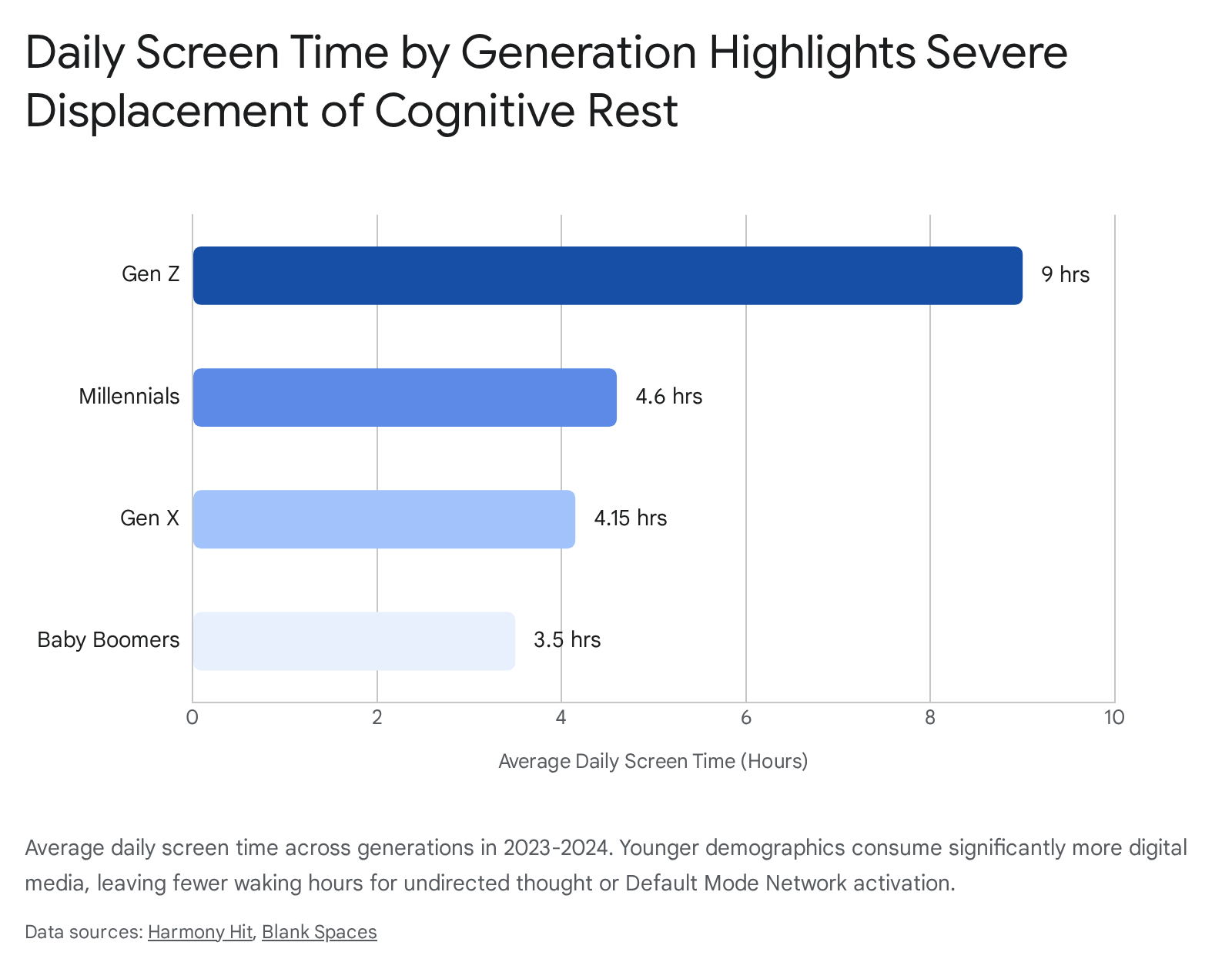
At this rate, an average individual in Generation Z will spend nearly 29 years of their life interacting with a digital screen - more time than is allocated to sleeping or all other leisure activities combined 22. The exposure begins virtually at birth; 98% of two-year-olds view screens daily, averaging over two hours - more than double the World Health Organization's recommended maximum 22.
The nature of this consumption dictates its psychological cost. Researchers distinguish between "active" and "passive" social media use 3132. Active use involves direct interaction, content creation, and conversational engagement, which can foster social connection 3132. However, the vast majority of consumption is passive: mindless scrolling, rapid context-switching, and continuous observation of curated feeds 3132. Passive use is heavily correlated with negative psychological outcomes, triggering Social Comparison Theory mechanisms that elevate dissatisfaction, while the constant barrage of fragmented information induces cognitive fatigue and elevates cortisol levels 531.
Functional MRI studies of problematic internet users reveal altered structural connectivity in brain regions associated with reward processing (such as the nucleus accumbens) and diminished efficiency in the frontoparietal network, which governs executive control 45. Prolonged exposure to short-form content platforms, such as TikTok, conditions the brain to expect instant gratification, measurably reducing the brain's tolerance for demanding, sustained activities - a phenomenon increasingly referred to as "brain rot" 21. This continuous external stimulation renders the physical world under-stimulating by comparison, creating an escalating dependency on digital input to avoid the friction of boredom 45.
Hustle Culture and the Pathologization of Rest
The mechanisms of the attention economy are bolstered by "hustle culture," a pervasive socioeconomic paradigm that moralizes constant labor and equates continuous output with personal virtue 3334. In this framework, periods of deliberate rest, silence, or inactivity are framed as moral failures, weaknesses, or missed opportunities 333536.
The Productivity Paradox and Cognitive Depletion
Hustle culture operates on the assumption of a linear relationship between hours worked and output produced, frequently promoting behaviors such as extreme sleep deprivation, chronic multitasking, and relentless connectivity 333637. However, biological and psychological research consistently disproves this correlation.
Studies mapping working hours to cognitive output identify a sharp decline in productivity after 50 hours per week 36. By 70 hours, total output is barely distinguishable from output at 56 hours, as the worker's cognitive capacity is so severely depleted that additional labor produces virtually nothing of value 36. Multitasking - a hallmark of hustle culture - further drains mental energy. The frequent task-switching required to monitor communications while performing deep work heavily taxes executive function, ultimately reducing the brain's ability to retain information and solve complex problems 1725.
The Physiological Toll of Sleep and Rest Deprivation
The most severe physical manifestation of hustle culture is systemic sleep deprivation. Sleep is not a passive state but an active period of neurological maintenance; during sleep, metabolic toxins are cleared, emotions are regulated, and learning is consolidated 3437.
According to a meta-analysis by Lim and Dinges (2010), chronic sleep restriction degrades sustained attention, working memory, and executive function 36. Modern professionals routinely sacrifice sleep for output, yet sleeping just 16 minutes less than an individual's baseline can induce measurable cognitive fog and distractibility the following day 35. A single night of poor sleep can drop cognitive performance to levels comparable to legal intoxication 35. Furthermore, MRI-based research indicates that individuals sustaining workloads exceeding 52 hours per week exhibit structural differences in 17 brain regions related to executive function and emotional regulation, suggesting that chronic overwork may physically alter brain architecture over time 36.
Despite overwhelming neurobiological evidence that rest is the foundational prerequisite for high-level cognitive function, the cultural script continues to portray exhaustion as a status symbol, driving high rates of occupational burnout, emotional detachment, and psychological distress 333437.
The Psychological Aversion to Solitary Thought
Given the biological necessity of rest, the widespread abandonment of silence cannot be attributed entirely to external economic pressures. Humans frequently demonstrate a profound, intrinsic aversion to unstructured cognitive time, preferring external distraction over the friction of navigating their own internal landscapes.
The "Just Think" Studies (Wilson et al., 2014)
The depth of this aversion was definitively mapped in a landmark 2014 study published in Science by Timothy Wilson and colleagues at the University of Virginia 26272829. The researchers sought to answer whether individuals actually enjoy putting themselves into "default mode" by disengaging from the external world.
Across 11 separate experiments involving diverse demographics - including 146 college students and 61 community adults ranging from ages 18 to 77 recruited from farmer's markets and churches - participants were placed in an unadorned room 2630. They were asked to relinquish their phones, reading materials, and writing implements, and simply sit alone with their thoughts for 6 to 15 minutes 26272930.
The results were overwhelmingly negative. Most participants found the experience highly unpleasant, reporting severe difficulty concentrating and unguided, frustrating mind-wandering 262930. When instructed to perform the exercise in the privacy of their own homes, the discomfort persisted, and approximately 32% of participants admitted to "cheating" by using a cell phone, listening to music, or getting out of their chair before the brief time elapsed 262930.
Preference for Pain Over Boredom
To test the limits of this aversion, the researchers introduced an option for negative stimulation. Participants were given a preliminary mild electric shock; most reported the sensation as unpleasant and stated they would theoretically pay up to $5 to avoid experiencing it again 2630. These same individuals were then placed back in the empty room for 15 minutes of solitary thought, with the knowledge that they could press a button to self-administer the shock if they chose 282931.
Astonishingly, despite their previous assertions, a significant portion of participants voluntarily shocked themselves rather than endure a quarter of an hour of silence 282931. Specifically, 67% of men (12 of 18) and 25% of women (6 of 24) administered at least one shock during the thinking period 293132.
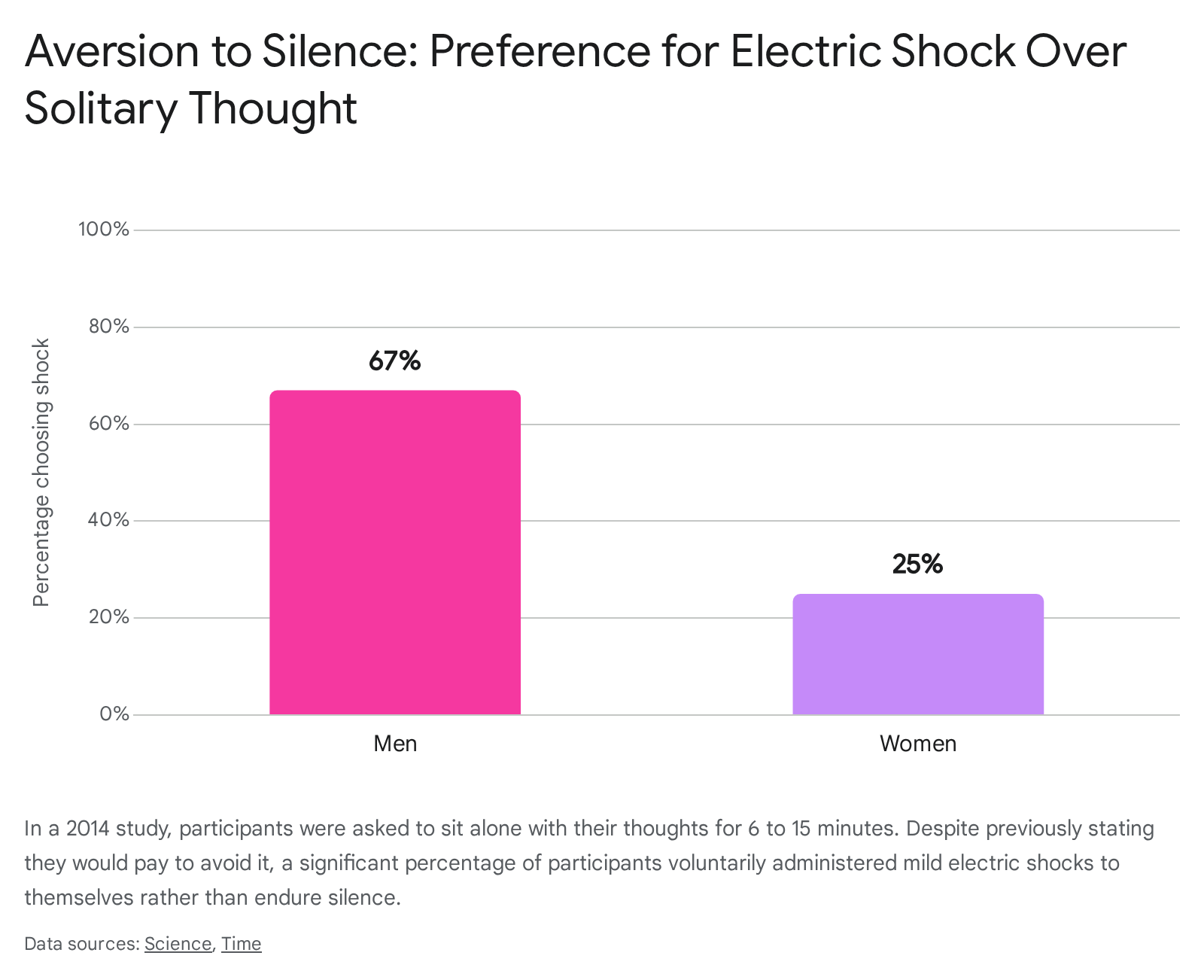
One male outlier pressed the shock button 190 times within the 15-minute window 29313233.
The researchers hypothesized that without the scaffolding of an external task, the untutored mind struggles to steer thoughts in pleasant directions, often collapsing into ruminative thought cycles regarding shortcomings or anxieties 293132. The mammalian brain evolved to monitor the external environment for threats and opportunities; the capacity to disengage completely and retreat into an internal narrative is a unique human adaptation that requires considerable cognitive effort and training (such as meditation) to execute comfortably 2633. Without such training, humans exhibit a strong preference for "doing" over "thinking," even when the doing is demonstrably harmful 31.
Western Conceptions of Emptiness: Horror Vacui
The psychological discomfort with silence is deeply interwoven with Western aesthetic and philosophical traditions, heavily influenced by the concept of horror vacui - the fear or abhorrence of emptiness 473435.
Originating as a principle in Aristotelian physics, which posited that "nature abhors a vacuum," the concept asserted that the normative order of the universe required space to be filled 47. Over centuries of philosophical debate involving figures like Heron of Alexandria, Robert Boyle, and Paolo Casati, the physical concept morphed into a cultural and aesthetic anxiety 47. In Baroque and subsequent Western art, horror vacui manifests as an obsessive drive to fill every centimeter of a canvas or architectural space with detail, ornamentation, or activity 35. The empty void was frequently equated with the ominous realm of non-being, spiritual poverty, or death 3435.
Contemporary architecture critic Herbert Muschamp argues that horror vacui remains a driving force in Western design, shaping public spaces and urban sprawl into crowded, over-stimulated environments 34. This spatial anxiety translates directly into temporal anxiety. In Western consciousness, a silent interval is rarely perceived as a standalone entity with intrinsic value; rather, it is viewed as an unnatural gap - a dangerous absence of utility that must be immediately colonized by labor, conversation, or media 3435. Thus, the modern inability to sit in silence is not merely an artifact of smartphone addiction, but the technological culmination of a centuries-old cultural imperative to eradicate the void.
Cross-Cultural Epistemologies of Silence and Stillness
Outside the dominant Western paradigm of horror vacui, numerous global philosophies conceptualize silence and emptiness as generative, structural elements of existence. In these frameworks, doing nothing is neither a failure of productivity nor a terrifying void, but an essential component of psychological and social harmony.
| Cultural Framework | Geographic Origin | Conception of Silence / Emptiness | Primary Function or Application |
|---|---|---|---|
| Horror Vacui | Western Europe / Classical Antiquity | A dangerous absence; an unnatural void that must be filled. | Drives continuous action, production, and sensory filling to avoid the anxiety of nothingness. |
| Ma (間) | Japan | An active, creative interval; pregnant negative space. | Provides meaning through contrast; cultivates control, aesthetic balance, and deliberate timing. |
| Dadirri | Indigenous Australia | Deep listening; quiet, still awareness of self and nature. | Facilitates healing, community connection, and respect for natural cycles without forcing outcomes. |
| Itutu / Dawn Silence | West Africa / Continental Africa | Coolness, composure; protection and spiritual grounding. | Fosters mental focus, emotional equanimity, and reverence for the unspoken. |
The Japanese Concept of Ma
In Japanese aesthetics and philosophy, the concept of Ma (間) represents the interval, gap, or negative space between objects, sounds, or events 36513738. Represented by a kanji character depicting light beaming through the empty space of a doorway, Ma is an active, resonant field rather than a neutral absence 3637.
Deeply rooted in Shinto animism and Zen metaphysics, Ma dictates that space and time are not objective containers waiting to be filled, but are unified through intervals 3651. In visual art (such as sumi-e painting or ikebana), the unpainted or empty areas are as vital to the composition as the physical strokes 3738. In communication, Ma is the deliberate pause that gives words their weight and prevents conversations from collapsing into noise 513754.
Philosophers such as Nishida Kitaro have framed Ma as the "place of absolute nothingness" - a field where opposites are held in relational tension without the need for immediate resolution 36. Practically, cultivating Ma serves as a mental discipline. By resisting the urge to prematurely fill silence, individuals maintain control over their timing and emotional reactions, utilizing stillness as a position of psychological leverage rather than passivity 3654.
Australian Aboriginal Dadirri
Indigenous Australian traditions emphasize a highly specific form of contemplative silence known as Dadirri, a concept originating from the Ngan'gikurunggurr and Ngen'giwumirri languages of the Daly River region 555639. Popularized by Aboriginal writer and senior elder Miriam-Rose Ungunmerr-Baumann, Dadirri translates to "inner, deep listening and quiet, still awareness" 5639.
Unlike meditation traditions that seek to empty the mind to achieve enlightenment, Dadirri is deeply relational and environmentally anchored. It involves sitting silently with the land, observing natural cycles without attempting to alter or accelerate them 555658. Aboriginal cultures view silence not as a threat, but as a welcoming environment in which the "Life-Giving Spirit" resides 56.
In modern therapeutic and educational contexts, Dadirri is increasingly utilized as a framework for trauma healing. It creates a sacred, non-judgmental space of suspended verbalization where individuals can process pain at their own pace, recognizing that profound emotional integration often requires the cessation of continuous questioning and dialogue 563940.
Native American and African Philosophies
Similar reverence for silence exists across Native American and African philosophical traditions. Native American cultures utilize silence as the "soft distance" between thoughts, words, and actions 4142. This distance ensures that judgments are made deliberately and that interpersonal interactions remain respectful 41. Grounded in animism, Native traditions view the environment not as a resource to be managed, but as a living entity to be listened to 434445. Cultivating silence is therefore a prerequisite for ecological stewardship and understanding the rhythms of the earth 4344.
In various African traditions, silence and stillness are linked to virtues of composure and focus. The Yoruba concept of Itutu denotes a "cool," calm, and unflappable demeanor 4647. A person possessing Itutu accepts the frustrations of existence without unnecessary agitation or verbal outburst, recognizing the limits of human control over the cosmic order 47. Furthermore, specific silence practices - such as dedicating the first 20 minutes of dawn to quiet introspection, undertaking silent nature walks, or eating meals in complete silence - are utilized to ground the nervous system and sharpen cognitive focus for the day ahead 67. The "Sage Philosophy" project, initiated by Henry Odera Oruka, highlighted how academically marginalized African sages utilized these traditional practices to maintain intellectual curiosity and provide practical guidance within their communities 48.
Physiological Outcomes: Comparing Auditory Environments
While total silence provides unique neurogenerative benefits, it is not the only alternative to the toxic noise of modern life. Scientific analysis reveals that different acoustic environments - specifically total silence, natural soundscapes, and urban noise - trigger entirely different physiological and cognitive responses.
Nature Sounds vs. Total Silence
Laboratory studies demonstrate that while complete silence excels at cortical tasks (such as DMN activation and hippocampal cell differentiation), natural soundscapes - such as flowing water, wind, or birdsong - are superior for rapid autonomic nervous system recovery 495051.
In comparative trials measuring physiological stress markers, exposure to forest sounds resulted in a significantly lower ratio of low frequency to high frequency heart rate variability (ln(LF/HF)), indicating a sharp decrease in sympathetic nervous activity 4952. Participants exposed to nature sounds exhibited lower heart rates, reduced blood pressure, and decreased cortisol levels compared to those exposed to city sounds 154952.
| Auditory Environment | Primary Physiological Impact | Primary Cognitive Impact | Utility for Modern Rest |
|---|---|---|---|
| Total Silence | Triggers hippocampal neurogenesis; lowers blood pressure. | Activates the Default Mode Network; facilitates memory consolidation. | Essential for deep internal reflection and neural regeneration, though psychologically difficult for many. |
| Nature Sounds (Water, Wind) | Rapidly decreases sympathetic nervous activity (fight-or-flight); lowers cortisol. | Replenishes directed attention via "soft fascination"; reduces mental fatigue. | Highly effective for stress recovery and restoring focus without triggering the anxiety of a total void. |
| Urban / Digital Noise | Elevates cortisol and adrenaline; stiffens blood vessels. | Fragments attention; prevents DMN activation; causes cognitive fatigue. | Detrimental to long-term health; necessitates deliberate periods of recovery. |
| White Noise | Neutral; does not significantly alter physiological stress markers. | Masks distractions, providing short-term concentration aids. | Functional for immediate task focus, but lacks restorative neurological benefits. |
The efficacy of natural sounds relies on a mechanism described by Attention Restoration Theory (ART). ART posits that natural environments induce a state of "soft fascination" 505173. This state gently holds the individual's attention without demanding heavy cognitive processing, allowing the brain's directed attention resources to rest and replenish 5073. Because natural sounds provide a subtle anchor for the mind, they often circumvent the psychological panic or ruminative thought loops that some individuals experience in total silence, making them an highly effective, accessible tool for emotional regulation and cognitive recovery 507353.
The Limits of Artificial Interventions
In an attempt to hack productivity, many individuals utilize artificial soundscapes, such as white noise, to block out urban distractions. While studies indicate that white noise can temporarily aid in task-focused concentration by masking disruptive acoustics, it does not provide the physiological or psychological restorative benefits of nature sounds or silence 5054. White noise does not significantly lower cortisol or activate the parasympathetic nervous system; it is a functional tool for labor, not a mechanism for biological rest 5054.
Synthesis
The eradication of silence and undirected time represents a profound shift in human ecology. Driven by the financial imperatives of the attention economy, the moral frameworks of hustle culture, and deep-seated cultural anxieties regarding emptiness, modern society has engineered an environment characterized by relentless cognitive and auditory stimulation.
However, neurobiological research provides an unambiguous counter-narrative: doing nothing is a biological necessity. Total silence physically regenerates the hippocampus and engages the Default Mode Network, enabling the memory consolidation and identity formation necessary for psychological health. Meanwhile, natural stillness recalibrates the autonomic nervous system, buffering against the chronic stress and cognitive decline inherent in modern life. As demonstrated by non-Western epistemologies spanning from Japanese Ma to Australian Dadirri, silence is not an empty void to be feared or conquered, but a generative structure essential to human thriving. Reclaiming periods of deliberate silence is no longer merely an aesthetic or spiritual preference; it is a fundamental requirement for preserving neurological integrity in the digital age.