
Quantum Field Theory in Curved Spacetime
Quantum field theory in curved spacetime represents an essential semiclassical framework in theoretical physics that bridges the principles of quantum mechanics with general relativity. Operating as an intermediate step toward a complete theory of quantum gravity, this approach treats the gravitational field as a fixed, classical pseudo-Riemannian manifold, while the matter and energy propagating through this geometry are fully quantized 123. It is highly effective in regimes where spacetime curvature is significant enough to alter quantum phenomena but not so extreme that the quantization of gravity itself becomes the dominant dynamic 13.
The framework has yielded profound theoretical discoveries, including particle creation in expanding universes, the Unruh effect, and Hawking radiation 14. Recent developments have utilized this semiclassical approach to address long-standing conceptual crises, such as the black hole information paradox, through the mathematical discovery of entanglement islands and replica wormholes 567. Furthermore, advancements in renormalization techniques and analogue gravity experiments have provided robust methodologies for testing the macroscopic thermodynamic limits of these semiclassical predictions 89.
Mathematical Foundations of the Semiclassical Approach
The Breakdown of Flat-Space Axioms
In standard Minkowski spacetime, quantum field theory is rigorously defined by the Wightman axioms, which rely heavily on the existence of global Poincaré symmetry 10. This symmetry ensures the existence of a unique, globally preferred vacuum state and a well-defined global notion of particles, governed by a spectrum condition that restricts the total energy-momentum to the closed future light cone 10. However, a generic curved spacetime lacks global timelike Killing vector fields, meaning there are no global spacetime symmetries to uniquely single out a preferred vacuum state 210.
Because the definition of positive and negative frequency modes depends fundamentally on the observer's time coordinate, the concept of a "particle" becomes inherently observer-dependent 2. What one inertial observer measures as an empty vacuum state, an accelerating observer or an observer residing in a different gravitational potential may measure as a thermal bath of particles 411. The lack of a unique vacuum means that unitarily inequivalent Hilbert space constructions exist for free quantum fields on spacetimes with noncompact Cauchy surfaces 10. Consequently, formulating quantum field theory in curved spacetime requires abandoning the traditional particle-centric view in favor of an approach that focuses on the local algebraic properties of quantum fields.
The Algebraic Formulation
To overcome the limitations of the Wightman framework, physicists employ Algebraic Quantum Field Theory. In the approach pioneered by Robert Wald and others, the theory is formulated by constructing a $C^*$-algebra of local field observables 310. Instead of starting with a predefined Hilbert space, the algebraic method defines the quantum field as an operator-valued distribution satisfying the covariant Klein-Gordon or Dirac equations, alongside specified commutation or anticommutation relations adapted to the causal structure of the curved manifold 2.
The states of the quantum field are then defined as linear, positive, normalized functionals on this algebra, mapping observables to real numbers representing expectation values 12. This structure bypasses the need for a globally preferred vacuum and provides a rigorous mathematical foundation for treating quantum fields on any globally hyperbolic spacetime 310. For physical predictions, the focus narrows to the class of Hadamard states. These states possess a specific short-distance singularity structure that mimics the Minkowski vacuum at short distances, ensuring that physical quantities, particularly the expected stress-energy tensor, can be meaningfully regularized and renormalized 131415.
Recent investigations have expanded the algebraic framework to examine the non-relativistic limit of quantum fields in non-inertial frames and arbitrarily strong gravitational fields 15. This research demonstrates how the Born probabilistic notion emerges in accelerating systems, revealing that non-relativistic states can be described in terms of wave functions quantifying position probability, despite the underlying nonlocal effects originating from the frame-dependent nature of the curved spacetime vacuum 15.
Stress-Energy Tensor Renormalization
The ultimate goal of semiclassical gravity is to calculate the back-reaction of quantum fields on the spacetime geometry. This interaction is governed by the semiclassical Einstein field equations, where the classical Einstein tensor $G_{ab}$ and cosmological constant $\Lambda$ are sourced by the expectation value of the quantum stress-energy tensor, $\langle T_{ab} \rangle$ 816. A critical distinction must be made between the canonical stress-energy tensor, derived via Noether's theorem from spacetime translation symmetry, and the Hilbert stress-energy tensor, which arises naturally from the functional differentiation of the matter action with respect to the background metric 1817. In curved spacetime, the Hilbert stress-energy tensor is universally employed to ensure covariant conservation and compatibility with general relativity.
Point-Splitting and Hadamard Regularization
The primary technical obstacle in this formulation is that the stress-energy tensor involves the product of field operators at the same spacetime point. Because quantum fields are distributions, such localized products are highly divergent and mathematically undefined 81213. To extract a finite, physically meaningful $\langle T_{ab} \rangle$, a rigorous regularization and renormalization prescription is mandatory.
The standard procedure is point-splitting regularization 818. The fields are evaluated at two distinct spacetime points, $x$ and $x'$, producing a bitensor $\langle T_{ab}(x, x') \rangle$. The divergent, state-independent geometric terms are mathematically isolated as the limit $x' \to x$ is taken. These divergent terms are entirely geometric in nature, depending only on the metric and its derivatives, and are absorbed into the renormalization of the bare gravitational constants - specifically Newton's constant, the cosmological constant, and higher-order curvature couplings 8.
This subtraction is executed using the Hadamard parametrix, a locally constructed geometric distribution that captures the exact singularity structure of the field 814. Constructing the Hadamard parametrix for generic spacetimes is technically demanding. Historically, the Candelas-Howard approach provided a foundational resolution for scalar fields on static black hole spacetimes, but it proved computationally cumbersome 8. Recent methodological breakthroughs have revolutionized these computations. The "pragmatic mode-sum prescription" developed by Levi and Ori has enabled the calculation of the renormalized stress-energy tensor even in rotating Kerr black hole geometries, a previously intractable problem 819. Concurrently, the "extended coordinate method" pioneered by Ottewill provides an extremely efficient Euclidean technique for computing vacuum polarization and stress-energy tensors for arbitrary field parameters in static black hole spacetimes 819.
Axiomatic Constraints on the Stress-Energy Operator
To guarantee that the renormalization procedure yields a physically sensible result, Robert Wald established five fundamental axioms that any renormalized stress-energy operator must satisfy 20.
First, the formal expression must be valid for calculating the matrix elements between any two orthogonal states, ensuring state independence of the renormalization counterterms 20. Second, the procedure must reduce to the standard normal-ordered stress-energy tensor when applied to flat Minkowski spacetime 20. Third, the resulting expectation value must be covariantly conserved, satisfying $\nabla^a \langle T_{ab} \rangle = 0$, which is required for consistency with the Bianchi identities of the Einstein tensor 20. Fourth, the tensor must obey causality, depending only on the causal past of the evaluation point 20. Finally, the procedure must not introduce spurious higher-derivative local curvature terms that would alter the fundamental character of the dynamical equations 20.
While these axioms firmly constrain the renormalization process, they leave a residual ambiguity regarding finite local curvature terms. This mathematical ambiguity is naturally resolved by empirical measurement of the renormalized coupling constants of the modified Einstein-Hilbert action 1820. An alternative formulation for computing the renormalized fluctuations of the energy-momentum tensor utilizes the Operator Product Expansion (OPE) on a fixed curved background, which extracts the finite component uniquely up to state-independent geometric ambiguities 15.
Trace Anomalies in Conformal Field Theories
A striking macroscopic consequence of stress-energy tensor renormalization in curved spacetime is the emergence of the trace anomaly, also known as the Weyl anomaly 212223. Classically, the stress-energy tensor of a conformally invariant field theory - such as a massless scalar or the electromagnetic field in four dimensions - is strictly traceless, meaning $T^\mu_\mu = 0$ . However, the process of quantum regularization inherently introduces a characteristic energy scale into the theory, breaking the classical conformal symmetry at the quantum level and resulting in a non-zero expectation value for the trace 22.
Dimensional Dependence and Classification
The structure of the trace anomaly is fundamentally dictated by the dimensionality of the spacetime. Anomalies appear strictly in even-dimensional spacetimes, as odd-dimensional spacetimes lack the required local conformal invariants constructed from the Riemann tensor 2425.
The systematic classification of trace anomalies was established by Deser and Schwimmer. In two-dimensional spacetime, the anomaly consists of a single term proportional to the Ricci scalar $R$, characterized by a single central charge $c$ 23. In higher even dimensions, trace anomalies are divided into three categories. Type A anomalies are proportional to the topological Euler density of the spacetime. Type B anomalies consist of independent, locally Weyl-invariant scalars constructed from the Weyl curvature tensor 21. Finally, there are trivial anomalies - often termed Type D anomalies - which consist of total derivatives, such as $\Box R$, that can be eliminated by the addition of a local, conformally variant counterterm to the effective action 2124.
In four-dimensional spacetimes, assuming parity symmetry, the trace anomaly $\langle T^\mu_\mu \rangle$ takes the definitive form:
$\langle T^\mu_\mu \rangle = c W^2 - a E_4 + b \Box R$
Here, $E_4 = R_{\mu\nu\rho\sigma}R^{\mu\nu\rho\sigma} - 4R_{\mu\nu}R^{\mu\nu} + R^2$ represents the topological Euler density (the Type A anomaly), and $W^2 = C_{\mu\nu\rho\sigma}C^{\mu\nu\rho\sigma}$ is the square of the Weyl tensor (the Type B anomaly) 2329. The coefficients $a$ and $c$ define the central charges of the specific quantum field theory 23.
Universal Coefficients for Free Fields
The exact values of the $a$ and $c$ coefficients act as central charges that classify the degrees of freedom of the conformal field theory 2329. By employing dimensional regularization and calculating the respective Seeley-DeWitt heat-kernel coefficients, researchers have established precise values for various free fields.
| Field Type | Spin | $c$ Coefficient (Weyl Tensor Squared) | $a$ Coefficient (Euler Density $E_4$) |
|---|---|---|---|
| Conformally Coupled Scalar | $0$ | $\frac{1}{120}$ | $\frac{1}{360}$ |
| Dirac Fermion | $\frac{1}{2}$ | $\frac{1}{20}$ | $\frac{11}{360}$ |
Table 1: Trace anomaly coefficients in four-dimensional curved spacetime. Coefficients are conventionally normalized by a prefactor of $1/(16\pi^2)$. Data derived from standard evaluations of the heat-kernel expansion for free fields .
The trace anomaly holds profound physical importance, as it directly governs the macroscopic back-reaction of quantum vacuum fluctuations. It provides exact sum-rule constraints on renormalization group flows via the $a$-theorem, which mandates that the $a$ coefficient must strictly decrease from the ultraviolet (UV) to the infrared (IR) fixed points, offering a non-perturbative measure of the decreasing number of degrees of freedom as massive modes decouple 232931. The inherent ambiguity in defining the improvement term of the stress tensor can be fixed unambiguously by studying the renormalization group interpolation between these limits, ensuring that the variational principle satisfies sum rules for the trace anomalies 31.
Boundary Effects and Chiral Anomalies
When a conformal field theory is defined on a manifold with a boundary, the trace anomaly acquires complex boundary-specific contributions 25. In the presence of boundaries, odd-dimensional spacetimes, which lack bulk trace anomalies, develop non-trivial integrated conformal anomalies generated entirely by boundary terms 25. For a three-dimensional bulk with a two-dimensional boundary, the boundary anomaly includes terms proportional to the integrated boundary Euler density and the trace of the square of the traceless extrinsic curvature tensor 25.
Calculations utilizing the anomaly-induced action with an auxiliary scalar field demonstrate that boundary effects map directly to the quantum states of the original field . However, the use of the anomaly-induced effective action is subject to topological restrictions; it can only be consistently applied to spacetimes where the Euler characteristic is zero, a condition generally guaranteed for 2D bounded spacetimes but not necessarily in 4D . Furthermore, when analyzing Dirac or Weyl fermions coupled to gauge fields in curved space, Pauli-Villars regularization reveals that the trace anomaly can be cast in a gauge-invariant form. While the chiral anomaly introduces a Pontryagin term representing the breakdown of axial gauge symmetry, precise parity analyses demonstrate that no odd-parity Chern-Pontryagin density emerges in the quantum trace of the stress tensor itself 2526.
Hawking Radiation and the Unruh Effect
The most celebrated predictions of quantum field theory in curved spacetime deal with the spontaneous creation of particles from the vacuum due to geometric acceleration and the presence of causal horizons. The year 2026 marks the fiftieth anniversary of the publication of the Fulling-Davies-Unruh effect, a cornerstone concept demonstrating the observer-dependent nature of thermality 427.
Acceleration and Thermality
The Unruh effect posits that an observer accelerating uniformly through the Minkowski vacuum will perceive it not as empty space, but as a thermal bath of particles with a temperature strictly proportional to their proper acceleration 427. This revelation radically challenges the notion of the "particle" as a fundamental, objective object in physics, pointing instead toward deeper connections between quantum entanglement, thermodynamics, and the structure of spacetime 427. The theoretical framework gives explicit predictions about the phenomenology of non-relativistic quantum systems in non-inertial motion, providing experimental constraints for the indirect observation of the Unruh effect via the hyperfine structure of accelerated atomic detectors 15.
The Mechanism of Black Hole Evaporation
In 1974, Stephen Hawking demonstrated that the formation of a black hole horizon causes pure vacuum states to evolve such that an asymptotic observer perceives a steady flux of thermal blackbody radiation, eventually causing the mass and rotational energy of the black hole to evaporate 528.
A pervasive and long-standing misconception regarding Hawking radiation - popularized largely by Hawking's own simplified analogies in non-academic literature - is that the radiation is generated exclusively at the event horizon by the spontaneous separation of virtual particle-antiparticle pairs, with negative energy partners falling in and positive energy partners escaping 2930. Rigorous semiclassical analysis strongly contradicts this localized picture.
Calculations tracing the outgoing radiation back to the horizon reveal an extreme, effectively infinite blueshift that yields a grossly inaccurate stress-energy profile for the local geometry 2931. Rather than originating infinitesimally close to the event horizon, the observable Hawking radiation is a global quantum phenomenon. The quanta do not physically separate and emerge as distinct real particles until they have propagated through a region extending several Schwarzschild radii away from the black hole 293031. Furthermore, Hawking radiation consists almost entirely of low-energy photons and massless radiation, not the heavy matter-antimatter pairs often depicted in introductory analogies 3031.
The Black Hole Information Paradox
Hawking's discovery initiated a severe crisis in theoretical physics known as the black hole information paradox 57. Semiclassical calculations suggest that a black hole formed by the gravitational collapse of matter in a pure quantum state will evaporate entirely into structureless, thermal Hawking radiation 53233. This implies that the final state of the universe is a mixed state, violating the foundational principle of unitarity in quantum mechanics, which dictates that quantum information cannot be destroyed and that the state of a system at one point in time must uniquely determine its state at any other point 573234.
The Unitarity Crisis and the Page Curve
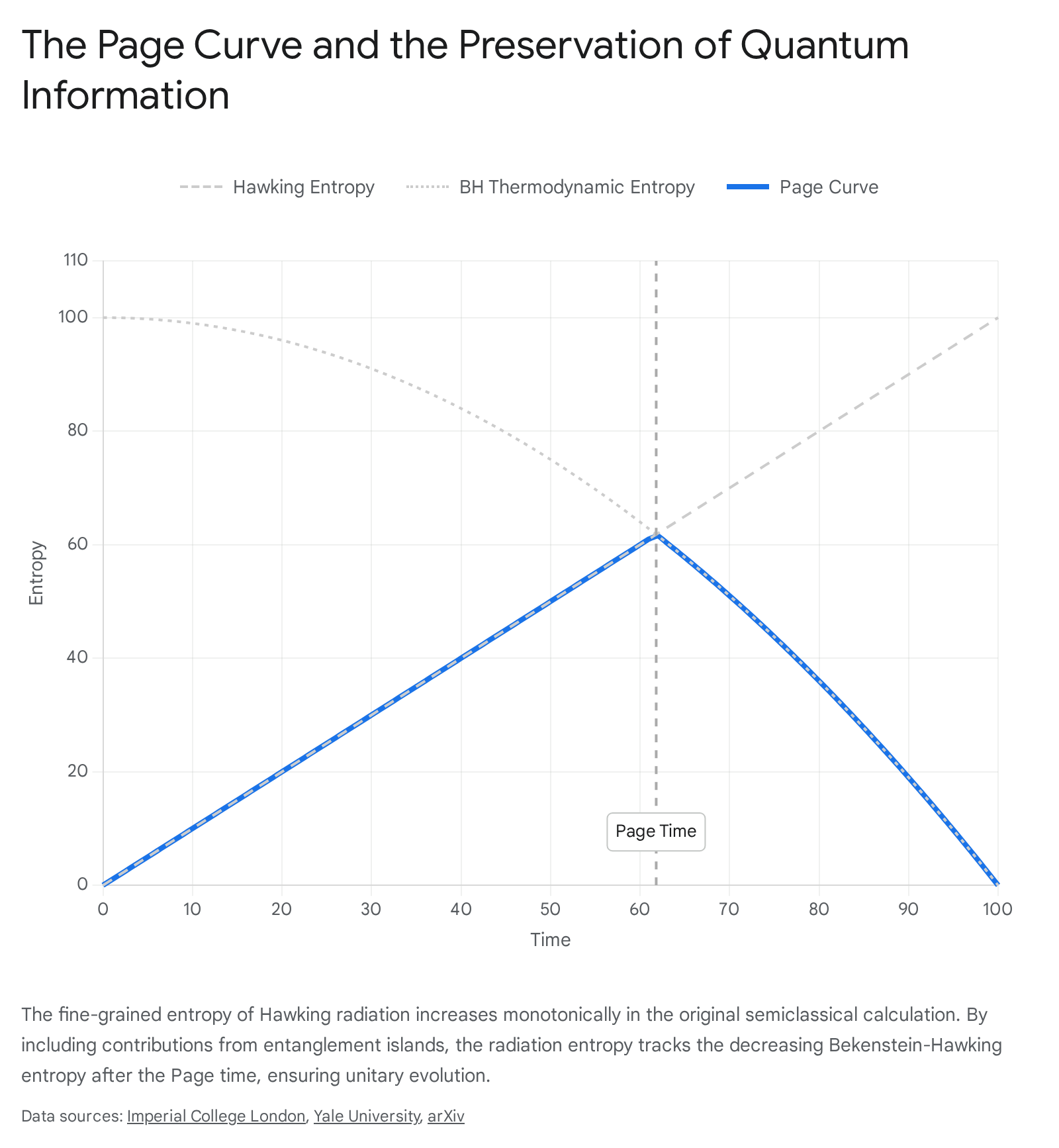
The "nice slice" argument provides an exposition of the paradox, mapping the evolution of spatial slices that capture both the infalling matter and the outgoing radiation 32. The evolution of quantum entanglement during the evaporation process is mathematically described by the Page curve 732. If black hole evaporation is a unitary process, the fine-grained (von Neumann) entropy of the emitted Hawking radiation must initially rise as the black hole emits entangled particles 3235. However, as the black hole shrinks, its coarse-grained thermodynamic entropy (proportional to its surface area via the Bekenstein-Hawking formula) decreases 2832.
Because the fine-grained entropy of a system cannot exceed the total number of degrees of freedom available to it, the radiation entropy must eventually turn over and decrease down to zero as the black hole disappears 3235. The turnover point, where the entanglement entropy of the radiation equals the decreasing thermodynamic entropy of the black hole, is known as the Page time 323536. Hawking's original calculations failed to produce the Page curve, showing instead that the radiation entropy grows linearly and monotonically until it massively exceeds the thermodynamic capacity of the black hole, thereby cementing the paradox 73237.
Replica Wormholes and Entanglement Islands
Between 2019 and 2022, a major breakthrough reshaped the field's understanding. Researchers successfully reproduced the unitary Page curve within the framework of semiclassical gravity by applying the holographic entanglement entropy formula equipped with precise quantum corrections 738.
They discovered that after the Page time, the fine-grained entropy of the Hawking radiation is no longer calculated solely by integrating over the exterior radiation region. Instead, it must include contributions from geometrically disconnected regions of spacetime residing inside the black hole horizon, termed "entanglement islands" 53238. For highly complex supermassive black holes, theorists have calculated that these islands may even protrude slightly beyond the event horizon, technically removing the obstruction to probing them from the exterior, though the protrusion distance is on the sub-atomic scale 39.
The inclusion of the black hole interior in the entropy calculation is rigorously justified through the gravitational path integral using the "replica trick" 632. When evaluating the path integral for the von Neumann entropy, the method reveals the existence of non-trivial spacetime topologies connecting the replica geometries, known as replica wormholes 56732. These replica wormhole geometries dominate the path integral at late times, inherently linking the interior island to the exterior radiation and mathematically forcing the calculated entropy to correctly follow the downward trajectory of the Page curve 6733. This resolution is further conceptualized by the ER=EPR conjecture, which posits that entangled pairs of particles are fundamentally connected by microscopic Einstein-Rosen bridges, providing a geometric pathway for information retrieval 7.
Back-Reaction Effects on Evaporation Dynamics
Recent literature spanning 2024 - 2026 extends these models to more complex astrophysical and holographic scenarios. Studies utilizing the AdS/CFT correspondence have analyzed deformed eternal anti-de Sitter (AdS) black holes back-reacted by the presence of uniform, static distributions of heavy fundamental quarks (string clouds) 3640. The introduction of geometric back-reaction significantly alters the entanglement structure. The deformation delays the emergence of the entanglement island, thereby shifting the peak of the Page curve to a later time 3637. Furthermore, computations reveal an increase in the scrambling time proportional to the back-reaction parameter, indicating a longer duration required for information retrieval from the deformed black hole 363740.
Similarly, island formalisms have been successfully applied to rotating Kerr black holes. By utilizing a two-dimensional conformal effective theory to describe scalar fields near the horizon in the small angular momentum limit, researchers proved that the entanglement entropy of Hawking radiation from non-extremal Kerr black holes correctly tracks the Page curve, saturating at the Bekenstein-Hawking entropy bound at late times 35.
Despite the overwhelming theoretical success of the island paradigm, specific criticisms remain under active debate. Physicists such as Hao Geng and Andreas Karch have published extensive arguments suggesting that the mathematical proofs underpinning the island conjecture may secretly rely on theories of massive gravity rather than standard massless general relativity, potentially limiting their applicability to the physical universe 38. Additionally, covariance-respecting black holes modeled in Loop Quantum Gravity (LQG) demonstrate that parameter shifts can suppress late-time entropy growth without strictly requiring standard island geometries, suggesting that the late-time behavior of black hole evaporation may not be universally uniform across all quantum gravity frameworks 41.
Analogue Gravity and Experimental Verifications
Because astrophysical Hawking radiation is generated at an effective temperature inversely proportional to the black hole's mass, the radiation emitted by stellar-mass black holes is many orders of magnitude too faint to be detected by current telescopes against the 2.7 Kelvin cosmic microwave background 2842. Consequently, experimentalists have turned to analogue models of gravity to test the kinematic predictions of quantum field theory in curved spacetime 928. Formulated theoretically by William Unruh in 1981, analogue gravity exploits the rigorous mathematical equivalence between the behavior of scalar fields in curved pseudo-Riemannian manifolds and the propagation of sound or light waves in moving fluids 94250.
Bose-Einstein Condensates and Acoustic Horizons
The most successful analogues to date utilize atomic Bose-Einstein condensates (BECs) cooled to ultralow temperatures 425043. By manipulating the fluid flow - such as sweeping a potential-energy step along a flowing BEC of rubidium atoms - researchers create a region where the condensate travels faster than the local speed of sound in the medium. This transition generates a "sonic horizon," the acoustic equivalent of an event horizon where phonons cannot propagate upstream 424453.
In a series of landmark experiments spanning the last decade, culminating in highly refined 8,000-atom rubidium chain configurations, researchers successfully measured the spontaneous emission of analogue Hawking phonons from these sonic horizons 42444546. Crucially, by utilizing precise correlation functions to measure density fluctuations, they confirmed that the emitted phonons were quantum-mechanically entangled with partner particles falling into the analogue black hole 444546. The observed thermal spectrum matched the Hawking prediction, directly validating the underlying quantum field theory mechanisms that govern spontaneous pair creation in effective curved spacetimes 4546. Experiments have also replicated dual-horizon configurations akin to charged black holes, demonstrating self-amplifying Hawking radiation that bounces between the inner and outer horizons to produce a lasing effect 4244.
Optical Fibers and Photonic Fluids
Beyond acoustics, analogue gravity has expanded rapidly into nonlinear optics. Intense, short pulses of light propagating through optical fibers or self-defocusing media locally alter the refractive index due to the Kerr effect. This generates a moving optical event horizon that appears to bring light to a standstill at the leading edge of the pump pulse 95347.
These photon-fluid models allow researchers to analyze the emission of "negative frequency" photons - the optical analogue to virtual particles falling past the horizon - and study black hole superradiance and quasinormal ringing within a controlled laboratory setting 953. By solving the master equation of motion for optical field fluctuations, physicists compute the frequencies of quasinormal modes, mapping how angular velocity and winding numbers impact the decay rates of the analogue black hole 53. While early experiments in water tanks and optical fibers generated false positives due to fluid ambiguities and Cherenkov radiation, modern sophisticated setups have conclusively demonstrated stimulated Hawking radiation 9.
Astrophysical Observations of Thermodynamic Properties
While analogue models probe the microscopic quantum emission process, advanced gravitational wave astronomy provides macroscopic validation of the classical thermodynamic laws that underpin the semiclassical paradox. In recent data analyses of binary black hole mergers - specifically the GW250114 event - the LIGO-Virgo-KAGRA collaborations confirmed Hawking's 1971 black hole area theorem with unprecedented precision 4849.
By analyzing the specific frequencies of the quasinormal ringing post-merger, astrophysicists verified that the surface area of the final remnant black hole was strictly greater than the combined surface areas of the two original progenitor black holes 4849. Because the event horizon area is directly proportional to a black hole's coarse-grained entropy, this direct observation confirms that the entropy of the system strictly increases. This result reinforces the deep connections between general relativity and macroscopic thermodynamics, securely grounding the physical bounds placed on semiclassical quantum gravity 284849.
Global Research Avenues and Future Prospects
The mathematical development of quantum field theory in curved spacetime continues to yield new conceptual avenues. As evidenced by intense academic scheduling for 2025 and 2026 - including major international conferences such as "Thermality in Quantum Field Theory in Curved Spacetime" hosted by ICTP-SAIFR in São Paulo, Brazil, and the fifth edition of the "Avenues of Quantum Field Theory in Curved Spacetime" workshop in Lisbon, Portugal - the field remains highly active across global research hubs 42750. Extensive research is also supported by specialized quantum information science centers, such as Q-NEXT, which investigate the application of curved spacetime probes using distributed atomic processor clocks 51.
Current cutting-edge theoretical work seeks to resolve the remaining tensions in the framework. Promising new approaches include "quantum first" methodologies that attempt to reconstruct discrete spacetime transformations directly from geometric superselection rules 52. This formulation utilizes a direct-sum Fock space structure to inherently preserve unitarity without relying entirely on purely continuous background manifolds 52. Concurrently, theories exploring dual pictures of spacetime noncommutativity - such as the existence of a curved momentum space - offer novel ways to build deformed Klein-Gordon and Dirac equations that mitigate basis-dependence problems 53.
While a fully background-independent, ultraviolet-complete theory of quantum gravity remains elusive, the semiclassical approach of quantum field theory in curved spacetime successfully charts the fundamental transition zone. By reconciling the geometric determinism of general relativity with the probabilistic algebraic fluctuations of quantum fields, this framework continues to decode the deeply thermodynamic and entangled nature of spacetime itself.