
Quantum discord and non-classical correlations in separable states
The boundary separating the classical and quantum domains was historically delineated by a single, monolithic property: quantum entanglement. For decades, entanglement was widely perceived as the exclusive signature of quantum correlations, standing as the theoretical engine behind quantum cryptography, teleportation, and computational supremacy. However, the discovery and formalization of quantum discord initiated a profound paradigm shift in modern physics. Quantum discord mathematically proves that separable, entirely unentangled mixed states can harbor genuine non-classical correlations - correlations that are fundamentally inaccessible to classical systems and cannot be simulated by classical probability theory 12.
This exhaustive research report investigates the foundational mechanics, operational metrics, and cutting-edge applications of quantum discord and related non-classical correlations. Drawing heavily upon recent breakthroughs spanning 2023 to 2026 in highly reputable, peer-reviewed physics literature, this analysis tracks the evolution of discord from a theoretical curiosity into a paramount resource. Crucially, the investigation debunks the pervasive misconception that entanglement is the absolute prerequisite for quantum computational advantage 345. Furthermore, it surveys alternative, computationally tractable metrics such as measurement-induced nonlocality (MIN) and super quantum discord, culminating in an analysis of how these robust correlations are actively driving advancements in Noisy Intermediate-Scale Quantum (NISQ) devices, quantum thermodynamics, high-energy particle physics, and global telecommunications networks across European and Chinese research hubs.
1. The Mathematical and Structural Decomposition of Quantum Mutual Information
To fully comprehend quantum discord, it is necessary to rigorously deconstruct how information is shared and distributed between two subsystems in a composite quantum state.
In classical probability and information theory, the mutual information $I(A;B)$ quantifies the total amount of correlation between two random variables, $A$ and $B$. Classically, it is defined in two mathematically equivalent ways. The first is based on joint entropy: $$I(A;B) = H(A) + H(B) - H(A,B)$$where $H$ represents the Shannon entropy 12. The second formulation is based on conditional entropy, describing how much uncertainty remains about $A$ after $B$ is known:$$J(A;B) = H(A) - H(A|B)$$
In the classical regime, Bayes' theorem guarantees that $I(A;B)$ and $J(A;B)$ yield identical results 126. However, the transition to quantum mechanics shatters this equivalence. When dealing with a bipartite quantum state $\rho_{AB}$, the classical Shannon entropy is replaced by the von Neumann entropy, defined as $S(\rho) = -\text{Tr}(\rho \log_2 \rho)$ 12.
The total quantum mutual information (QMI) extends naturally from the first classical definition: $$I(\rho_{AB}) = S(\rho_A) + S(\rho_B) - S(\rho_{AB})$$ where $\rho_A$ and $\rho_B$ are the reduced density matrices of the respective subsystems 68.
The divergence arises when attempting to formulate the quantum analog of the conditional entropy. In quantum mechanics, acquiring knowledge about subsystem $B$ necessitates a physical measurement, which inherently perturbs the state of the system due to the non-commutativity of operators. If a set of complete orthonormal projective measurements (or more generally, Positive Operator-Valued Measures, POVMs) denoted as ${\Pi_i^B}$ is performed on subsystem $B$, the state of $A$ collapses to a conditional state $\rho_{A|i}$ with a probability $p_i$ 27.
The classical correlation that can be extracted from the quantum state is thus defined as the maximum information about $A$ that can be gained by measuring $B$. This requires an extremization process over all possible local measurements to minimize the remaining uncertainty: $$J_A(\rho_{AB}) = S(\rho_A) - \min_{{\Pi_i^B}} \sum_i p_i S(\rho_{A|i})$$
1.1 The Formal Definition of Quantum Discord
In 2001, Harold Ollivier and Wojciech Zurek, alongside independent corroborating research by Leah Henderson and Vlatko Vedral, identified that the quantum versions of $I$ and $J$ are fundamentally distinct. The difference between the total correlation $I(\rho_{AB})$ and the classically extractable correlation $J_A(\rho_{AB})$ constitutes the quantum discord 12: $$D_A(\rho_{AB}) = I(\rho_{AB}) - J_A(\rho_{AB})$$
Quantum discord represents the "quantumness" of correlations - the purely non-classical information that is destroyed by local measurements and cannot be accessed or transmitted via classical communication channels 1. A critical feature of discord is its asymmetry; in general, $D_A(\rho_{AB}) \neq D_B(\rho_{AB})$ because the perturbative effect of measuring subsystem $A$ is not identical to the effect of measuring subsystem $B$ for an asymmetric mixed state 2.
A bipartite state possesses exactly zero quantum discord if and only if it is a classical-quantum state (often referred to as a pointer state). Such a state can be written as a statistical ensemble of orthogonal local states, $\rho_{AB} = \sum_i p_i |i\rangle\langle i|A \otimes \rho{B|i}$, meaning there exists a measurement basis that extracts information without disturbing the system's underlying correlations 12.
Recent analytical advancements have expanded these calculations beyond bipartite systems to multipartite environments. For instance, in generalized $N$-qubit Greenberger-Horne-Zeilinger (GHZ) states defined by a mixedness parameter $\mu$, exact analytic formulas for multipartite quantum discord have been derived spanning configurations up to $4n+3$ qubits. As the system size $N$ increases, the quantum discord curve of these multipartite mixed states progressively approximates a linear diagonal function, providing rigorous analytical tools for scaling quantum networks 10.
1.2 The Topological Venn Diagram of Correlations and Quantum Dissonance
The structural hierarchy of bipartite quantum states can be visualized conceptually through a topological Venn diagram mapping the subsets of quantum mutual information 6118.
Quantum mutual information encompasses all possible correlations within a state space. This total state space can be envisioned geometrically. Classical states - those with zero discord, corresponding to the completely diagonalizable classical-quantum pointer states - form a distinct, highly restricted subset. Conceptually, if mapped visually, this classical subset occupies a minimal, isolated region of the total domain (often conceptually shaded in neutral tones like light gray to denote classicality).
Non-classical correlations, which constitute Quantum Discord, occupy a vastly larger and more complex region of the state space (conceptually representing a broad, dynamic domain, perhaps mapped in vibrant blues). Crucially, within this expansive discordant region, entangled states form a strict, nested subset. This indicates that while all entangled states possess quantum discord, not all discordant states are entangled.
The topological region inside the boundaries of Quantum Discord, but strictly outside the nested subset of Entanglement, is defined as Quantum Dissonance 9141516. Quantum dissonance represents the domain of states that are fully separable (unentangled) yet possess non-zero quantum discord. The existence of this dissonant region (conceptually mapped in contrasting colors, such as mint green, to differentiate it from pure entanglement) fundamentally proves that separability does not equate to classicality 114. Mixed separable states can possess non-commuting local observables that generate macroscopic quantum effects. This structural realization has revolutionized quantum resource theory by establishing that entanglement is merely one specific subset of a much broader spectrum of non-classical resources 915.
2. Debunking the Entanglement Myth: Discord as a Resource for Quantum Advantage
A pervasive misconception in both popular science and early quantum information theory dictates that macroscopic quantum entanglement is the absolute, irreplaceable resource required for a quantum computer to achieve an exponential speedup over a classical counterpart. This belief is heavily influenced by the mechanics of pure-state quantum computing models, such as Shor's algorithm for factoring large primes, where the absence of entanglement allows the system to be efficiently simulated by classical algorithms in polynomial time 3510.
However, the assumption that unentangled mixed states are purely classical and computationally useless is demonstrably false. The deterministic quantum computation with one pure qubit (DQC1) model - often referred to as the Knill-Laflamme model - definitively debunks the entanglement-only myth 511.
2.1 The Mechanics of the DQC1 Algorithm
Unlike pure-state models, DQC1 relies on a highly mixed initial state. The architecture involves a collection of $n$ qubits prepared in a completely mixed, random thermal state, represented by the identity matrix $I/2^n$. These highly mixed qubits are coupled to a single "control" qubit that possesses non-zero purity 511. Through a defined sequence of controlled unitary operations, the DQC1 circuit can evaluate the normalized trace of a complex unitary matrix $U$ exponentially faster than any known classical algorithm 31011. This specific computational capability has profound applications in simulating chaotic quantum systems, calculating Jones polynomials in knot theory, and estimating the properties of physical Hamiltonians 310.
Because the $n$ target qubits remain in a highly mixed state throughout the protocol, the overall purity of the system is extremely low. Consequently, the maximum amount of entanglement generated during the DQC1 protocol is negligibly small. Across the natural bipartite split between the pure control qubit and the mixed register, entanglement is frequently strictly zero for typical instances of the algorithm 34511.
2.2 Quantum Dissonance as the Driver of Computational Speedup
If entanglement is negligible or zero, what physical resource powers the exponential quantum speedup in DQC1? Experimental implementations of the DQC1 algorithm utilizing scalable all-optical architectures and Nuclear Magnetic Resonance (NMR) quantum information processors have explicitly characterized the non-classical correlations generated during the protocol 3412.
These experiments revealed that while entanglement is absent, large amounts of Quantum Discord are generated, except in a few specific edge cases where efficient classical simulation is possible 411. The non-commutativity of the unitary logic gates applied to the highly mixed separable states creates quantum dissonance. The resulting state, while separable, contains latent, intrinsically quantum mechanical correlations that cannot be replicated by local hidden variables or classical bits 52021.
Therefore, quantum discord - specifically quantum dissonance - is identified as the necessary and sufficient figure of merit responsible for the algorithmic speedup in these mixed-state architectures. This realization shifts the paradigm of near-term quantum computing. Instead of the fragile, resource-intensive pursuit of maintaining macroscopic pure-state entanglement, researchers can exploit robust, highly mixed discordant states to achieve practical computational goals 35.
3. Comparative Dimensions: Classical Correlations, Discord, and Entanglement
To clarify the distinct operational definitions, physical behaviors, and programmatic utility of these correlation types, the following multidimensional matrix outlines their fundamental properties within quantum information theory.
| Dimension | Classical Correlations ($J$) | Quantum Discord ($D$) | Quantum Entanglement ($E$) |
|---|---|---|---|
| Mathematical Definition | $J(A|B) = H(A) - \min_{{\Pi}} H(A|B)$ | $D(A|B) = I(A;B) - J(A|B)$ | Inseparability of the state vector: $\rho \neq \sum p_i \rho_A \otimes \rho_B$ |
| State Representation | Pointer states; fully diagonal density matrices in local bases | Non-commuting separable mixed states (Quantum Dissonance) | Non-separable pure or mixed states |
| Robustness to Noise | Highly resilient; largely unaffected by standard dephasing | Asymptotic decay; exhibits non-Markovian "freezing" over finite times | Highly fragile; strictly subject to finite-time "Sudden Death" |
| Information Theory Focus | Information reliably extractable via local measurement | Information inevitably destroyed by local measurement | Non-local macroscopic correlations violating Bell inequalities |
| Symmetry | Asymmetric depending on measurement basis | Asymmetric in general ($D(A|B) \neq D(B|A)$) | Symmetric by definition across bipartite splits |
| Utility in Protocols | Classical data transmission, LOCC protocols | Resource for DQC1 speedups, remote state preparation, energy locking | Resource for Teleportation, pure-state speedups, superdense coding |
4. Robustness against Decoherence: Sudden Death versus Discord Freezing
One of the most critical challenges facing the development of scalable Noisy Intermediate-Scale Quantum (NISQ) devices is decoherence - the irreversible degradation of fragile quantum states due to continuous interaction with a noisy environment 131424. The practical viability of a quantum resource is heavily dependent on its decay profile. Entanglement and quantum discord behave radically differently under the influence of environmental noise, further emphasizing discord's utility in real-world engineering 1516.
4.1 The Phenomenon of Entanglement Sudden Death (ESD)
When an entangled bipartite system interacts with a dissipative environment, such as a thermal bath inducing amplitude damping or a scattering environment causing phase damping, the entanglement does not simply decay exponentially. Instead, entanglement can drop to identically zero in a finite amount of time, a well-documented phenomenon termed the "Sudden Death of Entanglement" (ESD) 15172818. For example, in a two-qubit Werner state subjected to independent thermal baths, the separability boundary is reached rapidly, completely destroying the entanglement resource long before the system reaches thermal equilibrium with the environment.
4.2 Asymptotic Decay and the "Discord Freezing" Anomaly
In stark contrast to entanglement, quantum discord exhibits remarkable intrinsic resilience against environmental decoherence. Theoretical models and experimental tracking from 2024 to 2026 demonstrate that in the exact same environments where entanglement suffers sudden death, quantum discord only vanishes in the asymptotic limit ($t \to \infty$) 6151617. Discord behaves similarly to the individual decoherence of a single qubit, remaining non-zero even under strong environmental influences that completely annihilate inseparability.
Furthermore, under specific noise conditions, quantum discord experiences a highly counterintuitive dynamical anomaly known as "Discord Freezing." In even-qubit systems subjected to phase-flip decoherence channels, the quantum discord remains strictly constant (frozen) for extended, finite periods of time, entirely unaffected by the ongoing environmental perturbation 610.
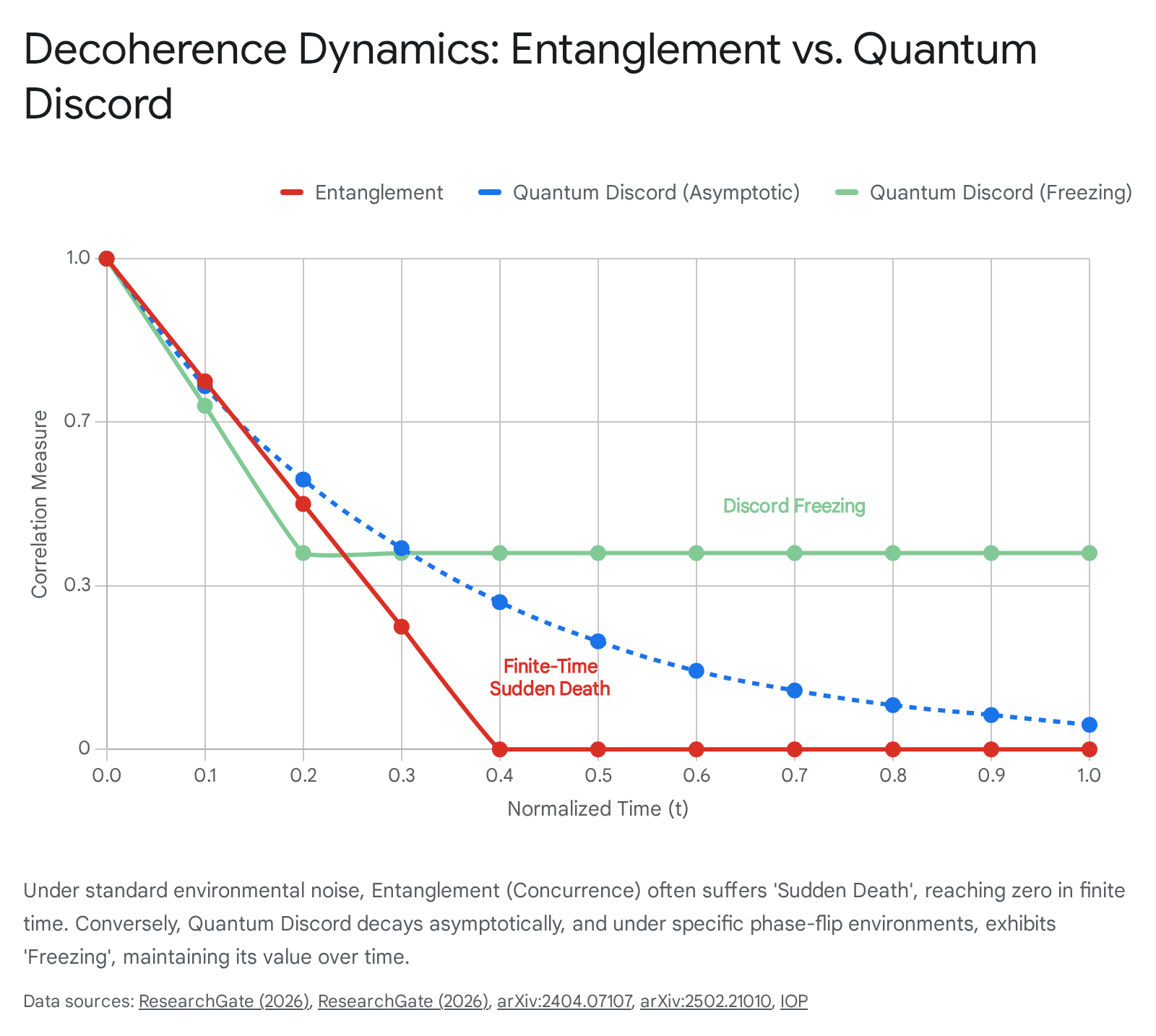
This freezing occurs because, under certain non-Markovian phase damping conditions (specifically when the correlation tensor coefficients meet conditions such as $c_2 = -c_1c_3$ with $|c_1| > |c_3|$), the geometry of the quantum state evolves perfectly parallel to the boundary of the set of classical states 6. Because the shortest distance to the classical set remains constant during this phase of the evolution, the quantum discord is "frozen."
This extreme durability has catalyzed the development of Entanglement Distribution with Separable States (EDSS) 16. In realistic quantum network architectures, sending entangled Bell states directly between remote nodes (Direct Entanglement Distribution) often fails due to the sudden death induced by dephasing noise in the fiber channels. The EDSS protocol circumvents this by transmitting separable, discordant carrier photons. Because discord is robust, the carrier survives the noisy channel. Once it reaches the remote node, the preserved discord is consumed as a catalyst to generate high-fidelity entanglement between the local quantum memories 16. While complex Zero-Added-Loss Multiplexing (ZALM) architectures involving simultaneous memory and channel noise can eventually degrade this advantage, EDSS utilizing discord remains a premier strategy for bridging noisy network gaps 16.
5. The Complexity Bottleneck and the Rise of Alternative Operational Metrics
Despite its profound physical implications, a fundamental barrier to utilizing the original Ollivier-Zurek quantum discord in the real-time compilation of practical quantum algorithms is its computational complexity. Calculating quantum discord requires a minimization over all possible local Positive Operator-Valued Measures (POVMs) on a subsystem. In 2014, complexity theorist Yichen Huang rigorously proved that computing quantum discord is NP-complete 303132. As a result, calculating exact discord for arbitrary mixed states beyond a few qubits is computationally intractable, with the required running time growing exponentially alongside the dimension of the Hilbert space 3031.
To bypass this NP-complete bottleneck, the quantum information community has engineered a suite of alternative, operationally defined measures. These metrics capture similar topological non-classicality but offer mathematical tractability, bypassing the extreme optimization requirements while providing unique physical interpretations 13319.
5.1 Geometric Quantum Discord (GQD)
Rather than relying on non-linear entropic quantities, Dakić, Vedral, and Brukner introduced Geometric Quantum Discord (GQD) 333536. GQD reformulates the problem by defining non-classicality as the minimum geometric distance from a given state $\rho$ to the closest zero-discord classical-quantum state $\chi$. Originally, this was measured using the Hilbert-Schmidt norm ($L_2$ norm): $$D_G(\rho) = \min_{\chi \in CQ} |\rho - \chi|_2^2$$ GQD was highly celebrated because it permits explicit analytical formulas for arbitrary two-qubit states based solely on the correlation matrix 33. However, subsequent analyses revealed a critical flaw in the Hilbert-Schmidt formulation: it is not contractive under Completely Positive Trace-Preserving (CPTP) maps 63537. This "local ancilla problem" meant that trivial, local reversible operations on the unmeasured party, or the mere addition of an uncorrelated ancillary state, could artificially inflate the measured discord, violating a core axiom of resource theory 6.
To rectify this, modern adaptations of GQD utilize the Trace Norm ($L_1$ norm), the Bures distance, or the Hellinger distance. The Trace Norm GQD, $D_T(\rho) = \min_{\chi \in CQ} |\rho - \chi|_1$, successfully guarantees contractivity, ensuring that non-classicality cannot be artificially generated by local operations 6.
5.2 Measurement-Induced Nonlocality (MIN)
Proposed by Luo and Fu, Measurement-Induced Nonlocality (MIN) evaluates non-classicality from an alternative topological perspective: the maximum global disturbance caused by locally invariant measurements 63538. Rather than searching for the closest classical state, MIN isolates the non-commutativity of the existing state by maximizing the distance between the pre-measurement state $\rho$ and the post-measurement state $\Pi^A(\rho)$, subject to the strict constraint that the local measurement $\Pi^A$ must not disturb the reduced density matrix $\rho_A$ 636.
The mathematical generalization is defined as $N(\rho) = \max_{\Pi^A} D(\rho, \Pi^A(\rho))$. Like the original GQD, the early Hilbert-Schmidt formulation of MIN suffered from non-contractivity. Consequently, researchers developed Trace Norm MIN, Relative Entropy MIN, and Skew Information MIN 63536. MIN provides a powerful operational meaning for tasks where locally invariant operations induce macroscopic shifts, making it highly applicable to quantum steering and cryptography without the NP-hard overhead of traditional discord 363839.
5.3 Super Quantum Discord via Weak Measurements
Recent advancements have pushed the boundary of non-classical quantification by transitioning from projective measurements to weak measurements, as originally formalized by Aharonov, Albert, and Vaidman 374041. Standard projective von Neumann measurements cause complete wave-function collapse, irrevocably destroying quantum coherence. Weak measurements, however, couple the target system to the measuring device with a tunable strength parameter, causing only partial information extraction and minimal loss of coherence 3742.
The metric derived from this process, termed "Super Quantum Discord" (SQD), consistently reveals greater magnitudes of hidden quantum correlation than standard discord across parameter spaces 3742. From a practical engineering standpoint, applying Quantum Measurement Reversal (QMR) operations after weak measurements can effectively reverse the minor disturbances introduced to the system 18. This combined protocol actively mitigates amplitude damping (AD) and delays decoherence in finite-temperature environments, presenting a highly scalable technique for extending the lifetime of quantum sensors 18.
6. Contemporary Applications in the NISQ Era and Beyond (2023 - 2026)
The theoretical maturation of quantum discord has transitioned rapidly from abstract mathematics into applied physical sciences. Between 2023 and 2026, the unique properties of discord have yielded transformative protocols in hardware optimization, thermodynamics, and high-energy collider physics.
6.1 NISQ Device Optimization and Variational Algorithms
Current Noisy Intermediate-Scale Quantum (NISQ) computers lack the hardware fidelity, qubit volume, and error-correction capabilities required to execute deep, fault-tolerant circuits 131424. When running algorithms designed to map complex chemistry or many-body physics problems onto these topologies - such as Variational Quantum Algorithms (VQAs) - the output suffers heavily from gate noise, crosstalk, and the notorious "barren plateau" optimization problem 1314.
Recent research (2025) demonstrates that algorithm-oriented qubit mapping, combined with discord-based error mitigation, dramatically improves VQA performance 1324. Because quantum discord is significantly more resilient to amplitude and phase damping than pure entanglement, selectively encoding algorithmic parameters into the highly discordant sub-spaces of the architecture ensures that computational correlations survive transit through noisy sub-topologies. Integrating optimal mapping algorithms targeting T- and H-shaped sub-topologies has resulted in depth-optimal solutions that reduce overall circuit depth by up to 82% while elevating the algorithmic success probability by 138% over classical approaches 1324.
6.2 Quantum Thermodynamics and Ergodiscord
In the evolving field of quantum thermodynamics, researchers (2025) have introduced the concept of Ergodiscord to physically bridge quantum information theory with practical energy extraction 4344. Ergodiscord acts as an operational quantifier of non-classicality measured via the thermodynamic work deficit. It is defined as the difference between the maximum thermodynamic work extractable from a multipartite quantum system under global, reversible unitary operations, versus the work extractable when the system is constrained by resources, specifically restricted to Local Operations and Classical Communication (LOCC) 394344.
This metric uncovers the remarkable phenomenon of nonlocal energy locking, wherein useful thermodynamic work becomes trapped within the non-classical correlations of a state 4344. Astoundingly, Ergodiscord exhibits a superadditivity phenomenon: a mixed non-classical state (a discordant state) can actually lock more extractable thermodynamic work than a maximally entangled pure state of the exact same system 4344. This counterintuitive discovery is fundamentally altering the design of quantum batteries and multi-cell quantum energy storage devices. It proves that cultivating discordant, mixed-state correlations is a superior, robust strategy for preserving energy capacity in noisy thermodynamic cycles compared to maintaining fragile pure-state entanglement 43.
6.3 Quantum Metrology and Particle Physics at the LHC
Quantum metrology leverages non-classical correlations to suppress statistical noise, surpassing the classical Cramér-Rao precision bound. In interferometric phase estimation protocols where the system's Hamiltonian is initially unknown, the quantum discord of the probe state directly dictates the minimum achievable precision 45. In late 2024, researchers derived multidimensional kinetic uncertainty relations (KURs) and thermodynamic uncertainty relations (TURs) using multi-parameter metrology based on the Fisher information matrix 46. These derivations demonstrated that discordant quantum coherence tightens measurement bounds significantly over classical stochastic dynamics, particularly in open quantum systems undergoing Markovian dynamics 46.
Perhaps most groundbreaking is the intersection of discord with high-energy particle physics 472021. In late 2024 and throughout 2025, rigorous theoretical and experimental roadmaps were established to measure quantum discord directly inside the Large Hadron Collider (LHC) at CERN 472122. By analyzing the top anti-top quark ($t\bar{t}$) decay system using both kinematic and decay reconstruction methods, high-energy physicists project that quantum discord can be empirically measured with an unprecedented 1-2% precision using current LHC datasets 4720.
At the forthcoming High-Luminosity LHC, this precision is expected to reach sub-percent levels 472122. This expansion of the quantum information toolkit into collider physics allows researchers to probe the fundamental survival of non-classical correlations and the emergence of objective reality at extreme relativistic energy scales 472023.
7. The Geopolitical Landscape of Quantum Correlation Research
The rapid acceleration of quantum discord research and broad correlation metrics is deeply intertwined with massive geopolitical investments targeting quantum supremacy. Two major epicenters currently dominate the translation of these foundational theories into scalable hardware: the European Union's coordinated Quantum Flagship and China's highly centralized State Laboratories.
7.1 The European Quantum Flagship Initiatives
Launched in 2018 with an initial €1 billion budget and now vastly expanded under the Horizon Europe framework, the European Quantum Flagship targets the creation of a secure, continent-wide "quantum web" 242526. The European strategy heavily focuses on translating theoretical quantum optics, correlation metrics, and quantum metrology - domains where European research hubs like the Walther Group at the University of Vienna have historically excelled - into widespread commercial reality 2728.
The EuroQCI (European Quantum Communication Infrastructure) initiative aims to integrate advanced post-quantum protocols and entanglement/discord distribution directly into existing terrestrial telecommunications grids across member states 2529. European efforts are characterized by deep, collaborative multinational consortiums (such as the OpenSuperQ and QSNP projects). These initiatives explore diverse hardware architectures, ranging from trapped ions to superconducting circuits, explicitly targeting NISQ-era quantum simulation and metrology while building a resilient, decentralized ecosystem 242829.
7.2 Chinese State Laboratories and USTC Advancements
Conversely, China's advancements in quantum scaling are highly centralized, driven predominantly by the University of Science and Technology of China (USTC) and the Chinese Academy of Sciences (CAS) under the leadership of prominent researchers like Pan Jianwei 303132. While Europe pursues broad industrial consortiums, USTC has aggressively targeted and rapidly secured world-first milestone records in quantum communication scaling and state manipulation.
In early 2026, the USTC team published landmark findings in Nature and Science detailing the first practical demonstration of a scalable building block for a quantum repeater 303132. By developing a long-lived trapped-ion quantum memory alongside a highly efficient ion-photon interface, they achieved device-independent quantum key distribution (DI-QKD) over 100 kilometers of city-scale fiber networks - surpassing previous international distance records by orders of magnitude 3031. Achieving these extreme distances relies implicitly on the preservation of non-local correlations and discord-like states over macroscopic distances, proving that fiber-based quantum networks are transitioning definitively from theoretical concepts to deployable infrastructure 3031.
8. Conclusion
The conceptual evolution from a strictly entanglement-centric view of quantum mechanics to a holistic understanding of non-classical correlations marks a defining paradigm shift in modern physics. Quantum discord, and its dissonant subsets, definitively prove that unentangled, highly mixed separable states possess intrinsic quantum advantages capable of vastly outperforming classical systems. This is empirically evidenced by the algorithmic exponential speedups in DQC1 protocols, the sub-classical precision bounds achieved in multi-parameter metrology, and the superadditive energy storage locked within quantum thermodynamics.
As the global race toward practical quantum utility accelerates through the constraints of the NISQ era, overcoming environmental noise remains the ultimate engineering barrier. The inherent robustness of quantum discord to decoherence - surviving and freezing long after the sudden death of fragile entanglement - positions discord and alternative metrics like measurement-induced nonlocality not merely as theoretical curiosities, but as the practical, resilient foundations for the next generation of scalable quantum algorithms, thermodynamic engines, and high-energy physical analysis.