Quantum chromodynamics at finite temperature and quark-gluon plasma
Theoretical Foundations of Strongly Interacting Matter
Quantum chromodynamics (QCD) is the fundamental non-Abelian gauge theory describing the strong interaction, which governs the dynamics of quarks and gluons. The theory is characterized by two defining, yet opposing, features: color confinement and asymptotic freedom 1234. Under ordinary vacuum conditions and low energy scales, the strong coupling constant diverges, rendering perturbative calculations ineffective. This non-perturbative regime manifests as color confinement, wherein quarks and gluons are permanently bound within color-neutral hadrons, such as three-quark baryons and quark-antiquark mesons 234. The QCD vacuum acts as a complex medium, often analogized to a dual superconductor that expels color-electric fields and confines quarks via flux tubes 45.
Conversely, asymptotic freedom dictates that the effective coupling between quarks and gluons decreases logarithmically as the energy scale of the interaction increases or the distance between particles decreases 123. This property implies that under extreme thermodynamic conditions - specifically, ultra-high temperatures ($T$) or extreme baryon chemical potentials ($\mu_B$) - the boundaries of individual hadrons should melt 367. The system undergoes a profound phase transition into a deconfined state of strongly interacting matter known as the quark-gluon plasma (QGP). In this state, quarks and gluons are liberated over a volume significantly larger than the standard confinement scale of approximately one femtometer ($1$ fm), behaving collectively as a continuous medium 4689.
Mapping the phase boundaries and thermodynamic properties of QCD matter is a central objective of modern nuclear physics. The theoretical QCD phase diagram visually synthesizes the relationship between these states, typically plotting temperature on the vertical axis against the baryon chemical potential on the horizontal axis. This conceptual map reveals distinct physical regimes: a high-temperature, low-density region corresponding to the early universe; a low-temperature, ultra-high-density region representing the cores of neutron stars; and a complex intermediate zone explored by heavy-ion collider experiments, featuring a smooth crossover boundary that is hypothesized to terminate at a first-order critical endpoint 11101112.
The Cosmological Epoch of the Quark-Gluon Plasma
In the standard cosmological paradigm, the universe emerged from the Big Bang in a state of nearly infinite density and temperature. During the initial fractions of a second, following the electroweak symmetry breaking, the universe was filled with a primordial plasma containing all particles of the Standard Model in thermal equilibrium 13. At temperatures exceeding $200$ GeV, the effective number of relativistic degrees of freedom ($g_{eff}$) in the cosmological plasma was $106.75$ 1314. As the universe expanded and cooled isentropically, massive particles - beginning with the top quark, followed by the Higgs, Z, and W bosons - became non-relativistic and decoupled, causing $g_{eff}$ to drop to $86.75$ 14.
Approximately ten microseconds ($10^{-5}$ seconds) after the Big Bang, the ambient temperature of the universe fell to the characteristic QCD energy scale, roughly $T_c \approx 150 - 170$ MeV 361415. At this epoch, the Hubble length scale was approximately $10$ kilometers, and the baryon density was minuscule compared to the photon density, resulting in a baryon chemical potential that was effectively zero ($\mu_B \approx 0$) 1416.
Under these specific conditions, the universe underwent the cosmic QCD phase transition. First-principles lattice QCD calculations have firmly established that for physical quark masses, the transition from the deconfined quark-gluon plasma to the confined hadronic gas was not a violent, first-order phase transition characterized by bubble nucleation, but rather a rapid, analytic crossover 31519. This smooth crossover implies that the early universe did not experience massive latent heat release or extreme scale symmetry breaking that would typically generate a detectable stochastic gravitational wave background from this specific epoch, though effective models like the Polyakov-quark-meson theory occasionally explore variations of this scenario 615.
As the temperature continued to drop below $T_c$, the liberated quarks and gluons rapidly bound together into color-neutral states. The lightest hadrons, the pions, were produced in overwhelming abundance, followed by the heavier baryons 817. This sudden reduction in the degrees of freedom dramatically altered the equation of state, setting the stage for Big Bang nucleosynthesis, which would occur minutes later when the universe cooled sufficiently to allow protons and neutrons to fuse 1618.
High-Density Quantum Chromodynamics in Compact Stellar Objects
While the early universe explored the high-temperature, low-density axis of the QCD phase diagram, the interiors of compact stellar objects - specifically neutron stars - probe the extreme low-temperature, high-density frontier. Formed in the aftermath of core-collapse supernovae, canonical neutron stars possess core densities that can exceed the nuclear saturation density ($\rho_0 \approx 0.16$ fm$^{-3}$) by a factor of five to ten, reaching mass densities of up to $3 \times 10^{15}$ g/cm$^3$ 819.
In these dense stellar cores, the thermal energy is negligible on the QCD scale ($T \ll 10$ MeV), while the baryon chemical potential is immense, often exceeding $1000$ MeV 192320. The proximity of nucleons under such extreme gravitational compression suggests that their wavefunctions overlap, potentially leading to the dissolution of hadronic boundaries and the formation of a cold, degenerate quark matter core, or exotic phases such as color superconductivity and color-flavor locking 311.
Determining the precise equation of state (EoS) for strongly interacting matter at these densities remains a formidable theoretical challenge, primarily due to the "hyperon puzzle." Theoretical models generally predict that as the baryon chemical potential increases, it becomes energetically favorable to populate the core with hyperons (baryons containing strange quarks) 1920. However, the introduction of hyperons typically softens the EoS, reducing the maximum mass the star can support against gravitational collapse. This contradicts the astronomical observation of massive neutron stars, such as PSR J0437-4715, which has a precisely measured mass of $2.08 \pm 0.07 M_\odot$ 19.
Resolving the hyperon puzzle requires the inclusion of strongly repulsive three-baryon forces (3BFs) at high densities. Phenomenological models utilizing low-energy constants demonstrate that a strongly repulsive $\Lambda$-hyperon potential can suppress the appearance of hyperons, stiffening the EoS sufficiently to support two-solar-mass neutron stars while remaining consistent with $\Sigma$-potential empirical constraints of approximately $30$ MeV 20. Furthermore, the era of multimessenger astronomy, inaugurated by the observation of the binary neutron star merger GW170817, has provided independent constraints on the speed of sound in dense nuclear matter and the tidal deformability of these objects, narrowing the permissible parameter space for the high-density QCD equation of state 1119.
To contextualize the distinct environments where deconfined strongly interacting matter occurs, Table 1 provides a comparison of the thermodynamic parameters characterizing the early universe, neutron star cores, and the transient matter generated in high-energy particle accelerators.
| Parameter | Early Universe Epoch | Neutron Star Cores | Heavy-Ion Collisions (RHIC/LHC) |
|---|---|---|---|
| Peak Temperature ($T$) | $\approx 150 - 200$ MeV (at transition) | $< 10$ MeV (effectively zero) | $200 - 600$ MeV (initial) |
| Baryon Chemical Potential ($\mu_B$) | $\approx 0$ MeV | $> 1000$ MeV | $0 - 600$ MeV (facility and energy dependent) |
| Density Regime | Low net baryon density | Up to $5 - 10 \times$ nuclear density | Variable, extreme energy density |
| System Lifespan | Continuous expansion over microseconds | Stable over billions of years | Transient ($\approx 10 - 15$ fm/$c$) |
| Transition Mechanism | Analytic Crossover | Unknown (possibly first-order) | Crossover / Targeted search for Critical Point |
Table 1: Comparative thermodynamic environments for strongly interacting matter across astrophysical, cosmological, and laboratory scales 451921.
Dynamics of Ultra-Relativistic Heavy-Ion Collisions
To empirically probe the properties of the quark-gluon plasma, physicists utilize massive particle accelerators to collide heavy atomic nuclei at ultra-relativistic speeds. The evolution of the resulting micro-bang is extraordinarily complex, occurring over a transient lifespan of roughly $10$ to $15$ fm/$c$ ($1 \text{ fm}/c \approx 3.3 \times 10^{-24}$ seconds) 92122. The collision dynamics unfold through several distinct chronological stages, transitioning from coherent gluon fields to a thermalized plasma, and finally to a rapidly expanding gas of stable hadrons.
The Initial State and the Glasma Phase
Prior to impact, the incident nuclei are accelerated to nearly the speed of light. In the laboratory frame, Lorentz contraction compresses the spherical nuclei into highly flattened discs 422. From the perspective of high-energy quantum chromodynamics, particularly at small Bjorken-$x$ values, the internal structure of these accelerated nuclei is overwhelmingly dominated by densely packed gluons. This saturated state of gluonic matter is described by an effective field theory known as the Color Glass Condensate (CGC), characterized by a defining saturation momentum scale, $Q_s$ 23292425.
When the Lorentz-contracted discs interpenetrate at proper time $\tau = 0$, they pass through each other, depositing a massive amount of energy into the spatial region between the receding fragments. This nascent, far-from-equilibrium phase is called the Glasma 232924. The Glasma is defined by intense, coherent longitudinal color-electric and color-magnetic flux tubes, with transverse domain sizes roughly proportional to $1/Q_s$ 2324. In this regime, the occupancy of the gluon fields is extremely high (scaling inversely with the weak coupling constant, $\sim 1/\lambda$), meaning the system behaves as a classical wave rather than a collection of quantum particles, and its dynamics are governed by classical Yang-Mills equations 2324.
The Glasma phase is highly anisotropic, featuring massive transverse pressure but negligible longitudinal pressure. Analytical proper-time expansions of the Glasma energy-momentum tensor indicate that the spatial asymmetry introduced by the initial nuclear collision geometry is transmitted to the azimuthal distribution of the gluon momentum fields almost immediately, at times as early as $\tau \ll 1$ fm/$c$ 2926. This finding indicates that the seeds of collective azimuthal flow are planted prior to the onset of true hydrodynamics.
Pre-Equilibrium and Hydrodynamization
The coherent, classical flux tubes of the Glasma are highly unstable and rapidly decay into a dense medium of partonic quasi-particles. The system undergoes a phase of "hydrodynamization" and subsequent thermalization. Through multiple partonic interactions, plasma instabilities, and radiative gluon emission, the highly anisotropic momentum distributions begin to isotropize 222326.
Remarkably, this equilibration occurs over exceptionally short timescales. Theoretical modeling and experimental data extraction suggest that the medium reaches a state accurately described by relativistic viscous hydrodynamics by $\tau \approx 0.1 - 0.6$ fm/$c$ at LHC energies, and slightly longer at RHIC energies 22232633. The precise microscopic mechanisms driving this rapid thermalization - whether driven by strong coupling or instabilities in weakly coupled plasmas - remain an active frontier in non-equilibrium quantum field theory 2326.
Hydrodynamic Expansion and the Perfect Liquid Paradigm
Once local thermal equilibrium is approached, the system formally transitions into the quark-gluon plasma phase. The extreme energy density deposited in the collision volume creates vast internal pressure gradients, driving a violent outward expansion of the medium 922.
Prior to the operation of the Relativistic Heavy Ion Collider in 2000, theoretical expectations - rooted in perturbative QCD - suggested that the QGP would behave as a weakly interacting, ideal gas of quarks and gluons due to asymptotic freedom 12728. However, experimental data fundamentally shifted this paradigm. When heavy ions collide with a non-zero impact parameter (non-central collisions), the initial spatial overlap region is almond-shaped rather than spherical. The pressure gradients are significantly steeper along the short axis of the almond. Relativistic viscous hydrodynamics accurately translates this initial spatial anisotropy into a final-state momentum anisotropy 29303139.
This collective motion is mathematically quantified via a Fourier decomposition of the azimuthal angular distribution of the emitted particles, yielding flow coefficients such as elliptic flow ($v_2$) and triangular flow ($v_3$) 303139. The overwhelming success of hydrodynamic models in reproducing these flow harmonics across different centralities and collision systems provides the primary evidence that the QGP behaves as a strongly coupled liquid, rather than a weakly coupled gas 313241.
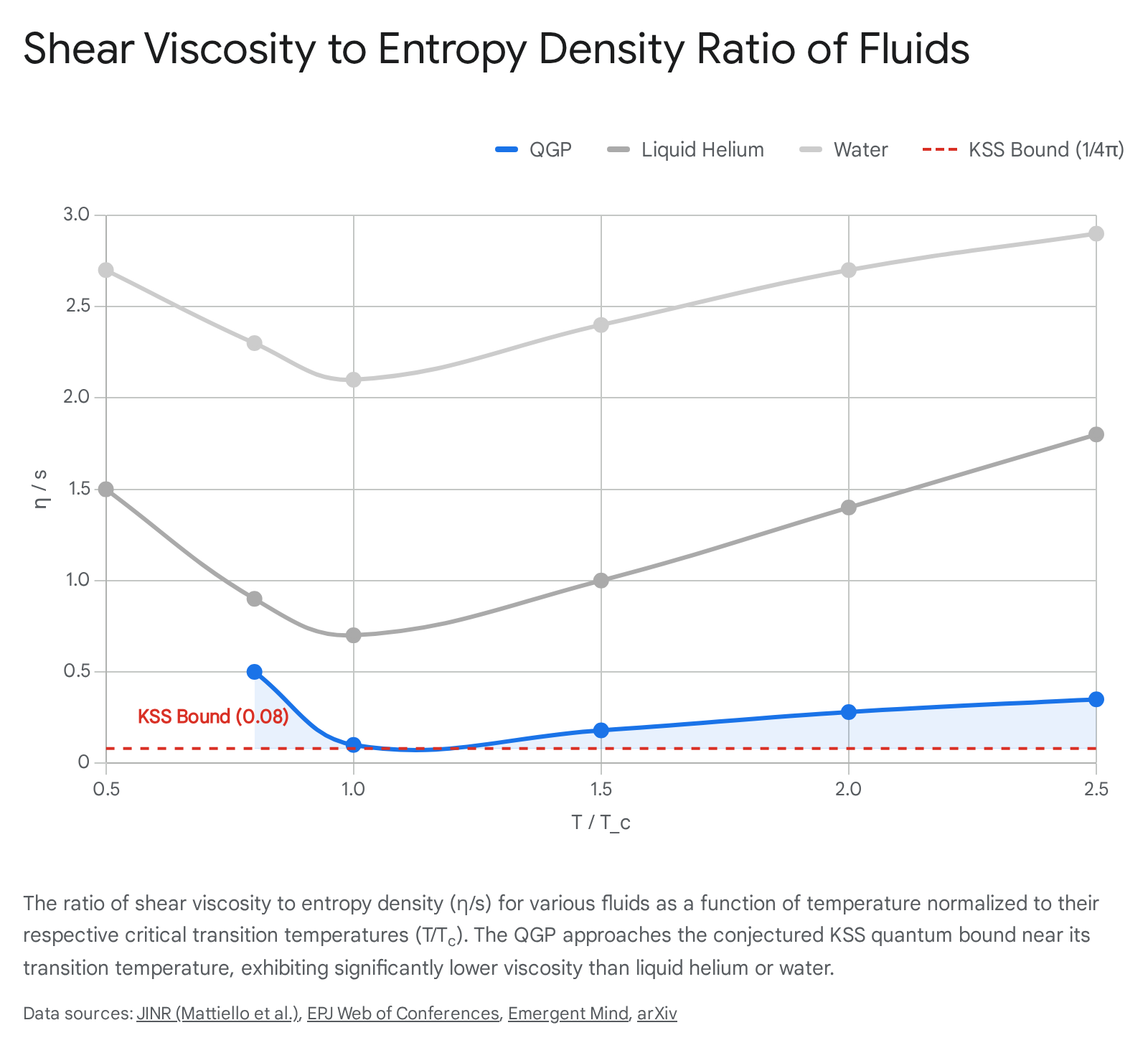
This state is widely referred to as the "perfect liquid," a perfection quantified by the ratio of shear viscosity to entropy density ($\eta/s$), which measures the fluid's resistance to flow and momentum diffusion 3233. In the context of quantum mechanics and gauge/gravity duality (the AdS/CFT correspondence), a theoretical lower bound for this ratio was proposed by Kovtun, Son, and Starinets (the KSS bound), defined as $\eta/s \geq \hbar / (4\pi k_B) \approx 0.08$ 32343536. Hydrodynamic modeling fitted to experimental flow data from both RHIC and the LHC indicates that the QGP possesses an $\eta/s$ value in the range of $0.1$ to $0.2$, placing it closer to the absolute quantum limit than any other known fluid, including superfluid liquid helium 73233. The temperature dependence of $\eta/s$ is also highly constrained; similar to conventional fluids, $\eta/s$ in the QGP reaches a deep minimum near the phase transition temperature ($T_c \approx 155$ MeV) and increases at higher temperatures as the medium becomes more weakly coupled 3033.
Jet Quenching and Heavy Flavor Transport
Beyond the macroscopic fluid properties described by hydrodynamics, the microscopic structure of the QGP is probed via its interaction with highly energetic partons. In the earliest stages of a heavy-ion collision, primary hard scattering events produce energetic quarks and gluons. In a standard vacuum environment, such as in proton-proton collisions, these partons fragment and hadronize into highly collimated sprays of particles known as jets 3738.
When these hard-scattered partons traverse the dense QGP, they interact strongly with the medium via collisional energy loss and medium-induced gluon bremsstrahlung. This intense interaction strips energy from the leading parton, a phenomenon known as jet quenching 313848. Experimentally, jet quenching manifests as a severe suppression of high transverse momentum ($p_T$) hadrons relative to expectations scaled from proton-proton baselines. This suppression is quantified by the nuclear modification factor ($R_{AA}$); a value significantly less than unity confirms the extreme opacity of the medium 73141.
Furthermore, the transport of heavy-flavor partons (charm and beauty quarks) provides specialized tomographic insights. Because their masses ($m_c \approx 1.3$ GeV, $m_b \approx 4.2$ GeV) are much larger than the typical QGP temperature, heavy quarks are produced almost exclusively in the initial hard scatterings and subsequently experience the full evolutionary history of the expanding plasma 394041. Measuring the spatial heavy quark diffusion coefficient, as well as the elliptic flow of heavy flavor mesons (such as $D^0$ and $J/\psi$), allows researchers to deduce the equilibration timescales of the medium and the specific mechanisms of parton energy loss 404152.
Hadronization and Freeze-out Mechanisms
As the hydrodynamic expansion forces the plasma volume to increase, the medium cools nearly isentropically. Eventually, the local temperature drops to the pseudo-critical temperature of the QCD crossover, approximately $155$ MeV 7922. At this boundary, the thermal energy is no longer sufficient to overcome color confinement, and the deconfined partons recombine to form a diverse array of color-neutral hadrons, emitting a spray of particles that travel outward.
The post-hadronization evolution of the system is governed by two distinct decoupling thresholds, known as freeze-outs, which lock in the observable properties of the emitted particles:
- Chemical Freeze-out: At the chemical freeze-out temperature ($T_{ch}$), inelastic collisions - which alter the fundamental identities of the interacting particles - cease. At this precise moment, the relative yields and ratios of different hadron species (e.g., pions, kaons, protons, hyperons, and strangeness abundance) are permanently fixed 22424344. Statistical thermal models have been highly successful in describing these particle abundances, indicating that chemical freeze-out occurs very close to the hadronization boundary itself, around $155 - 160$ MeV at top collider energies 94245. The global chemical non-equilibrium seen in some phenomenological models suggests a direct, sudden hadronization of a supercooled QGP into free-streaming particles, particularly at LHC energies where the expansion is incredibly rapid 46.
- Kinetic (Thermal) Freeze-out: Following chemical freeze-out, the system continues to expand rapidly as a dilute, interacting hadronic gas. Elastic collisions continue to exchange momentum between hadrons, cooling the system further and building up radial flow 4345. Eventually, the density drops so low that the mean free path of the hadrons exceeds the physical size of the expanding fireball, causing all elastic collisions to cease. This occurs at the kinetic freeze-out temperature ($T_{kin}$), typically around $90 - 110$ MeV 22424345. The final momentum distributions and spectral shapes of the particles are locked in at this point.
The separation between chemical and kinetic freeze-out temperatures is highly dependent on the initial collision energy. At higher energies, the larger initial energy density results in a significantly extended hadronic rescattering phase, driving a larger divergence between $T_{ch}$ and $T_{kin}$ 4243.
| Collision Energy / Facility | Chemical Freeze-out $T_{ch}$ | Kinetic Freeze-out $T_{kin}$ | Decoupling Behavior |
|---|---|---|---|
| Lower Energies (e.g., $\sqrt{s_{NN}} = 9.2$ GeV) | $\approx 140 - 150$ MeV | $\approx 140 - 150$ MeV | $T_{ch} \approx T_{kin}$ (rapid decoupling, minimal hadronic phase) |
| RHIC (e.g., $\sqrt{s_{NN}} = 200$ GeV) | $\approx 155 - 160$ MeV | $\approx 110 - 120$ MeV | $T_{ch} > T_{kin}$ (extended hadronic rescattering) |
| LHC (e.g., $\sqrt{s_{NN}} = 2.76$ / $5.02$ TeV) | $\approx 155$ MeV | $\approx 90 - 100$ MeV | $T_{ch} \gg T_{kin}$ (maximal collective flow development) |
Table 2: Comparison of chemical and kinetic freeze-out temperatures across varying collision energies. Higher initial energy densities lead to longer-lived hadronic phases, resulting in lower kinetic decoupling temperatures 2242434445.
After kinetic freeze-out, the hadrons stream freely through the vacuum toward the detection apparatus, carrying the encoded thermodynamic and kinematic history of the entire dynamic evolution 22.
Experimental Facilities and Recent Measurements
The empirical study of the quark-gluon plasma relies on the operation of massive international particle accelerators, primarily the Relativistic Heavy Ion Collider (RHIC) at Brookhaven National Laboratory and the Large Hadron Collider (LHC) at CERN. These facilities act as highly complementary tools; the LHC explores the highest achievable temperatures and lowest net-baryon densities, while RHIC maps out the QCD phase diagram across a much wider range of energies and chemical potentials 52127.
The Relativistic Heavy Ion Collider and the sPHENIX Program
Operating since 2000, RHIC collides gold (Au) and other heavy nuclei at center-of-mass energies per nucleon pair ($\sqrt{s_{NN}}$) ranging from a few GeV up to $200$ GeV 2127. A significant focus of RHIC's recent physics program has been the Beam Energy Scan Phase-II (BES-II), a dedicated campaign spanning 2019 to 2021 designed to systematically lower the collision energy. By doing so, BES-II maximizes the baryon chemical potential of the created matter, effectively searching for the elusive QCD critical endpoint 1047.
To finalize the high-energy mission of RHIC, the facility recently completed a major upgrade with the installation of sPHENIX, the first entirely new collider detector dedicated to heavy-ion physics in over two decades 373959. Successfully commissioned for Run 24, sPHENIX features a cutting-edge streaming-capable tracking system that fundamentally alters the data acquisition paradigm. This system allowed the collaboration to record over 100 billion unbiased proton-proton ($p+p$) collisions at $200$ GeV, achieving data rates 20 to 50 times higher than traditional trigger systems 3959. This massive baseline dataset is indispensable for high-precision measurements of open heavy flavor physics and jet quenching phenomena 395948.
Preliminary 2025 results from sPHENIX have already demonstrated unprecedented precision. From the initial Run 24 data, the collaboration reported the first observation of $D^0$ mesons and evidence of $\Lambda_c^+$ baryons in $p+p$ collisions at RHIC, enabling novel studies of charm quark hadronization 3959. In top-energy Au+Au collisions ($\sqrt{s_{NN}} = 200$ GeV), sPHENIX provided high-precision measurements of the transverse energy density ($dE_T/d\eta$) and charged hadron multiplicity. The data revealed that central head-on collisions release approximately ten times more energy and produce ten times more charged particles than peripheral, glancing collisions 374849. By utilizing fully reconstructed jets and measuring specific parameters like dijet imbalance ($x_J$) and acoplanarity ($\Delta\phi$), the sPHENIX program acts as a high-resolution microscope, aiming to determine whether the QGP is a uniform fluid at all scales or if it possesses a chunky, granular substructure 375063.
The Large Hadron Collider and ALICE Upgrades
The LHC explores the highest energy frontier, currently colliding lead (Pb) ions at an unprecedented $\sqrt{s_{NN}} = 5.36$ TeV during Run 3 92951. The peak initial temperatures achieved in these central collisions exceed $300$ MeV, generating a QGP with a substantially larger volume and a longer lifetime (approximately $10 - 11$ fm/$c$) compared to the plasmas created at RHIC 521.
A Dedicated heavy-ion experiment, ALICE (A Large Ion Collider Experiment), has undergone comprehensive upgrades for Run 3. A key advancement is the implementation of a continuous readout Time Projection Chamber (TPC) utilizing Gas Electron Multiplier (GEM) technology. This upgrade allows ALICE to record Pb-Pb collisions at interaction rates up to 50 kHz without the deadtime associated with traditional triggered readouts, drastically increasing recorded statistics 405253. Coupled with an improved Inner Tracking System (ITS2) for superior spatial resolution, ALICE has achieved remarkable precision in measuring hard probes. Recent Run 3 measurements of the elliptic flow ($v_2$) of inclusive $J/\psi$ mesons show significant non-zero values down to very low $p_T$. This compellingly indicates that heavy charm quarks thermalize within the QGP and reinforces the theory that the recombination of charm and anti-charm quarks within the medium is a dominant production mechanism at LHC energies 4041. Furthermore, ALICE recently achieved the first observation of top-quark pair production in Pb-Pb collisions at $5.02$ TeV, providing a novel, ultra-heavy probe of the nuclear parton distribution functions 54.
In a major milestone for 2025, ALICE executed novel data-taking cycles, colliding lighter nuclei such as oxygen-oxygen (O-O) and neon-neon (Ne-Ne) at $5.36$ TeV 2955. Analysis of these datasets revealed the first definitive evidence of geometry-driven hydrodynamic flow in small systems. The measured elliptic and triangular flow coefficients ($v_2$ and $v_3$) scaled precisely with the known intrinsic geometric deformation (the "bowling pin" shape) of the Ne and O nuclei 293955. This observation firmly establishes that the hydrodynamic paradigm of a strongly coupled fluid emerges robustly even in very small nuclear systems, bridging the conceptual gap between massive heavy-ion collisions and high-multiplicity proton-proton events 2939. Looking toward the 2030s, the collaboration is preparing the ALICE 3 project for LHC Runs 5 and 6, which will feature an entirely silicon-based tracking system within the beam pipe to optimize ultra-soft photon emission studies and multi-charm baryon tracking 405356.
The Quantum Chromodynamics Phase Diagram
A central and overarching objective of the high-energy nuclear physics community is to accurately map the entire QCD phase diagram. This diagram is spanned by temperature ($T$) on the vertical axis and the baryon chemical potential ($\mu_B$) on the horizontal axis. The baryon chemical potential is a thermodynamic variable representing the energy required to add one net baryon to the system, serving as a formal proxy for the net baryon density 117057.
The Crossover Region at Vanishing Baryon Density
The vertical axis of the phase diagram represents conditions of extreme temperature and exactly zero net baryon density ($\mu_B = 0$). This is the thermodynamic regime that characterized the early universe, and it is the primary domain explored by the LHC and top-energy RHIC collisions, where the immense collision energy produces particle-antiparticle pairs in roughly equal numbers 51421.
In this specific domain, first-principles theoretical calculations using lattice QCD can be executed with exceptionally high precision. Lattice QCD discretizes continuous Euclidean spacetime onto a hypercubic grid, allowing the path integrals of the strong interaction to be evaluated numerically using sophisticated Monte Carlo algorithms 51757. These rigorous simulations have firmly established that for physical quark masses, the transition from a hadronic gas to the QGP at $\mu_B = 0$ is not a sharp phase transition, but an analytic, smooth crossover 4719. High-precision lattice extrapolations have pinned down the pseudo-critical temperature of this chiral and deconfinement crossover to $T_c \approx 156.5 \pm 1.5$ MeV 47. In this crossover regime, there is no phase coexistence; instead, thermodynamic quantities such as entropy density, pressure, and energy density increase rapidly but continuously as the relevant degrees of freedom shift from hadrons to partons 372.
The Search for the Critical Endpoint
Theoretical consensus dictates that as the baryon density increases (moving rightward along the $\mu_B$ axis), the nature of the phase transition should eventually change 1173. Various effective field theory models - such as the Nambu-Jona-Lasinio (NJL) model, Polyakov-quark-meson (PQM) models, and holographic Einstein-Maxwell-dilaton (EMD) approaches - predict that at sufficiently large $\mu_B$, the transition boundary transforms into a discontinuous, first-order phase transition 4587559.
The exact thermodynamic coordinate where the continuous crossover ends and the first-order phase transition line begins is defined as the QCD Critical Endpoint (CEP) 1117358. At this specific point, the transition is of second order, and the system is predicted to exhibit universal critical phenomena, including massive scale-invariant fluctuations in conserved quantities like baryon number, electric charge, and dilepton emission rates 737577.
Locating the CEP has been the primary motivation for the RHIC Beam Energy Scan. By systematically lowering the collision energy, the stopping power of the colliding nuclei increases, creating a fireball with a higher net baryon density (larger $\mu_B$) 1142. Recent analyses of the high-precision BES-II data, specifically regarding the kurtosis (a higher-order statistical moment) of net-proton distributions, have begun to tightly constrain the theoretical space. Preliminary interpretations of BES-II data demonstrate an absence of the expected strong critical fluctuations at collision energies from $\sqrt{s_{NN}} = 7.7$ GeV and above 107560.
Consequently, the most recent theoretical consensus and lattice-constrained estimates confidently rule out the existence of the critical point at chemical potentials below $\mu_B \approx 400 - 450$ MeV 7079. Recent data-driven refinements of analytical holographic models, calibrated against the latest HotQCD and Wuppertal-Budapest lattice equations of state, place the likely coordinates of the CEP much deeper into the dense regime, predicting locations clustered around $\mu_B \approx 400 - 680$ MeV and $T \approx 100 - 130$ MeV 117258. Exploring these extreme densities, where the transition is theorized to be strictly first-order, will be the primary objective of upcoming low-energy, high-luminosity facilities such as FAIR (Germany), NICA (Russia), and HIAF (China) 757761.
Computational Methods and the Fermion Sign Problem
While the experimental heavy-ion program steadily produces empirical constraints, theoretical ab initio calculations of the phase diagram at non-zero baryon density confront a severe mathematical obstacle that has hindered the field for decades.
The Fermion Sign Problem
First-principles calculations of QCD rely on evaluating the grand canonical partition function. In the lattice formulation, the continuous gauge fields are represented as links connecting discrete grid sites, while the fermion (quark) fields reside on the sites themselves 562. Because fermions are represented by anti-commuting Grassmann numbers, they cannot be simulated directly and must be integrated out analytically. This leaves the partition function as an integral over the gauge configurations, weighted by the determinant of the fermion Dirac matrix multiplied by the exponential of the Yang-Mills action 62.
To evaluate this multidimensional integral numerically via standard Monte Carlo methods (such as the Metropolis-Hastings algorithm), this combined statistical weight must be a strictly real, positive number, allowing it to be treated as a valid probability distribution for importance sampling 576282. At zero chemical potential ($\mu_B = 0$) or for purely imaginary chemical potentials, the fermion determinant satisfies this requirement. However, when a real baryon chemical potential is introduced ($\mu_B > 0$), the Dirac operator loses its $\gamma_5$-Hermiticity, and the fermion determinant becomes complex.
Because a complex number cannot serve as a probability weight, standard Monte Carlo algorithms fail entirely. The highly oscillatory nature of the complex phase leads to catastrophic cancellations during integration, a fundamental numerical issue known as the fermion "sign problem" or the complex action problem 73628263.
Extrapolation Strategies and Analytic Continuation
To circumvent the sign problem, lattice theorists have developed several rigorous mathematical workarounds, though all possess stringent domains of validity.
The most prominent established method is the Taylor expansion of thermodynamic observables (such as pressure, density, and susceptibility) in powers of the ratio $\mu_B / T$, evaluated strictly at $\mu_B = 0$, where simulations are completely free of the sign problem 4705763. By computing these higher-order susceptibility coefficients at zero density, the equation of state can be mathematically extrapolated to finite density. A closely related method is analytic continuation, which involves performing simulations at an imaginary chemical potential ($\mu = i\mu_I$), fitting polynomial functions to the positive weights, and analytically continuing the results to the real axis 57796264.
Recent advancements in mathematical resummation techniques, such as the 4D-TExS (T-Expansion Scheme), have significantly improved the precision of these extrapolations. Currently, these methods provide confident, continuum-extrapolated equations of state up to a theoretical limit of $\mu_B / T \approx 2.5 - 3.5$ 736365. However, beyond this ratio, the truncation errors of the Taylor series diverge uncontrollably, making these extrapolation methods fundamentally incapable of probing the deep dense regions where the critical endpoint is expected to reside 8263. Other direct methods, such as reweighting techniques (which attempt to fold the complex phase into the observable itself), suffer from a severe signal-to-noise deterioration known as the overlap problem when pushed to high densities, rendering them unusable for deep phase diagram mapping 5763.
Complex Langevin Dynamics and Non-Perturbative Breakthroughs
To shatter the $\mu_B/T$ extrapolation barrier and solve the sign problem directly, researchers are actively developing alternative algorithms that do not rely on standard importance sampling. The most mathematically promising among these is the Complex Langevin (CL) method 19576667.
The Complex Langevin approach is founded on the principles of stochastic quantization. Rather than avoiding the complex nature of the action, the CL method embraces it by complexifying the underlying field manifold (allowing the real gauge fields to take complex values) and governing their evolution through an artificial stochastic "time" dimension. This evolution is driven by a Langevin equation utilizing Gaussian noise 1957. The drift term in this differential equation is determined directly by the derivative of the complex action, effectively trading the problematic complex weight for a well-behaved, real probability distribution over an enlarged, complexified state space 1967.
While theoretically elegant, early applications of CL to finite-density QCD were plagued by the "wrong convergence" problem. In these instances, the stochastic trajectories wandered too far into the imaginary direction of the complex plane, violating the boundary conditions required for the method's mathematical proofs, thereby yielding convergence to incorrect physical results 195767. Recent algorithmic breakthroughs have largely stabilized the method using targeted techniques. Gauge cooling applies non-unitary gauge transformations to continually pull configurations back toward the real axis, preventing runaway trajectories. Dynamical stabilization adds a carefully tuned regularizing penalty term to the drift forces to suppress excursions into the complex plane; the bias introduced by this stabilization can be systematically removed by extrapolating the results to zero dynamical force using a sigmoid fit 1957.
As of 2026, these stabilizations have enabled Complex Langevin simulations to successfully compute the continuum-extrapolated QCD equation of state at the physical point (using realistic quark masses) for unprecedentedly high baryon densities, far beyond the reach of any Taylor expansion 1957. Integrating these advanced numerical techniques alongside density of states methods and machine-learning-driven Lefschetz thimble contour deformations stands as the critical theoretical priority for finally mapping the cold, ultra-dense regions of the QCD phase diagram from first principles 526788.
Synthesis and Future Outlook
Quantum chromodynamics at finite temperature and density reveals a universe defined by extreme phase transitions and exotic states of strongly interacting matter. Through the combined, multi-decade efforts of the RHIC and LHC experimental programs, the quark-gluon plasma has been thoroughly established as the most perfect fluid in nature, characterized by practically instantaneous thermalization and an astonishingly low shear viscosity-to-entropy density ratio that borders on absolute quantum limits. The latest high-statistics campaigns, particularly the deployment of the sPHENIX detector and the continuous readout capabilities of ALICE Run 3, are currently transitioning the field from an era of broad discovery into an era of precision tomography. By utilizing small collision systems, heavy flavor probes, and high-resolution jet quenching measurements, researchers are resolving the microscopic substructure and precise transport coefficients of the QGP.
Concurrently, the theoretical mapping of the QCD phase diagram remains one of the paramount challenges in modern physics. While the high-temperature, zero-density crossover region is mapped with exquisite precision via lattice QCD calculations, the high-density frontier is heavily restricted by the formidable fermion sign problem. Extrapolation methods have successfully mapped the equation of state up to $\mu_B / T \approx 3.5$, but the definitive identification and localization of the first-order phase transition line and the QCD Critical Endpoint demand the continued advancement of novel non-perturbative techniques, such as Complex Langevin dynamics. Synthesizing these sophisticated theoretical developments with the incoming empirical data from the heavy-ion beam energy scans promises to finalize our understanding of the strong interaction across the vast spectrum of cosmic environments, extending from the first microseconds of the universe to the ultra-dense cores of neutron stars.