
Quantum Bayesian interpretation of physics
Introduction to Quantum Foundations
In the century following the mathematical formalization of quantum mechanics, the physical sciences have been singularly successful in predicting the outcomes of experiments at the microscopic scale. However, the conceptual foundation of the theory remains a subject of intense philosophical and physical debate. In classical mechanics, the state of a physical system is defined by definitive, observer-independent properties, such as position and momentum, which dictate the deterministic evolution of the system 1. Quantum mechanics permanently disrupted this ontological certainty by introducing the quantum state - represented mathematically as the wave function or state vector - which encodes a spectrum of possible measurement outcomes simultaneously in a state of superposition 1.
The challenge of reconciling the continuous, deterministic evolution of the wave function with the discontinuous, probabilistic reality of measurement outcomes is broadly known as the quantum measurement problem 2. Over the decades, physicists have proposed numerous interpretations to resolve this tension. These interpretations are generally categorized into two distinct classes based on the ontological status they assign to the quantum state 1. The first category encompasses $\psi$-ontic interpretations, which posit that the wave function represents an independent, physical element of reality 34. Examples include the Many-Worlds Interpretation, where all possible outcomes branch into parallel realities, and Bohmian mechanics, which supplements the wave function with deterministic hidden variables 156.
The second category comprises $\psi$-epistemic interpretations, which argue that the wave function merely represents an observer's incomplete knowledge of an underlying, objective physical state 14. However, a fundamental challenge to $\psi$-epistemic models arose with the Pusey-Barrett-Rudolph (PBR) theorem, which demonstrated that under the assumption of preparation independence, theories treating the quantum state as mere statistical knowledge of an objective reality conflict with the empirical predictions of quantum mechanics 47. To evade the strictures of the PBR theorem and resolve the measurement problem without invoking parallel universes or non-local hidden variables, a radical framework emerged at the beginning of the 21st century: Quantum Bayesianism.
The Core Tenets of Quantum Bayesianism
Rooted in the foundational work of Carlton Caves, Christopher Fuchs, and Rüdiger Schack in the early 2000s, and subsequently adopted and refined by N. David Mermin, Quantum Bayesianism - now almost exclusively referred to by the coined term QBism - is an agent-centered interpretation of quantum theory 8910. QBism pushes the epistemic viewpoint to its extreme logical conclusion by classifying the quantum state not as a representation of knowledge about an underlying reality, but strictly as a representation of a specific agent's subjective degrees of belief 468.
Because the concept of "knowledge" is factive - meaning it implies the existence of a true, objective fact that is known - QBists deliberately describe their interpretation as "doxastic" rather than epistemic 4. In the QBist framework, there is no hidden variable or underlying ontic state dictating the behavior of a quantum system. The quantum state is not an element of the physical furniture of the world 811. Instead, it functions as a normative tool - a user's manual that any given agent can utilize to evaluate their personal expectations regarding the content of their future experiences 61011.
The foundational structure of QBism relies on a strict subjectivist methodology. Proponents argue that the framework is built upon a distinct set of tenets that explicitly separate the mathematical formalism of quantum mechanics from the objective physical universe. First, a quantum state is defined entirely as an agent's personal judgment 1112. Second, a quantum measurement is not a passive revelation of a pre-existing property; it is an active intervention, an action taken by the agent upon the external world 1113. Third, the outcome of that measurement is strictly personal to the agent performing the action, registering as a unique subjective experience rather than an objective macroscopic event accessible to all 1112.
This profound subjectivity applies even to events that can be predicted with absolute certainty. According to the EPR criterion formulated by Einstein, Podolsky, and Rosen, if a physical quantity can be predicted with a probability equal to unity without disturbing the system, an element of physical reality must correspond to that quantity 8. QBism explicitly rejects the EPR criterion. In this framework, a probability of unity does not confer ontic status onto a physical property; it merely reflects an agent's supreme psychological confidence that a specific personal experience will occur 811. By severing the link between absolute probability and objective reality, QBism maintains that quantum mechanics is a strictly local theory, dissolving the apparent non-local paradoxes of entanglement 81013.
| Interpretational Framework | Status of the Wave Function | Nature of Probability | Measurement Outcomes | Approach to Locality |
|---|---|---|---|---|
| QBism | Doxastic (Subjective belief). | Personalist Bayesian. | Private experiences of the acting agent. | Strictly local. |
| Copenhagen Interpretation | Epistemic/Instrumental. | Objective/Frequentist. | Objective macroscopic registration. | Non-local wave function collapse. |
| Bohmian Mechanics | Ontic (Objective physical wave). | Deterministic (Ignorance of initial conditions). | Revelation of pre-existing particle positions. | Explicitly non-local. |
| Many-Worlds Interpretation | Ontic (Universal wave function). | Indexical (Branch location uncertainty). | Branching of the observer state relative to outcomes. | Local (No collapse occurs). |
The Nature of Probability and the Born Rule
The most significant theoretical divergence between QBism and standard interpretations lies in its treatment of probability. Traditional quantum physics largely relies on frequentist probability, treating quantum probabilities as objective properties of the world that dictate the statistical distribution of outcomes over infinite experimental trials 9. QBism, leveraging the classical subjective probability theories of Bruno de Finetti, argues that probabilities never exist out in the world; they exist only in the minds of agents assessing uncertainty 1014.
Dutch-Book Coherence
To establish a mathematically rigorous foundation for this subjectivity, QBism relies heavily on decision theory, specifically the concept of Dutch-book coherence 1516. In classical subjective Bayesianism, an agent's probability assignment for an event is equivalent to the valuation they would place on a lottery ticket that pays out a specific monetary unit if the event occurs, and nothing if it does not 1619. The normative principle of Dutch-book coherence dictates that a rational agent must not assign these valuations in a contradictory manner. If an agent's assigned probabilities violate the fundamental axioms of probability calculus, an opponent can construct a "Dutch book" - a series of bets that guarantees the agent a sure loss regardless of the experimental outcome 1620.
Therefore, in the classical domain, the rules of probability are not laws of physics; they are normative constraints on rational gambling behavior 1114. QBism asserts that the Born rule - the foundational postulate of quantum mechanics that squares the amplitude of a wave function to yield a probability distribution - serves the exact same normative function in the quantum domain 1521.
Symmetric Informationally Complete Measurements
The mathematical reduction of the Born rule to a coherence constraint relies on a specific theoretical construct known as a Symmetric Informationally Complete Positive Operator-Valued Measure (SIC-POVM) 111422. While standard von Neumann measurements involve orthogonal projectors, POVMs allow for more generalized quantum measurements. A SIC-POVM in a $d$-dimensional Hilbert space consists of $d^2$ rank-one operators whose pairwise inner products are identical 1123.
In the QBist framework, the SIC-POVM operates as an idealized reference measurement. The theoretical setup involves an agent considering two distinct gambling scenarios. In the first scenario (Experiment 1), the agent calculates probabilities for a standard von Neumann measurement 2224. In the second, counterfactual scenario (Experiment 2), the agent calculates probabilities for the same system, but assumes it is first subjected to a SIC-POVM, followed by a state preparation based on the outcome, and finally the von Neumann measurement 1417.
If the agent were interacting with a classical system, the Law of Total Probability would dictate a simple linear relationship between the expectations in Experiment 1 and the conditional probabilities of Experiment 2 2217. However, empirical reality dictates that quantum systems do not behave classically. The Born rule, when rewritten entirely in terms of the probabilities associated with the SIC-POVM outcomes, provides the precise mathematical correction necessary to align the agent's bets across the two experimental scenarios 141617.
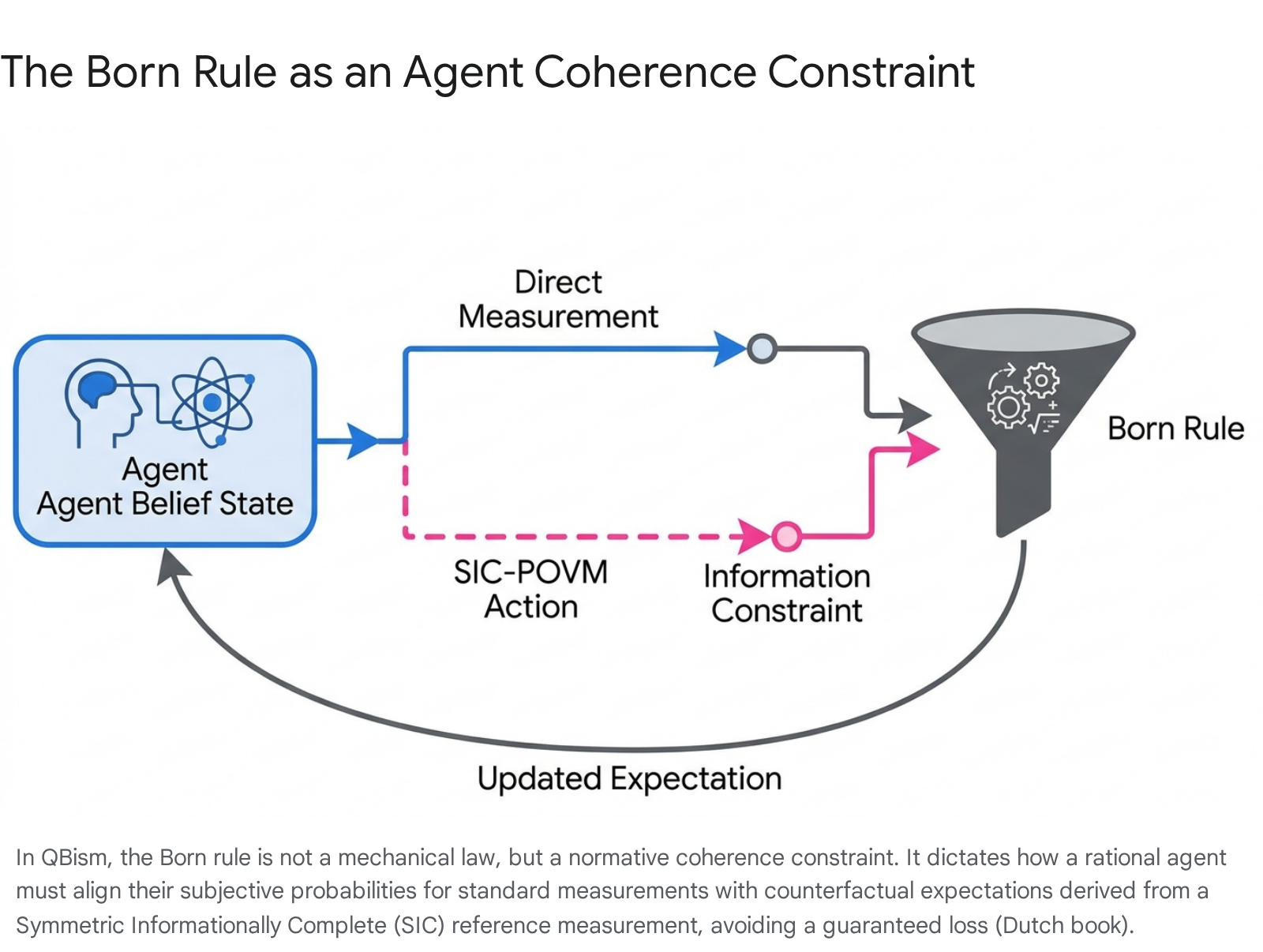
If an agent gambles on a physical system that admits a symmetric reference measurement, yet refuses to update their probabilities according to the Born rule, they open themselves to a quantum Dutch book 1620. In this light, the Born rule is not a mechanism governing particles, but a normative standard for rational decision-making - an empirical addition to probability theory reflecting the unique, non-classical structure of the universe 816.
Participatory Realism and the Solipsism Charge
By asserting that quantum states, unitary evolution, and measurement operators represent only the personal judgments of the agent using the formalism, QBism invites immediate philosophical scrutiny 612. Prominent physicists and philosophers have frequently criticized the interpretation as a form of instrumentalism, anti-realism, or outright solipsism 6826. Critics such as Mateus Araújo contend that if a theory treats the wave function of atoms, molecules, planets, and galaxies as entirely subjective, it leaves the external world "completely empty" and fails the fundamental scientific mandate to describe objective nature 26. The argument posits that an interpretation defining all experimental outcomes as personal experiences traps physics within the mind of the observer, dissolving any shared, mind-independent reality 626.
To counter the charge of solipsism, QBists - notably Fuchs and Mermin - introduced a philosophical framework termed "participatory realism," drawing heavily upon the later work of physicist John Archibald Wheeler 6818. Wheeler famously theorized a participatory universe built upon information processing ("It from bit") and posited a "law without law" ontology where physical rules are not rigidly prescribed from the beginning of time 1828.
Measurement as an Act of Creation
Participatory realism accepts the existence of a mind-independent physical universe, avoiding pure solipsism, but insists that this reality is not exhaustively pre-written 629. The fundamental mistake of standard scientific realism, according to QBism, is the pursuit of a "God's eye" view - a third-person, overarching description of reality that is assumed to be valid independent of any observer 629. QBism embraces a radical perspectivalism, arguing that physics only accurately describes the interactions at the exact interface between an embedded agent and the external world 6.
In participatory realism, a quantum measurement is not a process of discovering a hidden, pre-existing physical property. Rather, it is characterized as a "little act of creation" 6. When an agent takes an action, the universe responds, and the resulting measurement outcome is a genuinely novel event co-authored by the agent's intervention and the world's reaction 6.
The primary defense against solipsism lies in the unpredictability of this reaction. The QBist asserts that the existence of an external reality is confirmed precisely because the world provides an unpredictable "kick" in response to the agent's actions 6. The agent cannot control the outcome of the measurement; they can only assign a probability to it. This lack of control confirms that the agent is interacting with an autonomous, external entity 6. Therefore, participatory realism is a framework where reality comprises countless subjective perspectives, and the laws of quantum mechanics function as the objective rules guiding how any agent should rationally navigate the profound unpredictability of the physical world 618.
Wigner's Friend and Extended No-Go Theorems
The practical utility of QBism's radical perspectivalism becomes highly apparent when applied to the most severe conceptual paradoxes in quantum foundations. Since the inception of the theory, the "Wigner's Friend" thought experiment has served as a critical stress test for interpretations of the measurement problem 2.
In the standard Wigner's Friend scenario, an agent (the Friend) isolates themselves inside a laboratory and performs a measurement on a quantum system, observing a definite outcome. A second agent (Wigner) remains outside the isolated laboratory. From Wigner's perspective, because he has not yet interacted with the laboratory, unitary quantum mechanics dictates that he must describe the entire laboratory - including his Friend - as existing in an entangled state of superposition 21920. This creates a paradox if one assumes the quantum state represents objective reality: the system cannot be simultaneously in a collapsed state (for the Friend) and an uncollapsed, superposed state (for Wigner) 1920.
Between 2018 and 2026, researchers expanded this paradox into a series of highly rigorous Extended Wigner's Friend (EWF) no-go theorems. These mathematical proofs combine Wigner's Friend scenarios with Bell-type inequalities to test the logical limits of objective reality, resulting in severe constraints on standard interpretations of physics 221.
The Trajectory of Extended No-Go Theorems
The conceptual pressure on objective interpretations escalated rapidly through a sequence of proofs demonstrating that maintaining a mind-independent reality requires sacrificing other foundational principles of physics.
The first major disruption was the Frauchiger-Renner theorem (2018), which demonstrated that quantum theory cannot consistently maintain the assumption that agents can universally rely on the measurement outcomes observed by other agents 220. This was soon followed by the Local Friendliness (LF) theorem proposed by Bong et al., which formulated an inequality analogous to Bell's theorem but utilizing weaker assumptions. The LF theorem proved that quantum mechanics is incompatible with the joint assumptions of "Local Agency" (the requirement that actions only influence events within their future light cone) and the "Absoluteness of Observed Events" (AOE) - the premise that a measurement outcome is a singular, objective fact of the universe, independent of the observer 213334.
By 2025, Walleghem and Catani presented the Operational Friendliness theorem. Drawing on generalized contextuality in prepare-and-measure scenarios, they demonstrated that quantum theory contradicts AOE even when Local Agency is replaced by a much weaker assumption called "Operational Agency" 333. This indicated that the failure of objective reality in quantum systems does not solely rely on spatial separation and nonlocality.
In 2026, the theoretical constraints tightened further with the Causal Time-Symmetric Friendliness paradox, introduced by Hance and Mukherjee. This theorem transposed the EWF scenario from a spatially separated setup to a strictly time-ordered, timelike sequence. The researchers demonstrated that when replacing spatial locality with Axiological Time Symmetry (ATS) and assuming no retrocausality, quantum mechanics still violently contradicts the Absoluteness of Observed Events 352237. The 2026 findings proved that absolute, observer-independent events cannot be reconciled with quantum theory even in strictly local, timelike causal chains.
| Extended Wigner's Friend Theorem | Key Assumptions Tested Against Quantum Theory | Methodological Focus |
|---|---|---|
| Frauchiger-Renner (2018) | Universal validity of single-time predictions across multiple agents. | Multi-agent logical consistency. |
| Local Friendliness | Absoluteness of Observed Events (AOE) + Local Agency. | Spatial nonlocality in Bell-type scenarios. |
| Operational Friendliness (2025) | Absoluteness of Observed Events (AOE) + Operational Agency. | Generalized noncontextuality. |
| Causal Friendliness (2026) | Absoluteness of Observed Events (AOE) + Axiological Time Symmetry + No Retrocausality. | Timelike, sequentially ordered causal chains. |
The QBist Resolution
For standard interpretations of quantum mechanics, the EWF no-go theorems pose an existential crisis. To maintain the objective reality of the wave function or the absolute reality of measurement outcomes, these theories must accept profound physical violations, such as instantaneous superluminal signaling, pervasive retrocausality, or the continuous splitting of the universe into parallel branches 23538.
QBism bypasses the entire suite of no-go theorems flawlessly by rejecting their core, shared premise: the Absoluteness of Observed Events 2139. Because QBism defines a measurement outcome purely as the personal experience of the specific agent taking the action, there is no requirement for outcomes to be integrated into a single, global, observer-independent ledger of facts 1120.
In the QBist analysis of Wigner's Friend, both agents are applying quantum mechanics correctly relative to their own distinct situations 1920. The Friend experiences a definite outcome. Wigner, possessing no access to the Friend's experience, assigns an entangled state representing his own beliefs about what he will experience when he eventually opens the laboratory door 219. Because the quantum state is doxastic, Wigner's entangled assignment does not conflict with the Friend's definite experience. By treating facts as fundamentally relative to the agent, QBism preserves both strict spatial locality and temporal causality, achieving a theoretical consistency unattainable by $\psi$-ontic theories 820.
Critiques from the Vienna Circle: Information and Objectivity
Despite its logical elegance in resolving paradoxes, QBism's intense focus on the private mental states of agents places it at odds with other major research programs in quantum foundations. Among its most prominent detractors are physicists associated with the "Vienna Circle," notably Časlav Brukner and Anton Zeilinger. This group advances an information-theoretic interpretation of quantum mechanics that is historically derivative of the Copenhagen interpretation but diverges fundamentally from QBist subjectivism 104041.
Universal vs. Private Agents
Like QBism, the Brukner-Zeilinger framework views the quantum state not as a physical wave, but as a representation of information or an "expectation catalog" used to compute probabilities 4041. However, the ontology of that information is starkly different. Zeilinger proposes a foundational principle for quantum mechanics: that every elementary physical system inherently carries exactly one discrete bit of objective information 4123.
Furthermore, while Brukner utilizes the concept of an observer to ground this information, he explicitly defines it in relation to a "hypothetical observer" constrained strictly by objective experimental capabilities 40. In the Brukner-Zeilinger framework, the information encoded in the quantum state is structurally tied to the physical world and the universal limits of measurement, existing independently of any specific human mind 1040.
Andrei Khrennikov, a critical voice in quantum foundations, highlights this exact disparity as the fatal flaw of QBism 10. Khrennikov argues that while decision theory and the Bayesian approach accurately describe game theory, mapping a "totally individual perspective" onto physical phenomena is scientifically exotic and untenable 10. He posits that an epistemic theory can only serve as a methodology for natural science if it relies on a "universal quantum Bayesian agent" operating under the spirit of Kolmogorov's objective probability rules 10.
QBists, including Fuchs and Schack, explicitly reject the imposition of a universal or hypothetical agent. They argue that abstracting the observer away from a specific, localized individual resurrects the God's eye perspective, which inevitably reintroduces the paradoxes of nonlocality and the Wigner's Friend contradictions that QBism successfully eliminates 1040.
Critiques from the Perimeter Institute: Realism and Causal Inference
Parallel critiques of the QBist framework emerge from the Perimeter Institute for Theoretical Physics, where foundational research often leans heavily toward preserving scientific realism and objective causality 2425.
Toy Models and Causal Inference
Robert Spekkens, a leading foundational researcher at the Perimeter Institute, approaches the problem by rigorously separating the epistemic limits of observers from the ontic reality of the universe. Utilizing tools from causal inference, Spekkens has developed influential "toy theories" demonstrating that many phenomena typically considered uniquely quantum - such as the no-cloning theorem and interference - can be perfectly replicated in a classical, deterministic world, provided there is a fundamental restriction on how much an agent can know about the underlying ontic state 62545.
Spekkens advocates for "unscrambling the omelet" of quantum mechanics - a phrase borrowed from E.T. Jaynes - by meticulously separating the parts of the quantum formalism that describe our knowledge of reality from the parts that describe reality itself 45. Unlike QBism, which discards the ontic component entirely, Spekkens's research program operates under the assumption that a mind-independent causal structure exists beneath the quantum statistics 2545. Through the development of quantum causal inference models, researchers at Perimeter aim to identify the hidden relational variables that explain quantum correlations, treating probabilities as objective reflections of physical causal structures rather than normative constraints on betting behavior 2545.
The Demand for Deterministic Realism
Lee Smolin, a founding faculty member at Perimeter and a prominent voice in quantum gravity, presents an even starker rejection of QBism's anti-realist tendencies. Smolin's overarching theoretical goal is the development of a complete, deterministic theory of the universe that satisfies Einstein's philosophical desiderata 4626. For Smolin, a successful physical theory must describe a world that is completely comprehensible and exists in a definitive state independently of human perception or knowledge 26.
Smolin explicitly critiques the philosophical legacy of Niels Bohr and the anti-realist trajectory of the Copenhagen interpretation, which he views as having prematurely abandoned the search for an underlying objective reality 4626. By extension, he rejects contemporary relational and subjectivist frameworks that treat the wave function merely as an extension of ordinary language or a catalog of beliefs 46. For Smolin and aligned realists, substituting a description of the objective universe with a subjective user's manual for private agents constitutes a retreat from the primary explanatory mandate of theoretical physics 2627.
The Boundaries of Agency in Quantum Formalism
A lingering theoretical ambiguity within QBism - and related relational frameworks - is the strict definition of what constitutes an "agent." While the mathematical formalism of QBism rigorously details how probabilities must be updated to avoid a Dutch book, it remains conspicuously silent on the physical or biological substrate required to perform these updates 23.
The Brukner-Zeilinger information interpretation bypasses this issue entirely through "substrate flexibility"; because information is a foundational primitive of the universe, any physical system whose dynamics can be characterized informationally operates as an agent by default 23. Rovelli's Relational Quantum Mechanics explicitly permits a similar flexibility, stating that any physical system, from a human to a single electron, can serve as an observer relative to another system 23.
QBism, however, requires the agent to be capable of holding beliefs, experiencing expectations, and rationally navigating Dutch-book coherence constraints 1923. The literature has not yet reached a consensus on whether the QBist agent necessitates human consciousness, or if artificial intelligence algorithms, complex biological networks, or engineered wetware preparations could sufficiently instantiate the formal epistemic role required by the theory 23. As EWF theorems continue to test the boundaries of observation, the precise definition of the participating agent remains a critical frontier in the maturation of the QBist framework.
Conclusion
Quantum Bayesianism represents a profound philosophical and methodological pivot in the interpretation of physical law. By redefining the quantum state as a representation of personal expectation rather than an element of physical reality, and by recasting the Born rule as a normative coherence constraint derived from decision theory, QBism provides a mathematically rigorous escape from the persistent paradoxes of quantum mechanics. The recent proliferation of Extended Wigner's Friend no-go theorems in 2025 and 2026 underscores the immense logical strain placed on theories that cling to observer-independent facts in the quantum domain. QBism avoids these fatal contradictions by anchoring reality strictly in the situated, participatory interaction between the agent and the world.
However, this resolution demands a fundamental recalibration of scientific ambition. It requires physicists to accept that their most successful fundamental theory does not describe the inner workings of the universe in absentia, but merely provides the normative rules governing the interface between the universe and those acting upon it. Whether participatory realism offers a profound truth about the limits of scientific description, or whether it constitutes an elaborate retreat from the pursuit of objective physics, remains the central, unresolved debate defining the future of quantum foundations.