
Psychology of simultaneous global crises and constant change
The contemporary global environment is increasingly characterized by simultaneous, overlapping systemic shocks - a phenomenon widely debated under the nomenclature of the "polycrisis." The psychological processing of this landscape requires departing from traditional frameworks that view crises as temporary deviations from a stable baseline. Instead, individuals, organizations, and societies are increasingly forced to navigate a state of "permanent transition." This shift necessitates an evolution in how psychological adaptation, cognitive appraisal, and resilience are understood, particularly when factoring in the profound geopolitical asymmetries in how systemic volatility is experienced across the globe.
Structural Definitions of the Polycrisis
The conceptual framework of a world embroiled in perpetual, interconnected emergencies has necessitated a shift in sociological and psychological taxonomy. The concept of the "polycrisis" captures the synergistic and cascading effects of modern global threats.
Conceptual Origins and Contemporary Application
The term "polycrisis" was originally coined in the late 1990s by French complexity theorist Edgar Morin and Anne-Brigitte Kern to describe a dense matrix of interlocking and mutually reinforcing disorderly processes in world politics 1123. The concept gained renewed prominence when former European Commission President Jean-Claude Juncker utilized it in 2016 to describe the concurrent challenges facing the European Union, including the Syrian refugee crisis and the Brexit referendum 14. More recently, the term was popularized by economic historian Adam Tooze, who applied it to the global environment surrounding the COVID-19 pandemic, characterizing it as a landscape where health crises, inflation shocks, war in Europe, and climate extremes interact such that the whole is more overwhelming than the sum of its parts 11257.
A closely related term, the "permacrisis," is increasingly utilized to describe the subjective, lived experience of this volatility. Whereas a polycrisis describes the structural mechanics of overlapping shocks, permacrisis denotes a sustained psychological and societal condition of compounding disruptions that strips individuals of their sense of agency and generates pervasive unease 2697. Researchers point out that the polycrisis diverges from standard systemic risk because it involves complex, unrecognized causal links among economic, social, and ecological systems, causing multiple domains to go critical concurrently 3118.
Typology of Global Risks in the Current Decade
The empirical basis for the polycrisis framework is heavily supported by longitudinal risk assessments, most notably the World Economic Forum's (WEF) annual Global Risks Report. The 20th edition of the report, presenting findings from the 2024-2025 Global Risks Perception Survey (GRPS) of over 900 global experts, illustrates an increasingly fractured global landscape 91011.
According to these assessments, state-based armed conflict has emerged as the top immediate risk for 2025, identified by nearly a quarter of respondents as the most severe concern, reflecting heightened geopolitical fragmentation 11. Simultaneously, misinformation and disinformation remain leading short-term risks, threatening societal cohesion by eroding trust in governance and complicating the cooperative action required to address shared emergencies 1112. On a ten-year horizon, environmental risks dominate the threat landscape, led by extreme weather events, biodiversity loss, and critical changes to Earth systems, such as climate tipping points 111213. The continuous overlay of cost-of-living pressures, technological arms races, and weakened economic resilience leaves populations highly susceptible to cascading effects 1214.
Geopolitical Asymmetries in Crisis Perception
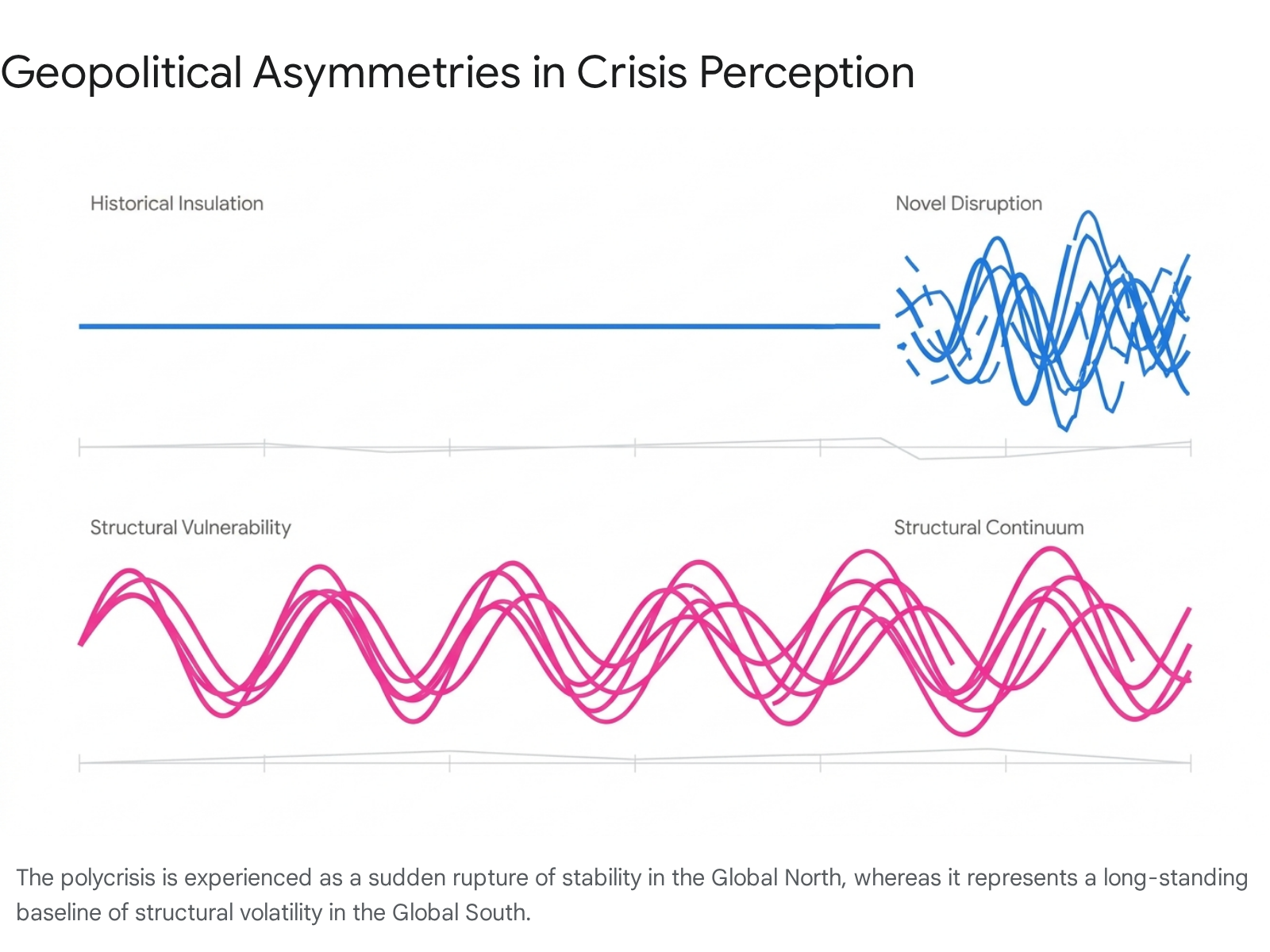
The declaration of a novel global polycrisis reveals profound asymmetries in how risk is historically and psychologically processed across different geopolitical regions. The psychological baseline for evaluating stability varies dramatically between the Global North and the Global South.
The Global North Vulnerability Shock
In the Global North, the polycrisis is frequently perceived as a novel, universal condition that represents a sudden rupture from historical stability 1215. For decades, affluent nations operated under the assumption that they were insulated from severe structural volatility by robust economic and institutional safety nets. The convergence of pandemic lockdowns, inflation, and climate disasters has shattered this insulation, resulting in a distinct psychological shock. The discourse surrounding the polycrisis in Western institutions often reflects a sudden "waking up" to systemic fragility, generating a specific form of elite bewilderment and public dread 2315.
Structural Continuity in the Global South
In stark contrast, populations in the Global South perceive these overlapping emergencies as a continuum and a long-standing historical norm 215. The convergence of ecological, economic, social, and political crises is not viewed as a new phenomenon, but as a structural feature of globalized capitalism and colonial legacy that these regions have navigated for decades 21516.
For instance, environmental pressures, extreme heat, and infrastructural deficits have long required communities in the Global South to manage polycrisis conditions effectively on low budgets, relying heavily on informal economies, mutual aid, and robust community networks rather than state-level intervention 162122. Consequently, when global institutions frame the current era as uniquely turbulent, it obscures the reality that marginalized populations have continuously operated under these compounded pressures. The heightened urgency in global discourse correlates directly with the fact that these crises have finally begun to impact the core of global economic power 2.
Epistemological Bias in Global Mental Health
The geopolitical divide extends into how mental health and psychological resilience are researched and treated. The Global Mental Health (GMH) movement, largely driven by institutions in the Global North, frequently attempts to export universalized models of psychiatric diagnosis to the Global South 2217. This dynamic often leads to the medicalization of structural suffering.
Research indicates that the vast majority of literature on climate change and mental health originates from the Global North, despite the Global South facing the most severe consequences, such as typhoons, drought, and extreme heat waves 2118. When individuals in the Global South report psychological distress stemming from systemic inequality or climate disaster, Western diagnostic frameworks frequently categorize these as treatable medical conditions (e.g., individual clinical depression or anxiety), recommending individualistic coping mechanisms rather than acknowledging the distress as a normative response to socio-economic adversity 2217. Consequently, the frequently cited "treatment gap" for mental disorders in low- and middle-income countries (LMICs) is often fundamentally a demand issue; individuals recognize that their well-being requires structural, economic, and community-based solutions rather than psychiatric interventions 17.
Theoretical Critiques of the Polycrisis Framework
While the polycrisis concept is widely utilized to describe contemporary volatility, it faces significant academic and theoretical debate across historical, political, and sociological disciplines.
The Historical and Neo-Malthusian Skepticism
Several historians and political scientists contest the novelty of the polycrisis. Critics such as Niall Ferguson have dismissed the term as a useless concept, characterizing it simply as "just history happening" 11511. Political scientist Daniel Drezner argues that proponents of the polycrisis framework assume the existence of powerful negative feedback loops that may not actually materialize 5711. Drezner and other skeptics suggest that characterizing the current era as uniquely perilous echoes the neo-Malthusian alarmism of the 1970s, which warned of resource depletion and population bombs that technological advancement ultimately mitigated 711.
Furthermore, critics argue that assuming overlapping crises inherently produce catastrophic outcomes ignores historical resilience. For instance, while the COVID-19 pandemic caused severe health and economic disruption, it temporarily resulted in positive environmental feedback loops, demonstrating that systemic entanglement does not exclusively yield negative synergy 5.
The Sociological Critique of Technocratic Framing
A separate critique emerges from progressive sociologists and political economists who argue that the polycrisis is a highly sanitized, technocratic buzzword utilized by the global elite to describe systemic breakdown without addressing its root causes 1234. Scholars such as Inderjeet Parmar and John Ganz suggest that the framework functions as a "Keynesianism of Despair," offering a baggy, imprecise description that obscures agency and conceals the true drivers of global instability: relentless, predatory globalized capitalism and neoliberalism 124.
By framing these events as an accidental or spontaneous "polycrisis," dominant institutions can propose modest, managerial solutions - such as market adjustments or isolated technological interventions - rather than undertaking the radical socio-economic transformations necessary to dismantle deeply embedded inequalities 12.
Cognitive Appraisal Mechanisms in Global Crises
Understanding how populations process the polycrisis requires examining the cognitive mechanisms of stress. The Transactional Model of Stress and Coping, developed by psychologists Richard S. Lazarus and Susan Folkman in 1984, remains the preeminent framework for analyzing how individuals interact with stressful environments 251927. The model posits that stress does not arise merely from an external event, but from a cognitive transaction wherein an individual evaluates whether a situation taxes or exceeds their available resources 1920.
Primary Appraisal and Threat Overload
The first phase of this transaction is primary appraisal, wherein an individual evaluates the significance of a potential stressor to their personal well-being 252921. A stimulus is categorized as irrelevant, benign-positive, or stressful 252921. If deemed stressful, it is further evaluated as involving harm/loss (damage that has already occurred), a threat (anticipation of future harm), or a challenge (an opportunity for growth) 20292122. Tools such as the Stress Appraisal Measure (SAM) divide this primary assessment into dimensions of threat, challenge, and centrality to one's well-being 20.
The polycrisis uniquely overloads the primary appraisal mechanism. Rather than facing discrete, sequential stressors, individuals are bombarded with concurrent, high-severity threats - ranging from pandemic outbreaks and extreme weather to macroeconomic instability 25192223. This constant exposure forces the cognitive apparatus into a chronic state of threat assessment, leading to heightened physiological arousal, anxiety, and eventual emotional exhaustion 251929.
Secondary Appraisal and Resource Depletion
Following primary appraisal, individuals engage in secondary appraisal, evaluating their ability to control the situation and the resources available to cope with the perceived threat 251920. This involves assessing internal resources (willpower, self-efficacy, experience) and external resources (financial backing, social support networks, institutional assistance) 2521.
In a polycrisis, primary appraisal is overloaded by concurrent threats, while secondary appraisal reveals depleted coping resources, frequently driving individuals toward emotion-focused rather than problem-focused coping strategies. Because systemic shocks degrade community infrastructures and economic safety nets simultaneously, individuals frequently conclude that the stressors are insurmountable 1920. When individuals appraise a situation as uncontrollable, they transition away from problem-focused coping (taking direct action to resolve the stressor) toward emotion-focused coping (strategies aimed at alleviating emotional distress, such as avoidance, distancing, or acceptance) 1924.
Distal Versus Proximal Stressor Impacts
Longitudinal research indicates that the human cognitive apparatus processes the various vectors of the polycrisis differently based on their proximity to daily survival. A study examining the mental health of adults in Germany between 2021 and 2022 analyzed the compounded effects of threats from climate change, COVID-19, the Russia-Ukraine War, and the rising cost of living 23.
The findings demonstrated that unadjusted group trends showed significant increases in mental distress and sleep problems over time 23. Crucially, when adjusted for individual perceptions, higher perceived threats from the rising cost of living and the pandemic were significantly associated with increased physical complaints, mental distress, and decreased life satisfaction 23. Conversely, while climate change threats worsened sleep problems, they did not show the same comprehensive mental health impact, and the geopolitical threat of the war did not significantly affect the measured mental health outcomes 23. This suggests that immediate, proximal stressors involving economic and physical security exert a far more direct toll on cognitive resources than distal, abstract geopolitical threats.
The Shift from Episodic Crisis to Permanent Transition
Historically, organizational and psychological frameworks approached crises as finite, episodic events. Foundational theories, such as Gerald Caplan's Crisis Theory or Kurt Lewin's unfreeze-move-refreeze model, operated on the assumption that an entity departs from a stable baseline, navigates a period of acute disorganization, mobilizes resources to resolve the crisis, and eventually refreezes into a new, stable equilibrium 25262728.
The velocity and interconnectivity of contemporary disruptions render these episodic models largely obsolete. Institutions, workforces, and individuals must now operate in a continuous state of "permanent transition" 2538.
Obsolescence of Equilibrium Models
Episodic models are criticized for failing to capture the constant flux of contemporary life 25. By treating the status quo as a reality rather than an illusion, episodic change strategies leave organizations vulnerable to the dynamic phenomena that occur between planned interventions 25. For instance, the deployment of artificial intelligence in the modern workforce operates at a speed that bypasses generational adjustment periods. A major insurance provider can deploy AI systems that eliminate or fundamentally evolve significant portions of the workload within eighteen months 38. This compression creates acute organizational challenges, shifting the requirement from episodic training interventions to the integration of continuous learning and skill development as a core, everyday practice 38.
Boundary Violations and Ego Depletion
The psychological impact of operating in permanent transition is profound, frequently manifesting at the individual level through "micro role transitions." Boundary theory defines these as the everyday, temporary shifts individuals make between domains, such as transitioning from a professional role to a familial one 2930. A permanent transition, or "macro role transition," involves lasting shifts such as retirement or major promotion 2930.
The modern technological and economic landscape facilitates constant boundary violations - events where one domain interrupts another, such as receiving work-related communications during home hours 2930. According to Affective Events Theory and Ego Depletion Theory, these daily interruptions require continuous cognitive context-switching, draining an individual's psychological and emotional resources 2930. The accumulation of these boundary violations directly causes emotional exhaustion, a fundamental characteristic of burnout that limits a person's capability to take initiative and fulfill daily demands 2930.
Information Systems and Intermittent Discontinuance
The strain of continuous cognitive processing is clearly visible in human-computer interaction, specifically regarding information systems and social media. Research into "intermittent discontinuance behavior" indicates that individuals frequently abandon or take temporary breaks from digital platforms due to overwhelming systemic pressures 3132. The Push-Pull-Mooring theory identifies "usage fatigue" (a push factor) and "transition fatigue" (a mooring factor) as critical drivers of this behavior 3132. Information overload serves as a consistent precursor to this fatigue, leading to decreased concentration, reduced academic and professional performance, and a generalized desire to escape continuous digital engagement 3132.
Comparative Framework: Episodic vs. Permanent Adaptation
Understanding the psychological requirements of the polycrisis requires distinguishing between traditional crisis management and the mechanics of permanent transition adaptation.
| Paradigm Feature | Episodic Crisis Management | Permanent Transition Adaptation |
|---|---|---|
| Core Assumption | Crisis is a temporary deviation from a stable baseline. | Volatility and change are the continuous, normal conditions of life. |
| Psychological Goal | Return to pre-crisis equilibrium or stabilize into a new, fixed state. | Develop cognitive flexibility for ongoing, perpetual readjustment. |
| Intervention Strategy | Acute, time-limited interventions targeting a single stressor or event. | Systems-level restructuring to build continuous learning and adaptive capacities. |
| Primary Risk Factor | Acute trauma or failure of immediate coping mechanisms. | Transition fatigue, chronic resource depletion, and emotional burnout. |
| Role of Boundaries | Strict containment of the crisis to protect core functioning. | Fluid negotiation of boundaries; integration of ongoing micro-transitions. |
| Theoretical Basis | Caplan's Equilibrium Model; Lewin's Change Model 252728. | Adaptive Resilience; Complex Adaptive Systems theory 9725. |
Demographic Variations in Permacrisis Processing
The psychological weight of permanent transition is not uniform; distinct demographic groups experience and appraise the polycrisis through highly specific generational and socio-economic lenses.
Generational Disenfranchisement and Youth Mental Health
Younger demographics, particularly Generation Z, report profound psychological strain in response to the permacrisis. A global survey of Gen Z individuals reveals that the continuous exposure to global crises via digital media generates a specific type of information overload that fosters feelings of overwhelm and a distinct loss of agency 6. For instance, 60% of Gen Z respondents reported feeling overwhelmed specifically after exposure to international news, compared to only 40% feeling overwhelmed by local community news 6.
For youth, the polycrisis is not an abstract political concept but a deeply personal threat to their future viability. The perception that macroeconomic, ecological, and geopolitical systems are locked in a downward spiral directly undermines their sense of empowerment. This leads to higher rates of psychological distress compared to older cohorts, who may possess accumulated internal resources, established social capital, or the historical perspective required to buffer against systemic shocks 633.
Educational and Geographic Transition Strain
The burden of permanent transition is also highly visible in educational migration and socio-economic mobility. For students from rural backgrounds or marginalized groups, the pursuit of higher education represents a permanent transition from one opportunity structure to another, a shift not typically demanded of privileged students 3445.
For example, data concerning the Hispanic population in Texas indicates a 46% earnings gap compared to white populations, largely driven by educational attainment disparities 34. Entering the higher education system, primarily through two-year public institutions, demands a profound cultural and geographic transition 34. Similarly, international and rural students frequently experience severe homesickness, emotional instability, and transition fatigue 45. Furthermore, in environments utilizing English-Medium Instruction (EMI), students often face "transition fatigue" due to the cognitive confusion of constantly switching between translanguaging-friendly environments and strict English-only professional spheres, which risks inconsistencies in academic output and emotional exhaustion 46.
Relocation Stress in Older Populations
At the opposite end of the demographic spectrum, older adults face acute transition stress when undergoing the permanent transition into residential aged care facilities. Moving into long-term care requires significant psychological adjustment, as elderly individuals experience anxieties regarding loneliness, loss of belonging, and the forfeiture of independence 3548.
Systematic reviews of aged care transitions indicate that this is an inherently distressing experience, yet interventions to reduce relocation stress (such as resident peer support, life review therapy, and mental health services) are typically only implemented within the first three months of relocation, pointing to a severe gap in pre-transition preparation 48. Interestingly, while the initial transition is fraught with physical and psychological burden, long-term adjustment depends heavily on an individual's active engagement in meaningful activities and their subjective participation in the decision-making process, underscoring the importance of autonomy in managing permanent transitions 35.
Frameworks for Psychological Resilience and Adaptation
As the nature of global risk shifts from episodic emergencies to permanent transitions, traditional models of psychological resilience - often defined merely as the absence of psychopathology or the ability to "bounce back" to a pre-crisis state - prove inadequate 4936. Contemporary psychology emphasizes that true resilience involves dynamic psychosocial processes resulting in positive adaptation and growth in the face of sustained adversity 493651.
Foundational Paradigms of Resilience
Developmental psychologist Dr. Edith Grotberg's paradigm organizes resilience factors into three core sources of strength: external supports ("I have"), inner psychological strengths ("I am"), and interpersonal problem-solving skills ("I can") 49. In a polycrisis, the "I have" domain - reliant on stable external institutions, financial security, and societal predictability - is frequently compromised. Consequently, individuals must rely heavily on cultivating the "I am" and "I can" domains, emphasizing cognitive flexibility, emotional regulation, and proactive communication 4951.
Similarly, Kumpfer's transactional model of resilience conceptualizes positive adaptation as the result of dynamic interactions between an individual's internal factors and the external environment. According to this framework, stressors activate an adaptation process that can result in the recombination of resilience traits, allowing individuals to navigate complex person-environment transactions 49.
Beyond Homeostasis to Resilient Reintegration
Glenn Richardson's metatheory of resilience provides a critical lens for understanding adaptation to continuous disruption. Richardson posits that individuals exposed to severe adversity undergo a disruption of their biopsychosocial homeostasis 49. Following this disruption, reintegration can occur in one of four ways: dysfunctionally (resulting in maladaptive behaviors), with loss (recovering but at a lower level of functioning), back to homeostasis (returning to the exact pre-crisis baseline), or through "resilient reintegration" 49.
Resilient reintegration represents the optimal outcome for managing permanent transition. It occurs when an individual experiences insight or growth as a direct result of the disruption, establishing a new, higher level of functioning that exceeds their starting point 49. This model explicitly rejects the goal of returning to a previous "normal," acknowledging that navigating a polycrisis requires evolving beyond obsolete baselines. Furthermore, the Broaden-and-Build Theory developed by Barbara Fredrickson highlights the role of positive emotions in this process; experiencing positive emotions broadens an individual's thought-action repertoire, fostering creative problem-solving and accelerating recovery from negative emotional states 37.
Clinical Interventions for Protracted Trauma
Clinical and community psychology has developed specific frameworks to address the psychological toll of protracted, complex crises, diverging from models designed for isolated, acute trauma.
The ADAPT Model for Continuous Adversity
For populations enduring severe, overlapping systemic failures - such as refugees fleeing geopolitical violence or communities displaced by climate disasters - the Adaptation and Development after Persecution and Trauma (ADAPT) model offers a comprehensive framework 3839405641.
Developed by Derrick Silove, the ADAPT model challenges conventional psychiatric assumptions that treat trauma as a discrete physical injury with a linear relationship to mental disorders such as PTSD 3840. Instead, the ADAPT framework views the human psyche as continually attempting to integrate past traumatic experiences with present survival conditions and anticipated future eventualities 3839. It identifies five core psychosocial pillars that are routinely ruptured during mass conflict and displacement: safety and security, interpersonal bonds and attachment, justice, identity and roles, and existential meaning 3842.
By focusing on the repair of these systemic domains, the ADAPT model provides an overarching structure for community mental health that respects the subjective, cultural meaning of suffering. It has been successfully utilized to train paraprofessionals in Group Integrative Adapt Therapy (IAT-G) in crisis settings, such as the Rohingya refugee camps in Bangladesh, helping individuals develop capacities to manage post-migration living difficulties rather than merely medicating acute psychiatric symptoms 3956.
Structured Crisis Intervention Protocols
While the ADAPT model addresses protracted, permanent transitions, acute destabilizations within a polycrisis still require immediate psychological first aid. Several established crisis intervention models provide structured approaches for stabilization 4344.
The ABC Model (Achieve rapport, Boil down the problem, Cope) offers a highly pragmatic, solution-oriented approach focusing on establishing immediate safety, identifying the core precipitating issue, and exploring actionable coping strategies 2844. The SAFER-R Model (Stabilize, Acknowledge, Facilitate understanding, Encourage coping, Recovery/Referral), structured around biopsychosocial needs, is heavily utilized by emergency responders to address immediate health requirements and facilitate emotional processing 44. Similarly, Roberts' Seven-Stage Crisis Intervention Model mandates a rigorous progression from lethality assessment through to the establishment of follow-up plans, ensuring comprehensive case management 44.
| Intervention Framework | Primary Application | Core Methodology | Psychological Focus |
|---|---|---|---|
| ADAPT Model 383956 | Protracted crises, mass displacement, complex trauma. | Repairing five psychosocial pillars (safety, attachment, justice, identity, meaning). | Meaning-making, resilient reintegration, long-term adaptation. |
| ABC Model 2844 | Acute, time-sensitive individual crises. | Achieve rapport, Boil down problem, Cope. | Immediate stabilization and pragmatic problem-solving. |
| SAFER-R Model 44 | Disaster response, psychological first aid. | Stabilize, Acknowledge, Facilitate, Encourage, Recover. | Biopsychosocial stabilization and emotional normalization. |
| Equilibrium Model 2728 | Severe emotional disequilibrium and disorientation. | Restoring basic coping mechanisms and control. | Returning to pre-crisis functional homeostasis. |
Institutional Strategies for Managing Continuous Disruption
To mitigate the psychological and operational fallout of the polycrisis, organizational and governmental leadership must transition from reactive crisis management toward proactive, systemic resilience building.
Adaptive Resilience at the Systemic Level
A state of permacrisis exposes the limitations of conventional risk management models that prioritize institutional endurance and recovery. Research indicates a critical need to shift toward "adaptive resilience" 97. This framework positions resilience as a dynamic process of continuous learning, decentralized decision-making, and inclusive, participatory governance 97.
Systematic literature reviews spanning crises such as the COVID-19 pandemic, climate adaptation in Kenya, and the 2023 Turkey-Syria earthquake identify three interdependent pillars of adaptive resilience: institutional quality, collaborative governance, and social capital 9. Systems that prioritize transparency, local autonomy, and cross-sector coordination demonstrate significantly greater agility in the face of disruption. Conversely, policy paralysis and rigid, centralized governance structures consistently undermine resilience, leading to profound development setbacks and the erosion of social trust 97.
Phased Crisis Lifecycle Management
Institutions must embed crisis management into their routine operational architecture. Modern crisis management methodologies generally divide operations into distinct phases: Mitigation/Pre-crisis, Preparedness, Response, and Recovery/Post-crisis 456246.
In the pre-crisis phase, organizations must focus on risk assessment and the creation of business continuity plans (BCPs) to preemptively identify vulnerabilities 4546. During the response phase, leaders are tasked with triaging immediate issues, managing the acute stress response of stakeholders, and maintaining transparent communication 456246. Crucially, the recovery phase in a polycrisis environment cannot simply aim to restore the prior state of affairs. Instead, it requires adopting strategic plans that address organizational weaknesses revealed during the disruption, renegotiating stakeholder agreements, and managing the long-term mental health impacts (duty of care) through employee assistance programs and peer support 4546.
By treating crisis management as a collaborative, inclusive, and dynamic discipline, institutions can foster the flexibility necessary to survive an era defined by permanent, cascading transitions 62.