
Psychology of crowd dynamics and digital influence
The psychology of crowds represents a fundamental duality in human behavior: the capacity for distributed networks of individuals to achieve profound collective intelligence, and the simultaneous susceptibility of those same individuals to converge into maladaptive, polarized, or violent mobs. Advances in computational sociology, network science, and social psychology over the past decade have necessitated a significant revision of classical crowd theories. Historically, theoretical models relied heavily on the concept of anonymity and a generalized loss of self-awareness to explain mob behavior. Contemporary research, however, demonstrates that both collective brilliance and crowd pathology are systematically driven by network topology, the mechanisms of identity fusion, and the perception of local group norms.
In the modern information environment, these foundational psychological mechanisms are increasingly mediated by algorithmic architectures. Artificial intelligence, predictive ranking systems, and automated astroturfing introduce unprecedented variables into crowd dynamics, optimizing for engagement by exploiting evolutionary cognitive biases. This analysis examines the structural prerequisites for collective intelligence, the psychological drivers of extreme group behavior, and the cascading effects of digital ecosystems on human crowd psychology.
Structural Foundations of Collective Intelligence
Collective intelligence arises when group-level cognition exceeds the capabilities of its individual members, enabling more effective learning, decision-making, and problem-solving 123. This phenomenon cannot be reduced to the mere aggregation of individual intellects, commonly referred to as the individual general intelligence or "g-factor." Research demonstrates the existence of a collective "c-factor" that predicts group performance across tasks, which correlates weakly with the maximum individual intelligence of group members 2. Rather, collective intelligence is intrinsically dependent on the structural dimensions of social organization. Social structure - defined as the patterned distribution of relationships and interactions within a group - is not merely the context in which cognition unfolds, but the active mechanism through which collective intelligence is enabled and sustained 145.
Network Centralization and Task Complexity
Network science provides a quantitative framework for distinguishing between populations that exhibit collective intelligence and those that succumb to groupthink or the madness of crowds. A governing parameter in this distinction is network centralization, which is dictated by the degree distribution within a social network 6.
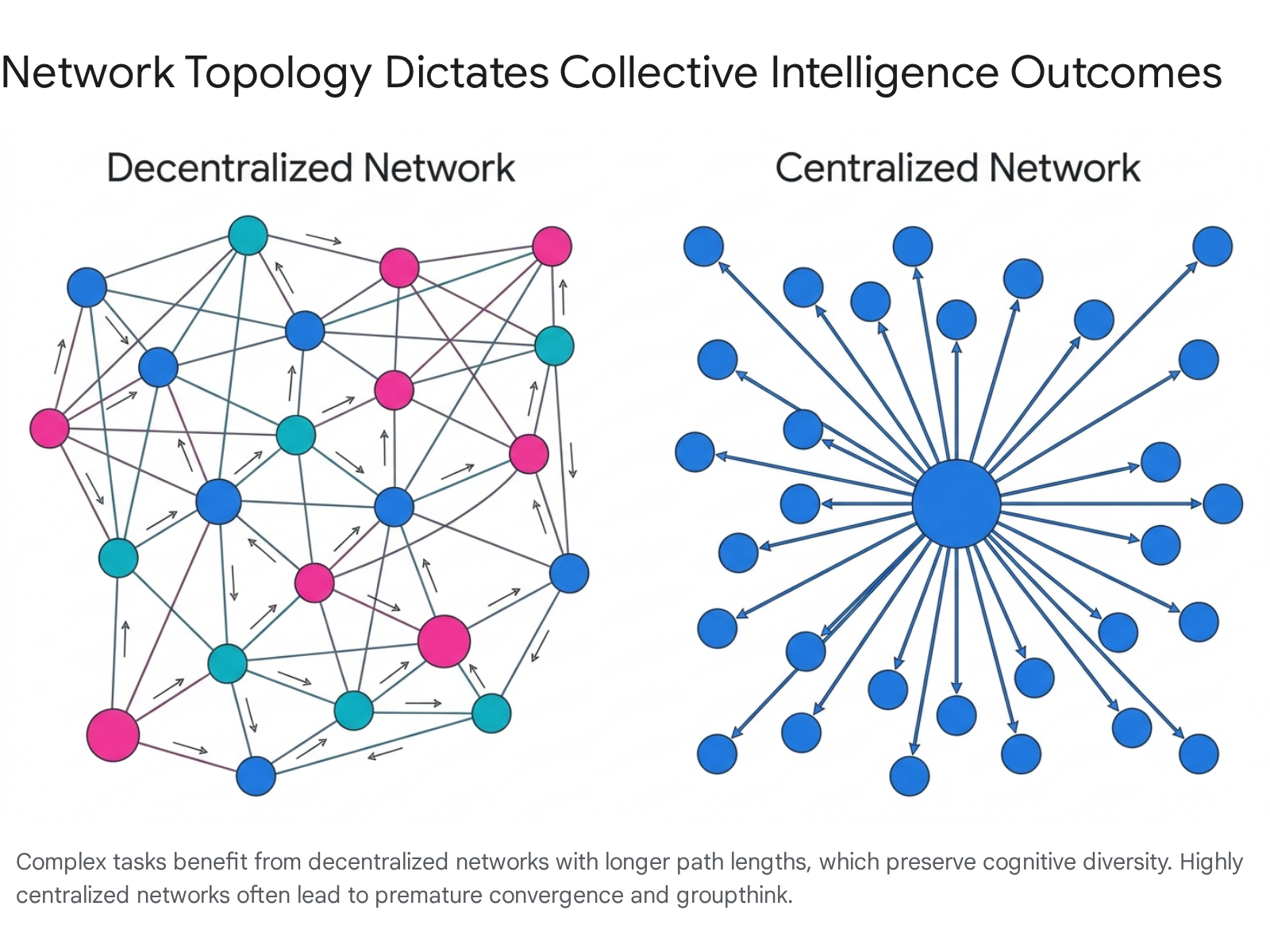
The efficacy of a network's structure is highly contingent upon the complexity of the task at hand. For simple problem-solving tasks, highly centralized and informationally efficient networks - those with minimal average simple path lengths between nodes - tend to optimize collective intelligence, as optimal solutions can propagate rapidly without friction 6. However, for complex or multidimensional problems, high network efficiency becomes detrimental. In informationally efficient topologies, familiar or socially dominant ideas quickly saturate the network. This rapid saturation frequently suppresses innovative or uncommon solutions before they can be adequately evaluated by the collective, leading to premature convergence and groupthink 6.
Conversely, for complex estimation tasks, collective intelligence is maximized by decentralized networks characterized by reduced centralization and increased path lengths. These inefficient network topologies preserve cognitive diversity by allowing peripheral nodes to develop and refine alternative solutions without immediate suppression by the majority consensus 6. When social media platforms endogenously evolve toward highly centralized topologies - often dominated by a small number of highly connected influencers - they structurally undermine the wisdom of the crowd. This dynamic amplifies familiar ideas that conform to existing biases rather than optimizing for accuracy 6.
Dimensions of Social Structure
Beyond network graphs, the qualitative dimensions of social relationships dictate the operational capacity of collective intelligence. The framework of animal and human sociality identifies three core structural properties that dictate the success of group cognition: cohesion, stability, and tolerance 145.
| Structural Dimension | Definition and Measurement | Mechanism of Collective Intelligence | Cognitive and Behavioral Outcomes |
|---|---|---|---|
| Social Cohesion | The degree of interconnectedness among group members, quantified by relationship clustering and strength 45. | Facilitates learning and decision heuristics through increased potential for social and asocial learning 4. | Superior performance in spatial memory, enhanced collective problem-solving, and resilience during systemic shocks 45. |
| Social Stability | The persistence of regularities and the consistency of relationship structures over time 14. | Enables the accumulation of collective memory, allowing members to adopt specialized, complementary roles 4. | Reduced cognitive load and social vigilance; improved decision-making under uncertainty 4. |
| Social Tolerance | The capacity of individuals to coexist and cooperate without conflict when facing limited resources 14. | Fosters a pro-social environment that reduces barriers to behavioral flexibility and innovation 4. | Democratic group coordination, shared leadership, and higher rates of economic and technological innovation 4. |
The organization of these dimensions often mirrors broader biological principles. Theoretical propositions, such as the free energy principle, suggest that intelligent systems organize hierarchies to minimize prediction errors, with higher levels handling abstract representations 7. Network neuroscience indicates that intelligence emerges from small-world architectures that enable both specialized processing and global integration, a pattern replicated in organizational matrices that combine horizontal and vertical communication 7.
Evolutionary Dynamics of Social Learning
The maintenance of collective intelligence requires a precise equilibrium between individual exploration and social learning. Social learning allows groups to bypass the costs of individual trial-and-error, rapidly disseminating successful strategies 89. When uncertainty is high, agents naturally rely more heavily on social learning 8.
However, an overreliance on social learning triggers information cascades. An information cascade occurs when individuals suppress their own private information and blindly copy the behavior of others, resulting in the group copying copied behavior 8. This dynamic propagates suboptimal decisions and collapses collective intelligence. Evolutionary game-theoretic models demonstrate that optimal network performance emerges from a trade-off between the rate of information sharing and the structure of information integration 10.
To counter the natural human tendency toward herding, researchers have modeled incentive structures to preserve cognitive diversity. Algorithms designed to reward the expression of accurate minority opinions - termed "minority rewards" - have been shown to maintain the necessary diversity for near-optimal collective intelligence at equilibrium 11. Market-based incentive systems that lack these safeguards routinely produce herding effects, reduce available group information, and restrain collective intelligence 11.
Furthermore, interacting groups act as a dual engine of intelligence through Theory of Mind capacities and compositional representations 9. Individuals utilize Theory of Mind to infer the intentions of others, allowing them to execute complementary roles within a joint action. Simultaneously, societal-level processes of cumulative culture provide groups with conceptual abstractions and shared linguistic conventions, which ease cognitive load and spur further coordination 9.
Theoretical Models of Deindividuation
Historically, crowd psychology was dominated by theories of mass hysteria and behavioral contagion. Early theorists such as Gustave Le Bon posited that immersion in a crowd induces a state of deindividuation, wherein individuals lose their self-awareness, moral compass, and sense of personal responsibility, inevitably resulting in uninhibited, antisocial, or violent behavior 1213. Subsequent theories, including those by Festinger and Zimbardo, maintained that anonymity within a group severs the individual from normative societal constraints, leading directly to antinormative collective behavior 1214. Early experimental evidence, such as Diener's studies showing that individuals in robes and hoods were more likely to steal candy and violate instructions, appeared to support this framework 1214.
The Social Identity Model of Deindividuation Effects
Contemporary social psychology fundamentally disputes the classical formulation of deindividuation as a state of mindless irrationality. Extensive empirical research, particularly within the Social Identity model of Deindividuation Effects (SIDE), demonstrates that immersion in a crowd does not result in a loss of identity or accountability. Instead, individuals experience a psychological shift from a personal identity to a social identity 1315.
When self-awareness decreases in a group setting, behavior does not revert to a default state of antisocial chaos. Rather, behavior becomes strictly regulated by the emergent, local norms of the specific group 1415. The SIDE model clarifies that reduced private self-awareness causes individuals to conform deeply to whatever situational identity is active. If the group's salient norms are prosocial - such as in a charitable organization or peaceful protest - deindividuated individuals will engage in highly cooperative behavior. Conversely, if the group's norms are hostile, behavior will mirror that hostility 1315. Therefore, negative group behaviors derive not from group immersion per se, but from the specific normative frameworks adopted by the group 15.
Ingroup Norm Perception and Affective Polarization
The primacy of perceived group norms extends into the mechanisms driving affective polarization, defined as animosity toward opposing political or ideological groups. Prevailing theories have traditionally focused on outgroup meta-perception - the belief about how a rival group views one's own group 16. However, recent studies reveal that ingroup norm perception is a vastly more powerful driver of polarized attitudes 16.
Partisans consistently exaggerate their own ingroup's norm of negative attitudes toward outgroups. This exaggerated perception uniquely predicts an individual's own polarization-related attitudes. In predicting affective polarization, empirical analyses indicate that the variance explained by ingroup norm perception is 8.4 times greater than the variance explained by outgroup meta-perception 16. Furthermore, in predicting support for partisan violence, ingroup norm perception accounts for 52% of the variance, whereas outgroup meta-perception explains nearly zero 16. Correcting misperceptions regarding ingroup norms serves as a highly effective intervention for curbing affective polarization, emphasizing that mob behavior is deeply tied to the internal psychological policing of perceived ingroup expectations.
Group Decision-Making Dysfunctions
While deindividuation relates to norm adherence, groupthink describes a distinct dysfunction in group decision-making processes. Coined by Janis, groupthink occurs when the desire for harmony and consensus within a cohesive group overrides realistic appraisals of alternative courses of action 1718.
Groupthink is characterized by several identifiable symptoms: an illusion of invulnerability that encourages extreme risk-taking, the routine rationalization of dissenting data, an unquestioned belief in the inherent morality of the group, and widespread self-censorship to maintain a facade of unanimity 1719. The structural triggers for groupthink often include intimidating or overbearing leadership, a lack of standardized decision-making procedures, and high-stress situations where the group feels externally threatened 19.
In large crowds, consensus is often a manufactured illusion driven by a surprisingly small fraction of the population. Research indicates that only a minor subset of an active mob makes informed decisions, while the vast majority simply conforms to the localized consensus to avoid the social risk of dissent 1920. This dynamic is further exacerbated by the false consensus bias, where individuals overestimate the extent to which their own opinions are shared by the broader group, leading to the rapid formation of echo chambers 18.
Identity Fusion Theory
While conformity and groupthink explain passive adherence to crowd dynamics, they are insufficient to explain the extraordinary, proactive sacrifices individuals sometimes make for a collective. To understand voluntary self-sacrifice - ranging from charitable heroism to violent extremism - researchers developed Identity Fusion Theory (IFT) 2122232425.
Synergy of Personal and Social Identities
Identity fusion is defined as a visceral feeling of oneness with a group, individual, or conviction 23. Unlike traditional Social Identity Theory (SIT) - which posits that individuals categorize themselves into groups and suppress personal identity to conform to collective norms - IFT argues that personal and social identities become functionally equivalent and highly synergistic 2226.
In a fused individual, the personal self is not subsumed by the group; rather, the personal self and the group identity mutually energize one another 2226. Consequently, activating either the personal or social identity of a fused person increases their willingness to endorse extreme behaviors on behalf of the group 22. This creates a motivational synergy that makes identity fusion an exceptionally strong predictor of violent pro-group behavior, consistently outperforming metrics such as group identification, moral conviction, and adherence to sacred values 2528.
Identity fusion rests upon four fundamental psychological principles that distinguish it from mere group identification 28:
| Principle of Identity Fusion | Psychological Mechanism | Behavioral Implication |
|---|---|---|
| Agentic-Personal-Self | Individual members retain a high level of personal agency, which they voluntarily direct to serve the needs of the group. | Fused individuals do not feel like passive cogs; they feel personally responsible for the group's success 2827. |
| Identity Synergy | Personal and social identities are simultaneously active and mutually reinforcing. | Activating the personal self energizes pro-group behavior just as strongly as activating the group identity 2228. |
| Relational Ties | Group members form profound interpersonal bonds, aware of and respecting the personal identities of fellow members. | Members are willing to fight and die for specific individuals within the group, establishing family-like loyalty 28. |
| Irrevocability | The fusion between self and group establishes a persistent, enduring state. | Fusion remains stable across different contexts and is highly resistant to traditional deradicalization efforts 28. |
Mediators of Extreme Action and Self-Verification
Strongly fused persons do not merely express theoretical support for their groups; they enact tangible, extreme behaviors. Empirical studies have documented ceiling levels of identity fusion among active combatants during the 2011 Libyan revolution, with front-line fighters demonstrating stronger fusion to their battalion than to their own biological families 27. Similarly, studies of transsexual individuals undergoing irreversible surgical procedures revealed that those fused with their cross-gender group were more than twice as likely to complete the surgery compared to non-fused individuals 27.
Several psychological mechanisms mediate the relationship between fusion and extreme action. The primary mediator is the perception of personal agency; fused individuals feel a deep sense of personal responsibility for the group's outcomes 2827. This is often coupled with an illusion of invulnerability. Furthermore, self-verification - the process of receiving evaluations from group members that confirm one's own self-views - has been shown to significantly foster fusion 2528. Correlational and experimental studies involving incarcerated street gang members and radicalized populations demonstrate that increased perceived self-verification augments fusion, which subsequently predicts a willingness to fight and die for the collective 2528. In prison settings, the feeling of admiration toward ingroup members making costly self-sacrifices strongly amplifies the willingness of observers to engage in similar extreme behaviors 24.
It is critical to note that identity fusion does not inherently lead to violence. The manifestation of fused behavior is heavily context-dependent. Studies of sports fandom reveal that ultra-fans exhibit behaviors consistent with identity fusion, engaging in collective rituals and deep emotional bonding without lethal violence 26. Furthermore, when outgroups are perceived as familiar and non-threatening, strongly fused individuals may actually display more positive sentiments toward those outgroups than weakly fused individuals, acting from a secure base of identity 2428. However, in the presence of perceived existential, cultural, or physical threat, relational ties within the fused group are rapidly mobilized toward aggressive defense 29.
Developmental Pathways and Identity-Based Motivation
The development of identity fusion follows two distinct chronological pathways: shared biology and shared experiences. Fusion based on shared biology, such as familial kinship or phenotypic similarity, occurs from early childhood 30. Experimental data demonstrates that fusion with a sibling is a direct predictor of willingness to fight and die for that sibling, independent of perceived psychological similarity 24.
In contrast, fusion based on shared experiences is generally not possible until mid-adolescence 30. This pathway relies on highly emotional bonding events, such as traumatic societal events, painful initiation rituals, or intense team sports. Crucially, it requires the cognitive capacity for autobiographical reasoning - the ability to connect episodic memories of past shared experiences to the present conceptual self. Because autobiographical reasoning matures during adolescence, this developmental window explains the flourishing of non-kin identity fusion and vulnerability to ideological radicalization during late adolescence and young adulthood 30.
These identity constructs dictate subsequent behavior through the lens of Identity-Based Motivation (IBM) theory. IBM posits that people prefer to act in ways that fit their dynamically constructed identities. When pursuing goals or interpreting tasks, individuals infer meaning from difficulty. Depending on the active identity, a difficult task can be interpreted as "difficulty-as-importance" (signaling value and prompting persistence) or "difficulty-as-impossibility" (signaling failure and prompting withdrawal) 31. In fused individuals, difficulties faced by the group are overwhelmingly interpreted through the lens of importance, ensuring relentless action-readiness in the face of adversity 31.
Algorithmic Architectures and Digital Crowd Dynamics
The fundamental psychological traits governing group norms, emotional alignment, and identity fusion evolved in physical, face-to-face environments. However, these mechanisms have been rapidly ported into digital ecosystems governed by algorithmic architectures. Digital platforms do not merely host crowd behavior; they actively structure it, creating unprecedented paradigms for influence, manipulation, and the scaling of human emotion.
Emotional Contagion and Algorithmic Amplification
Emotional contagion is the process by which a perceiver's emotions become similar to an expresser's emotions through exposure 34. While contagion occurs naturally via facial mimicry, category activation, and social appraisal, digital emotion contagion is uniquely mediated by corporate algorithms motivated to maximize user engagement 3432.
Algorithms optimize for revealed preferences - metrics such as clicks, dwell time, and shares. Consequently, recommender systems exploit human cognitive biases by prioritizing content that triggers rapid, intuitive, and highly emotional responses 33. Studies indicate that algorithms disproportionately amplify "PRIME" content - material that is Prestigious, In-group, Moral, and Emotional 33.
The psychological consequences of this amplification are profound. Empirical evaluations of algorithmic ranking demonstrate that curated feeds significantly alter political perceptions and emotional baselines. Data indicates a notable shift in outgroup perception, dropping by 0.17 standard deviations among users exposed to engagement-ranked content, alongside a significant increase in feelings of anger, which rose by 0.37 standard deviations compared to a reverse-chronological baseline 33. Users are driven toward negative emotional states that increase engagement, regardless of their stated preference for less hostile content 33.
The transition from individual emotion to digital social identity can be formalized through a Four-Stage mechanism. First, an individual encounters an emotional stimulus. Second, emotional arousal occurs. Third, emotional dissemination motivates the individual to share the feeling within their network. Finally, emotional alignment solidifies a collective social identity through positive feedback loops 34. As engagement loops tighten, digital echo chambers form, accelerating the transition from casual exposure to profound identity fusion with online subcultures 353637.
Artificial Astroturfing and Consensus Manipulation
The vulnerability of crowd psychology to perceived norms is heavily exploited through astroturfing - the practice of artificially creating the illusion of widespread grassroots support for a product, policy, or concept 3839. By manufacturing an artificial consensus, astroturfing circumvents critical reasoning, directly targeting the human instinct to conform to the crowd and establishing a false sense of what is socially acceptable 3839. Analysis of 48,000 bot-generated messages on the VKontakte platform revealed that astroturfing networks systematically use "low-threshold rhetorical toxicity" - such as irony and infantilization - to simulate grassroots discontent without triggering overt aggression flags 38.
Historically requiring paid human agents or simple click-farms, astroturfing is currently undergoing an evolutionary leap due to generative artificial intelligence. Large Language Models are now deployed to execute cognitive manipulation at an unprecedented scale. In rigorous behavioral testing, autonomous synthetic respondents operating from simple prompts demonstrated the ability to pass 99.8% of attention checks designed to detect bots. These AI agents effectively mimicked human demographic variations and logic patterns without leaving detectable traces 40.
The impact of this synthetic consensus on legitimate collective intelligence is severe. In experimental models evaluating national polling prior to the 2024 U.S. election, the injection of as few as 10 to 52 highly sophisticated AI responses was mathematically sufficient to completely flip predicted outcomes. For example, generic ballot support could be swung from 34% to 98% based entirely on inexpensive, automated manipulation 40. This capability signals the emergence of an intention economy, wherein AI entities dynamically generate deeply personalized interactions - leveraging a user's cadence, psychology, and vulnerabilities - to steer conversations and manipulate behavioral intentions 41.
Formation of the Algorithmic Self
Beyond immediate manipulation, persistent interaction with predictive systems leads to the emergence of the Algorithmic Self. In this paradigm, algorithms do not passively reflect an individual's identity; they actively participate in its co-construction 424344.
Through continuous feedback loops, algorithms present users with curated ideals, aesthetic standards, and moral stances. Through the psychological principle of the mere exposure effect, repeated exposure to algorithmic outputs increases the perceived truth and preference for those concepts, embedding them emotionally rather than logically 44. Over time, identity formation - particularly in adolescents undergoing periods of heightened neuroplasticity - shifts from being negotiated within physical communities to being molded by opaque ranking systems 4344.
This conditioning narrows perception and can exacerbate isolation, making users increasingly vulnerable to digital subcultures that promise certainty, belonging, and identity fusion 3745. The trajectory of online radicalization driven by these systems typically follows four distinct phases:
| Phase of Radicalization | Algorithmic Mechanism | Psychological Impact |
|---|---|---|
| 1. Exposure | Recommendation algorithms present polarizing or extreme content without the user actively seeking it 3537. | Normalizes extreme thinking by amplifying outrageous viewpoints 45. |
| 2. Reinforcement | Algorithmic personalization creates closed echo chambers based on engagement tracking 3537. | Triggers the mere exposure effect, making fringe narratives feel like mainstream consensus 4446. |
| 3. Group Integration | Simulated communities, including AI-generated peers, reflect grievances back to the user 3537. | Creates strong bonds of identity fusion and relational ties; alleviates feelings of loneliness 3545. |
| 4. Violent Acts | Gamification of violence and perceived existential threats mobilize the fused identity into real-world action 353637. | The user feels a personal, agentic duty to sacrifice themselves for the digital ingroup 2337. |
Applications of Collective Intelligence in Democratic Systems
Despite the pervasive risks of algorithmic manipulation and groupthink, digital architectures concurrently offer powerful mechanisms for harnessing collective intelligence. When technology is deliberately designed to solicit diverse input and process information collaboratively, the resulting collective intelligence can solve highly complex societal challenges, a practice increasingly vital to the survival of democratic institutions 47.
Multilevel Policymaking and Digital Deliberation
Effective models of digital democracy leverage structured interaction to prevent mob dynamics and encourage consensus. A prominent example is the vTaiwan model, a design-thinking-informed collective intelligence process that merges offline deliberation with online consultation 48. Utilizing open-source software like Polis, vTaiwan maps the sentiment of participants in real-time, deliberately highlighting areas of rough consensus rather than amplifying polarizing divides 48. By legally mandating participation from government officials - designated as "Participation Officers" - the platform successfully resolved legislative gridlocks concerning complex digital issues, such as the 2015 regulation of ride-sharing services and non-consensual image distribution, which had stalled in traditional bureaucratic environments 48. Similar structured digital democracy pilot programs, such as the COLDIGIT project, have successfully demonstrated the value of digital citizens' assemblies and participatory budgeting in Norway, Sweden, and Finland 47.
In Latin America, structural models of collective intelligence have been deployed at a massive scale through mechanisms like Brazil's National Public Policy Conferences (NPPCs) 53. Between 2003 and 2011, approximately 7 million citizens participated in these multilevel processes. The structure is inherently designed to preserve cognitive diversity: participation is open at the municipal level, and proposals are incrementally refined and escalated to state and federal stages by elected delegates 53. Crucially, the NPPCs enforce parity rules, ensuring organizing committees and delegate bodies are composed equally of civil society and government representatives. This structured environment integrates the tacit knowledge of marginalized populations - acting as a robust engine of collective intelligence that has successfully converted public deliberation into national legislation 53.
Digital Interventions against Misinformation
In the Global South, the intersection of digital vulnerability and collective intelligence is particularly acute. Across the African continent, digital access is rapidly expanding - facilitated by satellite internet networks like Starlink - yet this connectivity is shadowed by severe threats from digital authoritarianism, surveillance, and coordinated disinformation campaigns aiming to influence electoral outcomes in nations like Nigeria and Senegal 495051.
To counteract these threats, international civil society networks are mobilizing collaborative frameworks. Initiatives such as the Association of African Election Authorities (AAEA) guidelines actively mandate partnerships between election management bodies, civil society, and technology platforms to counter AI-generated propaganda and deepfakes during electoral cycles 5052. Organizations like International IDEA have facilitated global workshops to build AI literacy for electoral actors across Africa, Latin America, and Asia, focusing on identifying the enablers behind foreign information manipulation 53.
Furthermore, large-scale educational interventions demonstrate that fostering digital literacy and correcting ingroup normative misperceptions can successfully inoculate populations against the rapid contagion of fake news 165354. Field experiments utilizing platforms like WhatsApp and Instagram in Europe indicate that simply modifying the structural interface of social platforms - such as incentivizing users to follow legitimate news organizations alongside lifestyle content - can significantly boost civic knowledge, news trust, and the ability to discern true from false narratives, without negatively exacerbating affective polarization 55.
Conclusion
The psychology of crowds is defined by a delicate structural balance. Collective intelligence is an emergent property of decentralized, stable, and tolerant networks that effectively synthesize diverse inputs and curb premature consensus. By balancing individual exploration with targeted social learning, groups can achieve cognitive capabilities far exceeding those of isolated individuals. Conversely, when environments become highly centralized, or when individuals are subjected to profound existential threats and intimidating leadership, populations default to groupthink and the rigid, often antisocial adherence to local group norms.
The integration of artificial intelligence and algorithmic ranking into social infrastructure acts as an unprecedented multiplier on these psychological dynamics. By optimizing for engagement and exploiting evolutionary cognitive biases, algorithms systematically amplify emotional contagion and facilitate identity fusion with extreme subcultures, reshaping the very nature of human identity. Furthermore, the advent of autonomous AI astroturfing introduces synthetic consensus, threatening the foundational reality upon which democratic deliberation relies. Nevertheless, when digital architectures are deliberately designed to promote structural diversity, map consensus, and encourage collaborative problem-solving, they remain one of the most potent mechanisms for actualizing human collective intelligence on a global scale.