
Psychological factors of compulsive negative news consumption
The contemporary digital landscape has fundamentally altered the mechanisms through which human beings consume, process, and react to information. Over the past decade, and accelerating acutely since the onset of the COVID-19 pandemic, a novel behavioral paradigm has emerged: doomscrolling. Defined conceptually as the habitual, immersive scanning for timely negative information on social media newsfeeds, doomscrolling represents a complex intersection of evolutionary biology, human psychology, and the persuasive design architectures of modern digital platforms 1. This exhaustive analysis synthesizes current empirical research, cyberpsychology frameworks, and neurobiological models to unpack the psychology of doomscrolling, analyzing why individuals remain compulsively engaged with distressing content and examining the cascading consequences for global mental health.
Concept and Clinical Definition
The term "doomscrolling," interchangeably referred to as "doomsurfing," entered the colloquial lexicon around 2018 and achieved widespread recognition in 2020 during global lockdown measures 234. The World Health Organization's identification of the pandemic-era "infodemic" - characterized by an overwhelming abundance of both accurate and misleading information - provided the macroscopic context for the rapid normalization of this behavior 3. However, psychological research has moved beyond colloquial definitions to establish doomscrolling as a specific, measurable psychometric construct.
Distinguishing from Problematic Internet Use
In academic literature, doomscrolling is strictly differentiated from general information-seeking and broader problematic internet use. It is uniquely characterized by compulsivity, an overwhelming focus on negatively valenced content, and a distinct association with crisis-related contexts 5. Researchers define the phenomenon as an obsessive, difficult-to-stop consumption of negative news driven by underlying distress, cognitive dissonance, or uncertainty, which is maintained despite the user's conscious awareness of its emotional costs 56.
Unlike generalized social media addiction, which frequently involves seeking social validation, interpersonal connection, or escapist entertainment, doomscrolling is rooted in a maladaptive attempt to monitor environmental threats 57. The Compensatory Internet Use Theory (CIUT) provides a framework for understanding this behavior. CIUT posits that individuals experiencing low mood, depressive symptoms, or a lack of real-world support turn to the internet as a mechanism to up-regulate their mood or find cognitive relief 48. However, in the context of doomscrolling, this compensatory strategy backfires. The user seeks relief or a sense of control but instead encounters further uncertainty, trapping them in a maladaptive coping loop where the attempted technological intervention exacerbates the underlying psychological distress 578.
Similarly, the Uses and Gratifications Theory (UGT) elucidates why individuals engage with specific media forms to fulfill internal needs. In times of socio-political or environmental unrest, users rely on social media to stay informed and regulate emotions 9. Yet, because the content is overwhelmingly distressing, the anticipated gratification of "being prepared" is replaced by chronic emotional exhaustion, demonstrating a failure of traditional media consumption strategies in the modern algorithmic environment 9.
Psychometric Measurement and Scale Validation
To quantify this phenomenon, Sharma and colleagues developed the Doomscrolling Scale in 2022, confirming it as a distinct psychometric variable linked to online vigilance, problematic media use, and the fear of missing out (FOMO) 11010. The validation of this scale across multiple cultural and linguistic contexts has permitted researchers to systematically investigate the psychological scaffolding of the behavior.
The original scale is a unidimensional instrument utilizing a 7-point Likert scale to assess behaviors such as losing track of time while consuming negative news. It is available in a comprehensive 15-item form and an abbreviated 4-item short form 111. As researchers have adapted the instrument globally, the psychometric robustness of the scale has been repeatedly confirmed.
| Country of Validation | Study Authors & Year | Sample Size & Demographics | Psychometric Findings |
|---|---|---|---|
| Turkey | Satici et al. (2023) | N = 378 (General Adults) | Confirmed unidimensional structure via Confirmatory Factor Analysis (CFA). Excellent reliability (α = 0.938 - 0.944). Strong discriminative power using Item Response Theory. 1 |
| China | Yang et al. (2024) | N = 2,885 (University Students) | High internal consistency and two-month test-retest reliability. Structural Equation Modeling (SEM) confirmed doomscrolling mediates the bidirectional relationship between insomnia and depression. 111213 |
| Italy | Soraci et al. (2025) | Variable cohorts | Validated both the 15-item and 4-item forms, confirming doomscrolling as a homogeneous psychological construct related to compulsive negative engagement. 13 |
These cross-cultural validations demonstrate that doomscrolling is not merely an artifact of Western media consumption but a universal cognitive vulnerability exacerbated by global digital platforms.
Evolutionary Biology and Threat Detection
To understand the compulsion to doomscroll, it is necessary to examine the phenomenon not as a modern defect in self-control, but as an ancient survival mechanism applied to a novel digital environment. The behavior represents a textbook example of "evolutionary mismatch" - a phenomenon wherein biological characteristics that were once highly advantageous to a species gradually become detrimental due to rapid environmental shifts 14.
Negativity Bias
The foundational psychological driver of doomscrolling is "negativity bias." The human brain evolved over millennia to prioritize negative, threatening, or dangerous stimuli over positive or neutral information 71516. In ancestral environments, the cost of ignoring a physical threat (such as a predator or a hostile neighboring group) was potentially fatal, whereas the cost of ignoring a positive stimulus was merely a missed opportunity for temporary caloric or social gain. Consequently, humans are cognitively hardwired to rapidly attend to, memorize, and continually dwell on adverse events 31517.
In the context of the digital attention economy, this ancient threat-detection system is chronically hijacked. When an individual perceives a macroscopic crisis - whether a novel pathogen, geopolitical conflict, or natural disaster - the brain instinctively seeks out information to assess the threat level and formulate a survival strategy. However, because the internet provides an inexhaustible, continuously updating supply of crisis data, the human biological drive to scan the horizon for danger is never satiated 1518. The user is locked in a state of continuous information gathering, under the false evolutionary assumption that acquiring more data will eventually neutralize the threat.
Evolutionary Mismatch in the Digital Age
The evolutionary mismatch occurs because the digital environment lacks the resolution natural environments provide. A physical threat in the ancestral environment either resulted in escape or death; in either outcome, the state of acute threat monitoring concluded. Digital threats, however, are pervasive, abstract, and geographically distant, meaning the biological mechanism designed to resolve uncertainty operates in a vacuum. Individuals continuously scroll under the illusion of gaining control or preparedness, but the boundless nature of social media ensures that no amount of information will ever signal to the brain that the environment is finally safe 341519.
Neurobiological Pathways
Understanding the biological inescapability of doomscrolling requires mapping the specific brain structures and chemical pathways involved. The behavior is not merely a psychological habit but a profound neurological loop characterized by the dysregulation of the limbic system, the endocrine system, and the brain's reward architecture.
Amygdala Dominance and the HPA Axis
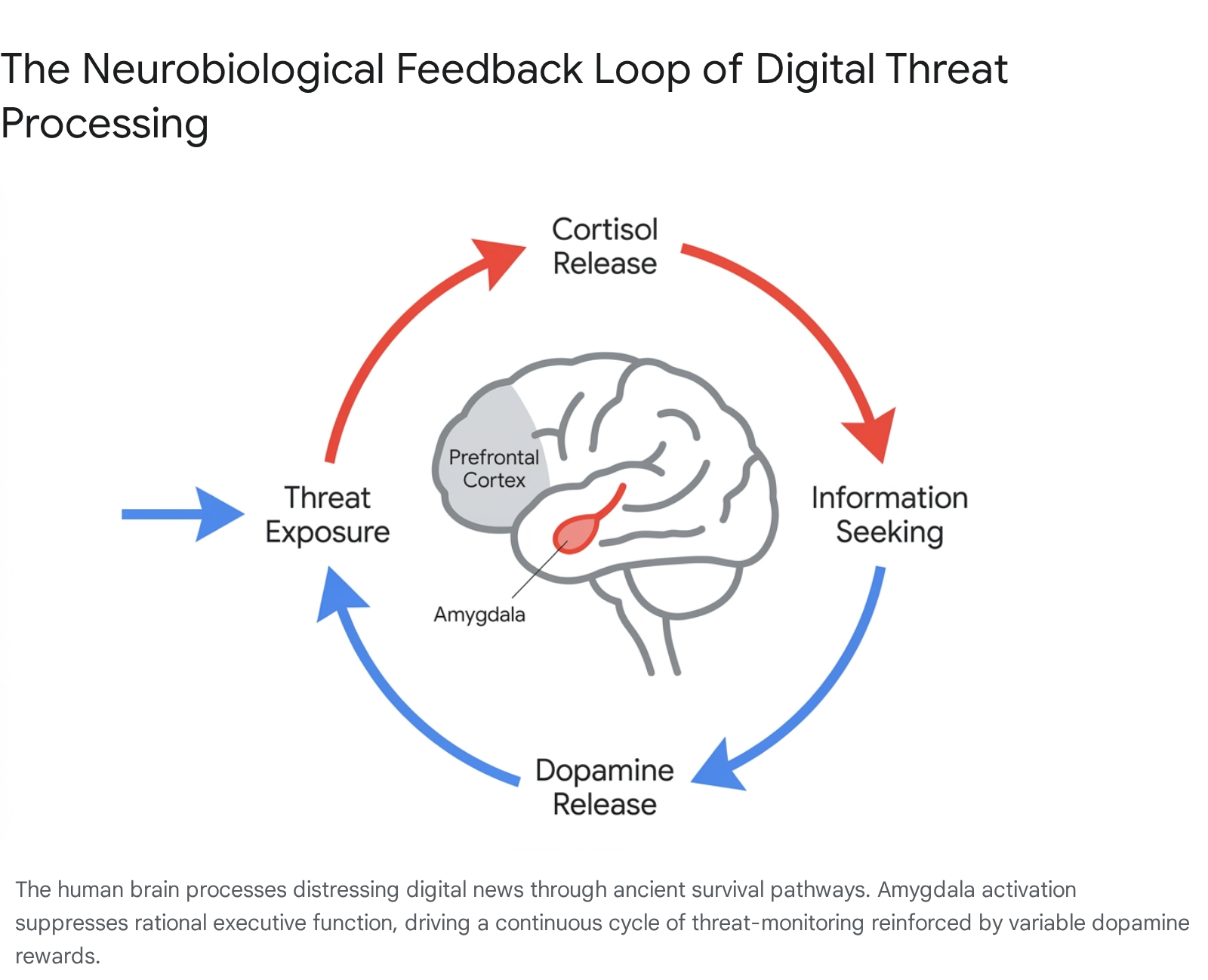
When an individual encounters alarming digital headlines, the limbic system - specifically the amygdala, which serves as the brain's primary emotional and fear-processing center - activates immediately 220. This activation triggers the hypothalamic-pituitary-adrenal (HPA) axis, the central hormone response system that initiates the body's "fight or flight" cascade. The endocrine system floods the bloodstream with stress hormones, prominently cortisol and adrenaline, forcing the body into a state of hyperarousal, elevated heart rate, and heightened physical alertness 1720212223.
Under natural evolutionary circumstances, this state of hyperarousal dissipates once the physical threat is bypassed, allowing the nervous system to return to a baseline state of homeostasis. However, the infinite nature of doomscrolling provides continuous, overlapping exposure to novel threats. The stress response becomes stuck in the "on" position, leading to chronically elevated cortisol levels 22. Furthermore, as the amygdala asserts dominance over cognitive processing, the prefrontal cortex - the anatomical region responsible for logical reasoning, complex decision-making, and conscious impulse control - is effectively suppressed 2023. The physiological dampening of the prefrontal cortex explains the subjective, paradoxical experience of the doomscroller: feeling entirely unable to stop scrolling despite possessing the conscious awareness that the behavior is actively causing psychological harm 20.
Dopaminergic Reward Systems and Neuroplasticity
Counterintuitively, doomscrolling is not solely driven by fear and cortisol; it is powerfully reinforced by the brain's dopaminergic reward circuitry. The search for information in an uncertain environment is treated by the brain as a critical, goal-directed behavior. When an individual discovers a new piece of information - even if that information is fundamentally grim or terrifying - the brain rewards the acquisition of knowledge by releasing dopamine, a neurotransmitter deeply associated with motivation, reward, and reinforcement 22022.
Social media newsfeeds operate on a psychological schedule of "variable rewards," utilizing mechanics virtually identical to those found in casino slot machines 1720. Because the user cannot predict what the next swipe or downward scroll will reveal - a benign life update from a friend, an enraging political opinion, or a devastating piece of breaking news - the unpredictability maximizes the intensity of the dopamine release. This neurochemical reward powerfully reinforces the scrolling behavior. Over time, through the process of neuroplasticity, the brain's neural pathways are physically altered to expect and subconsciously seek out negative news, fundamentally carving the addictive cycle into the brain's structural architecture 2023.
Platform Architecture and Human-Computer Interaction
The internal psychological vulnerabilities of the human user are systematically amplified by the external design features of the platforms they interact with. The discipline of Human-Computer Interaction (HCI) reveals how social media architectures are explicitly engineered for the "attention economy," a business model that prioritizes the maximization of user engagement above all other metrics, including user well-being 318.
The Attention Economy and Algorithmic Curation
Two primary technological features sustain and exacerbate doomscrolling: algorithmic content curation and the infinite scroll UI. Algorithms driving platforms like Twitter (X), Facebook, TikTok, and Instagram are optimized to serve content that generates the highest emotional arousal and interaction rates. Due to the innate human negativity bias discussed previously, emotionally charged, outrage-inducing, or frightening content naturally accrues the highest engagement metrics 45. Consequently, machine learning systems quickly identify these preferences and feed users a disproportionate, escalating volume of negative news. This creates a personalized echo chamber of despair, effectively training the algorithm to serve more distress-inducing content to keep the user on the platform 42524.
Interface Friction and the Infinite Scroll
Simultaneously, interface designs such as the "infinite scroll" intentionally remove natural stopping cues 35. In traditional media environments, the physical end of a newspaper page, the conclusion of a television broadcast, or the end of a magazine article provided a cognitive break. These natural endpoints allowed the user a moment of reflection and a chance to disengage. Infinite scrolling creates a frictionless environment where new content loads automatically at the bottom of the screen. In this environment, the user must exert active, prefrontal-cortex-driven cognitive effort to stop scrolling - effort that is already heavily compromised by the hyperarousal of the amygdala 320.
Feature and Vulnerability Mapping
The intersection of human biology and technological design creates a robust framework for compulsion. The alignment between specific psychological vulnerabilities, the platform features that exploit them, and the resulting clinical impacts is consistent across cyberpsychology literature.
| Psychological Vulnerability | Social Media Design Feature | HCI Mechanism of Action | Observed Clinical Impact |
|---|---|---|---|
| Negativity Bias 1516 | Algorithmic Content Delivery 517 | Prioritizes emotionally intense, threatening content to maximize user attention and retention. | Generalized Anxiety, Hypervigilance 101721 |
| Intolerance of Uncertainty 5 | 24/7 Real-Time Refresh 22 | Offers the illusion of gaining control through continuous, rapid information acquisition during crises. | Compulsive Checking, Rumination 517 |
| Variable Reward Seeking 20 | Intermittent Push Notifications 17 | Triggers dopamine release through unpredictable intervals of discovering new information. | Behavioral Addiction, Loss of Time Awareness 1725 |
| Depleted Executive Control 20 | Infinite Scroll / Frictionless UI 5 | Removes natural stopping cues, ensuring disengagement requires unusually high cognitive effort. | Cognitive Overload, Emotional Exhaustion 1828 |
| Fear of Missing Out (FOMO) 3 | Social Proof / Trending Topics 3 | Weaponizes social inclusion, suggesting critical, rapidly evolving threats will be missed if absent. | Sleep Disruption, Elevated Cortisol 61729 |
Psychometric Measurement and Trait Correlates
While doomscrolling is a widespread phenomenon, specific psychological profiles and demographic groups demonstrate significantly heightened susceptibility. Empirical research indicates that the behavior is not evenly distributed across the population, but rather clusters around specific personality matrices and socio-demographic markers.
The Big Five Personality Traits
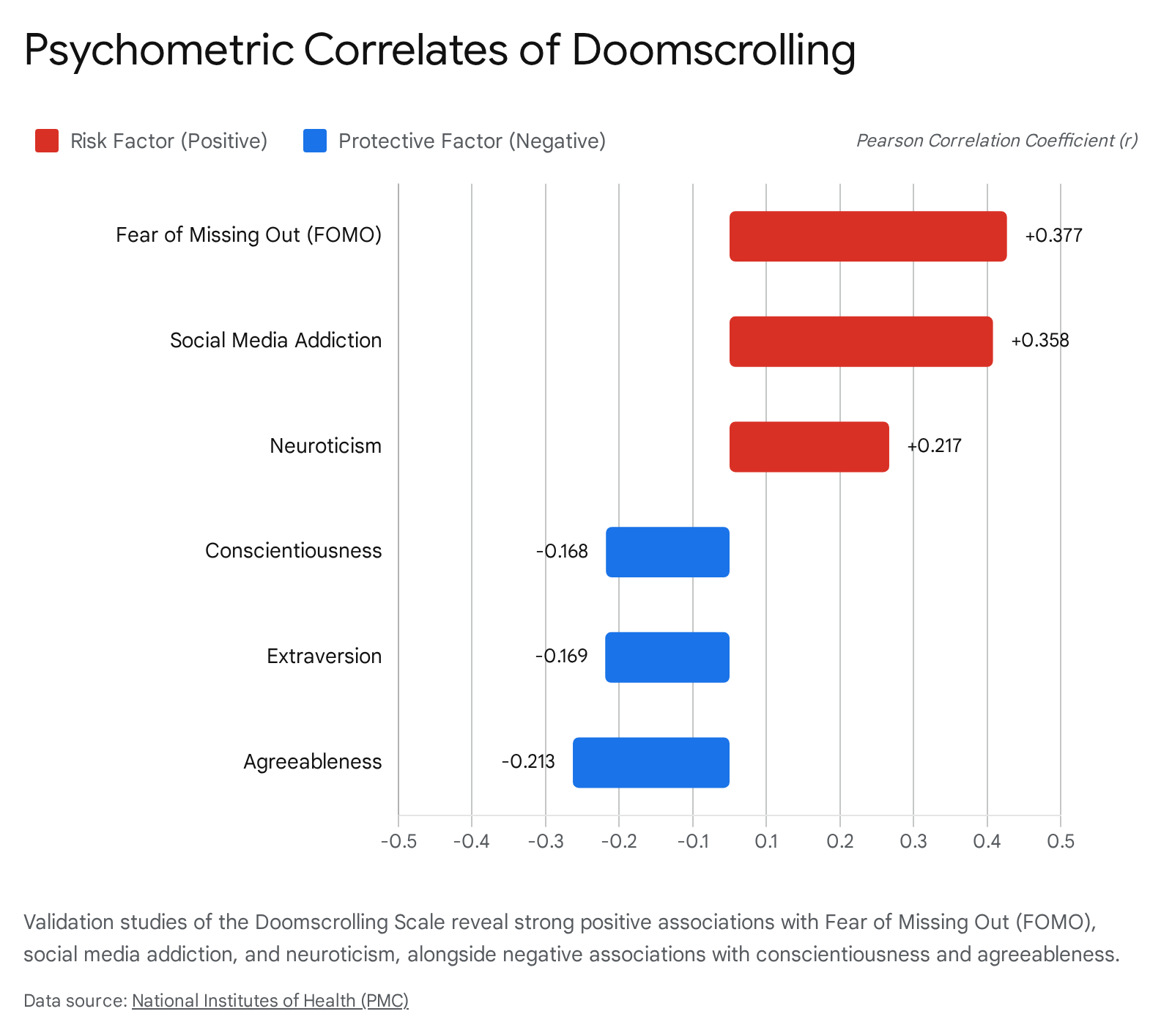
Psychometric analyses investigating the correlation between doomscrolling and the "Big Five" personality traits reveal highly consistent patterns across disparate studies. The behavior is strongly and positively correlated with trait neuroticism (the tendency to experience negative emotions and emotional instability) and sensation-seeking 115. Highly neurotic individuals are naturally prone to emotional reactivity; therefore, they are more easily drawn into downward spirals of rumination upon encountering distressing headlines 515.
Conversely, doomscrolling shows significant negative correlations with conscientiousness, extraversion, and agreeableness 1. Individuals exhibiting high conscientiousness generally possess superior impulse control and are better equipped to disengage from non-productive digital behaviors.
Demographic Susceptibility
Broad demographic surveys and global studies indicate that age is a major determining factor in doomscrolling frequency. A robust 2024 survey identified that 31% of the general American adult population engages in doomscrolling on a regular basis. However, this figure spikes significantly among younger demographics, with 46% of Millennials and a staggering 53% of Generation Z reporting regular doomscrolling 330. Younger generations - who represent the first cohorts to be raised entirely within the digital age - often view smartphones as mandatory extensions of their social and informational reality, making them uniquely vulnerable to the behavioral pull of platform algorithms 26.
Furthermore, research highlights distinct gender disparities. Multiple studies observe higher overall prevalence rates and greater emotional arousal regarding doomscrolling among males, as well as among individuals who are highly politically engaged 3102728. However, intersecting vulnerabilities complicate this general rule. Individuals possessing a history of physical, emotional, or systemic trauma - regardless of gender - are highly prone to doomscrolling out of an exaggerated psychological need to monitor their environment for safety, frequently turning the act into a potent trigger for traumatic relapses 29.
Psychological and Somatic Consequences
The sustained consumption of negative news yields profound, objectively measurable consequences on both mental and physical health. Rather than alleviating anxiety by providing actionable answers, doomscrolling perpetuates a state of generalized psychological distress.
Anxiety, Depression, and Vicarious Trauma
Extensive empirical literature confirms a robust positive correlation between doomscrolling and the incidence of anxiety and depressive disorders. A multi-wave longitudinal study assessing adolescents demonstrated that heightened social media addiction predicted future doomscrolling behavior, forming a cyclical trap that exacerbates depressive symptoms 1230. Individuals trapped in this digital loop reliably report feelings of helplessness, powerlessness, and emotional flooding 16.
Crucially, heavy media consumption of traumatic events can induce symptoms traditionally associated with direct, physical trauma exposure. The phenomenon of "vicarious trauma," occasionally referred to as the "Media-induced PTSD Hypothesis," occurs when an individual exhibits post-traumatic stress symptoms - such as intrusive nightmares, hypervigilance, and emotional numbing - solely from observing distressing events through digital screens 21313233. For example, seminal research conducted in the aftermath of the 2013 Boston Marathon bombing revealed that individuals who consumed six or more hours of related media per day exhibited higher acute stress symptoms than individuals who were actually physically present at the site of the bombing 221. Similarly, experimental studies examining COVID-19 news demonstrated that exposure to as little as two to four minutes of negative pandemic news significantly reduced immediate positive affect and baseline optimism 1534.
Existential Anxiety and Misanthropy
Beyond immediate mood dysregulation, prolonged doomscrolling fundamentally alters an individual's macroscopic worldview. The behavior acts as a modern digital conduit for "Mean World Syndrome" - a concept pioneered by George Gerbner in the 1970s through Cultivation Theory regarding heavy television viewership. Gerbner posited that long-term exposure to violence-related content causes individuals to perceive the real world as vastly more dangerous than it objectively is 31419. The algorithms driving doomscrolling supercharge this cultivation effect.
Recent cross-cultural research explicitly links doomscrolling to the Shattered Assumption Theory and existential dread. A pivotal 2024 study surveying 800 university students from the United States and Iran demonstrated that doomscrolling evoked high levels of existential anxiety across both distinct cultural demographics 18313235. Participants subjected to continuous negative news reported intense concerns regarding human mortality, the fundamental emptiness of reality, and the overall meaninglessness of life 283235. In the Iranian cohort specifically, doomscrolling additionally served as a highly significant predictor of misanthropy - a profound hatred, distrust, and systemic suspicion of humankind 313235. By constantly viewing curated digital evidence of human cruelty, corruption, or disaster, the fundamental psychological assumption of a "just and fair world" is eroded, leading to deep societal pessimism 3335.
Cognitive Overload and Psychological Fatigue
The mental toll of doomscrolling extends deeply into the brain's cognitive processing architecture. The brain's working memory is strictly finite; constant exposure to distressing, complex stimuli heavily taxes cognitive load, leaving minimal bandwidth for productive problem-solving, deep academic or professional work, or empathetic interpersonal connection 718. This fragmentation of attention has been colloquially termed "popcorn brain" - a biological state of continuous overstimulation that makes the slower pace of physical reality feel painfully under-stimulating and dull 29.
Studies analyzing contemporary workplace behavior, such as a 2024 study by Hughes et al. examining full-time employees in the UK and US, have found that doomscrolling during working hours significantly reduces professional engagement and heightens rumination, particularly among employees with high trait neuroticism 5152936.
Physical and Somatic Manifestations
Physiologically, the sustained activation of the sympathetic nervous system presents a myriad of somatic symptoms. Doomscrolling is causally linked to increased chronic muscle tension, cervicogenic neck and shoulder pain, gastrointestinal issues, and significant changes in baseline appetite 2929.
However, the most pervasive and destructive physical consequence is sleep disruption. A high proportion of digital users engage in doomscrolling late at night, often while in bed. The combination of intense psychological arousal and sustained ocular exposure to blue light - which directly suppresses the pineal gland's production of melatonin - severely impairs circadian rhythms 46101729. This results in delayed sleep onset, drastically reduced sleep duration, and diminished sleep quality, fostering chronic daytime fatigue, cognitive impairment, and heightened irritability the following day 4617.
The Permacrisis Environment and Threat Typologies
The sustained prevalence of doomscrolling well beyond the acute phase of the COVID-19 pandemic is largely attributed to the modern societal perception of a "permacrisis" - an extended, perhaps indefinite, period of instability and insecurity characterized by overlapping catastrophic events 3. Users transition seamlessly from pandemic-related doomscrolling to tracking geopolitical armed conflicts, domestic political instability, economic downturns, and environmental disasters.
Climate Change versus Acute Conflict
Climate change represents a uniquely potent vector for modern doomscrolling. Unlike acute disasters (such as a mass shooting or a localized hurricane), which have a distinct chronological beginning and end, climate change represents a chronic, existential, and constantly unfolding threat with no immediate resolution 373839. A comprehensive 2025 study by Dominguez-Rodriguez and colleagues investigating climate change-specific doomscrolling among 365 participants found a strong positive correlation with generalized doomscrolling behaviors.
The study noted critical demographic variations in how this specific threat is processed: depression correlated positively with climate doomscrolling for females, but displayed a negative correlation for males, while anxiety consistently demonstrated a positive association across all genders 3738. Importantly, the sheer, planetary scale of the climate threat frequently overwhelms individual coping mechanisms, rendering standard localized social support networks largely ineffective as protective psychological buffers 3738. Conversely, in contexts of active warfare and immediate geopolitical collapse, research indicates that direct, physical exposure to existential threats alters risk perception, occasionally causing vulnerable populations to compulsively consume media as a futile attempt to regain situational awareness in a chaotic, unpredictable environment 40.
Cross-Cultural Research and Global Variations
The majority of early digital behavior research was heavily confined to Western, Educated, Industrialized, Rich, and Democratic (WEIRD) societies. However, rigorous scholarship conducted between 2023 and 2025 emphasizes that while doomscrolling is a globalized phenomenon, its triggers and impacts are culturally nuanced.
Hofstede's Cultural Dimensions and Media Trust
Cultural psychology, particularly Geert Hofstede's dimension of Individualism versus Collectivism, provides a crucial theoretical lens for these geographical variations. In highly individualistic societies (such as the United States, the United Kingdom, and Australia), citizens are enculturated to seek out information independently and bear extreme personal responsibility for staying informed 25. This cultural expectation, coupled with highly polarized, market-driven media environments, fosters acute conditions for severe doomscrolling 25.
In contrast, in societies characterized by high institutional trust and robust, less sensationalized public broadcasting (such as Denmark or Finland), news consumption is less frenetic, and the population reports significantly lower levels of information-induced cognitive overwhelm 25.
Evidence from the Global South and Eastern Contexts
Research spanning the Global South and Eastern digital ecosystems confirms the ubiquitous danger of the behavior while highlighting localized mechanisms of psychological distress:
- China: The adaptation and validation of the Doomscrolling Scale for Chinese university students (N = 2,885) established exceptionally high internal consistency for the behavior across major regional platforms like WeChat and Weibo. The study utilized sophisticated structural equation modeling (SEM) to prove that doomscrolling acts as a critical mediator in the bidirectional relationship between clinical depression and insomnia disorders 111213.
- India: Research among 150 Indian college students demonstrated a severe, statistically significant correlation between doomscrolling frequency and "psychological fatigue" - a specific state of deep cognitive weariness and emotional depletion. The studies noted strong correlations with emotional fatigue (r = 0.672) and anxiety (r = 0.614), observing that nighttime scrolling was the primary vector for exacerbating academic burnout and feelings of inadequacy 94142.
- Middle East / North Africa: An Egyptian study (N = 399) utilizing the Generalized Anxiety Disorder Scale (GAD-7) established that doomscrolling has a strong direct effect on anxiety (β = 0.47) and a significant indirect effect by eroding the user's psychological resilience over time. The study proved that robust psychological resilience acts as a vital buffer against the anxiety-provoking effects of the digital feed 4344. Similarly, longitudinal data evaluating Turkish adolescents proved that social media addiction at Time 1 reliably predicts increased doomscrolling behavior at Time 2, establishing a dangerous developmental trajectory 30.
Clinical Interventions and Digital Hygiene
Because doomscrolling resides at the exact nexus of biological instinct and highly optimized, addictive platform design, mitigating its effects requires a sophisticated, multi-pronged approach. Willpower alone is generally insufficient against algorithmic optimization and the brain's dopamine reward system. Effective, evidence-based interventions are broadly categorized into technological modifications and cognitive-behavioral strategies 1718.
Technological and Environmental Modifications
The most immediate, actionable strategy for curbing doomscrolling involves introducing deliberate "friction" into the digital environment, directly countering the seamless, frictionless design of modern social media interfaces. * App Blockers and Time Limits: Utilizing external applications (e.g., ScreenZen, Freedom, AppDetox, or native OS limiters) to enforce hard time limits or entirely block access to specific news aggregators and social platforms after a predetermined duration 4171929. * Analog Boundaries and Sleep Hygiene: Removing the primary vector of consumption from vulnerable physical environments. Mental health experts heavily recommend keeping smartphones completely out of the bedroom, utilizing traditional analog alarm clocks to prevent early-morning and late-night scrolling cycles. This simple physical boundary directly preserves the circadian rhythm and prevents blue light exposure 29. * Low-Dopamine Mornings: Abstaining from screens for the first 30 to 60 minutes after waking. This practice prevents the brain's dopamine baseline from spiking unnaturally early in the day, setting a calmer neurochemical tone and reducing the compulsion to seek variable digital rewards as the day progresses 19.
Cognitive and Behavioral Interventions
Therapeutic approaches emphasize rebuilding the individual's executive control and emotional regulation capacity, moving from passive consumption to intentional engagement. * Mindful Mood Check-Ins: Instead of pursuing total digital abstinence - which is often impractical or professionally impossible in a highly connected world - psychologists recommend active mood monitoring. Users are advised to pause every 5 to 10 minutes during a scrolling session to consciously assess their somatic and emotional states. If feelings of tension, anger, or hopelessness are rising, the individual must train themselves to use this internal physiological cue to physically disengage from the device 445. * Cognitive Behavioral Therapy (CBT): For individuals whose doomscrolling has reached clinical levels of behavioral addiction, CBT techniques such as "thought stopping" and "attention regulation" are utilized. These therapies address the underlying intolerance of uncertainty, teaching patients to accept ambiguity regarding global events without resorting to compulsive, anxiety-driven information gathering 1718. * Building Psychological Resilience: Studies emphasize that robust psychological resilience acts as a critical buffer, significantly weakening the link between doomscrolling and clinical anxiety 4344. Cultivating this resilience involves engaging in analog, offline, restorative activities - such as physical exercise, community volunteering, and sustained face-to-face social interaction. These activities provide healthy, non-variable dopamine and re-establish a sense of physical agency, reminding the brain that the immediate physical environment is safe, even when the digital environment projects continuous global catastrophe 4729.