
Proton charge radius discrepancy and resolution
The proton charge radius, typically denoted as $r_p$ or $r_E$, constitutes a fundamental physical parameter that defines the root-mean-square (rms) spatial extent of the proton's electric charge distribution. Precise quantification of this parameter is essential for testing the non-perturbative regime of quantum chromodynamics (QCD), constraining nuclear physics models, and enabling high-precision tests of bound-state quantum electrodynamics (QED) 123. For decades, the global scientific consensus maintained that the proton radius was approximately 0.877 femtometers (fm), a value derived from a combination of elastic electron-proton scattering and the spectroscopy of ordinary atomic hydrogen 45.
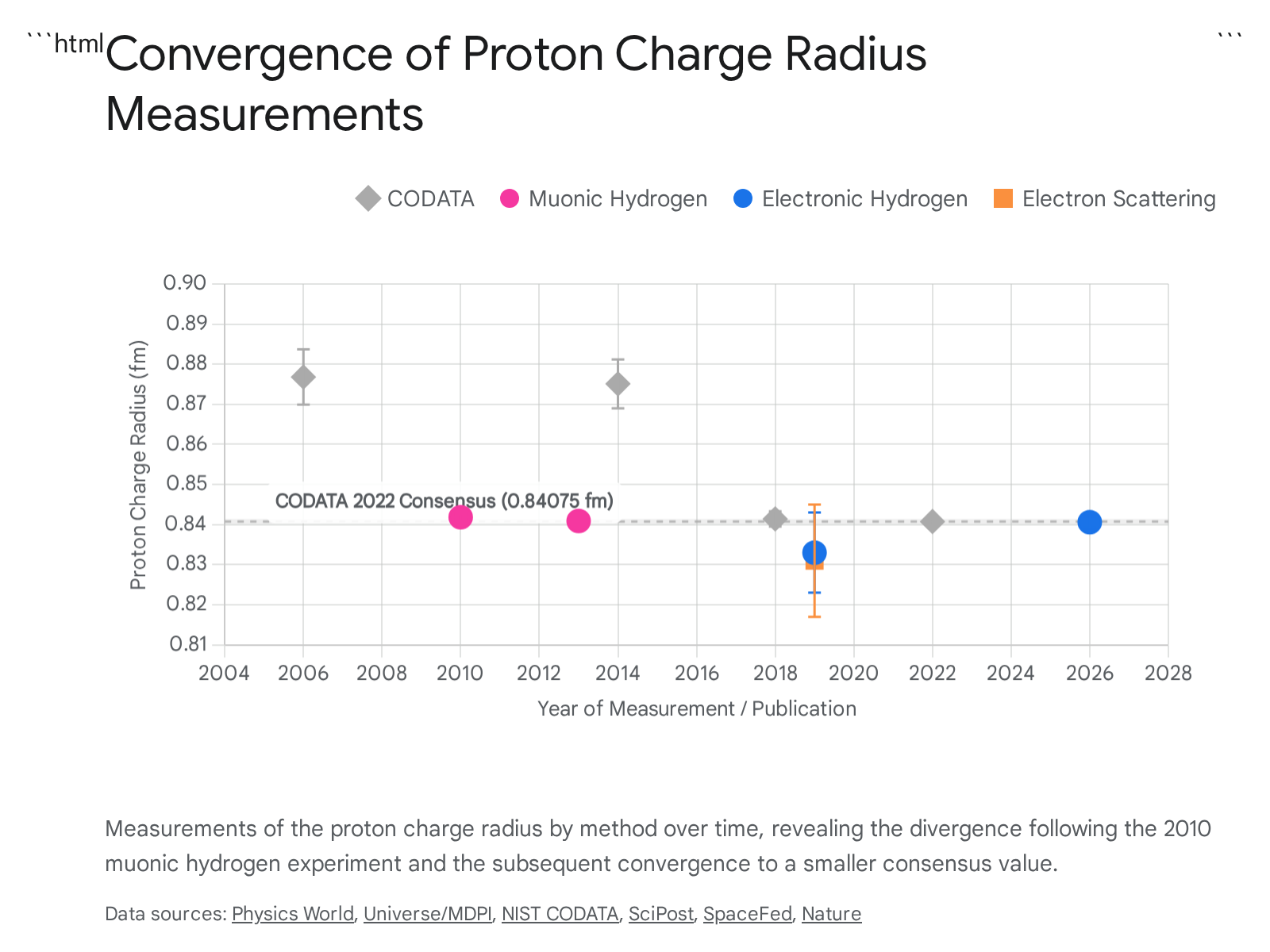
This consensus was disrupted in 2010 by a measurement utilizing muonic hydrogen, which produced a radius of approximately 0.842 fm. Because the experimental uncertainties involved were extremely small, this 4% difference equated to a 5 to 7 standard deviation discrepancy 467. This anomaly, termed the "proton radius puzzle," raised fundamental questions regarding the completeness of the Standard Model, specifically whether lepton universality was violated. Over the subsequent 16 years, the physics community mobilized an exhaustive theoretical and experimental effort. Through the development of magnet-free scattering calorimetry, sub-part-per-trillion optical metrology, and sophisticated analytical methodologies, the puzzle was ultimately resolved. The convergence of new data has validated the smaller muonic radius, attributing the historical discrepancy to unrecognized systematic uncertainties in data extrapolation and atomic spectroscopy rather than a breakdown of fundamental physical laws 8910.
Fundamental Definitions of the Proton Charge Radius
The proton is not a point particle nor a solid sphere; it is a composite object governed by the strong interaction dynamics of quarks and gluons. Its "radius" is a statistical measure of how its electric charge is distributed in space. The physical extraction of this value relies on two distinct and highly complementary theoretical frameworks: nuclear scattering kinematics and atomic spectroscopy.
Nuclear Form Factors and Scattering Kinematics
In electron-proton elastic scattering, the interaction is mediated primarily by the exchange of a single virtual photon. The scattering cross-section is described by the Rosenbluth formula, which modifies the theoretical cross-section of a point-like particle (the Mott cross-section) to account for the proton's internal structure 611. This structural modification is parameterized by the electric ($G_E$) and magnetic ($G_M$) Sachs form factors, which are functions of the squared four-momentum transfer, $Q^2$ 612.
The proton root-mean-square charge radius is strictly defined in a covariant manner as the derivative of the electric form factor evaluated at the limit of zero momentum transfer:
$\langle r_E^2 \rangle = -6 \frac{dG_E(Q^2)}{dQ^2}\Big|_{Q^2=0}$
Because a physical scattering experiment cannot measure $Q^2 = 0$ (which corresponds to no interaction), researchers measure the differential cross-section across a range of finite $Q^2$ values and extrapolate the slope to zero 13. In the non-relativistic limit, this momentum-space derivative corresponds to the second moment of the spatial electric charge distribution, $\langle r^2 \rangle = \int d^3r \rho_E(r) r^2$, providing a direct geometric interpretation of the radius 1114.
Atomic Spectroscopy and the Overlap Integral
The alternative method to determine the proton charge radius relies on the high-precision spectroscopy of hydrogenic atoms. Bound-state QED predicts the energy levels of simple atoms with extraordinary precision, accounting for the Dirac equation, relativistic recoil, and vacuum polarization. However, these calculations assume a point-like nucleus. The physical extension of the proton perturbs the electric potential near the origin, leading to a finite-size energy shift 1516.
This shift affects $S$-state orbitals, which are spherically symmetric and exhibit a non-zero probability density at the nucleus, significantly more than $P$-state orbitals, which contain a node at the origin. The leading-order energy shift $\Delta E$ caused by the nuclear finite size is proportional to the square of the wavefunction at the origin $|\psi(0)|^2$ and the mean-square charge radius of the nucleus 11:
$\Delta E = \frac{2 m_r^3 \alpha^4}{3 n^3} r_E^2$
where $m_r$ is the reduced mass of the orbiting lepton, $\alpha$ is the fine-structure constant, and $n$ is the principal quantum number. By measuring the energy difference between $S$ and $P$ states (the Lamb shift) or specific two-photon optical transitions (such as $1S-2S$), physicists can isolate the finite-size effect and extract $r_p$ 41517. For ordinary electronic hydrogen, this extraction requires separating the proton radius from the Rydberg constant ($R_\infty$), necessitating the combination of multiple distinct transition measurements to solve the coupled equations 1819.
Emergence of the Measurement Discrepancy
The proton radius puzzle originated from a direct confrontation between the two standard methodologies detailed above when a novel particle substitute - the muon - was introduced to the spectroscopic framework.
Historical Consensus Prior to 2010
From the 1960s to the early 2000s, dozens of scattering experiments at facilities such as Stanford, Orsay, and Mainz steadily improved the empirical constraints on $G_E(Q^2)$ 10. Concurrently, precision laser spectroscopy in Paris, Garching, and elsewhere produced consistent measurements of the electronic hydrogen Lamb shift. The Committee on Data for Science and Technology (CODATA) aggregated these independent global measurements. By 2006, the CODATA recommended value for the proton charge radius stood at 0.8768(69) fm, with an uncertainty of approximately 1% 520. A 2010 electron scattering study by the A1 collaboration at Mainz (MAMI) corroborated this, analyzing massive datasets to yield $r_p = 0.879(8)$ fm 61021.
The 2010 Muonic Hydrogen Paradigm Shift
In 2010, the CREMA (Charge Radius Experiment with Muonic Atoms) collaboration at the Paul Scherrer Institute (PSI) published a measurement that fundamentally disrupted the consensus. The CREMA team utilized muonic hydrogen ($\mu H$), an exotic atom in which the electron is replaced by a negative muon 220.
Because the muon is approximately 207 times more massive than the electron, its Bohr radius is proportionally smaller, causing it to orbit much closer to the proton. This proximity increases the overlap of the muon's wavefunction with the nuclear charge distribution. According to the mass-cubed scaling in the finite-size energy shift equation ($m_r^3$), the finite-size effect in muonic hydrogen is amplified by a factor of roughly $8 \times 10^6$ compared to ordinary electronic hydrogen 27. Consequently, the muonic hydrogen Lamb shift becomes highly sensitive to the proton radius, allowing for an extraction of $r_p$ that is largely insensitive to uncertainties in the Rydberg constant 22.
By performing laser spectroscopy on the $2S_{1/2}^{F=1} - 2P_{3/2}^{F=2}$ transition in muonic hydrogen, the CREMA collaboration determined a proton charge radius of 0.84184(67) fm. In 2013, they confirmed and refined this finding via multiple transitions, resulting in an even more precise value of 0.84087(39) fm 22023. While the absolute difference between 0.877 fm and 0.841 fm is only 0.036 fm, the unprecedented precision of the muonic measurement created a 5 to 7 standard deviation discrepancy with the CODATA world average 467.
Initial Theoretical Implications and New Physics Hypotheses
The profound statistical significance of the discrepancy triggered immediate theoretical investigation. If both the electronic and muonic experimental datasets were completely free of systematic errors, the divergence implied a violation of lepton universality. Under the Standard Model, electrons and muons possess identical electroweak interaction properties, differing strictly in mass. A radius discrepancy suggested the existence of undiscovered phenomena coupling preferentially to muons over electrons 710.
Theorists proposed several extensions to the Standard Model, including dark sector forces mediated by new particles. Notable among these were protophobic vector bosons (such as the hypothesized X17 particle) or massive scalar bosons that could selectively modify the muonic Lamb shift 2425. Concurrently, other physicists suspected that the missing factors resided in higher-order corrections of bound-state QED. Specifically, the two-photon exchange (TPE) mechanism - where the lepton interacts with the proton's internal structure and induces hadronic polarizability - was scrutinized. Theoretical models estimating nuclear structure corrections (such as the Friar radius or Zemach moments) were heavily audited, though calculations indicated these effects were too small to account for a 4% difference 61525.
Re-evaluation of Electron-Proton Scattering Data
With new physics serving as an extraordinary claim, the physics community systematically reviewed the conventional measurements. The electron scattering domain faced significant scrutiny regarding how form factor data was extrapolated to the zero-momentum limit.
Mathematical Challenges in Momentum Extrapolation
Traditional magnetic spectrometers used in elastic electron-proton scattering (such as those at MAMI and JLab) faced mechanical constraints preventing the detection of electrons scattered at extremely small forward angles. Consequently, experimental data often truncated around $Q^2 \approx 0.004$ GeV$^2$. Extrapolating the slope of $G_E(Q^2)$ down to $Q^2=0$ required fitting functions (such as polynomials or rational approximations) 613.
Retrospective analyses conducted between 2015 and 2020 demonstrated that the specific choice of analytic continuation functions could systematically bias the resulting radius. When groups re-analyzed historical datasets using dispersively improved chiral effective field theory (ChEFT), bounded polynomial z-expansions via conformal mapping, or constrained Gaussian processes, they consistently extracted smaller radii in the range of $\sim$0.84 fm, aligning closely with the muonic data 11121327. These studies revealed that earlier "high-radius" extrapolations suffered from over-fitting or inappropriate high-order polynomial choices that distorted the lowest-$Q^2$ slope.
The PRad Experiment
To provide definitive new data devoid of these extrapolation biases, the Proton Radius (PRad) experiment was designed at the Thomas Jefferson National Accelerator Facility (JLab). Bypassing traditional magnetic spectrometers, PRad deployed a novel magnet-free configuration. An electron beam was directed into a windowless, continuous-flow cryogenic hydrogen gas target, heavily reducing background scattering from containment materials 126.
The scattered electrons were detected by a high-resolution, large-acceptance hybrid electromagnetic calorimeter (HyCal) composed of lead tungstate (PbWO4) and lead-glass blocks, paired with Gas Electron Multiplier (GEM) tracking planes 1. This configuration allowed the detection of ultra-forward scattering angles, reaching an unprecedented minimum $Q^2$ of $2.1 \times 10^{-4}$ GeV$^2$, vastly reducing the distance the data needed to be extrapolated to zero 12.
Critically, PRad simultaneously detected elastic electron-proton scattering and elastic Møller scattering (electron-electron scattering) within the same geometrical acceptance. The well-understood QED Møller cross-section provided a continuous, high-precision normalization for beam flux and target density, eliminating major sources of systematic uncertainty 127. Published in 2019, the PRad result yielded a proton charge radius of 0.831 $\pm$ 0.007 (stat.) $\pm$ 0.012 (syst.) fm 2327. This landmark measurement represented the first modern electron scattering result to validate the muonic hydrogen radius, confirming that the discrepancy was rooted in historical measurement limitations rather than a true physical disparity 520.
| Experiment / Group | Methodology / Target | Extracted Radius $r_p$ (fm) | Relative Uncertainty | Source |
|---|---|---|---|---|
| CODATA 2006 | Global Adjustment | 0.8768(69) | 0.78% | 520 |
| MAMI A1 (2010) | $e$-$p$ Scattering | 0.879(8) | 0.91% | 61021 |
| CREMA (2013) | $\mu H$ Lamb Shift | 0.84087(39) | 0.046% | 223 |
| PRad (2019) | $e$-$p$ Scattering (Low $Q^2$) | 0.831(14) | 1.68% | 52027 |
| Reanalysis (2022) | Modified Dispersion Fits | $\sim$0.84 | Varies | 427 |
Advancements in Atomic Hydrogen Spectroscopy
While the scattering data was being corrected, the atomic spectroscopy community undertook rigorous independent efforts to remeasure electronic hydrogen with minimized systematic effects. If lepton universality held true, modern $eH$ spectroscopy should theoretically match the $\mu H$ results.
Quantum Interference and Historical Systematic Errors
Metrology of the hydrogen atom requires exceptional environmental control. Retrospective analyses of classical $1S-2S$ and $2S-2P$ hydrogen experiments identified unrecognized systematic shifts. One significant factor was line distortion arising from quantum interference between neighboring atomic resonances. Furthermore, uncompensated residual first- and second-order Doppler shifts systematically skewed spectral line centers in older, broader measurements 2829. The high correlation of historical measurements - where successive experiments often calibrated against or adopted assumptions from preceding ones - had inadvertently hardened an inaccurate radius value into the CODATA consensus.
Precision Metrology of High-n Transitions
In 2017, a team at the Max Planck Institute of Quantum Optics (MPQ) in Garching reported a breakthrough measurement of the $2S - 4P$ transition. Utilizing a cryogenic beam of atomic hydrogen prepared in a metastable state via state-selective optical excitation, the team heavily suppressed Doppler broadening and interference effects. They extracted a radius of 0.8335(95) fm, marking the first high-precision ordinary hydrogen result to align with the muonic hydrogen value 71328.
Subsequent experiments bolstered this paradigm shift. In 2019, a Canadian team performed a classical measurement of the $2S-2P$ Lamb shift in atomic hydrogen - a direct analog to the muonic measurement - utilizing the Frequency-Offset Separated Oscillatory Fields (FOSOF) technique. This resulted in an extracted radius of 0.833(10) fm 223.
The 2026 Sub-Part-Per-Trillion Measurement
The definitive spectroscopic resolution was achieved in early 2026 by Maisenbacher, Wirthl, et al. and published in Nature. The research team executed a sub-part-per-trillion precision measurement of the $2S - 6P$ fine-structure centroid transition in a cryogenic beam of atomic hydrogen. By alternately driving two dipole-allowed transitions ($2S-6P_{1/2}$ and $2S-6P_{3/2}$) with a linearly polarized 410-nm laser, and performing rigorous in situ velocity-resolved detection to determine Doppler slopes, they achieved an absolute transition frequency of $\nu_{2S-6P} = 730,690,248,610.79 \pm 0.48$ kHz 81929.
Because the theoretical QED uncertainty of the $2S$ level is eightfold lower than that of the $1S$ level, combining the newly measured $2S-6P$ transition with the precisely known $1S-2S$ transition effectively decoupled the proton radius from other dominant theoretical uncertainties. This synthesis yielded a proton charge radius of 0.8406(15) fm 822. This 2026 result was at least 2.5 times more precise than any prior atomic hydrogen determination. The measurement demonstrated a 5.5-sigma disagreement with the older CODATA 2014 consensus but proved to be in excellent, unassailable agreement with the 2010/2013 muonic values 81929.
Implications for Quantum Electrodynamics and Nuclear Structure
The resolution of the proton radius puzzle confirmed that lepton universality remains intact. Rather than breaking the Standard Model, the decade-long investigation significantly refined the global understanding of fundamental physical constants and hadronic structure 89.
Revisions to the Rydberg Constant and Fundamental Parameters
The Rydberg constant ($R_\infty$) is arguably the most accurately measured fundamental physical constant, serving as the scaling factor for all atomic energy levels. In QED theory, the extraction of $R_\infty$ from hydrogen spectroscopy is strongly coupled to the value of the proton charge radius 18. The historical overestimation of the proton radius had subsequently induced a systematic bias in the accepted value of the Rydberg constant.
Following the corroboration of the smaller muonic radius by electronic spectroscopy and PRad, CODATA executed a major adjustment. In 2018, the recommended proton radius was shifted to 0.8414(19) fm, accompanied by a corresponding recalibration of the Rydberg constant 524. The 2022 CODATA adjustment integrated newer data to refine the radius further to 0.84075(64) fm 3031. By 2026, combining the high-precision $2S-6P$ measurement with the $1S-2S$ transition yielded a derived Rydberg constant of $R_\infty = 10,973,731.568152(14)$ m$^{-1}$, possessing an uncertainty of merely 1.3 parts per trillion 19.
Furthermore, the 2026 measurements represented an extraordinary stress-test of the Standard Model. The theoretical prediction of the $2S-6P$ transition frequency matched the experimental observation to within 0.7 parts per trillion. Specifically, the higher-order bound-state QED corrections were validated to a precision of 0.5 parts per million - the most precise experimental verification of these complex field-theoretic corrections achieved to date 82932.
Two-Photon Exchange and Hadronic Polarization
While the muonic measurements delivered sub-0.1% precision, their accuracy is fundamentally bounded by theoretical models of the proton's internal structure. In muonic bound states, the muon orbits close enough to polarize the proton. The Two-Photon Exchange (TPE) contribution - where the lepton exchanges two virtual photons with the quarks in the nucleus - induces energy shifts dependent on the nuclear polarizability and the third Zemach moment 61023.
The effort to resolve the puzzle spurred massive advancements in non-perturbative QCD, dispersive methods, and lattice QCD frameworks intended to calculate these hadronic effects from first principles 101433. Studies quantifying the magnetic radii and axial charges of nucleons through generalized parton distributions (GPDs) have provided tighter constraints on the theoretical boundaries of these polarizability corrections, elevating the study of nuclear structure 1233. These refined models are currently being applied to calculate the charge radii of other light nuclei, such as the deuteron, helion ($^3$He), and alpha particle ($^4$He), utilizing parallel spectroscopic methods 233234.
| Nucleus / Parameter | Measurement Method | Extracted Value | Uncertainty Level | Implications / Source |
|---|---|---|---|---|
| Proton Radius ($r_p$) | Atomic H ($2S-6P$) | 0.8406(15) fm | 1.5 $\times 10^{-3}$ fm | Standard Model validated to 0.7 ppt 819 |
| Rydberg Constant ($R_\infty$) | Atomic H Combinations | 10,973,731.568152(14) m$^{-1}$ | 1.3 parts per trillion | Resolves internal CODATA tensions 1931 |
| Alpha Particle ($^4$He) | Muonic He-4 Ions | 1.67824(83) fm | 8.3 $\times 10^{-4}$ fm | Benchmark for few-nucleon theories 10 |
| Helion ($^3$He) | Muonic He-3 Ions | 1.97007(94) fm | 9.4 $\times 10^{-4}$ fm | Opens QED tests in He atoms 32 |
Ongoing and Next-Generation Experimental Initiatives
Although the anomaly characterizing the proton radius puzzle is resolved, the pursuit of extreme precision continues. The methodologies developed during the crisis have catalyzed a new generation of experiments aimed at driving the uncertainties of nucleon structure parameters down to unprecedented limits 9.
The MUon Proton Scattering Experiment (MUSE)
At the Paul Scherrer Institute (PSI), the MUon proton Scattering Experiment (MUSE) is poised to perform the definitive test of lepton universality in the scattering regime. Operating in the $\pi$M1 channel of the PSI High Intensity Proton Accelerator, MUSE is the first experiment designed to simultaneously scatter both electrons and muons - using both positive and negative polarities ($e^\pm, \mu^\pm$) - off a liquid hydrogen target 353836.
By comparing the scattering cross-sections of positive versus negative leptons, the collaboration can directly measure and cancel out Two-Photon Exchange (TPE) effects, which historically required complex theoretical modeling. Furthermore, by evaluating electron and muon scattering within the exact same geometric acceptance and momentum transfer range ($Q^2 = 0.002$ to $0.082$ GeV$^2$), MUSE eliminates relative systemic uncertainties between the lepton species 3837. As of mid-2025, MUSE had successfully acquired nearly 80% of its target statistics, with final data collection scheduled through 2026 3637.
PRad-II Upgrades
Following the success of the initial PRad experiment, the Thomas Jefferson National Accelerator Facility is upgrading the apparatus for the PRad-II initiative. Scheduled for operation in Hall B during the summer of 2026, PRad-II incorporates substantial hardware advancements 2638. The upgrade includes an additional Gas Electron Multiplier (GEM) plane to improve track resolution, a completely overhauled DAQ and readout system capable of higher event rates without sparsification, new scintillating detectors, and an optimized windowless gas flow target 3839.
Alongside modernized calculations for radiative corrections, these enhancements are projected to reduce the uncertainty on the extracted radius by a factor of 3.8, pushing the systematic precision frontier below a 0.43% margin of error 1038. PRad-II will also run concurrently with the X17 fixed-target search, allowing simultaneous cross-validation of dark sector models 2526.
High-Energy Muon Scattering at AMBER
At CERN, the Apparatus for Meson and Baryon Experimental Research (AMBER) applies a highly distinct kinematic approach. AMBER utilizes a 100 GeV muon beam to scatter off a high-pressure, hydrogen-filled Time Projection Chamber (TPC) active target 4041.
This extremely high beam energy - compared to the 0.1 - 0.2 GeV/c momentum utilized by MUSE - drastically suppresses the influence of the magnetic form factor ($G_M$), isolating the electric form factor for cleaner extraction. Furthermore, QED radiative corrections for high-energy muons are roughly an order of magnitude smaller than those for comparable electron beams (approximately 1.5% compared to 15-20% for electrons), eliminating another major source of theoretical uncertainty in the cross-section analysis 41. Operating through 2026, AMBER intends to provide an ultra-high precision, completely independent scattering verification of the $\sim$0.84 fm radius 41.
Through the synthesis of atomic physics, high-energy particle accelerators, and non-perturbative quantum field theory, the resolution of the proton radius puzzle has profoundly enhanced the analytical rigor of modern physics, affirming the Standard Model while equipping researchers with the tools to probe the microscopic universe with unprecedented clarity.