
Pinterest Algorithm and Brand Investment in 2026
Introduction
As the global digital ecosystem advances through the latter half of the 2020s, the paradigm of social media has fundamentally fractured. The broad categorization of "social networks" is no longer a viable heuristic for enterprise brands or performance marketers seeking to allocate capital efficiently. While platforms such as Meta, X, and TikTok continue to battle for passive entertainment retention and highly ephemeral engagement, Pinterest has successfully and deliberately decoupled itself from the traditional social media framework. By 2026, Pinterest operates explicitly as a high-intent, AI-powered visual discovery engine 112. Anchored by a massive user base of 631 million monthly active users globally, the platform processes over 80 billion visual and text-based searches every single month 34.
This unprecedented scale of active planning behavior translates directly into commercial vitality. In the first quarter of 2026, Pinterest reported revenues exceeding $1.008 billion, representing an 18% year-over-year growth trajectory, alongside an adjusted EBITDA of $207 million 45. This exhaustive analysis deconstructs the proprietary mechanics driving this growth. By examining the platform's machine learning stack - including the groundbreaking PinRec generative retrieval model, the model-agnostic integration of generative AI, and the highly specialized computer vision lifecycle - this analysis provides a comprehensive blueprint for how technical architecture dictates user intent. Furthermore, the evaluation explores geographic expansion dynamics, the extreme longitudinal value of a Pinterest asset compared to other digital platforms, and the strategic implications of the company's recent integration of Connected TV (CTV) via tvScientific.
The Paradigm Shift: Visual Search Engine vs. Social Network
To formulate a successful investment strategy on Pinterest, practitioners must first abandon the methodologies applied to traditional social networks. Pinterest is not engineered for chronological socializing, real-time news propagation, or passive entertainment scrolling. It functions as a visual search engine modeled entirely on user intent, future planning, and aesthetic curation 12.
The most critical behavioral metric separating Pinterest from its industry peers is the intrinsic nature of its search graph. In 2026, approximately 96% to 97% of the platform's billions of queries are entirely unbranded 67. Users do not typically search for specific corporate entities or legacy brand names; rather, they search for descriptive, intent-rich visual concepts. This dynamic creates a democratized discovery environment where algorithmic relevance outranks legacy brand equity, allowing agile advertisers to capture significant market share simply through rigorous visual search engine optimization 27.
This intent architecture is overwhelmingly commercial. Current data indicates that 90% of Pinterest users actively seek products, and 85% of weekly users report executing a purchase based on a brand Pin they discovered on the platform 36. This persistent behavior yields a purchase intent index that measures 5.6 times higher than the social platform average, with 75% of users operating in "active purchase mode," compared to just 28% on Facebook and 41% on Instagram 7. Engagement metrics further illustrate this philosophical divide. While a "like" on a short-form video platform generally signifies momentary entertainment, a "save" on Pinterest explicitly signals future purchase or project planning 9. Consequently, Pinterest maintains an average e-commerce conversion rate of 1.8%, delivering 2.3 times higher conversion value than competing social platforms when those sales land 7.
Historically perceived as a specialized utility for older demographics planning weddings or home renovations, Pinterest has undergone a radical demographic realignment. By 2026, Generation Z constitutes 42% of Pinterest's total global user base and represents the platform's fastest-growing segment 310. This cohort utilizes the platform to circumvent the algorithmic fatigue and social pressure inherent in traditional algorithmic feeds, opting instead for personalized aesthetic curation, study inspiration, and fashion discovery 8. Notably, 72% of all collage Pin creators are Generation Z, driving a new era of highly personalized, interactive content remixing 3.
| Metric | Pinterest Benchmark (2026) | Strategic Implication |
|---|---|---|
| Global Monthly Active Users (MAUs) | 631 Million | Demonstrates massive, sustained scale following Q1 2026 earnings reports. |
| Unbranded Search Volume | 96% - 97% | Levels the playing field, allowing highly optimized content to outrank legacy brands. |
| Users in Active Purchase Mode | 75% | Drastically outperforms the 28% benchmark seen on traditional social networks. |
| Generation Z User Share | 42% of total base | Secures the platform's cultural relevance and long-term viability among younger shoppers. |
| High-Income Penetration | 40% of U.S. households >$150K | Concentrates purchasing power, making the platform ideal for luxury and high-ticket goods. |
Despite the massive influx of younger users, the platform maintains an exceptionally lucrative older audience. Pinterest successfully reaches 40% of United States households earning over $150,000 annually, and 76% of all Pinterest users earn above the median income 68. This unique convergence of Generation Z cultural trendsetters and high-purchasing-power Millennials and Boomers establishes a powerful dual-engine for both top-of-funnel consumer discovery and lower-funnel high-ticket conversions.
Q1 2026 Financial Performance and Geographic Expansion
The commercial viability of this visual search model is validated by the company's financial disclosures. During the May 2026 earnings call, Pinterest leadership confirmed that the company entered the year focused on aggressive monetization and user growth, supported by AI-powered product enhancements and structural changes to their go-to-market organization 4. The first quarter of 2026 delivered revenues of $1.008 billion, growing 18% year-over-year 59. The company also reported an adjusted EBITDA of $207 million and executed massive capital returns by repurchasing roughly $2 billion of stock, effectively reducing outstanding shares by about 16% 45.
A significant catalyst for this financial health is the platform's successful geographic expansion. Pinterest's growth in 2026 is overwhelmingly driven by international markets, necessitating a highly complex localization strategy.
| Geographic Region | Q1 2026 MAUs | Year-Over-Year Growth | Regional Revenue Q1 2026 |
|---|---|---|---|
| United States & Canada | 106 Million | +4% | $750 Million (+13% YoY) |
| Europe | 159 Million | +7% | $186 Million (+27% YoY) |
| Rest of World (RoW) | 367 Million | +15% | $72 Million (+59% YoY) |
As evidenced by the geographic distribution, the "Rest of World" category represents the largest and fastest-growing segment of the user base. Crucial high-growth markets within this segment now include Brazil with 30 million users, Mexico with 20 million users, and a surging user base across Southeast Asia 38. Despite the massive user count internationally, the revenue disparity remains stark; the U.S. and Canada generated $750 million in revenue from 106 million users, while the Rest of World generated only $72 million from 367 million users 510. Closing this monetization gap remains a primary objective for the company's 2026 roadmap.
To manage this diverse global scale, Pinterest employs a sophisticated "best localized Pin selection algorithm." Initially deployed to tailor American-centric content for European and Latin American sensibilities, the system detects common linguistic phrases and regional aesthetic preferences to dynamically reprioritize the Homefeed 11. However, the core algorithmic architecture remains inherently globalized. Because Pinterest indexes visual taxonomy over pure text language, the algorithm attributes vast weight to topic, niche, and visual similarity rather than strict geographic boundaries 15. For example, a high-quality Pin uploaded in Thailand without VPN targeting can organically amass millions of impressions in the United States simply because the visual aesthetic aligns perfectly with American search intent 15.
For marketing and enterprise product launches, Pinterest utilizes a hybrid localization model 16. The global international operations team bridges local market insights with U.S. consumer product strategy. They execute "localization marketing" - translating universal brand messaging where appropriate, but utilizing specialized transcreators to craft hyper-local, culturally resonant content for specific tiers of the international market, ensuring that the visual search experience feels native regardless of the user's geographic location 16.
Deconstructing the 2026 Algorithmic Architecture
To achieve massive scale and hyper-personalization, the Pinterest algorithm in 2026 operates as a sophisticated fusion of heuristic ranking signals, real-time user action modeling, and advanced generative retrieval. At a macro level, the algorithm evaluates content through four core pillars. First is Pin Quality, which is determined by early engagement velocity, including saves, close-ups, and outbound clicks, alongside visual clarity and mobile optimization 11213. Second is Pinner Quality, representing the historical authority, posting consistency, and domain reputation of the creator's account 113. Third is Relevance, calculating how precisely a Pin's metadata - such as title, description, visually embedded features, and board taxonomy - aligns with an active user search or semantic interest cluster 112. Finally, Recency and Freshness play a critical role, as the platform explicitly favors net-new visual content linked to unique URLs, prioritizing early distribution for high-quality, novel images or videos rather than recycled assets 11213.
The Evolution of Pinnability and Real-Time Sequences
For years, the ranking of the Pinterest Homefeed was governed by a system known as "Pinnability," a state-of-the-art neural network that predicted the exact likelihood of a user engaging with a candidate Pin. Historically, this model relied heavily on PinnerSAGE, a static, offline-learned user representation that captured long-term interests based on deep historical interaction 1420. While highly effective at understanding broad user archetypes, it often failed to capture sudden shifts in user behavior.
By 2026, Pinterest engineering successfully integrated real-time, ultra-low-latency user action sequences to bridge the gap between historical preference and immediate, short-term intent. The modernized sequence processing module actively captures the user's past 100 engaged Pins, the specific action types taken (such as a repin, click, or hide), and the precise timestamps of those engagements 1420. These real-time signals are transformed through a multi-layer perceptron layer equipped with multiple action heads to predict the exact engagement a user will have with a newly retrieved candidate Pin 14. The practical implication is profound: if a user suddenly pivots from spending weeks searching for "minimalist office decor" to suddenly engaging with "spring garden landscaping," the Homefeed adapts instantaneously, prioritizing the immediate context over the historical baseline.
PinRec: The Revolution of Generative Retrieval
The most profound architectural upgrade to Pinterest's recommendation engine deployed across 2025 and 2026 is PinRec, an industrial-scale generative retrieval model. Traditionally, industrial recommendation systems relied heavily on two-tower models, where user embeddings and item embeddings are mapped in a shared vector space and retrieved via approximate nearest-neighbor search 1522. While highly efficient and scalable, two-tower models inherently struggle to capture the complex, evolving, sequential intent of a user's multi-step session.
PinRec completely abandons the traditional two-tower paradigm in favor of a Transformer-based, autoregressive generative architecture, specifically leveraging a GPT-2 style decoder framework 1522. Pre-trained on massive aggregates of user activity and fine-tuned for surface-specific business goals, PinRec does not simply look up existing items in a database. Instead, it mathematically generates diverse item embeddings step-by-step to proactively predict what the user wants to see next 22.
The model relies on a highly sophisticated Lambda architecture for signal processing. A daily Spark pipeline processes massive volumes of historical data for featurization, while a RocksDB key-value store provides ultra-low-latency access to real-time user engagements occurring since the last batch run 15. The model constructs its final input sequence by concatenating item embeddings, temporal offset embeddings, and surface embeddings, the latter indicating exactly where the user is interacting on the platform 22. During the transformer processing, causal attention masking is applied to ensure that the model strictly respects the chronological timeline of user actions, preventing future tokens from influencing the understanding of past behavior 22.
The true ingenuity of the PinRec system lies in its introduction of "outcome-conditioned generation." Standard next-token prediction algorithms often create a detrimental feedback loop of low-effort behaviors, inadvertently training models to serve clickbait if the user exhibits a momentary lapse in quality preference 15. PinRec solves this limitation by introducing specific, learnable embeddings for highly desired user actions, such as a repin, a grid click, or an outbound click 15. By explicitly conditioning the autoregressive generation process upon these outcome embeddings, Pinterest's machine learning engineers can literally steer the recommendation engine to generate candidate sequences optimized for deep, meaningful engagement or highly lucrative external web traffic 15. In rigorous production A/B tests, the deployment of PinRec demonstrated up to a 4.01% lift in Homefeed grid clicks and significant increases in overall time spent on the platform, establishing an entirely new industry benchmark for applied generative retrieval 15.
The Technical Lifecycle of a Pin
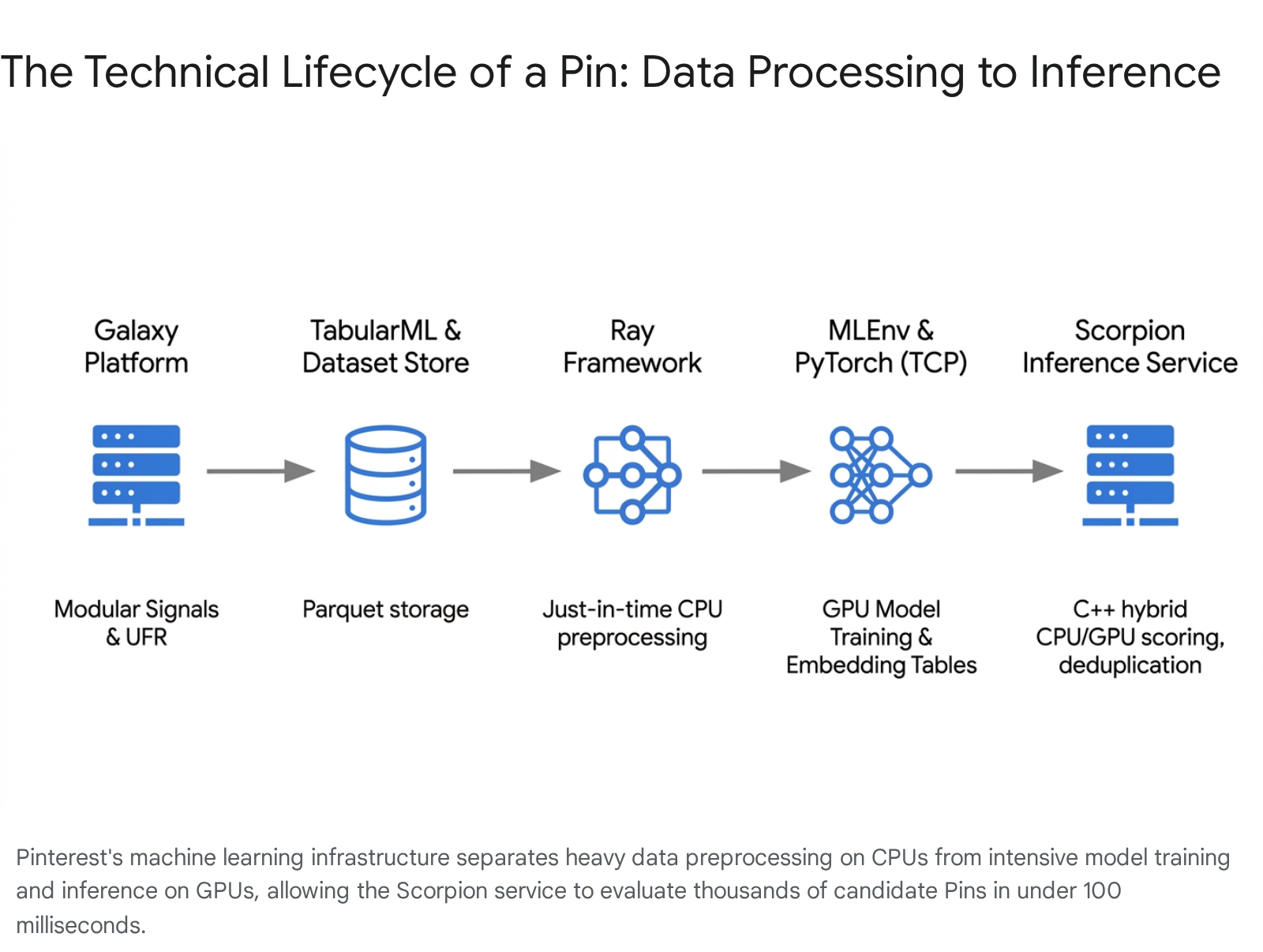
Understanding the algorithmic output requires an examination of the underlying hardware and data processing infrastructure. The technical lifecycle of a Pin from ingestion to final recommendation relies on massive-scale distributed computing and strict separation of CPU and GPU workloads to achieve ultra-low latency.
When a user interacts with or uploads a Pin, the data is first processed by Galaxy, Pinterest's unified signal platform. Galaxy converts the raw metadata, visual features, and user associations into standardized modular signals 16. These features are expressed utilizing the Unified Feature Representation, acting as a single, highly optimized container that is easily convertible into mathematical tensors required by deep learning frameworks like PyTorch and TensorFlow 16.
For comprehensive model training, this feature data is transitioned into TabularML, utilizing a columnar Parquet format that drastically reduces storage costs while significantly increasing the speed of data backfilling 16. These massive datasets are managed by the ML Dataset Store, a central repository that coordinates feature updates and label iterations 16. During the final critical mile of model training, the Ray distributed computing framework executes just-in-time data preprocessing on expansive CPU clusters before streaming the finalized data directly into high-performance GPU trainers 16. This strategic separation avoids the astronomical costs associated with fully materializing and storing every iteration of training data.
The actual model training occurs within the Training Compute Platform utilizing MLEnv, a standardized runtime stack 16. To capture extreme item-specific nuances regarding how users interact with individual pieces of content, the engineering teams rely on massive ID embedding tables containing billions of distinct parameters that update continuously as new data flows into the system 16.
Finally, the serving phase is managed by Scorpion, a C++ based inference service. Scorpion utilizes a hybrid architecture; massive embedding tables are stored on high-memory CPU hosts, while the actual neural network inference calculations are executed on GPUs 16. By decoupling the CPU-bound data fetching tasks from the GPU compute tasks, Scorpion scales independently, employing request-level deduplication to score thousands of candidate Pins for a single user in under 100 milliseconds, serving hundreds of millions of inferences per second globally 16.
Computer Vision and Multi-Modal Generative AI Integration
Pinterest's ability to function as a visual discovery engine is entirely predicated on its capacity to programmatically "see." The company's computer vision and artificial intelligence trajectory accelerated massively between 2024 and 2026, transitioning from basic object detection frameworks to highly complex semantic segmentation, multimodal understanding, and generative synthesis.
Initially popularized by features such as "Shop the Look," Pinterest's early computer vision relied heavily on bounding-box object detection algorithms, such as Faster R-CNN, to identify discrete items within a broader image 24. By 2026, the underlying technology graduated to dense semantic segmentation, wherein the AI model assigns every single pixel in an image to a specific object class 25. This permits the platform to understand profound visual nuance, differentiating the specific texture of a velvet couch from a linen throw pillow in the exact same frame without relying on rigid, overlapping bounding boxes.
This granular visual comprehension allows Pinterest to map vast amounts of unstructured visual data into its proprietary "Taste Graph." AI models predict subtle aesthetic associations based on deep neural network analysis, linking visually similar items across billions of images. Consequently, if a user uploads a photo containing a mid-century modern dining table, the computer vision pipeline extracts the precise color palette, the structural geometry, and the ambient lighting aesthetic, instantly connecting the user to shoppable products categorized under rising trends like "Eco-Industrial" or "Minimalist Home" 82426.
Because Pinterest queries are inherently multimodal, the search algorithm must process hybrid inputs combining text and imagery simultaneously. To achieve this, the platform utilizes a sophisticated retrieval pipeline featuring Multi-Fetching mechanisms that call upon three distinct Candidate Generators. The first is SearchSage, which is optimized for high text relevance and broad contextual image relevance, trained on massive troves of historic Pinterest text search engagement data 17. The second is an in-house iteration of SigLIP2, a specialized model that retrieves results highly visually analogous to a reference image while rigorously maintaining semantic alignment with any accompanying text queries 17. The third is MagicLens, an in-house model utilizing an early-fusion architecture to capture the deep, non-linear interactions between visual elements and text inputs 17. During the final ranking phase, a composite score is calculated using cosine similarities between image and text embeddings, predictive engagement scores, and attribute boosting factors, ensuring a harmonized display of results that are both visually and semantically perfect 17.
The Model-Agnostic Generative AI Strategy
Internally, Pinterest's strategic approach to Large Language Models and generative technology in 2026 is strictly "model-agnostic." Rather than expending vast resources to build a singular, monolithic foundational model from scratch, Pinterest employs a sophisticated orchestration strategy that blends multiple architectures.
Proprietary models engineered entirely in-house are maintained strictly for deep user personalization and managing the core logic of the Taste Graph 18. Conversely, Pinterest actively integrates closed-source models, such as OpenAI's offerings for specific consumer-facing product features and Anthropic's Claude for internal coding and enterprise tasks, utilizing them in scenarios where absolute performance and reasoning capabilities outweigh the financial cost 18. Simultaneously, the engineering teams have deployed open-source models, primarily Alibaba's Qwen, to handle heavy-duty visual and content understanding, large-scale data labeling, and underlying assistant tasks due to its exceptional multimodal proficiency and extreme cost-effectiveness 18.
This blended, hybrid architecture resulted in a staggering 90% reduction in artificial intelligence compute costs compared to their legacy proprietary-only approach. This immense financial efficiency freed up capital, allowing the company to invest heavily in the localized GPU infrastructure required to serve these models globally 18.
Consumer-Facing Innovations: Auto-Collages and the Pinterest Assistant
The culmination of this multimodal generative AI strategy birthed two revolutionary commercial features in 2026. The first is Auto-Collages. Fine-tuned by engineers throughout 2024 and heavily piloted in 2025 with major retailers such as Macy's, this feature utilizes a mix of LLMs to automatically ingest an advertiser's static, often sterile product catalog. The AI then dynamically generates highly aesthetic, lifestyle-oriented collages tailored for specific shopping feeds, removing the friction of manual creative production for enterprise brands 18.
The second major innovation is the Pinterest Assistant. Moving far beyond the traditional text-based search bar, the Pinterest Assistant is an AI-powered, voice-enabled, multimodal lifestyle collaborator launched in beta 192021. Users can speak directly to the application, stating prompts such as, "Show me holiday party dresses that fit my style." The AI immediately analyzes the user's historical boards, previous saves, and personal collages, cross-referencing these with the preferences of visually similar users globally, to instantly curate highly personalized, immediately shoppable results 2132. This proactive capability solves the classic consumer dilemma of "I'll know it when I see it," effectively transforming Pinterest from a passive visual search engine into an active, highly personalized conversational shopping assistant 22.
As generative AI proliferated across the internet, Pinterest also took a proactive stance against synthetic visual pollution. In late 2025 and 2026, the platform rolled out advanced AI detection and labeling protocols to maintain the authenticity of its visual index. The system operates on two tiers. The primary filter scans every uploaded image file for CIPA EXIF data and International Press Telecommunications Council (IPTC) Photo Metadata Standards, which explicitly log the specific editing processes and generative AI tools utilized in the asset's creation 3423. Recognizing that bad actors routinely strip metadata, Pinterest developed proprietary deep learning neural networks trained on millions of synthetic images to act as a secondary filter. These visual classifiers analyze pixel-level generation artifacts invisible to the human eye. By 2026, these systems achieved a 96% detection accuracy for DALL-E 3 images and a 93% accuracy rate for MidJourney V6 and V7 outputs 34. Any detected synthetic images are automatically appended with an "AI modified" tag in the user interface to preserve platform authenticity and protect consumer trust 23.
The Economics of Content Lifespan and Algorithmic Decay
The fundamental economic advantage of Pinterest over all other digital platforms is the extreme longitudinal lifespan of its content. Due to its foundational architecture as a search engine rather than a chronological social feed, content published on Pinterest compounds in value over time rather than decaying instantly into obscurity.
In 2026, comprehensive social media benchmark reports definitively highlight the unparalleled half-life of a Pinterest Pin. The half-life - defined mathematically as the time it takes for a post to receive 50% of its total lifetime engagement - demonstrates exactly how long content remains relevant and continues to distribute impressions organically without paid acceleration .
Data from 2026 reveals a stark reality for brands investing in traditional social networks. A standard post on X (formerly Twitter) possesses a half-life of roughly 18 minutes, requiring constant, real-time publishing to maintain visibility 3724. On Facebook, the half-life extends slightly to 1.43 hours; on Instagram, it reaches 18.27 hours; and on LinkedIn, it survives for 23.22 hours 39. YouTube performs considerably better due to its search-based nature, boasting a half-life of 10.60 days . However, Pinterest eclipses all other platforms by orders of magnitude.
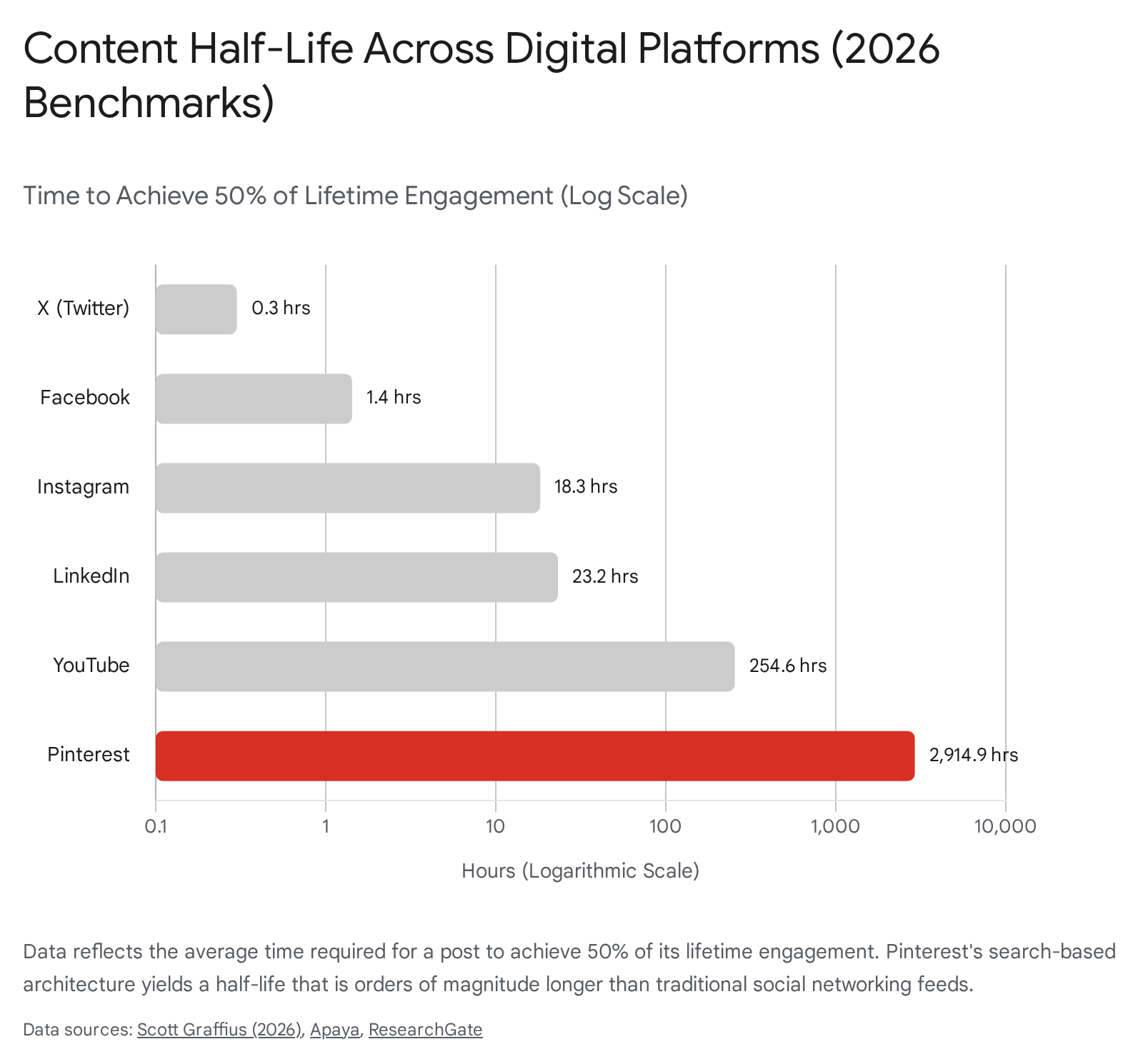
| Platform | Average Post Half-Life (2026) | Primary Decay Driver |
|---|---|---|
| X (Twitter) | 18 Minutes (0.3 Hours) | Hyper-chronological feed prioritization. |
| 1.43 Hours | Algorithmic recency bias and high content volume. | |
| 18.27 Hours | Feed saturation and ephemeral story prioritization. | |
| 23.22 Hours | Professional news cycle limitations. | |
| YouTube | 10.60 Days | Sustained by search engine indexing. |
| 3.99 Months (174,894 Minutes) | Evergreen visual search intent and algorithmic compounding. |
This extreme lifespan is not a statistical anomaly; it is mathematically engineered by the algorithm's treatment of "Fresh Pins." When a net-new URL and image combination is published to the platform, the algorithm initiates a slow, highly deliberate distribution expansion. Over the first 90 days of a fresh Pin's life, Pinterest rigorously gathers quality signals - such as saves, close-ups, and outbound clicks - steadily broadening the Pin's reach to more users based on relevance 25. As a result, highly successful or "winning" Pins often do not reach their absolute peak engagement until 1 to 2 years after their original publication date 25. This structural reality effectively transforms marketing spend on Pinterest from an ephemeral, short-term operational expense into a long-term digital capital asset that continues to yield free organic traffic and conversions for years 1341.
Overcoming Attribution Limitations via Connected TV
Despite its unparalleled purchase intent and extraordinary content lifespan, Pinterest historically struggled to capture its rightful share of enterprise advertising budgets. This friction stemmed primarily from legacy attribution modeling. Standard digital marketing performance is frequently measured on a 7-day last-click attribution model, a system highly optimized for impulse purchases generated by disruptive, interruptive feed advertisements on platforms like Meta 4142.
Pinterest users are systematic planners, not impulse buyers. Consequently, the platform exhibits a highly extended 21- to 30-day purchase window 43. A user may "save" a Pin regarding a major kitchen remodel, return to the platform two weeks later to compare specific appliance options, and finally complete the high-ticket transaction on a separate desktop computer on day 25 743. Under traditional last-click methodologies, Pinterest's initial discovery contribution is systematically under-credited, leading brands to erroneously misallocate budgets to lower-funnel retargeting platforms that merely capture the final click of a journey Pinterest initiated.
However, with Average Order Values tracking 50% higher than other social platforms, sophisticated advertisers utilizing data-driven or time-decay multi-touch attribution models realize profound returns on ad spend 4243.
| Advertising Metric | Pinterest Benchmark (2026) | Meta Benchmark (2026) | X (Twitter) Benchmark (2026) |
|---|---|---|---|
| Average Cost-Per-Click (CPC) | $0.50 - $1.50 | $1.06 - $1.72 | $3.00 - $5.00 |
| Average Cost-Per-Mille (CPM) | $2.00 - $5.00 | $5.00 - $15.00 | Data Highly Variable |
| E-commerce Conversion Rate | 2.0% - 4.0% | ~3.1% | Negligible |
| Average Order Value (AOV) Lift | +50% vs Social Avg. | Baseline | Below Baseline |
Data aggregated from 2026 performance marketing reports 41424344.
To aggressively bridge the gap between initial intent and measurable final outcomes, Pinterest executed a strategic masterstroke finalized in early 2026: the complete acquisition and integration of tvScientific, a performance-based Connected TV (CTV) advertising platform 264627.
Launched to major advertisers in April 2026, this integration allows brands to take the explicit, high-intent audience signals generated natively on Pinterest - such as identifying a cohort of users actively curating "nursery furniture" boards - and target those exact users with premium video advertisements on their living room televisions via streaming services 2627. This integration fundamentally transforms CTV from a highly expensive, top-of-funnel brand awareness channel into a highly measurable, lower-funnel performance marketing channel.
By enriching tvScientific's AI-powered bidding and optimization algorithms with Pinterest's proprietary first-party commercial intent data, early adopters witnessed phenomenal, mathematically proven results. On average, campaigns leveraging this integration achieved a 27% increase in measurable outcomes driven per $100 in ad spend, alongside a staggering 65% aggregate increase in actual purchases 262748. Specific corporate case studies, such as LG's early beta testing, demonstrated a 73% expansion in unique household reach and a corresponding 24% lift in net-new customer acquisition strictly attributable to Pinterest audience data 2627. By successfully expanding its rich intent data beyond its own walled garden and onto the "biggest screen in the house," Pinterest has fundamentally altered the mechanics of cross-screen media planning in 2026.
Visual SEO Optimization and Strategic Investment Timing
For brands to successfully leverage this ecosystem, they must execute rigorous technical Visual Search Engine Optimization. In 2026, succeeding on Pinterest requires recognizing that the platform parses both literal text strings and visual pixel data simultaneously to establish search relevance.
The fundamental unit of success remains the vertical visual asset, specifically maintaining a strict 2:3 aspect ratio (optimally 1000 x 1500 pixels) 149. Pinterest's mobile-first user interface heavily penalizes horizontal or square formats, resulting in severely reduced screen real estate and lower algorithmic distribution priority 49.
However, geometric formatting is entirely secondary to metadata taxonomy. Pinterest relies on a concept known as Keyword Layering to build deep semantic understanding. Brands must intricately weave exact-match and long-tail search queries across multiple metadata surfaces to signal relevance 13. The algorithm weights the first 100 characters of a Pin description heavily, and titles must explicitly front-load the primary keyword to capture intent immediately 1349. Alt-text is mandatory, providing accessibility compliance while double-serving as a hard keyword signal 1. Furthermore, Pinterest's computer vision reads the text natively printed on the image via Optical Character Recognition; clear, highly legible text overlays that directly match the user's search query dramatically improve initial click-through rates 1350. Crucially, boards are not merely organizational folders; they are vital SEO environments. Saving a Pin regarding "small patio decor" to a specifically titled, keyword-rich board like "Outdoor Entertaining Spaces" signals strict topic alignment and boosts the algorithmic clustering of the Pin, while saving it to a vaguely titled board severely dilutes its search authority 250.
While static images remain foundational, Pinterest's 2026 algorithm assigns immense distribution priority to dynamic, multi-page formats. Total video views on the platform surged 240% year-over-year 3. Consequently, Idea Pins - the platform's native multi-page vertical storytelling format - now achieve staggering engagement rates of 0.5% to 1.0%, outperforming standard static Pins by up to 400% 43. Because Pinterest indexes the captions and subtitles within these vertical videos using advanced natural language processing, brands that prioritize native video storytelling layered with highly descriptive captioning capture the overwhelming majority of organic reach in 2026 51.
Strategic Timing: Leveraging Predictive Intelligence
Timing is the final, critical variable in the Pinterest investment equation. Because the platform's search data operates as a leading indicator of cultural and commercial behavior, brands must act proactively rather than reactively.
To facilitate this, Pinterest publishes an annual report titled Pinterest Predicts, utilizing advanced machine learning and visual analysis to forecast macro-trends up to 24 months before they peak in mainstream culture 52. Exhibiting a remarkable 88% accuracy rate over the last six years, these are not speculative guesses; they are mathematical inevitabilities based on aggregated, high-intent planning behavior 5228. In 2026, the dominant trends center on themes of "Comfort, Identity, and Escape" - explicitly rejecting social media FOMO in favor of highly tactile, aesthetic individualism. High-growth, data-backed trends include "Gimme Gummy" (focusing on tactile, rubberized, and glossy aesthetics), "FunHaus" (sophisticated, bold circus-inspired interior decor), and "Cool Blue" (monochromatic blue food, drinks, and home styling) 525455.
For enterprise brands, the strategic investment timeline must be executed in three distinct phases: 1. Trend Inception (6 to 12 Months Prior): Brands must utilize Pinterest Predicts and the internal Pinterest Trends tool to identify rising aesthetics relevant to their specific commercial niche 1355. Content production, particularly Idea Pins and high-quality static images, must commence immediately to establish early domain authority. 2. Organic Seeding (3 to 6 Months Prior): Brands must publish content consistently. Because a fresh Pin's distribution builds slowly as the algorithm collects necessary engagement signals, publishing content a minimum of 45 to 90 days ahead of a projected seasonal peak is a mandatory requirement for algorithmic indexing 1325. 3. Paid Acceleration (Peak Season): As the seasonal or cultural trend finally hits its zenith, brands should overlay Promoted Pins and Shopping Ads to aggressively capitalize on the organic foundation they have built. This dual approach captures the lowest possible CPCs due to pre-established high relevance scores 4456. Simultaneously, brands should deploy tvScientific CTV ads to drive mass awareness of the trend among high-intent demographic cohorts on streaming television 4627.
Conclusion
In 2026, Pinterest represents a critical, highly lucrative inflection point in the global digital advertising landscape. It functions not as a social network battling for dwindling consumer attention spans through infinite, ephemeral feeds, but rather as a highly advanced, multi-modal search engine powered by generative retrieval models, state-of-the-art semantic computer vision, and predictive user intent sequencing.
By prioritizing visual discovery and future planning over chronological social graph interactions, Pinterest has curated an environment where users actively plan their financial futures - ranging from minor apparel purchases to major home renovations. For enterprise brands, the strategic mandate is unequivocal. Advertisers must abandon legacy last-click attribution models that fail to capture the 30-day planning cycle, invest heavily in vertical video formats and keyword-layered taxonomy, leverage the compounding half-life of evergreen content, and aggressively extend Pinterest's unique intent data into the living room via Connected TV. In an era defined by algorithm-induced trend fatigue and highly volatile social advertising costs, Pinterest provides the most stable, cost-efficient, and highest-intent commercial ecosystem available in the modern digital economy.