
Philosophy and psychology of the modern meaning crisis
Modern civilization currently exists within a historically unprecedented paradox: while technological, medical, and economic advancements have elevated material living standards to their highest recorded levels, psychological distress and existential alienation have escalated proportionately 1. Across advanced economies, populations report widespread feelings of groundlessness, anxiety, and a pervasive sense that modern life lacks intrinsic purpose 23. This psychological landscape has been formally designated by sociologists, cognitive scientists, and philosophers as the "meaning crisis" - a structural and epistemological collapse of the shared frameworks that historically provided human beings with a coherent narrative of reality 23.
The feeling of hollowness in modern life is not merely an aggregation of individual clinical pathologies, but rather a systemic consequence of how contemporary societies are organized and how modern individuals are enculturated to seek fulfillment. To understand the mechanisms driving this crisis, research spans multiple disciplines. Positive psychology examines the divergence between hedonic comfort and eudaimonic flourishing; cognitive science maps the breakdown of participatory sensemaking; sociological theory analyzes the alienating effects of systemic abstraction and hyperreality; and comparative philosophy highlights the limitations of Western individualism. Synthesizing these fields reveals that the structures designed to maximize human capability and comfort simultaneously dismantle the conditions necessary for generating meaning.
Conceptual Foundations of Well-Being
The academic investigation into the hollowness of modern life requires disentangling the overlapping, yet distinct, psychological constructs of happiness, meaning, and psychological functioning. Contemporary positive psychology, building upon classical philosophical foundations, demonstrates that the pursuit of positive emotion often diverges significantly from the cultivation of meaning, and that optimizing a society for the former may inadvertently suppress the latter.
Hedonic Happiness versus Eudaimonic Flourishing
The philosophical distinction between hedonia and eudaimonia forms the bedrock of modern subjective well-being research 45. Rooted in Epicurean thought, the hedonic tradition defines well-being as the maximization of pleasure and the minimization of pain, focusing primarily on subjective life satisfaction and positive affect 456. Modern socioeconomic structures are largely optimized for hedonic well-being, prioritizing the efficient satisfaction of consumer desires, the reduction of physical discomfort, and the maximization of convenience.
In contrast, the Aristotelian concept of eudaimonia - frequently translated as flourishing - posits that well-being is not a transient state of feeling but an active condition of living in accordance with one's deepest nature, exercising characteristic human excellences (virtues), and realizing one's potential 478. Aristotle argued that happiness is an activity rather than a passive sensation; it is something an individual continually enacts rather than a destination they arrive at 7.
Modern empirical research supports this philosophical divergence. Extensive psychological studies, notably those led by Roy Baumeister, demonstrate substantial trade-offs between seeking a happy life and seeking a meaningful life 10. Happiness is generally linked to the satisfaction of basic needs and wants, maintaining a present-oriented temporal focus, and functioning as a "taker" in social dynamics 910. Meaningfulness, conversely, is characterized by the cognitive integration of the past, present, and future, and is strongly associated with functioning as a "giver" 911.
| Analytical Dimension | Characteristics of a Happy Life | Characteristics of a Meaningful Life |
|---|---|---|
| Temporal Focus | Largely present-oriented; focused on immediate experiential conditions and the avoidance of past regrets or future anxieties 91011. | Integrates past, present, and future; involves mental time travel, long-term goal pursuit, and narrative coherence 91011. |
| Social Dynamic | Associated with being a "taker"; happiness arises when others do things for the individual or when individual desires are met 91011. | Associated with being a "giver"; meaning is derived from doing things for others, contributing to society, and fulfilling interpersonal duties 91011. |
| Needs and Wants | Strongly correlated with getting what one wants, finding life easy, and feeling physically healthy 10910. | Largely independent of basic need satisfaction; physical health and financial scarcity have minimal direct impact on meaning 10910. |
| Stress and Challenge | Negatively correlated with worry, stress, and anxiety. Flourishes in the absence of hardship and cognitive friction 912. | Positively correlated with higher levels of stress, worry, and involvement in ambitious, challenging projects with uncertain outcomes 91112. |
| Self-Expression | Irrelevant to concerns of personal identity or the active expression of the self 911. | Deeply tied to expressing the self, developing personal identity, and acting consistently with core values and long-term themes 10911. |
These findings highlight a crucial tension in modern society. The structural optimization of contemporary life for comfort, ease, and need-satisfaction strips away the friction, communal obligation, and necessary struggles that generate eudaimonic meaning 12. A highly optimized, frictionless life may yield high levels of subjective happiness while simultaneously registering as deeply hollow and devoid of purpose.
Psychological Richness as a Third Dimension
In recent years, psychological science has proposed a third dimension of the good life that operates independently of both hedonic happiness and eudaimonic meaning: "psychological richness" 1314. A psychologically rich life is characterized by a variety of interesting, novel, and perspective-changing experiences 1415.
While a happy life prioritizes comfort and a meaningful life prioritizes coherence and purpose, a rich life prioritizes curiosity, cognitive flexibility, and engagement with complexity 14. Empirical data indicates that psychological richness fosters cognitive resilience and social engagement, even when it involves physical discomfort or transient social isolation 13. Individuals leading psychologically rich lives tend to be more curious and think more holistically, often preferring a life of varied experiences over a purely comfortable or purely purposeful one 1415. The inclusion of this dimension suggests that the modern feeling of hollowness may not solely stem from a lack of meaning, but also from the homogenization and predictability of highly structured routines that deprive individuals of perspective-altering experiences 1314.
Logotherapy and the Will to Meaning
The necessity of meaning as a primary psychological driver was formalized by psychiatrist Viktor Frankl through the development of Logotherapy. Originating from existential psychology and Frankl's observations in concentration camps, Logotherapy posits that the fundamental human motivation is the "will to meaning" - the innate drive to find purpose and significance, even in the midst of extreme adversity 121619. This formulation stands in direct contrast to the Freudian "will to pleasure" and the Adlerian "will to power," arguing that humans are ultimately oriented toward values and meaning rather than mere drive reduction 1619.
According to this framework, an individual's inability to find purpose results in "existential frustration," a state that manifests clinically as the "existential vacuum" - a pervasive feeling of emptiness, boredom, and directionlessness 1619. Frankl identified three distinct pillars through which individuals discover meaning. The first is through creative values, which involve discovering meaning through active creation, doing a deed, or contributing work to the world 162021. The second is through experiential values, which are realized through receptive experiences, such as encountering beauty, nature, or forming deep, authentic connections and love with another human being 2021. The third, and arguably most profound, involves attitudinal values, which occur when meaning is found through the stance one takes toward unavoidable suffering, demonstrating the defiant power of the human spirit to transcend tragic circumstances 161920.
In the context of the modern crisis, the prevalence of the existential vacuum suggests that contemporary cultural frameworks fail to adequately facilitate these three pillars 16. When creative values are subsumed by automated labor, experiential values are mediated by digital screens, and attitudinal values are undermined by a culture that views all suffering as pathological rather than potentially transformative, individuals are left biologically and materially sustained but existentially starved 121621.
Cognitive Science of Sensemaking
To understand why meaning is eroding on a societal level, cognitive science offers mechanisms detailing how humans construct their relationship with reality. The meaning crisis is not merely a loss of comforting beliefs, but a breakdown in the fundamental cognitive processes that allow human beings to feel connected to their environment and to themselves.
Relevance Realization and Cognitive Architecture
Cognitive scientist John Vervaeke theorizes that meaning is not an objective fact to be discovered, nor a subjective illusion to be invented, but a "transjective" reality - a dynamic, relational interaction between an agent and its arena (the environment) 322. This interaction is governed by "Relevance Realization," the cognitive machinery through which the brain continuously filters an infinite amount of environmental data to determine what is significant, actionable, and important in any given moment 322.
Meaning-making, therefore, is an evolutionary necessity deeply embedded in biological cognition. It allows humans to navigate complex environments by highlighting what matters and suppressing what does not. The crisis of meaning occurs when this fundamental process of relevance realization breaks down or becomes persistently decoupled from the individual's lived experience, leading to a loss of coherence and a widespread feeling of insignificance 17.
The Four Epistemological Modes of Knowing
Vervaeke argues that human connection to reality operates through four distinct epistemological modes, termed the "Four Ways of Knowing" (the 4Ps) 22. These modes operate hierarchically, moving from abstract information down to fundamental embodiment.
| Mode of Knowing | Description and Cognitive Function | Example |
|---|---|---|
| Propositional Knowing | Knowledge of facts, concepts, and beliefs. Operates in a "having" mode (having a belief or possessing information). Represents the surface level of cognition 22. | Knowing the written rules of tennis; believing that Paris is the capital of France 22. |
| Procedural Knowing | Embodied knowledge of how to perform a skill or enact a process. Involves sensorimotor coordination and practice 22. | The physical, muscle-memory skill of knowing how to swing a tennis racket effectively 22. |
| Perspectival Knowing | Situational awareness and the ability to perceive the world from a specific vantage point. Understanding what a context demands in real-time 22. | Knowing whether a specific moment in a tennis match requires a forehand or a backhand shot 22. |
| Participatory Knowing | The deepest level of knowing, involving a profound "fitted-ness" with the environment. Operates in a "being" mode where the agent and arena co-create one another 322. | Achieving a "flow state" during the game, where the boundary between the player and the court dissolves into pure engagement 322. |
Modal Confusion and the Loss of Participatory Depth
The cognitive root of the meaning crisis lies in what Vervaeke terms "modal confusion" 22. Modern, post-Enlightenment societies overwhelmingly prioritize Propositional Knowing - the accumulation of facts, scientific data, technological metrics, and ideological beliefs. However, deep meaning and existential fulfillment are primarily generated at the deeper levels of Perspectival and Participatory Knowing 322.
When a culture attempts to solve a crisis of meaning by generating more propositional beliefs (such as adopting a new political ideology, consuming more data, or formulating rational arguments about existence), it commits a category error. Individuals attempt to satisfy a profound need for "being" and "fitted-ness" using the tools of "having" and "fact-gathering" 22. This modal confusion strips the environment of its participatory depth. Individuals are left feeling alienated and disconnected from a world that they can rationally comprehend but cannot meaningfully inhabit 322.
This cognitive detachment is further exacerbated by phenomena such as "domicide" - the destruction of the physical and cultural home, which severs the deeply embedded relationship between an agent and their specific arena 18. As global culture thins and becomes increasingly homogenized, the loss of specific, participatory environments leaves individuals uprooted, attempting to navigate a complex world with only abstract propositions to guide them 18. Certain subcultures and psychological interventions, such as the renewed clinical interest in psychedelics, are theorized to be responses to this specific lack, operating as mechanisms to temporarily disrupt rigid propositional framing and force a return to intense, participatory states of awe and connectedness 319.
Structural and Sociological Drivers
Beyond individual cognition, the architecture of modern complex societies inherently generates existential friction. Sociological analyses suggest that the very mechanisms responsible for human progress, economic capability, and safety are simultaneously responsible for the erosion of individual significance.
Abstraction, Scale, and the Informational Preconditions of Meaning
Sociological theory posits that meaning is fundamentally predicated on an individual's ability to perceive a direct connection between their actions and the resulting outcomes 1. Researcher Boris Kriger identifies this as the "informational preconditions of meaning." This principle dictates that a person must not only intellectually know their work matters, but must directly observe, feel, and experience the impact of their agency on the world 1.
However, the defining features of advanced civilization - extreme specialization, hierarchical bureaucracy, and massive scale - rely entirely on abstraction 1. To coordinate millions of people, maintain global supply chains, and govern modern nation-states, systems must insert vast layers of distance between an individual's action and the ultimate consequence 1.
This creates the paradox of progress: as systems grow exponentially larger and more capable of solving massive problems (e.g., curing diseases, managing global logistics), the individual operating within that system is reduced to managing abstract symbols, metrics, and proxies 1. The concrete chain of causality becomes invisible. Because human beings possess limited cognitive ability to instinctively process vast complexity, the invisible connection destroys the experiential feeling of meaning 1. The hollowness of modern professional and social life is therefore not a failure of individual psychology, but a mathematical trade-off of scale 1. Society builds systems capable of immense output, yet the individuals inside those systems feel small, lost, and fundamentally disconnected from the outcomes of their labor 1. Elite narratives often misdiagnose this structural alienation, reducing the immiseration caused by complex neoliberal economic policies into individualized psychological failings or branded "identity crises," obscuring the systemic loss of agency 26.
The Transition to the Transformation Age
This structural alienation is currently accelerating due to a macro-sociological shift. Sociologists and applied metatheorists describe the current historical moment as a transition from the Information Age into the "Transformation Age" 2. Coined to describe a post-postindustrial society, the Transformation Age is defined by the radical, rapid, and constant reshaping of previously stable background structures, including economic forms, cultural norms, and relational expressions 2.
This shift occurs because the flow of information has become so totalizing and rapid that it actively disrupts the epistemological processes that historically held cultural and social systems together 2. The resulting environment requires continuous adaptation, leaving individuals exhausted and perpetually unmoored from traditional sources of stability.
The Metacrisis and Global Destabilization
Within the Transformation Age, humanity faces what theorists term a "Metacrisis" - a complex, interpenetrating system of intractable global crises that transcend existing scientific, academic, and political capacities 22028. The Metacrisis encompasses several simultaneous, world-historic shifts 229: * A geopolitical fragmentation marked by the erosion of democratic institutions and the failure of post-war security architectures 229. * A technoeconomic singularity driven by artificial intelligence and automated information processing 23. * An ecological shift into the Anthropocene, characterized by severe environmental degradation and climate instability 22029. * An epistemological shift into "Hyperreality" 2. * The psychological and cultural "Meaning Crisis" 2.
These forces interact and amplify each other. For example, ecological crises feed the meaning crisis through pervasive eco-anxiety, which is subsequently numbingly medicated through algorithmic doomscrolling 20. Similarly, the meaning crisis drives political and cultural dispossession, which fractures geopolitical cooperation, making ecological solutions harder to implement 2. The sheer scale of the Metacrisis outpaces the processing capacity of standard human cognition, rendering traditional governance and institutional frameworks obsolete and exacerbating feelings of futility 230.
Hyperreality and Epistemological Fragmentation
A primary driver of the sensemaking collapse within the Metacrisis is the shift into Hyperreality. Following the theories of Jean Baudrillard, sociologists identify a transition from the "Real" - an actual, local, sense-grounded knowledge world - to the "Hyperreal" - a constructed, non-local, unbounded, and semi-fictional world mediated by screens, social media, and virtual environments 229.
The rise of decentralized social media and hyper-digitalization has radically dismantled traditional institutional channels for knowledge legitimation 2. Turning every individual with a smartphone into a potential producer and distributor of information has rendered the global attention space highly noisy and anarchic 2. Individuals are faced with a profound epistemological crisis: it has become exceedingly difficult to orient oneself, determine what is true, or find sufficient intelligibility in a topsy-turvy digital landscape 228. The proliferation of information warfare and the manipulation of subjective truths erode public trust, further collapsing shared values and driving widespread existential disengagement 2931.
Digital Identity and Existential Alienation
The integration of Hyperreality into daily life carries acute existential consequences for the individual. Existentialist philosophy, drawing from thinkers like Søren Kierkegaard and Jean-Paul Sartre, provides a powerful framework for understanding how the hyper-digitalized world threatens the coherence of the self 3233.
Selective Self-Presentation and Identity Fatigue
Digital environments architecturally compel individuals to engage in "selective self-presentation" 34. Users are incentivized to constantly curate and perform idealized online personas for audience consumption, leading to a profound tension between the curated avatar and the authentic self 3234.
Research indicates that nearly three-quarters of individuals present a fundamentally different version of themselves online compared to their physical-world persona 34. Maintaining these fragmented, multiple identities across various platforms leads to "digital identity fatigue" - a heavy cognitive and psychological strain resulting from continuous code-switching between differing versions of the self 34.
While digital platforms offer unprecedented global connectivity, the interactions cultivated online often lack the nuance, presence, and somatic depth of face-to-face engagement 33. Consequently, highly active social media users frequently report heightened levels of loneliness, anxiety, and isolation compared to passive users 333435. The performance of identity through a screen erodes the individual's sense of authenticity, weakening the vital psychological threads that anchor them to tangible reality and leading to a pervasive sense of inauthenticity and alienation 323334. Authentic self-expression, conversely, is strongly correlated with increased positive affect and reduced negative mood, underscoring the psychological cost of digital performativity 34.
Social Acceleration and the Loss of Resonance
The hyper-connectivity of the digital age also subjects individuals to severe information overload and continuous micro-decision making, intensifying existential anxiety 34. Sociologist Hartmut Rosa attributes this to the phenomenon of "social acceleration," wherein the pace of technological, social, and life changes constantly outstrips the human capacity for integration .
According to Rosa, a fulfilling life is characterized by "resonance" - a responsive, mutually transformative relationship between the individual and the world 21. The speed and instrumentalization of modern, digitally-mediated life systematically destroy the conditions necessary for resonance, replacing deep engagement with fleeting, superficial interactions 21. The world becomes "mute" or "alien," failing to respond to the individual in a meaningful way, which perfectly encapsulates the phenomenological experience of the modern meaning crisis.
Cross-Cultural Perspectives and Empirical Discrepancies
If the meaning crisis is a structural byproduct of advanced, hyper-digitalized, highly abstracted societies, empirical global data should reflect clear demographic discrepancies based on economic development and cultural organization. Survey data confirms a startling paradox: the populations of the most economically advanced nations frequently report the lowest levels of meaning in life, directly challenging Western assumptions regarding the linear relationship between progress and fulfillment.
The Paradox of Progress in Advanced Economies
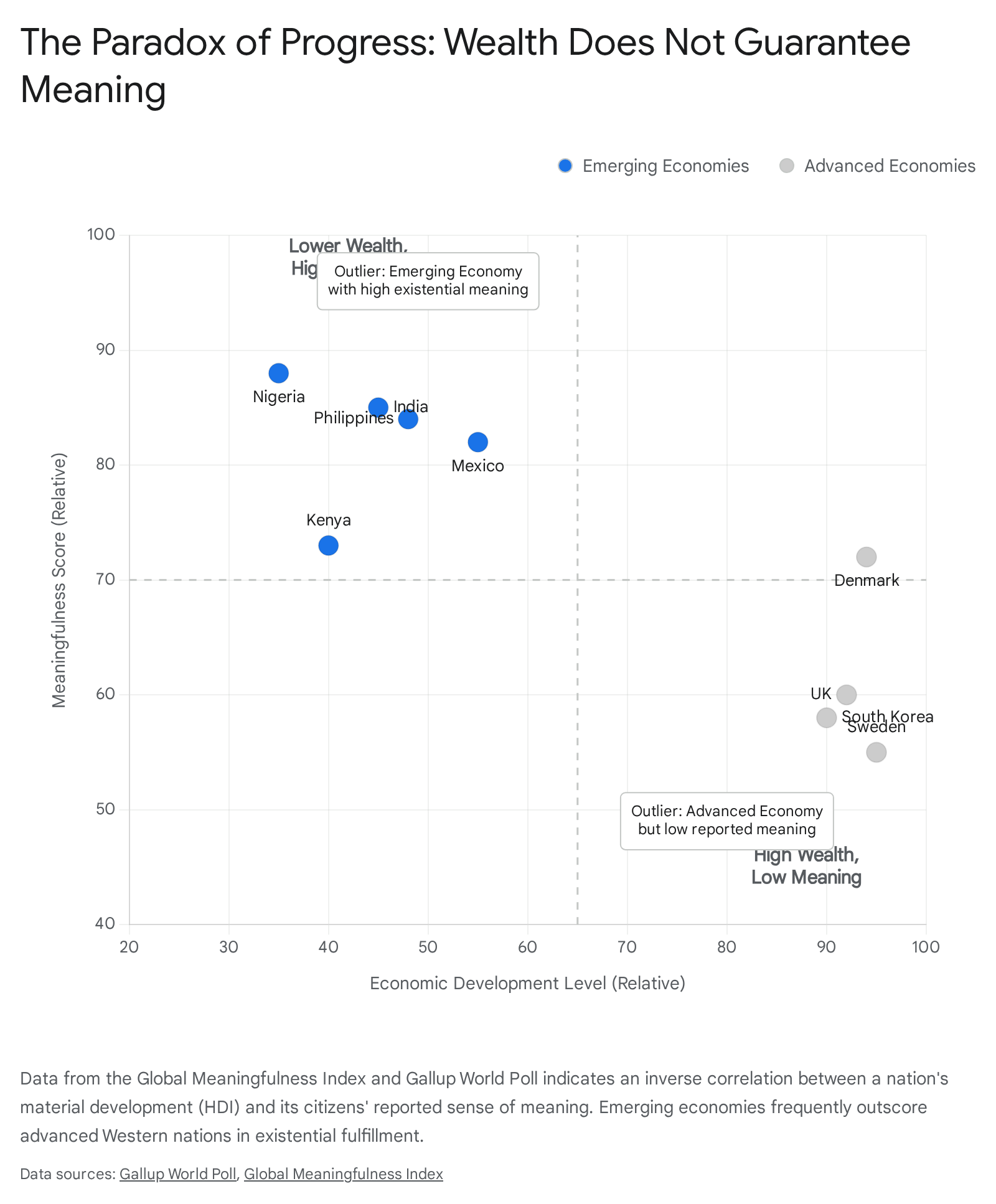
Traditional metrics of national success rely heavily on Gross Domestic Product (GDP), infrastructure, and objective factors like life expectancy and educational attainment 22. However, instruments specifically designed to measure subjective existential well-being - such as the Gallup World Poll and the Global Meaningfulness Index (GMI) - reveal that material wealth does not reliably translate into psychological or existential fulfillment 232425.
Data collected across more than 130 nations indicates that residents of poorer, developing countries consistently report a significantly greater sense of meaning in their lives than residents of wealthy nations 232526. This discrepancy is largely attributed to strong family ties, solid connections to religious traditions, and communal integration that remain intact in less economically developed regions, but have been eroded by hyper-individualism and secularization in advanced economies 2325.
Wealth, Development, and Meaning Scores
Despite high material prosperity and top rankings on traditional Human Development Indexes (HDI), countries such as Sweden, Denmark, the United Kingdom, and South Korea exhibit relatively low levels of lived meaningfulness or underperform relative to their wealth 22242543. Conversely, nations facing substantial economic and infrastructural challenges, such as Nigeria, Mexico, India, and the Philippines, report significantly higher levels of meaning in life 2225.
The data suggests an inverse correlation between a country's HDI score and its overall sense of meaning 22.
In advanced Western economies like Sweden, belonging is no longer a given community trait but an individualized project that must be actively constructed, often leading to fragmentation 43. Furthermore, while employment in advanced economies provides necessary structure and purpose, it frequently generates strain through overwork, performance pressure, and a detachment from deeper values, illustrating that material development and autonomy do not guarantee a coherent sense of purpose 2543.
Measurement Bias in Global Happiness Surveys
The interpretation of global well-being data is also heavily dependent on the metrics utilized, which frequently suffer from cultural biases. The widely cited World Happiness Report relies on the "Cantril Ladder," a single-item survey asking respondents to place themselves on a ladder where the top rung represents the best possible life and the bottom represents the worst 264427.
However, linguistic and cognitive analyses of the Cantril Ladder indicate that the framing inherently emphasizes power, wealth, and socioeconomic hierarchy over broader communal or eudaimonic well-being concepts 27. The metaphor of a ladder triggers social comparison and correlates strongly with an individual's relative position in the income distribution 27.
The concept of happiness as an individualistic, hedonistic pursuit suffers from a distinct Western bias - common to WEIRD (Western, Educated, Industrialized, Rich, and Democratic) societies 2646. Non-Western cultures frequently place greater emphasis on harmony, spirituality, balance, and communal integration 262746. When researchers measure "life satisfaction" or "meaning" rather than using the ladder metaphor, different global patterns emerge, proving that the tools used to diagnose global well-being often reflect the very hyper-individualistic values that precipitate the meaning crisis 4427.
Demographic Discrepancies in the Search for Meaning
Within specific populations, the experience of meaning is heavily stratified by demographic factors. Research using the Meaning in Life Questionnaire (MLQ) across 17 countries demonstrates that while the "presence of meaning" is somewhat consistent cross-culturally, the active "search for meaning" varies widely, suggesting that existential exploration carries different psychological weights depending on the cultural context 2829.
Age and education also play significant roles. The Global Meaningfulness Index notes a generational divide, with older demographics (Boomers) reporting higher levels of meaning compared to Millennials and Generation Z, who exhibit the lowest scores across drivers of meaning, particularly in areas of purpose and leadership 2225. Educational attainment and employment consistently correlate with higher meaning, highlighting that while advanced economies abstract labor, the fundamental structures of education and work remain critical for providing the daily orientation and social interaction necessary for fulfillment 25.
Philosophical and Practical Responses
If the structural frameworks of the modern West are inadvertently generating a crisis of meaning, alternative philosophical traditions and practical interventions may offer pathways to re-evaluate the modern condition. Scholars increasingly look to classical frameworks not as historical artifacts, but as pragmatic tools for navigating modern hollowness.
Critiques of the Western Authentic Self
In addressing the meaning crisis, scholars of classical Chinese philosophy challenge one of the most fundamental assumptions of Western existentialism and psychology: the concept of the "authentic self." Modern Western culture operates on the premise that each individual possesses a true, static inner core, and that the path to fulfillment involves looking inward, discovering this authentic self, and expressing it outward against the constraints of society 30313233.
Harvard philosopher Michael Puett argues that this prevailing ideology has resulted in an "Age of Complacency," where individuals are unfulfilled precisely because they allow self-imposed labels and established behavioral patterns to limit their potential 323435. The classical Chinese philosophers - such as Confucius, Mencius, and Zhuangzi - viewed the world as fragmented, capricious, and endlessly complex 323436. From their perspective, the idea of an isolated, authentic inner self is a fallacy; humans are fundamentally relational beings defined by their continuous interactions with others and their shifting environments 303132. By focusing rigidly on one's "strengths" or perceived "true interests" in the name of authenticity, an individual conditions themselves to avoid unpredictable encounters, thereby stifling their capacity for continuous growth and transformation 31.
Classical Chinese Philosophy and As-If Rituals
Rather than embarking on a grand, abstract quest for inner authenticity, classical Chinese philosophy suggests that meaning is generated through mundane, everyday actions and micro-relational dynamics 3237. Central to this is the Confucian concept of ritual. However, this refers not to rigid, traditional religious ceremonies, but rather to everyday social conventions transformed into intentional practices 32.
Confucian rituals function as "as-if" scenarios - small, deliberate breaks from normal, predictable behavior 3132. Because human beings naturally fall into habitual emotional reactions and predefined roles (such as defaulting to anger or passivity in specific relationships), engaging in a ritual allows an individual to temporarily step outside their conditioned patterns and act "as if" they are different 3132. These brief moments of behavioral transformation alter the relational dynamic, opening up new possibilities for connection that genuine, unfiltered "sincerity" might otherwise destroy or trap in negative feedback loops 3057.
Relational Dynamics and Continuous Cultivation
In this philosophical framework, the Dao (The Way) is not a harmonious, pre-existing ideal to be discovered, nor a fixed destiny dictated by an authentic self. Instead, it is a path forged continuously through daily choices, micro-interactions, and the intentional training of oneself to respond well to small moments 3032. Excellence and influence do not arise from wielding power or asserting one's natural abilities, but from holding back, cultivating perspective, and modifying small gestures to improve the relational environment 305859.
The integration of these perspectives suggests that overcoming the modern meaning crisis does not require a retreat into isolation to "find oneself," nor does it require adopting grand, new ideological propositions that merely operate at the level of propositional knowing. Instead, it demands a return to participatory engagement with the world - recognizing the structural forces that abstract our labor, rejecting the digital fragmentation of our identities, and actively cultivating meaning through deep, relational connection and the continuous, mindful shaping of our everyday reality 303132.
Emerging Systemic and Psychological Interventions
Beyond individual philosophical shifts, addressing the metacrisis requires systemic and clinical interventions. At the community level, movements toward decentralized governance, bioregionalism, and well-being economics represent attempts to rebuild local resilience and reconnect individuals to their immediate physical environments 2960. These frameworks aim to replace hyper-globalized abstraction with tangible, place-based regeneration, restoring the informational preconditions of meaning by allowing individuals to see the direct ecological and social impact of their actions 60.
Clinically, the resurgence of research into psychedelic therapy is increasingly framed as a direct response to the meaning crisis 319. If the crisis is characterized by a loss of participatory knowing and an over-reliance on rigid propositional framing, psychedelic interventions are theorized to act as profound disruptors. By temporarily dissolving the ego and the abstracted linguistic frameworks through which modern individuals mediate reality, these experiences often facilitate states of profound connectedness, awe, and a revitalization of the agent-arena relationship 319. Such interventions, alongside the adoption of ancient contemplative practices and relational philosophies, highlight a growing recognition that resolving the hollowness of modern life requires profound shifts in how human beings perceive, interact with, and actively participate in the world.