
Perfectoid spaces in arithmetic geometry
The Mixed Characteristic Problem and Non-Archimedean Topologies
The structural foundation of arithmetic geometry relies on understanding geometric objects defined over number fields and their completions. A foundational dichotomy within this domain is the separation between characteristic 0 environments - such as the rational numbers $\mathbb{Q}$, the complex numbers $\mathbb{C}$, and their algebraic extensions - and equal characteristic $p$ environments, such as finite fields $\mathbb{F}_p$ or the function field $\mathbb{F}_p((t))$. In characteristic $p$, the algebraic landscape is governed by the Frobenius endomorphism, defined by the mapping $x \mapsto x^p$. Because $(x+y)^p = x^p + y^p$ in characteristic $p$, the Frobenius map serves as a highly rigid ring homomorphism that restricts the geometry of polynomial equations, famously allowing for the resolution of topological invariants such as the Weil conjectures 12.
However, many fundamental challenges in number theory reside in "mixed characteristic," where a ring of characteristic 0 has a residue field of positive characteristic $p$. The quintessential example is the field of $p$-adic numbers, $\mathbb{Q}_p$, which is defined as the completion of the rational numbers with respect to the $p$-adic absolute value. Its ring of integers, $\mathbb{Z}_p$, reduces modulo $p$ to the finite field $\mathbb{F}_p$ 134.
Transporting the powerful, Frobenius-driven geometric tools of characteristic $p$ to mixed characteristic spaces has historically presented a massive topological barrier. The field $\mathbb{Q}_p$ and its finite algebraic extensions form totally disconnected topological spaces 15. In a standard totally disconnected space, any continuous function can be arbitrarily decomposed into locally constant functions on infinitesimally small open sets. Consequently, the traditional methodologies of differential geometry and complex analysis fail entirely; there is no analytic rigidity to hold a "geometric" space together, yielding an excess of continuous functions that prevents the formation of coherent geometric manifolds 16.
The Evolution Toward Adic Spaces
To formulate a functional geometry over $p$-adic fields, mathematicians developed several highly specialized frameworks that systematically bypassed these topological limitations. In the 1960s, John Tate introduced rigid analytic spaces. Tate's methodology involved defining a specialized Grothendieck topology based on "admissible covers" of affinoid algebras, which successfully permitted a coherent sheaf theory of convergent $p$-adic power series 167. While highly successful for specific algebraic applications, rigid analytic geometry required stringent noetherian finiteness assumptions, severely restricting the classes of topological rings that could be analyzed 26.
Subsequent advancements sought a more universal topological foundation. Vladimir Berkovich introduced Berkovich spaces, which added points corresponding to arbitrary multiplicative seminorms, generating a path-connected topological space suitable for $\ell$-adic cohomology 128. Concurrently, Roland Huber developed adic spaces, a broad framework that utilized continuous valuations of higher rank to define the spectrum of a topological ring. Huber's theory allowed for the study of highly non-noetherian spaces and provided a natural setting for formal models 126.
It was specifically within Huber's framework of adic spaces that Peter Scholze introduced perfectoid spaces in 2012. Perfectoid geometry formally harnesses the infinite ramification of certain $p$-adic fields to create an exact structural bridge between mixed characteristic 0 and equal characteristic $p$ 199.
Definition and Structure of Perfectoid Fields
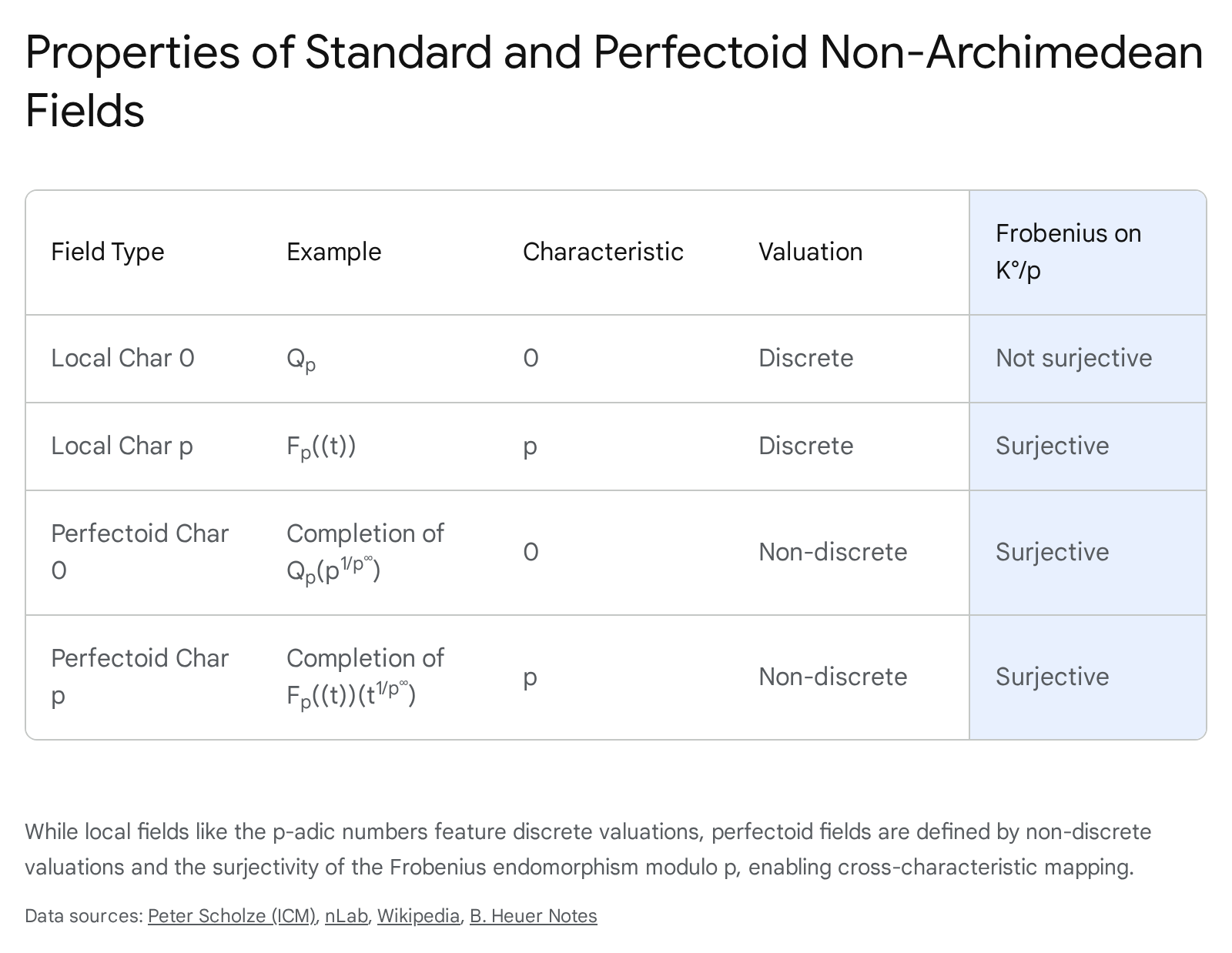
The foundational objects of perfectoid geometry are perfectoid fields. A perfectoid field $K$ is defined as a complete topological field whose topology is induced by a non-discrete valuation of rank 1, subject to two critical conditions: the residue characteristic of the field must be $p > 0$ (implying $|p| < 1$), and the Frobenius endomorphism $\Phi(x) = x^p$ must be surjective on the quotient $K^\circ/p$, where $K^\circ = {x \in K \mid |x| \leq 1}$ designates the ring of power-bounded elements 291011.
Infinite Ramification and the Non-Discrete Valuation
The mathematical requirement that the valuation of a perfectoid field is non-discrete ensures that the field is infinitely ramified. Consequently, the standard $p$-adic field $\mathbb{Q}_p$, as well as all of its finite extensions, are strictly excluded from being perfectoid because their value groups are discrete (e.g., the value group of $\mathbb{Q}_p$ is $p^\mathbb{Z}$) 212.
To construct a perfectoid field starting from $\mathbb{Q}_p$, one must adjoin an infinite sequence of $p$-power roots to force the value group to become dense. By adjoining roots such as $p^{1/p}, p^{1/p^2}, \dots$, one forms the infinite extension $\mathbb{Q}_p(p^{1/p^\infty})$. The topological completion of this infinite extension, denoted $\widehat{\mathbb{Q}_p(p^{1/p^\infty})}$, successfully satisfies the non-discrete valuation requirement and the Frobenius surjectivity condition, thereby forming a valid characteristic 0 perfectoid field 2710.
Another pivotal example of a perfectoid field is $\mathbb{C}_p$, the $p$-adic completion of the algebraic closure of $\mathbb{Q}_p$. The field $\mathbb{C}_p$ is algebraically closed, complete, and possesses a non-discrete valuation, functioning as a primary base field for characteristic 0 perfectoid geometry 1314. In an equal characteristic $p$ setting, a perfectoid field is equivalent to any complete perfect non-archimedean field, such as the completion of $\mathbb{F}_p((t))(t^{1/p^\infty})$ 23.
The Surjectivity of Frobenius Modulo $p$
The most mathematically significant definitional trait of a perfectoid field is the surjectivity of the Frobenius map on $K^\circ/p$. Because $K^\circ$ is an integral domain and the characteristic of the quotient $K^\circ/p$ is exactly $p$, the mapping $x \mapsto x^p$ operates as a valid ring homomorphism. Its mandated surjectivity dictates that for any element $x \in K^\circ$, there exists an element $y \in K^\circ$ such that $y^p \equiv x \pmod p$.
In practical terms, this establishes that perfectoid fields are characterized by the existence of abundant, approximate $p$-power roots for all integral elements 21016. This property serves as the direct mixed-characteristic analogue to perfect fields in characteristic $p$, where every element possesses an exact, rather than approximate, $p$-th root.
The Tilting Equivalence
The central operational mechanism of perfectoid geometry is the tilting equivalence. Tilting is a functorial operation that receives a perfectoid object in characteristic 0 and systematically translates it into a strictly analogous perfectoid object in characteristic $p$. This formalism drastically generalizes the 1979 Fontaine-Wintenberger theorem, which originally proved that the absolute Galois group of the mixed-characteristic field $\mathbb{Q}_p(p^{1/p^\infty})$ is canonically isomorphic to the absolute Galois group of the equal-characteristic field $\mathbb{F}_p((t))(t^{1/p^\infty})$ 310.
Algebraic Construction of the Tilt
For any perfectoid field $K$, its tilt, mathematically denoted as $K^\flat$, is constructed as a multiplicative monoid via the inverse limit of the field iterating under the $p$-th power map: $$K^\flat = \lim_{x \mapsto x^p} K$$ Explicitly, an element contained within $K^\flat$ is defined as an infinite sequence $(x_0, x_1, x_2, \dots)$ of elements in $K$ satisfying the relation $x_{i+1}^p = x_i$ for all non-negative integers $i$ 101115.
While the multiplication of elements in $K^\flat$ is straightforwardly computed coordinate-wise, the addition is highly non-trivial and is defined by sequences of limits of $p$-power approximations: $$(x+y)^{(i)} = \lim_{n \to \infty} (x^{(i+n)} + y^{(i+n)})^{p^n}$$ 10. The resulting algebraic structure $K^\flat$ is a perfect, complete non-archimedean field of pure characteristic $p$. The topological and valuation structures map flawlessly between the origin field and its tilt. A pivotal surjective mapping $\sharp: K^\flat \to K$ (the "untilt" or sharp map) is generated by projecting the sequence to its zeroth coordinate, $x \mapsto x^\sharp = x_0$, allowing for a continuous multiplicative mapping from the tilt back to the original mixed-characteristic field 1617.
Categorical and Topological Equivalence
Scholze proved that the categories of perfectoid fields over $K$ and perfectoid fields over $K^\flat$ are canonically equivalent 71819. If $L$ is an arbitrary finite extension of $K$, then $L$ is guaranteed to be perfectoid, and its tilt $L^\flat$ acts as a finite extension of $K^\flat$ of the exact same mathematical degree. This categorical equivalence preserves Galois theory entirely, providing a purely geometric formalization of the Fontaine-Wintenberger theorem 310.
Beyond isolated fields, the tilting equivalence scales seamlessly to perfectoid algebras and global perfectoid spaces. If $X$ is a perfectoid space over $K$, a corresponding tilted perfectoid space $X^\flat$ over $K^\flat$ can be explicitly constructed.
The structural translation between a characteristic 0 perfectoid space and its characteristic $p$ tilt preserves fundamental geometric and topological properties while fundamentally altering the underlying arithmetic base.
| Geometric/Algebraic Layer | Mixed Characteristic ($X$) | Equal Characteristic ($X^\flat$) | Equivalence Status |
|---|---|---|---|
| Field Arithmetic | Characteristic 0 (Arithmetic with carry) | Characteristic $p$ (Arithmetic without carry) | Divergent |
| Frobenius Operator | Incomplete / Approximate mapping | Exact automorphism ($x \mapsto x^p$) | Acquired in Tilt |
| Topological Space | Pathological, totally disconnected | Identical topological structure | Homeomorphic ($X \cong X^\flat$) |
| Étale Topoi | $X_{\text{ét}}$ | $X^\flat_{\text{ét}}$ | Equivalent ($X_{\text{ét}} \cong X^\flat_{\text{ét}}$) |
| Galois Representations | Absolute Galois Group $\text{Gal}(\overline{K}/K)$ | Absolute Galois Group $\text{Gal}(\overline{K^\flat}/K^\flat)$ | Isomorphic |
Because the underlying topological spaces are naturally homeomorphic and the étale topoi are equivalent ($X_{\text{ét}} \cong X^\flat_{\text{ét}}$), covering spaces, étale cohomology groups, and local geometric attributes are mathematically indistinguishable between the characteristic 0 space and its characteristic $p$ tilt 71011.
Limitations and the Problem of Untilting
Despite its vast power, the tilting equivalence operates under strict limitations. The primary constraint is that it necessitates the base field to be perfectoid. Because standard fields like $\mathbb{Q}_p$ possess discrete valuations, one cannot directly tilt a standard algebraic variety defined over $\mathbb{Q}_p$ 212. A highly ramified base change must first be performed to escalate the field to a perfectoid environment (such as $\widehat{\mathbb{Q}_p(p^{1/p^\infty})}$). Only then can the tilting equivalence be applied, the geometric problem solved in characteristic $p$, and the result descended back down to $\mathbb{Q}_p$ 220.
Furthermore, the tilting operation is mathematically "lossy" with respect to the characteristic 0 origin. Two distinct, non-isomorphic characteristic 0 perfectoid fields can generate the exact same characteristic $p$ tilt 1523. Consequently, mapping backward - the process of "untilting" - is highly ambiguous. The parameterization of all possible characteristic 0 untilts associated with a given characteristic $p$ perfectoid field requires a complex mathematical structure, which was formalized in the construction of the Fargues-Fontaine curve 15.
Model-Theoretic Interpretation (Continuous Logic)
The tilting correspondence also drew immediate interest from the field of mathematical logic. Traditionally, theorems relating mixed characteristic fields to positive characteristic fields - such as the Ax-Kochen-Ershov (AKE) theorems - operate asymptotically, meaning the logical theories converge only as the residue characteristic $p$ approaches infinity 121521.
Tilting, however, is definitively not asymptotic; it forces a direct and immediate comparison for fixed values of $p$. From a model-theoretic standpoint, researchers demonstrated that the tilt/untilt correspondence functions as a quantifier-free bi-interpretation within continuous logic 121521. This positive continuous logic framework guarantees the preservation of existentially closed structures across the tilt, explaining mathematically why features such as the Fontaine-Wintenberger Galois isomorphism and adic space topologies translate flawlessly without requiring asymptotic limits 1221.
Perfectoid Algebras and the Almost Purity Theorem
To construct global geometric spaces, local affine building blocks must be formally defined. In perfectoid geometry, these building blocks are affinoid perfectoid spaces, constructed directly from perfectoid algebras.
Huber Rings and Affinoid Perfectoid Spaces
A perfectoid $K$-algebra $R$ is formulated as a complete Banach algebra over a perfectoid field $K$ such that the subring of power-bounded elements $R^\circ \subset R$ constitutes a bounded subset, and the Frobenius map behaves surjectively on $R^\circ/p$ 2722. Similar to the field parameters, this requires that the algebra $R$ contains an abundance of approximate $p$-power roots. Consequently, perfectoid algebras are massive, highly non-noetherian topological rings 2.
Utilizing Huber's topology of adic spaces, one defines the affinoid perfectoid space $X = \text{Spa}(R, R^+)$, where $R^+$ acts as an open, integrally closed subring of $R^\circ$. The points of this specific space represent equivalence classes of continuous valuations on $R$ 71920. In a highly non-trivial result, Scholze proved that despite the extreme lack of noetherian finiteness, the presheaves of functions $\mathcal{O}_X$ and $\mathcal{O}_X^+$ on these spaces operate as true sheaves, and that higher cohomology groups strictly vanish on rational subsets 237. General perfectoid spaces are subsequently assembled by gluing these affinoid perfectoid spaces together 723.
The Almost Purity Theorem
A critical operational engine of perfectoid geometry is the Almost Purity Theorem. In classical algebraic geometry, the purity of the branch locus governs how ramification behaves in finite extensions. In standard $p$-adic geometry, Gerd Faltings previously introduced "almost mathematics," a highly specialized framework where modules and morphisms are evaluated "up to $p$-power torsion." In this setting, a mathematical kernel or error term is considered "almost zero" if it is entirely annihilated by the maximal ideal of the valuation ring 3923.
Scholze's perfectoid analogue of the Almost Purity Theorem decrees that if $R$ is a perfectoid $K$-algebra, and $S$ acts as a finite étale extension of $R$, then $S$ inherently becomes a perfectoid algebra. More profoundly, at the strict integral level, the extension of power-bounded elements $S^\circ$ over $R^\circ$ is almost finite étale 71011.
This theorem systematically dismantles the severe semistable reduction hypotheses that paralyzed earlier formulations of $p$-adic Hodge theory 79. Because the tilting equivalence fully preserves finite étale extensions, the almost purity theorem empowers mathematicians to seamlessly transfer highly complex ramification behavior from characteristic 0 into characteristic $p$. Once in characteristic $p$, these complexities can be cleanly resolved using standard, highly developed tools of positive-characteristic commutative algebra 910.
Resolutions in Cohomology and Commutative Algebra
The invention of perfectoid spaces catalyzed a rapid succession of breakthroughs across arithmetic geometry, resulting in the resolution of several conjectures that had resisted proof for decades.
Deligne's Weight-Monodromy Conjecture
The initial impetus for defining perfectoid spaces was Deligne's Weight-Monodromy Conjecture. This profound conjecture dictates the behavior of the poles of L-functions and specifies the action of the absolute Galois group on the $\ell$-adic étale cohomology of algebraic varieties defined over local fields 913. While Pierre Deligne had proven the conjecture for varieties over equal characteristic $p$ fields, the mixed-characteristic analogue remained unyielding.
Scholze deployed the tilting equivalence to fracture the mixed-characteristic obstruction. By selecting a proper smooth variety over a mixed characteristic field, performing an infinite base change to force it into a perfectoid environment, and subsequently tilting the entire space, he derived a corresponding geometric object strictly within characteristic $p$. By establishing rigid comparison maps between the étale cohomology of the characteristic 0 variety and its characteristic $p$ tilt, Scholze successfully proved the Weight-Monodromy conjecture for complete intersections within toric varieties 71520. While the conjecture in its maximum generality remains an open question, perfectoid methodology effectively reduced it to a technical problem of approximating fractal-like characteristic $p$ perfectoid spaces utilizing standard algebraic varieties 9.
p-adic Hodge Theory and Rigid Analytic Varieties
In classical complex geometry, Hodge theory provides a strict correspondence relating the topological cohomology of a complex manifold to the differential forms defined by its inherent complex structure. Alexander Grothendieck famously requested a $p$-adic analogue: a "mysterious functor" that would strictly link the algebraic de Rham cohomology of a $p$-adic variety to its $p$-adic étale cohomology 1.
Historically, the theorems of $p$-adic Hodge theory were proven through pure algebra, completely devoid of an analytic interpretation for étale cohomology 1. Perfectoid spaces supplied the long-missing analytic superstructure. Scholze established that proper smooth rigid analytic varieties over algebraically closed $p$-adic fields contain finite-dimensional $p$-adic étale cohomology, effectively formalizing a general Hodge-Tate spectral sequence for rigid analytic spaces 9. The perfectoid framework demonstrated that geometric properties intrinsic to the generic fiber automatically extend "almost" to the integral level, creating the unified, geometric treatment of $p$-adic Hodge theory that John Tate had originally hypothesized in 1967 39.
The Direct Summand Conjecture
By 2016, perfectoid geometry transcended non-archimedean geometry and impacted pure commutative algebra. Yves André utilized perfectoid spaces to finally prove Hochster's Direct Summand Conjecture, a central pillar of the homological conjectures introduced in 1969 152425.
The conjecture asserts that if $R$ is a regular local ring and $R \to S$ represents a finite extension of rings, then $R$ must be a direct summand of $S$ when viewed as an $R$-module. The characteristic $p$ proof was accomplished early via the Frobenius map, and the equal characteristic 0 proof was resolved using trace maps. The mixed characteristic case, however, was notoriously intractable 2425.
André engineered faithfully flat extensions of perfectoid algebras wherein discriminants systematically acquired all $p$-power roots, successfully bypassing the historic mixed-characteristic obstructions. Shortly thereafter, Bhargav Bhatt formulated an elegant, streamlined proof leveraging Scholze's perfectoid version of the Riemann extension theorem (the Hebbarkeitssatz). This not only verified the conjecture but expanded it to a derived variant, definitively cementing the utility of perfectoid topological methods within broader algebraic theory 2425.
| Application / Conjecture | Mathematical Domain | Current Resolution Status | Operational Role of Perfectoid Spaces |
|---|---|---|---|
| Weight-Monodromy | Arithmetic Geometry | Partially Resolved (Complete Intersections) | Tilting directly transfers the variety's étale topoi to characteristic $p$, allowing for the application of Deligne's established proofs. |
| $p$-adic Hodge Theory | Non-Archimedean Geometry | Resolved for Rigid Analytic Varieties | Provides the rigorous analytic spatial structure required to compute Hodge-Tate spectral sequences for non-algebraic rigid spaces. |
| Direct Summand | Commutative Algebra | Fully Resolved (André, Bhatt) | Extends the Abhyankar lemma and the Riemann extension theorem precisely into mixed characteristic topological rings. |
Geometrization of the Local Langlands Correspondence
Arguably the most expansive application of perfectoid topological geometry lies within the Langlands Program. The Local Langlands Correspondence postulates a strict parameterization of the irreducible smooth representations of a reductive group $G$ defined over a local $p$-adic field $E$, mapped in terms of Langlands parameters that transition the Weil group of $E$ into the Langlands dual group $^L G$ 2627.
The Fargues-Fontaine Curve
In the function field setting, V. Lafforgue successfully proved the global Langlands correspondence by utilizing moduli spaces of shtukas defined over algebraic curves. For decades, constructing a parallel geometric proof in $p$-adic fields was deemed structurally impossible because there existed no mathematical analogue of an "algebraic curve" over fields like $\mathbb{Q}_p$ 262832.
The underlying mechanics of perfectoid spaces allowed Laurent Fargues and Jean-Marc Fontaine to synthesize exactly this missing structure: the Fargues-Fontaine curve, denoted $X_S$. If $S$ represents a perfectoid space of characteristic $p$, the curve $X_S$ functions as an absolute geometric bridge that strictly parameterizes all characteristic 0 perfectoid untilts of $S$ 1526. Topologically, the curve behaves remarkably like a classic Riemann surface, yet it functions entirely within the discrete $p$-adic domain 27.
Moduli Stacks and Diamonds
Leveraging this curve, Fargues and Scholze posited a total geometrization of the Local Langlands Correspondence. They formally constructed the moduli stack of $G$-bundles, designated $\text{Bun}_G$, directly over the Fargues-Fontaine curve. This stack is an extraordinarily advanced v-stack formulated using the continuous topology of perfectoid diamonds 2627.
The resulting conjecture argues that the classical Local Langlands correspondence can be organically realized through the geometric Langlands correspondence operating over this curve. This geometric framework directly links Kottwitz sets and perverse $\ell$-adic sheaves on $\text{Bun}_G$ to specific L-packets of representations 273229. This geometrization successfully subsumes massive sectors of deep representation theory, providing a singular, unified geometric origin for local Shimura varieties, Rapoport-Zink spaces, and the cohomology of $p$-divisible groups 3234.
Shimura Varieties and Completed Cohomology
Within the broader global Langlands program, perfectoid spaces have restructured the analysis of Shimura varieties. Scholze demonstrated that Shimura varieties evaluated at infinite level at $p$ (where the $p$-power torsion inherent in the level structure is pushed to an infinite limit) naturally acquire the exact structure of perfectoid spaces 29.
This revelation allowed analysts to prove that the completed cohomology of Shimura varieties - a massive inverse limit of cohomology groups designed to capture all $p$-adic automorphic forms - strictly vanishes in higher degrees above the middle dimension. This finding directly resolved long-standing conjectures proposed by Calegari and Emerton 3031. Furthermore, the perfectoid framework enabled the precise geometric comparison of distinct analytic structures induced by Hodge and Hodge-Tate period maps, formally establishing purely local, $p$-adic bi-analytic Ax-Lindemann theorems that govern period spaces 3432.
Subsequent Foundational Expansions
The introduction of perfectoid geometry did not represent an endpoint; rather, its operational success highlighted the necessity for even more refined foundational theories, sparking two massive, ongoing paradigm shifts in modern mathematics.
Prismatic Cohomology as Deperfection
While perfectoid spaces require the explicit topological presence of completeness and infinite $p$-power roots, the vast majority of arithmetic geometry analyzes standard, non-perfect schemes (such as $\mathbb{Z}_p[x]$). To compute cohomology universally across all these structures, Bhargav Bhatt and Peter Scholze engineered Prismatic Cohomology in 2019 3339.
Prismatic cohomology functions as a structural "deperfection" of perfectoid rings. The foundational object is a prism, defined formally as a pair $(A, I)$ where $A$ operates as a $\delta$-ring (a commutative ring equipped with a highly specific lift of the Frobenius map) and $I \subset A$ represents a Cartier divisor satisfying strict completeness and ramification constraints 3334. Perfect prisms are categorically and formally equivalent to perfectoid rings, explicitly proving that perfectoid spaces are simply the boundary case of a much larger prismatic landscape 333441. Prismatic cohomology successfully unifies étale, de Rham, crystalline, and topological Hochschild homology into a singular, cohesive $p$-adic structure 3334.
Condensed Mathematics and the Topology of Abelian Groups
As perfectoid spaces drove topological algebra to extreme limits, Scholze and Dustin Clausen isolated a fatal categorical flaw in the foundation of 20th-century mathematics: the category of Hausdorff topological abelian groups is strictly not an abelian category 3536.
The failure occurs because a continuous bijection that alters a space's topology (for example, mapping $\mathbb{R}$ with the discrete topology to $\mathbb{R}$ with the standard Euclidean topology) acts as both a monomorphism and an epimorphism, but lacks a continuous inverse, meaning it fundamentally fails to be an isomorphism 36373839. Consequently, taking kernels and cokernels in advanced homological algebra over standard topological rings results in pathological, analytically unusable structures 3537.
To resolve this crisis, Clausen and Scholze authored Condensed Mathematics. They systematically replaced arbitrary topological spaces with "condensed sets" - defined as sheaves evaluated purely on the site of profinite sets (which are totally disconnected, compact Hausdorff spaces) 354041. Because every compact Hausdorff space mathematically admits a surjection from a profinite set, condensed sets capture all meaningful topological data while maintaining flawless categorical behavior 3641.
The resulting category of condensed abelian groups satisfies all Grothendieck AB axioms, forming a perfect abelian category 35. This breakthrough allows for the total integration of functional analysis, complex analytic geometry, and non-archimedean $p$-adic geometry into a single derived framework, utilizing "liquid vector spaces" to handle complete topological vector spaces accurately 4042.
Formal Verification and Public Misconceptions
The extreme abstraction of perfectoid geometry, adic spaces, and condensed mathematics introduced profound pedagogical challenges, prompting new methods of proof verification and inadvertently generating notable public misconceptions.
The Lean Formalization Project
The foundational texts delineating perfectoid spaces are notoriously dense, sparking concerns among mathematicians regarding the ability to verify increasingly complex human-written proofs. To address this, Kevin Buzzard, Johan Commelin, and a collaborative team of mathematicians launched the Lean Formalization Project 620.
In 2020, the team successfully formalized the complete definition of perfectoid spaces within the Lean interactive theorem prover. This required mapping thousands of nested definitions across topology, valuation theory, and Banach algebras into strict, verifiable computer code 620. Subsequently, Scholze formally challenged the community to verify a highly complex foundational theorem of liquid vector spaces - an initiative known as the Liquid Tensor Experiment. The successful computational verification of this theorem signaled a major paradigm shift toward computer-verified pure mathematics 204142.
The Riemann Hypothesis Misconception
In the popular scientific press, the monumental success of perfectoid spaces generated exaggerated claims, the most prominent being the persistent misconception that perfectoid geometry had either solved, or was directly poised to solve, the classical Riemann Hypothesis 4344.
This confusion stems from a fundamental misunderstanding of a historical analogy. In the 1940s, André Weil successfully proved the geometric Riemann hypothesis for curves defined over finite fields (which exist in characteristic $p$) 4445. Because the tilting equivalence of perfectoid spaces empowers mathematicians to transfer theorems from characteristic $p$ into characteristic 0, commentators erroneously speculated that one could simply "tilt" Weil's established proof back into characteristic 0 to effortlessly resolve the classical Riemann Hypothesis 4345.
This assumption is mathematically false. The classical Riemann Hypothesis concerns the Riemann Zeta function operating over $\mathbb{C}$, which relies implicitly on the prime integers functioning as continuous variables 4553. Perfectoid spaces operate strictly over highly ramified, non-archimedean $p$-adic fields, not over $\mathbb{C}$ or $\mathbb{Z}$. Furthermore, the tilting equivalence strictly mandates that the characteristic 0 field be perfectoid; global foundational structures like the integers cannot be tilted 154345. While perfectoid geometry is universally regarded as one of the most significant advancements in 21st-century arithmetic geometry, the classical Riemann Hypothesis remains unproven and rests entirely outside the direct operational scope of the tilting functor 434453.