
Origin and composition of proton spin
The internal structure of the proton represents one of the most intricate and heavily scrutinized systems in modern quantum chromodynamics (QCD). Since the discovery that hadrons are composite particles, physicists have sought to explain how the macroscopic observables of the proton - namely its mass, charge, and spin - emerge from the microscopic dynamics of its constituent quarks and the gluons that bind them. While the proton's charge is easily modeled as the sum of the fractional charges of two up quarks and one down quark, its intrinsic angular momentum, or spin, has resisted simple decomposition for decades.
The proton is a spin-$\frac{1}{2}$ fermion. Under the naive quark model, which dominated particle physics throughout the 1970s and early 1980s, the entirety of this spin was assumed to derive from the vector sum of the intrinsic spins of the three valence quarks 12. However, deep inelastic scattering experiments in the late 1980s revealed a profound discrepancy between theoretical expectations and physical reality, precipitating what was originally termed the proton spin crisis 1.
Over the subsequent decades, high-energy particle accelerators, advanced supercomputer simulations, and refined theoretical frameworks have demonstrated that the proton is not a static vessel of three constituent quarks, but a highly dynamic, relativistic system. The "crisis" has subsequently evolved into the "proton spin puzzle," reflecting a shift in focus toward accurately quantifying the precise angular momentum contributions from transient sea quarks, gluon helicity, and the orbital angular momentum of all partons 1. This research report provides a comprehensive analysis of the theoretical formalisms, experimental methodologies, and computational advancements in lattice QCD that have brought the physics community toward a highly resolved understanding of the origin of the proton's spin.
Theoretical Foundations of Proton Spin
The Naive Quark Model and the Ellis-Jaffe Sum Rule
Prior to the advent of high-energy polarized scattering experiments, the proton was predominantly conceptualized through the lens of the non-relativistic or naive quark model. In this framework, the proton is treated as a bound state of three constituent quarks (uud) existing in the lowest possible energy state. The ruling hypothesis held that the proton, being a stable system, occupies a spherically symmetric $s$-wave state characterized by zero spatial contribution to angular momentum 1.
Because the proton is a fermion with a total spin of $\frac{1}{2}$, Pauli exclusion principles and angular momentum addition dictated a configuration where two of the valence quarks align their spins parallel to the proton's overall spin, and the third quark aligns antiparallel 1. Consequently, the net spin of the proton was theorized to be carried entirely by its valence quarks. This expectation was formally encapsulated by the Ellis-Jaffe sum rule, a theoretical framework derived from the axial-vector current and SU(3) flavor symmetry 34. The Ellis-Jaffe sum rule anticipated that the net helicity contribution from quarks (denoted as $\Delta\Sigma$) would approximate 100% of the proton's total spin 3.
During this era, visualization techniques such as the "bag model" were employed to understand quark confinement. The bag model posited that quarks move freely within a restricted elastic volume, behaving essentially as free particles at short distances (asymptotic freedom) but facing immense restorative forces if separated 5. Within this bag, the gluons - the gauge bosons mediating the strong nuclear force - and the transient "sea" of virtual quark-antiquark pairs were largely considered to be spin-less spectators that did not meaningfully contribute to the overall angular momentum of the nucleon 16.
Deep Inelastic Scattering and the 1987 Anomaly
The theoretical consensus was irrevocably disrupted in 1987 by the European Muon Collaboration (EMC) operating at CERN. The EMC experiment was designed to directly measure the spin-dependent structure function $g_1^p(x)$ of the proton over a broad range of the Bjorken scaling variable $x$ 37. By firing a highly energetic, longitudinally polarized muon beam at a stationary, polarized proton target composed of ammonia, researchers could measure the deep inelastic scattering cross-sections associated with different spin alignments 178.
The experimental apparatus was sophisticated enough to probe quarks with much lower momenta than previous experiments at the Stanford Linear Accelerator Center (SLAC), reaching energies of 200 GeV 7. If the naive quark model and the Ellis-Jaffe sum rule held true, the scattered muons would yield an asymmetry indicating that the valence quarks possessed a strong net polarization in the direction of the proton's spin.
Instead, the EMC observed that the number of quarks with spins aligned with the proton was nearly perfectly offset by quarks with spins aligned in the opposite direction 1. The collected data indicated that the net quark helicity contribution, $\Delta\Sigma$, was approximately $0.060 \pm 0.047 \pm 0.069$ at a momentum transfer squared of $Q^2 = 10.7$ GeV$^2$ 3. When integrating the structure function over all sampled momenta, the results suggested that quarks contributed a mere 4% to 24% of the proton's total spin - a value statistically consistent with zero 1.
Paradigm Shift from Crisis to Puzzle
This staggering shortfall meant that the prevailing understanding of nucleon structure was fundamentally incomplete. The results directly contradicted the Ellis-Jaffe sum rule and demonstrated the limitations of modeling the proton using perturbative QCD at low energy scales 3. The physics community termed this anomaly the "proton spin crisis" 1910.
Initial reactions to the crisis included hypotheses that the experimental data might be flawed or that perturbative QCD was fundamentally breaking down. However, subsequent, highly precise experiments at SLAC, CERN, and the DESY laboratory in Germany confirmed the EMC findings 7. As the theoretical machinery of QCD matured, the terminology within the literature shifted deliberately from "proton spin crisis" to "proton spin puzzle" 1.
Physicists recognized that the EMC data did not invalidate quantum chromodynamics. Instead, the data illuminated the fact that the proton is a complex many-body quantum system whose properties are dominated by emergent, non-perturbative dynamics 310. The resolution required abandoning the static three-quark picture in favor of a highly dynamic parton model where gluons, sea quarks, and relativistic orbital dynamics are central to the proton's existence 10. The contemporary scientific endeavor focuses on achieving high-precision phenomenological constraints and first-principles calculations for these missing angular momentum components.
Relativistic Kinematics and the Melosh-Wigner Rotation
A critical, albeit initially overlooked, factor in resolving the apparent shortfall of quark spin involves the role of relativistic kinematics. The discrepancy between the naive quark model and the EMC data is, in part, an artifact of mapping observations between different relativistic reference frames 111213.
Reference Frames and Infinite Momentum
The naive quark model describes the proton in its rest frame, utilizing conventional equal-time dynamics. In this frame, the vector sum of the constituent quark spins equals the proton's total spin 12. Conversely, deep inelastic scattering experiments probe the proton in the infinite momentum frame (also modeled via light-cone formalism), where the proton and its partons are moving relativistically along the collision axis 1315.
When analyzing a composite system traveling at velocities approaching the speed of light, the vector spin structure of the hadrons manifests differently than it does in the rest frame 12. The expectation value of the individual sources of angular momentum depends heavily on the chosen scale and the chosen frame of reference 1.
Transverse Motion and Spin Precession
The transformation of spin states between the proton's rest frame and the infinite momentum frame is governed by the Melosh-Wigner rotation 1113. In a highly relativistic system, the quarks possess not only longitudinal momentum but also intrinsic transverse momentum due to their confinement within the femtometer-scale boundaries of the proton.
These transverse momentum fluctuations cause the spin vectors of the individual quarks to precess. When the light-cone spin of the individual quarks is calculated using the Melosh rotation, a significant portion of what is measured as purely intrinsic spin in the rest frame manifests as orbital angular momentum in the infinite momentum frame 415.
Consequently, the quark helicity $\Delta q$ measured in polarized deep inelastic scattering is fundamentally different from the constituent quark spin evaluated in the rest frame 11. The relativistic effect of quark transversal motions naturally suppresses the measurable helicity. Theoretical calculations utilizing the Melosh rotation demonstrated that relativistic effects alone reduce the theoretical expectation of the quark helicity fraction from 100% to roughly 65%, before accounting for any gluon or sea-quark dynamics 1114. This mathematical mechanism allows the strict Bjorken sum rule to remain valid even while the Ellis-Jaffe sum rule is broken, demonstrating that comparing rest-frame models directly to infinite-momentum-frame scattering data is an invalid approach 1213.
Sum Rules and Angular Momentum Decomposition
To rigorously locate the precise sources of the proton's spin beyond relativistic corrections, physicists utilize angular momentum sum rules derived from the QCD energy-momentum tensor. The total angular momentum of the proton must equal exactly $\frac{1}{2}$ (in units of $\hbar$). The two most prominent theoretical frameworks used to partition this total spin into individual parton contributions are the Ji decomposition and the Jaffe-Manohar decomposition 1516.
The Ji Decomposition
Proposed by Xiangdong Ji in 1997, this gauge-invariant decomposition splits the total angular momentum of the proton into overarching quark and gluon contributions: $$\frac{1}{2} = J_q + J_g$$ Here, $J_q$ and $J_g$ represent the total angular momenta of the quarks and gluons, respectively. The quark total angular momentum can be further divided into its intrinsic spin (helicity) and its orbital angular momentum (OAM): $$J_q = \frac{1}{2}\Delta\Sigma + L_q$$ Thus, the full Ji spin sum rule is frequently expressed as: $$\frac{1}{2} = \frac{1}{2}\Delta\Sigma + L_q + J_g$$ The primary advantage of the Ji decomposition is its strict gauge invariance and the phenomenological reality that its total components ($J_q$ and $J_g$) can be directly related to the second Mellin moments of Generalized Parton Distributions (GPDs) 161720. GPDs are experimentally observable in hard exclusive processes such as Deeply Virtual Compton Scattering (DVCS), rendering the Ji sum rule accessible to current and future particle accelerators 8. However, the Ji decomposition possesses a distinct limitation: it does not further split the gluon total angular momentum $J_g$ into separate spin ($\Delta G$) and orbital ($L_g$) components in a local, gauge-invariant manner.
The Jaffe-Manohar Decomposition
In contrast, the Jaffe-Manohar decomposition is grounded in the light-cone gauge and explicitly separates the gluon total angular momentum into gluon helicity and gluon OAM: $$\frac{1}{2} = \frac{1}{2}\Delta\Sigma + \Delta G + \mathcal{L}_q + \mathcal{L}_g$$ This formulation aligns more naturally with the standard parton model interpretation used in deep inelastic scattering, where $\Delta\Sigma$ and $\Delta G$ correspond directly to the measurable parton helicity distributions 316.
The critical mathematical and physical distinction between the Ji and Jaffe-Manohar frameworks lies in the precise definition of the orbital angular momentum. The Ji OAM ($L_q$) represents the kinetic orbital angular momentum, which intrinsically includes interactions with the gauge field via covariant derivatives. Conversely, the Jaffe-Manohar OAM ($\mathcal{L}_q$) represents the canonical orbital angular momentum 16.
Lattice QCD calculations have demonstrated that these two definitions yield quantitatively different results. The Jaffe-Manohar quark OAM is significantly enhanced in magnitude - often by 30% to 50% - compared to the Ji quark OAM 151618. This enhancement highlights the profound impact of the specific gauge link paths and the strong chromodynamic fields through which a quark propagates inside the nucleon.
Novel Formalisms in Rotating Frames
While the Ji and Jaffe-Manohar decompositions dominate the literature, theoretical frameworks continue to evolve. Recent 2025 proposals introduce novel approaches for investigating the spin structure of hadrons based on the two-point function in quantum field theory evaluated in a rotating frame 219.
Traditional QCD sum rule studies focus on analyzing the two-point function in an inertial frame to extract hadron masses via operator product expansions 19. However, hadron spin information is not readily apparent in an inertial frame. By establishing a rotating frame with a uniform angular velocity $\Omega$ and isolating the leading rotational corrections proportional to $\Omega$, theorists can achieve a complete decomposition of the total spin of a composite system into the angular momenta of its constituent particles 219. Applying this rotating-frame methodology to the proton in the massless quark limit yields a theoretical quark spin contribution of approximately 27% at low energy scales 19. This independent theoretical derivation firmly corroborates the values obtained from deep inelastic scattering, further closing the gap between theory and empirical data.
Experimental Measurements of Quark Helicity
Decades of global analyses following the EMC experiment have refined the measurement of the quark helicity contribution ($\Delta\Sigma$). These efforts require measuring spin-dependent structure functions across an array of momentum transfers ($Q^2$) and momentum fractions ($x$).
Deep Inelastic Scattering at COMPASS and Jefferson Lab
Facilities such as the HERMES experiment at DESY, the COMPASS experiment at CERN, and the CEBAF Large Acceptance Spectrometer (CLAS) at Jefferson Lab have served as the workhorses for nucleon spin mapping 3820. COMPASS utilizes high-intensity muon beams at 200 GeV scattered off solid polarized ammonia targets to achieve high-precision measurements of the longitudinal spin structure 8.
At lower energies, Jefferson Lab's EG4 experiment utilized polarized electron beams scattering off polarized protons and deuterons to measure spin-dependent cross-sections at large distances. This corresponds to the region of low momentum transfer squared, ranging between 0.012 and 1.0 GeV$^2$ 20. These low-$Q^2$ kinematics provide unique tests of chiral effective field theory predictions, though extracting the deep structure of individual partons at these energies requires complex extrapolations to the photon point 20.
Antiquark Polarization via W-Boson Decay at RHIC
A fundamental limitation of early deep inelastic scattering was its inability to cleanly separate the spin of the three valence quarks from the spin of the vast "sea" of transient quark-antiquark pairs that continually emerge and annihilate via gluon splitting 624. To fully map the quark spin, experimentalists must isolate the polarization of these antiquarks.
At the Relativistic Heavy Ion Collider (RHIC) at Brookhaven National Laboratory, the STAR and PHENIX collaborations pioneered the use of $W$ boson production in polarized $p+p$ collisions to probe antiquark helicity 2122. RHIC operates as the world's only polarized proton-proton collider, allowing physicists to bypass the electromagnetic interaction entirely 2223.
Because the weak interaction is maximally parity-violating, $W^+$ and $W^-$ bosons are produced exclusively through the annihilation of specific quark and antiquark flavors with strict, predetermined helicity alignments 2122. By observing the asymmetric decay patterns of $W$ bosons into electrons and positrons when the longitudinal spins of the colliding protons are flipped, researchers successfully constrained the spin of the $\bar{u}$ and $\bar{d}$ sea quarks 21.
The data extracted from the STAR and PHENIX detectors demonstrated that antiquark polarization is highly marginal, contributing very little to the overall polarization of the proton 21. Furthermore, a slight flavor asymmetry was observed, where the spin contribution of $\bar{u}$ quarks differs from that of $\bar{d}$ quarks. This asymmetry suggests that non-perturbative mechanisms govern the generation of the quark sea, as perturbative gluon splitting would yield equal distributions of up and down antiquarks 21.
Synthesizing decades of global data, including the RHIC W-boson constraints, establishes that the total quark and antiquark intrinsic spin ($\Delta\Sigma$) accounts for approximately 30% to 38% of the proton's total angular momentum at typical experimental scales 123.
Experimental Measurements of Gluon Helicity
With quarks providing only roughly one-third of the proton's spin, the remainder must arise from the strong force field itself - specifically, the helicity of the gluons ($\Delta G$) and the orbital angular momentum of all partons.
The Axial Anomaly Hypothesis
Following the initial EMC discovery, theorists proposed that the U(1) axial anomaly might be responsible for the missing spin. In quantum field theory, the axial vector current is not strictly conserved due to quantum fluctuations. Through anomalous interactions, a highly polarized gluon distribution could negatively screen the measured quark spin, making the intrinsic quark contribution appear significantly smaller than it actually is 1428.
For the axial anomaly to fully explain the spin crisis without requiring large orbital angular momentum, the gluon helicity $\Delta G$ would need to be exceptionally large - on the order of 4 units of $\hbar$ 14. However, early measurements from the COMPASS and HERMES collaborations looking at high transverse-momentum ($p_T$) hadron production found $\Delta G / G$ to be extremely small (approximately $0.06 \pm 0.31$) in the low-$x$ region 814. This placed severe constraints on the axial anomaly hypothesis. It became clear that anomalous gluon screening was insufficient to account for the discrepancy, necessitating precise, direct measurements of $\Delta G$.
Polarized Proton Collisions at RHIC
Because gluons carry color charge but no electric charge, they cannot be probed directly via the exchange of virtual photons in standard electron-proton scattering. They must be isolated through processes where the strong interaction dominates. RHIC was purpose-built to isolate the gluon spin through high-energy polarized $p+p$ collisions 2223.
Through the measurement of double-helicity asymmetries ($A_{LL}$) in inclusive jet and neutral pion ($\pi^0$) production, the STAR and PHENIX experiments provided the first definitive evidence of polarized gluons 32930. When the longitudinal spins of the colliding protons were aligned parallel versus anti-parallel, significant variations in the scattering rates of the produced jets were observed 23.
Subsequent global analyses demonstrated that, for momentum fractions $x > 0.05$, the gluon helicity is distinctly positive, meaning the gluons rotate preferentially in the same direction as the overall proton spin 324. In 2024, state-of-the-art methodology combining experimental data with advanced theoretical modeling generated two distinct fits for the gluon contribution; while one fit suggested a potential negative overall contribution, the rigorously verified data confirms a positive alignment in the measurable kinematic range 2432. Neural network-based parton distribution fits, alongside the latest high-precision RHIC data, indicate that the truncated integral of gluon helicity accounts for approximately 25% to 40% of the proton's spin 13.
The Low-Momentum Extrapolation Challenge
Despite the successes at RHIC, a major source of uncertainty persists in the low-$x$ regime ($x < 0.01$) 633. Current accelerator data cannot definitively map gluon polarization at extremely small momentum fractions, where the density of gluons rises exponentially.
In this dense gluon environment, theoretical models suggest the onset of parton saturation, potentially forming a novel state of matter known as the Color Glass Condensate 2526. In such a saturated state, non-linear gluon recombination effects may significantly alter the behavior of the spin budget. Fully closing the $\Delta G$ integral to achieve zero mathematical uncertainty requires extending experimental reach into this deeply unmapped kinematic territory.
Orbital Angular Momentum and Lattice Quantum Chromodynamics
With $\Delta\Sigma \approx 30\%$ and $\Delta G \approx 35\%$, roughly 30% to 35% of the proton's angular momentum remains unaccounted for. This missing fraction resides in the orbital angular momentum (OAM) of the quarks ($L_q$) and gluons ($L_g$) 13.
OAM arises from the transverse motion of partons circling the longitudinal spin axis of the proton 27. Unlike helicity distributions, which map one-dimensional longitudinal momentum, orbital angular momentum requires multidimensional mapping. OAM is intrinsically linked to the correlation between a parton's transverse spatial distribution (its impact parameter) and its transverse momentum 151826.
Experimentally, extracting OAM is profoundly difficult. It relies on measuring GPDs through Deeply Virtual Compton Scattering and Transverse Momentum Dependent distributions (TMDs) via semi-inclusive deep inelastic scattering 263738. Because experimental extraction of OAM is heavily model-dependent, physicists increasingly rely on Lattice Quantum Chromodynamics (LQCD) to evaluate these quantities from first principles.
Principles of Lattice Regularization
LQCD discretizes the continuous QCD action onto a Euclidean space-time grid, usually a hypercubic lattice with a specific lattice spacing $a$. This spacing acts as an ultraviolet regulator, rendering the quantum field theory finite and calculable 2829. Unlike perturbative QCD, which fails at low energies, LQCD allows for non-perturbative calculations by numerically evaluating the path integral that defines the strong interaction 28.
Modern LQCD calculations employ advanced techniques such as $N_f = 2+1+1$ Wilson twisted-mass fermions with clover improvement. These sophisticated algorithms address challenges related to fermion doubling and chiral symmetry breaking, allowing simulations to be performed directly at or near the physical pion mass ($m_\pi \approx 140$ MeV) rather than relying on unphysical heavy quark mass extrapolations 202841.
The Direct Derivative Method for Orbital Angular Momentum
In the 2020s, LQCD methodologies achieved unprecedented precision in calculating OAM. A major breakthrough involved the direct calculation of Generalized Transverse Momentum-Dependent parton distributions (GTMDs), which encode the simultaneous distribution of quark transverse positions and momenta 161842.
Historically, determining OAM on the lattice required taking a derivative with respect to momentum transfer. Extracting this derivative a posteriori from numerical correlator data introduced severe numerical biases that afflicted early exploratory calculations 1538.
This limitation was overcome by the development of the "direct derivative method." In this approach, the momentum derivative of a correlator is directly sampled within the lattice simulation itself, rather than extracted after the fact 151842. By utilizing this unbiased method, lattice physicists reconciled the GTMD extractions of quark OAM with values obtained independently via the traditional Ji sum rule, thoroughly validating the approach 161842.
Spin-Orbit Correlations and Ground State Extraction
State-of-the-art LQCD simulations demonstrate a strong coupling between quark spin and OAM, reinforcing the concept that the proton spin emerges from a highly correlated, many-body ground state 1620. By evaluating the Mellin moments of twist-2 axial-vector GPDs and factoring out short-distance contributions, recent 2025 calculations have determined the exact quark helicity and OAM contributions to the nucleon spin in the impact-parameter space 20.
These first-principles calculations prove that the net OAM unambiguously fulfills the remainder of the proton spin sum rule. While significant cancellations occur between specific quark flavors and gluons at varying energy scales, the total OAM reliably provides the remaining ~35% of the angular momentum budget 130.
Alternative and Hydrodynamic Models of Nucleon Structure
While the consensus view relies on the framework of perturbative QCD, global parton distribution fits, and lattice regularization, the long-standing mystery of the proton spin has occasionally inspired non-standard phenomenological models.
Superfluid Vortices and Asymmetric Geometries
Some independent researchers have proposed hydrodynamic models that reimagine the internal structure of quarks as irrotational circular vortices operating within a superfluid vacuum 1024. These models challenge the traditional view of quarks as point-like entities and instead conceptualize the proton as having an asymmetric, mushroom-like shape 10.
In such theoretical frameworks, two up quarks rotate around a central axis defined by the down quark, forming a three-dimensional cap structure. The gluons are reinterpreted as spiral arms emerging from vortex dynamics that simultaneously connect the quarks and contribute massive orbital angular momentum 10. Proponents argue that the energy stored in the rotational fields of the quark-gluon vortices naturally accounts for both the proton radius puzzle and the proton spin puzzle 10.
However, it must be explicitly stated that these vortex-based geometric models remain highly speculative. They do not represent the mainstream consensus of the particle physics community, which relies on the rigorously tested principles of standard Quantum Chromodynamics, asymptotic freedom, and confinement 2431. Calibrated uncertainty requires noting their existence as theoretical exercises rather than empirically validated descriptions of nucleon structure.
The Future Experimental Landscape
Resolving the remaining ambiguities in the proton spin puzzle - specifically verifying the exact spatial mapping of OAM and measuring the low-$x$ gluon helicity - requires experimental infrastructure beyond the capabilities of current colliders. The global strategy involves transitioning from static, one-dimensional momentum mapping to fully three-dimensional proton tomography 2631.
Current Methodological Limitations
The pursuit of the proton's spin structure has been a multi-generational effort spanning several distinct collider environments. Each facility has encountered specific kinematic limits that highlight the need for a next-generation machine.
| Facility / Experiment | Collision Type | Max CM Energy ($\sqrt{s}$) | Primary Spin Observables & Achievements | Methodological Limitations |
|---|---|---|---|---|
| CERN (EMC/COMPASS) | Muon on Fixed Proton/Deuteron Target | ~20 GeV | Discovered the spin anomaly (EMC). Precision DIS for quark helicity $\Delta\Sigma$ (COMPASS) 18. | Fixed-target kinematics strictly limit the minimum accessible Bjorken-$x$. Sensitive mostly to quarks via electromagnetic probes 78. |
| Jefferson Lab (CLAS/EG4) | Electron on Fixed Target | 12 GeV | High-precision valence quark extraction at large $x$. Tests of chiral effective field theory at very low $Q^2$ 2032. | Low center-of-mass energy prevents access to the gluon-dominated low-$x$ region 3326. |
| RHIC (STAR/PHENIX/sPHENIX) | Polarized Proton on Polarized Proton | 500 GeV | First measurements of gluon helicity $\Delta G$ via jets/$\pi^0$. Antiquark mapping via $W$ boson decays 212223. | Hadronic initial states create severe QCD background. Difficult to extract precise 3D spatial (OAM) variables 3334. |
| Electron-Ion Collider (EIC) | Polarized Electron on Polarized Proton/Ion | 140 GeV | Comprehensive 3D tomography (GPDs/TMDs). Unambiguous separation of $\Delta\Sigma$, $\Delta G$, and OAM 2548. | Currently under construction at BNL (First beam anticipated ~2029) 3326. |
The Electron-Ion Collider
The Electron-Ion Collider (EIC), currently under construction at Brookhaven National Laboratory using the existing RHIC tunnel infrastructure, represents the definitive machine designed to permanently close the proton spin puzzle 254835.
The EIC will collide highly polarized (~70%) electron beams with highly polarized proton and light ion beams at variable center-of-mass energies spanning 20 to 140 GeV 4835. By combining the clean, point-like electromagnetic probe of an electron with the high energy of a collider (avoiding the background noise inherent to proton-proton collisions), the EIC will achieve a luminosity $10^{33}$ to $10^{34}$ cm$^{-2}$s$^{-1}$ - orders of magnitude higher than previous electron-hadron facilities like HERA 3435.
Crucially, the EIC's kinematic reach extends down to extremely low values of $x$ (below $10^{-3}$), allowing it to directly measure the gluon helicity in the dense quark-gluon sea without relying on wide extrapolations 648. Through high-luminosity measurements of Deeply Virtual Compton Scattering and semi-inclusive DIS, the EIC will map the spatial distributions and transverse momentum of quarks and gluons simultaneously 2526. This 3D imaging will provide the definitive experimental extraction of quark and gluon orbital angular momentum, verifying the computational predictions currently being produced by lattice QCD 72627.
Current Consensus on the Proton Spin Budget
Nearly forty years after the EMC experiment destabilized the foundations of the naive quark model, a coherent synthesis of theoretical formalisms, computational simulations, and high-energy experimental data has produced a robust budget for the proton's angular momentum 3.
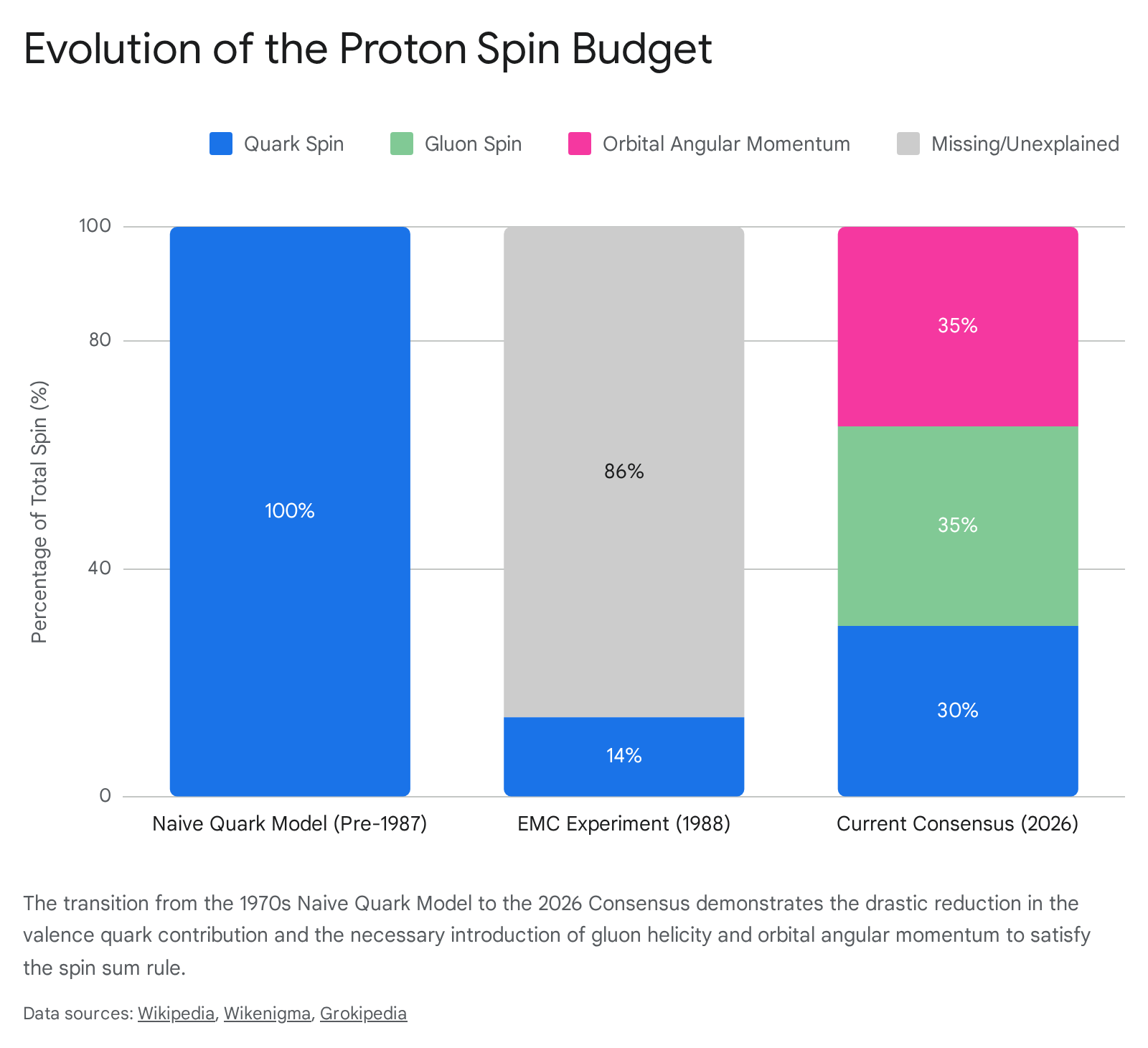
As of the 2025 - 2026 data synthesis, the scientific consensus regarding the proton spin sum rule at a standard renormalization scale (e.g., $Q^2 \approx 10$ GeV$^2$) is established as follows:
| Angular Momentum Component | Estimated Contribution to Proton Spin | Primary Verification Method |
|---|---|---|
| Quark Helicity ($\frac{1}{2}\Delta\Sigma$) | 30% to 38% | Global DIS fits (HERMES, COMPASS, JLab) and W-boson decay constraints (RHIC) 13821. |
| Gluon Helicity ($\Delta G$) | 25% to 40% | Double-helicity asymmetries ($A_{LL}$) in $p+p$ collisions (RHIC) combined with Lattice QCD 132332. |
| Orbital Angular Momentum ($L_q + L_g$) | 20% to 40% | Lattice QCD Direct Derivative Method (GTMDs) and preliminary SIDIS measurements 131630. |
This budget confirms that the naive quark model dramatically over-predicted the static quark contribution because it failed to account for relativistic transverse motion (the Melosh-Wigner rotation) and the emergent properties of the strong force 1112. The data unequivocally proves that gluons contribute positively to the proton's spin, primarily from the $x > 0.05$ momentum fraction 137. Furthermore, orbital angular momentum is now recognized not as a minor mathematical correction, but as a central, dominant physical pillar of nucleon structure 151830.
The "proton spin crisis" was never a crisis of the Standard Model's validity; it was a crisis of human intuition. The failure to predict the proton's spin distribution forced the physics community to confront the non-perturbative, highly relativistic reality of strong force confinement. The proton is not merely a static vessel containing three inert quarks; it is a chaotic, relativistic storm of virtual particles, fluctuating gluon fields, and massive orbital dynamics. With the imminent completion of the Electron-Ion Collider, the era of the proton spin puzzle is poised to conclude, transitioning from a mystery of missing fractions to an era of high-precision, three-dimensional nuclear tomography.