
Optimal Social Media Posting Times by Platform in 2026
Algorithmic Architecture and Content Distribution
The mechanics of social media distribution have undergone a fundamental architectural redesign between 2022 and 2026. Historically, social media platforms operated on a chronological "social graph," where content delivery to an established follower base dictated visibility 12. Under this older paradigm, the time of publishing was the absolute primary variable for organic reach. By 2026, all major platforms have transitioned to an "interest graph" model powered by multi-stage, artificial intelligence-driven recommendation engines 13. In this highly personalized ecosystem, a user's follower count no longer guarantees reach; instead, the content itself must earn distribution through complex behavioral signals processed in real time 1.
Despite these algorithmic shifts, the initial timing of a social media post remains a highly predictive variable for overall success. The concept of a "golden window" persists across network architectures: the initial 30 to 90 minutes after a post goes live serves as a critical, high-stakes testing phase 45. During this window, recommendation algorithms expose the content to a small, predictive seed audience 67. If this initial audience exhibits high engagement velocity - measured through rapid interactions, dwell time, video completion rates, saves, and shares - the algorithm scores the content positively and expands its distribution to a wider network of non-followers 689.
Conversely, if a post is published when the target demographic is asleep, commuting without mobile access, or otherwise inactive, the initial seed group will fail to provide the necessary behavioral signals 710. Without this immediate validation, the algorithmic system learns that the content is "not for them," and the post is quietly contained, effectively suppressing the content regardless of its objective production quality 78. While the gap between peak and off-peak engagement windows has narrowed slightly due to the algorithmic blending of fresh and historical content, the differences in optimal timing between discrete platforms have widened 111.
Core Ranking Signals
In 2026, superficial metrics such as passive "likes" have been deprioritized across several networks in favor of high-friction engagement signals that indicate deep user interest. Modern platforms utilize deep learning, natural language processing, and computer vision to ingest and categorize content natively, reducing the historical reliance on hashtags and manual metadata 16.
The primary signals driving distribution algorithms include dwell time and completion rate, which are the most heavily weighted ranking signals across video-first platforms 13. For example, on TikTok, the threshold required to trigger viral distribution has risen to a video completion rate of approximately 70% 3. For short-form video algorithms, a viewer dropping off in the first three seconds sends a strong negative signal, effectively halting further reach 112.
Additionally, "dark social" metrics, primarily post saves and direct message shares, are now weighted exponentially higher than public likes or comments. On LinkedIn, a save is estimated to be roughly five times more powerful than a standard like 5. On platforms like Instagram and TikTok, saves indicate utility and future reference value, while shares indicate high emotional resonance and virality potential 368.
Engagement Half-Life and Content Decay
To fully understand why publishing timing matters, it is necessary to examine how platforms score content chronologically and how quickly that content decays within the recommendation feed. The temporal relevance of a digital post is quantified by its "half-life" - defined as the time required for a piece of content to generate 50 percent of its total lifetime engagement 13.
Research analyzing 5.6 million posts across 11 major platforms in 2026 reveals extreme variance in content decay and lifespan 13.
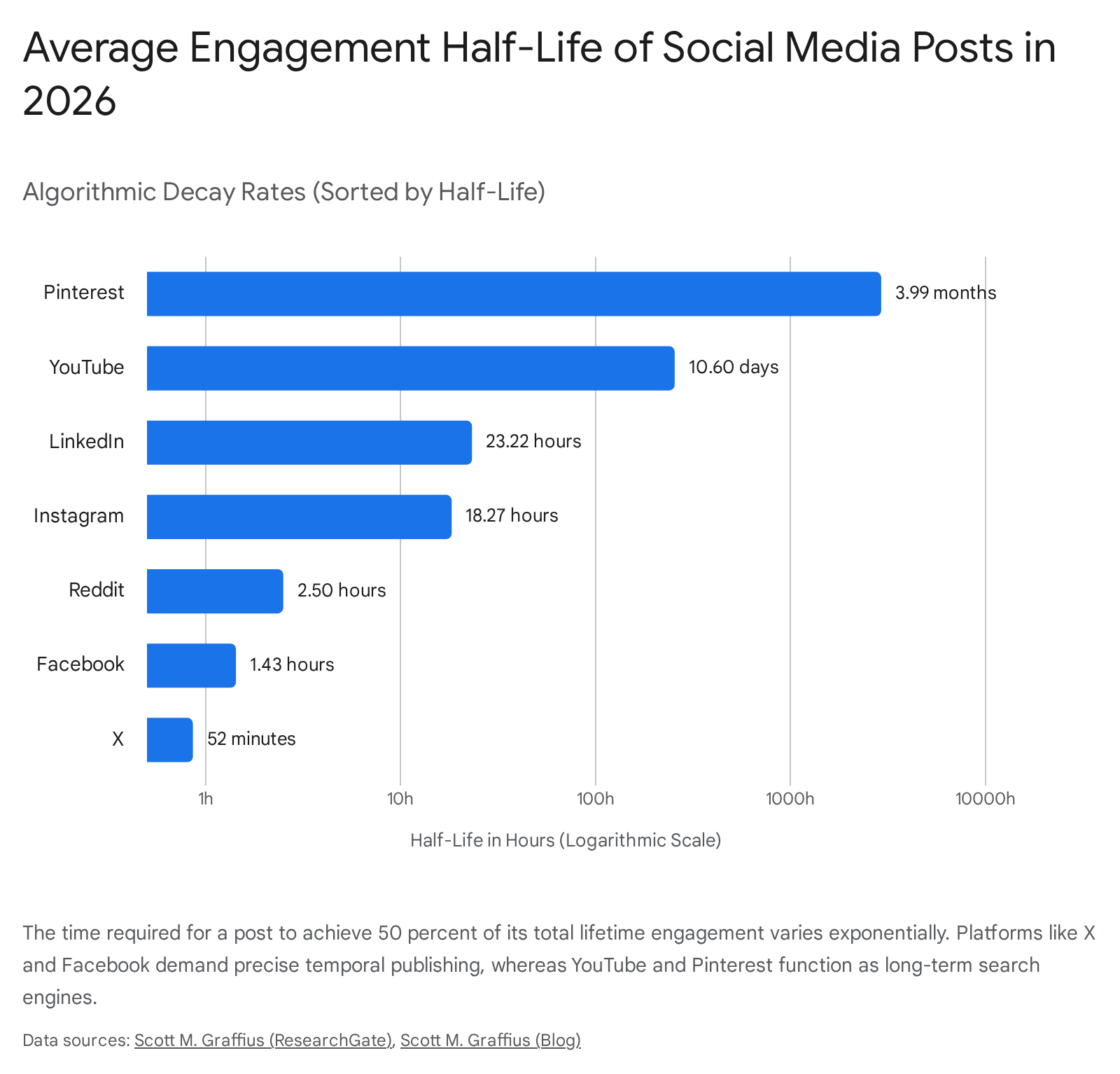
The data indicates that X (formerly Twitter) possesses a highly volatile half-life of just 52 minutes, while Facebook posts reach their half-life at 86 minutes 13. Because these feeds cycle rapidly and prioritize immediate chronological relevance, missing the audience's active window guarantees analytical failure. Conversely, platforms like Instagram (18.27 hours) and LinkedIn (23.22 hours) have extended their half-lives by algorithmically blending older, highly engaged posts into current feeds to maintain user retention 13.
YouTube (10.60 days) and Pinterest (3.99 months) operate fundamentally closer to search engines than standard social feeds. For these platforms, the initial publishing time is secondary to search engine optimization (SEO), metadata accuracy, and long-term content utility . Furthermore, ephemeral platforms like Snapchat, and to some extent the rapid-scroll environment of TikTok's primary feed, exhibit a median engagement half-life of zero minutes for the vast majority of non-viral content, meaning visibility vanishes almost instantaneously if initial thresholds are not met .
Aggregate Global Engagement Patterns
While platform-specific strategies are strictly necessary for optimization, aggregate data drawn from billions of user engagements reveals baseline human behavioral patterns regarding digital media consumption in 2026.
Midweek Consumption Trends
Across all major social networks, aggregate data establishes Tuesdays and Wednesdays as the absolute peak days for overall user engagement 14. The prime window for capturing audience attention globally spans from 11 a.m. to 6 p.m. in the user's local time zone 14.
This mid-week, mid-day peak aligns directly with modern hybrid and remote work behaviors. Rather than checking social media exclusively during structured morning or evening commutes, users in 2026 consistently browse feeds during brief mental breathers, extended lunch hours, and the late-afternoon work slump 141516. Publishing content during these highly active periods capitalizes on dense user populations, allowing algorithms to harvest early engagement signals rapidly. Thursday maintains strong momentum, particularly in the late morning and early afternoon, serving as a secondary peak for platforms like Facebook and Instagram 14.
Weekend Engagement Declines
Conversely, weekends consistently underperform across the majority of text and image-based networks. Sundays are universally recognized across multiple large-scale studies as the worst day to post on social media, yielding the lowest median engagement rates across the board 1416. Audiences largely unplug or shift their attention away from digital feeds toward real-world activities, resulting in smaller initial test groups for new content 141617.
Friday afternoons also exhibit a steep drop in digital interaction as users mentally check out from the workweek and transition into evening leisure 16. The primary exceptions to the weekend decline are visual, long-form entertainment platforms like YouTube, and highly immersive short-form platforms like TikTok, where leisure viewing naturally spikes on Saturdays and Sundays 71819.
Aggregate Publishing Windows
The following table synthesizes 2026 data regarding the highest-performing baseline publishing windows across the major platforms, highlighting the divergence in audience behavior.
| Social Network | Highest Performing Days | Optimal Time Windows (Local Time) | Days to Avoid | Primary Content Driver |
|---|---|---|---|---|
| Tuesday, Wednesday, Thursday | 10 a.m. - 12 p.m.; 1 p.m. - 5 p.m. | Saturday, Sunday | Text, Carousels, Professional Video | |
| Tuesday, Wednesday | 11 a.m. - 1 p.m.; 6 p.m. - 9 p.m. | Sunday | Reels, High-quality visual carousels | |
| TikTok | Tuesday, Wednesday, Thursday | 2 p.m. - 6 p.m.; 6 p.m. - 11 p.m. | Sunday (disputed) | Immersive short-form video (sound-on) |
| Wednesday, Thursday | 9 a.m. - 3 p.m. | Saturday, Sunday | Community updates, video, links | |
| X (Twitter) | Tuesday, Wednesday | 8 a.m. - 11 a.m.; 12 p.m. - 6 p.m. | Saturday, Sunday | Breaking news, real-time events |
| YouTube (Shorts) | Friday, Saturday | 4 p.m. - 7 p.m.; 6 p.m. - 11 p.m. | Early weekday mornings | Entertainment, educational snippets |
Note: Data aggregated from multiple 2026 reports. All times are localized to the target audience's primary time zone. 111416182021
Platform Timing and Algorithm Data
Because a single chronological baseline does not apply universally, a granular analysis of each network's 2026 algorithmic architecture and specific audience behaviors is required to deploy an effective distribution strategy.
LinkedIn Engagement and Scheduling
LinkedIn boasts the highest median engagement rate of any major platform in 2026, hovering at approximately 6.1% to 6.2%, though it experienced a slight 5% decline from previous years 222324. The platform is heavily segmented by its Business-to-Business (B2B) nature, closely mirroring traditional corporate working hours.
The peak windows for LinkedIn are Tuesdays, Wednesdays, and Thursdays between 9 a.m. and 5 p.m. 142025. Within this broad block, data reveals concentrated micro-peaks during mid-morning (10 a.m. to 12 p.m.) and mid-afternoon (1 p.m. to 4 p.m.) as professionals browse between meetings or during breaks 1620. Publishing on weekends results in a severe distribution penalty, as professional activity plummets and users log off 2025. B2B posts published on Tuesday and Wednesday mornings show a distinct 40% performance increase over the platform baseline 20.
LinkedIn's 2026 algorithm prioritizes "knowledge-sharing" and professional tone, actively penalizing broad, non-professional viral content 2. Initial engagement velocity in the first 30 to 60 minutes is critical; posts that generate quick, meaningful comments receive up to three times more total reach 520. Furthermore, organic reach for standard Company Pages has declined drastically, now making up only 1% to 2% of the feed 5. To succeed, brands must leverage the personal profiles of executives and employees, which generate 561% more reach than identical content posted on a corporate page 5. From a format perspective, multi-page carousels (PDF documents) are the highest-performing asset, driving a median engagement rate of 21.77%, followed by native video at 7.35% 22.
Instagram Format Bifurcation
Instagram's user dynamics have shifted notably, resulting in an overall platform engagement decline of approximately 26% year-over-year in 2025 and 2026, dropping the median interaction rate to roughly 5.4% 222324. This decline is largely attributed to platform saturation and a heavy algorithmic pivot toward Reels, which cannibalized the reach of traditional static posts 24. As a result, Instagram requires a bifurcated timing strategy based entirely on the content format being published.
Static posts and multi-image carousels perform best during daytime hours, particularly Wednesdays and Thursdays between 11 a.m. and 1 p.m., capturing audiences during lunch breaks and quick aesthetic check-ins 91516. Conversely, short-form video requires higher intent and audio availability. Reels achieve peak distribution when published in the evening, specifically between 6 p.m. and 11 p.m. on weekdays, when users are relaxing at home 9111826.
Another highly effective, albeit counterintuitive, window identified in 2026 data is early morning. Later's analysis of six million Instagram posts found that posting at 5 a.m. local time yields exceptionally high engagement 27. This early window allows the algorithm to index the content and surface it to users during their initial morning scroll, benefiting from minimal feed competition before other brands begin publishing at standard business hours 112729. Instagram operates essentially as four distinct algorithms (Feed, Reels, Explore, and Stories), meaning creators must maintain format-specific schedules 8.
TikTok Distribution and Delayed Virality
TikTok maintains a highly active user base, commanding an average of 95 minutes of global user attention per day 28. Its algorithm is the purest iteration of an "interest graph," heavily favoring raw watch time and shareability over established follower relationships 3.
While timing is less predictive of absolute virality on TikTok than on Facebook - due to the phenomenon of "delayed virality" where a video may surge days or weeks after publishing - initial timing still heavily impacts the critical first test batch of viewers 3129. The consensus across 2026 datasets points to late afternoon and evening dominance. Sprout Social identifies Tuesdays through Thursdays from 2 p.m. to 6 p.m. as the peak global window, leveraging the mid-afternoon energy slump 21. Other researchers extend this into the evening, highlighting 6 p.m. to 11 p.m. as peak entertainment hours 181933. TikTok is also one of the few platforms where weekend publishing yields strong discovery metrics, particularly Saturday and Sunday mornings around 9 a.m. to 1 p.m., as users engage in extended scrolling sessions 111819.
In 2026, TikTok made a significant algorithmic shift by testing content primarily with a creator's existing followers before pushing it to the broader For You Page (FYP), a departure from its historical model 3. Niche consistency is strictly enforced; creators who oscillate between unrelated topics experience a 45% reduction in reach 330. Furthermore, following corporate restructuring and the Oracle data center migration, the algorithm for US users has been retrained entirely on domestic data, meaning international content strategies must account for diverging recommendation patterns 330.
YouTube Hybrid Video Strategies
YouTube operates distinctly from scroll-based algorithmic feeds. It is fundamentally a search and long-form retention engine, though the rapid expansion of YouTube Shorts has altered channel growth strategies globally.
YouTube Shorts mimic the behavioral patterns of TikTok, thriving during high-leisure, mobile-first windows. The peak times for publishing Shorts are Fridays and Saturdays between 4 p.m. and 7 p.m., as well as weekday evenings from 6 p.m. to 11 p.m. 183331. Shorts boast an impressive 5.91% engagement rate, marginally higher than TikTok (5.75%) or Instagram Reels 1231. Conversely, traditional horizontal videos require a high commitment of time from the viewer. The best windows for publishing long-form content are Sunday mornings (around 10 a.m.) and evenings (6 p.m. to 10 p.m.) early in the week, allowing videos to accumulate views when audiences have uninterrupted leisure time 18.
In 2026, the most successful YouTube strategy relies on a hybrid ecosystem approach. Shorts act as the primary discovery mechanism, with 74% of Shorts views coming from non-subscribers, effectively funneling new viewers into the broader channel 31. Long-form content is then utilized to build deep trust, community loyalty, and higher monetization via extended watch times 1236. Data indicates that channels combining both formats consistently grow 41% to three times faster than single-format channels 3137.
Facebook and Microblogging Platforms
Facebook remains a massive driver of global web traffic, though organic reach for traditional business pages has fundamentally collapsed as Meta forces a "pay-to-play" advertising model and prioritizes private community group content and Reels 138. The optimal posting times for organic Facebook content hover around conventional business hours: Wednesdays and Thursdays between 9 a.m. and 3 p.m. 1618.
X (formerly Twitter) remains a fast-paced, real-time news and cultural commentary engine. Due to its exceptionally short half-life of 52 minutes, precise timing is paramount 13. Weekday mornings, specifically between 8 a.m. and 11 a.m. on Tuesdays and Wednesdays, capture professionals and news consumers starting their day 1832. Despite the high frequency of posting, median engagement rates on X are the lowest among major platforms, hovering around 2.5%, though this represents a relative increase from previous years 222324.
Pinterest operates as a visual search engine for inspiration and planning, giving its content the longest lifespan of any network. Users are highly active during early mornings (as early as 4 a.m. to 7 a.m.) and late into the weekends 1117. Threads, Meta's microblogging competitor, sees peak engagement on weekday mornings between 7 a.m. and 12 p.m., though its overall median engagement rate dropped to 3.6% in 2026 as user volume increased and organic traction became more difficult 18222324.
Regional Audience Demographics
The pursuit of an optimal posting time is ultimately a proxy for audience availability. Behavioral patterns diverge sharply when analyzing different demographic and geographical targets, meaning global social media strategies cannot rely solely on US-centric data 1425.
The dichotomy between Business-to-Business (B2B) and Business-to-Consumer (B2C) audiences heavily dictates scheduling strategies. B2B audiences treat social media as an extension of their workflow. Their engagement is heavily concentrated on LinkedIn and X between Tuesday and Thursday, strictly within the 9 a.m. to 5 p.m. boundary 20. Mid-morning (10 a.m. to 11 a.m.) serves as the absolute apex for B2B engagement, capturing professionals immediately after they have cleared their morning emails 101520. Conversely, B2C audiences exhibit fragmented, "always-on" behavior. Consumers engage in frequent, brief sessions during downtime and extended deep-scroll sessions in the evenings and on weekends 101620.
Regional platform adoption also significantly alters strategic timing:
| Region | Dominant Growth Platforms | Key Behavioral Traits | Generational Adoption Gap |
|---|---|---|---|
| Southeast Asia (SEA) | TikTok, YouTube, Instagram | High daily usage (e.g., 190 mins/day in Thailand). TikTok functions as a primary search engine and e-commerce hub (TikTok Shop). | Low gap. Broad adoption across demographics. |
| Latin America (LATAM) | TikTok, Instagram, Facebook | Rapid growth in short-form video. High reliance on micro-influencers over polished studio content. | Low gap. TikTok usage between Gen Z and Boomers differs by under 20%. |
| North America / EU | YouTube, LinkedIn, Instagram | High algorithmic fragmentation. Saturation leads to lower organic reach. LinkedIn dominates B2B interactions. | High gap. TikTok usage between Gen Z and Boomers differs by over 50%. |
Data aggregated from 2026 regional behavioral studies. 40334234
Marketing in Southeast Asia in 2026 requires hyper-localized nano-influencers and raw, unpolished video content rather than high-budget studio productions, with a heavy emphasis on mobile-first discovery 4042. Furthermore, time zones must be explicitly accounted for; centralized scheduling software should automatically localize posts to the target market's primary meridian rather than the corporate headquarters' location 1425.
Artificial Intelligence and Ad Delivery Automation
The debate over manual posting times for organic content is increasingly overshadowed by the integration of Artificial Intelligence in paid ad delivery and content distribution.
In late 2025 and 2026, Meta finalized the rollout of its "Andromeda" ad retrieval system and the Generative Ads Recommendation Model (GEM) 4435. This transition functionally eliminated the efficacy of manual micro-targeting 36. Instead of marketers defining the exact audience demographics and delivery times, the algorithm requires "creative diversification" - inputting up to 50 genuinely different creative assets per campaign 44. The AI parses the visual and textual data of the creative itself, autonomously matching it to users across its network at the precise moment they are statistically most likely to convert 4447.
In this environment, the creative asset acts as the targeting mechanism 47. Consequently, while timing remains highly relevant for organic baseline testing, achieving massive scale on platforms like Facebook and Instagram is now dictated by an AI's ability to predict user intent in real-time, stripping granular chronological control away from the traditional media buyer 4436.
The Fallacy of Universal Posting Times
The divergence in datasets - such as some studies citing Wednesday as the worst day for TikTok, while others cite Sunday - highlights a critical reality of 2026 digital marketing: universal posting times are a fallacy 181921.
Generic timing recommendations serve only as starting points. Because algorithms test new content with a seed audience, the only timing that truly matters is when a brand's specific followers are active 112948. Furthermore, engagement velocity can be artificially manipulated through community management. Data from 2026 shows that creators who reply to comments consistently within the first hour of posting outperform those who do not, boosting overall post engagement by up to 42% on conversational platforms like Threads, and 30% on LinkedIn 49. This immediate interaction signals to the algorithm that the post is fostering active community dialogue, thereby extending its half-life and reach 49.
Case Studies in Digital Campaign Timing
The intersection of precise timing, platform dynamics, and content quality is best illustrated through successful 2026 brand campaigns that leveraged these variables effectively.
Strategic Humor and Cultural Timing: The skincare brand CeraVe executed a highly successful campaign by partnering with actor Michael Cera prior to the 2024 Super Bowl. By releasing cryptic, humorous content across TikTok and Instagram during the weeks leading up to the event - a period of high digital consumption and cultural attention - the brand captured millions of views and massive search spikes, proving that timing content to coincide with broader cultural moments amplifies algorithmic reach 37. Similarly, Liquid Death launched an anti-soda satirical campaign that garnered 3.6 million views within a month by leaning into highly shareable, irreverent content that users naturally distributed via DMs, triggering exponential algorithmic growth 37.
Aligning with Global Issues and Micro-Communities: Nike's 2026 sustainability campaign demonstrated the power of platform-specific alignment. By utilizing educational content and eco-conscious influencers on platforms like Instagram and YouTube, Nike aligned its publishing schedule with global environmental awareness events. This targeted approach boosted engagement by 20% across platforms 38. Airbnb deployed a similar strategy by shifting away from mega-celebrities toward micro-influencers. By having these influencers post authentic, localized content showcasing unique properties, Airbnb reached highly engaged niche communities, resulting in an 18% increase in bookings 38.
Conclusion
The extensive research encompassing 2026 social media data establishes that there is no single, universal time to publish content. Attempting to apply a uniform timestamp across a multi-platform strategy will inevitably result in suppressed reach, algorithmic penalties, and wasted resources.
To maximize digital impact, organizations must adopt strategies that respect algorithmic architecture. This includes prioritizing the midweek baseline for broad organic reach, tailoring schedules by format rather than just by platform (e.g., treating Reels differently than static images), and optimizing for initial engagement velocity. Furthermore, embracing a hybrid content ecosystem - pairing short-form, high-reach video with long-form, high-retention media - ensures both rapid audience acquisition and long-term brand loyalty.
Ultimately, chronological scheduling serves as a mathematical amplifier. Publishing at the optimal hour provides excellent content the highest statistical probability of escaping the initial algorithmic filter, but it cannot rescue irrelevant, poorly structured, or unengaging material from algorithmic decay.