
Online audience attention spans and content strategy in 2026
The digital media ecosystem of 2026 operates under unprecedented cognitive and technological pressures. As internet users navigate a landscape where generative artificial intelligence (GenAI) systems produce over half of all new web content, the fundamental mechanics of human attention have been forced to undergo a radical adaptation 1. The conventional wisdom that human attention spans are merely "shrinking" fails to capture the complex, adaptive neurobiological reality of modern media consumption. Instead, digital audiences have developed highly sophisticated, task-selective filtering mechanisms to process an overwhelming velocity of algorithmic stimuli 23.
This comprehensive report synthesizes peer-reviewed literature, Human-Computer Interaction (HCI) research, geographic usage data from the Asia-Pacific (APAC) region, and commercial analytics benchmarks from industry leaders like Chartbeat and Parse.ly to provide a definitive analysis of online attention in 2026. By debunking legacy myths and exploring the cognitive cost of digital immersion, this document establishes the strategic implications for content format, length, and measurement in the contemporary attention economy.
Deconstructing the Goldfish Myth: Biological Limits vs. Task-Selective Filtering
For over a decade, digital marketers, media theorists, and cultural commentators have perpetuated the "goldfish myth" - the assertion that the human attention span has deteriorated to less than eight seconds, rendering it inferior to that of a common aquatic pet. Contemporary cognitive psychology and neurobiology entirely debunk this narrative 24. The human brain's biological capacity for sustained attention has not decayed; rather, the ecological demands of the digital environment have necessitated a profound shift in how attentional resources are allocated and conserved 24.
Extensive longitudinal tracking of screen time behavior, notably conducted by Dr. Gloria Mark and her colleagues at the University of California, Irvine, reveals a more nuanced, albeit stark, trajectory. In 2004, leveraging early computer logging software, researchers found that the average duration of focus on a single screen before a user switched contexts was approximately 150 seconds, or two and a half minutes 356. By 2012, as smartphone penetration and social media usage accelerated, this metric had declined precipitously to 75 seconds 35. In the contemporary digital environment of the mid-2020s, the average attention span on any given screen rests at just 47 seconds, with a median of 40 seconds - meaning half of all observed screen-focus intervals are 40 seconds or less 257.
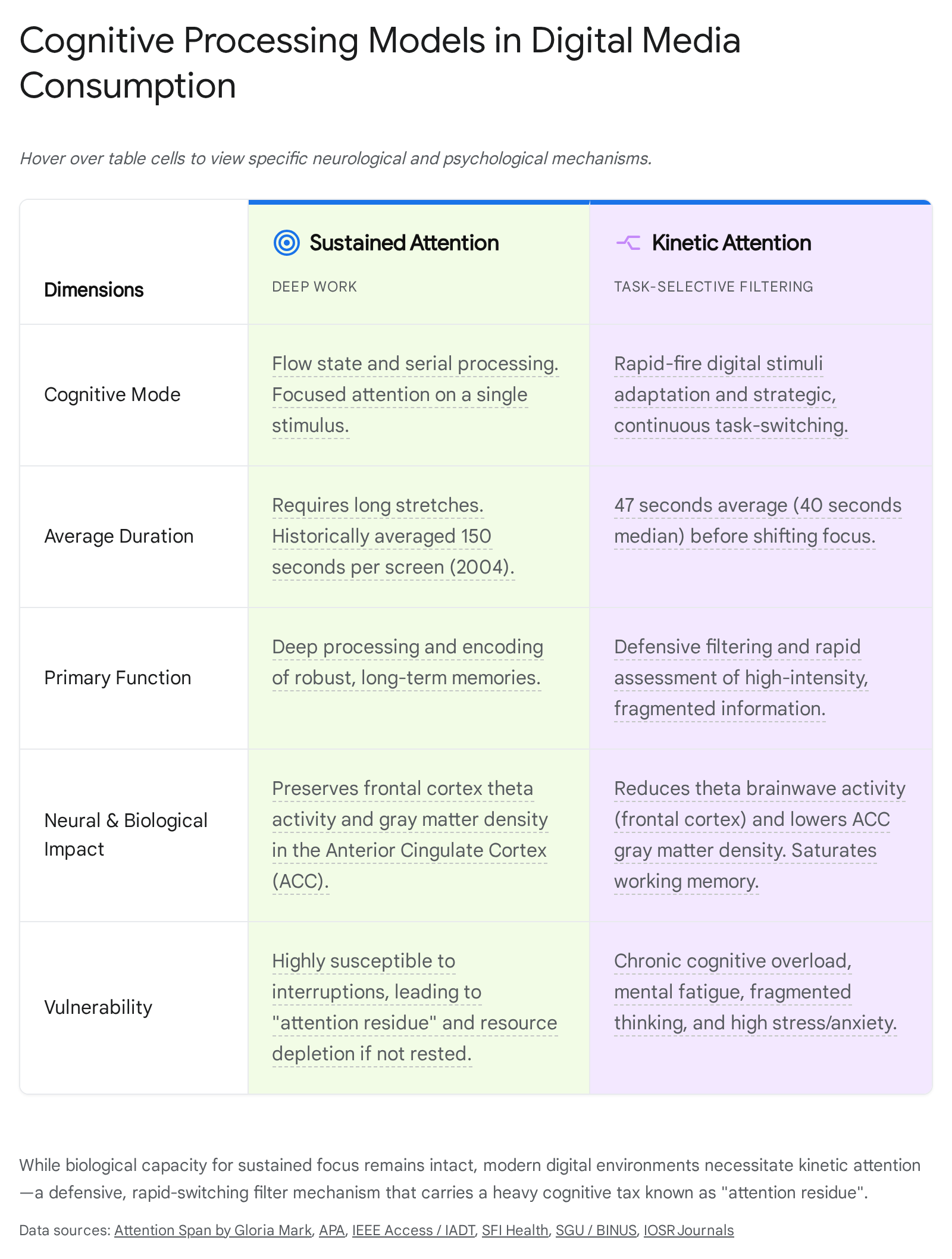
However, this metric must not be interpreted as an absolute loss of cognitive ability or a biological degeneration. Instead, it reflects the deployment of what researchers term "kinetic attention" 24. In a hyper-saturated information environment, the brain engages in strategic, rapid task-switching to prevent mental fatigue and maximize information foraging 24. When individuals are faced with infinite content, the biological system intuitively prioritizes rapid evaluation over prolonged immersion unless the stimulus immediately proves its high value or relevance 3.
This phenomenon highlights the critical distinction between biological sustained attention and task-selective filtering. The human brain remains a serial processor; it cannot effectively perform multiple attention-heavy cognitive tasks simultaneously 3. Instead of true multitasking, the brain engages in rapid, sequential filtering. The modern audience member is not biologically incapable of deep focus; they are simply employing a highly attuned, evolutionary defense mechanism against irrelevant data. The 47-second screen-switch is a symptom of users actively filtering for resonance, relevance, and psychological reward 27.
When a piece of content successfully clears this filtering threshold, biological sustained attention engages fully. This explains the apparent paradox of modern consumption: the same user who cannot focus on a corporate blog post for more than 40 seconds possesses the cognitive endurance to binge-watch hours of streaming video narratives, immerse themselves in deep-dive podcasts, or read exhaustive, 5,000-word investigative reports 48. Therefore, the "short attention span" so frequently lamented by marketers is more accurately defined as a ruthlessly abbreviated evaluation window.
The Cognitive Cost: Continuous Partial Attention and HCI Insights
While task-selective filtering is a necessary adaptation to digital noise, it carries significant, cumulative cognitive costs. Recent Human-Computer Interaction (HCI) research, prominently featured in the ACM Digital Library and CHI conferences throughout 2024 and 2025, heavily scrutinizes the phenomenon of continuous partial attention and the specific physiological tolls of media multitasking (MMT) 91011.
When users constantly shift their focus between browser tabs, social feeds, and incoming user interface (UI) notifications, they invariably suffer from "attention residue." Originally theorized by Sophie Leroy in 2009 and heavily expanded upon in contemporary HCI literature, attention residue occurs when cognitive resources remain anchored to a previous, often unfinished task, even after the user has physically and visually switched to a new stimulus 91011. For example, when a knowledge worker or media consumer is interrupted by a smartphone notification or an algorithmic content recommendation, it triggers an "interruption lag" during which the brain encodes the switch, followed by a "resumption lag" when the user attempts to re-orient to the original task 10. Research indicates that unresolved interruptions can create an attention residue requiring up to 25 minutes for full cognitive recovery and re-immersion into a state of deep work 2.
This state of continuous partial attention creates a condition of chronic, low-level stress. Multitasking in digital environments has been shown to increase user stress by up to 40% while functionally halving productivity and depth of processing 2. Furthermore, excessive reliance on rapid context-switching physically alters neural connectivity and brain topography. Neuroimaging studies, including fNIRS (functional near-infrared spectroscopy) and fMRI mapping, demonstrate that heavy media multitaskers and frequent consumers of short-form video exhibit reduced theta brainwave activity 7131215. More alarmingly, these individuals demonstrate lower gray matter density in the anterior cingulate cortex (ACC) and the prefrontal cortex (PFC) - regions of the brain that are absolutely critical for impulse control, error identification, emotional regulation, and sustained focus 71215.
The implications for interface design and content strategy are profound. MMT leads to increased impulsiveness, heightened distractibility, and a diminished capacity for working memory encoding 1012. Digital platforms, particularly those utilizing short, highly engaging videos, trigger continuous, minor dopamine releases in the orbitofrontal cortex, effectively training the brain to expect rewards in 15-to-30-second bursts 13. Consequently, HCI research suggests that "disruptiveness" in the modern era is not merely a device-centered problem, but a deeply ingrained habit-centered one 9. Content that requires deep prospective memory - the cognitive ability to remember to execute a previously planned action - suffers severely in environments optimized for continuous partial attention 11.
Technological Drivers: AI Inundation and Algorithmic Hyper-Personalization
The transformation of human attention spans cannot be isolated from the technological infrastructure responsible for delivering the content. In 2026, two primary technological drivers have irrevocably reshaped the cognitive landscape: the exponential, industrialized surge of AI-generated content and the pervasive shift toward algorithmic hyper-personalization.
As of early 2026, empirical research indicates that over 50% of all written content on the internet is generated by artificial intelligence, with specific SEO analyses revealing that up to 74% of newly created web pages incorporate synthetic text 1. Before the advent of mass-market Large Language Models (LLMs) in late 2022, that figure hovered around 5% 1. This unprecedented, explosive volume of information actively accelerates the necessity for task-selective filtering. The internet is effectively drowning in "semi-structured sludge," overwhelming human regulatory capacities and making it increasingly difficult for users to identify what is truly relevant and meaningful 1617.
This abundance has triggered a widespread behavioral phenomenon known in cognitive psychology as "cognitive offloading" - the reliance on external systems to shoulder cognitive demand 1618. In a parallel to the "Google effect" of the early 2010s, where humans became less likely to remember information they believed was readily searchable online, users in 2026 rely heavily on GenAI summaries to bypass the effort of reading 18. Studies consistently demonstrate that individuals using GenAI tools exhibit an "illusion of competence"; they complete tasks faster and report higher confidence, but demonstrate weaker subsequent memory recall, diminished depth of inquiry, and markedly poorer critical thinking skills 1618. Because users increasingly trust AI to pre-digest the content ecosystem, their native attention spans for raw information extraction and critical evaluation continue to atrophy. This atrophy is so pronounced that Gartner predicts that by 2026, 50% of global organizations will require "AI-free" skills assessments to evaluate the independent critical thinking capabilities of their workforce 13.
Simultaneously, content delivery mechanisms have evolved to ruthlessly exploit the brain's dopamine pathways. Algorithms on platforms like TikTok and Instagram no longer wait for users to actively search for content; instead, they serve a hyper-personalized, frictionless, and infinite stream of stimuli 37. This algorithmic hyper-personalization essentially weaponizes the 47-second attention span. By constantly feeding the user exactly what they want before they even consciously register the desire, the algorithm minimizes friction and maximizes platform retention 318. However, this simultaneously destroys the user's capacity to tolerate the "desirable difficulties" required for slow, effortful cognitive work 18. When external aids and predictive algorithms continuously shoulder the cognitive demand, the human instinct is to let them, leading to a profound erosion of sustained inquiry 18.
The Barbell Effect: The Divergence of Ultra-Short and Ultra-Long Media
A direct consequence of kinetic attention, cognitive offloading, and task-selective filtering is the manifestation of the "barbell effect" in content marketing and media consumption patterns. Because the modern consumer's evaluation window is exceptionally brief, mid-tier, generalized content - often colloquially termed the "messy middle" - is increasingly ignored 520. The market has bifurcated entirely, moving aggressively toward two extremes: ultra-short, highly stimulating snackable media designed to bypass cognitive load, and ultra-long, deeply immersive content designed to reward the user who selectively commits their sustained attention 814.
Ultra-Short Media: The Top of the Funnel
Short-form video, categorized primarily as content under 60 seconds (e.g., TikToks, Instagram Reels, YouTube Shorts), functions as the ultimate capitulation to continuous partial attention. Statistically, short-form videos under 60 seconds account for 68% of all global social media shares, and videos under 90 seconds achieve a 76% average completion rate across devices 8. On TikTok, which boasts the highest engagement metrics globally, videos under 21 seconds command the highest completion rates at a staggering 88% 8.
These ultra-short formats are algorithmically engineered to provide immediate neurochemical rewards, capitalizing on the user's desire for velocity and novelty. From an engagement metric standpoint, short-form content generates immense interaction volume; short-form videos receive 94% more comments than long-form content across major platforms, and Instagram Reels drive 73% of total platform engagement on that specific network 8. However, this engagement is frequently shallow. The behavioral outcome is rapid consumption without deep cognitive retention, acting primarily as an engine for brand discovery, top-of-funnel reach, and impulsive interaction rather than meaningful knowledge transfer 822.
Ultra-Long Media: The Anchor of Trust and Authority
Conversely, the opposite end of the barbell demonstrates that when the 47-second filtering threshold is successfully passed, audiences actively seek profound depth and narrative immersion. Long-form content - such as 2,000+ word deep-dive articles, comprehensive whitepapers, and podcast episodes exceeding an hour - provides the cognitive immersion that short-form media intrinsically lacks.
Statistically, the return on investment (ROI) of long-form content is irrefutable for deep engagement, lead qualification, and authority building. Long-form content averaging 2,500 words generates 63% more backlinks than content under 1,000 words 8. In the B2B sector, 79% of marketers rank long-form content as their primary driver of high-quality leads, with conversion rates substantially outperforming short-form equivalents 823. Engagement metrics reflect this immersion: long-form articles exceeding 1,800 words achieve an average time-on-page of 7 minutes and 42 seconds, a stark contrast to the mere 2 minutes and 11 seconds secured by articles under 600 words 8.
Most critically, long-form content facilitates memory encoding and establishes trust in an era of synthetic media. Readers retain 31% more information from long-form articles than from short summaries, and consumers are 57% more likely to trust brands that commit to publishing rigorous, long-form assets 8. In a media ecosystem plagued by AI-generated "slop," misinformation, and superficiality, the ultra-long format signals credibility, human effort, and intellectual rigor 1824.
| Content Paradigm | Ultra-Short-Form Media (<60 seconds / <500 words) | Ultra-Long-Form Media (>10 minutes / >2,000 words) |
|---|---|---|
| Primary Cognitive Function | Rapid discovery, entertainment, and habitual task-switching. | Deep learning, analytical research, and emotional immersion. |
| Cognitive Requirement | Kinetic attention; low barrier to entry; capitalizes on dopamine loops. | Sustained attention; high cognitive load; requires filtering bypass. |
| Global Share Dominance | Accounts for 68% of all global social media shares 8. | Substantially lower raw share volume, but higher qualitative sharing. |
| Completion Rate Dynamics | 76% average completion (88% for TikToks under 21s) 8. | Lower absolute completion rate, but vastly higher total engagement time. |
| Authority and SEO Impact | Minimal backlink generation; low search authority. | Generates 63% more backlinks than short-form content 823. |
| Average Time-on-Page | Less than 2 minutes and 11 seconds 8. | Exceeds 7 minutes and 42 seconds 8. |
| Information Retention | Low; prone to fragmented memory encoding and attention residue 12. | High; readers retain 31% more information 8. |
| Primary Business Utility | High reach, impulse engagement, and broad brand awareness. | Trust building, high-quality MQL generation, and thought leadership. |
The Citation Economy and the Demise of Traditional Search
The barbell effect is further reinforced by the evolution of search engines into "answer engines." As AI-powered discovery tools like Google's AI Overviews and Perplexity intercept user queries, the traditional SEO model based on ranking and click-through rates is collapsing. In 2026, 60% of searches end without a single click to any external website 15. AI Overviews now appear on 48% of all Google queries, and only 8% of general searchers click a link when an AI summary is present 15.
This has shifted digital marketing from the "Attention Economy" to the "Citation Economy" 16. In this new paradigm, visibility is not defined by where a brand appears on a search engine results page, but by whether the brand is remembered and referenced by an LLM 16. LLMs trade in trust signals, context density, and entity relevance rather than traditional backlinks and keyword density 16. Brands no longer merely compete for human eyeballs; they compete for inclusion in an AI's memory matrix. If a brand's long-form content does not possess deep, original insights - such as proprietary statistics, which see 28% to 40% higher visibility in AI search results - the AI will ignore it, entirely removing the brand from the user's evaluation window before a human ever has the chance to apply their kinetic filtering 15.
Geographic Expansion: The APAC Super-App Ecosystem and Mobile-First Engagement
While Western media paradigms often view digital platforms as fragmented, isolated destinations - for example, utilizing one application for video consumption, a separate application for messaging, and a third for financial transactions - the Asia-Pacific (APAC) region presents a divergent and highly advanced evolutionary path. The APAC region is the undisputed global epicenter of the "super app" model, commanding 46.8% of the global super app market 17. Platforms like WeChat in China (reporting over 1.41 billion monthly active users) and Grab in Southeast Asia have centralized the digital experience into massive, comprehensive ecosystems 1728.
Consolidated Attention and Habitual Engagement
The super-app architecture fundamentally alters the mechanics of attention residue and cognitive load. In Western markets, task-switching often means changing contexts entirely - leaving a reading application to open a banking application - which triggers a high cognitive switching cost and distinct interruption lags 10. In APAC's mobile-first economies, users remain within a single, unified interface 1728. This closed ecosystem anchors multiple services, including commerce, mobility, social networking, and finance, around a single user identity and payment layer 17.
Consequently, digital engagement metrics in the APAC region frequently outpace Western counterparts, demonstrating a deep integration of digital habits into daily life. For instance, the APAC region records the longest average gaming session lengths globally, clocking in at an average of 33.14 minutes per session 18. Furthermore, finance application usage in APAC surged by 50% year-over-year in 2025, compared to a 21% rise globally, reflecting a population that manages virtually all aspects of modern life through a single pane of glass 18.
The Danger of Embedded Distractions
However, this extreme consolidation brings highly concentrated cognitive risks. While the frictional cost of switching between entirely different applications is reduced, the volume of internal notifications within the super app is exponentially magnified. Studies examining WeChat usage indicate that incoming social message signals within the app act as severe distractors during continuous performance tasks 13. The omnipresence of the super app means that users are never truly disconnected; the boundary between professional deep work, financial management, and social interruption is effectively erased, exacerbating the stress associated with continuous partial attention 1319.
The Demand for Co-Creation
Culturally and technologically, APAC consumers are also leading a profound shift from passive media consumption to active, integrated participation. According to Omnicom Media Group APAC's 2026 trends report, consumers are actively demanding co-creation and community interaction 31. Livestreaming and social commerce have transformed engagement from a one-way broadcast into a two-way collaborative street 31. One in four APAC consumers explicitly states they are more likely to promote a brand they feel directly involved with, highlighting that active interaction - rather than passive screen-staring - is the new baseline for measuring genuine attention in the region 31.
Measuring Attention: Commercial Vendor Data vs. Peer-Reviewed Academic Validity
As the very nature of human attention shifts toward rapid filtering and deep immersion, the metrics used by the media and advertising industries to quantify it have undergone a necessary revolution. For two decades, the digital ecosystem relied on legacy proxy metrics: pageviews, impressions, and click-through rates (CTR) 3233. In 2026, these metrics are widely acknowledged as inadequate for measuring true cognitive engagement. A pageview merely records that a server delivered a file; it does not confirm that a human being cognitively processed the information 3220.
The Emergence of Modern Attention Metrics
To address this epistemological gap, specialized analytics vendors like Chartbeat and Parse.ly have pioneered advanced, behavioral attention metrics, attempting to quantify genuine human focus.
Chartbeat champions real-time, minute-by-minute analytics designed specifically to help newsrooms and digital publishers make immediate editorial decisions 2136. Its core philosophy relies on specific, active behavioral proxies rather than passive loads: * Engaged Time: Defined as the average amount of time (in seconds) visitors actively spend interacting with a page (e.g., clicking, scrolling, moving the mouse, typing) 362223. Chartbeat's research notes that content in view just above the digital fold receives the shortest actual view time, while engagement reliably peaks deeper into the page (around 1200 pixels) 23. * Recirculation: The percentage of active readers who click through to a second piece of content on the site, indicating sustained platform loyalty over single-page abandonment 362324. * Scroll Depth: Tracking how far down the page users travel, capturing content consumption well beyond the fold 2223.
Parse.ly (now integrated into Automattic/WordPress VIP) approaches attention from a broader, historical, and strategic perspective, boasting over 30 unique attention metrics 404125. Parse.ly emphasizes long-term content strategy and audience development, tracking: * Active Interaction: Filtering out passive tabs left open in the background to measure true, active audience attention 25. * Audience Segmentation & Return Visitor Rate: Measuring the critical difference between volatile, single-session traffic and loyal, returning subscribers 202325. * Content Conversions: Tying specific content engagement directly to bottom-funnel business actions, such as newsletter signups, demo requests, and paid subscriptions 362526.
| Measurement Category | Traditional Proxy Metrics (Pre-2020) | Modern Attention Metrics (2026 Standard) | Primary Insight Derived |
|---|---|---|---|
| Volume & Reach | Pageviews, Unique Visitors, Raw Impressions | Active Engaged Time, Quality Page Views (>15s of active engagement) | Differentiates actual cognitive presence from accidental clicks, bot traffic, and passive background tabs 2022. |
| Behavioral Interaction | Click-Through Rate (CTR), Bounce Rate | Scroll Depth, Active Cursor Movement, Recirculation Rate | Identifies exact friction points, layout optimization opportunities, and narrative drop-offs 2344. |
| Commercial Value | Cost Per Mille (CPM), Basic Conversion Rate | Attentive Minutes per Thousand, Pipeline Influence, Cohort Retention | Demonstrates a 0.98 correlation between attentive minutes and incremental profit across major media types 3245. |
| Social / Off-Site | Likes, Raw Follower Count | Refs/Interaction Ratio, Cross-Channel Attention Score | Measures the true viral coefficient, dark social sharing, and genuine community advocacy 2747. |
Academic Critique of Commercial Attention Metrics
While vendors market "Engaged Time" and "Scroll Depth" as revolutionary windows into the consumer's mind, peer-reviewed literature and academic journalism studies offer critical caveats regarding their absolute validity.
First, researchers note that "dwell time" or "engaged time" provides only a partial picture of reader activity 28. A user might spend 90 seconds on a page scrolling, but behavioral analytics cannot easily distinguish between a user deeply reading the text, a user skimming frantically to find a specific fact, or a user engaged in a heated, toxic argument in the comment section 2829. Therefore, academics argue that without pairing behavioral data with biometric signals (such as fNIRS, facial recognition, or eye-tracking), engaged time remains an approximation of emotional attachment and rational loyalty, not a definitive proof of it 283051.
Second, the pervasive integration of these metrics into newsrooms has profoundly impacted the sociology of journalism and content creation. Ethnographic studies of media outlets, such as the extensive research conducted by Caitlin Petre at the Tow Center, reveal that metrics exert a powerful, sometimes detrimental influence on journalist morale, anxiety, and editorial autonomy 3352. In some environments, journalists become fixated on dashboard analytics, chasing high "engaged time" or "concurrent user" scores rather than pursuing stories of vital civic importance 52. When 5 seconds of average engaged time defines a categorical failure, journalists and content marketers are heavily incentivized to utilize clickbait formatting, emotional manipulation, or sensationalism to artificially inflate metrics, thereby eroding institutional trust and compromising the social mission of the press 222931.
Consequently, leading media scholars, cognitive psychologists, and advanced analytics practitioners advocate for a highly balanced approach. Predictive models, viral evaluators, and engaged time dashboards must be cross-checked against qualitative, first-party analytics, ensuring that optimization for attention does not devolve into the optimization of shallow sensation 2231.
Strategic Implications and Conclusion
The attention span of the online audience in 2026 is not fundamentally broken; it is fiercely protected. The average screen-focus time of 47 seconds is a symptom of necessary cognitive adaptation - a heuristic filter deployed against an overwhelming flood of AI-generated content, hyper-personalized algorithmic feeds, and incessant UI notifications that continuously threaten the user's cognitive load.
For digital media strategists, publishers, and enterprise brands, the implications of this ecosystem are absolute. The "middle ground" of content creation is a strategic dead zone. Modern content strategy must seamlessly align with the Barbell Effect:
- Exploit Top-of-Funnel Kinetics: Deploy ultra-short, highly modular content (under 60 seconds) to successfully navigate the user's initial task-selective filter. This content must be devoid of friction, immediately rewarding, and designed specifically to capture the kinetic, task-switching mind.
- Reward Bottom-of-Funnel Immersion: Once the user's filter is bypassed, organizations must offer ultra-long, rigorously researched, human-authored content (exceeding 2,000 words or 10 minutes). This satisfies the user's innate desire for depth, fosters cognitive encoding, builds brand authority, and secures vital inclusion in the emerging AI-driven "Citation Economy."
- Optimize for Active Attention, Not Volume: Pivot measurement frameworks away from legacy pageviews and toward active engaged time, scroll depth, and return visitor ratios. Recognize that 15 seconds of active, intentional interaction is infinitely more valuable than a passive, algorithmic impression.
Ultimately, capturing attention in 2026 requires profoundly respecting the user's cognitive limits. In a world where attention residue fragments the mind, continuous partial attention induces chronic stress, and artificial intelligence attempts to offload critical thinking entirely, the most valuable media will be that which earns the right to break the user's kinetic cycle. The future of media lies in offering a rare sanctuary of depth, resonance, and sustained focus.