
Newsletter Subscriber Acquisition and Retention in 2026
The digital publishing and creator economy landscape in 2026 is defined by a rapid maturation of infrastructure and a fundamental shift in audience acquisition dynamics. Driven by a confluence of macroeconomic factors, algorithmic volatility, and the widespread adoption of artificial intelligence in search environments, newsletters have transitioned from ancillary marketing channels to the central operating systems of digital businesses 12. The global creator economy, projected to surpass $310 billion to $480 billion in 2026, relies heavily on owned audiences to insulate revenue from platform instability 233. Consequently, the mechanics of acquiring, tracking, and retaining email subscribers have become increasingly sophisticated, requiring precision in data hygiene, multi-channel acquisition modeling, and engagement analytics.
The Macroeconomic and Distribution Environment
The structural foundation of how audiences discover content has fundamentally changed, altering the incentive structures for audience capture. As social media algorithms deprecate outbound links and search engines answer queries natively through generative artificial intelligence, the newsletter serves as the primary mechanism for audience retention and direct monetization 456.
The Decline of Organic Search and Social Referrals
The "traffic era" of the internet, characterized by an implicit social contract where search engines and social networks routed users to publisher websites in exchange for content indexing, is rapidly closing 47. The rollout of AI Overviews and generative answer engines by major technology platforms has led to a phenomenon termed "zero-click searches," where user queries are satisfied directly on the search engine results page 49.
Data from the Reuters Institute for the Study of Journalism's 2026 Digital News Report, corroborated by Chartbeat analytics across 2,500 global sites, indicates a 33% year-over-year decline in organic Google search traffic 789. In the United States, this drop is even more pronounced, reaching 38% 10. The impact is highly stratified by publisher size and vertical. Utility and lifestyle content formats, such as recipes, weather reports, and how-to guides, are easily summarized by large language models, leading to traffic plunges of up to 89% for certain queries, as reported by media conglomerates like DMG Media 6711. Small publishers generating 1,000 to 10,000 daily page views have experienced a devastating 60% decline in search referral traffic over the past two years, compared to a 47% decline for medium publishers and a 22% decline for large publishers 14.
A rigorous analysis by the Pew Research Center tracking 68,000 real search queries found that users clicked on traditional results only 8% of the time when AI summaries appeared, compared to 15% without them, representing a 46.7% relative reduction in click-through rates 11. This aligns with independent Ahrefs studies showing a 34.5% drop in organic link clicks when AI overviews are present 9. Media executives are bracing for further deterioration, forecasting that search engine referrals will fall by an average of 43% over the next three years, with a fifth of publishers expecting losses exceeding 75% 6710.
Simultaneously, social media referral traffic has collapsed. Algorithmic shifts designed to keep users natively engaged within applications have severely reduced outbound click-throughs. Global traffic from X (formerly Twitter) to publishers has fallen by 70% since late 2022, while Facebook referrals remain down by 43% since mid-2023 following the platform's deprioritization of news content 510. Alternative AI platforms like ChatGPT and Perplexity are growing rapidly but currently drive 95% to 96% less referral traffic than traditional search engines, accounting for less than 1% of total publisher page views 7914. Because organic top-of-funnel discovery is shrinking across both search and social ecosystems, the imperative to convert passing traffic into permanent email subscribers is higher than ever. Newsletters act as a hedge against algorithmic volatility, transforming rented attention into an owned asset 115.
Changing Audience Behaviors and News Avoidance
The decline in traffic is not solely technological; it is also behavioral. Trust in traditional news media remains stagnant at a global average of 40%, with sharp regional variations ranging from 67% in Finland to just 22% in Greece and Hungary 121314. Active news avoidance has reached critical levels, particularly in Eastern Europe, where over 60% of respondents in Bulgaria and Croatia report often or sometimes avoiding the news 1214.
In response, audiences are shifting toward personality-led content consumption. Independent creators and "newsfluencers" on platforms like YouTube, TikTok, and Instagram are increasingly acting as primary filters and commentators for current events, particularly among younger demographics 121516. Among 18- to 24-year-olds, 44% cite social media as their main news source 12. This transition has forced institutional publishers to adapt their strategies. Approximately 76% of media executives now plan to encourage their journalists to behave more like creators, and 50% intend to partner directly with independent influencers for content distribution 6817.
Despite the popularity of these individual creators, public concern regarding misinformation remains high. Online influencers and personalities are identified by 47% of global respondents as a top threat for spreading false or misleading information, equal to the perceived threat from national politicians 1516. This dynamic creates a distinct opportunity for newsletter operators who can combine the authoritative, fact-based rigor of institutional publishing with the authentic, personality-driven voice of the creator economy.
Regulatory Pressures and Data Privacy Compliance
Aggravating the challenges of audience acquisition are escalating privacy regulations that limit cross-site tracking and data collection. In Europe, the General Data Protection Regulation (GDPR) continues to fundamentally shape acquisition tactics, and its principles are increasingly mirrored in legislation globally.
The Evolution of GDPR and the Digital Omnibus
Marketers operating in or targeting the European Union face strict requirements for explicit consent when building newsletter lists. Pre-ticked opt-in boxes are explicitly prohibited, and double opt-in processes have become the industry standard to maintain a verifiable audit trail of consent 18. The implementation of GDPR has led to tangible reductions in tracking capabilities; academic studies analyzing 32 months of data across 294 publishers demonstrated a 14.79% decrease in the use of third-party trackers among EU-based publishers compared to unaffected control groups 19.
In 2025, the European Commission introduced the Digital Omnibus Regulation proposal to modernize and simplify specific GDPR provisions 2021. A primary objective of this package was to combat "consent fatigue" by exempting low-risk analytics cookies - such as those used for basic audience measurement and website security - from strict consent banner requirements 20. The Omnibus estimates that explicit consent will no longer be required for approximately 60% of cookies 20. However, the core requirements governing direct marketing, data subject access requests (DSARs), and cross-border data transfers remain robust. Businesses of all sizes, regardless of whether they have 250 employees or fewer, must comply if they process EU personal data 18.
This strict regulatory environment accelerates the deprecation of third-party cookies and forces organizations to rely almost entirely on first-party data. The email address has subsequently become the foundational identifier for digital marketing. Because publishers know exactly who their subscribers are - allowing for precise segmentation based on engagement behavior without relying on external tracking pixels - the strategic value of a legally acquired, opted-in newsletter subscriber has surged 1822.
Subscriber Acquisition Economics and Channels
With organic distribution channels constrained and third-party tracking diminished, publishers and creators are increasingly treating subscriber acquisition as a calculated financial investment. Understanding Customer Acquisition Cost (CAC) and Cost Per Lead (CPL) across paid search, social advertising, and programmatic newsletter sponsorships is vital for maintaining a profitable subscriber growth engine.
Paid Search and Social Acquisition Dynamics
Paid acquisition costs escalated dramatically between 2023 and 2025, rising by 40% to 60% across major platforms due to heightened competition, privacy-driven signal loss, and general inflation in digital media 23. By 2026, the median Cost Per Acquisition (CPA) on Google Ads across all industries sits at $23.74, while Meta Ads (Facebook and Instagram) averages $38.19 2429.
However, blending all industries obscures massive vertical disparities. Business-to-Business (B2B) subscriber acquisition commands a significant premium due to the higher lifetime value (LTV) of professional audiences and extended sales cycles 2930.
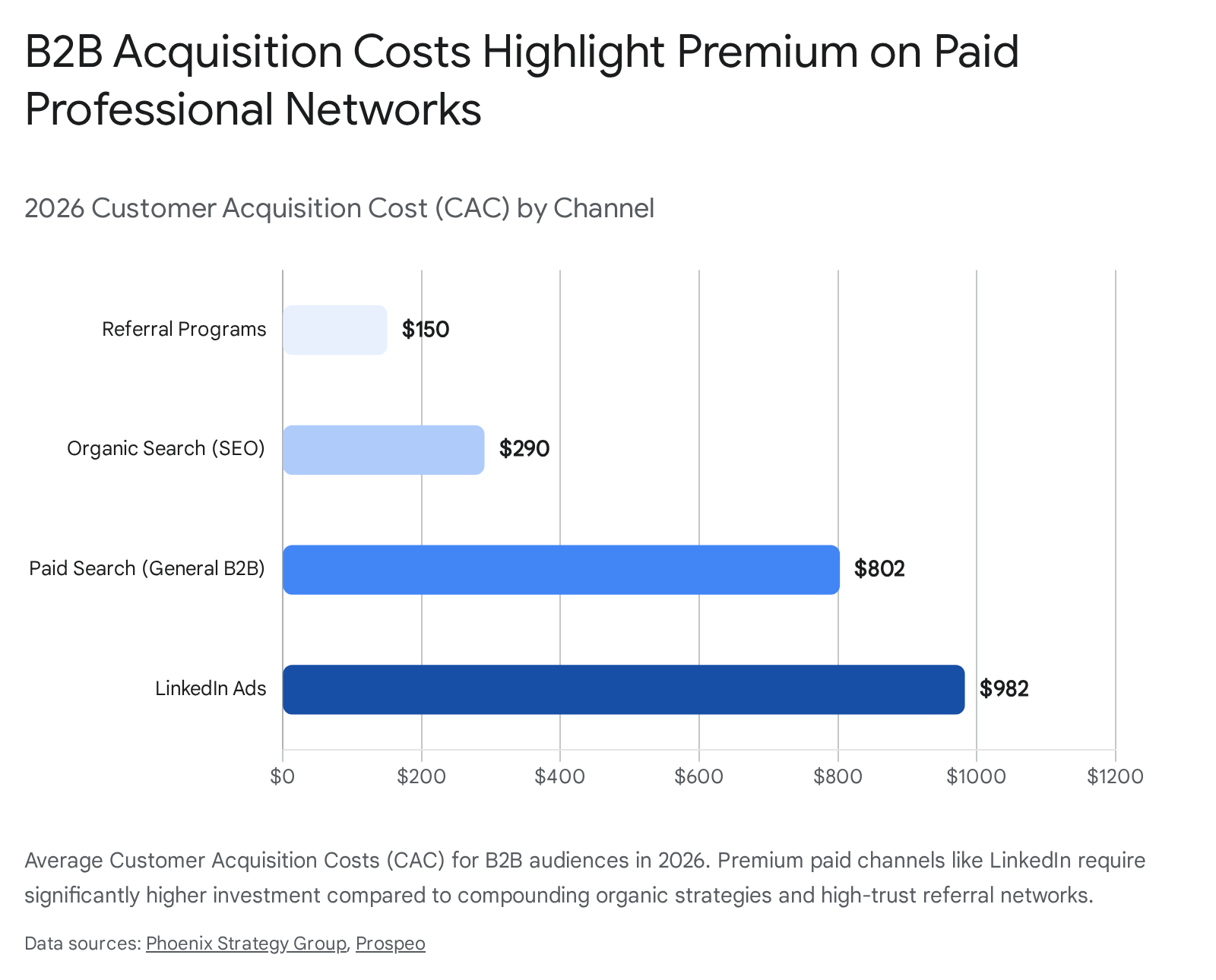
| Marketing Channel | General Average CPL / CPA (2026) | B2B Specific CPL / CAC (2026) | Market Context and Notes |
|---|---|---|---|
| Paid Search (Google Ads) | $23.74 - $70.11 | $128.40 - $802.00 | High intent, highly competitive. The Technology and Legal sectors routinely exceed $130 per acquisition, with Enterprise SaaS averaging $172.50 23243031. |
| Paid Social (Meta Ads) | $38.19 | $230.00 | CPMs rose 20% year-over-year, requiring heavy reliance on AI creative optimization to maintain flat overall CPAs 232429. |
| Paid Social (LinkedIn) | N/A | $982.00 | Highest acquisition cost, reserved primarily for enterprise B2B audiences with exceptional contract values 2324. |
| Organic Search (SEO) | $31.00 - $290.00 | $290.00 - $647.00 | Longest payback period (typically 3-9 months), but provides the most sustainable compounding returns over a multi-year horizon 233225. |
| Referral & Partner Programs | N/A | $150.00 | Lowest CAC channel for B2B SaaS and creator products due to built-in trust and network effects 2324. |
The underlying mechanics of these costs reveal shifting platform dynamics. On Meta, for instance, overall CPA only rose by 1.04% year-over-year in 2026, but this flat metric masks a 20.03% surge in Cost Per Mille (CPM) across all industries 24. Advertisers only managed to hold their acquisition costs steady by utilizing AI-driven Advantage+ campaigns to squeeze higher conversion rates out of more expensive impressions 2429.
The timeline for return on investment (ROI) dictates how growth budgets are deployed. Paid channels deliver immediate traffic within 24 hours but cease functioning the moment the advertising budget is depleted 1525. Conversely, organic acquisition requires a 4-to-12-week runway for initial traction and typically takes 8 to 14 months to reach the breakeven point where content ROI surpasses paid alternatives 2534. However, organic content compounds. Companies with active content marketing strategies generate 67% more leads per month at a 62% lower average cost than outbound or paid alternatives 3435. To balance these dynamics, sophisticated operators typically deploy a 60/40 budget model, allocating 60% of resources to compounding organic systems and 40% to paid experiments for rapid validation 25.
Direct Newsletter Sponsorships and Cross-Promotion
Beyond traditional ad networks, publishers frequently pay to acquire subscribers directly from other newsletters. Because newsletters represent a controlled inbox environment with first-party data, they offer a highly engaged, opted-in audience that commands premium advertising rates compared to algorithmic display networks 22.
Newsletter advertising rates in 2026 range widely based on list size, engagement metrics, and audience niche. A general consumer lifestyle newsletter might charge a CPM of $15 to $40, while a specialized B2B publication reaching decision-makers in finance, technology, or cybersecurity commands CPMs between $50 and $150+ 2236. For premium inventory, such as a "Dedicated Send" where an advertiser purchases a standalone email sent to the publisher's entire list with 100% share of voice, costs range from $5,000 to $15,000 for lists of 500,000 subscribers, scaling up to $50,000 for elite multi-million subscriber lists 36.
For direct subscriber acquisition, Cost Per Acquisition (CPA) models are increasingly favored through programmatic newsletter networks. In these arrangements, advertisers pay $10 to $100+ per confirmed subscriber, transferring the risk of poor conversion from the advertiser to the publisher 2226. This model works exceptionally well for brands with high-converting landing pages (above 5% conversion rate) and substantial lifetime customer value 22.
Furthermore, native cross-promotion has become institutionalized within modern newsletter software. Platforms now feature built-in recommendation networks that allow creators to explicitly endorse other newsletters during the subscriber onboarding flow. This collaborative growth mechanism yields high-quality, free subscriber acquisition by leveraging the network effects inherent to specialized creator ecosystems 272829.
Platform Infrastructure and Creator Ecosystems
The software infrastructure supporting newsletter growth has bifurcated into two distinct product categories: highly complex, event-driven CRM systems designed for e-commerce, and streamlined, monetization-focused "operating systems" tailored for creators, coaches, and digital publishers 3031.
The Maturation of the Creator Economy
The creator economy has transitioned from an emerging cultural trend into a mature, institutionalized sector of the global digital economy, estimated to represent between $250 billion and $480 billion in annual economic activity 23244. Growth is increasingly concentrated inside small, intentional communities where retention and recurring revenue matter more than raw audience scale 3. Data indicates that 44% of creator communities have between 1 and 100 members, and 56% of creators launched their community infrastructure within the past two years 3.
Creators are rapidly professionalizing. In 2026, 48% of digital creators operate as solo entrepreneurs managing end-to-end business operations, and 88% of community builders monetize directly through memberships rather than relying on volatile brand sponsorships 3. In fact, only 18% of creators now report earning their primary revenue from advertising or sponsorships, signaling a massive shift toward owned digital products, courses, and paid subscriptions 332.
Creator-First Operating Systems versus Commerce CRM
To support this shift toward direct monetization, email platforms have evolved far beyond basic text delivery. The 2026 rebrand of ConvertKit to "Kit" illustrates this industry-wide pivot. Kit positions itself not just as an email marketing tool, but as the premier operating system for the creator economy, actively used by over 640,000 creators to generate over $41 million in annual recurring revenue for the software company 2933.
A definitive competitive divide exists in how different platforms architect their software, largely dictated by their target audience.
| Platform Archetype | Target Audience | Data Model | Core Strengths and Features |
|---|---|---|---|
| Creator-First (Kit, Beehiiv) | Content creators, bloggers, podcasters, digital educators 3044. | Subscriber-centric. Segmentation relies heavily on manual tagging and list assignments 30. | Deep monetization tools (paid newsletters, tip jars, digital product delivery). Built-in Creator Networks for cross-promotion and audience growth 272931. |
| Commerce-First (Klaviyo) | Direct-to-consumer (DTC) brands, traditional retail e-commerce 30. | Event-centric. Tracks intricate user behaviors (items viewed, cart abandoned, purchase history) 30. | Unmatched predictive analytics, advanced behavioral flow logic, and deep integration with store ecosystems (Shopify, WooCommerce) for revenue attribution 3031. |
| CRM-Tied (ActiveCampaign) | B2B service businesses, agencies, sales teams 31. | Pipeline-centric. Integrates email behavior directly with sales CRM deal stages 31. | Complex multi-channel orchestration. Ideal for businesses where email marketing must trigger actions for human sales representatives 31. |
Modern creator platforms natively incorporate multi-stream monetization infrastructures that previously required a patchwork of third-party integrations. For instance, creators using Kit can sell digital products, run tiered paid subscriptions, and broker paid recommendations all within the core dashboard, completely fee-free via built-in Stripe integrations 2734. The financial impact of this consolidated infrastructure is substantial; creators utilizing Kit's native commerce tools earn an average of 3.5 times what they spend on their platform subscription 35.
The selection of an infrastructure provider directly dictates a publisher's acquisition strategy. Platforms like Kit and Beehiiv that offer built-in recommendation networks create a powerful moat; they artificially lower a publisher's effective Customer Acquisition Cost by supplying a steady stream of organic, peer-endorsed subscribers that platform-agnostic tools simply cannot replicate 29.
Engagement Metrics and Performance Evaluation
As the infrastructure for acquiring subscribers has matured, the methodology for tracking their engagement has undergone a forced paradigm shift. The metrics that guided the email industry for two decades are now fundamentally unreliable, requiring operators to recalibrate their key performance indicators (KPIs) toward bottom-of-funnel actions.
The Distortion of the Open Rate by Mail Privacy Protection
Apple's Mail Privacy Protection (MPP), introduced with iOS 15 in late 2021, permanently broke the email open rate as an absolute performance metric. MPP routes emails through proxy servers to pre-fetch message content before the human recipient ever opens the email application. Consequently, the invisible tracking pixel embedded by email service providers fires automatically, registering a "false open" regardless of whether the subscriber actually read the content 3637.
Because Apple Mail commands approximately 55% to 60% of the global email client market share, average open rates have been artificially inflated across the entire industry 3638. In 2026, baseline open rates routinely report between 35% and 42% on average, with certain high-affinity sectors like religion, non-profits, and hobbies showing rates exceeding 50% 36513940. However, data analysts estimate that MPP inflates raw open rates by 15 to 20 percentage points 4041.
While open rates remain useful for relative A/B testing - comparing Subject Line A versus Subject Line B sent to the same list segment at the same time - they are obsolete as a benchmark of absolute list health 3742. Furthermore, true deliverability metrics present a much bleaker reality than inflated open rates suggest. Despite reported delivery rates of 98%, average inbox placement sits around 83% to 85%, meaning one in six emails never reaches the inbox. Gmail inbox placement specifically has dropped to 53.7%, indicating that nearly half of all marketing emails land in the Promotions or Spam tabs 40.
Click-Through and Click-to-Open Rate Benchmarks
To accurately assess subscriber engagement, the industry has universally standardized around the Click-Through Rate (CTR) and the Click-to-Open Rate (CTOR). Unlike opens, a click cannot be easily faked by a proxy server (though Apple's Link Tracking Protection does strip UTM parameters, complicating downstream attribution); a click represents a deliberate human action indicating genuine interest 43.
A healthy CTR for standard promotional or content emails ranges from 2% to 5% across most industries, with the overall cross-industry median sitting at approximately 2.62% 37414357. The median CTOR - calculated as unique clicks divided by unique opens - sits around 12.3%, though this is also slightly distorted by the inflated open denominator 4158.
Engagement metrics vary wildly based on industry intent and the specific type of email being sent. High-utility B2B sectors dramatically outperform general consumer e-commerce.
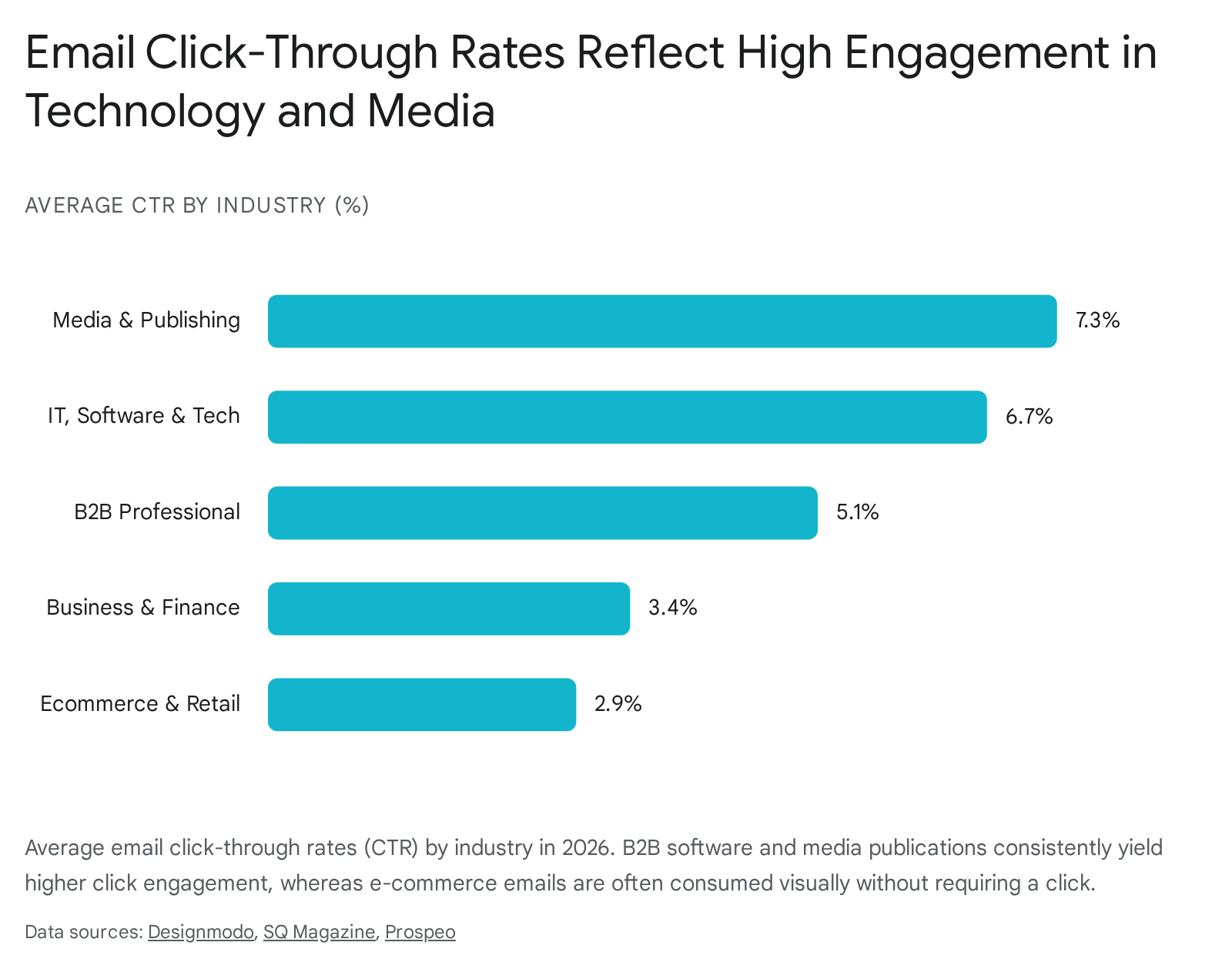
Automated, behaviorally triggered sequences vastly outperform standard mass-broadcast campaigns. Triggered emails such as cart abandonment sequences or welcome series achieve an average conversion rate of 5.31% to 8.17%, compared to just 0.87% for non-segmented promotional blasts 41.
To optimize CTR, structural and technological tactics prove highly effective. Emails containing video preview thumbnails increase CTR by up to 300% compared to static emails, as an animated GIF of a product demo provides a low-effort, high-return visual cue 3943. Placing the primary call-to-action (CTA) button above the fold boosts clicks by 28%, and optimizing for mobile-first readers improves CTR by an average of 14% 3943. Furthermore, utilizing AI-generated subject lines and dynamic product recommendations lifts click rates and revenue significantly, pushing top-performing campaigns to conversion rates exceeding 8% 4143.
The Redefinition of the Active Subscriber
Because total list size includes a high proportion of deadweight that actively damages deliverability, advanced newsletter operators focus exclusively on the "Active Subscriber Rate." An active subscriber is strictly defined as a user who has opened, clicked, or otherwise verifiably engaged with an email within a specific trailing window - typically 90 to 180 days 594445.
A list of 200,000 subscribers with only a 20% active rate is functionally a 40,000-person list; the remaining 160,000 addresses act as a massive drag on engagement metrics, skew A/B test results, and unnecessarily increase platform software hosting costs 37. Reframing growth around active subscriber volume, alongside Revenue Per Subscriber (RPS), rather than top-line raw acquisition, is the standard practice for modern newsletter revenue optimization 3738.
Subscriber Retention, List Decay, and Database Hygiene
Subscriber retention is an ongoing battle against digital entropy. Email lists do not remain static; they actively degrade due to external factors entirely outside the publisher's control. Managing this churn through rigorous database hygiene is just as critical to overall growth as top-of-funnel acquisition.
The Mathematics of Database Degradation
Data decay is a persistent, structural challenge in email marketing. According to analysis by ZeroBounce covering over 11 billion verified addresses in 2025, approximately 23% to 28% of an email database becomes invalid or risky within a 12-month period 626364. This translates to a monthly degradation rate of roughly 2.1% to 2.5% 6365.
The causes of list decay are primarily environmental, not programmatic: 1. Professional Mobility: In B2B databases, where decay rates can spike to an astonishing 70.3% annually, contacts change jobs, roles, and companies. Research indicates that 70.8% of business contacts change within 12 months, and 65.8% experience job title or function changes, rendering their previous corporate email addresses invalid 6365. 2. Account Abandonment: Consumers switch internet service providers, abandon legacy accounts, or allow personal domains to expire 65. 3. Spam Traps and Abuse: Lists naturally accumulate "catch-all" addresses (which accounted for over 1 billion addresses in 2025), disposable temporary emails, and recycled spam traps utilized by inbox providers to catch reckless senders. Furthermore, "abuse emails" - contacts known for routinely marking messages as spam - pose a severe threat to sender reputation 6264.
Because nearly one in four addresses will rot within a year, an unmanaged database quickly triggers spam filters. Major inbox providers like Google and Yahoo strictly monitor bounce rates and spam complaints. Surpassing a complaint threshold of just 0.3% will result in severe deliverability penalties, shifting even legitimate, high-quality content into the spam folder 4062. To combat this, best-in-class operators run real-time email verification via APIs at the point of sign-up, ensuring toxic data never enters the database, and conduct comprehensive list cleaning quarterly 626646.
Implementation of Sunset Policies and Pruning
List growth without aggressive pruning leads directly to declining performance. The industry standard for maintaining healthy deliverability is the strict enforcement of a "sunset policy" 47.
A sunset policy dictates the exact threshold at which a publisher automatically stops sending emails to an unengaged user. Typically, subscribers who demonstrate absolutely no engagement (zero clicks and zero verified opens) for a continuous 90- to 180-day period are classified as inactive 594647. Continuing to mail these dormant addresses depresses overall engagement ratios, signaling to inbox algorithms that the sender's content is unwanted. Inactive segments must be suppressed or entirely deleted from the database to protect the sender's domain reputation 425947. Implementing quarterly list hygiene to remove contacts inactive for over six months has been shown to yield a 28% improvement in overall deliverability 41.
Re-engagement Campaign Performance
Before permanently sunsetting dormant addresses, operators typically attempt a final win-back effort. Re-engagement campaigns are automated, multi-step email sequences designed to recapture the attention of lapsing subscribers before they are scrubbed from the list 5947. These emails leverage high-contrast subject lines (e.g., "Still interested?" or "We miss you"), highly personalized dynamic content, or significant financial incentives to prompt a measurable interaction 4648.
Despite the dormant status of the recipients, re-engagement campaigns are surprisingly effective when properly executed. Statistical analysis reveals that win-back sequences successfully reactivate between 14% and 29% of inactive subscribers 4849. In e-commerce environments, incorporating free shipping offers into win-back emails lifts conversion by an additional 12% compared to standard percentage discounts 48. Subscribers who click a link within this sequence are immediately cycled back into the "active" segment, preserving the initial acquisition investment while maintaining strict list hygiene parameters 46.
Synthesis and Strategic Outlook
Newsletter growth in 2026 is no longer a volume game; it is an exercise in data quality, unit economics, and community depth. As AI-driven answer engines and shifting social media algorithms choke off traditional top-of-funnel referral traffic, the inbox remains the most reliable, algorithm-resistant distribution channel available to publishers and creators. Consequently, acquiring an email subscriber is more expensive and competitive than ever before.
Successful operators mitigate these rising acquisition costs by treating their newsletters not just as marketing blasts, but as unified business operating systems. They utilize creator network recommendations to lower CAC, rely on sophisticated behavioral segmentation to drive engagement, and track Click-Through Rates rather than distorted open rates to accurately gauge content resonance. Crucially, they view rigorous list hygiene - accepting natural 25% annual decay rates and ruthlessly pruning inactive subscribers via strict sunset policies - as a defensive necessity rather than an administrative chore. In 2026, a high-growth newsletter is defined not by how many total addresses sit in a database, but by the measurable, active human engagement it can consistently command, transforming rented internet traffic into a resilient, owned asset.