
Neuroscience of self-representation and personal identity
The question of how the human brain generates, maintains, and updates a coherent sense of self remains one of the most complex inquiries in cognitive neuroscience, psychology, and philosophy. Historically, intuitive models of consciousness relied on the "homunculus fallacy," a conceptual error that posited the existence of a central, unified observer - a miniature self - inside the brain that receives sensory input and directs behavior 123. This framework, often referred to as the Cartesian Theater, suggests that perception is a passive act where a centralized self watches a continuous internal movie of reality 1. Modern neuroscience has decisively rejected this paradigm due to the problem of infinite regress: if an internal observer watches representations, another observer must exist within the first, ad infinitum 13.
Instead, contemporary neurobiology reveals that self-representation is not the product of a localized command center. It is an emergent property of highly distributed neural processes and information networks interacting across specialized cortical and subcortical brain regions 14. The phenomenon of personal identity - the persistent feeling of being a continuous, integrated subject of experience - arises through the dynamic integration of autobiographical memory, predictive coding, interoceptive signaling, and socio-cultural frameworks.
Philosophical Foundations of Personal Identity
Before localizing the self in neuroanatomy, cognitive science relies on philosophical frameworks to define what constitutes personal identity and how it persists over time. The problem of personal identity is generally divided into two distinct structural inquiries: the reidentification question and the characterization question 56. Analytic philosophy has traditionally emphasized the former, but robust neurobiological models must account for both 5.
The Reidentification Question and Psychological Continuity
The reidentification question focuses on numerical identity. It asks what makes a person at a given time mathematically and logically identical to a person at a past or future time 57. Traditional psychological continuity theories, heavily influenced by seventeenth-century philosopher John Locke and later modified by contemporary reductionists like Derek Parfit, focus almost exclusively on this metaphysical tracking 689. Locke distinguished between the "man" (the biological organism) and the "person" (a forensic term related to consciousness and memory), arguing that personal identity is founded on the continuity of consciousness 6.
Parfit expanded this into psychological reductionism, which posits that identity over time relies on overlapping chains of psychological connections (e.g., memories, intentions, beliefs) rather than a continuous, indivisible ego 89. In Parfit's view, the relation between a person at different times might not even take the logical form of a one-to-one identity relation; it can be a matter of degree, or one-to-many, leading to his controversial conclusion that numerical identity is not what truly matters for survival 8910. However, critics argue that such reductionist models fail to adequately support the motivating intuitions behind personal identity, such as why we hold individuals morally responsible for past actions or why we feel self-interested concern for our future 81011.
The Characterization Question
To resolve the limitations of strict reidentification, philosopher Marya Schechtman introduced the "characterization question." While an amnesia victim asking "Who am I?" is struggling with historical reidentification, a confused adolescent asking the same question is struggling with characterization 5. The characterization question seeks to define the specific relation that holds between a person and the particular actions, experiences, beliefs, and values that belong to them 578.
Schechtman argues that separating these two questions allows for a more fruitful approach 5. The characterization sense of identity is fundamentally practical and forensic; it underwrites our moral judgments, the attribution of responsibility, and how societies organize practices of reward and compensation 81112. To address these features of human existence, theories of identity must explain not just how a subject survives, but how a subject claims ownership over a specific set of psychological traits and life events 611.
The Narrative Self-Constitution View
To answer the characterization question, Schechtman proposes the "Narrative Self-Constitution View." According to this theory, individuals constitute their identities by developing and internalizing autobiographical narratives that organize their experiences into a coherent, linear life story 5711. This narrative framework allows an individual to experience themselves as a persisting subject, integrating past experiences with future expectations 1113.
Unlike passive psychological continuity, narrative self-constitution is an active, interpretative process. Narratives are highly selective, the product of continuous editing and re-evaluation in response to new experiences 812. A crucial limitation on this self-authorship is that to function as an identity, the self-conception must bear the right relation to external reality. It must align with the basic contours of the material environment, embodied limits, and intersubjective accounts provided by other people 5712. Through narrative plotting, humans achieve epistemological strength, making sense of why they value specific things or acted in certain ways, thereby grounding both moral agency and self-interested concern 1112.
Phenomenological Dimensions of Selfhood
To bridge philosophical definitions of narrative identity with measurable neurobiology, cognitive science and phenomenology generally distinguish between two interdependent layers of self-experience: the minimal self and the narrative self 1415. These two dimensions represent the pre-reflective and reflective aspects of consciousness, respectively, and are supported by overlapping but distinct neural architectures 1516.
Minimal Phenomenal Selfhood
The minimal self, also termed the pre-reflective self or minimal phenomenal selfhood, is the immediate, unextended sense of being an embodied subject and the agent of one's actions 141516. It encompasses the fundamental sense of bodily ownership (the feeling that this body is mine), spatial location (the feeling of being situated in a specific environment), and a unified first-person perspective 1415.
The minimal self is anchored in immediate sensorimotor processing and interoceptive awareness, representing the most basic, foundational form of self-consciousness 1416. It does not rely on language, memory, or complex conceptual thought. Instead, it provides the tacit, structural "mineness" that accompanies all conscious experience 1416. In the architecture of the mind, the minimal self is considered a prerequisite for higher-order cognition; without a stable anchor of physical embodiment and perspective, higher cognitive functions lose their referential center 1416.
The Narrative Self in Cognitive Science
Building upon the minimal self is the narrative self, a higher-order, reflective construct that corresponds directly to Schechtman's self-constitution framework. The narrative self involves autobiographical memory, semantic self-knowledge, social identity, and the projection of oneself into the past and future through mental time travel 141617.
While the minimal self exists purely in the present moment, the narrative self relies on complex cognitive faculties to interpret and assign meaning to experiences over a temporal continuum 16. Brain imaging studies suggest that the narrative self heavily relies on midline cortical structures to access episodic memory and generate the concept of a temporally extended person 1518. Treasured memories play a crucial role in this process; by recalling the subjective gestalt of past events, individuals maintain a profound sense of self-complexity and interpersonal connection that stabilizes their identity over decades 1319.
Interactions Between Minimal and Narrative Selves
The precise mechanisms linking the minimal and narrative selves remain a subject of active research, particularly in the context of psychiatric disorders. Current literature proposes several theoretical models for this interaction 1620.
The Structural model posits a hierarchical relationship where disturbances in the minimal self inevitably cascade upwards to disrupt the narrative self 16. The Dialectical model suggests reciprocal interactions, where changes in one's narrative framework can influence minimal, embodied experience, and vice versa 16. Finally, the Contextual model emphasizes that both levels of self are continuously shaped by biological, social, and territorial dimensions 16. Disruptions in these interaction models - where the modular outputs of the mind lose their semantic tagging and coherence - reveal how deeply dependent our life stories are on the silent, continuous functioning of embodied self-perception 1416.
Neural Substrates of Self-Referential Processing
The transition from phenomenological models to neuroanatomical reality relies on the study of large-scale, resting-state brain networks. Neuroimaging has repeatedly demonstrated that self-representation is not localized to a single brain region. Instead, it emerges from the coordinated, synchronized activity of widespread cortical hubs, most prominently within the Default Mode Network 212223.
The Default Mode Network
The Default Mode Network (DMN) is the primary neural system supporting internally directed cognition, autobiographical memory, and the narrative sense of self 222425. Initially identified by its unique pattern of deactivation during externally focused, goal-directed tasks, the DMN becomes highly active during "rest," mind-wandering, and periods of introspection 212224.
The DMN is a topologically organized spatiotemporal network comprising several highly connected nodes. It can be subdivided into functionally distinct subsystems, including a dorsal medial prefrontal cortex subsystem, a medial temporal lobe subsystem, and a midline core 25. The core regions essential for self-referential mentation include the medial prefrontal cortex (mPFC), the posterior cingulate cortex (PCC), the precuneus, the angular gyrus, and the hippocampal formation 212426. These regions integrate memory, emotion, and identity to sustain the feeling of temporal continuity required by the narrative self 2224.
Medial Prefrontal and Posterior Cingulate Contributions
Within the DMN, specific nodes manage distinct aspects of self-representation. The medial prefrontal cortex (mPFC) is heavily involved in processing self-relevant information, social cognition, and evaluating the emotional valence of autobiographical memories 2122. The mPFC is specifically engaged when individuals evaluate whether trait adjectives describe themselves compared to others, functioning as an integration hub that drives the self-reference effect (SRE) - the phenomenon whereby information related to the self is processed more deeply and retained more effectively 1827.
The posterior cingulate cortex (PCC) and the adjacent precuneus are critical for memory retrieval, spatial orientation, and the construction of internal narratives 2122. The PCC facilitates the "mental time travel" required to reflect on past events and simulate alternative future scenarios 1722. Functional connectivity between the mPFC and PCC allows for the seamless synthesis of past episodic memories with present semantic self-knowledge. This synchronization essentially writes the ongoing narrative of the self, allowing the brain to simulate future actions based on historical identity 2225.
Neurochemical Mechanisms and Excitation-Inhibition Balance
Macro-scale functional connectivity within the DMN is underpinned by localized neurochemical balances that regulate synaptic excitation and inhibition. The efficacy of self-related cognition, including the self-reference effect on memory, relies heavily on these chemical environments 27.
Proton magnetic resonance spectroscopy (H-MRS) studies demonstrate that the balance of glutamate (an excitatory neurotransmitter) and gamma-aminobutyric acid (GABA) (an inhibitory neurotransmitter) within DMN circuits is crucial for self-representation 27. The regional excitation/inhibition (E/I) balance in midline structures like the mPFC and PCC directly modulates the functional connectivity required to integrate self-referential information 27. Theoretical models also suggest that self-awareness is regulated by dopaminergic pathways interacting with the GABA system in the anterior cingulate cortex 27. When this delicate neurochemical balance is disrupted, individuals may experience atypical self-representation, failing to appropriately integrate memory and identity - a deficit observed in variations of autism and schizophrenia 27.
The Triple Network Model of Cognitive Control
While the DMN is central to generating internal narrative and introspection, adaptive human functioning requires the ability to fluidly shift attention away from the self and toward the external environment. This dynamic, moment-to-moment balancing act is conceptualized in the Triple Network Model, which describes the interactions between three large-scale systems: the Default Mode Network (DMN), the Central Executive Network (CEN), and the Salience Network (SN) 242829.
Salience Network as a Dynamic Switch
The Salience Network acts as the critical mediator and switching mechanism within the Triple Network framework 283130.
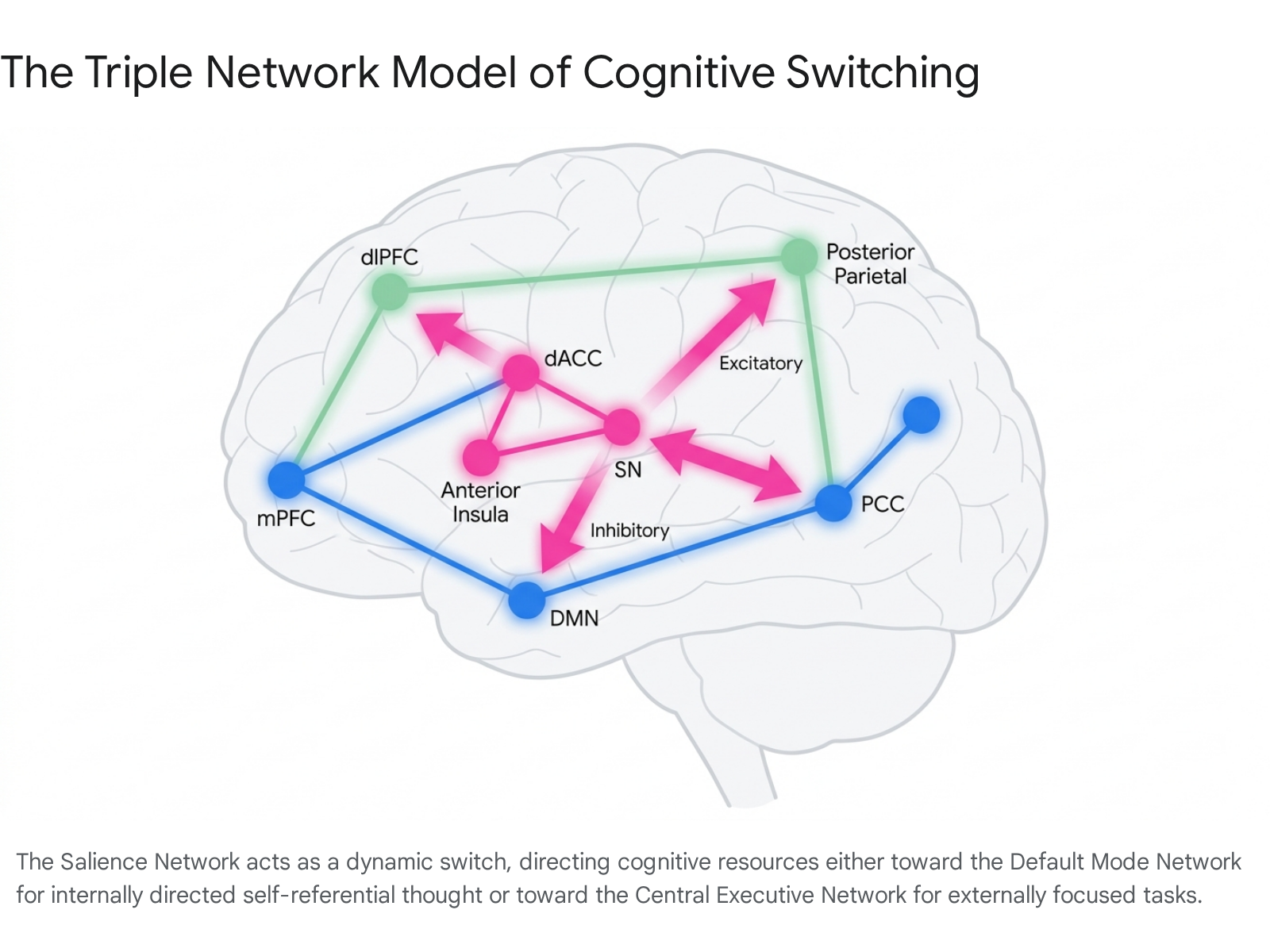
Anchored primarily in the anterior insula (specifically the right fronto-insular cortex) and the dorsal anterior cingulate cortex (dACC), the SN continuously monitors incoming interoceptive (internal body) and exteroceptive (external environment) signals to detect behaviorally relevant, or "salient," stimuli 242831.
When the SN detects a salient event - such as a threat, a social cue, or a demanding task - it initiates a large-scale neurocognitive switch. The SN causally influences the other networks by downregulating the DMN, thereby suppressing internal narrative and mind-wandering, while simultaneously upregulating the CEN to engage goal-directed attention 282931. Transcranial magnetic stimulation (TMS) studies have confirmed this directional causality, showing that stimulation of SN nodes enhances both within-SN and within-CEN connectivity, actively facilitating the transition to task-oriented cognition 28.
Central Executive Network and External Attention
The Central Executive Network (CEN), also known as the frontoparietal network, supports executive functions, working memory, and active problem-solving 212431. Its core nodes are located in the dorsolateral prefrontal cortex (dlPFC) and the posterior parietal cortex 2831. Under normal conditions, the CEN and the DMN are anticorrelated; as activity in the CEN increases to manage an external task, activity in the DMN decreases to prevent internal thoughts from interfering with performance 2130.
This switching mechanism ensures that cognitive and emotional resources are deployed adaptively. In the absence of demanding external stimuli, the SN allows the brain to transition back to DMN dominance, resuming self-referential processing, creative ideation, and memory consolidation 2432. Disruptions in this dynamic control - such as weakened SN-CEN coupling or attenuated SN-DMN antagonism - are hallmarks of numerous cognitive and emotional disorders, highlighting that a healthy sense of self requires not just DMN integrity, but the ability to flexibly disengage from it 2431.
Predictive Processing and the Bayesian Brain
While anatomical network models map where self-representation occurs, theoretical and computational neuroscience seeks to explain why and how computational imperatives give rise to subjective identity. Two prominent paradigms - Predictive Processing and the Temporo-spatial Theory of Consciousness - offer profound mathematical and phenomenological models of selfhood.
The Free Energy Principle and Active Inference
The predictive processing framework, formally articulated through Karl Friston's Free Energy Principle (FEP), fundamentally reorganizes the conceptualization of perception, action, and consciousness 3334. The FEP postulates that all self-organizing biological systems - from single cells to complex human brains - maintain their structural integrity by actively resisting entropy 333437. They achieve this by minimizing "variational free energy," which in cognitive terms translates to minimizing "surprise" or prediction error 3334.
Rather than acting as a passive receiver of sensory data that processes information bottom-up, the brain is an active prediction machine 3438. Using a hierarchical Bayesian architecture, upper cortical layers continuously generate top-down probabilistic predictions about the causes of incoming sensory signals 3338. The brain only processes the discrepancies - the prediction errors - passing them bottom-up to update the internal models 3438. Organisms minimize this error through two mechanisms: perceptual inference (updating internal models to match reality) and active inference (acting on the environment to make sensory data match existing predictions) 3334.
Selfhood as a Predictive Model
Within the FEP framework, the self is not an immutable, metaphysical entity; it is the brain's most robust, high-level predictive model 33. To effectively minimize prediction error in a complex world, the brain must construct a model of itself as an agent to anticipate the sensory consequences of its own actions and internal states 3337. The feeling of a continuous, unified identity arises because maintaining a stable hypothesis of a "self" remains the most mathematically efficient way to explain the vast streams of sensory data encountered over a lifetime 3338.
Neuroscientist Anil Seth describes subjective experience as a "controlled hallucination," wherein perception is essentially the brain's best guess about the world, continuously corrected by prediction errors 38. Similarly, the experience of being a self is a controlled hallucination generated to keep the organism alive 38. This predictive account elegantly eliminates the need for an internal homunculus by treating the self as an implicit feature of a hierarchical inference engine 3334.
Embodied Cognition and Interoceptive Inference
The predictive model of selfhood is fundamentally embodied. According to theories of interoceptive inference, the brain generates predictions not just about the external world, but about the physiological state of the body (e.g., heart rate, temperature, glucose levels) 3338. The body acts as the structured interface through which external information becomes self-relevant 2533.
Philosopher Andy Clark and others emphasize that consciousness is not confined to neural tissue but emerges from the continuous interplay between the brain, the body, and the environment 3339. The minimal self discussed in phenomenological literature maps perfectly onto this interoceptive predictive machinery 1416. By constantly tagging incoming signals with predictions of bodily ownership and agency, the brain creates a boundary between self and non-self, generating the feeling of an embodied presence without requiring a "ghost in the machine" 125.
Spatiotemporal Dynamics of Consciousness
Complementing the predictive processing framework is the Temporo-spatial Theory of Consciousness (TTC), proposed by Georg Northoff. The TTC argues that the mystery of consciousness cannot be solved by looking solely at stimulus-related activity or specific cognitive content; instead, it must be understood through the brain's intrinsic construction of time and space 3536.
Temporo-Spatial Theory of Consciousness
The TTC asserts that the spatial topography and temporal dynamics of the brain's spontaneous, resting-state neural activity form the fundamental architecture of consciousness 3536. Time and space act as a "common currency" shared by the brain's biological neural activity and the subjective mental states of the mind 3637. The construction of time and space by the brain is entangled with the construction of objects, events, and the self as contents of consciousness 43.
Unlike other theories, the TTC explicitly considers the relationship of the brain to its environment as a defining feature of the self, addressing the ontological "world-brain problem" 4338. The spontaneous activity of the brain, largely driven by networks like the DMN, provides long intrinsic timescales that allow the brain to integrate disparate stimuli over time 3839. This temporal integration is what allows a person to feel like the same self across past, present, and future 3839.
Mechanisms of Temporo-Spatial Integration
The TTC outlines four specific neuro-spatiotemporal mechanisms that correspond to distinct dimensions of conscious experience 353640:
- Temporo-spatial nestedness: The hierarchical organization of spontaneous activity across different frequency bands (scale-free dynamics). This mechanism accounts for the baseline level or state of consciousness, acting as the neural predisposition of consciousness (NPC) 3540.
- Temporo-spatial alignment: The mechanism by which the brain adapts and aligns its intrinsic resting-state dynamics to the rhythms of external environmental stimuli and internal bodily signals. This stochastic alignment provides the form or structure of consciousness, acting as the neural prerequisite (preNCC) 353840.
- Temporo-spatial expansion: The early, localized neural response to a specific stimulus. This expansion accounts for phenomenal consciousness and qualia - the actual content of conscious experience (NCC) 3540.
- Temporo-spatial globalization: The late, widespread distribution of stimulus-induced activity across the brain's global network. This accounts for cognitive access and higher-order reflective consciousness, enabling the reporting and manipulation of self-representation (NCCcon) 3540.
Through these four mechanisms, the TTC provides an integrative model explaining how an ongoing biological system constructs a stable phenomenological self that remains aligned with environmental realities 3641.
Cultural Modulation of Neural Architecture
If the self is a predictive narrative constructed by neural networks, it is inherently susceptible to environmental and cultural shaping. The relatively new field of cultural neuroscience provides robust empirical evidence that the fundamental functional architecture of the self - specifically the connectivity of the DMN and CEN - is plastic and highly responsive to societal values 424344.
Independent Versus Interdependent Self-Construal
Cross-cultural psychology broadly categorizes human self-construal into two distinct types: independent and interdependent 1845.
The independent self-construal, prevalent in Western, individualistic societies, emphasizes personal uniqueness, autonomy, and a sharp demarcation between the self and others 1846. The self is viewed as a distinct entity defined by internal attributes 18. Conversely, the interdependent self-construal, dominant in East Asian and many non-Western cultures, views the self as fundamentally relational, flexible, and context-dependent 1847. Identity is heavily defined by social roles, in-group relationships, and communal harmony 184447.
Default Mode Network Connectivity Variations
Neuroimaging studies reveal that these cultural paradigms actively modulate how the brain processes identity. During task-based fMRI studies involving self-referential processing, individuals with independent self-construals show significantly greater activation in the mPFC and PCC when making judgments about themselves compared to making judgments about close others (such as their mothers) 1846. This reflects a highly differentiated neural representation of the self. In contrast, individuals with strong interdependent self-construals exhibit overlapping or identical neural activation in these midline regions when judging themselves and their mothers, reflecting a neural architecture where the self incorporates close social relations 1848.
These differences extend beyond active tasks into the brain's intrinsic resting state. Whole-brain functional connectivity analyses indicate that independent self-construal scores correlate positively with functional connectivity within the DMN (specifically between the PCC and mPFC) and within the Executive Control Network (ECN) 4548. However, independent self-construal correlates negatively with functional connectivity between the DMN and ECN 4548.
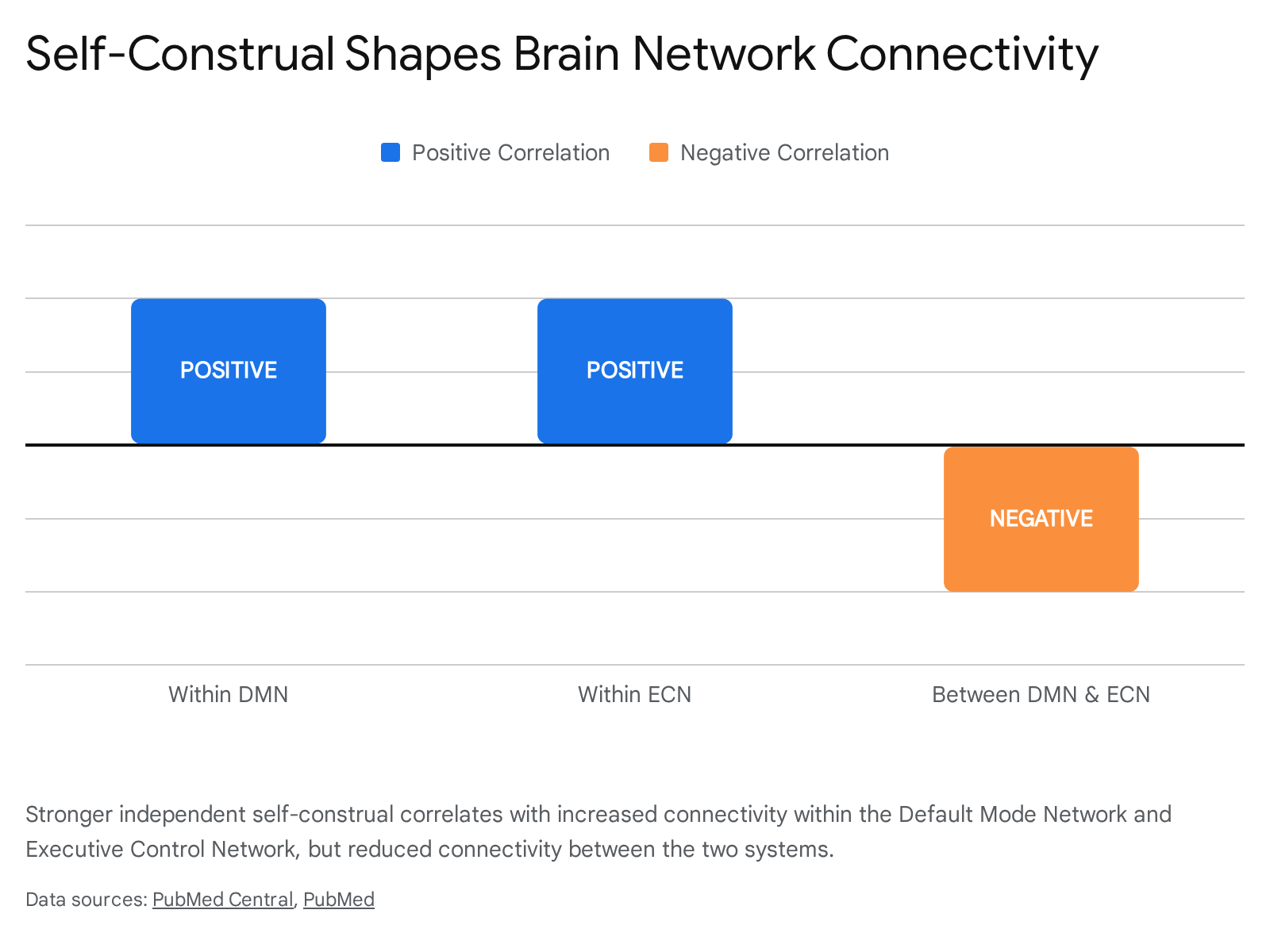
This suggests that a Western, independent cognitive style relies on more highly segregated networks, whereas interdependent styles may foster a different topological balance that integrates internal state monitoring with external contextual awareness 4849.
Behavioral and Phenotypic Implications
The neural divergence driven by cultural self-construal has tangible behavioral outcomes. For example, EEG studies reveal that higher independent self-construal is associated with stronger alpha power at rest, a correlate of DMN activity and self-referential processing 44. Furthermore, structural MRI studies indicate that interdependent self-construal predicts increased gray matter volume in brain regions responsible for holistic scene processing, confirming that cultural emphasis on context physically alters brain morphology 44.
To summarize these cross-cultural neurobiological distinctions, the following table outlines the key differences observed in neuroimaging research:
| Feature / Network Attribute | Independent Self-Construal (e.g., Western Cultures) | Interdependent Self-Construal (e.g., East Asian Cultures) |
|---|---|---|
| Conceptual Definition of Self | Autonomous, unique, distinct from others 1846. | Relational, embedded in social contexts, flexible 1847. |
| mPFC/PCC Task Activation | High differentiation: significantly greater activation for self-judgments vs. other-judgments 18. | Low differentiation: overlapping activation for self-judgments and close-other judgments 1848. |
| Intra-network Connectivity | Positive correlation with functional connectivity within the DMN (PCC to mPFC) and within the ECN 4548. | Distinct baseline topologies, often emphasizing interconnected holistic processing regions 4448. |
| Inter-network Connectivity | Negative correlation with functional connectivity between DMN and ECN 4548. | Altered engagement patterns, indicating distinct DMN-ECN balance dynamics 4548. |
| Structural/EEG Correlates | Higher resting-state alpha power, indicating salient personal self 44. | Increased gray matter volume in contextual scene processing regions 44. |
Neuropathology and Disruptions of Identity
The precise, finely tuned neurobiological mechanisms that sustain a coherent self become most apparent when they fail. Various psychiatric and neurological conditions highlight how the dysregulation of large-scale networks compromises personal identity, resulting in severe subjective distress.
Depersonalization-Derealization Disorder
Depersonalization-Derealization Disorder (DPD) presents a profound and disturbing disruption of both the minimal and narrative self. Individuals with DPD experience recurrent, persistent feelings of detachment from their own body, feelings, and identity (depersonalization), or a sense that the external environment is unreal, artificial, or dreamlike (derealization) 505152. This condition represents a primary disturbance of self-familiarity, fundamentally challenging human consciousness 51.
Recent applications of dynamic functional network connectivity (dFNC) and graph theory have elucidated the large-scale network dysfunction underlying DPD. Structurally, DPD is associated with reduced fractional anisotropy (a measure of white matter integrity) in left temporal and right temporoparietal regions, indicating that aberrations in structural fiber tract communication present a primary pathophysiology for the disorder 505354.
Functionally, DPD involves disrupted temporal coordination between the Sensorimotor Network (SMN), the Frontoparietal Network (FPN), and the DMN 52. Analysis of dynamic brain states reveals that DPD patients spend an anomalous amount of time in a "Global Cohesive State" (State-1), characterized by hyper-connectivity across all networks, which may preclude the adaptive modularity required for clear self-other distinction 52. Conversely, the severity of depersonalization symptoms is negatively correlated with time spent in states of weak intra-network connectivity (State-2) 52. These findings, alongside evidence of hyperconnectivity during trauma-related dissociation, suggest that DPD represents a profound failure of the brain to properly integrate interoceptive sensory states with the DMN's narrative structures 5152.
Schizophrenia and Minimal Self-Disorders
In the schizophrenia spectrum, disturbances span both the minimal and narrative levels of selfhood. Schizophrenia is increasingly conceptualized as a disorder of minimal phenomenal selfhood, where the foundational sense of "mineness" regarding one's thoughts and body breaks down 1416. Patients often experience symptoms like thought insertion or auditory hallucinations, where self-generated cognitive outputs lose their semantic tagging and are misattributed to external agents 1439.
Neurobiologically, schizophrenia is characterized by aberrant network interactions and temporal imprecision 2139. There is a noted reduction in the normal anticorrelation between the DMN and CEN, which impairs cognitive flexibility and the boundary between internal mentation and external reality 2124. Furthermore, altered intrinsic neural timescales and disrupted phase dynamics correlate directly with the severity of hallucinations and ego-dissolution 1639. These clinical observations validate predictive processing models: when the brain's internal timing mechanisms or predictive error minimizations fail, the cohesive predictive model of the self shatters 3839.
Major Depressive Disorder and Rumination
The Triple Network Model provides a crucial lens for understanding affective disorders of the self. Major Depressive Disorder (MDD) is heavily characterized by an overactive, negatively biased narrative self. Neuroimaging consistently demonstrates hyperconnectivity within the DMN in depressed patients, particularly involving the subgenual anterior cingulate cortex (sgACC) and medial prefrontal areas 2255.
This hyperconnectivity physiologically anchors the brain in repetitive, negative self-referential thought processes (rumination) 22. In MDD, the Salience Network fails to properly mediate network switching; it does not adequately disengage the DMN to allow the Central Executive Network to deploy attention to external tasks 2428. As a result, the individual becomes trapped in an overwhelming internal cognitive bias, unable to detach from a destructive self-narrative 3155.
Narcissistic Personality Disorder and Empathic Dysfunction
Disruptions in self-representation also underlie personality disorders characterized by interpersonal dysfunction. Narcissistic Personality Disorder (NPD) involves patterns of grandiosity, entitlement, and significant deficits in emotional empathy 56. Structural imaging of individuals with NPD consistently reveals reduced gray matter volume in the medial prefrontal cortex and the left anterior insular cortex 56.
Given that the anterior insula is a primary node of the Salience Network, its structural impairment in NPD provides a neurobiological explanation for the disorder's trademark empathic dysfunction 56. Researchers suggest that the SN in individuals with NPD fails to properly inhibit the DMN during social interactions. Consequently, the individual remains locked in self-related information processing and self-focus, even when confronted with the distress of others, precluding the network shifts required for empathetic engagement 56.
Volitional Modulation and Altered States
While psychopathology highlights involuntary and distressing disruptions of the self, various practices and mental states demonstrate that the mechanisms of self-representation can be voluntarily modulated. The emerging field of neurophenomenology - which seeks to rigorously combine first-person subjective reporting with third-person neurophysiological data - has begun mapping how specific states alter network connectivity 575859.
Neurophenomenology of Meditative Self-Boundary Dissolution
Advanced contemplative traditions, particularly Buddhist practices such as Samatha (focused attention) and Vipassana (open monitoring), aim to systematically deconstruct the conventional, dualistic sense of self 6061. Through rigorous mental training, practitioners aim to achieve "non-dual awareness," a profound state of consciousness where the boundary between the internal observing subject and the external observed environment completely dissolves 576862.
Neuroimaging studies of expert meditators experiencing self-boundary dissolution (often referred to as jhanas in Theravada traditions) reveal massive reorganization of large-scale networks. Phenomenologically, self-dissolution involves the temporary cessation of spatial self-location, bodily agency, and the first-person perspective 5963. Neurally, these non-ordinary states of consciousness are marked by several distinct shifts:
- DMN Downregulation: There is decreased activity and modularity within the posterior medial cortex (PMC), a core hub of the DMN. This reduction scales linearly with the subjective loss of self-location and the silencing of the narrative self 1564.
- Sensorimotor Disengagement: Researchers observe frequency-specific reductions in high-beta band oscillatory power across dorsal parietal and somatomotor networks. Because beta power in these systems reflects the integration required to sustain a sense of bodily agency, its reduction maps directly to the dissolution of the minimal, embodied self 64.
- Global Connectivity Shifts: Advanced meditative absorption features a highly integrated, desegregated global functional connectivity profile. The typical boundaries and anticorrelations between the DMN, visual, and executive networks are blurred, reflecting the subjective experience of unity 6265.
These neurophenomenological findings challenge the assumption that a persistent, demarcated self is an unalterable biological absolute. Instead, they suggest that personal identity is an active, resource-intensive neural construct that can be temporarily dismantled through the intentional suspension of predictive bodily and narrative models 5961.
Flow States and Transient Network Deactivation
Similar, albeit less profound, temporary alterations in self-representation occur during "flow" states. Flow is defined as a state of optimal engagement and complete immersion in a demanding task, such as musical improvisation, video gaming, or high-level athletics, where the challenge perfectly matches the individual's skill level 3266.
During flow, individuals often report a loss of self-consciousness and a distortion of subjective time 6166. Neuroimaging of flow states reveals a specific network reconfiguration: a downregulation of core DMN regions (diminishing self-referential thought and internal self-criticism) combined with increased activity in lateral prefrontal areas (enhancing goal-directed focus) 66. Crucially, flow induces functional connectivity between the DMN and the executive control network - a pairing that is typically strongly anticorrelated 66. This unique network synergy facilitates high-level, simultaneous idea generation and task execution, entirely stripped of the cognitive overhead typically required to monitor and maintain the narrative self 66.
Hypnotic Modulation of Self-Referential Processing
Hypnosis provides another mechanism for exploring the flexibility of self-representation. Traditionally viewed as a clinical tool for symptom reduction, cognitive neuroscience increasingly recognizes hypnosis as a state that modulates large-scale brain networks to reorganize emotional experience and self-integration 47.
Highly hypnotizable individuals demonstrate altered baseline connectivity profiles that allow for more flexible network engagement 47. During the hypnotic state, there is a consistent reduction in connectivity within the DMN, particularly between the posterior cingulate cortex and the medial prefrontal cortex 47. This uncoupling reduces self-referential rigidity and mind-wandering, allowing the individual to accept suggestions that temporarily override their standard narrative and minimal self-constructs 47.
Conclusion
The neuroscience of self-representation presents a paradigm shift away from traditional concepts of an indivisible soul or a centralized neural homunculus. Instead, personal identity is a continuously constructed, dynamic phenomenon dependent on the fragile synchrony of widespread brain networks.
The narrative self - the autobiographical identity crucial for social functioning, moral accountability, and temporal continuity - arises predominantly from the integrative operations of the Default Mode Network, particularly its midline prefrontal and posterior cingulate hubs. Concurrently, the minimal, embodied self is sustained by sensorimotor integration and the Salience Network's constant monitoring of interoceptive states.
Through the lens of the Triple Network Model, predictive processing, and the Temporo-spatial Theory of Consciousness, the self emerges not as a static object, but as the brain's most vital predictive model. It serves as an adaptive, resource-intensive interface negotiating the boundary between the internal biological milieu and the external socio-cultural environment. Whether physically shaped by cultural paradigms of independence versus interdependence, shattered by the network dysregulations of psychiatric conditions like depersonalization and schizophrenia, or voluntarily dissolved in advanced meditative states, the brain's ability to generate and maintain a sense of self remains its most profound, complex, and defining achievement.