
Neuroscience of Psychopathy and Antisocial Personality
Introduction to Psychopathy and Antisocial Personality
Psychopathy is a highly complex and heavily researched clinical construct characterized by a specific constellation of interpersonal, affective, lifestyle, and antisocial features. In both psychiatric and forensic literature, psychopathy is consistently distinguished from the broader diagnostic category of antisocial personality disorder (ASPD). While ASPD, as defined by the Diagnostic and Statistical Manual of Mental Disorders (DSM-5), primarily describes chronic behavioral violations of social norms and laws - such as deceitfulness, impulsivity, and aggressive rule-breaking - psychopathy involves a distinct and profound affective deficit. This deficit encompasses traits such as grandiosity, callousness, manipulativeness, and an absolute lack of empathy, guilt, or remorse 123.
The architecture of psychopathy is conventionally divided into two distinct dimensions, frequently measured by the Psychopathy Checklist-Revised (PCL-R), which remains the gold standard in forensic assessment. Factor 1, known as the interpersonal-affective dimension, captures traits like superficial charm, pathological lying, fearless dominance, and emotional detachment. Factor 2, known as the lifestyle-antisocial dimension, captures impulsivity, poor behavioral controls, reactive aggression, and overt antisocial actions 45. While these two dimensions often co-occur, they represent distinct behavioral patterns governed by different underlying neurobiological mechanisms.
The public health and socioeconomic burdens imposed by individuals with high psychopathic traits are staggering. Although people with psychopathy make up a small minority of the general population, they are responsible for an estimated 30% to 40% of all violent crimes in the United States 6. Furthermore, psychopathic traits are robustly linked to severe public health threats, including elevated rates of substance use disorders and sexual risk behaviors. Among offenders, those exhibiting high levels of psychopathy are more than five times as likely to re-offend compared to those without the disorder, and the aggregate cost of psychopathy to the criminal justice system and society is estimated to approach $460 billion annually 26.
Modern neuroscientific inquiry has increasingly sought to map these dimensional traits onto specific biological substrates, utilizing advances in functional magnetic resonance imaging (fMRI), structural neuroimaging, and molecular genetics. The integration of neuroscience into the study of psychopathy has fundamentally shifted the theoretical understanding of the condition from a purely moral or behavioral failing to a complex neurodevelopmental pathology. By examining localized brain dysfunction, network-level connectivity aberrations, and epigenetic modifications driven by early environmental adversity, researchers are assembling a mechanistic model of how empathy deficits and fearlessness emerge. The implications of this research extend far beyond clinical psychiatry, directly challenging foundational legal concepts of culpability, influencing the prediction of violent recidivism, and highlighting the intricate biological and cultural mechanisms that shape human morality 26.
Global Prevalence and Cultural Variance
While psychopathy is frequently conceptualized as a fixed biological trait, its prevalence, expression, and measurement are heavily modulated by diagnostic criteria and sociocultural environments. The behavioral expression of antisocial traits does not occur in a vacuum; it is shaped by local socioeconomic conditions, cultural values regarding individualism and collectivism, and the structural integrity of the surrounding society.
Global Prevalence and Measurement Challenges
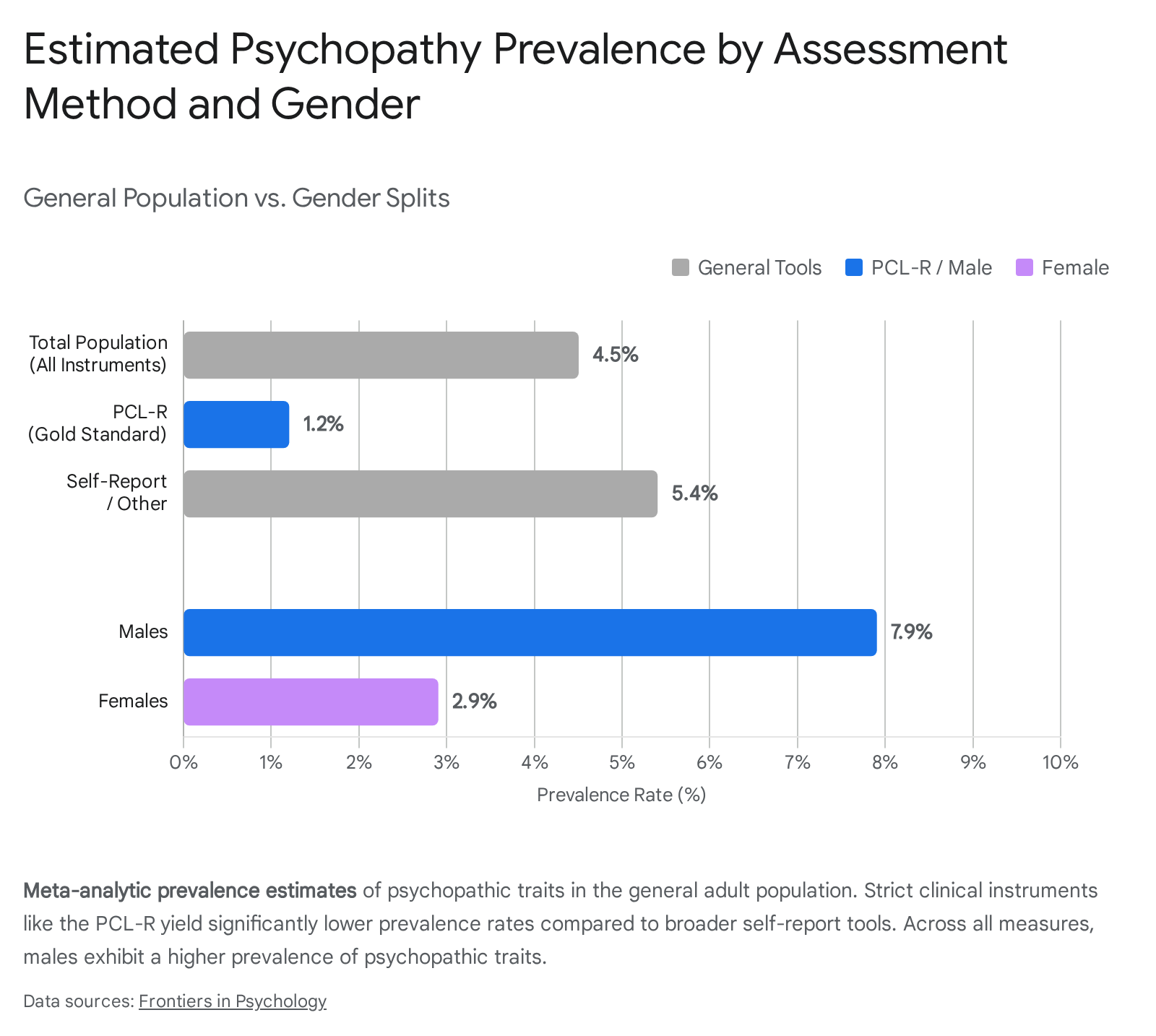
Meta-analytic reviews of the general adult population provide a baseline for understanding the distribution of psychopathic traits. An exhaustive meta-analysis examining 15 studies across multiple international databases estimated the overall prevalence rate of psychopathy in the general adult population at approximately 4.5% 789. However, this figure is highly contingent upon the specific diagnostic instrument utilized. When the strict clinical criteria of the PCL-R are applied, the general prevalence drops precipitously to 1.2% 789. Conversely, when broader self-report tools assessing psychopathic personality traits are used, the estimated prevalence can quadruple to 5.4% 7.
Consistent across all methodologies and global regions is a severe demographic gender disparity. Males exhibit psychopathic traits at significantly higher rates than females. In broad community samples, the combined prevalence of psychopathy is estimated at 7.9% in males compared to just 2.9% in females 79.
This disparity is mirrored in ASPD statistics; in the United States, ASPD is approximately three times more common among men than women, with a peak diagnostic prevalence occurring between the ages of 24 and 44 3. Furthermore, incarceration vastly concentrates these traits. Reviews of global prison systems reveal that ASPD is ten times more common among incarcerated individuals than in the general public, affecting nearly 47% of male prisoners and 21% of female prisoners 3.
The Dark Factor of Personality Across Societies
Cross-cultural data reveal significant variance in the manifestation of these traits depending on macro-level societal conditions. A massive global study encompassing over 1.7 million individuals across 183 countries evaluated the "Dark Factor of Personality" (D) - a psychological construct capturing the generalized tendency toward self-serving, exploitative, callous, and manipulative behavior that underlies psychopathy, narcissism, and Machiavellianism 10.
The study found that elevated levels of the Dark Factor consistently correlate with environments characterized by severe poverty, socioeconomic inequality, institutional corruption, and systemic violence 10. In societies where harsh conditions persist and rule-breaking frequently goes unpunished by robust institutions, exploitative behaviors may be adopted as a defensive survival strategy 10. When exploitation is pervasive, defensive selfishness is perceived as a safer strategy than trust and prosocial cooperation. Furthermore, individuals learn from their immediate surroundings; if rule-bending appears normal and advantageous, collective societal beliefs can shift toward cynicism and self-gain 10. This environmental calibration suggests that while the biological predisposition for psychopathy remains static, the threshold for its behavioral expression is fluid, adapting to the perceived dangers and reward structures of the immediate cultural ecology.
Cultural Contexts of Moral Decision-Making
Cultural frameworks also heavily influence the cognitive processing of moral transgressions, which is central to the expression of psychopathy. Diagnostic criteria for psychopathy largely evolved within Western, Educated, Industrialized, Rich, and Democratic (WEIRD) contexts. Consequently, applying these tools across diverse global populations frequently encounters issues of measurement invariance 111213.
Research spanning distinct geographic regions indicates that individuals in individualistic cultures (such as the United States) and collectivist cultures (such as Japan) process interpersonal moral dilemmas differently 1415. When assessing the moral gravity of a transgression committed by a close associate, people in individualistic cultures frequently prioritize the protection of the specific relationship over abstract societal rules, demonstrating high protective prosociality toward their in-group despite the transgression. Conversely, those in highly collectivist cultures tend to prioritize overarching societal harmony, rendering harsher judgments and demonstrating less protectiveness toward transgressors even if they belong to their immediate social circle 14.
Because the interpersonal-affective dimensions of psychopathy are closely tied to the violation of social norms and the exploitation of personal relationships, actions classified as pathological in one cultural context may be viewed differently in another. For example, traits categorized as fearless dominance or assertive manipulation might align with expectations in highly competitive, success-driven individualistic societies, whereas they would be severely sanctioned in cultures emphasizing embeddedness and social harmony 1213. The lack of strict cross-cultural measurement invariance indicates that evaluating antisocial personality purely through the lens of Western moral norms risks either pathologizing culturally specific adaptive strategies or failing to capture the unique presentation of callousness in non-Western settings 121316.
Structural and Functional Brain Architecture
For decades, the prevailing neurobiological theories of psychopathy focused on localized structural deficits, isolating specific regions of the brain assumed to be uniquely responsible for moral reasoning and emotional regulation. However, as neuroimaging technology has advanced, research has demonstrated that psychopathy involves complex, widespread functional anomalies that disrupt entire neural networks rather than isolated cortices.
Global Connectivity and the Psychopathy Network
Early structural imaging studies of psychopathy yielded highly heterogeneous results, leading to ongoing debates regarding the exact biological signature of the disorder. To resolve this lack of replication, recent meta-analyses utilizing advanced functional connectomes have mapped the peak coordinates of disparate studies onto a common functional connectivity network 181920. An exhaustive 2024 meta-analysis encompassing 23 functional neuroimaging studies (analyzing data from over 1,100 participants) found that while there is little strict regional spatial convergence when examining localized coordinates, the heterogeneous findings converge overwhelmingly onto a distinct "Psychopathy Network" when viewed through the lens of network topology 181920.
This specific network demonstrates a replicability reaching up to 85.2% across prior functional studies 19. The network is characterized by critical connectivity hubs that include the dorsal anterior cingulate cortex, midcingulate cortex, caudate nucleus, anterior insula, lateral prefrontal cortex, thalamus, midbrain, and specific lobules (VIIIa-b, IX) of the cerebellum 18. Crucially, the functional layout of the Psychopathy Network aligns strongly with known lesion networks causally linked to acquired antisocial behaviors, as well as neurotransmission systems involving dopamine and serotonin 19. This indicates that psychopathy is most accurately conceptualized as a network-level disruption affecting the integration of multiple streams of cortical and subcortical information, particularly regarding socio-affective representations and value-based decision-making 192017.
Furthermore, the structural anomalies in psychopathy show a pronounced dimension-specific alignment. Advanced mapping using the Julich-Brain Atlas has shown that traits associated with PCL-R Factor 2 (lifestyle-antisocial behavior, impulsivity) correlate robustly with reduced volumes in structures governing behavioral regulation. These include the basal ganglia, thalamus, basal forebrain, pons, and the orbitofrontal cortex 45. Disruptions in these frontal-subcortical circuits - which form essential feedback loops between the cortex and deeper structures - deprive the individual of the inhibitory control required to evaluate risks and modulate aggressive impulses 4. By contrast, Factor 1 traits (interpersonal-affective, lack of empathy, pathological lying) exhibit weaker and more individualized structural deviations, occasionally presenting localized reductions in the dorsolateral-frontal cortex and left hippocampus 5. Overall brain volume is also frequently reduced in severe psychopathy, with notable localized differences in the right subiculum of the hippocampus 5.
The Amygdala and Stimulus-Reinforcement Learning
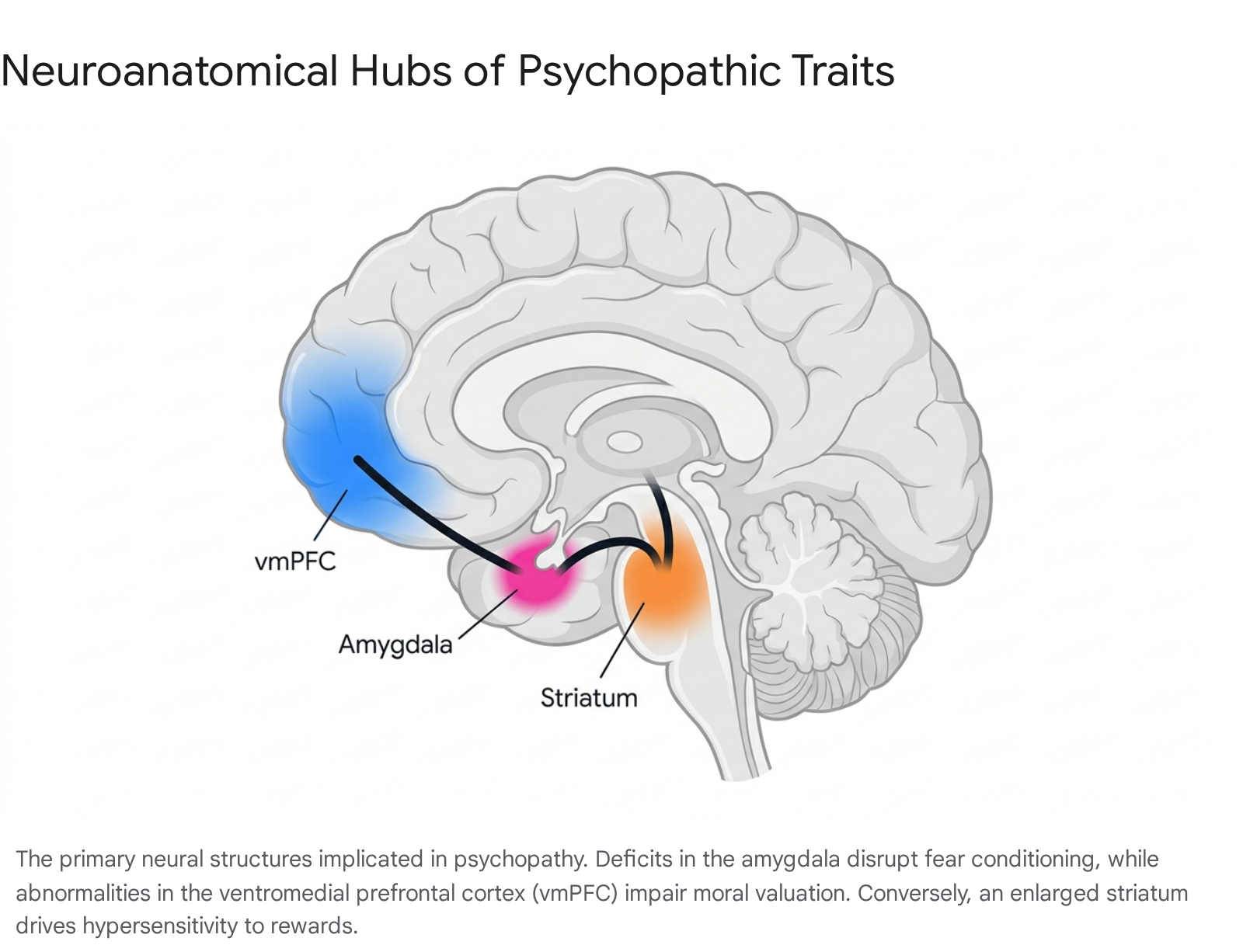
A cornerstone of the neurobiology of psychopathy is the profound dysfunction of the amygdala, a critical subcortical limbic structure responsible for processing emotional stimuli, fear conditioning, and forming stimulus-reinforcement associations. In neurotypical populations, the amygdala facilitates the rapid association of actions that harm others with the aversive reinforcement of the victim's distress. This process relies heavily on the brain's ability to recognize and react to expressions of fear, sadness, and pain in others 1819.
Individuals with high psychopathic traits demonstrate severe amygdala dysfunction, characterized by significantly reduced activation during fear conditioning paradigms and when viewing distress cues 1819. This hyporeactivity prevents the psychopathic brain from experiencing the normal physiological autonomic arousal and subjective distress that usually accompany the contemplation or commission of moral violations. Because the amygdala fails to correctly process fearful expressions as negative reinforcers, the individual demonstrates a severe impairment in passive avoidance learning - the ability to learn to withhold a response to avoid a punishing outcome 192025.
The behavioral consequence of this amygdalar deficit is twofold. First, the lack of emotional sensitivity results in a blunted capacity for affective empathy, making it exceedingly difficult for the individual to intuitively infer or care about the emotional states of others. Second, because punishment-based associations fail to form during critical developmental windows, the individual is not deterred by the prospect of social, physical, or legal repercussions 1819. Consequently, the probability that antisocial and aggressive behaviors will be utilized instrumentally to achieve personal goals increases dramatically 1820.
The Ventromedial Prefrontal Cortex and Moral Valuation
While the amygdala identifies emotional salience, the ventromedial prefrontal cortex (vmPFC) is tasked with representing reinforcement expectancies, integrating emotional signals, and guiding subsequent complex decision-making. The interaction between the amygdala and the vmPFC forms a vital neural circuit for the regulation of prosocial behavior and the suppression of reactive aggression. In the psychopathic brain, this circuitry is frequently compromised, resulting in an attenuated output signal from the emotional centers in the temporal lobes to the prefrontal executive systems 1921.
Lesion studies have historically provided the strongest evidence for the vmPFC's fundamental role in the "moral brain." Patients suffering focal damage to the vmPFC exhibit a syndrome known as acquired sociopathy or "pseudopsychopathy." This syndrome is characterized by blunted affect, poor tolerance for frustration, irritability, and a striking deterioration of social appropriateness and empathy 22. Modern computational modeling and behavioral testing indicate that the vmPFC is directly responsible for assigning value to social factors and principles. For instance, in controlled experiments, patients with vmPFC lesions display a distinct reduction in prosocial effort - they earn significantly fewer rewards for others, discount rewards steeply when physical effort is required for another's benefit, and demonstrate reduced implicit moral evaluations of transgressions compared to healthy controls 2324.
In forensic psychopathic populations, the functional connectivity between the amygdala and the vmPFC is remarkably degraded 19. Under the somatic marker hypothesis, the somatic states (physiological arousal) generated by the amygdala in response to anticipated outcomes provide an automatic, intuitive mechanism to guide the individual away from disastrous or immoral choices 25. Without proper integration and representation in the vmPFC, this somatic warning system is silenced. Consequently, psychopathic individuals often rely heavily on cold, utilitarian cognitive frameworks during moral dilemmas, detached from the normative affective constraints that typically inhibit humans from inflicting harm upon one another 2223.
The Striatum and Hypersensitivity to Reward
Historically, psychopathy research heavily emphasized neural deficits - smaller brain volumes, blunted affect, reduced cortical activation, and impaired connectivity. However, recent evidence establishes that psychopathy is also characterized by specific neurobiological surpluses, most notably regarding the striatum. The striatum is a deep subcortical brain structure intricately involved in reward processing, motivation, and goal-directed behavior 26.
Volumetric neuroimaging has revealed that individuals with pronounced psychopathic traits possess a striatum that is, on average, approximately 10% larger than that of non-psychopathic controls 26. This structural enlargement correlates directly with a hypersensitivity to rewards and an exceptionally strong drive for stimulation. Rather than merely lacking fear or moral constraint, psychopathic individuals are biologically primed to pursue rewards - be they financial, sexual, status-driven, or power-oriented - with an intensity that easily overrides potential risks or future consequences.
This reward dominance fundamentally alters the individual's decision-making calculus. When the hyperactive striatal reward signal is coupled with the absence of inhibitory restraint from the dysfunctional amygdala and vmPFC, the outcome is a highly impulsive, thrill-seeking behavioral profile.
The individual pursues gratification at the direct expense of others, viewing victims merely as instrumental mechanisms to achieve immediate, hyper-valued rewards 26.
| Brain Region | Primary Functional Role in Neurotypical Brain | Observed Abnormality in Psychopathic Brain | Primary Behavioral Consequence |
|---|---|---|---|
| Amygdala | Emotional processing, fear conditioning, stimulus-punishment association. | Reduced volume; severe hyporeactivity to distress cues and fear. | Lack of affective empathy; fearless temperament; absolute failure to learn from punishment. |
| Ventromedial Prefrontal Cortex (vmPFC) | Integration of emotion and cognition, moral valuation, prosocial effort computation. | Reduced gray matter density; degraded functional connectivity with the amygdala. | Impaired moral judgment; lack of guilt; reliance on cold utilitarian reasoning; failure to inhibit antisocial impulses. |
| Striatum (Caudate/Putamen) | Reward processing, motivation, value-based decision making. | ~10% increased volume; hyper-reactivity to anticipated rewards. | Profound thrill-seeking; extreme impulsivity; hyper-fixated goal-directed behavior that ignores obvious risks. |
| Posterior Cerebellum | Coordination, integration of complex cognitive and affective information. | Structural impairment; altered functional connectivity within the broader Psychopathy Network. | Deficient emotional detachment regulation; poor integration of affective states into higher cognition. |
Genetic and Epigenetic Mechanisms
The emergence of psychopathic traits is not dictated exclusively by static neuroanatomy. Extensive behavioral genetics research demonstrates that psychopathy is highly heritable, with genetic factors accounting for approximately 50% of the variance in aggressive and antisocial behaviors 627. However, the search for a singular "psychopathy gene" has proven futile. Instead, the condition arises from a complex polygenic interplay, heavily moderated by environmental exposures during critical periods of childhood development.
The MAOA Gene and Gene-Environment Interactions
The monoamine oxidase A (MAOA) gene, which encodes an enzyme responsible for the degradation of neurotransmitters such as dopamine and serotonin, has been extensively studied in the context of aggression. The low-activity allele of this gene (MAOA-L) does not directly or deterministically cause psychopathy or violent behavior on its own 2728. Polymorphisms impacting complex human behaviors operate non-deterministically, increasing the risk for certain behavioral expressions only by a small, cumulative margin 27.
However, the behavioral manifestation of the MAOA-L allele is subject to profound gene-environment interaction. Gathering evidence consistently suggests that the MAOA-L variant strongly predisposes males to reactive violence, aggression, and externalizing behaviors primarily when they experience severe early life adversity, abuse, or trauma 2829. Without the catalyst of early trauma, the genetic polymorphism remains largely latent. This interaction highlights a critical developmental pathway where early environmental toxins - such as parental neglect, physical abuse, or severe instability - act upon genetic vulnerabilities to sculpt an antisocial trajectory.
Epigenetic Modifications and HPA Axis Dysregulation
Beyond simple gene-environment interactions, childhood trauma fundamentally alters gene expression through epigenetic mechanisms, specifically DNA methylation and histone modification. Epigenetic processes allow plasticity in gene regulation in response to significant environmental events, effectively leaving a molecular scar on the genome that can persist into adulthood 2935303132.
A primary target of trauma-induced epigenetic alteration is the NR3C1 gene, which encodes the glucocorticoid receptor (GR), alongside genes like FKBP5 which modulates receptor sensitivity 2930. The GR is a crucial component of the hypothalamic-pituitary-adrenal (HPA) axis, the body's primary stress response system. Animal models and human postmortem studies demonstrate that severe early life trauma - such as parental death, physical abuse, or maternal separation - is associated with hypermethylation of specific promoter regions (e.g., the exon 1F promoter) of the NR3C1 gene 2935.
Hypermethylation effectively suppresses the transcription of the NR3C1 gene, leading to a significant downregulation of glucocorticoid receptors in critical brain regions including the hippocampus, basolateral amygdala, and nucleus accumbens 2935. A reduction in available glucocorticoid receptors weakens the negative feedback loop of the HPA axis. The physiological result is an extended, dysregulated stress hormone activity and altered cortisol signaling 2930.
In the context of psychopathy, severe disruptions to the stress response system early in life can produce a paradoxical blunting of autonomic arousal. Chronic exposure to overwhelming stress hormones during neurodevelopment may result in habituation or toxic damage to limbic structures. This ultimately contributes to the low anxiety, emotional coldness, and profound autonomic under-arousal that characterize the primary psychopathic phenotype 21. Notably, emerging research indicates that some epigenetic changes, including NR3C1 methylation, may be partially reversible through successful exposure-based psychotherapy. Studies have linked NR3C1 methylation dynamics to psychotherapy outcomes in trauma patients, raising the possibility that targeted early interventions could reverse biological risk markers in high-risk youth 3032.
Advances in artificial intelligence and machine learning are increasingly capable of detecting these epigenetic traces. Blood-based DNA methylation panels can now generate methylation risk scores capable of predicting an individual's long-term vulnerability to externalizing problems, addiction, and antisocial behaviors nearly two decades after the initial childhood trauma occurred 3031.
Compensatory Mechanisms and Successful Psychopathy
A significant evolution in the neuroscientific understanding of psychopathy is the recognition of "successful" or non-incarcerated psychopaths. The traditional assumption in forensic psychology relied heavily on samples drawn from prison populations, creating a systemic bias toward the "unsuccessful" psychopath - those who fail to evade capture due to extreme impulsivity, violence, or lower cognitive functioning 334041. However, psychopathy exists on a spectrum, and a substantial proportion of individuals with high psychopathic traits manage to lead non-incarcerated, superficially successful lives, often rising to positions of significant influence 334034.
Neurobiological Advantages in Self-Regulation
To explain the divergence between successful and unsuccessful psychopaths, researchers have proposed a compensatory model. This model posits that successful psychopathic individuals possess the same core dark traits - fearlessness, manipulativeness, and callousness - but develop heightened self-regulatory capacities to compensate for their antisocial impulses 3435. Rather than acting out with overt physical violence or criminal recklessness, these individuals channel their lack of empathy into domain-general inhibitory control and domain-specific suppression of aggression. This allows them to achieve their goals via covert, nonviolent, and socially acceptable methods 3334.
Neuroimaging of non-incarcerated, successful psychopaths provides compelling support for the compensatory model. Structural MRI studies reveal that these individuals exhibit greater gray matter density in the ventrolateral prefrontal cortex (vlPFC) compared to controls 35. The vlPFC operates as a critical hub for self-regulation and cognitive inhibition, responsible for the down-regulation of primitive and reactive emotions such as fear and anger 35.
While unsuccessful psychopaths suffer from extensive frontotemporal impairments that severely degrade decision-making and impulse control, successful psychopaths display intact or even enhanced executive functioning 3335. In psychological assessments, this neurobiological advantage manifests as elevated scores in specific facets of conscientiousness, such as self-discipline and order 4034. They maintain the superficial charm, grandiosity, and emotional coldness associated with Factor 1 traits, but utilize their heightened prefrontal regulation to navigate complex social hierarchies without triggering catastrophic legal consequences.
| Trait / Feature | Unsuccessful (Incarcerated) Psychopath | Successful (Non-Incarcerated) Psychopath |
|---|---|---|
| Prefrontal Neuroanatomy | Extensive volume reductions in prefrontal gray matter; widespread frontotemporal impairments. | Intact or increased gray matter density in the ventrolateral prefrontal cortex (vlPFC). |
| Executive Functioning | Deficient impulse control; highly reactive to immediate provocation; poor planning. | Enhanced domain-general inhibitory control; highly calculating; capable of delaying gratification. |
| Aggression Style | High rates of reactive and overt physical violence; prone to criminal impulsivity. | Instrumental, covert, and relational aggression; utilizes intimidation and systemic manipulation. |
| PCL-R Expression | High scores on both Factor 1 (Affective) and Factor 2 (Lifestyle/Antisocial). | High scores on Factor 1; lower scores on Factor 2 due to suppression of overt criminality. |
| Conscientiousness | Uniformly low across all facets; highly irresponsible and reckless. | Capable of high self-discipline, order, and strategic organization when aligned with personal goals. |
Corporate Psychopathy and Organizational Behavior
The integration of successful psychopaths into the general community frequently occurs within high-stakes vocational environments, such as corporate management, politics, and finance. The traits of primary psychopathy - fearless dominance, glibness, low anxiety, and interpersonal manipulation - are frequently misidentified by organizational systems as indicators of strong leadership, confidence, and executive presence 403637.
However, the presence of psychopathic traits in leadership generates profound toxicity within organizational structures. Extensive meta-analyses of psychopathy in the workplace (encompassing over 49,000 subjects) demonstrate that corporate psychopathy substantially reduces task performance and Organizational Citizenship Behavior (OCB) - the voluntary, helpful actions employees take beyond their formal job descriptions 383940. Simultaneously, it drastically enhances Counterproductive Work Behavior (CWB), such as sabotage, theft, and active disengagement 3839.
Psychopathic leaders rely heavily on intimidation, bullying, and aggressive persuasion 4041. They utilize impression management to project a charming image upward to their superiors while actively exploiting and exhausting the resources of their subordinates. This dynamic severely degrades the quality of Leader-Member Exchange (LMX), creating an atmosphere where employees feel pressured, micromanaged, and undervalued 40. Due to their cognitive empathy - the ability to understand the emotional states of others without feeling affective resonance or sympathy - they are highly adept at identifying psychological vulnerabilities and isolating targets for manipulation, maintaining multiple corporate facades to circumvent controls 4150.
Methodological Critiques and Ethical Implications
The rapid advancement of neurocriminology and the neurobiology of psychopathy has generated significant methodological debates. The application of brain imaging to forensic populations, while providing critical data, brings profound ethical risks concerning biological determinism, sample bias, and the use of unrefined science in high-stakes legal contexts.
Limitations of Neuroimaging in Forensic Populations
Much of the foundational literature linking specific brain volumes to psychopathy relies heavily on scans of incarcerated individuals. A prominent example is the work of neuroscientist Kent Kiehl, whose team utilized mobile fMRI scanners inside maximum-security prisons across the United States, generating a database of over 3,500 neural scans of inmates 4142. While these studies established vital correlations between psychopathic scores and limbic system deficits, critics have raised severe methodological concerns regarding the inherent sample bias of such populations 43.
Incarcerated populations in the United States are disproportionately composed of individuals from impoverished backgrounds and marginalized racial groups . A brain-centric view of criminality derived predominantly from this specific population risks conflating the structural neurological impact of systemic social issues - such as chronic poverty, malnutrition, untreated childhood trauma, and systemic racism - with innate biological criminality .
Furthermore, the broader field of neuroimaging relies heavily on correlational analysis and complex adaptive algorithms. Critics point out that fMRI statistical models can sometimes exaggerate effect sizes and produce false positives 43. Because fMRI detects blood oxygenation level-dependent (BOLD) signals as a proxy for neural activity rather than direct neuronal firing, translating these hemodynamic responses into definitive, causal conclusions about an individual's moral character or capacity for violence remains epistemologically perilous 43.
The Limits of Biological Determinism
The danger of biological determinism in psychopathy research is sharply illustrated by the autobiographical case of neuroscientist James Fallon. While conducting blind analyses of brain scans for an Alzheimer's study, Fallon inadvertently discovered that his own PET scan exhibited the classic structural signatures of a severe psychopath: drastically low activity in the orbital cortex, ventromedial prefrontal cortex, and temporal lobes 44. Subsequent testing confirmed he possessed multiple high-risk genetic alleles associated with aggression and low empathy, including the MAOA-L variant 3644.
Despite possessing both the genetic blueprint and the anatomical brain structure of a primary psychopath, Fallon evolved into a non-violent, highly successful academic and family man 44. His case stands as a powerful, public counter-narrative to biological fatalism. It underscores that neuroanatomy is not destiny; the presence of high-risk genetic variants can be neutralized or redirected by highly positive, nurturing early childhood environments 36. The absence of severe abuse or abandonment during Fallon's neurodevelopment prevented the activation of the epigenetic switches that typically convert structural vulnerability into antisocial violence 5044. His trajectory demonstrates that while genetics load the gun, environment pulls the trigger.
Neuroprediction and Legal Frameworks
The most contentious application of psychopathy neuroscience lies in "neuroprediction" - the attempt to utilize brain imaging, algorithms, and genomic data to forecast future violent behavior and recidivism 284546. In legal systems, predicting "future dangerousness" is already a common actuarial practice in parole hearings, civil commitments, and capital sentencing 454647. The introduction of neurobiological evidence into the courtroom to refine these predictions operates as a complex double-edged sword.
Defense attorneys frequently introduce evidence of prefrontal or amygdalar dysfunction as a mitigating factor, arguing that these structural deficits fundamentally limit a defendant's cognitive abilities, impulse control, and ultimate legal culpability. They argue the defendant is a victim of a broken brain 2747. Conversely, prosecutors frequently weaponize the exact same neuroscientific data as an aggravating factor. By arguing that psychopathy represents an incurable, hardwired biological defect, prosecutors utilize neuroprediction to demonstrate that a defendant poses a permanent, unmanageable threat to society, thereby justifying lengthier sentences or the death penalty 2747. Furthermore, compelling suspects to undergo brain scanning raises unresolved constitutional issues surrounding Fourth Amendment protections against warrantless searches and Fifth Amendment protections against self-incrimination 47.
The current scientific consensus asserts that while neurobiology provides powerful explanatory models for group differences, it currently lacks the predictive validity required for individual forensic application 2746. Averaging scientific data across thousands of brain scans cannot reliably forecast the future behavior of a specific, complex human being. The tools of neuroscience remain far too crude to bridge the substantial disconnect between the deterministic, generalizing methodologies of science and the individualized moral judgments required by criminal law 2746.
Conclusion
The emergence of psychopathy and antisocial personality is driven by a highly complex, non-deterministic interplay between neuroanatomy, genetics, and early environmental adversity. Neuroscience has successfully mapped the functional and structural deficits of the psychopathic brain, moving beyond isolated regional dysfunction to identify a cohesive "Psychopathy Network." This network is characterized by a profound failure in communication between the amygdala, the ventromedial prefrontal cortex, and an enlarged, hyperactive striatum. These disruptions sever the vital link between emotion and cognition, resulting in an individual who lacks affective empathy, fails to learn from punishment, and is driven by an overwhelming biological sensitivity to immediate reward.
However, the neurobiological blueprint is not an absolute prophecy of violence. Epigenetic mechanisms triggered by severe childhood trauma dictate whether latent genetic vulnerabilities are transcribed into behavioral reality. Furthermore, the presence of heightened prefrontal regulatory capacities allows successful, compensatory psychopaths to navigate society without incarceration, albeit often inflicting profound organizational and interpersonal damage in corporate and political spheres.
As the field of neurocriminology advances, it is imperative to resist the allure of biological determinism. Brain scans and genetic profiles offer critical insights into the etiology of empathy and fear, but they cannot entirely account for the protective power of prosocial environments, nor can they responsibly replace the nuanced, individualized evaluations required by the justice system. Future methodologies must actively integrate cross-cultural variances and address the profound socioeconomic biases inherent in forensic sampling to ensure that the neuroscience of psychopathy illuminates the human condition without stripping away its inherent complexities.