Neuroscience of agency and free will
The Neurophilosophical Foundations of Volition
The inquiry into human agency - whether individuals possess the capacity to make autonomous choices independent of strict causal determinism - has historically been the exclusive domain of metaphysics and theology. Classical philosophers, from Descartes and Kant to Hume, grappled with the implications of human freedom in relation to causality and moral responsibility 1. However, the advent of modern electrophysiology and functional neuroimaging has transformed this debate, situating the problem of free will at the intersection of cognitive psychology, physics, and neuroscience 123. Historically, philosophical positions have fractured into three primary camps: hard determinism, which posits that all events are necessitated by prior causes, rendering free will an illusion; libertarianism, which argues that human agents can initiate entirely uncaused actions; and compatibilism, which maintains that deterministic physical laws can coexist with meaningful forms of moral agency and self-regulation 2456.
The integration of empirical neuroscience into this discourse has fundamentally challenged traditional, pre-scientific notions of a dualistic, unconstrained will 7. By identifying the neural correlates of decision-making, researchers have demonstrated that unconscious brain activity routinely precedes conscious awareness of the intent to act 24. These findings have prompted some neuroscientists and philosophers to advocate for eliminativism - the view that conscious will is a retrospective narrative constructed by the brain to make sense of biologically determined outputs 2. Yet, contemporary neurophilosophy resists a purely reductionist conclusion. Emerging computational models, dynamic fMRI studies of executive function, and cross-cultural analyses suggest that agency is not a binary property localized to a single neural event, but rather a dynamic, spectrum-based capacity that emerges from complex brain networks interacting with environmental, biological, and cultural constraints 28.
The Readiness Potential and the Classical Interpretation
The empirical investigation of free will in modern neuroscience largely originated with the discovery of the Bereitschaftspotential, or Readiness Potential (RP), by Kornhuber and Deecke in 1965 910. The RP is defined as a slow, negative-going buildup of electrical potential measured via electroencephalography (EEG) over the motor cortex and supplementary motor area (SMA) that reliably precedes spontaneous, self-initiated movements 79111213.
Libet's Paradigm and the Early-Decision Account
In 1983, Benjamin Libet leveraged the RP to test the temporal relationship between neural preparation and conscious intention. In his seminal experimental paradigm, participants were instructed to perform a spontaneous, voluntary wrist flexion while observing a fast-rotating clock. They were asked to note the exact position of the clock's hand at the moment they felt the conscious "urge" or "decision" to move - a metric Libet termed "W-time" 7141516.
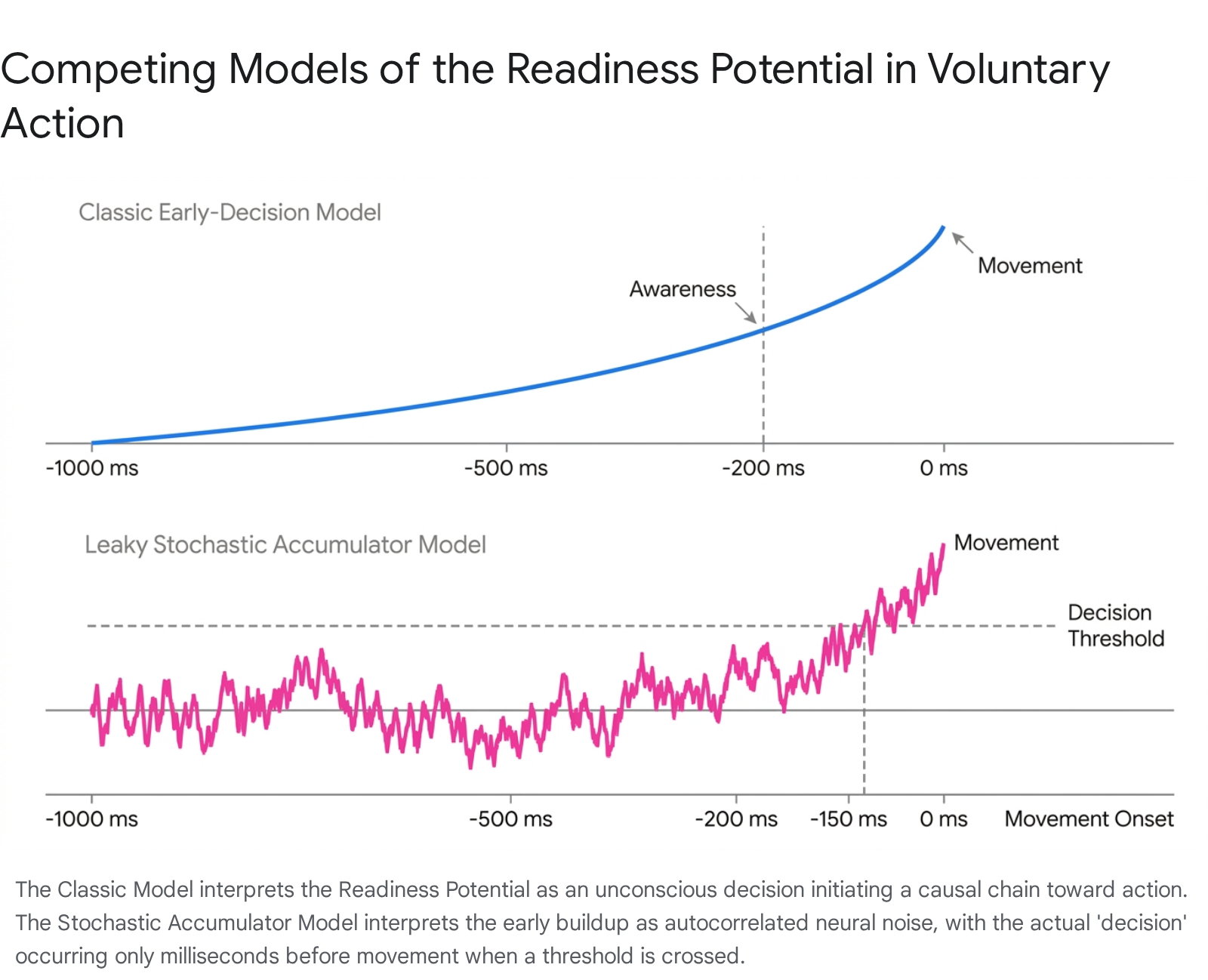
The results of Libet's experiments were deeply disruptive to conventional understandings of volition. The EEG data demonstrated that the Readiness Potential began to build up approximately 500 to 1,000 milliseconds before the physical onset of the movement. However, the participants' conscious awareness of the intent to move (W-time) occurred only about 200 milliseconds prior to the action 191516.
Under the classical interpretation - often referred to as the "early-decision" account - the onset of the RP marks an unconscious neural commitment to act 101517. Because the brain initiates the preparatory motor sequence several hundred milliseconds before the mind becomes consciously aware of the decision, researchers concluded that conscious will cannot be the initiating cause of voluntary movement 124. In this framework, the subjective feeling of agency is epiphenomenal, functioning as a post-hoc illusion wherein consciousness merely observes a decision that the brain has already executed unconsciously 24718.
The Point of No Return and Conscious Veto
Despite the deterministic implications of his findings, Libet himself did not completely abandon the concept of free will. He hypothesized that the 200-millisecond window between conscious awareness and motor execution provided an opportunity for the individual to exert a "conscious veto" to abort the impending action - a phenomenon sometimes colloquialized as "free won't" 71316.
This preservation of inhibitory agency remained a point of theoretical contention until it was empirically tested directly through advanced brain-computer interface (BCI) paradigms. In a pivotal 2016 study, Schultze-Kraft and colleagues designed a paradigm where participants engaged in a "duel" against a BCI trained to detect their individual Readiness Potentials in real-time 19202122. The BCI was programmed to issue a stop-signal upon detecting the onset of the RP, challenging participants to cancel their impending, self-initiated movement.
The results demonstrated that participants could successfully veto their actions even after the unconscious RP had begun to build. However, this cancellation was only possible up to a strict "point of no return," which occurs approximately 200 milliseconds before the onset of electromyographic (EMG) muscle activity 19212223. If the stop-signal was delivered after this 200-millisecond threshold, the motor command became entirely ballistic, and the movement could not be consciously countermanded before execution 121923. This finding is highly significant for the neuroscience of volition: it indicates that the early buildup of movement-related brain signals does not constitute an irreversible causal chain, thereby reinstating a functional, measurable role for conscious inhibitory control within the motor execution sequence 13192122.
The Leaky Stochastic Accumulator Model
While the BCI veto studies refined the timeline of motor inhibition, a more fundamental challenge to the classical interpretation of the RP emerged from the field of computational neuroscience. In 2012, Schurger, Sitt, and Dehaene proposed the leaky-stochastic-accumulator (LSA) model, which fundamentally reinterprets the physiological meaning and causal status of the Readiness Potential 10142425.
Autocorrelated Neural Noise
The LSA model posits that in experimental tasks requiring spontaneous movement without a specific temporal cue (such as the Libet paradigm), the brain's premotor regions are subjected to a generalized, weak "imperative to move" 1425. This weak imperative does not trigger an immediate, directed motor plan. Instead, it elevates the baseline of spontaneous, autocorrelated stochastic fluctuations - essentially, background neural noise - within the motor cortex 10142628.
According to this "late-decision" account, a voluntary movement is triggered only when these random subthreshold fluctuations happen to accumulate and cross a specific motor activation threshold 91013. The LSA model elegantly demonstrates that the gradual, negative-going curve of the RP observed in EEG traces is largely a statistical artifact created by the methodology of "event-locked averaging" 91015. Because researchers isolate epochs of EEG data by locking the timeline to the exact moment of movement (which necessarily occurs when the threshold is crossed) and averaging hundreds of trials backward in time, the random fluctuations mathematically resolve into a smooth, exponential-looking curve 121425.
Therefore, the early onset of the RP does not signify an early, unconscious neural commitment to a specific course of action. Rather, it reflects a pre-decisional bias or inclination. The actual neural commitment to initiate movement happens much closer in time to the onset of the movement itself - typically within 150 milliseconds of the action 910.
2025 Probe-Based Paradigm Updates
Recent empirical developments have provided further evidence for the stochastic accumulator model while actively dismantling the classical link between the RP and conscious intention. A rigorous 2025 study utilizing a novel "probe-based" paradigm investigated whether the amplitude of the RP correlated with a participant's subjective awareness of preparing to move 12. In this paradigm, participants were interrupted at random intervals with an auditory probe and asked immediately if they were consciously preparing an action.
Contrary to earlier hypotheses that linked the RP directly to intention, the study found no relationship between pre-probe RP buildups and reported awareness of motor preparation 12. By applying advanced computational modeling to the EEG data, researchers concluded that subjective awareness of intention is not tied to the slow amplitude buildup of the RP. Instead, awareness of motor preparation is highly correlated with low-beta power desynchronization (in the 12 - 20 Hz range) over the contralateral motor cortex shortly before the onset of the probe 12.
Furthermore, the study introduced a "dual-stage" reporting model, suggesting that metacognitive access to motor preparation operates similarly to perceptual metacognition, where post-decision evidence continues to accumulate to form subjective awareness 12. By systematically separating trials where actions had become ballistic ("failures to inhibit") from genuine motor preparation, researchers demonstrated that the pre-probe RP traces overlapped entirely whether participants reported preparing to move or not 12. These findings isolate the RP as an integration-to-bound process of autocorrelated noise that is metacognitively accessible under certain external demands, but which fundamentally does not represent the deterministic onset of a conscious intention 12.
The Prefrontal Cortex and Executive Control
While the mechanistic study of spontaneous, arbitrary motor tasks (such as wrist flexions) provides insights into primary motor initiation, it offers limited insight into the types of complex, value-laden decisions that define meaningful human agency 213. To understand free will in a functional, ecological sense, cognitive neuroscience turns to the mechanisms of executive function (EF) and cognitive control (CC) - the higher-order mental processes that separate purposeful, goal-directed action from impulsive, automatic reactions 272829.
Functional Neuroanatomy of Volition
The prefrontal cortex (PFC), which comprises over 30% of the human brain's cortical cells, serves as the central executive hub for cognitive control 2729. Agency, defined neurobiologically, relies on the PFC's ability to exert top-down regulation over signals originating in lower-level sensory, affective, and motor regions 272830. This top-down control is the biological architecture of volition; it allows individuals to act in alignment with long-term goals and abstract rules rather than succumbing to immediate environmental stimuli or habitual reflexes 2829.
Neuroimaging (fMRI) studies consistently reveal that cognitive control operates through spatially distributed but functionally integrated brain networks. The frontoparietal network (FPN) and the cingulo-opercular network (CON) are reliably activated during diverse EF tasks 28. Specific subregions of the PFC manage distinct, dissociable components of volition.
| Component of Executive Control | Primary Prefrontal Region(s) | Functional Role in Agency and Volition |
|---|---|---|
| Working Memory & Planning | Dorsolateral PFC (dlPFC) | Maintains task-sets and simulates future outcomes, allowing actions to be guided by internal goals rather than external stimuli 282931. |
| Response Inhibition | Ventrolateral PFC (vlPFC) & Anterior Cingulate Cortex (ACC) | Suppresses prepotent, automatic, or habitual responses; critical for the "veto" power of conscious volition and error monitoring 293132. |
| Cognitive Flexibility | Dorsolateral PFC & Parietal Cortex | Shifts attention between competing demands and updates behavioral rules in response to changing environments 282931. |
| Value & Motivation ("Hot" Control) | Medial PFC (mPFC) & Orbitofrontal Cortex (OFC) | Integrates emotional states, somatic markers, and anticipated rewards into decision-making, ensuring choices align with personal values 282930. |
Recent mapping of resting-state functional connectivity (rsFC) demonstrates that the intrinsic communication between the PFC and parietal/occipital lobes strongly predicts an individual's general executive function capacity, even in the absence of an immediate goal-directed task 2728.
Furthermore, clinical neuroimaging underscores the necessity of these circuits for self-regulation. Experiments utilizing the Wisconsin Card Sorting Task have shown that specific prefrontal activation patterns during executive functioning - such as increased activity in the right middle frontal gyrus and left superior frontal gyrus - can reliably predict patient responses to cognitive behavioral therapy (CBT) in older adults suffering from late-life depression 33. Similarly, investigations into the neurocognitive effects of physical activity reveal that physically active older adults exhibit highly efficient prefrontal activation (particularly in the right dorsolateral frontal gyrus) during cognitive flexibility tasks, highlighting how lifestyle variables structurally alter the neurobiological parameters of agency 3132.
Hard Determinism and its Scientific Critiques
Despite the identification of these sophisticated, top-down self-regulatory networks, some prominent scientists maintain that neuroscience entirely abolishes the concept of free will. The most visible contemporary proponent of hard incompatibilism is Robert Sapolsky, whose 2023 book Determined: A Science of Life Without Free Will synthesizes genetics, neuroendocrinology, and complexity theory to argue that humans are "nothing more or less than the cumulative biological and environmental luck, over which we had no control" 3437.
Sapolsky contends that because every neurobiological event is preceded by an unbroken chain of prior physiological, developmental, and evolutionary causes, there are no "gaps" in the physical universe where an uncaused, immaterial will could intervene 3536. Consequently, he argues that the concepts of moral responsibility, blame, and desert must be eradicated from social and legal systems. Instead, he proposes a purely medicalized model of quarantine for dangerous individuals, stripped of retributive justice 13737.
Methodological and Philosophical Fallacies
Sapolsky's absolute, Laplacian determinism has faced severe critique in peer-reviewed scientific literature and philosophical discourse for relying on outdated metaphysics, methodological oversights, and conceptual errors 3438.
First, critics point out that Sapolsky systematically attacks a strawman definition of free will. By defining free will strictly as an uncaused, acontextual neural event that operates entirely independent of a person's biology and history (an a priori empty set), he forces a category error 3438. Modern neuroscience and neurophilosophy do not conceptualize agency as biological independence; rather, agency operates through biological mechanisms 353638. Critics argue that looking for free will in a single neuron is a reductionist fallacy, akin to looking for the property of "traffic" in a single spark plug 3539.
Second, Sapolsky is criticized for simplistic causality. He relies on a strictly linear, bottom-up model of causation, effectively ignoring established principles of theoretical biology and complex systems theory 3438. In complex biological organisms, the principle of "constraint causation" allows higher-level organizational structures (like the distributed prefrontal executive networks) to exert genuine causal efficacy by constraining and channeling the behavior of lower-level neuronal components 3438.
Third, critiques highlight Sapolsky's conflation of historicity with necessity. He views a person's accumulated biological and environmental history exclusively as a cage that dictates their future 3438. Conversely, cognitive science demonstrates that biological historicity - the accumulation of episodic memories, learned cognitive skills, and prefrontal integrity - is precisely the architecture that enables agency. It allows an organism to respond flexibly, rationally, and intelligently to novel situations rather than relying on hardwired reflexes or immediate stimuli 3438. Finally, the established existence of computational undecidability and deterministic chaos at the macroscopic scale implies that even if the universe operates on deterministic physical laws, human behavior remains fundamentally unpredictable, precluding the exactness required for hard biological determinism 373539.
Behavioral and Societal Consequences of Free Will Beliefs
While the ontological debate over the precise neurobiological status of free will continues, psychological research demonstrates that the belief in free will carries profound behavioral, societal, and health-related consequences 18404142. Determining whether free will exists is scientifically complex, but determining whether the concept matters for human functioning is empirically settled: it dictates fundamental patterns of behavior.
Prosociality, Ethics, and Self-Regulation
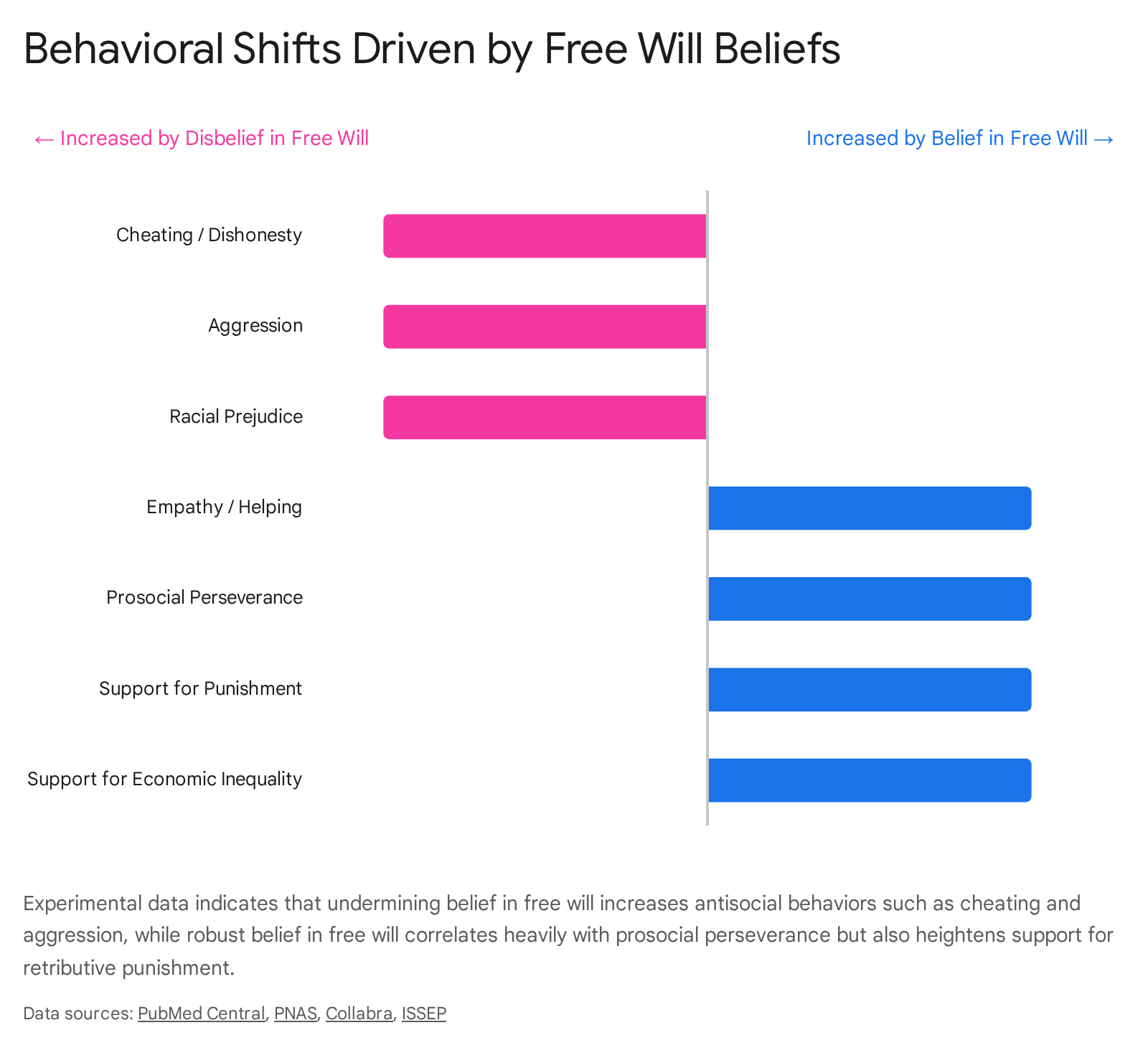
Experimental manipulations, spearheaded by the seminal 2008 studies of Vohs and Schooler, have shown that artificially diminishing a person's belief in free will - typically by having them read academic texts asserting that science has disproved it - measurably alters their ethical conduct 184042. Participants primed with deterministic disbelief engaged in significantly more cheating on academic and financial tasks than control groups 184041. Subsequent meta-analyses and replication studies have reinforced these findings, indicating that reducing belief in free will increases antisocial tendencies, including higher levels of aggression, and reduces empathy or the willingness to help others 1840.
Psychologically, the belief in free will acts as a foundational pillar for self-regulation. Stronger beliefs in personal agency correlate with higher job satisfaction, the setting of more meaningful life goals, greater perseverance in the face of adversity, and an enhanced sense of authenticity 184243. In the realm of health psychology, strong agency convictions predict higher perceived behavioral control, leading to healthier lifestyle choices, such as increased physical activity and dietary restraint 4042. Weakening these beliefs has been shown to make participants feel more self-alienated and disconnected from their "true selves" during periods of moral decision-making 18.
Punitiveness, Retribution, and Inequality
However, the psychological reliance on free will acts as a double-edged sword. While it promotes ethical behavior and robust self-control, it concurrently underpins harsh, retributive moral judgments. Experimental and survey studies demonstrate that robust belief in free will intensifies the correspondence bias - the psychological tendency to attribute a person's behavior strictly to their internal disposition, largely ignoring external, situational, or systemic factors 40.
Consequently, individuals with strong free will beliefs exhibit a much higher intolerance for unethical behaviors and demonstrate stronger support for severe criminal punishment 404148. Extensive data drawn from the World Values Survey, analyzing responses from over 65,000 individuals across 46 countries, confirmed that robust free will beliefs globally predict support for harsh criminal punishment, though the intolerance of unethical behavior is moderated by the institutional integrity of the country 41.
Furthermore, strong belief in free will strongly correlates with increased support for economic inequality. By engendering the belief that individuals are entirely responsible for their economic status, strong believers in free will are more likely to attribute poverty to a lack of effort rather than systemic barriers, thereby rationalizing and justifying existing social stratification 4048.
Cross-Cultural Frameworks of Volition and Responsibility
The intersection of neuroscience, philosophy, and behavioral psychology regarding free will is heavily skewed toward Western, Educated, Industrialized, Rich, and Democratic (WEIRD) populations. In Western paradigms, free will is intrinsically tied to individualism: it presupposes an autonomous, independent self making isolated choices based on private desires and universal principles 44454647. However, investigating volition through a cross-cultural lens reveals fundamentally divergent constructions of agency, moral obligation, and identity.
Individualism Versus Collectivism
Individualistic cultures view the self as autonomous and consistent across all situations, emphasizing personal rights, privacy, and internal motives 4554. In contrast, collectivistic cultures, found predominantly in East Asia, Latin America, and parts of Africa, view the self as interdependent and relational. They prioritize group cohesion, social harmony, and shared obligations 455448.
In collectivist paradigms, agency is not defined by the exercise of isolated personal preference, but rather by the successful coordination of behavior to align with group needs. Motivation and choice-making are frequently distributed. For example, major life decisions regarding careers or marriage may be made collaboratively by the family rather than the individual, without this process being perceived as a violation of freedom or personal agency 4448.
Confucian Role Ethics and Relational Agency
Confucian heritage cultures (such as China, Japan, and South Korea) operate on a highly structured socio-moral framework of relational harmony and role ethics 46474957. The Confucian model fundamentally rejects the Western concept of the absolute, isolated individual, defining a person instead by their dynamic, ongoing web of social relations 4749.
Moral agency in Confucianism relies heavily on filial piety (xiao) and benevolence (ren). In Western ethics, a free agent is expected to choose universal, abstract justice over personal bias 46. In contrast, Confucian ethics dictate that an agent acts morally by explicitly favoring close relations; the moral obligation to the family overrides abstract legalistic principles 46. For example, classical texts suggest that a son is morally obligated to hide a father's misconduct to preserve filial loyalty, fulfilling a primary duty even if it violates a universal legal principle of justice (yi) 46.
This socio-moral structure does not imply an absence of individualism or personal agency in Confucian societies. Rather, individuals must exercise robust self-restraint, intense moral reflection, and deliberate intentionality to successfully fulfill their complex social roles and maintain public harmony (wa) 464758. The psychological agency is simply directed toward relational fidelity and collective stability rather than atomic self-actualization 4749.
Buddhist Conceptions of Agentless Agency
Buddhist philosophy provides another highly sophisticated counter-model to Western dualism. Buddhism fundamentally rejects the existence of a permanent, independent "self" (the doctrine of anatman or non-self). This rejection immediately problematizes the Western assumption that an autonomous "self" must exist as the author of free will 50515253.
Instead, Buddhism relies on the principle of "dependent origination" - the idea that all mental and physical phenomena arise exclusively due to a complex web of prior causes and conditions 5053. Historically, the Buddha explicitly rejected both absolute determinism (fatalism) and absolute indeterminism (pure chance) because both extreme views paralyze moral effort and eliminate the functional rationale for spiritual practice 5263.
Modern neurophilosophical interpretations frame the Buddhist position as a form of "soft compatibilism" or "agentless agency" 51. While recognizing that desires, thoughts, and initial impulses are strictly causally conditioned by past events and neurobiology, Buddhism emphasizes the cultivation of meta-level control 5163. Through rigorous mindfulness and attentional training, an individual can insert a temporal and cognitive gap of awareness between a stimulus and a response, observing subconscious neural processes without being compelled by them 5063. Thus, the Buddhist enterprise aligns remarkably closely with cognitive neuroscience's view of prefrontal top-down executive control: true freedom is not the uncaused initiation of action, but the acquired, trained capacity to regulate, inhibit, and wisely direct one's neurobiological responses 515363.
| Framework | Conception of the "Self" | Basis of Moral Agency | View of Determinism vs. Freedom |
|---|---|---|---|
| Western Individualism | Autonomous, atomic, and independent. | Abstract universal justice; acting on uncoerced personal choices. | Heavily debated; centers on whether physical determinism negates individual autonomy. |
| Confucian Role Ethics | Relational, embedded, and interdependent. | Fulfilling social roles, filial piety, and maintaining collective harmony. | Emphasizes situational constraints; agency lies in accepting and navigating relational duties. |
| Buddhist Philosophy | Illusory; a construct of transient psychological aggregates. | Alleviating suffering through wisdom, compassion, and intention. | Relies on "dependent origination." Rejects fatalism; freedom achieved by transcending unexamined impulses via mindfulness. |
The Integration of Neuroscience and Western Jurisprudence
The debate over the neurobiology of free will has profound implications for modern legal systems. Criminal law presupposes a "folk-psychological" view of the person, asserting that behavior is driven by conscious mental states such as desires, beliefs, intentions, and plans 5455. Retributive justice requires a defendant to be a rational agent capable of acting otherwise; therefore, a demonstration that behavior is purely deterministic threatens the foundation of criminal culpability 154.
However, the translation of mechanistic neuroscience into the courtroom remains fraught. Neurons and localized brain networks do not possess intent, recognize the future, or act maliciously - people do 54. Because of the established spectrum of agency and the capacity for prefrontal top-down control, the majority of legal scholars advocate for a compatibilist approach. Neuroscience is increasingly utilized not to prove the non-existence of free will globally, but to identify specific excusing conditions - such as severe prefrontal dysfunction, automatism, or localized lesions - that demonstrably impair an individual's placement on the spectrum of agency 154. This integration is slowly driving a paradigm shift away from purely retributive justice toward rehabilitative and preventative models that respect neurobiological constraints while maintaining societal safety 155.
Conclusion
The intersection of advanced neuroscience, philosophy, and behavioral science paints a highly nuanced, non-binary picture of human free will. Early electrophysiological findings, such as the classical interpretation of the Readiness Potential, seemingly threatened the concept of volition by demonstrating that unconscious neural processes precede conscious awareness 27. However, advanced computational models, such as the leaky stochastic accumulator, have successfully reframed these early potentials not as deterministic neural decisions, but as the buildup of auto-correlated noise that biases, but does not finalize, an action 101214. Furthermore, empirical verifications of a 200-millisecond "point of no return" confirm the presence of robust top-down inhibitory control mechanisms within the human brain 1922.
Neuroscience does not disprove free will; rather, it dismantles the scientifically untenable definition of a magical, uncaused soul operating completely outside the laws of physics 13554. What remains is a biologically grounded, compatibilist framework where agency emerges dynamically from the prefrontal cortex's capacity to maintain goals, simulate future scenarios, and suppress immediate impulses 5272866.
This biologically constrained agency operates on a spectrum, highly dependent on neurological integrity, environmental context, and cultural conditioning 245. Acknowledging this reality is crucial, as the fundamental belief in personal agency dictates prosocial behavior, ethical conduct, and the architecture of legal frameworks 184056. Ultimately, understanding the neural, computational, and cultural scaffolding of free will allows society to move past anachronistic arguments of absolute determinism versus absolute freedom, moving toward a calibrated approach to moral responsibility that respects both the physical constraints of human biology and the undeniable efficacy of human self-regulation.