Neurobiology of socioeconomic inequality
Introduction
The intersection of developmental cognitive neuroscience, biological psychiatry, and sociological theory has catalyzed a paradigm shift in the scientific community's understanding of how socioeconomic status shapes human development. Historically, the academic conceptualization of poverty has frequently oscillated between framing it as a strict economic condition defined by income-to-needs ratios or attributing it to pathological cultural values. However, over the past decade, high-impact research systematically published in leading peer-reviewed journals - including Nature Neuroscience, JAMA Pediatrics, and The Lancet Psychiatry - has definitively mapped the biological embedding of socioeconomic adversity 1234. Poverty is no longer viewed merely as a structural variable; it is recognized as a profound, multidimensional ecological exposure that fundamentally sculpts the cellular, structural, and functional architecture of the developing human brain 156.
As the temporal and spatial resolution of neuroimaging technologies improves, alongside the advent of epigenome-wide association studies, researchers can trace the precise biological pathways through which environmental scarcity, chronic stress, and systemic disadvantage become physically embedded under the skin. Current empirical evidence underscores that early-life adversity does not merely influence behavioral outcomes - such as lower academic achievement or heightened psychopathology - but actively alters the physiological development of the central nervous system 78910. Yet, this rapidly expanding body of literature presents a significant theoretical and ethical risk. Early interpretations of socioeconomic disparities in brain development frequently relied upon a "deficit model." This framing inadvertently risked a resurgence of biological determinism by characterizing the brains of individuals facing poverty as inherently damaged, irrevocably delayed, or biologically inferior 11121313.
This comprehensive report synthesizes the contemporary literature surrounding socioeconomic status and brain development, prioritizing studies from 2023 onward. It delineates the specific structural and functional alterations in key neural circuits, moving beyond the historical focus on the hippocampus to rigorously examine the prefrontal cortex and the amygdala 281415. It uncovers the molecular mechanisms driving these changes, exploring the interconnected pathways of allostatic load, systemic neuroinflammation, and DNA methylation 1416171819. Crucially, this report challenges the dominant "scarcity mindset" framework proposed by behavioral economists Mullainathan and Shafir, arguing that cognitive bandwidth limitations are deeply entangled with, and frequently superseded by, structural disenfranchisement and systemic barriers 20222324. By examining empirical data from the Global South and dissecting the latest longitudinal findings from the Baby's First Years interventional trial, this analysis moves past a US-centric, deficit-oriented paradigm to propose an evidence-based model of neurobiological adaptation and systemic accountability.
The Neuroanatomy of Scarcity: Beyond the Hippocampus
Socioeconomic status exerts a highly specific, non-uniform influence on the developing brain. The most profound structural and functional variations are typically observed in neuroanatomical regions characterized by protracted postnatal development trajectories and high densities of glucocorticoid receptors. These physiological traits render these specific regions uniquely sensitive to environmental input and stress hormone neurotoxicity 9101921. While early neurodevelopmental research focused heavily on the hippocampus due to its established vulnerability to elevated cortisol levels, recent high-resolution structural magnetic resonance imaging (sMRI), functional MRI (fMRI), and electroencephalography (EEG) studies have expanded this focus to encompass the intricate networks of the prefrontal cortex and the amygdala 281415.
The following table synthesizes the core cognitive and emotional functions of these critical brain regions alongside the specific structural and functional alterations repeatedly linked to childhood poverty and low socioeconomic status in recent neuroimaging literature.
| Brain Region | Core Cognitive and Emotional Functions | Specific Structural & Functional Alterations Linked to Scarcity and Low SES |
|---|---|---|
| Hippocampus | Episodic memory consolidation, spatial navigation, contextual learning, and physiological stress regulation via the HPA axis. | Smaller bilateral gray matter volume, particularly localized to the head of the hippocampus; heightened vulnerability to chronic cortisol exposure leading to reduced synaptic proliferation and dendritic atrophy; impaired white matter connectivity to the putamen 215222328. |
| Amygdala | Threat processing, fear conditioning, emotional regulation, salience detection, and coordination of the acute autonomic stress response. | Volumetric variations (often reduced volume in chronic adolescent poverty, though early acute trauma may cause enlargement); heightened functional reactivity to negative/threatening social stimuli; decreased resting-state functional connectivity with the medial and ventrolateral prefrontal cortex 1415282425. |
| Prefrontal Cortex (PFC) | Executive function, working memory, inhibitory control, complex decision-making, future planning, and top-down emotional regulation. | Reduced gray matter volume and cortical thickness in the dorsolateral (dlPFC), ventrolateral (vlPFC), and orbitofrontal cortex (OFC); accelerated cortical thinning during early adolescence; lower baseline high-frequency (gamma) resting EEG activity; impaired microstructural white matter integrity 69102627. |
The Prefrontal Cortex: Executive Function and the Maturation Trajectory
The prefrontal cortex, particularly its dorsolateral (dlPFC) and ventrolateral (vlPFC) subdivisions, is intimately tied to higher-order executive functions such as working memory, cognitive flexibility, and inhibitory control 810. Because the prefrontal cortex undergoes extensive, dynamic maturation stretching well into the mid-twenties, it represents a prolonged window of vulnerability to chronic environmental stress 10. The protracted development of the PFC is theorized to underlie its heightened sensitivity to experiential input, helping to explain the variations in self-control and decision-making often observed across different socioeconomic strata 10.
High-impact studies tracking cortical thickness, surface area, and global efficiency demonstrate a clear dose-response relationship between family income and prefrontal volume. Children living at or below the federal poverty line exhibit an average 8% to 9% reduction in frontal gray matter volume compared to established developmental norms, whereas children residing at 150% of the poverty line demonstrate milder reductions of 3% to 4% 2427. Analyses utilizing data from the Adolescent Brain Cognitive Development (ABCD) study - the largest long-term study of brain development in the United States - reveal that socioeconomic disadvantage is consistently associated with smaller dlPFC and orbitofrontal cortex (OFC) surface areas 1028. These structural differences often mediate the relationship between poverty, lower academic performance, and higher externalizing behaviors 10.
Furthermore, the integrity of white matter tracts, which facilitate communication across brain networks, is significantly compromised by socioeconomic adversity. Recent neuroimaging data indicates less directional movement of water molecules in the brains of children living in poverty, signifying structural alterations in white matter regions 2829. The discovery of higher water content in spherical spaces within the brain hints at possible neuroinflammation actively disrupting prefrontal connectivity in these children 2829. Functionally, lower-SES infants show reduced high-frequency resting brain activity (gamma power) in frontal regions, signaling potential early disruptions in the neural networks required for sustained attention and complex problem-solving 27.
The Amygdala: Threat Detection and Emotional Reactivity
The amygdala serves as the brain's primary alarm system, heavily implicated in the processing of threat and the generation of fear responses. Volumetric findings regarding the amygdala have historically been heterogeneous. Some research has shown amygdalar enlargement in response to acute early trauma, such as institutionalization or severe abuse, while other studies indicated volume reductions in populations facing chronic poverty 1528. Recent high-impact analyses have clarified this discrepancy. A comprehensive 2024 analysis using multiple large neuroimaging datasets indicates that while early childhood poverty may not consistently predict smaller amygdala volume across all ages, chronic low socioeconomic status throughout adolescence is significantly associated with reduced volume across all major subdivisions: the basolateral complex, the centromedial region, and the superficial cortical division 1528.
Beyond pure volume, the functional profile of the amygdala is heavily altered by systemic scarcity. Individuals who grow up in lower-SES environments exhibit heightened amygdala reactivity when exposed to negative or threatening stimuli, such as angry or fearful faces, an adaptation likely calibrated to unpredictable environments 242530. This hyper-reactivity is compounded by a diminished functional connectivity between the amygdala and the prefrontal cortex, specifically the medial prefrontal cortex (mPFC) and the ventrolateral prefrontal cortex (vlPFC) 2425263132. In a typical neurodevelopmental trajectory, the prefrontal regions exert top-down inhibitory control over the amygdala to regulate fear and emotional distress. In individuals exposed to chronic childhood poverty, the prefrontal cortex must work considerably harder to regulate amygdalar hyperactivity 102426. This represents a state of neural inefficiency that leaves individuals at a statistically higher risk for anxiety, depression, impulsive aggression, and emotional dysregulation in adulthood 102426.
The Hippocampus: Memory, Context, and Stress Vulnerability
The hippocampus is dense with glucocorticoid receptors, rendering it acutely sensitive to the physiological stress response. A robust body of literature, including findings published in JAMA Pediatrics and Nature Neuroscience, confirms that children and adolescents growing up in lower-income households consistently present with smaller bilateral hippocampal volumes 23232838. The morphological differences are particularly localized to the head of the hippocampus 28.
This volumetric reduction is mechanistically driven by elevated cortisol levels, which can inhibit neurogenesis, reduce synaptic density, and induce dendritic atrophy in this region 121628. Because the hippocampus is central to declarative learning, episodic memory consolidation, and spatial navigation, these structural differences frequently manifest as disparities in standardized cognitive testing and overall school readiness. The impairment of these specific memory networks by the biological sequelae of poverty directly perpetuates the intergenerational cycle of economic disadvantage 121633.
Biological Pathways of Embodiment: How Scarcity Gets Under the Skin
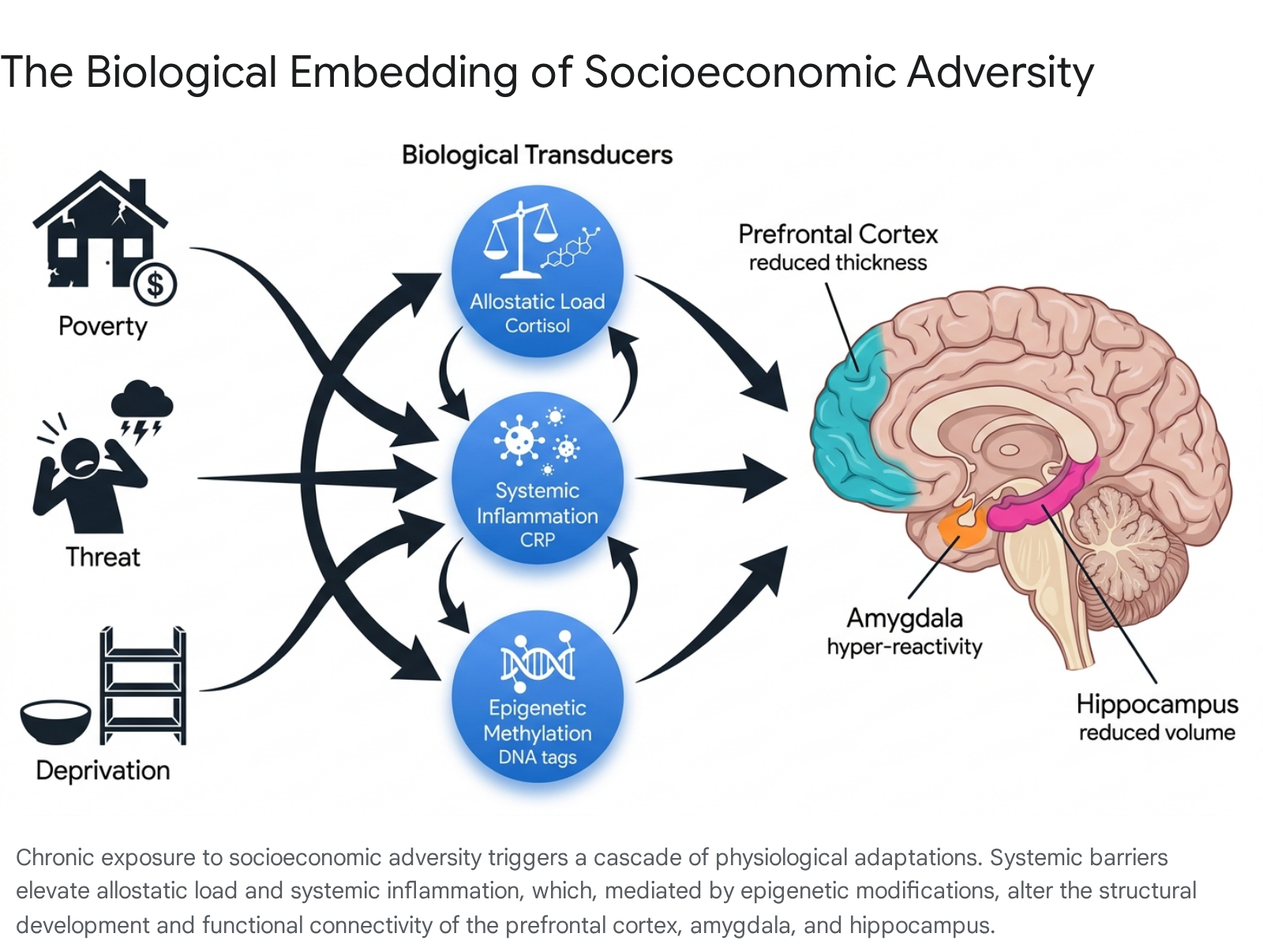
The direct observation of neural differences across diverse socioeconomic strata requires an investigation into the precise mechanisms of embodiment. How exactly does an external socioeconomic environment translate into altered cortical thickness or amygdalar hyperactivity? The interdisciplinary literature from 2023 onward emphasizes three interconnected biological pathways that serve as the primary transducers of socioeconomic adversity: allostatic load, systemic neuroinflammation, and epigenetic regulation.
Allostatic Load and the Neuroendocrine Stress Response
The human physiological system is designed to manage acute stress through allostasis - the process of maintaining stability through active physiological change. However, chronic exposure to the adversities inherently associated with poverty (e.g., food insecurity, neighborhood violence, housing instability, environmental toxins, and discrimination) leads to a persistent, unremitting activation of the hypothalamic-pituitary-adrenal (HPA) axis and the sympathetic adrenal system 192140. This chronic wear and tear on the body's regulatory systems is formalized in the concept of allostatic load 403435.
Recent longitudinal studies consistently demonstrate that children and adolescents from socioeconomically disadvantaged backgrounds exhibit significantly higher allostatic load scores, quantified via a composite of neuroendocrine, metabolic, cardiovascular, and immune biomarkers 4034. For example, young children from low-SES homes consistently present with elevated morning cortisol levels, a primary biomarker of profound HPA axis dysregulation 21. This phenomenon is intricately linked to the "weathering hypothesis," which proposes that chronic exposure to disadvantage promotes an acceleration of the normal biological aging process 161834.
Sustained hyper-cortisolemia is distinctly neurotoxic over time. Chronic cortisol exposure reduces the synthesis of brain-derived neurotrophic factor (BDNF), suppresses neurogenesis, and induces dendritic atrophy in the hippocampus and prefrontal cortex, while simultaneously driving hypertrophy and hyper-reactivity in the amygdala 2161936. Consequently, poverty exacts a heavy toll on cognitive performance and self-regulatory capacity, primarily through the sustained, damaging elevation of the body's own survival hormones 161921.
Systemic Inflammation and Neuroimmune Dysregulation
While cortisol represents the endocrine arm of the chronic stress response, systemic inflammation represents its immunological counterpart. Contemporary biological psychiatry literature reveals that SES-related psychosocial stress fundamentally upregulates the innate immune system. This results in chronic, low-grade systemic inflammation characterized by chronically elevated levels of C-reactive protein (CRP) and pro-inflammatory cytokines such as interleukin-6 (IL-6) and tumor necrosis factor-alpha (TNF-α) 14193738.
A landmark 2024 study tracking structural brain changes over time provided direct evidence for this pathway, demonstrating that increases in systemic inflammation (measured via blood-spot CRP) negatively predicted changes in amygdala gray matter volume over a two-year period in adolescents 14. Crucially, this neuroimmune effect was significantly compounded in youths experiencing greater neighborhood and family-level SES disadvantage 14. Peripheral inflammatory cytokines can breach the blood-brain barrier - whose permeability is frequently compromised by chronic stress and systemic inflammation - to activate microglia, the brain's resident immune cells 193639.
Once activated, microglia shift from a neuroprotective role to a pro-inflammatory state. They release cytokines that disrupt synaptic transmission, alter dopaminergic signaling, suppress neurogenesis, and precipitate structural damage in the prefrontal cortex, amygdala, and hippocampus 193639. This process is further exacerbated by the gut-brain axis; chronic stress and poor nutrition prevalent in low-SES environments induce gut dysbiosis and oxidative stress. This imbalance increases intestinal permeability, allowing bacterial lipopolysaccharides (LPS) into the systemic circulation, which further fuels the chronic inflammatory response that ravages the central nervous system 193940.
Epigenetics and DNA Methylation
The most profound and enduring mechanism linking the external social environment to internal biology is epigenetics - the modification of gene expression without altering the underlying DNA sequence. DNA methylation, the addition of a methyl group to a cytosine-guanine (CpG) dinucleotide, acts as a molecular switch that can turn specific gene transcription on or off 17184841.
High-impact 2024 studies have successfully identified distinct DNA methylation "signatures" of socioeconomic status. Surrogate biomarkers of childhood and adult SES derived from epigenome-wide association studies show that social disadvantage alters the methylation of genomic features regulating inflammation, metabolic functioning, and immune system responses 1848. For example, lower SES during adolescence is associated with increased methylation of the proximal promoter of the serotonin transporter gene (SLC6A4). This specific epigenetic tag predicts greater threat-related amygdala reactivity, directly linking a socioeconomic variable to an epigenetic change, and subsequently to a neurobiological outcome that heightens the risk for clinical depression 30.
Furthermore, studies examining placental tissue have revealed that prenatal maternal adversity alters methylation on genes critically associated with neurodevelopment, such as the AIFM1 and FRY genes, suggesting that the biological embedding of poverty begins in utero 41. High levels of early-life unpredictability and household instability induce rapid, longitudinal within-subject changes in the methylome during the first years of life, and these dynamic changes strongly correlate with impaired executive function at age five 42. These epigenetic marks can endure for decades, functioning as a permanent biological memory of early poverty and perpetuating the intergenerational transmission of health disparities and cognitive alterations 18484142.
Dismantling the Scarcity Mindset: Cognitive Load vs. Systemic Barriers
As developmental neuroscience meticulously mapped the biological toll of poverty, behavioral economics sought to explain the behavioral correlates that often accompany low socioeconomic status. In 2013, Sendhil Mullainathan and Eldar Shafir introduced the highly influential "Scarcity Mindset" framework. They posited that the psychological experience of having too little - whether it be money, time, calories, or social connection - imposes a permanent cognitive load on the poor 20235143. This "bandwidth tax" forces individuals to tunnel their attention toward immediate, pressing survival needs, thereby reducing available working memory and fluid intelligence for long-term planning. According to this framework, the resulting cognitive deficit leads to suboptimal decision-making, which inadvertently reinforces the poverty trap 2043444555.
While the scarcity framework elegantly integrates cognitive psychology and economics, it has increasingly become the target of rigorous academic critique. Current sociological, psychological, and policy scholarship cautions heavily against over-relying on the cognitive load theory, as it risks inadvertently pathologizing individuals experiencing poverty while absolving the institutions that create the scarcity 22233355.
The Illusion of Cognitive Deficit vs. Rational Adaptation
The primary academic critique of the scarcity mindset is that it reduces the complex, violent reality of structural inequality to an internal, psychological deficit 72333. By framing poverty-driven decisions as the product of compromised "mental bandwidth," the framework risks suggesting that the poor are cognitively deficient in their decision-making capacities 723.
Critics argue that what Mullainathan and Shafir classify as "suboptimal decisions" - such as taking out high-interest payday loans, failing to adhere to long-term preventative healthcare regimens, or neglecting to invest in distant educational goals - are actually highly rational adaptations to an irrational, punishing system 202246. A present-bias in decision-making is not a cognitive error or a failure of executive function if an individual faces severe liquidity constraints where immediate survival outweighs hypothetical future investments 20. In systems where high educational costs and reliance on market mechanisms restrict social mobility, long-term planning is often an inaccessible luxury 5547. When the institutional environment lacks a safety net, features predatory lending, involves severe bias in hiring processes, and provides systematically underfunded public services, focusing predominantly on the individual's "tunneling" effect represents a profound misallocation of analytical focus 2233554648.
Learned Helplessness and Structural Disenfranchisement
Furthermore, the psychological and physiological exhaustion associated with poverty is not merely a bandwidth issue, but a symptom of profound structural disenfranchisement that breeds learned helplessness. Drawing on Martin Seligman's foundational psychological theories, modern critiques note that when communities are subjected to systemic racism, chronic housing instability, and inequitable access to resources, individuals often internalize a deeply valid sense of powerlessness 2249. The failure to engage in proactive, long-term planning is less a product of hijacked attention (as the scarcity theory claims) and more a calculated, conditioned response to environments characterized by chronic uncontrollability 2224.
For individuals living in persistent poverty, the constant struggle to secure food, shelter, and basic safety leaves little room for pursuing higher-order goals, a reality better explained by Maslow's hierarchy of needs than by a temporary depletion of cognitive bandwidth 3346. The academic consensus is therefore shifting toward a model that acknowledges the reality of cognitive load but insists on centering structural and macroeconomic reform. The Scarcity Hypothesis is highly effective when utilized as an analytical lens to critique the overarching systems that impose scarcity. However, it becomes actively harmful if weaponized to justify paternalistic "nudges" aimed at fixing the decisions of the poor, rather than enacting progressive taxation, universal basic income, and policies that fix the economic systems depriving them of resources in the first place 22233355.
Debunking Biological Determinism: Neuroplasticity and the Adaptation Framework
The translation of neuroscientific findings into public discourse and policy carries significant ethical risks. Historically, the biological investigation of marginalized populations has been weaponized to justify inequality. Late 19th-century Lombrosian criminology, for example, posited that criminality and low social standing were the result of innate biological inferiority 1360. Although sociological responses, such as Robert Merton's strain theory, successfully argued that social systems and economic inequalities force people into deviance, the specter of determinism remains 13. Today, observing reduced cortical volume or amygdalar hyperactivity in children living in poverty triggers valid, urgent fears of a modern resurgence of biological determinism - the deeply stigmatizing idea that poverty causes irreversible brain damage, rendering individuals permanently deficient or inherently less capable 12136050.
To counter this dangerous narrative, leading developmental cognitive neuroscientists are explicitly reframing the discourse surrounding the socioeconomic brain. The contemporary scientific consensus strictly rejects biological determinism by emphasizing two core concepts: the evolutionary adaptation model and experience-dependent neuroplasticity.
From Deficit to Evolutionary Adaptation
Historically, developmental differences in the brains of low-SES youth have been framed purely as "deficits" or "delays." This medicalized model assumes that the brain development of affluent, white, Western populations is the objective "norm," and any deviation from this trajectory represents damage that must be corrected or overcome 1251.
Emerging neurobiological frameworks, however, argue that the brains of children in adversity are not "broken"; rather, they are engaging in highly sophisticated, context-appropriate adaptations 12. Brain development is guided by ecological relevance, prioritizing skills that ensure survival in a specific environment. For instance, heightened amygdala reactivity and hyper-vigilance are frequently classified as clinical deficits leading to anxiety and impaired selective attention in a quiet classroom setting 12. However, in a volatile, resource-scarce, or dangerous neighborhood characterized by high crime, the rapid detection of threat and constant environmental vigilance are highly adaptive survival mechanisms, often referred to as "hidden talents" 1224.
Similarly, early exposure to extreme neglect or caregiver deprivation has been shown to accelerate the maturation of prefrontal-limbic connectivity, resulting in "adultlike" neural profiles in childhood 1252. Rather than a deficit, this accelerated brain maturation serves as a short-term evolutionary adaptation to reduce anxiety and promote early independence in the absence of reliable caregiving, even if it carries long-term trade-offs for cognitive flexibility and mental health later in life 1240.
Intersectionality, Reversibility, and Neuroplasticity
Crucially, these neurobiological changes are neither innate nor immutable. Socioeconomic disparities in brain function are not universally present at birth; they emerge, widen, and consolidate as a function of accumulating environmental exposure 12. Because these structural and functional changes are rooted in neuroplasticity, they are inherently reversible 1253. Interventions that reliably reduce allostatic load - such as providing stable housing, unconditional income, and strong social support - can reshape neural architecture, proving that biology is not destiny 53.
Furthermore, debunking biological determinism requires an intersectional approach that acknowledges the inextricable link between socioeconomic status and systemic racism. In the United States, 89% of children living in poverty are children of color 12. The chronic stress of navigating pervasive racial discrimination independently contributes to the allostatic load and subsequent neurodevelopmental adaptations observed in minoritized youth 1213. Acknowledging that these brain states are plastic, rational responses to systemic violence shifts the burden of change from the biology of the child to the overarching structure of society.
Geographic Expansion: Insights from the Global South and Non-WEIRD Contexts
A critical, long-standing limitation in developmental cognitive neuroscience is that the vast majority of research linking socioeconomic status to brain development is exclusively drawn from WEIRD (Western, Educated, Industrial, Rich, and Democratic) populations, particularly cohorts in the United States and Western Europe 6115154. Because poverty is a culturally, socially, and geopolitically relative construct, generalizing findings from high-income nations to the Global South limits the field's scientific validity and risks fundamentally misrepresenting the neurobiology of the vast majority of the world's children 8115154.
Distinct Architectures of Adversity in LMICs
Recent initiatives are beginning to correct this profound geographic bias. High-impact studies conducted in Latin America, South Asia, and Sub-Saharan Africa reveal that while the fundamental biological pathways - such as stress hormone cascades and systemic inflammation - are conserved, the specific social determinants of health (SDH) and their neurodevelopmental manifestations differ significantly.
In low- and middle-income countries (LMICs), poverty is more frequently compounded by distinct biological and structural stressors, including infectious diseases, severe malnutrition, environmental toxins, and an absolute lack of healthcare infrastructure. This creates a distinct, often more severe, allostatic load than the relative poverty experienced in Western nations 115254. For example, the Drakenstein Child Health Study, a landmark birth cohort based in the Western Cape of South Africa, successfully utilized functional and structural MRI on young children during natural sleep, a massive methodological achievement in a resource-limited setting. The study confirmed that cortical surface area and thickness in frontal and temporal regions are highly correlated with cognitive and language development in an African cohort 55. However, the environmental variables driving these cortical differences frequently include a higher prevalence of maternal psychopathology, intimate partner violence, and early infectious disease exposure compared to standard US cohorts 55.
Heterogeneous Effects and the Need for Localized Norms
A comprehensive 2023 meta-analysis of global neuroimaging findings highlighted significant statistical heterogeneity in the main effects of SES on the brain across European, South Asian, and Latin American regions 1151. The analysis revealed that while effect sizes were strong in high-income and lower-middle-income countries, in some upper-middle-income countries, the effect sizes of SES on executive function and brain volume failed to reach statistical significance 1151.
Similarly, localized data challenges universal assumptions. In a massive longitudinal High-Risk Cohort Study for Psychiatric Disorders in Brazil, researchers analyzed data from over 700 children. While family conflict strongly predicted externalizing and internalizing behaviors, the researchers surprisingly found no evidence that SES and family conflict interacted to affect hippocampal or amygdala volumes in the expected manners typically seen in US studies 67. Likewise, findings from the Pelotas birth cohort in Brazil identified unique, culturally specific risk factors for depression linked to SES, further illustrating that the pathways of adversity are not globally uniform 67.
These findings underscore a critical truth: the neurobiological impact of SES is heavily moderated by the local sociopolitical ecosystem, the generosity of the surrounding welfare state, and community-level social capital 255. Expanding research to the Global South is not merely an exercise in replication; it is a vital necessity for untangling the deeply contextual nature of how human brains adapt to varying dimensions of scarcity, threat, and community support.
Interventional Neuroscience: The Limits and Lessons of Unconditional Cash Transfers
For years, scientists debated a fundamental question of causality: whether the structural brain differences observed in low-SES children were causally driven by a lack of financial income itself, or merely correlated with the myriad of confounding factors inextricably associated with poverty, such as neighborhood quality, parental education, and genetic inheritance 565758. To definitively answer this question and isolate the variable of income, a consortium of researchers launched Baby's First Years (BFY), the first randomized controlled trial in the United States designed to assess the direct causal impact of poverty reduction on infant brain development 56575960.
In this landmark study, 1,000 low-income mothers across four diverse U.S. metropolitan areas were randomized shortly after giving birth to receive either a substantial unconditional cash transfer of $333 per month (the high-cash group) or a nominal $20 per month (the low-cash group) 565759.
Initial Optimism: The Age 1 Findings
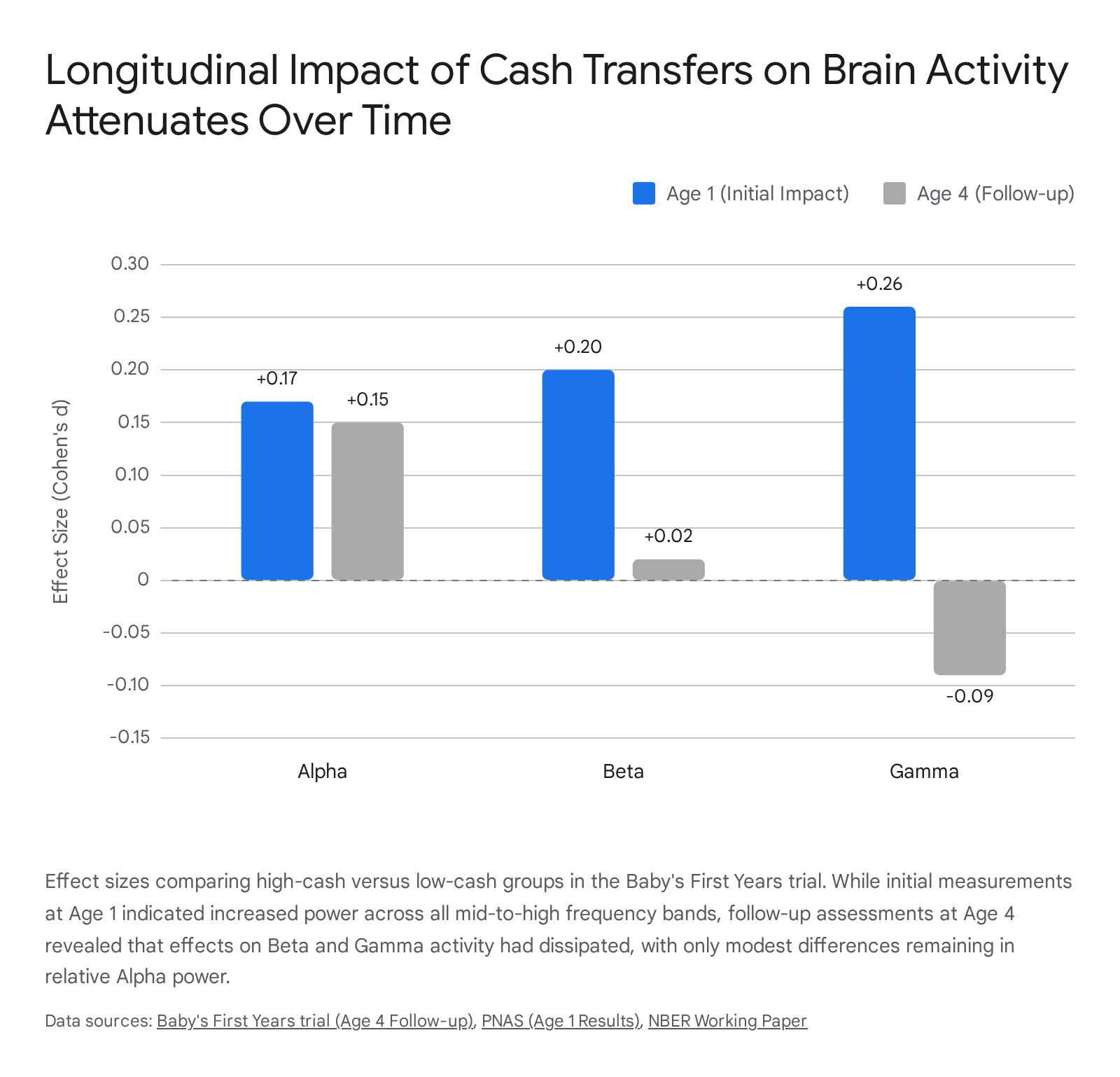
The initial findings, measured via mobile electroencephalography (EEG) in the infants' homes at approximately one year of age, were highly promising and garnered significant international attention. Infants in the high-cash gift group exhibited greater absolute and relative power in mid-to-high-frequency brain activity (specifically the alpha, beta, and gamma bands) compared to the control group 575961. High-frequency EEG power is widely associated with the development of complex cognitive skills, language proficiency, and robust socio-emotional regulation 575961. These early results provided the first rigorous causal evidence that providing predictable, unconditional economic resources to mothers could directly alter the neuroplastic trajectory of their infants' brains, adapting them toward a pattern associated with higher long-term cognitive achievement 5657.
The Age 4 Attenuation and Its Structural Implications
However, the scientific process relies on longitudinal validation, and subsequent follow-ups paint a markedly more complex picture. Recent data published in 2024 and 2025 regarding the Baby's First Years cohort at age four revealed that the robust neural differences observed in infancy had largely attenuated 565862. Upon the four-year follow-up, analyses found no statistically significant impacts on the primary preregistered outcome (a composite index of mid-to-high-frequency brain activity) or the secondary outcome of frontal gamma power 565860. While exploratory analyses indicated some sustained elevation in relative alpha power for the high-cash group, the broader effects on beta and gamma power had entirely disappeared 56.
Furthermore, while the cash transfers led to increased parental investments in children, they did not produce significant improvements in maternal mental health, parental stress levels, child BMI, or direct assessments of children's language and executive function 586276.
This attenuation does not render the intervention a failure; rather, it provides profound, sobering insights into the limits of individualized economic interventions in the face of pervasive, systemic adversity. As children transition from infancy into preschool ages, their environments drastically expand beyond the immediate home. They become increasingly exposed to broader neighborhood conditions, systemic inequalities, and structural disadvantages that a $333 monthly stipend cannot insulate against 5662. The findings strongly suggest that while unconditional cash transfers are a vital, humane tool for immediate poverty alleviation, overcoming the deeply embedded biological impacts of poverty requires sweeping macro-level policy shifts. Modest income bumps cannot eradicate the systemic barriers - such as unsafe neighborhoods, structural racism, lack of access to quality healthcare, and generational trauma - that persistently drive the allostatic load and neuroinflammation underlying these cognitive disparities 22586276.
Conclusion
The scientific understanding of poverty's impact on the human brain has evolved far beyond observing simple behavioral correlations in cognitive deficits; it now involves mapping a highly sophisticated cascade of neurobiological embodiment. Systemic adversity, chronic stress, and social disenfranchisement initiate a severe physiological chain reaction: HPA axis dysregulation elevates cortisol levels, psychosocial stress triggers systemic inflammation that disrupts the blood-brain barrier, and environmental scarcity chemically alters DNA via epigenetic methylation. Together, these molecular pathways sculpt the physical architecture of the developing brain, driving measurable alterations in the prefrontal cortex, amygdala, and hippocampus.
Yet, as the resolution of our biological mapping improves, the scientific community must remain vigilant in how these findings are interpreted and disseminated. The neurological variations observed in socioeconomically disadvantaged populations do not signify broken biology, nor do they support deterministic views of inherent inferiority. Instead, they represent the remarkable, experience-dependent plasticity of the human brain engaging in highly rational, evolutionary adaptations to irrational and punishing environments. Heightened threat detection in the amygdala and accelerated limbic maturation are survival mechanisms fundamentally optimized for unpredictable scarcity.
Moving forward, the integration of diverse empirical data from the Global South and the nuanced longitudinal findings of direct economic interventions like the Baby's First Years trial confirm a crucial reality: cognitive capacity is not merely an individual trait to be optimized through psychological "nudges" or modest cash stipends. Rather, optimal brain development requires dismantling the systemic and structural barriers that impose scarcity in the first place. Addressing the neurobiology of poverty ultimately demands political and systemic courage, recognizing that the healthiest environment for a developing brain is a fundamentally equitable society.