
Neurobiology and Psychology of Forgiveness
The human brain is evolutionarily optimized to remember danger, making the act of forgiveness a profound biological and psychological challenge. When an individual experiences interpersonal harm, rejection, or betrayal, the nervous system engages deeply entrenched survival mechanisms designed to prevent repeat exploitation. Consequently, forgiveness is not a passive decay of memory but an active, metabolically expensive process of neuroplastic rewiring. This report synthesizes contemporary research on the neural, physiological, and cognitive mechanisms of forgiveness, examining the neurological barriers to releasing resentment, the functional brain networks that facilitate empathetic reappraisal, the methodological challenges in modern neuroimaging, and the clinical and cross-cultural frameworks used to operationalize forgiveness.
Evolutionary and Physiological Foundations of Resentment
To understand why the brain struggles to forgive, it is necessary to examine the neurobiology of resentment. From an evolutionary perspective, remembering individuals who caused harm was critical for navigating early social hierarchies and ensuring survival. When a person experiences a betrayal, the brain initiates a severe threat response 12. The amygdala, a central hub within the limbic system responsible for threat detection and emotional processing, tags memories of betrayal with a high degree of emotional urgency 1.
Neurological imaging and laboratory studies demonstrate that recalling a personal betrayal triggers up to fifty percent stronger activation in the amygdala than recalling other types of negative, non-interpersonal memories 2. This "never forget" mechanism was highly adaptive for early humans, protecting them from repeated harm. However, in contemporary psychological contexts, this same survival mechanism traps individuals in chronic, debilitating loops of resentment. When a victim ruminates on an offense, they repeatedly reactivate the exact neural pathways associated with the original trauma. This repetitive cognitive replay strengthens the emotional intensity of the memory through a process known as long-term potentiation, effectively hardwiring the physiological stress response into the nervous system 1.
The systemic consequences of this prolonged limbic activation are severe. An overactive amygdala continually signals the hypothalamus and pituitary glands, resulting in the chronic release of stress hormones such as cortisol and adrenaline. Over time, this sustained autonomic hyperarousal contributes to a persistent state of systemic inflammation, sleep disturbances, elevated blood pressure, weakened immune function, and significant cardiovascular distress 1.
Furthermore, this biological state of resentment directly impairs higher-order cognitive functions. Laboratory diagnostics reveal that chronic anger and resentment weaken prefrontal cortex function, reducing impulse control and executive problem-solving capabilities by up to thirty-one percent 2. The persistent danger signals emitted by the amygdala also suppress heart rate variability, a critical biometric indicator of autonomic nervous system flexibility and emotional resilience 2. Consequently, the brain resists "letting go" because the central nervous system perceives the release of anger as the dangerous abandonment of a necessary biological defense mechanism.
Neural Circuitry and Cognitive Control
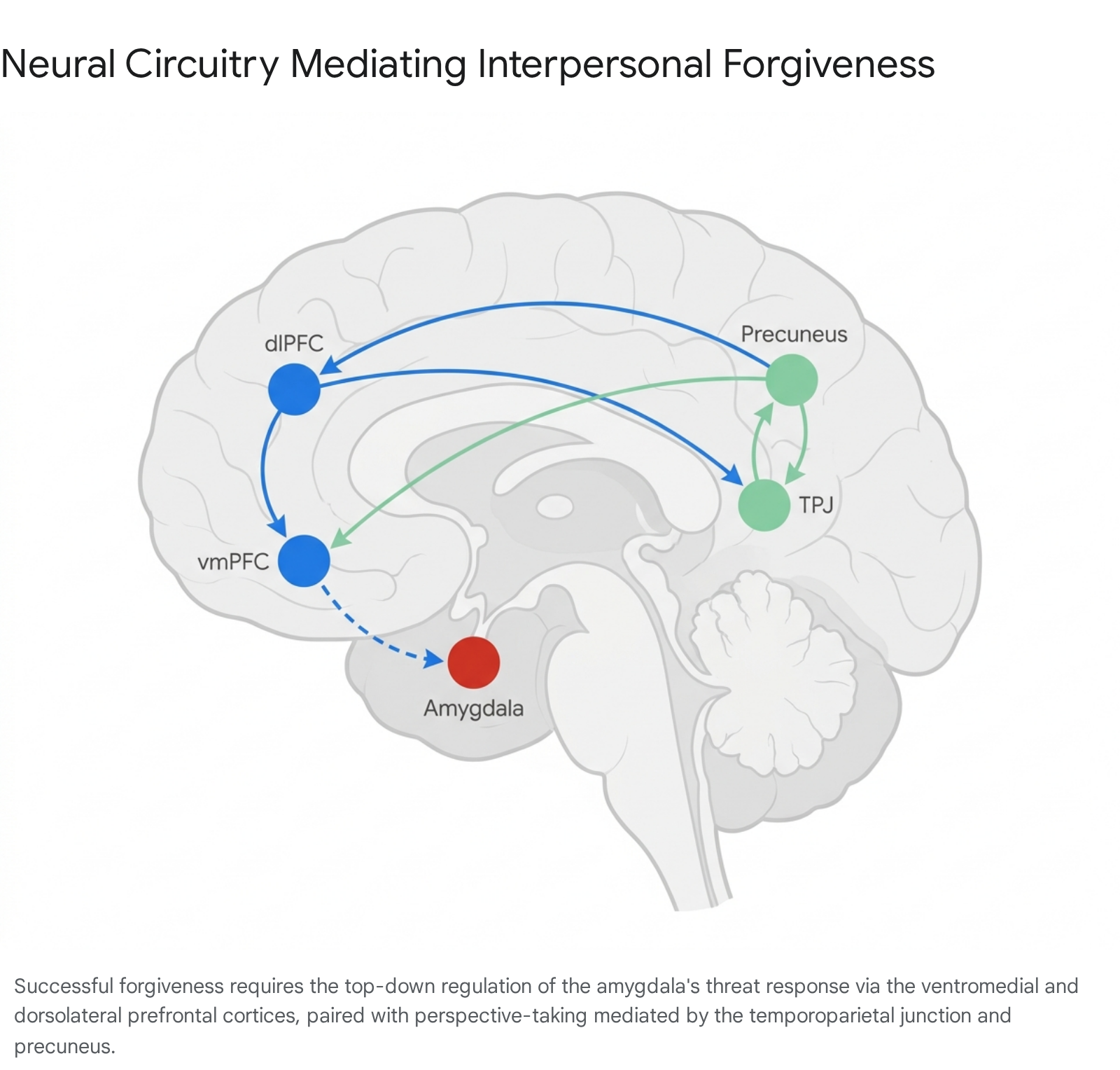
Transitioning from a state of unforgiveness to forgiveness requires an intentional, top-down cognitive override of the brain's defensive limbic responses. Forgiveness relies on cognitive reappraisal - the executive ability to actively reframe a hurtful event and view it from an alternative perspective. This complex psychological achievement recruits a highly distributed network of cortical regions, primarily spanning the prefrontal cortex and the theory of mind network 123.
Prefrontal Cortex Regulation
The core neurobiological mechanism of forgiveness is mediated by distinct subdivisions within the prefrontal cortex, which work in concert to down-regulate the limbic system. The dorsolateral prefrontal cortex is consistently implicated in the cognitive reframing of negative interpersonal events. Increased metabolic activity in this region suggests that overcoming detrimental rumination requires deliberate executive control to modulate raw emotional responses 24. Individuals engaging in forgiveness demonstrate heightened activation in the dorsolateral prefrontal cortex, indicating active efforts to reinterpret the consequences of a hurtful event in less threatening terms. Interestingly, neuroanatomical studies utilizing voxel-based morphometry indicate that individuals with a larger left dorsolateral prefrontal cortex tend to exhibit a higher baseline disposition toward forgiveness, as they possess greater structural capacity for executive emotion regulation 2.
The ventromedial prefrontal cortex and the dorsomedial prefrontal cortex operate to resolve the emotional ambiguity and internal conflict inherent in being wronged 5. The ventromedial prefrontal cortex has direct structural connections to the amygdala and plays a critical role in fear extinction and the top-down inhibition of negative affect 67. When an individual successfully forgives, the ventromedial prefrontal cortex acts to regulate the amygdala, dampening the physiological stress response and allowing for the generation of more benevolent motivations 568.
Empathy and Perspective Taking Networks
Beyond simple emotion regulation, forgiveness requires the neurological capacity to understand the mental state, intentions, and vulnerabilities of the offender. This psychological shift activates the brain's theory of mind network, which includes the temporoparietal junction, the superior temporal sulcus, and the precuneus 49.
Activation in the temporoparietal junction and the precuneus enables an individual to shift out of a strictly egocentric viewpoint. This activation fosters the understanding that the offender's actions may have been driven by external pressures, ignorance, or unhealed trauma rather than pure malice 49. The dorsomedial prefrontal cortex also contributes heavily to this network by simulating the emotional states of others. Deficits in dorsomedial prefrontal cortex activity or reduced anatomical volume in this region are strongly correlated with a reduced capacity to imagine the feelings of others, a deficit that directly impairs the ability to forgive 2. Additionally, the anterior insula, which processes physical experience and emotional expressions, helps the forgiver simulate the perpetrator's emotional state, influencing the intrinsic motivation to grant forgiveness 9.
To synthesize the functional neuroanatomy involved in the transition from resentment to forgiveness, the following table maps the distinct brain regions to their specific behavioral and cognitive outputs during the forgiveness process.
| Brain Region | Functional Role in Forgiveness | Consequence of Dysfunction or Inhibition |
|---|---|---|
| Amygdala | Bottom-up threat detection; affective tagging of interpersonal betrayal and injustice. | Hyper-reactivity traps the individual in rumination and chronic autonomic stress 12. |
| Dorsolateral Prefrontal Cortex | Executive control; conscious cognitive reappraisal of the offense and its consequences. | Inability to reframe the narrative; sustained depressive or vengeful psychological states 24. |
| Ventromedial Prefrontal Cortex | Top-down emotional regulation; fear extinction; resolution of social ambiguity. | Failure to down-regulate amygdala activation; sustained hostility and hyperarousal 567. |
| Temporoparietal Junction | Theory of Mind processing; perspective-taking and evaluation of social contexts. | Egocentric fixation; profound inability to contextualize the offender's behavior 4910. |
| Precuneus | Empathy generation; placing oneself in another's psychological and emotional position. | Lack of compassion; rigid adherence to a victim narrative without acknowledging shared humanity 349. |
Neurovisceral Integration and Autonomic Regulation
The connection between the central nervous system networks described above and the peripheral nervous system is a vital component of the science of forgiveness. The Neurovisceral Integration Model posits that shared neural networks support both the effective regulation of emotions and the regulation of heart rate. Heart rate variability serves as an objective, peripheral index of prefrontal inhibitory control 1113. High heart rate variability indicates a flexible, adaptive autonomic nervous system capable of shifting between sympathetic arousal (stress) and parasympathetic relaxation (calm), which is essential for emotional forgiveness 12.
A comprehensive 2023 study by Tupitsa et al. utilized functional magnetic resonance imaging to track the covariance of heart rate variability and amygdala functional connectivity during active emotion regulation tasks. Participants were instructed to cognitively reappraise negative affective images while their peripheral physiological responses were monitored 1113. The study revealed significant age-related differences in how the autonomic nervous system couples with the brain during emotional reappraisal. Among younger adults, higher task-related heart rate variability was strongly correlated with weaker functional connectivity between the amygdala and the medial prefrontal cortex. This inverse association suggests that a highly adaptive peripheral nervous system (indicated by high heart rate variability) efficiently decouples the prefrontal cortex from the amygdala's threat signaling, allowing for faster resolution of negative affect 1113.
Conversely, in older adults, higher task-related heart rate variability correlated positively with stronger connectivity between the right amygdala and the right ventrolateral prefrontal cortex 1113. This distinction highlights that the biological mechanisms underlying the capacity to let go of negative stimuli undergo neurodevelopmental shifts across the lifespan. Assessing heart rate variability alongside neural functional connectivity provides researchers with a more complete understanding of how central cognitive decisions translate into peripheral physiological relief 1314.
Memory Updating and the Emotional Fading Mechanisms
A critical debate in affective neuroscience is how the psychological act of forgiveness practically alters a victim's memory of a transgression. The popular adage "forgive and forget" suggests an erasure or degradation of episodic memory. However, neuroscientific research published in 2025 and 2026 refutes this notion, presenting an alternative framework categorized as "forgive and update."
Recent studies demonstrate that forgiveness does not degrade the episodic clarity of a memory; rather, it updates the memory trace with new relational information, such as an offender's apology or a broader understanding of the context surrounding the offense 15. In neuroimaging studies where subjects were treated poorly and later offered an apology, deciding to forgive engaged the dorsomedial prefrontal cortex (associated with mentalizing and social evaluation) alongside the posterior hippocampus (associated with episodic memory consolidation) 15. This simultaneous activity indicates that the brain actively revises the memory of the negative experience by binding it to the new, mitigating information. The memory is not deleted; it is functionally consolidated into a less threatening state to aid in social reconciliation 15.
This neurobiological observation is formalized in the "emotional fading account" of forgiveness. In comprehensive behavioral studies conducted by Fernandez-Miranda et al. in 2025, researchers empirically tested the "episodic fading account" against the "emotional fading account" across multiple large-scale participant cohorts 16. The episodic fading theory posited that forgiveness results in a less vivid and less detailed memory of the wrongdoing. By contrast, the emotional fading theory posited that only the affective intensity of the memory diminishes, while the factual details remain intact 16.
The data definitively supported the emotional fading account 16. Participants who had forgiven their transgressors rated their memories of the wrongs as significantly less affectively intense and less negatively valenced compared to those who held grudges 1617. However, there was no measurable difference in the episodic characteristics, such as the vividness or the factual recall of the events, between the two groups. Furthermore, this change in emotional intensity was directly related to a decrease in the victim's tendency to want to avoid the perpetrator and a cessation of retaliatory motivations 17. Therefore, forgiveness is an emotion-regulation achievement where the memory of the betrayal is preserved for future behavioral reference and learning, but its capacity to trigger severe autonomic emotional distress is neutralized.
Methodological Discrepancies in Forgiveness Research
Despite robust theoretical and anatomical models, the scientific measurement of forgiveness faces significant methodological challenges. Researchers must navigate profound divergences between subjective self-reporting, objective autonomic biomarkers, and the interpretation of functional neuroimaging data.
Subjective Self-Reports Versus Objective Biomarkers
Much of the foundational literature relies on subjective psychological scales, such as the Enright Forgiveness Inventory and the Heartland Forgiveness Scale, to gauge an individual's state of forgiveness 1819. However, when these psychological reports are cross-referenced with biological markers of stress and autonomic regulation - such as salivary cortisol levels, heart rate variability, and the free testosterone-to-cortisol ratio (FTCR) - the correlations are frequently weak, discordant, or highly context-dependent 2021.
Extensive systematic reviews indicate that while subjective measures are highly sensitive to acute changes in psychological states and conscious cognitive shifts, objective biomarkers often display a physiological lag or fail entirely to reflect the internal psychological resolution claimed by the participant 2021. For instance, studies examining perceived stress and physical load demonstrate only weak negative associations between self-reported stress and FTCR 2021. This low-to-moderate agreement suggests that the conscious, cognitive decision to forgive (often termed decisional forgiveness) may occur long before the body's autonomic nervous system fully down-regulates its deeply entrenched physiological stress response (emotional forgiveness). Consequently, scientists are increasingly cautious about relying exclusively on self-reports. Subjects may report high levels of forgiveness due to social desirability biases or cognitive dissonance, while their biological systems remain in a state of covert hyperarousal 224.
Reevaluating the Functional MRI Paradigm
A profound methodological disruption occurred in the neuroscience community in late 2025 regarding the foundational tool of cognitive neuroscience: functional magnetic resonance imaging. For nearly three decades, functional magnetic resonance imaging studies of emotion regulation, trauma, and forgiveness relied heavily on the blood-oxygen-level-dependent (BOLD) signal. This paradigm operated under the fundamental assumption of neurovascular coupling - the belief that increased neuronal activity is strictly and proportionately coupled with increased localized cerebral blood flow to meet higher oxygen demands 252223.
A landmark study by Epp et al., published in Nature Neuroscience in 2025, fundamentally challenged this assumption. Utilizing a novel quantitative magnetic resonance imaging technique to measure actual, absolute oxygen consumption simultaneously with standard functional magnetic resonance imaging, researchers discovered severe discrepancies in the traditional model. In approximately forty percent of observed cases, an increased functional magnetic resonance imaging BOLD signal was actually associated with reduced neuronal activity. Conversely, decreased blood-oxygen-level-dependent signals occasionally appeared in regions demonstrating highly elevated neuronal activity 252224.
The quantitative analyses demonstrated that certain brain regions, particularly those within the default mode network, meet additional energy demands by extracting more oxygen from the existing blood supply rather than triggering a vascular influx of new blood 2223. This means the neural tissue becomes more metabolically efficient without altering perfusion rates. Because tens of thousands of studies on emotion regulation and complex cognitive states rely on the canonical interpretation of BOLD signals, these 2025 findings necessitate a reassessment of past neuroanatomical claims. Future investigations into the neuroscience of forgiveness will likely require the adoption of energy-based brain models that directly quantify absolute oxygen metabolism rather than relying on vascular proxies, ensuring a more accurate mapping of how the brain manages the metabolic cost of letting go 2522.
Clinical Interventions and Psychological Process Models
To bridge the gap between biological reactivity and psychological resolution, clinical psychology has developed structured, phase-based frameworks to guide individuals through the neurocognitive process of forgiveness. The two most empirically supported interventions in the scientific literature are the Enright Process Model and the REACH Forgiveness Framework 2526.
The Enright Process Model
Developed by educational psychologist Robert Enright, this model conceptualizes forgiveness as a gradual, arduous developmental journey. It is highly structured and has demonstrated particular efficacy in individual psychotherapy for severe, specific traumas, such as abuse, infidelity, or systemic injustice 262732. The model operates through four distinct, sequential phases.
The initial phase is the Uncovering Phase. Here, the individual actively confronts the psychological pain and anger resulting from the offense. This phase demands deep emotional honesty and often results in acute psychological distress, as the trauma is actively analyzed and brought into conscious awareness rather than suppressed or avoided 2728. Following this is the Decision Phase. In this stage, the individual realizes that their ongoing rumination is causing unnecessary, prolonged suffering. They undergo a cognitive shift, committing to explore forgiveness as a deliberate healing strategy and deciding to cease overt vengeful behaviors 2728.
The core therapeutic effort occurs during the Work Phase. The individual actively utilizes perspective-taking techniques to build cognitive empathy for the offender. This involves reframing the narrative to understand the contextual pressures, childhood history, or systemic factors that may have contributed to the transgressor's actions, without excusing the behavior 2728. Finally, in the Deepening Phase, the individual works to extract existential meaning from the trauma. This phase often results in emotional relief, increased global compassion, and a renewed sense of life purpose, moving the victim from a state of passive suffering to active resilience 2728.
The REACH Forgiveness Framework
Developed by Everett Worthington, the REACH model is an acronym-based intervention heavily utilized in psychoeducational groups, community settings, and self-directed workbooks 252629. The framework is designed to facilitate rapid emotional forgiveness by actively replacing negative, stress-inducing emotions with positive, benevolent affect.
The first step is to Recall the hurt objectively. Participants are guided to remember the event clearly without falling into patterns of self-pity or severe rage, establishing a baseline of factual acceptance 35. The second step requires the individual to Empathize with the offender. By engaging the brain's theory of mind networks, the victim attempts to understand the humanity and fallibility of the transgressor 35.
The third step is framing forgiveness as an Altruistic gift. Participants recognize that forgiveness is an unearned gift of mercy. They are often asked to reflect on times they themselves needed and received forgiveness for their own transgressions, fostering a sense of shared human imperfection 19. The fourth step involves a Commitment. Individuals make a public, written, or recorded commitment to their decision to forgive, which psychologically solidifies their cognitive intent and creates a benchmark for future behavior 1926. The final step is to Hold on to forgiveness. Because trauma memories are likely to resurface, participants develop specific cognitive strategies to maintain their state of forgiveness during moments of triggered recall, thereby preventing the re-consolidation of toxic resentment 2935.
Comparative Clinical Efficacy
Extensive meta-analyses adjusting for treatment duration show that the Enright Process Model and the REACH Forgiveness Framework are equally effective in clinical settings.
| Feature Comparison | Enright Process Model | REACH Forgiveness Framework |
|---|---|---|
| Architectural Structure | Four progressive phases (Uncovering, Decision, Work, Deepening) 27. | Five acronym-based steps (Recall, Empathize, Altruistic, Commit, Hold) 19. |
| Primary Delivery Format | Heavily utilized in deep, long-term individual psychotherapy; addresses severe trauma 2629. | Highly adaptable to short-term psychoeducational groups, couples therapy, and self-directed workbooks 2529. |
| Core Mechanism of Action | Emphasizes the deep emotional processing of anger, cognitive empathy development, and finding existential meaning 2732. | Emphasizes rapidly replacing toxic, stressful emotions with positive affect such as compassion and sympathy 2935. |
| Quantifiable Clinical Outcomes | Generates approximately a 0.1 standard deviation increase in forgiveness per hour of treatment. Significantly reduces depression and anxiety 2527. | Generates approximately a 0.1 standard deviation increase in forgiveness per hour of treatment. Reduces depression and anxiety while significantly elevating hope 2529. |
Sociocultural Contexts and the Dynamic Process Model
The clinical models discussed above primarily originated in Western, individualistic contexts. In these paradigms, the ultimate goal of forgiveness is often intrapsychic relief - reducing personal distress, lowering biological stress markers, and achieving emotional closure for the individual 3031. However, the science and application of forgiveness vary considerably when mapped onto different global sociocultural realities.
Ho and Fung (2011) developed the Dynamic Process Model of Forgiveness to account for how macro-level cultural values dictate the micro-level cognitive and emotional processes of forgiving 303233. Based fundamentally on emotion-regulation theory, this model argues that the broader societal context heavily influences how an individual appraises an offense and regulates their subsequent biological responses 40.
In individualistic cultures, individuals are socialized to strive for personal differentiation and autonomy. Therefore, when wronged, they prioritize emotional forgiveness - the internal resolution of negative affect to restore personal psychological peace, regardless of whether the relationship with the offender is maintained 34.
Conversely, in collectivist cultures - such as many East Asian societies - individuals are socialized to prioritize collective norms, social harmony, and the preservation of group cohesion. In these contexts, decisional forgiveness - the behavioral commitment to restore the relationship, maintain face, and act constructively within the group - is often prioritized over the immediate resolution of internal emotional distress 3234. High-activation negative emotions, such as overt anger or prolonged resentment, are culturally discouraged because they disrupt community harmony. This leads to entirely different emotion-regulation strategies that favor avoidance, rapid reconciliation, or the suppression of individual grievances to maintain the structural integrity of the social network 30.
African Relational Ontology and Restorative Justice
In African philosophy, particularly within Southern African Nguni cultures, the concept of forgiveness is inextricably linked to the philosophical framework of Ubuntu 3536. Encapsulated in the maxim "Umuntu ngumuntu ngabantu" ("A person is a person through other persons"), Ubuntu represents a relational ontology where individual identity, psychological well-being, and human dignity are entirely dependent on communal interconnectedness 3537.
The Philosophy of Ubuntu
Under the Ubuntu framework, forgiveness is not merely an internal psychological therapeutic tool for the victim; it is a profound moral and systemic obligation necessary for the survival of the community. A breach of trust or an act of violence is viewed as a tear in the social fabric that fundamentally damages the humanity of both the victim and the perpetrator 3536. To harbor chronic resentment or to refuse to forgive is to perpetuate communal instability and accept a state of diminished humanity. Consequently, the Ubuntu model focuses heavily on restorative justice rather than retributive justice, emphasizing shared purpose, mutual accountability, and the social reintegration of the offender back into the community 3738.
Institutional Application in Rwandan Gacaca Courts
The practical efficacy of these sociocultural forgiveness models is most vividly demonstrated in the context of post-conflict transitional justice. Following the devastating 1994 genocide, Rwanda faced the impossible task of prosecuting hundreds of thousands of perpetrators. The infrastructure of the standard punitive justice system was decimated, necessitating a pivot to a decentralized, restorative model heavily influenced by traditional Ubuntu principles: the Gacaca courts 394748.
The societal reconciliation process generally operated through three necessary steps of restorative justice. The first step involved imagining evil, which required the public, communal recognition of the systemic violations of human rights that had occurred 47. The second step focused on remembering evil through rigorous truth-telling. Perpetrators were required to stand before their communities, publicly confess their specific crimes, establish a factual record of the events, and formally acknowledge the suffering of the victims 394748.
The final step involved redressing evil through practical reparation. Instead of standard, isolated incarceration, confessed perpetrators were often ordered to participate in community labor, engage in joint agricultural projects with victims' families, and formally seek forgiveness. This structure forced interactions that facilitated the resocialization of perpetrators back into the community fabric 3949. While these mechanisms faced international criticism regarding standard legal due process, they successfully operationalized forgiveness at a massive institutional level. The Rwandan experience demonstrates that when forgiveness is structurally embedded in a culture's relational ontology, it possesses the capacity to interrupt generational cycles of revenge and facilitate unprecedented macro-level psychological healing 4850.