
Neural oscillation binding hypothesis and consciousness
The human brain processes diverse sensory attributes - such as color, shape, motion, and spatial location - in anatomically and functionally segregated neural circuits. Despite this modularity, conscious perception is experienced as a unified, seamless phenomenon. The computational challenge of explaining how the brain integrates these distributed, fragmented features into a single perceptual object is formally defined as the feature binding problem 123.
The feature binding problem is not restricted to visual processing; it encompasses general neural coordination, the subjective unity of phenomenal consciousness, and the temporal integration of decisions and actions 134. In the primate visual system, for instance, early feature processing is divided into two primary cortical pathways: the ventral stream, which evaluates object identity and "what" attributes primarily through cortical area V4, and the dorsal stream, which computes spatial location and "where" information via the posterior parietal cortex 1. Because these sensory data are processed in parallel across specialized regions, the neurobiological system requires a mechanism to prevent erroneous associations - such as mistakenly linking the color of one object to the motion trajectory of a separate object 1.
| Variant of the Binding Problem | Core Challenge | Anatomical Correlates |
|---|---|---|
| Visual Feature Binding | Associating distinct visual properties (color, shape, motion) to the correct individual object without feature confusion. | Ventral stream (V4), Dorsal stream (posterior parietal cortex), early visual cortex (V1/V2). |
| Temporal Binding | Integrating sensory information that arrives at the brain at slightly different latencies into a simultaneous percept. | Occipital alpha rhythms, theta rhythm modulations, early sensory cortices. |
| Variable Binding | Linking abstract symbolic elements, logic structures, or linguistic components into coherent conceptual frameworks. | Prefrontal cortex (PFC), anterior temporal lobe (ATL), language-dominant networks. |
| Subjective Unity Problem | Merging all modalities (visual, auditory, interoceptive) and emotional states into a single, seamless first-person phenomenal experience. | Global cortical networks, thalamocortical loops, prefrontal-parietal hubs. |
Table 1: The primary subdivisions of the binding problem in cognitive neuroscience and their respective cortical domains. 1256
Evolution of the Binding-by-Synchrony Hypothesis
Historically, the most prominent theoretical solution to the binding problem has been the binding-by-synchrony (BBS) hypothesis, pioneered by researchers such as Christoph von der Malsburg and Wolf Singer 137. The BBS hypothesis posits that distinct features of an object are bound together through the precise, synchronized temporal firing of distributed cortical neurons 78. According to this framework, neural populations encoding different properties of the same stimulus align their action potentials in time, effectively "tagging" these features as belonging to a single object 9.
This rhythmic synchronization frequently manifests in the gamma frequency band, typically defined as oscillatory activity ranging between 30 and 150 Hertz (Hz), with a classical focal point around 40 to 60 Hz 310. The biophysical foundation for gamma oscillations lies primarily in the interplay between excitatory pyramidal cells and fast-spiking, parvalbumin-positive (PV+) GABAergic interneurons 111213. This is modeled as a Pyramidal-Interneuron Network Gamma (PING) mechanism 12. When pyramidal cells fire, they excite PV+ interneurons, which subsequently fire and apply rapid, powerful inhibition back onto the local pyramidal cells 1112. As this inhibition decays, pyramidal cells recover and fire again, establishing a rhythmic sequence of excitability windows 12. Because neurons firing synchronously have a stronger summative impact on downstream target neurons, gamma-band synchronization provides a robust biophysical mechanism for routing bound features into higher-order associative networks 45.
Theoretical Critiques and Rate-Based Alternatives
Despite the elegance of the BBS hypothesis, the fundamental premise of the feature binding problem has been scrutinized by theoretical neuroscientists. Critiques, notably by Vincent Di Lollo, argue that the feature binding problem may be an "ill-posed" construct 4514. This critique asserts that the brain may not require a specialized, active mechanism to "glue" independent features together because early feature modules are not as strictly independent as traditional models assume 514.
Instead, the cortex may utilize population rate coding, wherein modules jointly encode multiple features simultaneously 1414. In rate-based architectures, feature binding is achieved through coordinated elevations in neuronal firing rates across distributed networks, enabling the non-synchronous integration of representations without strict reliance on precise gamma-band phase locking 1. Furthermore, a hierarchical reentrant system - where an initial feed-forward sweep activates high-level perceptual hypotheses that are subsequently routed back to lower levels to correlate with ongoing activity - can explain the emergence of coherent visual objects without an active synchrony-based binding step 14. Within this system, spatial attention mechanisms and top-down feedback signals appear capable of resolving ambiguities, heavily suggesting that gamma synchrony might be a correlate of sustained attention rather than the binding mechanism itself 231415.
Communication Through Coherence and Neural Routing
Building upon the foundations of the BBS hypothesis, the "Communication Through Coherence" (CTC) hypothesis, formulated by Pascal Fries, proposes that neuronal synchronization is not merely a perceptual tag for feature binding, but the primary mechanism for all selective inter-areal communication in the brain 1316171819.
The CTC hypothesis posits that neuronal networks undergo rhythmic fluctuations in membrane excitability. For a presynaptic neuronal group to effectively transmit information to a postsynaptic group, their oscillatory phases must be appropriately aligned 1820. When the spikes from a sending cortical region arrive during the peak excitability phase of a receiving region's cycle, synaptic transmission is maximally effective 1822. Conversely, if inputs arrive at random phases, or during the inhibitory trough of the receiving cycle, they face a lower effective connectivity and are suppressed 1822. By aligning temporal windows of excitability, anatomical connections are dynamically rendered functional or non-functional based solely on the presence or absence of rhythmic synchronization 181920.
Recent empirical evaluations and revisions to the CTC framework have refined its mechanisms. While the original CTC statement proposed that bidirectional communication occurs via zero-phase synchronization, modern updates recognize that inter-areal gamma-band synchronization naturally entails a non-zero phase lag 1920. Consequently, bidirectional cortical communication is realized separately for each direction through distinct unidirectional CTC mechanisms 19. Furthermore, evidence indicates that inter-areal influences are spectrally segregated: feedforward communication is predominantly mediated by higher frequencies, such as gamma, whereas feedback communication operates through lower frequency alpha and beta bands 1920.
Cross-Frequency Coupling and the Beta Gating Mechanism
Empirical work has substantially expanded the CTC framework by highlighting the antagonistic relationship between different frequency bands, specifically illustrating how slower rhythms actively govern the expression of gamma waves. Research from Earl Miller's laboratory describes this architecture as a spatial and temporal gating mechanism where beta rhythms (15-30 Hz) act as "stencils" that dictate precisely where and when gamma rhythms can encode information in the cortex 21.
In this model, deep cortical layers generate sustained beta oscillations that carry top-down contextual signals, such as task rules, predictions, or working memory constraints 21. These strong beta rhythms actively suppress local gamma activity in superficial cortical layers 21. When novel sensory information must be encoded, or when a specific working memory item needs to be accessed, beta power transiently drops in a highly localized manner 21. This drop creates a functional "hole" in the inhibitory beta stencil, permitting a brief burst of gamma activity to encode or transmit the sensory content 21.
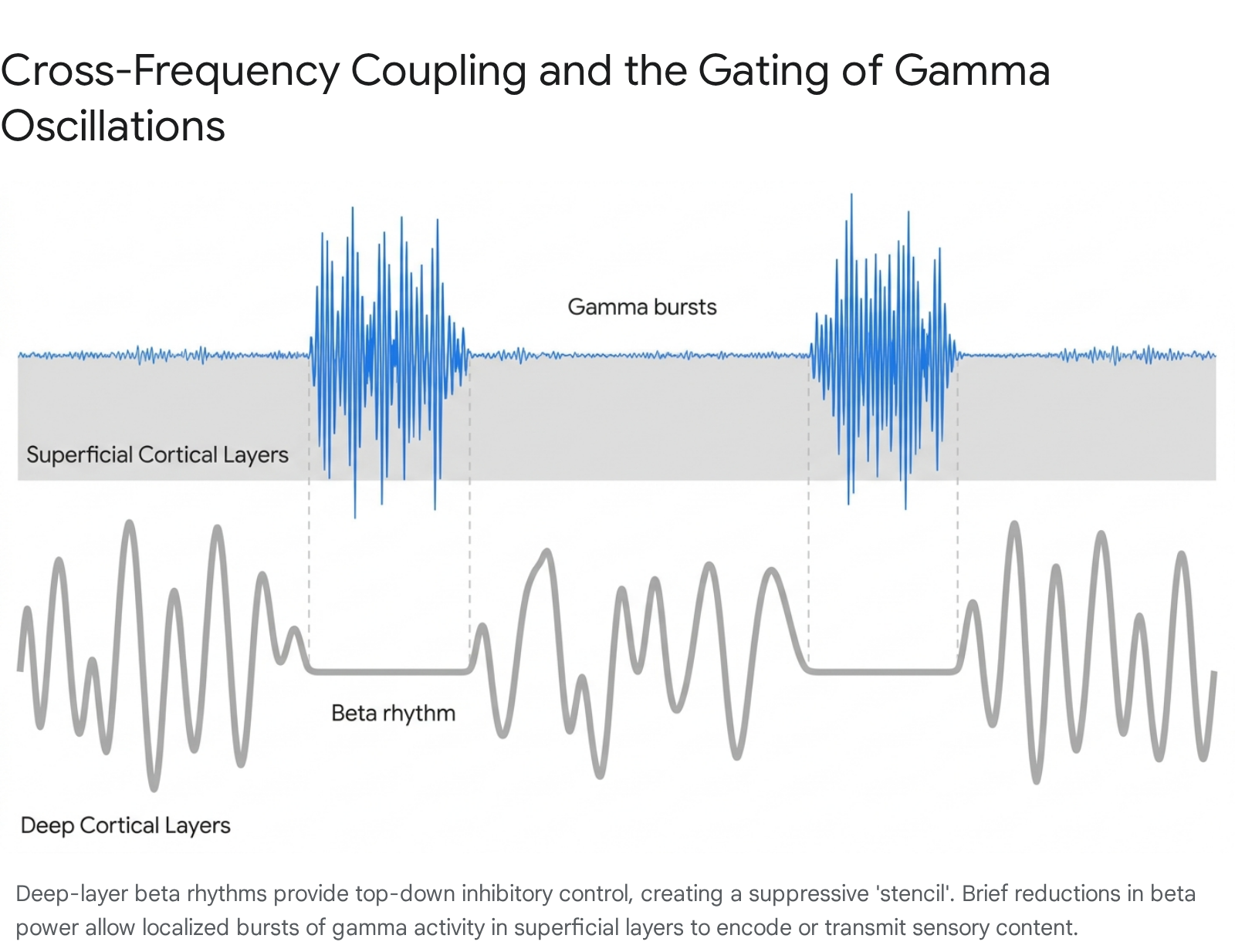
This cross-frequency interplay fundamentally reframes the role of high-frequency oscillations: gamma does not operate as an uninterrupted binding stream, but rather as a highly regulated carrier of discrete informational packets constrained by lower-frequency control networks.
Epiphenomenal Coherence and Empirical Critiques
While CTC is widely cited, rigorous computational modeling and electrophysiological testing have exposed significant limitations in its scope, leading to alternative interpretations of inter-areal gamma synchrony 1620.
A primary critique of the CTC hypothesis concerns causal directionality. Theoretical models increasingly propose a "coherence through communication" paradigm, wherein neuronal coherence is viewed as an epiphenomenon - a mathematical byproduct of synaptic communication between brain areas rather than the causal facilitator of that communication 20. Developments such as the Synaptic and Source-Mixing (SSM) model demonstrate that coherence and Granger causality metrics between a sending and receiving area can be driven entirely by the density of active synapses and the power spectrum of the sender 20. In computational simulations, a receiving cortical area displayed high coherence with a sending area without possessing significant endogenous oscillations of its own and without active phase-locking among its spiking neurons 20. Furthermore, strong phase coherence can be observed between two entirely disconnected cortical areas if both are being driven by a third centralized source, such as the pulvinar nucleus of the thalamus 20. Consequently, high gamma coherence measured at the cortical surface does not definitively prove that a strict temporal gating mechanism is actively facilitating information transfer.
Computational implementations of CTC also indicate that the mechanism is fragile. Oscillatory gating operates optimally only within a narrow parameter space; for instance, reducing structural connectivity between areas can result in strong phase coherence but negative signal onset enhancement 20. Because the cortex is an inherently noisy environment, high levels of local cortical noise or subtle variations in signal transmission speeds can continuously shift phase differences between brain areas, making strict phase-offset matching unreliable for sustained signal routing 20. This has led researchers to propose alternative models, such as "communication subspaces," which posit that brain areas communicate through low-dimensional shared activity spaces embedded within high-dimensional neural activity, rather than relying exclusively on strict temporal phase alignment 16.
| Feature | Communication Through Coherence (CTC) | Predictive Coding Framework | Epiphenomenal Coherence (e.g., SSM Model) |
|---|---|---|---|
| Core Function of Gamma | Causal facilitator of information routing via precise phase alignment. | Carrier of bottom-up sensory prediction errors when models fail. | A mathematical byproduct of active synaptic connectivity; non-causal. |
| Causal Direction | Coherence causes and enables communication. | Top-down predictive mismatches cause gamma generation. | Communication causes coherence metrics to appear. |
| Role of Slow Rhythms | Establish inter-areal phase synchrony and open temporal windows. | Carry top-down predictions to suppress expected sensory input. | Modulate broad local excitability but do not dictate discrete routing. |
| Network Sensitivity | Highly sensitive to phase offsets, delays, and background noise. | Highly sensitive to stimulus predictability, surprise, and novelty. | Robust; coherence emerges naturally from basic synaptic signal mixing. |
Table 2: Comparison of prevailing theoretical frameworks regarding the origin and computational function of gamma-band synchrony in cortical networks. 1620222324
Adversarial Testing of Macro-Theories of Consciousness
The hypothesis that gamma oscillations serve as the fundamental binding medium of conscious experience has been subjected to rigorous direct testing by comparing the two leading macro-theories of consciousness: Integrated Information Theory (IIT) and Global Neuronal Workspace Theory (GNWT).
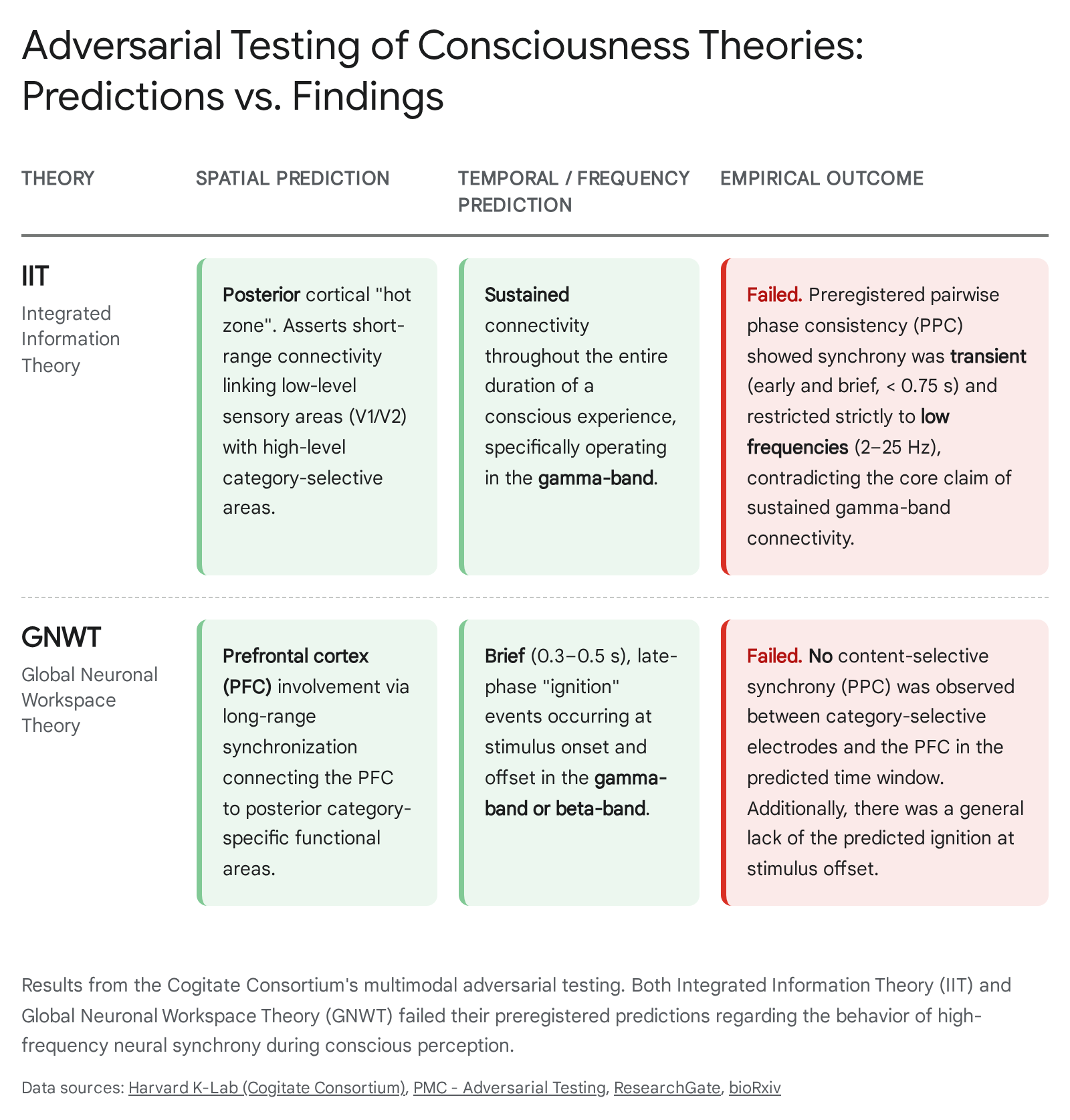
Integrated Information Theory posits that consciousness is an intrinsic, fundamental property of specific complex network architectures 25262728. IIT predicts that conscious content is specified by the maximal irreducibility of a network, which is primarily located in a posterior cortical "hot zone" encompassing occipital, temporal, and parietal areas 252829. Crucially, IIT hypothesizes that conscious experience strictly correlates with sustained, continuous high-frequency (gamma) synchronization within this posterior network for the entire duration a stimulus is consciously perceived 252829.
In stark contrast, Global Neuronal Workspace Theory views consciousness as a functional computational property of information broadcasting 2527303132. GNWT posits that non-conscious processing occurs in isolated, modular sensory networks. Information becomes conscious only when it is selected by attention and broadcast widely across a global workspace, a network heavily reliant on the prefrontal cortex (PFC) 25303132. GNWT predicts that this broadcasting manifests as brief, transient "ignitions" of gamma and beta synchronization linking the PFC to category-specific posterior sensory areas, occurring primarily at the onset and offset of a stimulus, rather than being sustained continuously 252931.
Results from the Cogitate Consortium
To resolve these conflicting predictions, an unprecedented open-science adversarial collaboration known as the Cogitate Consortium was established 253334. The consortium tested IIT and GNWT simultaneously using a theory-neutral experimental design involving functional Magnetic Resonance Imaging (fMRI), Magnetoencephalography (MEG), and highly invasive Electrocorticography (ECoG) data 253334. The 2024-2025 results produced outcomes that challenged the foundational premises of both theories.
Evaluating inter-areal synchronization using Pairwise Phase Consistency (PPC) - the preregistered primary metric for testing phase locking - the consortium tested IIT's prediction of sustained posterior gamma synchrony. The invasive ECoG data revealed that synchrony between category-selective electrodes and early visual areas (V1/V2) was entirely restricted to low frequencies (2 - 25 Hz) and occurred only early and briefly (lasting less than 0.75 seconds) 252933. No sustained gamma-band synchronization was observed throughout the stimulus duration, directly contradicting IIT's core prediction that high-frequency network connectivity acts as the continuous physical substrate of conscious content 252933.
GNWT also failed its primary preregistered tests. The theory predicted transient, content-selective phase synchrony between the PFC and posterior category-selective areas in the 300 - 500 ms window post-stimulus. The PPC analysis revealed no such synchronization 2529. Furthermore, GNWT was challenged by a general lack of expected prefrontal "ignition" at stimulus offset, and multivariate decoding analyses showed that the PFC contained limited representations of task-irrelevant conscious dimensions compared to posterior areas 283334.
While exploratory analyses using Dynamic Functional Connectivity (DFC) - a metric sensitive to amplitude co-modulation rather than strict phase locking - found brief gamma-band connectivity between the PFC and object-selective areas that loosely aligned with GNWT, the overarching conclusion of the Cogitate Consortium was clear 2533. The empirical reality of neural synchrony does not neatly align with its hypothesized role as the master binding mechanism of consciousness 2533.
Predictive Coding Framework for Gamma Activity
If gamma oscillations do not act as the literal glue of consciousness, what is their primary computational function? Increasingly, cognitive neuroscience is shifting toward the predictive processing (or predictive coding) framework to explain high-frequency neural dynamics 2223323536.
The predictive coding framework posits that the brain operates as a hierarchical inference machine, continuously generating internal models of the environment to predict incoming sensory data 3236. In this architecture, higher-order cognitive areas send predictions down to lower-level sensory areas. If the sensory input matches the top-down prediction, the input is suppressed, and little to no further upward processing is required. If there is a mismatch, a "prediction error" is generated and propagated up the hierarchy to update the internal model 22.
Electrophysiological evidence strongly supports a frequency-specific division of labor in this process. Slower rhythms, specifically in the alpha and beta bands, act as the carriers of top-down predictions, while gamma-band activity serves as the carrier for bottom-up, feedforward prediction errors 222335. Consequently, gamma oscillations represent the "unexplained part" of sensory input. Because gamma power reflects prediction errors, it scales parametrically with surprise; gamma synchrony increases substantially when the probability of a sensory event is low (high surprise) and decreases as the predictability of the event increases 22.
Under the predictive coding framework, the concept of feature binding is fundamentally reinterpreted. The perception of a unified object is not the result of a horizontal gamma web tying disparate features together; rather, it is the result of a successful top-down prediction effectively suppressing prediction errors across multiple lower-level feature modules 2332. Furthermore, cross-frequency coupling facilitates this hierarchical control 37. For example, hippocampal theta activity has been shown to modulate the appearance of neocortical fast gamma oscillations (100-150 Hz) during memory encoding, effectively organizing high-frequency error signals into discrete temporal windows governed by slower top-down cognitive states 3537. In this light, gamma synchrony is less a signature of unified consciousness and more a highly localized marker of active sensory updating and network adaptation.
Spatiotemporal Resolution Limits in Neuroimaging
Evaluating the exact role of gamma oscillations is intrinsically difficult due to severe physical and mathematical limitations in human neuroimaging technologies. The debate surrounding the binding hypothesis is inextricably linked to the spatial and temporal resolution constraints of available diagnostic tools 41423844.
Electroencephalography (EEG) and Magnetoencephalography (MEG) are the primary non-invasive tools for measuring neural oscillations. While both offer exceptional, millisecond-scale temporal resolution, their spatial resolution is notoriously poor 4139464041. Electrical potentials generated by synchronized pyramidal neurons in cortical columns must pass through the cerebrospinal fluid, skull, and scalp before reaching external sensors. Because these tissues possess varying and inhomogeneous electrical conductivities, the signal becomes highly distorted and spatially blurred - a phenomenon known as volume conduction 423846.
Because of volume conduction, a single EEG electrode records a complex mixture of local and distant neuronal sources. This spatial smearing inevitably degrades the temporal resolution of the recorded signal 38. The scalp-level time course becomes a weighted sum of underlying source dynamics, creating artificial phase delays and making independent cortical generators appear falsely synchronized, drastically complicating the measurement of phenomena like Communication Through Coherence 38.
To partially overcome these limitations, researchers utilize high-density EEG (HD-EEG) combined with spatial deblurring algorithms, such as the Surface Laplacian (Current Source Density) transform. By computing the second spatial derivative of the voltage distribution, Surface Laplacians significantly mitigate volume conduction effects, mathematically isolating the true temporal phase relationships of underlying generators 384243. Even with these mathematical corrections, resolving the exact source of a scalp signal remains an "ill-posed" inverse problem, as multiple different internal brain configurations can theoretically produce the exact same scalp topography 424644. Advanced algorithms like LORETA can improve spatial resolution as sensor arrays approach 70 or more electrodes, but they still cannot match the millimeter precision of hemodynamic techniques 52.
| Neuroimaging Modality | Temporal Resolution | Spatial Resolution | Signal Origin | Primary Limitations Regarding Gamma Oscillations |
|---|---|---|---|---|
| EEG (Scalp) | High (~1 millisecond) | Low (Centimeters) | Extracellular potentials of pyramidal neurons | Severe volume conduction blurs true phase relationships and source origins. |
| MEG | High (~1 millisecond) | Moderate (5 - 7 mm) | Magnetic fields from intracellular neuronal currents | Highly sensitive to source orientation; struggles to localize deep subcortical sources. |
| fMRI (BOLD) | Low (Seconds) | High (Millimeters) | Hemodynamic response (blood oxygenation) | Sluggish response completely unable to resolve 40+ Hz phase oscillations or fast synchronization. |
| ECoG / Intracranial | High (~1 millisecond) | High (Millimeters) | Direct local field potentials (LFP) on cortex | Highly invasive, extremely limited spatial coverage, restricted to rare clinical populations (e.g., epilepsy). |
Table 3: Spatial and temporal resolution limits of primary neuroimaging modalities and their respective constraints in studying high-frequency neural synchrony. 41443946414546
The limitations of surface recordings force researchers into a persistent trade-off. Functional Magnetic Resonance Imaging (fMRI) provides millimeter-level spatial localization of blood-oxygen-level-dependent (BOLD) signals, but its sluggish temporal resolution renders it entirely blind to high-frequency gamma phase dynamics 4446414546. To definitively test hypotheses regarding precise temporal phase synchronization, researchers must rely on Electrocorticography (ECoG) or depth electrodes. By placing sensors directly on the cortical surface or penetrating the parenchyma, ECoG bypasses volume conduction, offering simultaneous high spatial and temporal resolution 4144464748. However, because these methods require invasive neurosurgery, they are restricted to specific clinical populations - such as patients undergoing evaluation for drug-resistant epilepsy - which severely limits sample sizes, generalizability, and whole-brain coverage 414647.
Clinical Implications and Neuromodulation Initiatives
Despite theoretical uncertainty regarding its exact role in phenomenal consciousness, gamma-band activity remains a critical biological marker for brain health. Aberrations in high-frequency synchronization are heavily implicated in severe neuropsychiatric and neurodegenerative diseases, driving massive investment in clinical neuromodulation.
Gamma Deficits in Schizophrenia
In conditions such as schizophrenia, the finely tuned excitatory/inhibitory (E/I) balance required to generate stable gamma oscillations is severely disrupted. This disruption is frequently measured using the 40 Hz auditory steady-state response (ASSR). While healthy individuals exhibit robust phase coherence in the auditory cortex when presented with a 40 Hz stimulus, patients with chronic schizophrenia, first-episode psychosis, and even recent-onset schizophrenia demonstrate significant impairments in both the intertrial phase coherence (ITC) and event-related spectral perturbation of the gamma-band ASSR 11.
These electrophysiological deficits are hypothesized to stem from abnormalities in parvalbumin-positive (PV+) GABAergic interneurons and N-methyl-D-aspartate receptor (NMDAR) hypofunction, which compromise the specific microcircuits necessary for generating rhythmic cortical inhibition 11. Research from Japan's Brain/MINDS (Brain Mapping by Integrated Neurotechnologies for Disease Studies) project provided the first in vivo electrophysiological evidence of an abnormal association between NMDAR dysfunction (indexed by mismatch negativity amplitude) and GABA dysfunction (indexed by ASSR) in recent-onset schizophrenia, illustrating that gamma dysregulation is fundamentally tied to the onset of psychosis 11495051.
Gamma Entrainment in Alzheimer's Disease
Conversely, artificially restoring gamma synchrony has shown profound therapeutic potential. A highly researched experimental intervention for Alzheimer's disease (AD) is Gamma ENtrainment Using Sensory stimuli (GENUS). By exposing subjects to 40 Hz flickering light or 40 Hz auditory tones, researchers can exogenously entrain the brain's endogenous gamma rhythms without invasive surgery 1052.
Recent human and animal trials indicate that 40 Hz repetitive transcranial magnetic stimulation (rTMS) and GENUS can significantly improve cognitive function, preserve gray matter volume, and promote local and long-range functional integration within regions like the angular gyrus 52. Crucially, the induction of 40 Hz oscillations initiates a cascade of physiological benefits entirely separate from "conscious binding": it enhances cerebral blood flow, activates microglia to clear toxic amyloid-beta plaques, and stimulates the glymphatic system to improve metabolic waste clearance and sleep homeostasis 1052. This positions gamma synchrony not merely as a cognitive variable, but as a vital neurobiological maintenance rhythm necessary for cellular health.
Large-Scale Brain Mapping Projects
The investigation into macro-scale neural oscillations is currently spearheaded by extensive, government-funded international consortiums. Following the foundational work of the US BRAIN Initiative and Europe's Human Brain Project, the 15-year China Brain Project (CBP), launched in 2016 and extending through 2030, is aggressively mapping the topological axes of the brain 5354635556.
Structured as "one body and two wings" - aiming to map the fundamental neural mechanisms of cognition (the body) to develop interventions for brain diseases (wing one) and advance brain-inspired artificial intelligence (wing two) - the CBP is utilizing massive datasets to decode how intrinsic genetic blueprints dictate the organization of neural connections 5354635556. Recent outputs from these large-scale projects highlight the development of advanced multi-omics maps, non-human primate functional imaging, and new brain-computer interface (BCI) algorithms that leverage high-frequency field potentials and rhythmic motor imagery to decode human intent with unprecedented accuracy 5354555758.
Conclusion
The neural oscillation binding hypothesis, once championed as the definitive answer to how the human brain constructs a unified conscious reality, has undergone significant recalibration. While gamma waves (30 - 150 Hz) represent a fundamental and ubiquitous mode of cortical operation, empirical evidence from recent adversarial testing severely restricts their role as the global, continuous "glue" of consciousness 252933. Sustained, wide-scale gamma synchronization does not uniformly correlate with the maintenance of conscious percepts in either the posterior cortex or the prefrontal networks 2533. Furthermore, computational critiques suggest that observed inter-areal coherence may often be an epiphenomenon of underlying synaptic density and signal mixing, rather than an active, causal routing protocol 2024.
Instead, a more precise, functional consensus has emerged. Gamma oscillations are primarily localized phenomena that arise from the continuous interplay of excitatory and inhibitory cortical microcircuits. Functionally, they are tightly gated by slower, top-down rhythms (such as beta-band "stencils") and act as the principal carriers of bottom-up prediction errors when sensory input violates the brain's internal models 212223. While gamma oscillations may not single-handedly bind the entirety of phenomenal consciousness together, their rhythmic integrity is biologically vital. The precise timing of gamma oscillations is essential for healthy cognitive processing, sensory updating, and cellular maintenance, ensuring their position as an indispensable target for both theoretical neuroscience and clinical neuromodulation.