
Neural mechanisms of trust evaluation and oxytocin
Introduction to the Neurobiology of Trust
The evaluation of trustworthiness is a foundational cognitive and evolutionary process that enables cooperative social structures, economic exchange, and interpersonal bonding. Historically, behavioral economics and evolutionary psychology modeled trust as a rational calculus of risk and reciprocity, frequently conceptualizing actors as entities purely maximizing utility. However, the advent of social neuroeconomics and functional magnetic resonance imaging (fMRI) has fundamentally redefined trust as a dynamic, biologically mediated process. Trust is no longer viewed as being governed by a single centralized mechanism, nor is it merely a calculative financial decision; it relies on an interconnected network of brain regions that process uncertainty, attribute mental states to others, predict rewards, and compute the salience of social cues 1.
For over a decade, scientific and popular consensus held that the neuropeptide oxytocin functioned as a dedicated prosocial hormone, directly increasing human trust and moral behavior 234. Subsequent rigorous methodological scrutiny and high-powered replication failures have since dismantled this monolithic view, leading to a profound reassessment of both the neurochemical drivers of social behavior and the systemic publication biases within behavioral science 5678.
Today, the neuroscience of trust is understood through two primary lenses. The first is neuroanatomical, focusing on how specific cortical and subcortical structures - such as the amygdala, striatum, medial prefrontal cortex, and anterior insula - coordinate to evaluate risk and predict social outcomes 19.
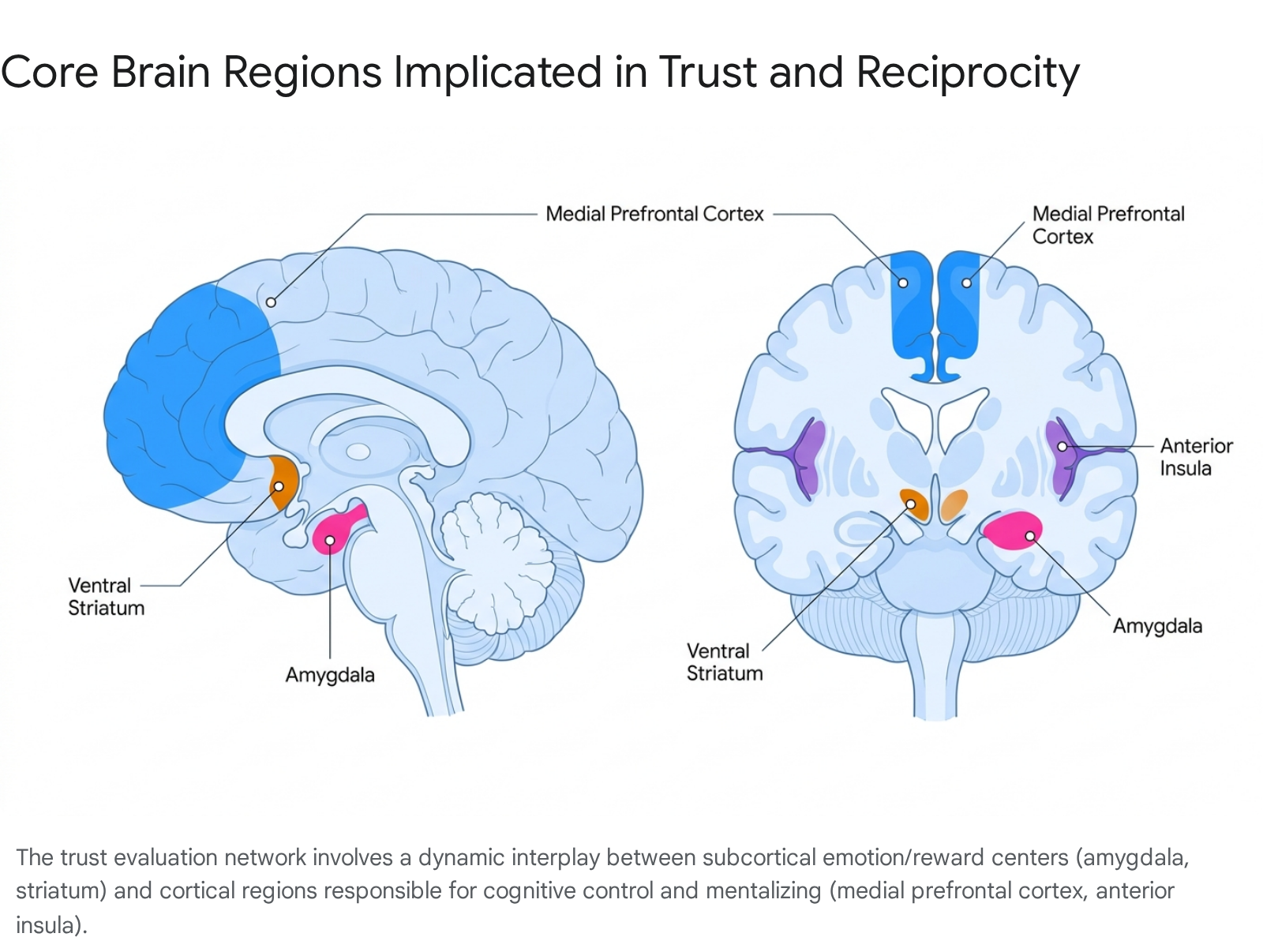
The second is neurochemical, wherein oxytocin is no longer viewed as a universal trust enhancer, but rather as a neuromodulator that increases the salience of social cues, yielding either prosocial or antisocial behavior depending heavily on context, culture, and individual psychopathology 1011. This report provides an exhaustive analysis of how the human brain evaluates trustworthiness, the functional networks involved across different stages of social exchange, the influence of cross-cultural neuroplasticity, and the historical trajectory of the oxytocin-trust paradigm.
Neuroanatomical Substrates of Trust Evaluation
The capacity to trust a stranger involves overcoming innate betrayal aversion, mentalizing the stranger's probable intentions, and predicting the hedonic value of reciprocity. Extensive fMRI studies have mapped these discrete cognitive requirements to distinct neural circuits, indicating that the basal ganglia work in concert with the cortex to execute motivated, well-planned social behaviors 19.
Amygdala Pathways in Threat and Trust Appraisal
The amygdala is central to implicit, appearance-based trust evaluations and the initial assessment of social risk. Extensive neuroimaging literature indicates a quadratic response in the amygdala to facial trustworthiness, wherein activation increases in response to both highly trustworthy and highly untrustworthy faces 1213. This suggests its primary role is not strictly to detect isolated threat, but to flag highly salient social stimuli that require subsequent cognitive evaluation.
Within the context of economic trust decisions, the amygdala does not operate as a homogenous unit. High-resolution fMRI studies separating the basolateral amygdala (BLA) from the central amygdala (CeA) reveal a distinct phase-dependent functional dissociation during repeated trust interactions. The CeA exhibits elevated activation during the preparation and behavioral planning phase of a trust decision, likely orchestrating autonomic arousal and initial risk assessment 14. Conversely, the BLA is selectively activated during the outcome phase, when the individual receives feedback on whether their trust was reciprocated or betrayed 14. The BLA's dense interconnectivity with the nucleus accumbens in the ventral striatum forms a critical circuit for associative learning, updating the predicted value of the social partner based on their behavior. Research into fear extinction models suggests that the BLA-ventral striatum circuit is recruited to weaken the return of fear or apprehension, an essential neurobiological step for allowing trust to re-emerge or persist in an uncertain environment 1516.
The Striatum and Reward Prediction Mechanisms
The striatum, divided into dorsal and ventral compartments, facilitates the transition from initial, uncertainty-laden trust decisions to habituated, learned reciprocity. The ventral striatum (VS) - encompassing the nucleus accumbens - is heavily implicated in reward prediction and anticipatory trust. The VS receives its primary input from the orbital prefrontal cortex, insular cortex, and the amygdala, serving as the functional interface between motivation and movement 917.
When an individual decides to invest resources in a stranger, activation in the VS parametrizes based on the size of the investment and the individual's internal belief that the trust will be reciprocated 118. This implies that the VS codes for the anticipated social reward of mutual cooperation. As an individual interacts repeatedly with the same partner, reliance shifts dynamically from the ventral to the dorsal striatum (DS). While the VS handles the anticipation of outcomes, the DS is consistently recruited during the feedback stage of multi-round interactions 1. The DS is fundamental to reinforcement learning; it evaluates the prediction error - the mathematical difference between the expected reciprocity and the actual outcome - allowing the trustor to continuously adjust future investments. The anterior dorsomedial striatum, functioning in tandem with goal-oriented cortical areas, translates this updated social information into modified behavioral strategies, effectively converting risky social evaluation into a habitual, goal-directed behavior 1619.
The Medial Prefrontal Cortex and Mentalizing Networks
To evaluate whether a partner is trustworthy, an individual must engage in mentalizing - the social-cognitive ability to attribute beliefs, desires, and intentions to others. The medial prefrontal cortex (mPFC) and the temporoparietal junction (TPJ) represent the core hubs of the brain's mentalizing network 20212223.
During interactive exchange games, interacting with a human partner elicits significantly greater mPFC and frontal pole activation compared to interacting with a computer executing a known probabilistic strategy 2024. This differential activation underscores the mPFC's specialized role in modeling the hidden states of autonomous social agents. Impairments in this network are evident in clinical populations characterized by social dysfunction. For instance, individuals with generalized social anxiety disorder exhibit blunted mPFC activation when mentalizing in a trust context, which correlates with a systemic tendency to form overly negative or distorted predictions about the intentions of others 20. Furthermore, resting-state functional magnetic resonance imaging (rsfMRI) reveals that the baseline functional connectivity and fractional amplitude of low-frequency fluctuations within the mPFC, precuneus, and lateral prefrontal cortex can actively predict an individual's intrinsic propensity to trust strangers prior to any task engagement 24.
The Anterior Insula and Betrayal Aversion
Decisions to trust inherently require the assumption of vulnerability. The anterior insula (AI) represents the affective cost of this vulnerability. Coordinate-based Activation Likelihood Estimation (ALE) meta-analyses analyzing thousands of participants consistently demonstrate AI activation during the decision phase of one-shot trust scenarios 125.
The AI is widely associated with processing interoceptive states, evaluating uncertainty, and generating aversive feelings. In the context of trust, AI activation is tightly coupled with betrayal aversion - the specific, potent negative affect generated by the prospect of being intentionally exploited by a social partner. This aversion is neurologically distinct from general risk aversion regarding probabilistic, non-social monetary loss 126. The ALE meta-analyses further suggest a hemispheric specialization: the left anterior insula is more strongly associated with reward evaluation and social strategy, while the right is involved in associative learning and cognitive control in the face of uncertainty 252728. Studies comparing low-frequency and high-frequency users of digital financial platforms show that baseline sensitivities to punishment, mediated by insular and temporal cortical volume, directly dictate generalized trust thresholds in modern economic environments 26.
Chronological Processing in Economic Trust Games
To standardize the measurement of trust across laboratories, researchers frequently rely on the "Trust Game" (or Investment Game), a sequential economic exchange paradigm. In this game, a trustor is endowed with money and must decide how much to transfer to an anonymous trustee. The transferred amount is multiplied (e.g., tripled) by the experimenter. The trustee then decides how much of the multiplied sum to return to the trustor. Transferring money is an objective, quantifiable measure of trust, while returning money measures reciprocity 2931.
The neurocomputational processing of this game unfolds across distinct chronological phases, each governed by different neural subnetworks responding dynamically to the changing state of the interaction.
Table 1: Meta-Analytic Synthesis of Neural Activations Across Trust Game Stages
| Sequential Game Stage | Primary Neural Activations | Putative Cognitive and Affective Function |
|---|---|---|
| 1. Preparation & Planning | Central Amygdala (CeA), Ventrolateral PFC | Orchestrates autonomic arousal, establishes baseline social risk evaluation prior to resource allocation. 1314 |
| 2. Investment Decision | Ventral Striatum (VS), Anterior Insula (AI) | VS codes for reward anticipation based on subjective beliefs; AI codes for betrayal aversion and risk mitigation. 118 |
| 3. Waiting Phase | Dorsolateral Prefrontal Cortex | Maintenance of alternative strategies; evaluation of ongoing strategy reliability and belief-mediated anticipation. 2728 |
| 4. Feedback & Outcome | Dorsal Striatum (DS), Basolateral Amygdala (BLA) | DS drives reinforcement learning via prediction errors; BLA updates the associative value of the specific partner. 114 |
| 5. Reciprocity (Trustee) | Intraparietal Sulcus (IPS), Anterior Insula | IPS evaluates numerical reciprocity options; AI processes the pressure of social norms, fairness, and guilt aversion. 1 |
In multiround versions of the game, the interplay between the prediction phase (ventral striatum) and the feedback phase (dorsal striatum) allows for active trust learning. As a partner repeatedly proves trustworthy, reliance on the uncertainty-processing anterior insula diminishes, and interactions become increasingly automated via dorsal striatal pathways 119. However, when an established trust bond is breached, the dorsal anterior cingulate cortex (dACC) is heavily recruited, signaling cognitive conflict and the immediate need to inhibit prosocial tendencies to adjust to the partner's newly revealed untrustworthiness 2227.
Cross-Cultural Variations in Trust Processing
Because trust is inherently reliant on social norms, heuristics, and expectations, cultural frameworks fundamentally alter the neural pathways through which trustworthiness is processed. The majority of early neuroeconomic literature was criticized for focusing almost exclusively on WEIRD (Western, Educated, Industrialized, Rich, and Democratic) populations, leading to an over-generalization of findings 32. Cross-cultural neuroscience explicitly investigates the structural and functional divergence between individualistic (e.g., Western European, American) and collectivistic (e.g., East Asian) models of cognition 3031.
Self-Construal and the Medial Prefrontal Cortex
Individualistic cultures promote an independent self-construal, conceptualizing people as autonomous entities characterized by stable, internal personality traits. In contrast, collectivistic cultures promote an interdependent self-construal, viewing individuals as highly interconnected and continually defined by specific contextual and social relationships 31. The "rice theory" of cultural development posits that these differences stem from historical agrarian requirements: labor-intensive rice paddy farming necessitated careful community coordination and interdependence, whereas wheat farming could be managed by independent family units 32.
These distinct psychological frameworks manifest physiologically in the medial prefrontal cortex. Cross-cultural fMRI studies demonstrate that individuals endorsing individualistic values show significantly greater mPFC activation when processing general self-descriptions (e.g., "I am honest"). Conversely, those endorsing collectivistic values exhibit greater mPFC activation during contextual self-descriptions (e.g., "When talking to my mother, I am honest") 3132. The architecture of self-knowledge, a prerequisite for evaluating others, is thus fundamentally shaped by cultural norms.
Mentalizing Profiles and Temporoparietal Junction Engagement
The recruitment of the temporoparietal junction (TPJ) during mentalizing tasks also differs significantly by culture. When asked to reflect on personal attributes versus the attributes of a public figure, Chinese participants induced significantly greater activity in the TPJ than Danish participants. This difference was directly mediated by the participants' psychometric scores on cultural interdependence 2123.
A systematic review of cross-cultural mentalizing studies involving populations from over 45 countries supports these neuroimaging findings. The data indicate that individualistic cultures generally exhibit a "self > other" mentalizing profile, prioritizing internal cognitive states, whereas collectivistic cultures exhibit a "self < other" mentalizing profile, placing greater neurocognitive weight on external social harmony, non-verbal cues, and the mental states of the broader group 33. This suggests that collectivistic backgrounds train individuals to adopt distinct, more externally-focused neural strategies for self-reflection and mentalizing, shifting the weight of the social brain network dynamically 2133.
Table 2: Cross-Cultural Divergences in Neural Processing of Social and Visual Cues
| Cognitive Domain | Individualistic Emphasis (e.g., USA, Western Europe) | Collectivistic Emphasis (e.g., Japan, China) | Primary Neural Divergences 323435363738 |
|---|---|---|---|
| Self-Construal | Independent; identity based on stable internal traits. | Interdependent; identity based on context and relationships. | mPFC: Tracks general traits in Individualists, contextual traits in Collectivists. |
| Mentalizing | Self-oriented mentalizing profile. | Other-oriented mentalizing profile. | TPJ: Greater engagement in Collectivists when reflecting on social attributes. |
| Visual Perception | Analytical; focuses on specific, independent objects. | Holistic; focuses on background context and object relations. | Fusiform / LOC: Greater activation in Individualists for specific details; Collectivists recruit attentional systems differently for absolute judgments. |
| Emotion Suppression | Preference for cognitive reappraisal to manage emotions. | Preference for expressive/emotional suppression to maintain harmony. | Amygdala: Higher baseline reactivity to emotional faces in Collectivistic cohorts; potential OXTR genetic interactions. |
Visual Processing and Facial Trustworthiness
Cultural values fundamentally rewire low-level perceptual pathways used to evaluate appearance-based trustworthiness. When individuals from individualistic cultures view complex visual scenes, they demonstrate heightened activation in the lateral occipital complex (LOC) and object-processing areas of the ventral visual cortex, aligning with an analytical focus on independent objects 343638. Individuals from collectivistic cultures show distributed processing that emphasizes the relationship between objects and backgrounds 3436.
In the specific context of cross-cultural trust evaluation, recognizing emotions and inferring trustworthiness from faces is significantly more accurate when observing members of one's own cultural group. While the amygdala responds to untrustworthy faces universally across cultures, studies show distinct functional patterns in the superior temporal sulcus (STS) and cuneus when inferring the intentions of out-group versus in-group members. For example, Native Japanese and American participants both show heightened amygdala responses to fear from their own cultural groups, but recruit the STS more heavily only when judging the mental states of in-group targets based on eye-region expressions 121334. Furthermore, encoding specific visual details of objects and faces relies more heavily on the left fusiform gyrus and left hippocampus in East Asian populations compared to American populations, highlighting how cultural conditioning modulates the actual encoding resolution and retrieval mechanisms of social memory 373839. At a macro scale, analysis of scientific communication and citation sentiment reveals that countries indexing higher in individualism generate significantly more critical citations, underscoring how deeply sociocultural factors pervade cognitive assessment and academic trust 43.
The Oxytocin Paradigm and the Replication Crisis
The most heavily scrutinized narrative in the neuroscience of trust is the role of the neuropeptide oxytocin (OT). Synthesized in the hypothalamus, OT was traditionally known for its peripheral physiological roles in parturition, lactation, and maternal attachment. However, the early 2000s saw a massive paradigm shift in neuroeconomics regarding its behavioral and psychological effects.
Early Consensus and the Prosocial Account
In a highly influential 2005 paper published in Nature, Kosfeld, Heinrichs, Zak, Fischbacher, and Fehr reported that the intranasal administration of oxytocin caused a substantial increase in the monetary transfers made by investors in a standard Trust Game. The study concluded unambiguously that "oxytocin increases trust in humans" 5640.
This single finding catalyzed the creation of an entirely new subfield of neuroeconomics. Paul Zak, a co-author of the original study, popularized oxytocin as the biological basis for the golden rule, branding it the "moral molecule" and the "love hormone" in subsequent literature and highly viewed public lectures 2331. Prominent theories posited that oxytocin operated by reducing the natural fear of trusting a stranger, suppressing amygdala hyperactivity, and promoting virtually all prosocial behaviors, from charitable giving to corporate collaboration 24. Zak argued that civilization itself was dependent on oxytocin, and organizational consultants widely adopted these findings, suggesting that leaders could optimize workplace performance by implementing management behaviors designed to artificially spike endogenous oxytocin levels, such as recognizing excellence, inducing challenge stress, and showing vulnerability 441.
Methodological Scrutiny and Failed Replications
Despite the immense popularity and funding dedicated to the oxytocin-trust hypothesis, severe methodological cracks began to appear roughly a decade after the original publication. In 2015, Nave, Camerer, and McCullough published a critical meta-review assessing the cumulative evidence on oxytocin and trust. Their rigorous statistical analysis revealed that the foundational claim - intranasal OT increases trust - had consistently failed to replicate in well-powered, independent studies. They additionally highlighted that peripheral plasma measurements of OT (used frequently in earlier correlational studies) were scientifically flawed due to the molecule's inability to reliably cross the blood-brain barrier in measurable quantities, and that genetic polymorphism associations with trust were highly inconsistent and prone to false discovery rates 6.
Simultaneously, independent laboratories attempted to replicate other highly cited OT paradigms. A notable example was the "Envelope Task," an economic measure of trust based on the degree to which a participant opens an envelope containing confidential information. Lane et al. (2015) conducted two independent replication attempts of this task with sufficient statistical power (N=95 and N=61). Both attempts completely failed to replicate the original prosocial findings. In a rare and vital step for scientific integrity, the authors published their negative results, warning that the positive predictive value of early OT literature was remarkably low and heavily polluted by publication bias 84243.
The most definitive blow to the original 2005 paradigm occurred when some of its original authors, including Ernst Fehr, published a massive, pre-registered replication attempt. Utilizing a sample size that yielded over 95% statistical power (N=321), a double-blind, placebo-controlled design, and exact methodological conditions matching the 2005 paper, the researchers found no effect of intranasal oxytocin on trusting behavior in the primary experimental condition 294049. A subsequent pooled meta-analysis published in 2026, combining multiple large-scale registered reports totaling 532 subjects, conclusively demonstrated that the effect of intranasal oxytocin on trusting behavior was statistically equivalent to zero, suggesting the effect is too small to be of any practical interest or validity 44.
Systemic Publication Bias and Citation Inertia
Despite this conclusive empirical shift, the original 2005 paper remains unaltered in its host journal and has accumulated over 5,100 citations, continually referenced by new studies and media outlets as though the replication failures never occurred 5.
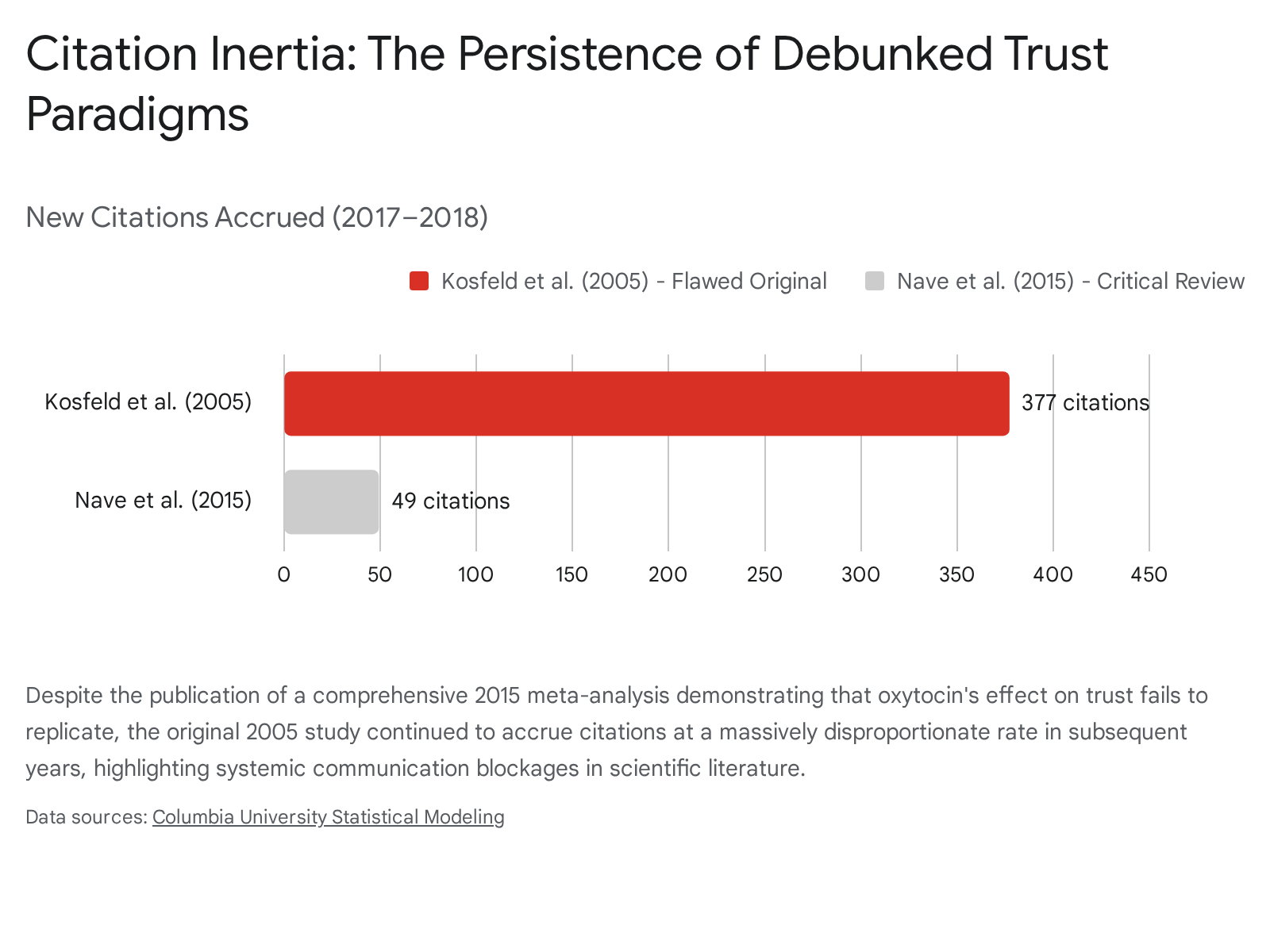
This phenomenon has sparked widespread debate regarding the misaligned incentives in the scientific publishing system. Journals function simultaneously as gatekeepers of valid science and entities requiring high-impact, attention-grabbing headlines. Because exact replications are inherently not novel, researchers find it highly difficult to publish negative findings, leaving the literature polluted with "dead research results" that continue to propagate false narratives into mainstream psychology 56.
The Social Salience Hypothesis of Oxytocin
The realization that oxytocin does not act as an unconditional "trust serum" forced neuroscientists to develop more nuanced, biologically plausible frameworks. If oxytocin does not directly cause prosocial behavior, its true function requires a different theoretical approach. The current scientific consensus points to the Social Salience Hypothesis, advanced primarily by Shamay-Tsoory, Abu-Akel, and peers 1011.
Contextual Amplification via Dopaminergic Pathways
The Social Salience Hypothesis argues that oxytocin acts as a general neuromodulator that increases the perceptual salience of social cues, primarily through its heavy functional interaction with the brain's dopaminergic system 101145. Rather than dictating a specific behavioral output (e.g., trust or generosity), oxytocin amplifies attention-orienting responses to the external social context.
If an individual is situated in a cooperative, familiar, or safe environment, oxytocin amplification makes those positive cues more salient, facilitating increased trust, empathy, and in-group preference 464748. However, if the context involves threat, intense competition, or an anonymous out-group, oxytocin amplifies those specific negative cues. Consequently, multiple robust studies have demonstrated that intranasal oxytocin can actively induce antisocial effects. In competitive paradigms, oxytocin administration significantly increases feelings of envy when a competitor wins, and elevates schadenfreude (gloating) when the participant defeats a competitor 114546. Furthermore, in contexts involving intergroup relations, oxytocin has been shown to enhance defense-motivated aggression toward out-group members, and it actively decreases trust in strangers when individuals are presented with subtle behavioral cues that the partner might be unreliable 424546.
This model elegantly reconciles the previously contradictory literature. The original studies in the early 2000s, conducted in highly safe, cooperative laboratory environments using exclusively in-group university students, recorded prosocial outcomes precisely because the underlying social cues were overwhelmingly positive 4548. When independent labs subsequently introduced competitive variables, diverse populations, or minimal social contact, the prosocial effects vanished or reversed 294049.
Clinical Implications in Autism Spectrum Disorder
The effects of oxytocin are not only constrained by external context but are highly dependent on baseline individual differences. Genetic polymorphisms, personality traits, gender, and attachment history critically moderate how oxytocin affects social evaluation. For instance, in individuals who have experienced severe childhood maltreatment, oxytocin administration can actually have detrimental effects on social cognition, arguably because their neurodevelopmental history biases them to perceive heightened social salience as a potent signal of untrustworthiness or imminent threat 114950.
Understanding oxytocin through the lens of the Social Salience Network (SSN) has profound implications for treating psychiatric conditions characterized by aberrant social behavior. In disorders such as Autism Spectrum Disorder (ASD), where individuals often struggle with evaluating socio-sensory cues and maintaining social motivation, disruptions in the SSN and atypical expression of oxytocin receptors in amygdala-insular networks are well-documented 5152.
Clinical trials utilizing intranasal oxytocin for ASD initially yielded the same mixed, inconsistent results seen in the behavioral economics literature 53. However, recent dose-response meta-analyses indicate that clinical efficacy is highly dependent on precise dosage optimization. While standard doses (e.g., 24 IU) frequently fail to separate from placebo in altering core symptoms like repetitive behaviors or social responsiveness, higher doses (e.g., 48 IU per day) have shown statistically significant beneficial effects in recent trials 53. This suggests a complex, potentially inverted U-shaped dose-response curve, wherein the optimal modulation of the amygdala and striatum to rescue social phenotypes requires rigorous titration tailored to the individual 5354.
Applications in Schizophrenia and Cognitive Aging
The salience framework is similarly applicable to schizophrenia, a condition which frequently features blunted facial affect and pronounced deficits in facial trustworthiness evaluation. These deficits are neurologically linked to prefrontal-amygdala decoupling. Recent clinical investigations have demonstrated that oxytocin administration shows promise in increasing facial expressivity and normalizing patient sensitivity to socially meaningful cues, acting as an adjunct to traditional therapies by targeting the underlying salience dysregulation 4855.
In healthy aging populations, baseline changes in socioemotional processing also interact with the oxytocin system. Older adults naturally exhibit different functional connectivity between the amygdala and the mPFC compared to younger cohorts. This altered connectivity can sometimes reduce their sensitivity to cues of untrustworthiness, rendering them more susceptible to financial exploitation in trust-based exchanges 5657. Emerging fMRI studies show that oxytocin administration directly modulates insula activity in response to negative social feedback and unreciprocated trust across all age groups. However, complex age-by-sex interactions remain actively debated, requiring further longitudinal clarification to understand fully how neurochemical baseline shifts impact economic trust and vulnerability in the elderly 5657.
Synthesized Conclusions
The neuroscience of trust has evolved from early biological reductionism into a highly sophisticated, systems-level discipline. Trust is not localized to a single neurological "trust center," nor is it triggered by a single "moral molecule." Instead, it is the emergent property of a dynamic neural calculus.
- Network Integration: Evaluating trustworthiness requires the central amygdala to prepare for social risk, the anterior insula to process betrayal aversion, the medial prefrontal cortex to mentalize the partner's intentions, and the striatum to continuously update predictions of social reward and punishment 114.
- Cultural Conditioning: The precise weighting of these neural hubs is profoundly shaped by sociocultural environments. Collectivistic and individualistic societies train the brain to process social cues differently, altering everything from low-level visual object recognition in the fusiform gyrus to high-level self-construal networks in the mPFC and TPJ 213138.
- The Demise of the "Love Hormone": The claim that intranasal oxytocin reliably and directly increases human trust is a prominent casualty of the replication crisis. The persistence of this myth highlights severe systemic flaws in scientific publishing, where highly-cited false positives often overshadow rigorous, high-powered refutations 564944.
- The Reality of Oxytocin: The prevailing Social Salience Hypothesis reframes oxytocin as a powerful contextual amplifier. By interacting with dopaminergic pathways, it heightens sensitivity to social cues, driving empathy in safe, cooperative environments, and envy, suspicion, or aggression in competitive or traumatic contexts 101145.
Ultimately, trust remains a fundamentally adaptive mechanism - a continuous, highly context-dependent negotiation between the brain's drive for social reward, its mandate for self-preservation, and the cultural frameworks that define social reality.