Navier-Stokes existence and smoothness problem
Origins of the Navier-Stokes Equations
The Navier-Stokes equations represent the foundational mathematical framework for the motion of viscous fluids. Formulated over several decades in the early 19th century by Claude-Louis Navier, George Gabriel Stokes, and independently by Siméon Denis Poisson, these partial differential equations (PDEs) are a continuum expression of Newton's second law of motion applied to fluid dynamics 123. By extending the inviscid Euler equations formulated in 1757 to include the effects of internal friction (viscosity), the Navier-Stokes equations describe a vast array of physical phenomena, ranging from oceanic currents and atmospheric weather systems to aerodynamic drag and cardiovascular hemodynamics 245.
Despite nearly two centuries of intense mathematical and physical scrutiny, the rigorous analytical understanding of these equations remains profoundly incomplete. The core unresolved issue asks a fundamental question: given a smooth, globally defined initial vector velocity field with finite kinetic energy, do the three-dimensional (3D) incompressible Navier-Stokes equations guarantee a smooth, globally defined solution for all future time? Alternatively, do there exist initial conditions under which the equations break down, producing singularities where quantities such as velocity or vorticity become infinite in finite time 4678?
Recognizing the critical importance of this gap in mathematical physics, the Clay Mathematics Institute designated the Navier-Stokes existence and smoothness problem as one of the seven Millennium Prize Problems in 2000, offering a one-million-dollar reward for its resolution 69. The problem, formally defined by Charles Fefferman, remains officially unsolved as of 2026, standing as a pivotal obstacle to achieving a rigorous mathematical theory of turbulence 68.
Mathematical Formulation of Viscous Flow
The standard formulation of the Millennium Prize Problem focuses on the incompressible, unforced Navier-Stokes equations in three-dimensional Euclidean space ($\mathbb{R}^3$) or on the three-dimensional torus ($\mathbb{T}^3$) for periodic boundary conditions. The equations are expressed as a coupled system 710:
$$\frac{\partial \mathbf{u}}{\partial t} + (\mathbf{u} \cdot \nabla)\mathbf{u} = -\nabla p + \nu \Delta \mathbf{u}$$ $$\nabla \cdot \mathbf{u} = 0$$
In this system, $\mathbf{u}(x,t)$ is the three-dimensional flow velocity vector field, $p(x,t)$ is the scalar pressure field, and $\nu > 0$ represents the kinematic viscosity 710. The equations are derived from the broader Cauchy momentum equation and assume a Newtonian fluid 29. The dynamics are governed by three competing mathematical terms:
- Convective Acceleration: The nonlinear term $(\mathbf{u} \cdot \nabla)\mathbf{u}$ describes how the fluid velocity is transported by the flow itself. It is the primary driver of complexity, responsible for the transfer of energy across different spatial scales and the generation of turbulence 110.
- Pressure Gradient: The term $-\nabla p$ acts as an instantaneous, non-local constraint that enforces the incompressibility condition ($\nabla \cdot \mathbf{u} = 0$). In this incompressible framework, pressure is not an independent thermodynamic variable related by an equation of state; rather, it is a mathematical multiplier that ensures the volume of fluid parcels remains constant, making the pressure at any given point dependent on the entire velocity field instantaneously 111.
- Viscous Diffusion: The linear Laplacian term $\nu \Delta \mathbf{u}$ acts as a stabilizing, dissipative mechanism. It smooths local variations in the velocity field, diffusing momentum and dissipating kinetic energy into thermal energy 210.
Supercriticality in Three Dimensions
The central analytical difficulty of the Navier-Stokes existence and smoothness problem lies in the super-critical nature of the nonlinear convective term in three spatial dimensions 1012. To prove global regularity for a nonlinear PDE, mathematicians typically rely on globally controlled quantities, such as total energy, which are strictly bounded over time.
For a controlled quantity to prevent a singularity, it must be either "critical" or "subcritical" relative to the scaling of the equation's nonlinear terms. The total kinetic energy of a Navier-Stokes fluid is conserved (or strictly decreasing due to viscosity), but in three dimensions, this energy bound is "supercritical" 1216. This implies that even though the total energy of the system is finite, the mathematical bounds provided by energy conservation are too weak to prevent the derivatives of the velocity field from blowing up to infinity 121613. The fundamental question is whether the convective term can amplify gradients fast enough to outpace the smoothing effect of viscous diffusion, thereby concentrating finite energy into an infinitesimally small region to create a singularity 41011.
Turbulent Dynamics and the Energy Cascade
To understand why the mathematics of the Navier-Stokes equations defy standard analytical control, it is necessary to examine the physical phenomenology of turbulence, primarily formalized by Andrey Kolmogorov in his 1941 theory (often referred to as K41) 111415.
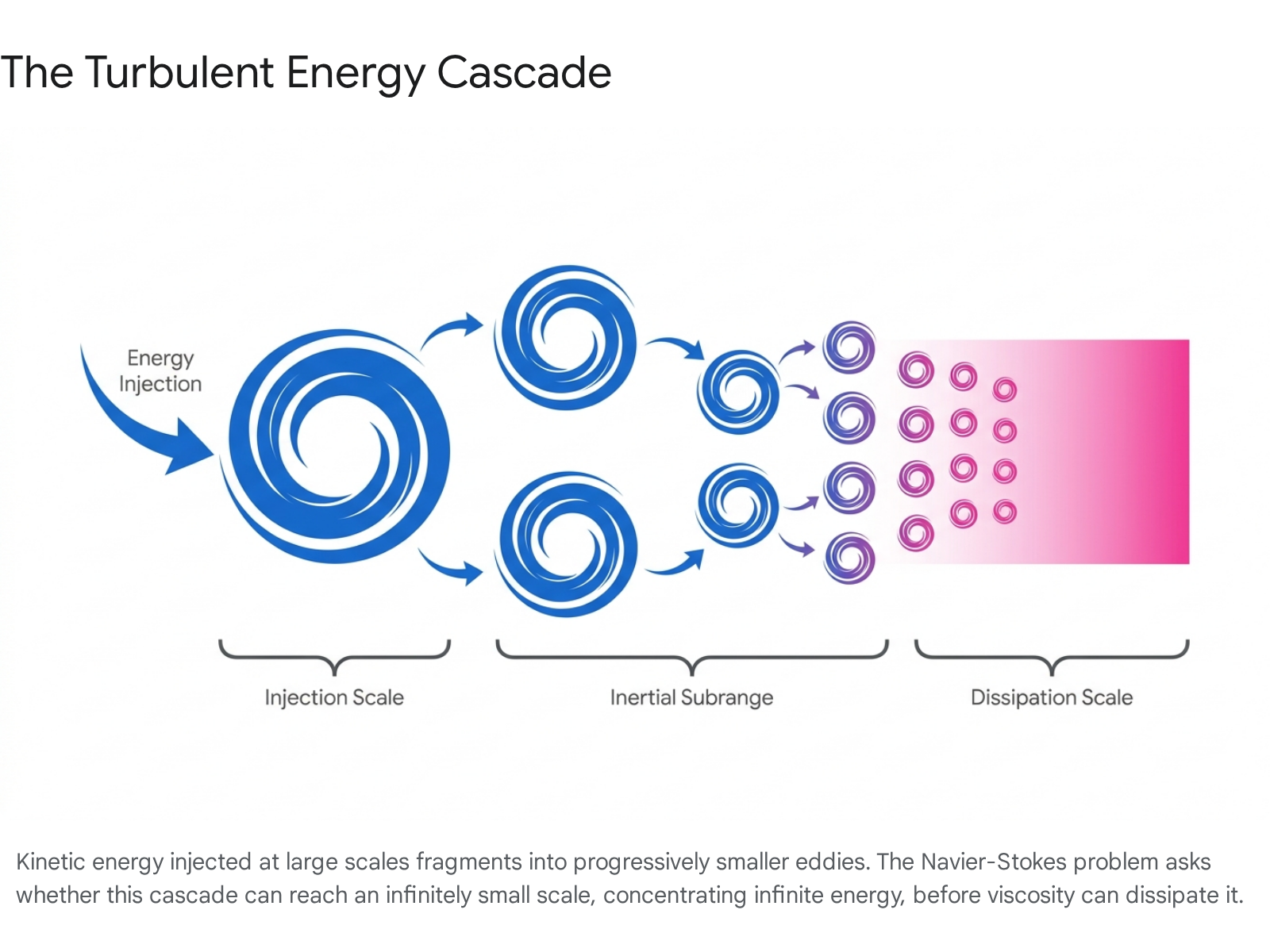
Turbulence is characterized by a complex, multi-scale hierarchy of vortical structures or "eddies." When kinetic energy is injected into a fluid system at large macroscopic scales (the integral scale, $L_0$), inertial forces dominate viscous forces, characterized by a high Reynolds number ($Re = V_0 L_0 / \nu$) 1617. Because macroscopic eddies are inherently unstable in 3D flows, they fragment into smaller eddies, transferring their kinetic energy downward in a sequence known as the energy cascade 111718.
This cascading process progresses through an "inertial subrange" - a statistically self-similar regime where energy is passed to progressively smaller scales at a constant flux rate. In this range, the spectral kinetic energy exhibits a universal $k^{-5/3}$ power-law dependence on the wavenumber $k$ 141519. Eventually, the cascade reaches the Kolmogorov microscales ($\eta$), where the local Reynolds number drops to order unity. At this infinitesimal scale, the viscous diffusion term ($\nu \Delta \mathbf{u}$) overtakes inertia, rapidly smoothing the velocity gradients and dissipating the kinetic energy into heat 1417.
The Millennium Prize Problem effectively maps this physical phenomenon to a mathematical boundary question: can a "rogue" energy cascade operate infinitely fast? Is it mathematically possible to construct a specific initial fluid state that acts as a singularity-generating mechanism, accelerating the cascade such that the size of the eddies approaches zero - and the velocity approaches infinity - in a finite amount of time, thereby outrunning the stabilizing grip of viscosity 2021?
Dimensional Characteristics of Fluid Dynamics
A critical benchmark for understanding the difficulty of the three-dimensional Navier-Stokes problem is that its two-dimensional (2D) counterpart has already been solved. In 1969, mathematician Olga Ladyzhenskaya proved that smooth, globally defined solutions always exist for the 2D incompressible Navier-Stokes equations 81122. The divergence in solvability between 2D and 3D fluids stems from fundamental topological and physical mechanisms regarding how vorticity behaves in different spatial dimensions.
Vortex Stretching Mechanisms
In fluid dynamics, the vorticity vector $\boldsymbol{\omega}$ is defined as the curl of the velocity field ($\boldsymbol{\omega} = \nabla \times \mathbf{u}$), representing the local rotation or angular velocity of fluid parcels 2324.
In a strictly two-dimensional flow, fluid movement is confined to a single plane, and the vorticity vector points strictly perpendicular to that plane 2325. Consequently, while 2D vortices can translate, merge, and spin, they cannot stretch along their axis of rotation. Because of this topological constraint, vorticity in 2D behaves essentially as a conserved scalar quantity advected by the flow, remaining globally bounded by the values of its initial state 1123.
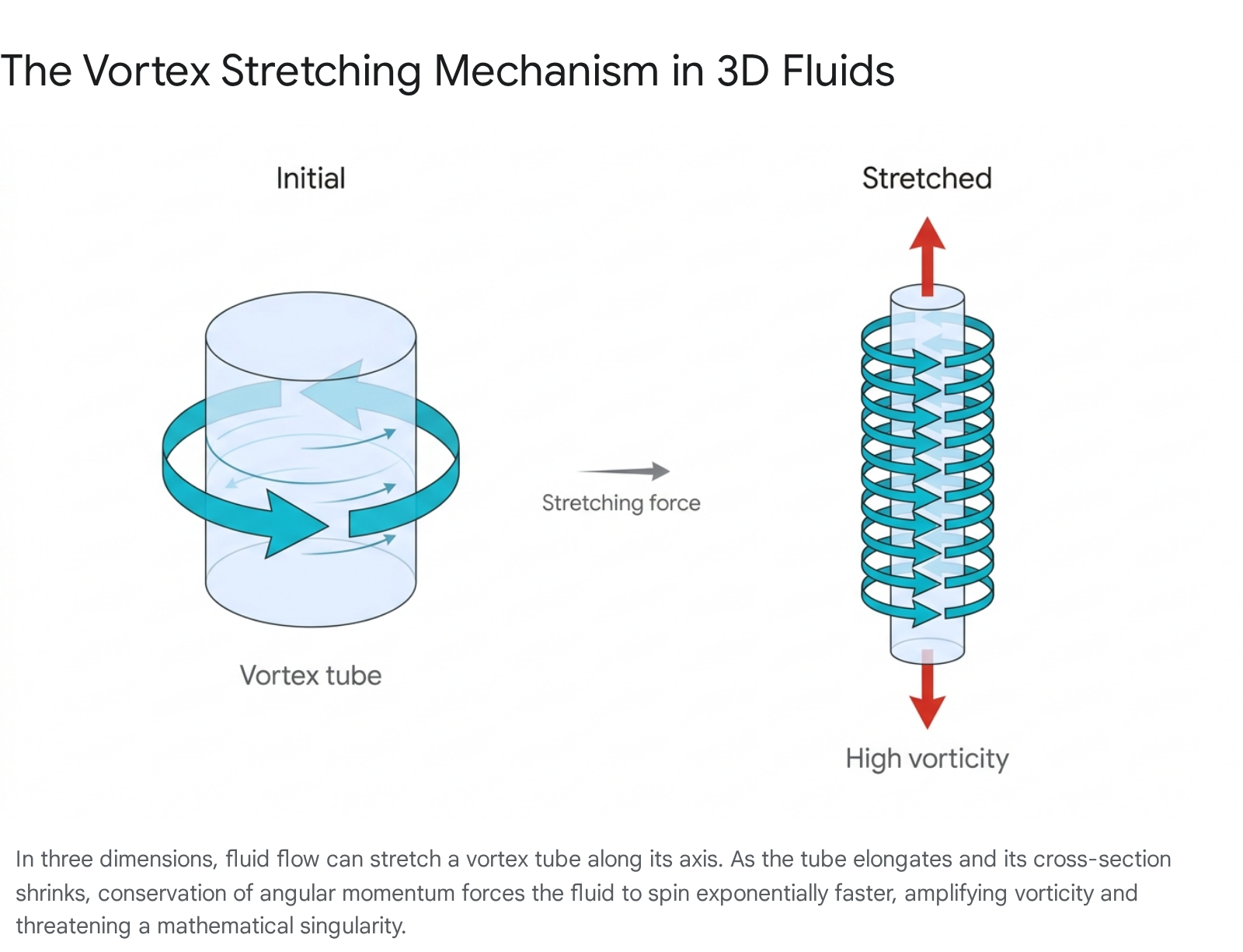
In three dimensions, vortices are free to point in any direction, forming complex, tangled vortex tubes 2426. The 3D Navier-Stokes equations contain the nonlinear vortex stretching term $(\boldsymbol{\omega} \cdot \nabla)\mathbf{u}$, which is entirely absent in the 2D formulation 1323. If the surrounding fluid flow pulls on the ends of a 3D vortex tube, the tube stretches, and its cross-sectional area decreases. Due to the conservation of angular momentum, the fluid within this narrowing tube must spin exponentially faster, resulting in a dramatic, localized amplification of vorticity 11132627. The fluid dynamics community widely views this vortex stretching mechanism as the primary vehicle capable of generating a finite-time singularity, as it has the potential to concentrate immense energy into an infinitely thin filament 1113.
Cascade Directionality and Enstrophy
The absence of vortex stretching in 2D fundamentally alters the direction of the energy cascade. According to the Kraichnan-Leith-Batchelor (KLB) theory of 2D turbulence, the constraints on vorticity force an inverse energy cascade, where kinetic energy flows from small injection scales upward to larger spatial scales, forming massive, stable structures (such as planetary cyclones or oceanic eddies) 22282930.
Simultaneously, 2D flows undergo a direct enstrophy cascade 1930. Enstrophy, defined as the integral of the squared vorticity ($\Omega(t) = \frac{1}{2}|\boldsymbol{\omega}|^2_{L^2}$), measures the total rotational dissipation in the fluid. In 2D, enstrophy cascades toward the microscopic dissipation scale while remaining strictly bounded by viscosity, precluding blowup 1022. In 3D flows, however, both energy and enstrophy cascade downward toward smaller scales, and the super-critical stretching mechanism prevents mathematicians from bounding the enstrophy growth dynamically 10132930.
| Analytical Property | Two-Dimensional (2D) Fluid Flow | Three-Dimensional (3D) Fluid Flow |
|---|---|---|
| Vorticity Geometry | Restricted to a single perpendicular scalar component 2325 | Full 3D pseudovector field forming tangled tubes 2426 |
| Vortex Stretching | Zero; vorticity behaves as a conserved, advected scalar 111325 | Highly active $((\boldsymbol{\omega} \cdot \nabla)\mathbf{u})$; heavily amplifies local vorticity 1323 |
| Energy Cascade | Inverse (transfers from small to large macroscopic scales) 222829 | Direct (transfers from large scales down to dissipation scales) 181929 |
| Enstrophy Behavior | Direct cascade; remains globally bounded, ensuring smoothness 102230 | Cascades downward; vulnerable to unbounded super-critical growth 101330 |
| Helicity Invariance | Degenerates to zero 31 | Conserved topologically in ideal (inviscid) flows 2731 |
| Global Regularity | Mathematically proven (Ladyzhenskaya, 1969) 811 | Unproven; subject of the Millennium Prize Problem 47 |
Weak Solutions and Partial Regularity
Because proving the existence of global smooth solutions in 3D has eluded the field, the mathematical community has heavily focused on analyzing weakened formulations of the Navier-Stokes equations to establish foundational constraints.
In 1934, the French mathematician Jean Leray achieved a monumental breakthrough by proving the existence of global "weak" solutions (now known as Leray-Hopf solutions) 48. A weak solution does not strictly require the differential equations to hold pointwise everywhere in the spatial domain; rather, the equations must hold in the sense of distributions, satisfying integral mean values 732. Leray's proof established that a finite-energy fluid flow will exist globally in time, but it deliberately left open the possibility that these weak solutions could possess singular points where the velocity field loses its smoothness and diverges to infinity.
If such singularities do form in 3D fluids, subsequent mathematical research has proven they must be vanishingly rare. In 1982, mathematicians Luis Caffarelli, Robert Kohn, and Louis Nirenberg established a landmark partial regularity theorem. They demonstrated that for suitable weak solutions to the Navier-Stokes equations, the set of all singular points in space and time must have a one-dimensional Hausdorff measure of zero 4833. Consequently, a singularity cannot form along a persistent line, sheet, or volume; if it occurs, it is confined to an infinitesimally sparse set of points.
Further constraints on potential singularities were established in 1984 by the Beale-Kato-Majda (BKM) criterion. This theorem proved that for a smooth solution of the 3D fluid equations (including both the Euler and Navier-Stokes equations) to break down and form a singularity at a specific finite time $T$, the integral of the maximum spatial vorticity over time must diverge as it approaches $T$ 4834. The BKM criterion fundamentally links the abstract concept of a singularity directly to the physical mechanism of vortex stretching; without the generation of infinite vorticity, there can be no finite-time blowup.
Non-Uniqueness of Leray-Hopf Solutions
A corollary to the existence problem is the question of uniqueness. If the Navier-Stokes equations accurately represent classical, macroscopic physical reality, the evolution of a fluid from a given initial state should be deterministic, resulting in a single, unique trajectory.
Recent breakthroughs have severely challenged this assumption for weak solutions. In 2022, mathematicians Dallas Albritton, Elia Brué, and Maria Colombo shocked the fluid dynamics community by proving the non-uniqueness of Leray-Hopf solutions for the forced 3D Navier-Stokes equations 3536. Building on convex integration techniques and the analysis of unstable self-similar profiles pioneered in the context of the 2D Euler equations by Misha Vishik, the team demonstrated that identical initial conditions subject to the exact same external body forces can produce distinct fluid trajectories in the probabilistically weak sense 354137.
This paradigm was extended significantly in late 2025. Researchers Thomas Hou, Yixuan Wang, and Changhe Yang utilized rigorous, computer-assisted proofs to establish the non-uniqueness of Leray-Hopf solutions for the unforced 3D Navier-Stokes equations 41. By identifying an exact self-similar profile with an unstable eigenvalue and bounding the linearized operator with strict computational error control, they demonstrated the existence of a second valid solution branching from the initial state 37.
While the non-uniqueness of weak solutions does not explicitly prove that classical smooth solutions blow up, it has profound physical implications. It implies that if smooth solutions do eventually fail and reach a singularity, the physical model loses its deterministic predictive power beyond that blowup time, yielding infinitely many mathematically valid but non-physical continuations 3738.
Singularity Scenarios in the Euler Equations
To attack the Navier-Stokes problem indirectly, researchers frequently study simplified analog models, most notably the 3D incompressible Euler equations. The Euler equations are identical to the Navier-Stokes equations but assume an idealized, frictionless fluid by setting the kinematic viscosity term to zero ($\nu = 0$). Because Euler fluids lack the dissipative mechanism of viscous diffusion, they are theoretically far more susceptible to unbounded vortex stretching and finite-time blowup 239.
For decades, numerical simulations hinted at singularities in the Euler equations, but because discrete computer models cannot rigorously handle infinite values, the results remained mathematically inconclusive 540. A watershed moment occurred in 2022 when Thomas Hou (Caltech) and Jiajie Chen (NYU) published an irrefutable analytical proof of a finite-time singularity in the 3D Euler equations 547.
Their proof was based on the "Hou-Luo scenario," first observed computationally in 2014, wherein an idealized frictionless fluid is bounded within a cylinder. The top and bottom halves of the fluid swirl in counter-rotating directions, generating complex meridional currents that collide at the boundary. This boundary collision forces vortex stretching to accelerate asymptotically until vorticity reaches infinity in finite time 548. By developing a computer-assisted stability analysis of the self-similar blowup profile, Hou and Chen bounded the error margins to rigorously confirm the singularity 3747.
While this resolved the singularity question for the 3D Euler equations with boundaries, transferring the proof to the Navier-Stokes equations is extraordinarily difficult. Viscosity acts as a severe dampener. Research indicates that introducing even a minuscule constant viscosity (e.g., $\nu = 10^{-5}$) to the Hou-Luo initial conditions drastically alters the scaling dynamics, turning a multi-scale blowup structure into a single-scale structure and heavily suppressing the relative growth of maximum vorticity .
Consequently, researchers are increasingly utilizing machine learning to discover new blowup candidates. Mathematicians such as Tristan Buckmaster and Ching-Yao Lai have deployed deep neural networks to bypass human intuition, training AI models to indiscriminately search the topological space of simplified fluid equations for highly unstable, asymmetric singularity profiles that evade traditional theoretical discovery 39.
Undecidability and Turing Completeness
Another radical paradigm shift in understanding the bounds of the Navier-Stokes equations has emerged from the intersection of differential geometry and theoretical computer science. In 2016, mathematician Terence Tao proposed an unconventional approach to the Millennium Problem: rather than attacking the equations with standard functional analysis, one might attempt to encode a universal Turing machine into the fluid's dynamics. If successful, predicting whether the fluid reaches a certain state (or blows up) would become formally equivalent to the halting problem - proving the long-term dynamics are logically undecidable 4142.
This theoretical hypothesis became a proven reality for stationary fluid states. In 2025, mathematicians Robert Cardona, Eva Miranda, and Daniel Peralta-Salas published a landmark theorem demonstrating that stationary (time-independent) solutions to the Navier-Stokes equations on certain Riemannian 3-manifolds are Turing complete 415143.
Utilizing the advanced machinery of cosymplectic geometry and nonvanishing harmonic 1-forms, they constructed a geometric framework where the Lagrangian trajectories of an individual fluid particle explicitly encode algorithmic computation steps 4243. Crucially, the researchers proved that this computational universality remains robust across any non-negative value of internal friction ($\nu \ge 0$). This demonstrated that the introduction of viscosity does not inherently destroy the flow's ability to harbor formally undecidable logic 424344.
The Turing completeness of stationary Navier-Stokes flows indicates that algorithmic unpredictability is a structural feature of viscous fluid motion 4151. Even if the velocity field remains completely stable and smooth, tracking whether a specific fluid particle will ever reach a defined region is formally unprovable 5144. While this does not prove finite-time blowup, it establishes that the complexity embedded within the Navier-Stokes equations represents a profound logical obstruction that defeats conventional analytic and predictive bounds.
Computational Fluid Dynamics and Continuum Mechanics
A common misconception is that the lack of a rigorous mathematical proof for global existence renders the Navier-Stokes equations unreliable for real-world engineering. In reality, the equations are successfully used daily in aerospace aerodynamics, meteorology, automotive design, and biomedical hemodynamics modeling 4845.
Because exact analytical solutions are impossible for arbitrary real-world geometries, engineers utilize Computational Fluid Dynamics (CFD). CFD algorithms discretize continuous spatial domains and time intervals into finite grids using finite difference, finite volume, or finite element methods, solving approximations of the equations numerically 19. For turbulent flows, methods like Direct Numerical Simulation (DNS) resolve all scales down to the Kolmogorov microscale, while more computationally efficient approaches like Large Eddy Simulation (LES) or Reynolds-Averaged Navier-Stokes (RANS) model the smallest turbulent scales statistically 39.
Discretization and Numerical Noise
The disparity between practical CFD success and the unsolved Millennium Problem lies in the fundamental distinction between discrete numerical models and continuous mathematics.
Numerical discretization inherently enforces a minimum length scale bounded by the grid size. A true mathematical singularity relies on energy concentrating into an infinitely small point, creating infinite velocity 81020. A computer grid simply cannot resolve physical phenomena smaller than its smallest cell, effectively halting the mathematical cascade before a singularity can geometrically form 840. Furthermore, the round-off and truncation errors inherent in floating-point computer calculations introduce "numerical noise" that acts as artificial viscosity, which further smooths out potential mathematical singularities during simulation 55.
However, resolving the Millennium Problem holds profound consequences for the validity of classical physics. The Navier-Stokes equations are derived upon the continuum assumption - the premise that a fluid can be treated as a continuous, unbroken medium rather than a collection of discrete molecules 946. This assumption is quantified by the Knudsen number, which must remain extremely small for the equations to hold 916. If mathematicians prove that a finite-time blowup occurs from smooth initial data, it indicates a critical mathematical boundary where the continuum assumption fails. At the point of a theoretical blowup, physical velocity gradients would become so extreme that the continuum model is no longer physically valid, requiring a transition to discrete molecular dynamics or the kinetic Boltzmann equation to accurately model reality 164647.
If exact analytical properties or new coercive bounded quantities are discovered to prove global smoothness, they could radically improve CFD methodologies by providing exact closure models for turbulence, eliminating immense truncation errors and drastically reducing computational costs across engineering disciplines 4548.
Fractional and Stochastic Extensions
Beyond the classical deterministic framework, researchers are heavily investigating advanced extensions of the Navier-Stokes equations to better model anomalous diffusion, complex media, and the chaotic nature of microscopic turbulence.
One significant branch of research focuses on fractional-order PDEs. By replacing classical integer-order time derivatives with Caputo fractional derivatives (where the fractional order $\beta \in (0,1)$), mathematicians can model anomalous diffusion and memory effects in complex fractional media 4950. Researchers deploy advanced analytical techniques - such as the Adomian Decomposition Method (ADM), the Natural Decomposition Method (NDM), and Sumudu transforms - to establish the existence and regularity of mild solutions in these fractional multidimensional domains 4950.
Concurrently, there is massive momentum in the study of Stochastic Partial Differential Equations (SPDEs). Physical fluids are constantly subjected to internal, external, or environmental thermal noise 5551. Researchers are analyzing whether the inclusion of stochastic perturbations (rough noise) exerts a regularizing effect on the fluid. In highly singular or degenerate quasilinear SPDEs where classical variational approaches fail, it has been shown that noise can actually stabilize the system, creating globally stable long-time behavior (such as collapsing a random attractor to a single point) where the deterministic Navier-Stokes equivalent remains unstable 52. Theoretical tools such as rough path analysis and paracontrolled distributions are frequently deployed to analyze these stochastic fluid limits 3663.
Global Research Landscape and Unverified Claims
The pursuit of the Navier-Stokes existence and smoothness problem has mobilized mathematical institutes globally. Progress is driven by massive collaborative networks rather than isolated individuals: * North America & Europe: The Clay Mathematics Institute regularly convenes global experts to discuss recent advances in fluid and plasma models, fostering dialogue between researchers analyzing the Euler, Navier-Stokes, and Boltzmann equations 53. European centers, such as the Max Planck Center for Complex Fluid Dynamics and the stochastic PDE groups at TU Berlin and the Max Planck Institute for Mathematics in the Sciences (Leipzig), are pioneering research into complex nanometric fluid dynamics and the stabilizing effects of noise on PDEs 526354. * Asia: The PDE group at Peking University and the Research Institute for Mathematical Sciences (RIMS) in Japan are aggressively pursuing well-posedness in critical Besov spaces, harmonic analysis applications, and the global regularity of complex fluids 5556. * South America & Africa: Expanding global involvement is evident through initiatives like the "PDEs on the Sphere" workshops based in Brazil (IME-USP) and the African Strategy for Fundamental and Applied Physics, establishing grassroots frameworks for advanced computational and theoretical infrastructure in the global south 35770.
Unverified Preprints and the Future of the Problem
The prestige of the Millennium Prize ensures a steady influx of proposed solutions. Throughout 2025 and early 2026, several preprints emerged on platforms like arXiv claiming resolutions to the problem.
Recent examples include Genqian Liu's theoretical approach, which attempts to map the Navier-Stokes equations to parabolic inertia Lamé equations to prove smooth existence by letting a Lamé constant tend toward infinity 3371. Alternatively, computational researcher Shijun Liao published claims of non-uniqueness for smooth solutions observed through "clean numerical simulation" (CNS) algorithms operating at an extreme $10^{-40}$ magnitude of precision to bypass artificial numerical noise 72. Further alternative frameworks, such as Michael Aaron Cody's "HULYAS Math," attempt to redefine the problem entirely by replacing energy inequalities with a motion-persistence structure and compression thresholds 7374.
As is standard for this notoriously difficult problem, none of these specific claims have yet passed the rigorous, multi-year peer-review scrutiny required by the broader expert community or the Clay Mathematics Institute 8. Frequent pitfalls in proposed proofs include the conflation of weak and strong solutions, circular bootstrapping assumptions, dimensional analysis errors, or the assumption of control over a supercritical norm that has not been rigorously established in three dimensions 8.
Until new global coercive bounds are discovered, or a verifiable counter-example is computationally isolated and analytically proven, the Navier-Stokes existence and smoothness problem remains the ultimate, million-dollar frontier in the mathematical understanding of the physical world.