
Multi-platform B2B content repurposing and strategy data 2026
Introduction: The Macroeconomic Imperative for Content Repurposing
The business-to-business (B2B) content marketing landscape has undergone a profound structural transformation between 2023 and 2026. Constrained by rigid macroeconomic realities, chief marketing officers face a complex dual mandate: accelerate pipeline velocity while fundamentally halting the exponential, resource-draining increase in net-new content production. According to Gartner's widely cited CMO Spend Surveys spanning 2024 to 2025, enterprise marketing budgets have definitively stabilized at an average of 7.7% of total company revenue, representing a stark plateau well below pre-pandemic norms 113. With financial constraints solidifying, productivity and utilization - rather than mere volume generation - have become the operative principles for global marketing departments.
Simultaneously, objective assessments of content utilization reveal a staggering inefficiency within traditional marketing operations. Forrester Research has consistently surfaced a hidden tax on enterprise marketing, estimating that 60% to 70% of all generated B2B content goes completely unused by internal sales teams and target audiences 1. Assets are frequently published once to a corporate resource center and immediately abandoned, leading to severe under-utilization of high-cost intellectual property. Consequently, the prevailing strategic framework has pivoted aggressively away from sheer volume creation toward extreme asset utilization. The Content Marketing Institute's recent benchmark reports reflect this shift, indicating that 72% of B2B marketers now view systemic content repurposing as an absolutely critical component of their overarching strategy 42.
However, the rapid democratization of generative artificial intelligence (GenAI) has fundamentally altered the economics, mechanics, and operational risks associated with content amplification. While specialized AI tools have drastically reduced the time and capital required to transform core assets into multi-channel campaigns, they have simultaneously catalyzed a massive influx of generic, low-effort content across the digital ecosystem 3. In response to this homogenization, major digital platforms such as LinkedIn and YouTube have overhauled their core recommendation algorithms, deploying sophisticated large language models to actively penalize blind syndication while rewarding platform-native, human-led insights 378. Furthermore, as B2B brands expand their global footprint, Western-centric distribution frameworks frequently fail to penetrate high-growth markets like Southeast Asia, where content consumption is heavily dominated by semi-private messaging ecosystems such as WeChat, LINE, and Zalo 91011.
This exhaustive research report synthesizes current empirical data from authoritative B2B research firms, critically calibrates vendor-supplied metrics to account for inherent biases, and provides a comprehensive, data-driven analysis of modern content repurposing flywheels. By dismantling prevailing misconceptions, mapping the precise temporal decay rates of digital assets across networks, and outlining strategic frameworks for navigating algorithmic penalties and regional consumption nuances, this report establishes a definitive operational blueprint for B2B content amplification in 2026.
The Economics of Production: Evaluating Generative AI's Impact on Workflow Efficiency
The traditional "Create Once, Publish Everywhere" (COPE) methodology historically required significant manual labor, making comprehensive, high-fidelity repurposing financially prohibitive for mid-market and even some enterprise teams 12. Re-editing a one-hour webinar into platform-specific social media clips, drafting contextual email sequences, and writing search-engine-optimized blog summaries demanded hours of dedicated work from specialized video editors, copywriters, and digital strategists. The integration of advanced generative AI tools into the production pipeline has systematically dismantled these resource barriers, effectively shifting the organizational bottleneck from mechanical execution to strategic oversight and editorial judgment 414.
Categorical Divergence in AI Toolsets: Structural vs. Predictive Editing
To accurately assess labor efficiency, marketing leaders must understand that the market for AI video, audio, and text repurposing has bifurcated into two distinct operational philosophies, best exemplified by platforms like Descript and OpusClip 5. These tools serve entirely different functions within the content supply chain.
Transcription-based editors, such as Descript, are positioned as comprehensive studio replacements that anchor the editing process in AI-generated text transcripts 56. By allowing marketers to edit high-definition video simply by deleting text in a document, automatically excising filler words (such as "um" and "uh"), and utilizing features like Studio Sound to algorithmically clean imperfect audio environments, these tools serve as the foundational engine for deep asset restructuring 417. Furthermore, capabilities like synthetic voice overdubs permit creators to seamlessly correct misspoken words without initiating costly re-shoots 6. While highly precise and deeply integrated, this workflow remains fundamentally manual in its narrative construction, requiring a human architect to dictate the flow of the content.
Conversely, algorithmic clipping engines like OpusClip operate strictly downstream as predictive distribution mechanisms 45. These engines ingest long-form media - such as a podcast URL or webinar recording - and utilize proprietary machine learning models to isolate high-retention conversational moments 6. They automatically frame the subject for vertical consumption, superimpose dynamic captions, b-roll, and assign predictive "virality scores" based on current platform trends 56.
The temporal efficiency gains achieved by contrasting or combining these tools are staggering. Recent time-motion workflow studies reveal a dramatic operational divide. Manually scrubbing a 22-minute video transcript to select, trim, adjust pacing, and export ten distinct vertical clips requires approximately 48 minutes in a text-based editor like Descript 5. In sharp contrast, a clipping engine like OpusClip executes the identical extraction generation in under three minutes, with an additional eight minutes typically required for a human editor to review the outputs and select the optimal assets - totaling roughly 11 minutes for a suite of publish-ready clips 5. When these efficiencies are scaled across a standard monthly B2B production calendar, creators and marketing teams report reclaiming an average of 45 minutes per project, which compounds to nearly 40 hours of manual editing time saved per month 4. The most sophisticated marketing teams now employ a "90/10 rule," wherein AI handles 90% of the mechanical volume - finding clips, transcribing, adding captions, and color correcting - while human editors reserve their cognitive load for the final 10% of narrative judgment and brand alignment 4.
The Macro ROI of Generative Repurposing in B2B Enterprises
Broader enterprise research on generative AI implementation in B2B marketing quantifies these workflow enhancements in precise, board-level financial terms. Organizations deploying integrated AI repurposing pipelines have documented sweeping operational improvements across production time, cost structures, and strategic responsiveness.
Data indicates that organizations have achieved an overall average reduction in production time per content unit ranging from 40% to 70% 7. Specifically, the time required to repurpose core assets into social media content fell by 68% (from 2.2 hours to 0.7 hours), while the heavy lift of transforming complex technical documentation saw a 45% time reduction 7. Similarly, drafting email campaigns - a critical component of downstream repurposing - experienced a 73% reduction in labor time, dropping from 4.6 hours to merely 1.2 hours per sequence 7.
These temporal savings directly correlate to steep cost deflation. Per-unit content costs have dropped by an average of 30% to 60% within AI-augmented workflows 7. The cost to produce a social media asset dropped from an average of $220 to $92, while the cost to restructure long-form content plummeted by 38%, falling from $4,200 to $2,604 per asset 7. Consequently, total content output capacity typically increases between 100% and 300%, enabling brands to support an average of 58% more distribution channels and tailor content variations to 320% more audience segments without expanding their internal headcount 7.
However, Forrester's 2025 reporting introduces a critical caveat to these efficiency metrics: raw tool adoption is insufficient without systemic adaptation. Teams that meticulously mapped AI across structured workflow zones improved cross-functional productivity by 38%, but organizations that explicitly redesigned their content processes specifically for AI collaboration achieved a 72% higher return on investment than those that simply inserted AI tools into legacy, linear workflows 719. Effective process redesign requires establishing clear delineations of AI and human responsibilities, restructuring approval workflows to include rigorous quality controls, and creating feedback loops that continuously improve AI outputs based on performance analytics 7.
Cost, Labor Efficiency, and the Repurposing ROI Matrix
To operationalize these macroeconomic and workflow efficiencies, marketing leaders must rigorously evaluate specific "flywheel" paths, balancing the computational ease of AI extraction against the strategic value of the final asset. Content repurposing is not a uniform endeavor; different transformations yield vastly different returns on investment and require varying degrees of human intervention.
The following structured comparison maps the requisite time and cost efforts against the expected B2B ROI and strategic value for specific, high-priority content flywheel paths in the 2026 digital ecosystem.
| Content Flywheel Path | Required Tools & Workflow Integration | Time / Cost Effort Analysis | Expected ROI & Strategic Value |
|---|---|---|---|
| Long-Form Video/Podcast $\rightarrow$ Short-Form Vertical Clips | Algorithmic clipping engines (e.g., OpusClip, Zebracat) for AI extraction and auto-captioning, paired with basic human review 620. | Low: 10 - 15 minutes per video for computational extraction and human curation 45. Tool costs average $19-$49/month 5. | Moderate-High: Excellent for top-of-funnel reach, brand awareness, and algorithm hacking on high-velocity feeds. However, this path is highly vulnerable to algorithmic penalties if deemed low-effort or inauthentic by platform filters 37. |
| Webinar/Keynote $\rightarrow$ In-Depth SEO Blog Post | Transcription tools (e.g., Descript) feeding into LLMs for structural drafting, followed by mandatory Subject Matter Expert (SME) refinement 177. | Moderate: While AI handles transcription and outlining instantly, 1 - 2 hours of human labor is required for deep editorial refinement, fact-checking, and brand voice alignment 719. | High: Drives compounding organic traffic and long-term discoverability. Directly influences self-serve B2B buying journeys, which increasingly rely on deep-dive textual research before vendor contact 3. |
| Industry Report/Whitepaper $\rightarrow$ LinkedIn Carousel / Document | Human strategic extraction of core contrarian data points, structured via design automation tools (e.g., Canva, Framer) 421. | Moderate: Demands cognitive labor to ensure native formatting. Cannot be blindly automated; requires narrative pacing across sequential slides 112. | Very High: Native LinkedIn documents/carousels are highly favored by the algorithm, yielding median engagement rates 196% higher than standard video posts 8. Crucial for targeting the 6 - 10 decision-makers in complex B2B buying committees 19. |
| High-Performing Blog Post $\rightarrow$ Automated Nurture Email Sequence | Generative AI for drafting varied behavioral triggers, integrated directly into marketing automation platforms (e.g., ActiveCampaign, HubSpot) 710. | Low-Moderate: Initial setup requires strategic segmentation mapping, but ongoing execution and delivery are entirely automated, dramatically reducing marginal labor costs 1112. | Exceptional: Email consistently yields an average ROI of $36 to $42 per $1 spent. Furthermore, automated behavioral sequences drive up to 320% more revenue than single broadcast blasts 10111227. |
| Customer Interview $\rightarrow$ Multi-Channel Case Study Variants | Audio/Video cleanup (Descript) branching into sales deck slides, retargeting ad scripts, and dedicated website modules 69. | High: Demands stringent brand governance, human-led storytelling, and cross-functional collaboration to design multiple distinct formats from a single source 9. | Very High: Critical for late-stage pipeline conversion. Modern B2B buyers consume an average of a dozen pieces of content before contacting sales, relying heavily on peer-validated case studies presented in multiple formats 913. |
This matrix illustrates a fundamental reality of the modern B2B flywheel: the paths that require the least effort (such as automated video clipping) often yield volatile, top-of-funnel metrics that are susceptible to algorithmic disruption. Conversely, paths that leverage AI strictly for mechanical heavy-lifting while relying on human cognitive labor for final assembly (such as deep SEO blogs or targeted email sequences) generate highly resilient, pipeline-driving returns.
Dissecting the Core Misconception: Blind Syndication vs. Platform-Native Adaptation
A pervasive and damaging misconception in digital marketing strategy is that "repurposing" equates to cross-posting identical assets across disparate channels. Driven by an executive desire for total market omnipresence and enabled by legacy scheduling software, marketers frequently utilize automation to indiscriminately broadcast a single message - identically formatted - to X, LinkedIn, Facebook, and Instagram simultaneously. This approach, known as blind syndication, fundamentally misunderstands the underlying logic, user psychology, and algorithmic architecture of modern digital ecosystems.
The Failure of the Asset-First Approach
Blind syndication is inherently an asset-first methodology. It operates on the flawed assumption that a completed deliverable - such as a 3,000-word corporate blog post, a heavily branded promotional video, or a gated whitepaper - is the definitive, immutable source of truth. The subsequent objective becomes merely forcing that rigid asset into various distribution pipes 30. Data clearly indicates that this operational model is highly suboptimal and frequently counterproductive.
Algorithmic environments are deeply insular; they actively suppress external links that drive users away from their native ecosystems. On platforms like LinkedIn, generic external link shares generate significantly lower engagement compared to native content, with click-through rates to external domains often plunging to fractional percentages 814. To maintain strong organic reach, marketers are increasingly forced to place links in comment sections or biographical profiles, as the platform's feed algorithm aggressively deprioritizes outbound traffic routing 8. Similarly, networks like Instagram actively throttle content published via automated API cross-posting if it fails to utilize native platform features, punishing brands that treat the platform as a mere dumping ground for generic content 30.
Furthermore, B2B buyers are highly sophisticated and increasingly sensitive to generic syndication. According to Forrester's 2024 State of B2B Personalization report, over half of B2B buyers explicitly state that standard vendor content is entirely useless to their decision-making process 13. More alarmingly, Forrester's 2024 B2B Predictions found that thinly customized, AI-generated vendor content actively degrades the purchasing experience for more than 70% of B2B buyers 13. Buyers recognize when content is unmoored from their specific context; they are not seeking an overwhelming volume of content, but rather evidence of deep relevance to their internal dynamics, market constraints, and specific operational challenges 13. When a generic asset is syndicated identically across all touchpoints, it signals a lack of bespoke understanding, severely damaging brand credibility.
The Platform-Native Translation Framework
Effective content repurposing, therefore, is not an exercise in formatting or resizing; it is an exercise in translation. The highest-performing strategies separate the core intellectual idea from the initial asset format 30. An idea-first, platform-aware approach requires marketing teams to understand that each network has a distinct psychology, consumption pattern, and native syntax that must be respected to achieve visibility.
For example, a comprehensive 50-page market research report cannot simply be linked on X (formerly Twitter) with the title acting as the caption. A platform-native adaptation involves extracting the most contrarian, highly debated data point from the report and structuring it as a highly readable, native thread that sparks immediate, localized conversation 3014. On LinkedIn, the same underlying research must be translated into a multi-slide PDF document or carousel. LinkedIn's algorithm inherently favors this format for keeping users engaged within the feed, boasting median engagement rates of 21.77% - staggeringly higher than the engagement rates for video or standard text posts on the same platform 814.
On TikTok or YouTube Shorts, the research must be distilled into a single, hook-driven narrative delivered directly to the camera within the first three seconds, embracing the platform's demand for raw authenticity and high-paced editing 532. Meanwhile, when adapting that same research for an email marketing campaign, the content must be serialized. Email remains a profoundly effective repurposing destination, but a 3,000-word essay will fail in an inbox. Instead, the core insights should be divided into a five-part automated drip sequence, delivering bite-sized, highly targeted value directly to the recipient over several weeks, thereby leveraging email's exceptional 3600% ROI potential 1112.
By investing the labor hours saved via generative AI into the strategic translation of ideas, brands maintain the scale and efficiency promises of the COPE methodology while bypassing the severe engagement penalties associated with blind syndication.
Algorithmic Decay and the Temporal Dynamics of Content
To execute a platform-native strategy successfully, marketing teams must master the temporal dynamics of digital networks. Content does not exist in perpetuity; it is subject to continuous algorithmic decay. In digital analytics, the "half-life" of an asset is defined objectively as the amount of time required for a post to accumulate 50% of its total lifetime engagement - encompassing views, likes, shares, clicks, or conversions 33.
Understanding content half-life is non-negotiable for determining publication frequency, allocating advertising amplification budgets, and defining repurposing intervals. A post on a high-velocity microblogging network will exhaust its visibility within mere minutes, necessitating high-volume replenishment, whereas an SEO-optimized asset may yield compounding returns for years without requiring intervention.
Targeted Table: The Anatomy of Content Decay (2024 - 2026 Longitudinal Tracking)
Based on rigorous longitudinal data tracking spanning 2024 through early 2026, the following table maps the empirical half-life of content across major digital platforms, highlighting shifting algorithmic trends over the multi-year period.
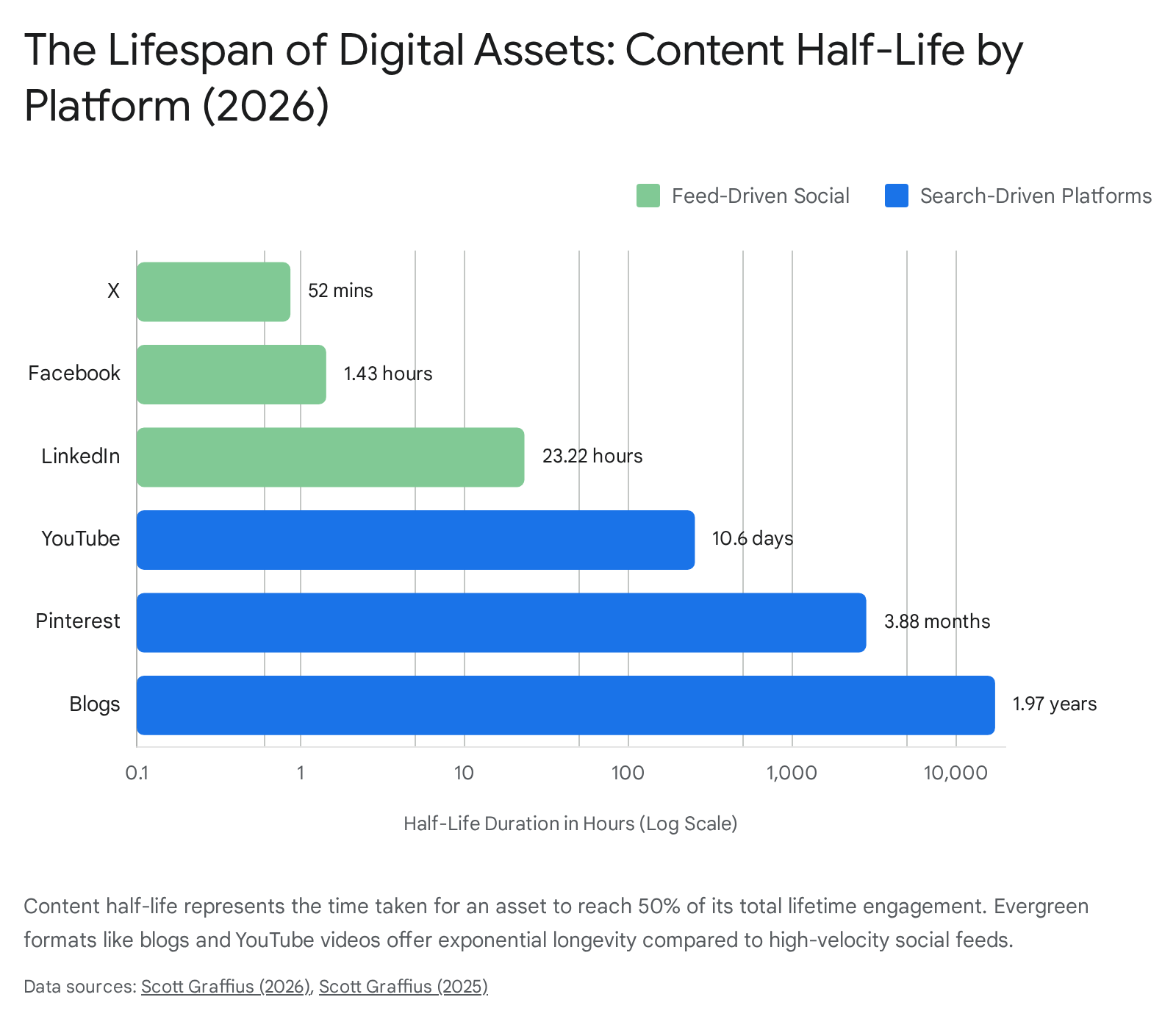
| Platform / Medium | Calculated Half-Life (2026) | Historical Trend (2024 - 2025) | Algorithmic Decay Dynamics & Mechanisms |
|---|---|---|---|
| X (formerly Twitter) | 52 Minutes | Rose slightly from 43 mins (2024) and 49 mins (2025) . | Designed for real-time, global information flow. Content is immediately displaced by chronological signals and trending topics. Requires extremely high-frequency posting to maintain baseline visibility . |
| 1.43 Hours (86 mins) | Rose marginally from 1.27 hours (2024) and 1.35 hours (2025) . | Heavily throttled organic reach for corporate brand pages. The feed prioritizes interpersonal connections, algorithmic recommendations, and paid placements, driving a rapid initial spike followed by near-instantaneous decay . | |
| 23.22 Hours (1,393 mins) | Dropped slightly from 24.3 hours (2024) and 23.77 hours (2025) . | The professional network sustains engagement over a multi-day window. The algorithm evaluates dwell time and meaningful, threaded comments, allowing high-quality posts to resurface in second- and third-degree connections' feeds over 24-48 hours 8. | |
| TikTok | Trend-Dependent (effectively 0 mins to 7 days) 37 | Remained highly volatile, tied intrinsically to sound and trend cycles 37. | Operates on a unique momentum and completion model. The algorithm determines viability in the first 15 - 60 minutes. If engagement thresholds (e.g., 70%+ completion rate) are met, it pushes content to broader "For You" pages. Trends peak between days 4-7 before total permanent decay 37. |
| Email Marketing | Intensely Front-Loaded (22% in Hour 1) 1127 | Open rates inflated by Apple Mail Privacy Protection (MPP), but decay curve remains stable 3839. | The half-life is uniquely front-loaded. 22% of all campaign opens occur within the very first hour of deployment 1127. Despite this rapid decay, the overarching ROI remains unmatched, averaging $36 per $1 spent due to direct inbox placement and minimal platform intermediation 10111227. |
| YouTube | 10.60 Days (15,276 mins) | Steadily increasing from 8.83 days (2024) and 9.67 days (2025) . | Functions fundamentally as the world's second-largest search engine. Strong metadata, thumbnail optimization, and sustained click-through rates trigger algorithmic cascading. High-quality videos often experience massive "second winds" months or years after publication 3315. |
| 3.88 Months (169,789 mins) | Consistently extending from 3.76 months (2024) . | Operates as a visual discovery and bookmarking engine rather than a chronological feed. "Pins" are saved and categorized to personal boards, leading to extremely long-tail traffic generation over multiple quarters . | |
| Owned Blogs (SEO) | 1.97 Years (1,037,340 mins) | Stable, showing slight fluctuation from 1.95 years (2024) . | The definitive gold standard for evergreen content. When optimized for user search intent and technical SEO parameters, structured long-form text compounds in value, drawing sustained organic traffic for years before requiring content refreshes 33. |
Strategic Implications of Temporal Metrics
This vast disparity dictates a clear, non-negotiable operational hierarchy for repurposing workflows. Marketing teams must anchor their strategies in "long-half-life" assets - such as deep-dive YouTube videos, comprehensive SEO blogs, and evergreen podcast episodes - which serve as permanent reservoirs of intellectual property that accrue value over time.
Conversely, "short-half-life" platforms (like X, Facebook, and TikTok) must be treated purely as top-of-funnel distribution nodes. Because content on these platforms decays within minutes or hours, creating highly produced, net-new content exclusively for them is economically inefficient and unsustainable. Instead, these ravenous feeds must be continuously supplied by micro-assets computationally extracted from the long-half-life anchors. This hub-and-spoke model ensures that the brand remains highly visible in ephemeral, fast-moving social feeds without exhausting the marketing budget on disposable, low-ROI creative endeavors.
Limitations and Competing Views: The "AI Slop" Backlash and Algorithmic Penalties
While the theoretical mechanics of the multi-platform content flywheel are incredibly compelling, aggressive execution carries severe systemic downsides. The uncalibrated, enthusiastic use of generative AI tools to flood networks with repurposed content has triggered a paradigm of audience fatigue, brand dilution, and - most critically for marketing operations - punitive algorithmic countermeasures from the platforms themselves.
The Dilution of Brand Equity and Audience Fatigue
The primary strategic risk of hyper-repurposing is the rapid erosion of perceived value and thought leadership. When an executive's nuanced industry keynote is atomized by an AI tool into dozens of generic social media quotes and out-of-context video snippets, it strips the intellectual insight of its necessary foundation. Forrester Research points to a rising dissatisfaction among B2B buyers who increasingly recognize the hallmarks of automated, soulless content 13. When every brand in a sector utilizes the exact same generative LLMs to rewrite the exact same industry news, the resulting output homogenizes into what cultural commentators and technology analysts now term "AI slop" - a deluge of low-quality, mass-produced content generated with minimal human creativity 3.
For mid-market and enterprise B2B organizations, where sales cycles extend across quarters and institutional trust is the primary currency, publishing formulaic, low-effort content actively damages credibility. A buying committee of 6 to 10 decision-makers, evaluating a seven-figure enterprise software contract, will not be swayed by a generic AI-scripted video short featuring synthetic voiceovers 9. They require evidence of deep, localized expertise, genuine conflict resolution, and peer-validated case studies that AI currently struggles to synthesize autonomously without descending into platitudes.
Algorithmic Retaliation: YouTube and LinkedIn Intervene
In direct response to the deluge of synthetic content degrading user experiences, major platform architectures have pivoted dramatically throughout 2025 and 2026 to prioritize authenticity and heavily penalize low-effort automation.
The YouTube Monetization Purge: As of July 15, 2025, YouTube instituted stringent updates to its Partner Program (YPP) monetization policies, directly targeting the mechanics of low-effort repurposing and AI generation 37. The platform now actively demonetizes and algorithmically suppresses channels relying on mass-produced, repetitive, or inauthentic content 37. Explicitly flagged categories in this policy purge include slideshows with minimal original commentary, compilations of unedited third-party stock footage, and the heavy reliance on text-to-speech synthetic voiceovers reading non-original, AI-generated scripts 7. YouTube's algorithmic cascading filters now require significant transformational value. Merely slicing a webinar into 50 unedited shorts via a tool like OpusClip and posting them en masse is no longer a viable growth mechanism; the platform flags this behavior as spam and restricts its reach 7.
LinkedIn's LLM Algorithm Overhaul: More profoundly for the B2B sector, LinkedIn executed a fundamental restructuring of its core feed algorithm in early 2026. Transitioning away from a system that leaned heavily on basic historical engagement data (likes and superficial comments), the platform deployed advanced, transformer-based Generative Recommender models 8. Because these new algorithmic filters share the exact same underlying architecture as large language models (like ChatGPT), they are exceptionally adept at detecting formulaic, AI-generated semantic patterns 8.
LinkedIn's new system explicitly deprioritizes generic AI-generated content, engagement-bait prompts (e.g., "Comment 'YES' to get the PDF"), and recycled thought leadership that repeats conventional industry wisdom without adding original perspective 8. Posts that appear algorithmically assembled rather than humanly authored face severe reach penalties before they even enter the ranking stage 8. Conversely, the algorithm disproportionately rewards topical consistency, demonstrated subject-matter expertise within a specific niche, and native formatting 8. For example, uploading videos directly to LinkedIn keeps users on the platform and generates dwell-time signals that the algorithm weighs heavily, whereas posting external YouTube links actively triggers suppression to prevent users from abandoning the LinkedIn feed 8.
The synthesis of these developments serves as a stark operational warning: automation tools are execution levers, not strategic substitutes. B2B marketing organizations must allocate human oversight to inject distinct brand voice, lived experience, and contrarian insights into AI-generated drafts, lest they face total algorithmic obsolescence.
Geographic and Regional Nuance: Navigating the Southeast Asian Messaging Paradigm
A critical failure point in global B2B marketing expansion is the assumption of platform universality. While LinkedIn, YouTube, and X dominate the North American and European B2B discourse, content distribution strategies must be radically re-engineered for the Asia-Pacific (APAC) and Southeast Asian (SEA) markets. Regional variations in platform dominance, internet infrastructure, and cultural consumption habits dictate entirely different repurposing flywheels.
The Hyper-Engaged Southeast Asian Market
Southeast Asia represents one of the most digitally active and socially engaged populations globally. Recent 2024 and 2025 demographic reports indicate that internet users in the Philippines spend an astonishing average of 3 hours and 33 minutes daily on social media platforms - significantly eclipsing the global average of 2 hours and 19 minutes 1643. Similarly, Indonesians devote nearly half (44.3%) of their total online time specifically to social platforms, exhibiting the highest global propensity to actively search for and research brands via social media 4344.
Consumption of specific formats also dwarfs Western metrics. In Vietnam, the average time spent on Facebook's Android app per month is 24 hours and 11 minutes, while TikTok Android users in the region spend an impressive 34 hours and 15 minutes per month on the app - nearly 10 hours more than the global average 43. However, alongside this massive adoption of public video feeds, the foundational architecture of digital interaction and commerce in SEA is heavily skewed toward private and semi-private messaging super-apps 1617.
The Shift from Public Feeds to Messaging Ecosystems
Unlike Western markets, where content is primarily consumed, debated, and shared on public algorithmic feeds, significant portions of B2B and high-consideration B2C engagement in Asia occur within closed messaging applications. A repurposing strategy built for a public timeline will fail in an inbox environment.
- WeChat (China & Diaspora): WeChat is not merely a communication tool; it functions as a holistic digital operating system encompassing payments, social networking, and enterprise services. B2B content repurposing for WeChat requires a total paradigm shift away from standard textual blog posts toward "H5 brochures" - highly interactive, mobile-optimized digital experiences embedded directly within the platform's browser 46. Furthermore, WeChat's stringent ecosystem rules heavily penalize clickbait and overtly promotional content, demanding short, value-dense, and highly visual educational material that respects the user's attention 46.
- LINE (Japan, Taiwan, Thailand): LINE boasts immense market penetration across East Asia. Brands utilize verified Official Accounts to broadcast content, but success depends on conversational formatting and the integration of rich media, branded stickers, and interactive menus. Repurposing a dense corporate whitepaper for LINE involves translating its executive summary into a sequential, serialized messaging flow rather than broadcasting a static PDF link that users must open in an external browser 1011.
- Zalo (Vietnam): With overwhelming messaging dominance in Vietnam, Zalo serves as a primary conduit for customer interaction, community building, and brand research 911. Official accounts on Zalo are critical touchpoints; repurposed short-form video content and localized infographics perform exceptionally well when adapted to Zalo's native UI and integrated seamlessly with its customer support and mini-app functionalities 1147.
- WhatsApp (Indonesia, Malaysia, Global South): While owned by Meta and globally ubiquitous, WhatsApp's usage in markets like Indonesia (which logs 1,374 monthly WhatsApp sessions per user, the second-highest globally) transcends casual personal chatting 16. It is a vital business and peer-to-peer sharing channel. Content must be repurposed into highly compressed, easily shareable formats - such as optimized micro-videos or bulleted text blocks with clear calls-to-action - designed specifically for "dark social" sharing within private industry groups 1617.
For global B2B organizations, a monolithic content distribution strategy is demonstrably ineffective. Expansion into these regions necessitates localization that goes far beyond simple linguistic translation. It requires "architectural translation" - reformatting a webinar into a localized WeChat H5 interactive guide, or restructuring a customer case study into a conversational sequence for a LINE Official Account. Failure to adapt to these messaging-first paradigms results in near-zero organic market penetration.
Source Quality Calibration: Vendor Bias vs. Objective Enterprise Research
In synthesizing this comprehensive view of the 2026 content landscape, it is intellectually imperative to critically evaluate the provenance of the underlying data. The digital marketing ecosystem is inherently noisy, rife with statistics and benchmarks propagated by software-as-a-service (SaaS) vendors, whose research reports often serve as cleverly disguised top-of-funnel collateral for their own platforms.
Deconstructing Platform-Provider Data
Platform providers like Casted (specializing in B2B podcast and video marketing) and Riverside (a remote video and audio recording platform) produce highly valuable telemetry on user behavior and format preferences. Their reports - such as Casted's "State of Content Marketing" or Riverside's trend analyses - correctly identify the overwhelming structural shift toward audiovisual formats. For example, Casted's data notes that 61% of organizations expect to raise investments in social video, with an astonishing 88% of marketers reporting positive ROI from video formats 4849.
However, these metrics must be viewed critically through the lens of inherent vendor bias. These platforms financially benefit from the prevailing narrative that more video and more audio content mathematically equates to better business outcomes. Their software solutions are specifically designed to lower the friction of asset creation, which inadvertently encourages the very blind syndication and hyper-repurposing that major algorithms are now actively penalizing 73049. Vendor research frequently measures success by the sheer volume of content processed, the reduction in raw production hours, and vanity metrics like impressions, rather than the ultimate revenue impact, pipeline velocity, or buyer satisfaction generated by the content itself.
The Anchor of Objective Enterprise Research
To counterbalance this vendor-driven optimism, sophisticated content strategies must be anchored in objective data from authoritative B2B research institutions like Gartner, Forrester, and the Content Marketing Institute (CMI).
These institutions provide a much more sober, holistic reality of the market. Gartner's revelation that marketing budgets have irrevocably stalled at 7.7% of revenue shifts the strategic imperative away from "produce more" to "utilize better" 13. Forrester's quantification that 60% to 70% of B2B content goes completely unused highlights the profound financial waste inherent in asset-first, volume-driven strategies advocated by production platforms 1. Furthermore, CMI's benchmark studies consistently show that while 72% of B2B marketers utilize generative AI tools, their primary, enduring challenges remain "creating the right content for our audience" and "differentiating our content" - deep, strategic challenges that computational automation alone is entirely incapable of solving 218.
The synthesis of these two disparate data streams presents the ultimate truth of the 2026 content landscape: Platform vendors are absolutely correct that AI has revolutionized the efficiency of production, allowing teams to execute complex workflows at a fraction of the historical cost. However, Gartner and Forrester are correct that only human-led, strategically aligned, and rigorously governed content will survive the ensuing algorithmic backlash and pervasive buyer fatigue 1313.
Conclusion and Strategic Mandates
The transition from a historical scarcity of content to a modern overabundance of synthetic media has forced a fundamental recalibration of B2B marketing strategies. Generative AI tools have successfully eradicated the mechanical labor constraints associated with multi-channel distribution, driving production costs to near-zero and yielding unprecedented time-based ROI. However, this same unbridled efficiency has saturated digital channels, prompting search and social algorithms to rapidly evolve from passive engagement-chasers into rigorous, LLM-powered quality filters.
To navigate this complex, unforgiving ecosystem, marketing leadership must adopt a highly disciplined, platform-native operational model governed by the following strategic mandates:
- Enforce Architectural Translation over Blind Syndication: Mandate at the organizational level that content is never simply copy-pasted across platforms. Reallocate the thousands of labor hours saved by AI automation directly into deep, platform-native translation. A core insight must be meticulously reformatted to respect the unique syntax, character limits, visual expectations, and user psychology of LinkedIn, X, YouTube, and email independently.
- Align Output with Algorithmic Decay Rates: Acknowledge the stark mathematical reality of content half-lives. Invest heavily in long-term, evergreen assets (such as deeply researched SEO blogs and comprehensive YouTube deep-dives) that accrue compounding value over years. Feed ephemeral networks with AI-extracted micro-content to maintain visibility, but ensure strict human oversight to prevent the publication of penalizable, brand-damaging "AI slop."
- Localize for the Messaging Paradigm in Emerging Markets: For global expansion, particularly into the Asia-Pacific region, abandon the reliance on public Western feeds. Redesign repurposing workflows to integrate seamlessly with dominant super-apps like WeChat, LINE, and Zalo. Prioritize interactive, conversational, and highly compressed mobile formats that align with how business is actually conducted in these regions.
- Prioritize Human Insight as the Ultimate Differentiator: As algorithms on platforms like LinkedIn become highly adept at suppressing generic templates and AI-generated platitudes, the only sustainable competitive advantage left for B2B brands is proprietary data, contrarian viewpoints, and genuine, hard-won subject-matter expertise. Artificial intelligence must be utilized strictly as a structural and mechanical assistant, never as the authoritative voice of the brand.
By treating digital platforms as distinct environmental ecosystems and rigorously balancing AI-driven mechanical efficiency with human-led authenticity, B2B organizations can construct a resilient, high-yield content amplification architecture capable of thriving in the complexities of 2026 and beyond.