
Meta Advertising Algorithms and Advantage+ in 2026
The landscape of digital advertising on Meta platforms has undergone a fundamental architectural transformation between 2024 and 2026. Transitioning from a system reliant on manual audience segmentation and deterministic targeting, Meta has rebuilt its core infrastructure around predictive machine learning, deep neural network retrieval, and generative artificial intelligence. Backed by staggering capital expenditures projected between $115 billion and $135 billion for the 2026 fiscal year 12, the platform now operates on an AI-first paradigm designed to navigate an increasingly fragmented digital privacy environment. This infrastructure investment aligns with the company's broader financial success, marked by a 24% year-over-year revenue growth to $59.9 billion in Q4 2025, driven heavily by AI-driven performance gains in the advertising ecosystem 345.
This comprehensive report details the granular technical mechanics of this transformation. By examining the underlying AI architectures powering Advantage+ campaigns - specifically the Andromeda retrieval engine, the Generative Ads Recommendation Model (GEM), and the Meta Lattice ranking system - the analysis deconstructs the modern Meta ad auction. Furthermore, the report addresses the critical infrastructure requirements surrounding the Conversions API (CAPI), analyzes the strategic divergence between Advantage+ and manual campaign setups, and explores the profound regional compliance challenges introduced by the European Union's Digital Markets Act (DMA).
The Modern Meta Ad Auction: Algorithmic Evaluation and Pacing Mechanics
At the core of Meta's advertising ecosystem is a real-time auction that evaluates billions of placement opportunities daily. Unlike traditional bidding environments where the highest financial offer unilaterally secures the placement, the Meta ad auction operates on a complex, multi-variable calculation designed to maximize "Total Value" for both the advertiser and the platform user 6. The fundamental equation governing this auction is an amalgamation of financial commitment, algorithmic prediction, and qualitative user experience. The ad auction prioritizes this Total Value equation, balancing an advertiser's financial bid with algorithmic predictions of user action and real-time ad quality scores to determine the winning placement. The calculation relies on three primary components: the advertiser's bid, the Estimated Action Rate (EAR), and the Ad Quality and Relevance score 6789.
Deconstructing the Estimated Action Rate (EAR)
The Estimated Action Rate (EAR) is the algorithmic prediction of a specific user's likelihood to complete the campaign's designated optimization event - such as clicking a link, submitting a lead form, or finalizing an e-commerce purchase 910. EAR functions as a primary mathematical weighting mechanism against the financial bid. If the algorithm determines that an ad has a significantly higher probability of converting a specific user, it will prioritize that ad over competitors with higher financial bids but lower predicted engagement 6.
In 2026, the inputs driving EAR have shifted dramatically. The system no longer relies solely on historical demographic performance or superficial click-through rates. Instead, it utilizes predictive behavioral modeling based on sequence learning 7. Meta's sequence learning architecture processes long-term user behavior over weeks or months, identifying nuanced, multi-stage patterns that precede a conversion 712. Consequently, audience intent, creative messaging, and post-click landing page experiences are tightly coupled in the algorithmic assessment 613. When these signals align seamlessly, the algorithm's confidence increases exponentially, raising the EAR and effectively lowering the Cost Per Mille (CPM) and Cost Per Action (CPA) required to win the auction 6.
Ad Quality, Relevance, and the March 2026 Attribution Overhaul
The third pillar of the auction equation, Ad Quality and Relevance, acts as a penalty or multiplier based on the user experience. The algorithm continuously scans for negative signals, such as engagement bait, slow-loading post-click experiences, or rapid creative fatigue 613. Creative fatigue is typically detected when the CPM-reach (CPMr) increases without broader market pressure, indicating that the EAR is declining, the algorithm is running out of responsive users, and the ad is becoming less competitive in the auction 1415.
A pivotal shift in how engagement is measured, and consequently how ad quality is interpreted, occurred in March 2026. Meta fundamentally redefined ad attribution by decoupling true outbound intent from superficial platform engagement 16. Under the new framework, "Click-Through Attribution" is strictly limited to actual link clicks that successfully direct users to an external website, app, or lead form 1718. Previously, social interactions such as likes, shares, comments, profile taps, and saves were counted as clicks for attribution purposes 8.
These non-link interactions have now been segregated into a newly expanded category called "Engage-Through Attribution" 89. This metric operates on a strict 1-day conversion window and encompasses all social engagements, as well as engaged video views across all ad formats 810. Furthermore, Meta reduced the threshold for an engaged video view from 10 seconds to 5 seconds. This adjustment was made because internal data revealed that 46% of Reels-driven purchase conversions now occur within the first two seconds of user attention, indicating that the modern consumer makes purchasing decisions far faster than previous models accounted for 910.
| Attribution Type (Post-March 2026) | Defining Action | Qualifying Interactions | Default Conversion Window |
|---|---|---|---|
| Click-Through Attribution | Outbound Intent | Link clicks to external websites, apps, or native lead forms. | 7-Day |
| Engage-Through Attribution | On-Platform Engagement | Likes, comments, shares, saves, profile visits, and video views over 5 seconds. | 1-Day |
| View-Through Attribution | Impression Exposure | Ad appears on user's screen without a recorded click or engagement. | 1-Day |
While this reclassification caused reported click-through conversions to drop by 40% to 60% in many accounts during the rollout phase, it did not represent a loss in actual campaign performance 9. Rather, it provided a cleaner, higher-fidelity signal of true outbound intent, aligning Meta's internal reporting more closely with third-party analytics platforms like Google Analytics 4 (GA4), which historically only counted link clicks 1810.
The AI Trinity: Andromeda, GEM, and Lattice Architectures
The operational mechanics of the Meta ad auction are now entirely governed by a multi-stage recommendation pipeline consisting of three interconnected artificial intelligence frameworks: Andromeda, GEM, and Lattice. This infrastructure overhaul, rolled out progressively from late 2024 through 2025, represents a 10,000x increase in model complexity compared to legacy systems, processing billions of daily ad impressions 1112.
Andromeda: The Deep Neural Network Retrieval Stage
Andromeda operates as the proprietary machine learning engine responsible for the initial "retrieval" phase of the ad delivery pipeline 11. When a user opens a Meta application, millions of active ad candidates are eligible to be shown. Andromeda's function is to filter these tens of millions of candidates down to a highly relevant shortlist of approximately 1,000 ads in milliseconds 111213.
Running on highly advanced hardware, including NVIDIA Grace Hopper Superchips (GH200), Andromeda achieves what Meta engineers term "sublinear inference cost" 1112. This architectural breakthrough allows the system to process exponentially more creative variations without requiring exponentially more computing power 12. Unlike legacy systems that filtered users based on deterministic advertiser targeting (e.g., manual inputs of interests and demographic parameters), Andromeda reverses the paradigm. It uses deep contextual understanding to scan visual and auditory semantics within the creative itself 25. The algorithm indexes visual hooks frame-by-frame; for example, if an ad features a dog within the first three seconds, Andromeda automatically begins indexing the ad toward pet-related behavioral clusters before any financial budget is spent 25.
In this retrieval environment, creative diversity is structural, not just aesthetic. Andromeda clusters visually similar ads under a single "Entity ID" 7. If an advertiser deploys ten ads featuring the identical product photo but different textual headlines, Andromeda treats them as a single Entity ID, granting the advertiser only one "ticket" to the retrieval lottery 726. Conversely, providing diverse visual formats - such as combining user-generated content (UGC), studio photography, and text-heavy graphics - generates multiple distinct Entity IDs, dramatically increasing the probability of passing the retrieval stage and entering the final auction 713.
GEM (Generative Ads Recommendation Model): The Central Intelligence
Once Andromeda retrieves the top 1,000 candidates, the Generative Ads Recommendation Model (GEM) functions as the central predictive intelligence layer 111314. Introduced in mid-2025, GEM is the industry's largest foundation model for recommendation systems (RecSys), built explicitly at the scale of modern Large Language Models (LLMs) 15. Training GEM required a complete overhaul of Meta's hardware infrastructure and training recipes, utilizing multi-dimensional parallelism across thousands of GPUs, and delivering a 23x increase in effective training FLOPs while improving Model FLOPs Utilization (MFU) by 1.43x 1516.
The technical deployment of GEM relies on advanced engineering to handle dense and sparse model components. Dense model parts utilize Hybrid Sharded Distributed Parallelism (HSDP) to optimize memory usage, while sparse components - primarily massive embedding tables for user and item features - employ a two-dimensional approach combining data and model parallelism 16. Meta further reduced training bottlenecks by implementing custom in-house GPU kernels, graph-level compilation in PyTorch 2.0 to automate activation checkpointing, and FP8 quantization for memory compression 16. GPU communication collectives were managed through NCCLX, Meta's fork of NVIDIA's NCCL, eliminating contention between compute and communication workloads 16.
GEM processes billions of sparse user-ad interactions to identify deep, non-obvious relationships between content and user intent across multiple delivery channels 1116. In Q4 2025, Meta doubled the GPU allocation dedicated specifically to training GEM for ad ranking, integrating a new sequence learning architecture capable of processing much richer information about longer sequences of user behavior 12. This model acts as the brain that feeds insights back into Andromeda for better retrieval predictions and forward into Lattice for final ranking 1314. GEM's implementation is credited with driving a 5% increase in ad conversions on Instagram and a 3.5% lift in ad clicks on Facebook Feed shortly after deployment, creating billions in incremental revenue 121114. Furthermore, GEM powers the generative AI elements within the Ads Manager platform, enabling real-time background generation, image-to-video transformations, and dynamic text overlays to automatically diversify Entity IDs at scale without external production teams 2630.
Lattice: The Ranking and Final Auction Layer
The final stage of the pipeline is governed by Meta Lattice. Where Andromeda retrieves the candidates and GEM provides the predictive insights, Lattice executes the final ranking and auction optimization 11. Prior to the introduction of Lattice, Meta utilized hundreds of siloed machine learning models, each optimized independently for a specific surface (e.g., Feed, Reels, Stories) or a specific advertiser objective (e.g., clicks, video views, conversions) 17.
Lattice consolidated these fragmented models into a unified Multi-Domain, Multi-Objective (MDMO) framework 1317. This architecture utilizes specialized components, such as the Lattice Zipper to balance data freshness with long-term attribution, and the Lattice Filter to select the most relevant features across domains 13. This allows for unprecedented cross-surface knowledge sharing; a user's interaction with a Reel now directly informs the ranking of a direct-response ad they might subsequently see in their Feed 17. By balancing multiple domains and objectives simultaneously, Lattice captures both real-time immediate intent and long-term, delayed purchasing signals 17. This holistic optimization pushes the system toward Pareto optimality, where no single objective can be improved without harming another 17. The deployment of Lattice has demonstrably improved the quality of the user experience, generating an approximate 8% to 12% improvement in ad quality ratings and lifting overall conversions by 6% 7121732.
Dismantling the Black Box Misconception: Advantage+ Controls and Guardrails
As the underlying AI architecture matured, Meta's user-facing campaign structures adapted to facilitate it. The hallmark of this transition was the Advantage+ suite. Initially viewed by practitioners as an opaque "black box" that stripped away control, frequent platform updates extending into 2026 have revealed a system that relies on structured guardrails rather than total, uncontrollable autonomy.
The Deprecation of Advantage+ Shopping in Favor of Advantage+ Sales
A significant structural shift occurred throughout 2025 with the phasing out of Advantage+ Shopping Campaigns (ASC). Originally hailed as Meta's flagship automated e-commerce product, the legacy ASC model forced advertisers to relinquish almost all manual controls, consolidating everything at the campaign level with no ability to create granular ad sets or enforce strict audience exclusions 1819.
However, in a surprising strategic pivot that prioritized advertiser control, Meta systematically replaced Advantage+ Shopping with Advantage+ Sales 1819. Effective Q1 2026, a breaking API change permanently removed the ability to create or edit the older Advantage+ Shopping Campaigns across all API versions 35. The new Advantage+ Sales framework retained the algorithmic power of the Andromeda and Lattice engines but reinstated critical structural elements 19. Most notably, ad sets were brought back, allowing advertisers to categorize their budgets internally 19. The creative limit per ad set reverted to 50 (down from ASC's highly automated 150 limit), forcing advertisers to distribute massive creative testing across multiple ad sets rather than dumping hundreds of assets into a single opaque pool 19.
Audience Controls vs. Audience Suggestions
A prevailing misconception is that modern Meta Advantage+ advertising offers zero targeting capabilities. In reality, the targeting framework has evolved into a definitive two-tiered system: Controls and Suggestions.
- Audience Controls (Hard Rules): These are strict constraints that the algorithmic engine cannot bypass. In 2026, the only universally respected hard controls in automated Advantage+ setups are Location (country, region, city) and Minimum Age 3637. If an advertiser restricts delivery to a specific geographical radius or sets a minimum age of 21 for age-restricted goods, the Lattice ranking system will strictly enforce those boundaries, refusing to serve impressions outside of them 20.
- Audience Suggestions (Soft Signals): Interests, Custom Audiences, Lookalike Audiences, and Gender are now treated exclusively as "soft signals" 3620. When an advertiser inputs a Custom Audience of past purchasers as a suggestion, GEM and Andromeda use this as a starting seed to identify similar intent signals. However, if the predictive models find a user outside of that suggestion who exhibits a high conversion probability, the system will dynamically expand the audience to capture that conversion 3720. The algorithm prioritizes the end goal over the suggested pathway.
To further dispel the black box myth, Meta introduced explicit budget guardrails. The "Existing Customer Budget Cap" allows advertisers to define a strict percentage limit on how much of the Advantage+ Sales budget is allocated to retargeting known purchasers 3940. By capping existing customer spend at 20% to 30%, the algorithm is artificially constrained from taking the path of least resistance (retargeting warm leads) and is forced to deploy the remaining budget toward true top-of-funnel prospecting, where novel intent signals provide the highest incremental value 40.
The Opportunity Score Integration
To guide advertisers toward optimal machine-readable setups, Meta formalized the "Opportunity Score" globally in 2025 18. Displayed natively in Ads Manager, this 0-to-100 metric evaluates campaign architecture against Meta's algorithmic best practices across dimensions such as creative variety, signal quality (CAPI integration), budget liquidity, and audience breadth 3041. In March 2026, Meta expanded the "Apply via API" support to encompass 14 different Opportunity Score recommendation types 16. This allows advanced media buying teams to programmatically automate optimizations based on the algorithm's direct feedback, ensuring campaigns remain aligned with the Lattice system's evolving preferences without requiring constant human intervention 16.
Structural Paradigm: Advantage+ Sales vs. Manual Campaigns
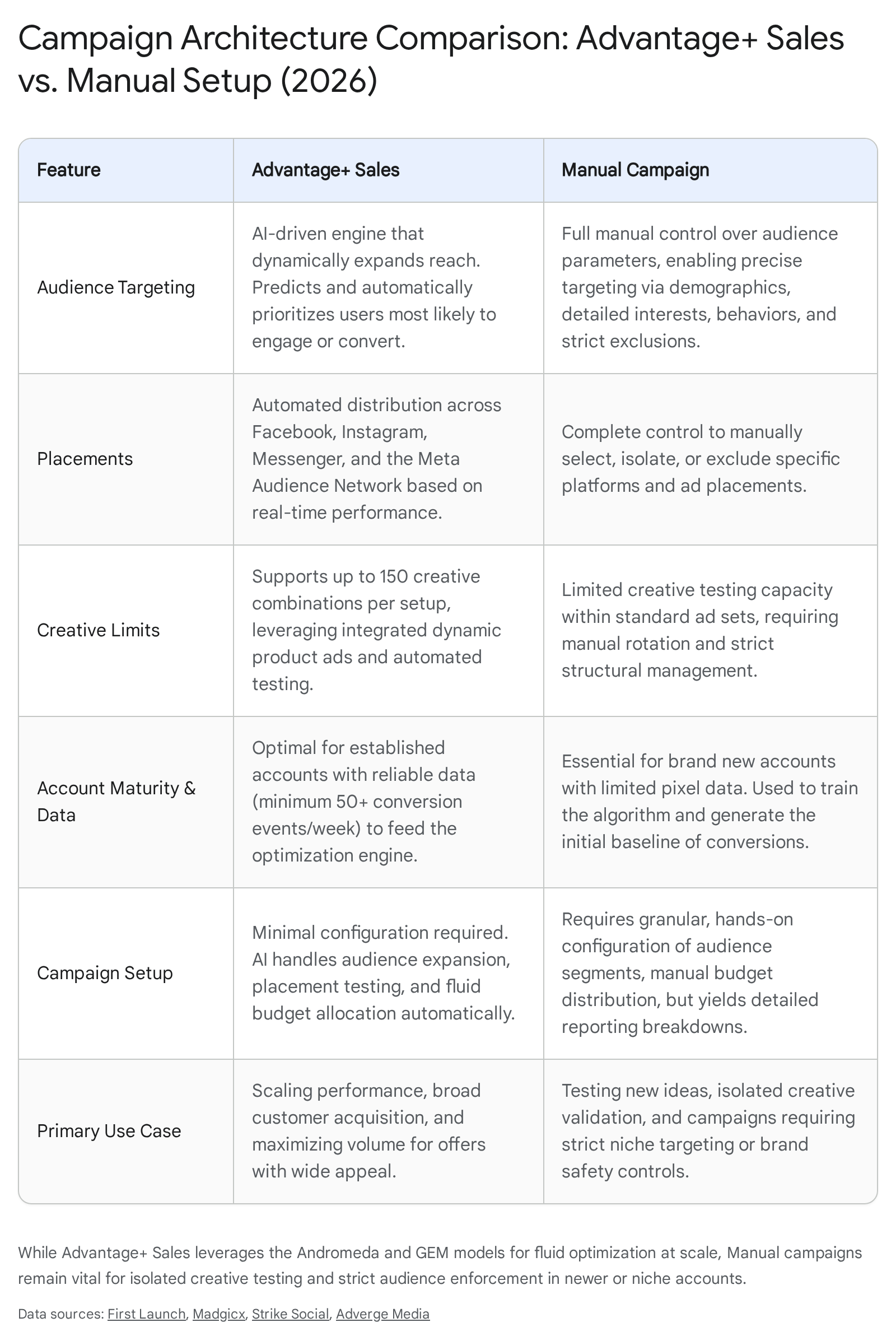
The coexistence of Advantage+ Sales and legacy Manual Campaigns necessitates a nuanced strategic approach. While Meta pushes automation as the default for scale, manual setups remain indispensable for specific use cases, creative testing, and niche market penetration in 2026.
The Hybrid Testing Methodology
The most sophisticated performance marketing strategies in 2026 do not treat Advantage+ and Manual campaigns as mutually exclusive; rather, they employ a hybrid model, utilizing the specific strengths of both architectures 4243. Manual campaigns act as the "testing laboratory." Advertisers allocate approximately 30% of their budget to manual ad sets to isolate and validate specific creative concepts without the interference of fluid algorithmic budget shifting that occurs in Advantage+ 44.
A standard 2026 framework dictates the "60-30-10 rule" within a controlled testing environment: 60% of the testing budget is protected for proven winning creatives, 30% is dedicated to iterating on variations of those established winners, and 10% is allocated to completely fresh, blind concepts 45. Manual campaigns ensure that these fresh concepts receive enough structured delivery to gather the mandatory 10 to 15 conversion events required to accurately assess CPA, rather than being prematurely throttled by the algorithm in favor of high-engagement but low-converting clickbait 45.
Concurrently, advertisers utilize the "3:2:2 Creative Testing Method" within these manual sandboxes 46. This approach systematically tests three distinct creative concepts, two varying textual hooks, and two distinct headlines. Once a creative asset validates its EAR and Ad Quality in the manual testing laboratory, it is "graduated" into the primary Advantage+ Sales campaign 4344. Inside the automated environment, the Andromeda and Lattice engines distribute the validated creative across broad audiences, utilizing dynamic placements to achieve maximum scale and ROI efficiency at a reported 17% lower baseline CPA than manual scaling 4447.
Infrastructure Imperatives: Conversions API and Predictive Data
The advanced capabilities of Lattice and GEM are entirely dependent on high-fidelity data inputs. The algorithmic architecture is only as intelligent as the conversion signals it processes. In 2026, relying solely on the browser-based Meta Pixel is considered an architectural failure that actively degrades campaign performance.
The Depreciation of Pixel-Only Tracking
The traditional Meta Pixel relies on third-party cookies and client-side browser execution to track user behavior. However, aggressive privacy regulations (such as the GDPR and CCPA), pervasive ad-blocking software, and restrictive mobile environments (e.g., iOS tracking transparency and in-app browsers) have severely degraded client-side tracking efficacy 4849. Server-side tracking vendors reported in 2026 that Pixel-only setups routinely miss 50% or more of actual conversion events 50.
When Meta is blind to half of the purchases occurring on a website, the GEM predictive model cannot accurately sequence user behavior, and the Advantage+ system is forced to optimize based on a distorted, incomplete reality 49. This signal degradation forces the algorithm to chase lower-intent users, creating unstable scaling and inflating acquisition costs significantly 49.
Conversions API (CAPI) Implementation and Signal Deduplication
To bridge this critical data gap, the Meta Conversions API (CAPI) establishes a direct, server-to-server connection between the advertiser's backend infrastructure and Meta's optimization algorithms, bypassing the user's browser restrictions entirely 4821. When an advertiser implements CAPI alongside the Pixel, they achieve "dual tracking" 48. Meta then utilizes a complex matching mechanism to synthesize the data. This requires an Event Match Quality (EMQ) score of 7.0 or higher, achieved by passing robust customer identifiers (hashed emails, phone numbers, IP addresses) alongside the event payload 50. Using parameters such as the event_id, the system performs deduplication logic to merge the signals, ensuring that redundant events sent by both the browser and server are ignored, while successfully capturing the offline or blocked conversions the browser missed 4849.
In April 2026, Meta aggressively pushed to close the technical gap for smaller advertisers by launching "Meta-enabled CAPI." This one-click integration allows businesses to activate server-side tracking directly within Events Manager without requiring dedicated developer resources or external server hosting 4922. While highly effective for capturing standard web events (e.g., Page Views, Add to Cart, Purchase), Meta-enabled CAPI mirrors the Pixel's existing setup and lacks the sophistication required for advanced data payloads 49.
For advanced operations and enterprise brands, Custom CAPI integrations remain necessary to transmit complex payloads that directly inform Advantage+ predictive analytics 49. For instance, Custom CAPI allows the transmission of advanced algorithmic parameters like predicted_ltv (Predicted Lifetime Value) and offline subscription renewal events that occur entirely outside the browser session 49. By feeding predicted_ltv data directly into the Lattice ranking system, the algorithm shifts its focus from minimizing the immediate, superficial Cost Per Acquisition to maximizing long-term profitability, actively bidding higher in the auction for users whose behavioral sequences indicate high lifetime loyalty 114953.
Regional and Regulatory Divergence: EU Digital Markets Act (DMA) Compliance
While Meta's AI architecture functions seamlessly in environments with robust data liquidity like the United States, the global standardization of this technology has been fractured by the European Union's Digital Markets Act (DMA). The DMA's stringent requirements regarding user consent, anti-monopoly data sharing, and algorithmic profiling have forced Meta to implement a bifurcated advertising infrastructure, resulting in profound differences between EU and US campaign execution in 2026.
The "Less Personalized Ads" Tier
The regulatory battle reached a critical inflection point following a €200 million non-compliance fine levied by the European Commission in April 2025 regarding Meta's original binary "pay-or-consent" model 2324. Regulators argued that forcing users to either pay a subscription fee or submit to full behavioral tracking did not constitute a fair choice under the DMA 2324.
In response, Meta introduced a tertiary option 2324. Beginning in January 2026, users in the EU are presented with an explicit, multi-tiered choice: consent to full data sharing for highly personalized ads, pay a subscription for an ad-free experience, or opt into a free tier supported by "Less Personalized Ads" 232526.
This "Less Personalized" tier fundamentally alters how the Meta ad auction operates for a significant segment of the European population. For users who opt out of behavioral tracking, the system is legally prohibited from utilizing the GEM model's deep sequence learning or historical cross-site data 2327. The predictive accuracy of the Estimated Action Rate (EAR) plummets because the algorithm is rendered blind to the user's past actions, search history, and off-platform behaviors.
Contextual Signaling vs. Behavioral Tracking
To monetize this restricted audience without violating the DMA, Meta's ad delivery in the EU reverts to contextual signaling 2327. Under this framework, ads are served based on a minimal set of immediate, privacy-safe data points: the user's location, age, gender, and the context of the content they are currently viewing in their active session 2759.
This creates a stark contrast between US and EU media buying strategies.
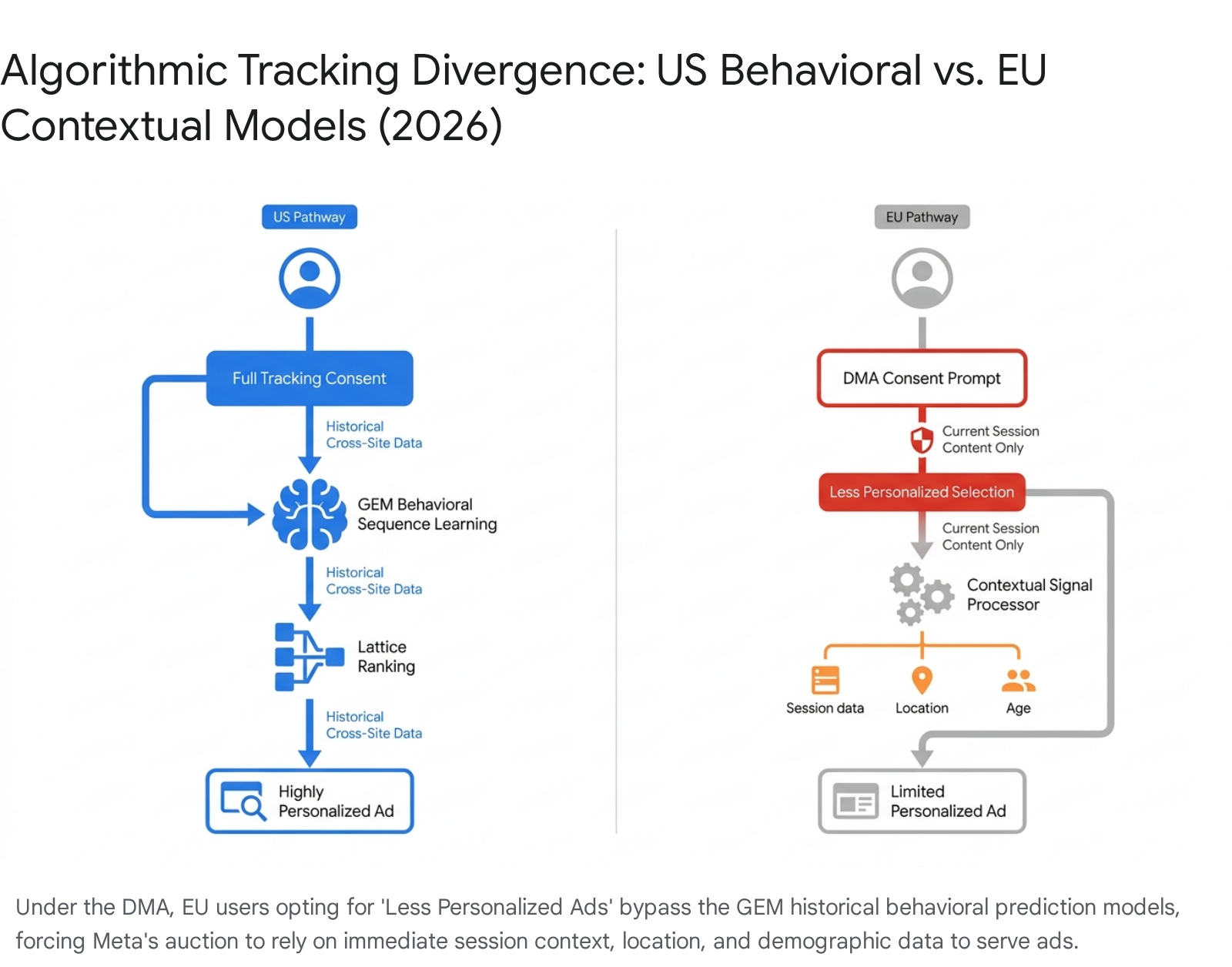
In the US, an Advantage+ campaign relies on Andromeda's deep indexing and GEM's historical behavioral tracking to find high-intent purchasers regardless of the content they are currently viewing 1112. The system effortlessly connects a user's past search for "running shoes" on an external e-commerce site with an ad displayed while they scroll through entirely unrelated comedy videos on Reels.
In the EU, for users on the less-personalized tier, the algorithm must deduce intent purely from the immediate session context and broad demographic categorization 27. Consequently, European advertisers must place a hyper-focus on the visual and auditory semantics parsed by Andromeda 25. The creative itself must act as the ultimate filtering mechanism; it must be designed to explicitly attract the desired demographic while simultaneously repelling unqualified users, as the underlying algorithm lacks the historical behavioral data to perform this filtering autonomously 37.
| Regulatory Model | Primary AI Driver | Core Data Inputs | Market Impact |
|---|---|---|---|
| US: Behavioral Tracking | GEM Sequence Learning | Cross-site activity, historical purchases, off-platform behavior. | High predictive accuracy; relies heavily on CAPI and broad targeting. |
| EU: Contextual Signaling | Contextual Signal Processor | Current session content, immediate interactions, broad demographics (age/location). | Lower algorithmic prediction; shifts burden to highly specific ad creative acting as a manual filter. |
Despite Meta rolling out this contextual option to appease the European Commission, tensions remain high. In March 2026, consumer advocacy groups like the European Consumer Organisation (BEUC) published comprehensive reports arguing that Meta's implementation still violates the DMA, the General Data Protection Regulation (GDPR), and the Unfair Commercial Practices Directive (UCPD) 2460. The BEUC claims the interface design utilizes non-neutral language and behavioral "dark patterns" to steer users toward accepting the fully personalized tracking option, failing to provide the legal standard of "free, specific, informed and unambiguous consent" 2460. Consequently, the regulatory landscape surrounding data modeling in the EU remains a volatile variable for global advertisers, demanding constant vigilance and adaptive infrastructure throughout 2026.
Conclusion: The 2026 Meta Advertising Paradigm
The Meta advertising ecosystem of 2026 is no longer defined by the granular audience hacking or manual bid manipulation tactics that dominated the early decade. It has matured into a highly sophisticated, AI-driven retrieval environment governed by the intertwined processing power of the Andromeda, GEM, and Lattice architectures. Advertisers succeeding in this new paradigm understand that Advantage+ is not an uncontrollable black box, but a powerful engine that requires specific, high-quality inputs: diverse creative Entity IDs to feed the retrieval algorithm, robust server-side Conversions API data to train predictive intent models, and strategic guardrails like budget caps to force programmatic scaling.
Simultaneously, the regulatory pressures imposed by the EU's Digital Markets Act emphasize the fragility of unchecked behavioral data reliance. As the platform adapts to localized contextual signaling in Europe to maintain compliance, the universal constant across all regions remains the creative asset. In an era where artificial intelligence autonomously handles the bidding, placement, and ranking, the creative itself has become the ultimate targeting mechanism - dictating who enters the auction, what the algorithm predicts they will do, and ultimately, which businesses achieve sustainable and profitable scale.