
Mental health challenges of company founders
Introduction: Deconstructing the Entrepreneurial Mythos and Evolving Research Paradigms
The narrative surrounding entrepreneurship has historically been dominated by a mythos of relentless resilience, unbounded innovation, and eventual triumph. This "hero-founder" archetype, heavily propagated by mainstream business media and celebrated in cultural lore, conceptualizes venture creation as an ultimate expression of professional autonomy and financial actualization. However, beneath the surface of hyper-growth metrics, glorified unicorn statuses, and venture capital press releases lies a deeply complex, often perilous psychological landscape. Entrepreneurship is not merely an occupational choice or a series of strategic business calculations; it is a profound psychological immersion that uniquely exposes individuals to chronic stressors, acute existential risks, and extreme cognitive dissonance.
Historically, the academic understanding of founder mental health was anchored by the foundational 2015 University of California, San Francisco (UCSF) study by Freeman et al., which established that 72 percent of entrepreneurs experienced mental health concerns, including high rates of depression, attention-deficit/hyperactivity disorder (ADHD), and bipolar spectrum conditions 1223. While this study served as a crucial epidemiological baseline, the entrepreneurial ecosystem has fundamentally mutated in the ensuing decade. The cessation of the Zero Interest Rate Policy (ZIRP) era, the subsequent contraction of venture capital, widespread technological layoffs, and the harsh shift toward rigorous profitability mandates have introduced unprecedented macroeconomic stressors that have fundamentally altered the psychological reality of building a company 5678.
Concurrently, recent peer-reviewed literature published in top-tier academic outlets such as the Journal of Business Venturing and the Journal of Applied Psychology has pushed beyond mere prevalence reporting. Modern research seeks to understand the causal mechanisms behind founder distress. It investigates how structural corporate governance decisions - such as those articulated in Noam Wasserman's "Founder's Dilemma" - serve as direct catalysts for clinical psychological strain 41011. Furthermore, contemporary scholarship recognizes that the entrepreneurial experience is not geographically monolithic; non-Western cultural contexts introduce entirely different psychological variables, particularly concerning the severe social stigmatization of venture failure 5614.
This exhaustive research report dissects the psychological architecture of entrepreneurship. It explores how foundational structural choices trigger specific mental health crises, challenges the toxic narratives of "hustle culture" and survivorship bias, provides an updated epidemiological analysis of neurodivergence and psychiatric conditions among founders compared to corporate managers, and analyzes the compounding nature of entrepreneurial burnout through the Job Demands-Resources (JD-R) model.
The Structural Mechanics of Psychological Stress: Wasserman's "Rich vs. King" Dilemma
Noam Wasserman's seminal concept of the "Founder's Dilemma" establishes a fundamental structural trade-off at the core of venture creation: the choice between maximizing financial wealth (the "Rich" path) and maintaining absolute control over the enterprise (the "King" path) 101115. Mainstream startup narratives often falsely promise that a founder can achieve both simultaneously, suggesting that absolute authority and massive financial outcomes are perfectly correlated. However, empirical data and governance mechanics demonstrate that these objectives inevitably diverge. To achieve massive scale, a founder must typically attract external resources, specifically venture capital and experienced executive talent, which inherently requires the dilution of equity, the surrender of board control, and the eventual transition away from the chief executive role. Conversely, founders who stubbornly retain majority equity and the CEO position generally build significantly less valuable companies 1116.
While Wasserman framed this primarily as a strategic, economic, and governance dilemma, recent organizational psychology literature reveals that these structural choices are essentially blueprints for distinct psychological stressors 417. The choice of corporate architecture dictates the specific psychological pathology the founder will eventually face, transitioning the dilemma from a boardroom discussion to a clinical vulnerability.
The Psychological Toll of the "Rich" Path: Identity Threat and Loss of Autonomy
Choosing the "Rich" path initiates a complex sequence of psychological displacements. By accepting venture capital, founders introduce profound structural constraints on their autonomy. As the company scales beyond the founder's managerial capacity, the founder is frequently replaced by a professional CEO or subordinated to a newly empowered board of directors. This transition is rarely seamless and is heavily fraught with psychological friction. The dilution of control triggers severe psychological stressors stemming from role conflict and identity threat 415.
Founders typically exhibit a high degree of "identity fusion" - a psychological state where the cognitive and emotional boundaries between the self and the venture blur completely. The company ceases to be a mere project and becomes a physical and psychic extension of the founder's ego. When a founder is demoted, sidelined, or forced to report to a newly appointed executive suite, they do not just lose a job title or a degree of influence; they experience a profound existential crisis 418. The psychological literature documents that such transitions frequently induce severe impostor syndrome, feelings of betrayal, and profound cultural dissonance as the scrappy, mission-driven startup morphs into an unfamiliar corporate bureaucracy governed by quarterly metrics 417.
Furthermore, this transition fundamentally alters the founder's motivational matrix. The focus often shifts aggressively from intrinsic drive - the passion for the product, the customer, and the mission - to extrinsic incentives, such as vesting schedules, liquidation preferences, and financial earn-outs. Psychological research consistently demonstrates that a prolonged reliance on extrinsic motivation, particularly in high-stress environments where the individual no longer holds ultimate authority over the outcome, is highly correlated with severe burnout, chronic insomnia, and debilitating depressive episodes 47. The founder becomes a highly compensated prisoner of their own creation, stripped of the autonomy that drew them to entrepreneurship in the first place.
The Psychological Toll of the "King" Path: Resource Starvation and Single-Point Failure
Conversely, the "King" path - often realized through bootstrapping, alternative financing, or strict resistance to external venture capital - carries its own severe psychological burdens. While these founders successfully maintain their autonomy and protect their identity fusion from external corporate interference, they voluntarily subject themselves to chronic resource starvation and immense operational strain 1017.
The primary psychological stressor here is not the loss of control, but the crushing weight of absolute, unshared responsibility. The founder becomes the single point of failure for the entire enterprise. The refusal to share control or dilute equity often means the founder cannot afford to hire elite executive talent, forcing them to execute tasks well outside their core competencies. This leads to severe role overload and chronic fatigue. Without the financial buffer provided by venture capital, the day-to-day survival of the business is inextricably linked to the founder's personal financial stability. This chronic uncertainty and the persistent threat of financial ruin activate the body's sympathetic nervous system over prolonged, uninterrupted periods, leading to physical deterioration and cognitive exhaustion.
Moreover, the isolation inherent in the "King" path is absolute. Because they have no true peers, no co-founders with equal stakes, and no board members to share the strategic burden or provide objective counsel, the "King" founder suffers from profound relational isolation. This specific type of social isolation makes them highly susceptible to acute anxiety disorders and paranoia, as every strategic decision carries the weight of total enterprise survival without the safety net of shared culpability 1189.
Deconstructing Misconceptions: Hustle Culture, Survivorship Bias, and the Founder Mask
The psychological deterioration of entrepreneurs is frequently exacerbated by the broader cultural narratives surrounding the technology and startup sectors. Chief among these are the glorification of "hustle culture," the pervasive influence of survivorship bias, and the necessity of projecting "toxic positivity." These phenomena collectively normalize biological unsustainability, penalize emotional vulnerability, and create a culture of silence around founder mental health 22232425.
The Pathology of Hustle Culture and Effort Justification
Hustle culture - amplified by social media algorithms that reward performative overwork and evangelized by high-profile venture capitalists - posits that extreme work hours, chronic sleep deprivation, and the complete sacrifice of personal relationships are mandatory prerequisites for venture success 2225. From a neurobiological and psychological standpoint, this narrative is deeply flawed and demonstrably counterproductive. Rigorous performance science demonstrates that cognitive performance, executive functioning, lateral problem-solving, and emotional regulation deteriorate markedly under sleep restriction and chronic stress 2223.
Despite the empirical evidence contradicting extreme hustle culture, founders frequently fall into the psychological trap of "effort justification bias." Having sacrificed their physical health, financial security, and personal relationships for the survival of their startup, founders develop a deep psychological need to validate those sacrifices 22. Questioning whether such extreme sacrifice actually optimizes business outcomes creates a highly threatening state of cognitive dissonance. Consequently, founders double down on self-destructive work patterns. Without clear outcome metrics in the chaotic early stages of a startup, observable work hours serve as a visible proxy for contribution and leadership. This elevates performative hustle - such as conspicuous midnight emails and weekend office presence - over the invisible, high-leverage strategic activities that frequently drive superior business outcomes 1822.
Survivorship Bias in Startup Narratives
The startup ecosystem suffers from profound, systemic survivorship bias. Mainstream media, entrepreneurial autobiographies, and venture capital portfolios disproportionately highlight the extreme outlier successes - the multi-billion-dollar exits and the rapid ascensions to unicorn status - while rendering the failures entirely invisible 2324. The narrative eagerly highlights rare success cases that followed brutal work patterns, ignoring the vast graveyard of identical approaches that resulted in bankruptcy, organizational collapse, and physical exhaustion.
This bias severely distorts risk perception and strategic judgment. Founders are conditioned to model the behaviors of the fraction of a percent who survived, assuming a direct causality between extreme stress and ultimate financial success 232425. When founders inevitably encounter the messy reality of stalled growth, missed payrolls, and product failures, they interpret these systemic challenges as personal moral failings. Having internalized the false narrative that "real" founders simply push through obstacles via sheer willpower, they are unable to objectively assess when a pivot is necessary or when a venture is fundamentally unviable 18. The realization that hard work does not guarantee success in a market governed by extreme variance and network effects often leads to deep psychological despair.
The Founder Mask and Toxic Positivity
Due to the precarious nature of venture funding and talent acquisition, founders are essentially forced to engage in relentless impression management. They must project unwavering confidence and exponential growth potential to secure capital from skeptical investors, while simultaneously exuding unshakeable optimism to retain high-performing employees who are often working below market rates in exchange for illiquid equity 1810.
This structural requirement to constantly project confidence generates an environment of "toxic positivity" and forces the adoption of the "founder mask." The psychological toll of maintaining this mask is staggering. Founders experience severe emotional dissonance - the agonizing conflict between internally felt despair, panic, or uncertainty and the externally displayed enthusiasm required by their role 18. Because admitting vulnerability could immediately trigger a loss of investor confidence, a tightening of credit terms, or a panic among key employees, the founder has no safe outlet for their authentic emotions within the organizational hierarchy. This structural isolation prevents founders from seeking the very social support required to buffer against clinical depression and anxiety, trapping them in a cycle of silent suffering 28.
Epidemiological Prevalence: Neurodiversity and Clinical Mental Health
While the 2015 UCSF study established a 72 percent prevalence of lifetime mental health conditions among entrepreneurs, contemporary research and major institutional reports from 2023 to 2025 indicate that the psychological crisis is actually deepening, likely exacerbated by shifting macroeconomic conditions. Recent institutional data, including the 2024 Founder Resilience Research Report and comprehensive analyses published in entrepreneurship journals, reveal that up to 87.7 percent of startup founders currently struggle with at least one mental health issue, and a staggering 93 percent exhibit clinical signs of mental strain 112812.
Entrepreneurs report experiencing specific psychiatric conditions at vastly disproportionate rates compared to corporate middle managers and the general population. The data suggests an intricate, bidirectional relationship between neurodiversity, psychiatric vulnerability, and the propensity to engage in entrepreneurship.
Prevalence of Mental Health Conditions: A Comparative Analysis
The following table synthesizes current peer-reviewed prevalence data, comparing the rates of specific mental health conditions across startup founders, corporate managers, and the general population to illustrate the stark psychological disparities 22112813143215161718.
| Mental Health Condition | Startup Founders | Corporate / Middle Managers | General Population |
|---|---|---|---|
| Depression (Lifetime / Clinical) | 19.8% - 30.0% Founders are up to twice as likely to experience depression. Male founders report slightly higher rates of severe, treatment-resistant depression compared to their female counterparts. |
18.0% Managers exhibit higher depression rates than frontline workers, primarily due to "structural squeeze" - the pressure from executives above and the demands of subordinates below. |
7.0% - 10.3% The generally accepted baseline for adult populations globally, varying slightly by geographic region and economic stability. |
| Anxiety Disorders | 50.2% Consistently ranked as the absolute highest psychological stressor. Founder anxiety levels operate at approximately five times the national average, driven by constant existential threat to the venture. |
~20.0% - 25.0% Supervisors and middle managers report anxiety at nearly twice the rate of standard employees, though the anxiety is typically bounded by job security rather than total financial ruin. |
15.0% - 31.1% Varies significantly by diagnostic criteria (e.g., generalized anxiety vs. specific phobias), but consistently lower than entrepreneurial cohorts. |
| ADHD (Adult / Lifetime) | 29.0% Highly correlated with entrepreneurial intent. Symptoms such as hyper-focus and risk-tolerance are often viewed by founders as providing a distinct competitive advantage in chaotic, unstructured environments. |
3.5% - 4.5% Prevalence among corporate professionals is slightly lower than the general population. Rigid corporate hierarchies and standardized performance metrics tend to actively filter out or penalize severe neurodivergent traits. |
2.5% - 5.3% The established global baseline for adult Attention-Deficit/Hyperactivity Disorder, acknowledging that childhood symptoms remit in some individuals. |
| Bipolar Spectrum Disorders | 10.0% - 11.0% Founders are nearly ten times more likely to exist on the bipolar spectrum. Hypomanic traits correlate heavily with venture creation, fundraising charisma, and the ability to operate on minimal sleep. |
~8.0% Observed among high-level executives and historically among heads of state, suggesting that certain mood elevation traits can facilitate ascension in hierarchical organizations. |
1.0% - 2.5% The general population baseline, representing a mix of Bipolar I and Bipolar II diagnostic categories. |
The Neurodiversity Paradox: Dopaminergic Traits as Assets and Liabilities
The extraordinarily high rates of ADHD and Bipolar spectrum disorders among founders are not merely incidental or a byproduct of stress; they are foundational to the entrepreneurial personality architecture 231920. Recent psychobiological research into the dopaminergic underpinnings of entrepreneurship confirms that the traits associated with ADHD (impulsivity, hyper-focus, high risk-tolerance) and bipolar disorder (hypomania, grandiosity, boundless energy) often serve as massive evolutionary advantages in the chaotic, high-ambiguity early stages of venture creation 20.
The inattention to standard protocols and the impulsivity characteristic of ADHD translate into lateral thinking, rapid pivoting, and a willingness to break established industry paradigms. Individuals with ADHD often struggle in highly structured corporate environments (explaining the lower 3.5% prevalence among corporate managers), leading them to self-select into entrepreneurship where they can design their own operational environment 132021. Similarly, the hypomanic states of the bipolar spectrum provide the sheer kinetic energy, supreme self-confidence, and infectious charisma required to convince skeptical investors to part with capital and to persuade talented employees to join an unproven venture 141920.
However, this neurodiversity is a profound double-edged sword. The same traits that enable a founder to successfully launch a company - impulsivity, lack of inhibition, and manic energy - frequently become fatal liabilities when the company inevitably scales. As a startup matures into a true enterprise, it requires consistent management, careful emotional regulation, meticulous attention to unit economics, and sustained executive functioning 192040. Without rigorous self-awareness, metacognitive coping strategies, and robust mental health support, the very neurological wiring that makes someone a brilliant early-stage entrepreneur makes them highly susceptible to spectacular, sudden burnout and organizational mismanagement in the later stages 1340. The rapid cycling of moods can destabilize company culture, and ADHD-driven impulsivity can lead to catastrophic strategic misallocations of capital.
The Macroeconomic Catalyst: Navigating the Post-ZIRP Environment
The psychological profile of the entrepreneur cannot be analyzed in a clinical vacuum; it is highly reactive to macroeconomic forces. For over a decade following the 2008 financial crisis, the global technology sector operated within a Zero Interest Rate Policy (ZIRP) environment. Free-flowing, inexpensive capital fundamentally distorted the incentive structures of venture creation. During the ZIRP era, venture capital was extraordinarily abundant, valuations were highly speculative, and founders were celebrated and rewarded purely for rapid headcount growth, user acquisition, and fundraising prowess - often entirely divorced from underlying business fundamentals or profitability 5841.
The abrupt transition into a post-ZIRP reality - characterized by sustained high interest rates, a sudden dry-up of late-stage and pre-seed funding, and intense investor scrutiny on unit economics and immediate profitability - has triggered a systemic mental health crisis among founders 781822. The psychological ramifications of this macroeconomic shift are profound and multi-faceted.
Down Rounds and the Destruction of Identity and Wealth
In a capital-constrained market, startups that previously raised funds at inflated ZIRP-era valuations are increasingly forced to raise "down rounds" - securing new capital at a significantly lower valuation than the previous funding round 743. Because a founder's psychological self-worth is often inextricably linked to the perceived valuation of their company (a direct manifestation of identity fusion), a down round is not merely a financial recalibration or a mathematical adjustment; it is experienced as a severe public humiliation and a direct refutation of their competence 418.
Furthermore, the restrictive terms associated with down rounds (such as aggressive anti-dilution provisions and participating preferred liquidation preferences demanded by new investors) often heavily dilute the founder's equity. This abruptly erases years of accumulated "paper wealth" and strips the founder of their remaining governance control. This dynamic thrusts the founder back into Wasserman's "Rich vs. King" dilemma, but under highly punitive conditions where they are suddenly neither rich nor the king 101141. The psychological fallout is frequently characterized by profound bitterness, a sense of betrayal by early investors, and severe depressive episodes.
The Psychological Trauma of Mass Layoffs
The post-ZIRP era has necessitated aggressive, widespread cost-cutting. In recent years, the technology sector witnessed hundreds of thousands of layoffs as the industry swapped excessive headcount for AI automation and lean operational efficiency 68. For founders, conceptualizing and executing mass layoffs is a profoundly traumatic event. Founders who intentionally built strong, familial corporate cultures - often utilizing the "we are a family" narrative to inspire loyalty during the growth phase - experience acute guilt, shame, and moral distress when severing their workforce 21823.
The burden of having hired aggressively under ZIRP assumptions, only to terminate those individuals due to shifting macroeconomic realities, frequently triggers severe depressive episodes, chronic insomnia, and survivor syndrome 27. The founder must simultaneously process their own grief while maintaining the "founder mask" to project strength and stability to the remaining, often deeply unsettled, employees.
The "Doing More With Less" Burnout Trap
With venture capital scarce and headcounts drastically reduced, founders and their remaining teams are expected to achieve identical or superior growth metrics with a fraction of the historical resources 78. This dynamic critically disrupts the psychological balance of the entrepreneurial role. The job demands (investor expectations, product delivery, market competition) remain impossibly high, while the job resources (capital, engineering teams, marketing budgets) are severely depleted. This structural imbalance ensures that the founder must personally absorb the massive workload deficit, jumping back into the trenches to handle operational minutiae. This regression from strategic leadership back to tactical execution accelerates the trajectory toward total physical and cognitive exhaustion, leaving the founder highly vulnerable to stress-induced physiological breakdown 843.
Cross-Cultural Dimensions of Entrepreneurial Distress: The East Asian Context
While the vast majority of academic literature and popular discourse on founder mental health focuses on Silicon Valley, London, and other Western entrepreneurial hubs, the psychological brutality of venture creation takes on a distinctly different character in non-Western cultural contexts. The geographic and cultural scope must be broadened, particularly to East Asia (e.g., Japan, South Korea), to understand how deeply cultural norms influence entrepreneurial resilience and distress 5614.
In Western entrepreneurial narratives, business failure is frequently repackaged as a badge of honor - a necessary pedagogical step on the path to ultimate success. The ubiquitous Silicon Valley mantra of "fail fast, fail often" strips failure of its moral weight, transforming it into a mere data point in the iterative process of innovation 2425. However, in highly collectivist cultures like Japan and South Korea, the sociological and psychological framing of failure is radically, and often destructively, different.
Severe Social Stigmatization and the Loss of Face
In East Asian business cultures, the failure of a venture does not merely represent a localized financial loss or a strategic miscalculation; it triggers a profound social stigmatization and a catastrophic loss of "face" (social standing, honor, and reputation) 56. Because East Asian societies place immense value on conformity, social harmony, stability, and hierarchical success (often associated with lifetime employment in large conglomerates or Chaebols), the very act of choosing entrepreneurship over traditional corporate employment is already viewed as inherently rebellious, highly eccentric, or excessively risky 1425.
When an entrepreneur fails in this context, the psychological costs are magnified exponentially. Research indicates that the social stigma associated with bankruptcy or business collapse in these regions frequently leads to total ostracization from professional networks, severe relational breakdown (including exceptionally high rates of divorce), and deep familial shame 524. The failed entrepreneur is viewed not as a brave, ambitious risk-taker, but as a reckless, selfish individual who disrupted social harmony, squandered resources, and failed their obligations to their family and society.
The Suppression of Entrepreneurial Learning and Help-Seeking Behavior
This intense cultural stigmatization completely short-circuits the cognitive process of "entrepreneurial learning" 524. In environments where failure is accepted and normalized, entrepreneurs engage in a healthy "grief recovery process." This process balances loss orientation (processing the emotional grief of the failed venture) with restoration orientation (extracting strategic, objective lessons for future ventures). In cultures with high failure stigma, the psychological trauma and public shame are so acute that founders engage in deep psychological avoidance and denial. This trauma prevents them from processing the failure constructively, severely inhibiting their ability to reintegrate into the economy or launch subsequent businesses 52425.
Furthermore, the pervasive mental health stigma in East Asia acts as a massive barrier to clinical intervention. Studies consistently show that a vast majority of highly distressed professionals in places like Singapore, South Korea, and Japan actively refuse to seek psychiatric help or psychological counseling due to the fear of being permanently labeled as having a "weak personality" or bringing shame to their lineage 614. Consequently, Asian entrepreneurs suffer in absolute, agonizing silence. They are deprived of the executive coaching, peer support groups, and psychological safety nets common in Western hubs. This cultural isolation leads to disproportionately high rates of untreated burnout, severe clinical depression, and elevated suicide risk among founders in these regions 614. Informal interventions in these regions, such as the Japanese practice of nomikai (informal, often heavy drinking gatherings with colleagues), provide some rudimentary social buffering, but they are grossly insufficient to address profound clinical psychiatric needs and often exacerbate substance use disorders 26.
Compounding Factors of Founder Burnout: A Job Demands-Resources (JD-R) Perspective
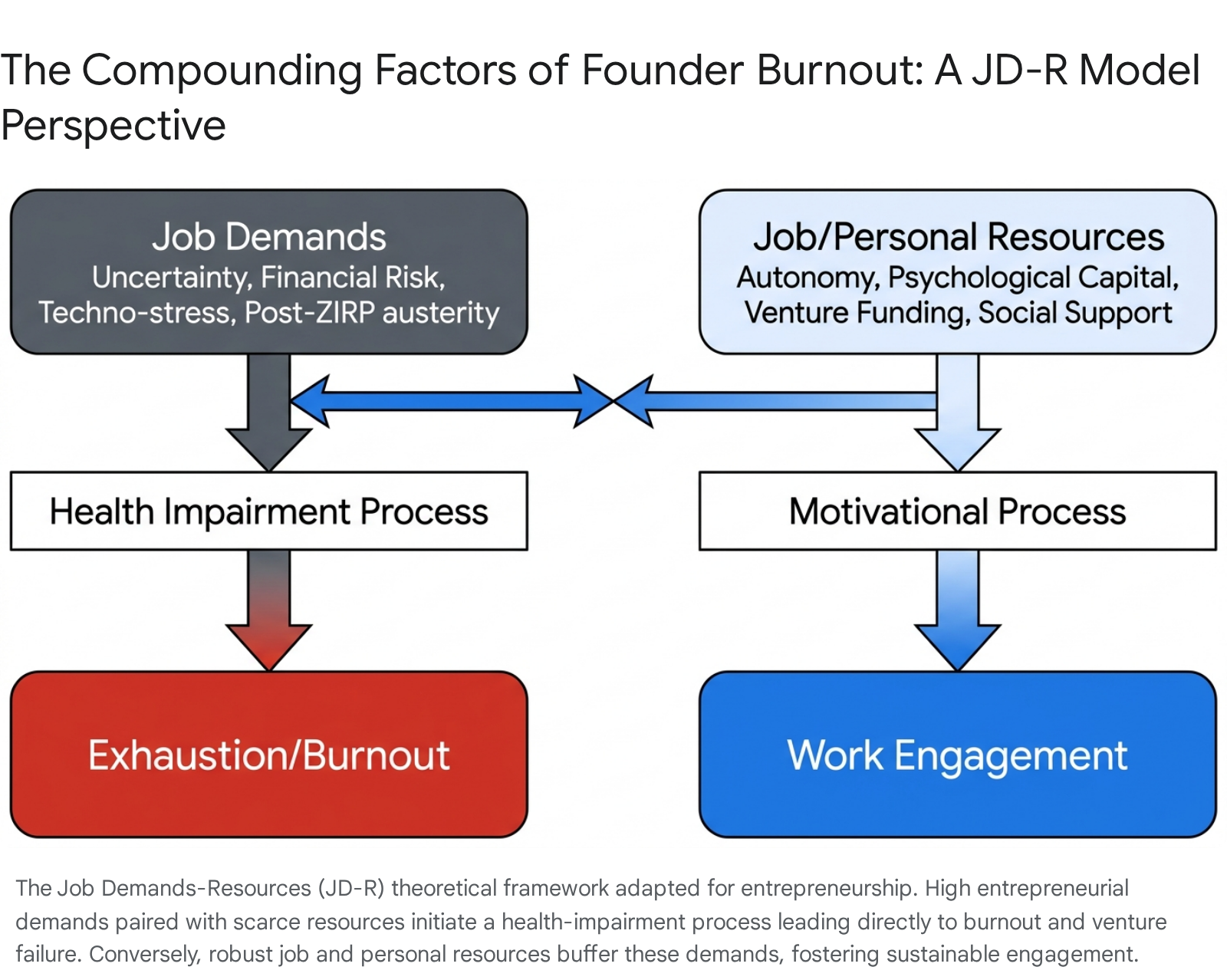
To truly understand why the modern entrepreneur is so uniquely susceptible to psychological collapse, we must move beyond the analysis of isolated stressors and examine the systemic, compounding nature of their environment. The Job Demands-Resources (JD-R) model, highly prominent in the Journal of Applied Psychology, provides the most robust theoretical framework for analyzing the interactive mechanisms that drive founder well-being and distress 27285152.
According to the JD-R theory, all work environments consist of two primary categories: Job Demands and Job Resources. Burnout occurs when a prolonged, severe imbalance exists - specifically, when job demands are exceptionally high and the requisite job resources to manage them are absent or systematically depleted 5129.
The Health Impairment Process: Escalating Demands
In the context of venture creation, "Job Demands" represent the physical, psychological, social, and organizational aspects of the role that require sustained cognitive and emotional effort, thus cumulatively depleting physiological and mental energy 2830. For founders, these demands are extraordinary and relentless. They include severe financial uncertainty, responsibility for employee livelihoods, non-standard and boundaryless working hours, and the emotional labor of maintaining the "founder mask" 3132. Furthermore, founders increasingly face intense "techno-stress" - the unrelenting pressure to rapidly integrate emerging technologies (like generative AI) into their product pipelines or risk immediate obsolescence 33.
In the post-ZIRP era, these demands have magnified exponentially. The pressure to achieve immediate profitability without external funding acts as a massive operational constraint. These chronic, compounded demands initiate a biological and psychological "health impairment process." The constant activation of the sympathetic nervous system leads directly to severe emotional exhaustion, cognitive detachment from the mission, and profound cynicism toward the venture itself 3034.
The Attrition of Job Resources and the Motivation Deficit
"Job Resources," conversely, are the physical, psychological, social, or organizational assets that help an individual achieve work goals, reduce job demands, and stimulate personal learning and development 2851. Traditionally, the primary and most powerful psychological resource for an entrepreneur has been autonomy - the absolute freedom to direct one's own destiny and operational environment 3132.
However, as dictated by Wasserman's Dilemma, achieving scale often inherently requires sacrificing this very resource to venture capitalists and boards of directors 410. Furthermore, social support - a critical, universally recognized resource for mitigating occupational stress - is structurally limited for founders. The profound loneliness of the chief executive position means they cannot ethically or practically confide in subordinates without risking morale, and admitting strategic weakness or exhaustion to a board of directors directly risks their tenure and funding.
Therefore, the founder is trapped in a vicious structural paradox: the very act of building and scaling the business continuously multiplies their job demands while simultaneously stripping away their most potent job resources (autonomy and social support) 8931. Without these critical buffering resources, the "motivational process" breaks down. The entrepreneur rapidly accelerates toward clinical burnout, depressive episodes, and, ultimately, the catastrophic failure of both their mental health and the venture they sought to build.
Conclusion
The contemporary entrepreneurial landscape exacts a psychological toll that far exceeds the sanitized, highly curated narratives of "hustle and grit" promoted by popular business culture and social media algorithms. An evidence-based examination of the organizational psychology literature reveals that the very structural decisions required to build a viable company - such as navigating the complex equity-control tradeoffs of the Founder's Dilemma - serve as potent, predictable triggers for deep psychological distress, existential identity crises, and severe role conflict.
The staggering prevalence of mental health conditions among founders, with nearly 93 percent exhibiting signs of mental strain and over 50 percent suffering from clinical anxiety, is not a statistical anomaly; it is a direct reflection of an inherently hazardous occupational architecture. This danger is drastically amplified by the post-ZIRP macroeconomic reality, which has abruptly replaced the exuberant financial safety nets of cheap capital with brutal operational austerity. This paradigm shift forces founders to endure humiliating down rounds, execute traumatic mass layoffs, and internalize the psychological burden of doing vastly more with significantly fewer resources.
When this reality is transposed onto high-context, non-Western cultures - where venture failure is not merely a learning experience but equates to profound social excommunication and a total loss of face - the psychological danger becomes acute. This cultural stigma effectively silences the distress of founders who desperately need intervention, highlighting the critical need for culturally nuanced approaches to entrepreneurial well-being.
To ensure the long-term viability and sustainability of global innovation ecosystems, the venture capital community, economic policymakers, and founders themselves must actively dismantle the toxic paradigms of survivorship bias and the performative "founder mask." Recognizing that neurodivergence acts as both the potent engine of entrepreneurial ideation and the primary vector for its collapse is paramount. Ultimately, mitigating founder burnout requires an intentional, systemic rebalancing of the Job Demands-Resources equation. It requires providing founders not just with financial capital, but with the psychological safety, rigorous peer support networks, and structural autonomy necessary to survive the profound psychological brutality of venture creation.