
Mathematics of the Langlands Program
The Langlands program represents one of the most expansive and intricate theoretical frameworks in modern mathematics. Proposed by the Canadian mathematician Robert Langlands in a 1967 letter to André Weil, the program posits a vast network of profound connections between seemingly disparate domains of mathematics: algebraic number theory, the theory of automorphic forms, representation theory, and arithmetic geometry 123. Often characterized as the grand unified theory of mathematics, the Langlands conjectures suggest that the deep arithmetic data encoded in Galois groups can be perfectly mirrored by the analytic data of automorphic representations defined over locally symmetric spaces 345.
Over the decades, this unifying vision has expanded significantly beyond its original arithmetic boundaries. The program has evolved into three primary pillars - number fields, function fields, and complex Riemann surfaces - and has recently assimilated advanced geometric concepts from $p$-adic geometry, perfectoid spaces, and topological quantum field theory 2678.
Foundational Principles and Weil's Rosetta Stone
The conceptual foundation for the Langlands program's multi-domain approach was established in 1940 by André Weil. In a letter to his sister, the philosopher Simone Weil, he articulated a vision of mathematics as a trilingual text of which only disparate fragments were known 910. Weil proposed a Rosetta stone linking three specific areas of mathematical study: number theory (number fields), algebraic geometry over finite fields (function fields), and the theory of Riemann surfaces 101112.
Weil's critical insight was that the middle column - function fields - serves as a central translation bridge. While importing the full machinery of complex analysis directly into finite fields or the integers is impossible, polynomials over finite fields possess arithmetic properties that loosely parallel the arithmetic of whole numbers 10. This structural similarity allows geometric intuition derived from Riemann surfaces to be translated into algebraic statements over finite fields, and eventually into arithmetic statements over number fields 1314.
The translation pathways across these three domains allow theorems and conjectures to migrate across fields. The structural analogies between the three pillars of the Langlands program are summarized below:
| Conceptual Component | Number Fields (Arithmetic) | Function Fields (Bridge) | Riemann Surfaces (Geometry) |
|---|---|---|---|
| Base Object | Number field $F$ (e.g., $\mathbb{Q}$) | Function field $\mathbb{F}_q(C)$ | Complex algebraic curve $C$ |
| Local Environment | $p$-adic fields $\mathbb{Q}_p$ and $\mathbb{R}$ | Laurent series $\mathbb{F}_q((t))$ | Punctured disk $\mathbb{C}((t))$ |
| Global Ring | Ring of integers $\mathcal{O}_F$ (e.g., $\mathbb{Z}$) | Polynomial ring $\mathbb{F}_q[t]$ | Ring of holomorphic functions |
| Prime Elements | Prime numbers $p \in \mathbb{Z}$ | Irreducible polynomials | Points $x \in C$ |
| Symmetry Group | Absolute Galois Group $\text{Gal}(\bar{\mathbb{Q}}/\mathbb{Q})$ | Étale Fundamental Group $\pi_1^{et}(C)$ | Fundamental Group $\pi_1(C)$ |
| Analytic Data | Automorphic representations | Automorphic sheaves | D-modules on $Bun_G(C)$ |
| Invariants | Ideal class group / Zeta functions | Picard group / Zeta functions | Moduli spaces of bundles |
In the number field setting, primes behave with distinct arithmetic constraints, sometimes splitting when passing to field extensions. For example, the prime 5 factors as $(2+i)(2-i)$ in the Gaussian integers $\mathbb{Z}[i]$ 9. In the geometric setting of Riemann surfaces, this arithmetic splitting is strictly analogous to the behavior of points under topological covering maps, where fibers may consist of multiple distinct points mapping to a single base point 915. Ramification in number fields maps geometrically to branch points on covering surfaces, providing a powerful dictionary between the continuous topological world and the discrete arithmetic world 131617.
The Classical and Arithmetic Langlands Correspondence
The classical Langlands program operates in the first column of the Rosetta stone: algebraic number theory. It posits a non-abelian generalization of class field theory, specifically the Artin reciprocity law, which connects one-dimensional representations of the Galois group to Dirichlet characters and their associated $L$-functions 51819.
Artin Reciprocity and Galois Representations
In algebraic number theory, the absolute Galois group $\text{Gal}(\bar{F}/F)$ of a number field $F$ encodes the symmetries of all algebraic roots of polynomial equations 316. Langlands conjectured a precise mapping between the $n$-dimensional continuous representations of this Galois group and the automorphic representations of the general linear group $GL_n(\mathbb{A}_F)$, where $\mathbb{A}_F$ is the ring of adèles of $F$ 318.
The adèle ring is a restricted topological product of all local completions of the number field, encompassing both the $p$-adic fields (for all prime ideals $p$) and the archimedean fields (the real or complex numbers) 81320. Constructing Galois representations over these adèlic spaces allows mathematicians to study local arithmetic phenomena simultaneously across all primes.
Automorphic Forms and L-Functions
Automorphic representations are essentially vast generalizations of modular forms. They are complex-valued functions defined over locally symmetric spaces that exhibit high degrees of symmetry under discrete subgroups 2417. By viewing these spaces through the lens of harmonic analysis, automorphic forms can be decomposed into eigenfunctions of specific differential and integral operators, much like quantum mechanical wavefunctions or complex Fourier series 21721.
The Langlands reciprocity conjecture states that to every sufficiently well-behaved (irreducible and continuous) $n$-dimensional Galois representation, there exists a corresponding cuspidal automorphic representation of $GL_n(\mathbb{A}_F)$ 318. Crucially, this correspondence dictates that the $L$-functions attached to both objects - complex analytic functions generalizing the Riemann zeta function - must be exactly equal, sharing identically matched Euler products and functional equations 31819.
The Principle of Functoriality and Endoscopy
To unify the theory for algebraic groups beyond the general linear group $GL_n$, Langlands introduced the concept of the Langlands dual group, denoted $^L G$ 3. If $G$ is a connected reductive algebraic group over $F$, its Langlands dual $^L G$ is a complex Lie group formed by inverting the roots and coroots of $G$ and taking the semi-direct product with the absolute Galois group 3.
The Functoriality Principle asserts that given any two reductive groups $H$ and $G$, and a well-behaved homomorphism between their dual groups $^L H \to ^L G$, there must exist a natural transfer (a lifting) of automorphic representations from $H$ to $G$ that preserves the $L$-functions 3. If fully proven, this principle would imply several major outstanding theorems in number theory, including the generalized Ramanujan conjecture and the Artin conjecture on the holomorphy of $L$-functions 3522.
A major technical barrier to establishing functoriality is the phenomenon of endoscopy, which involves the study of automorphic representations of a group $G$ by relating them to representations of smaller, simpler quasi-split groups $H$ 2223. The Arthur-Selberg trace formula is the primary tool used to attack these problems, expressing spectral data in terms of geometric orbital integrals 2223.
Ngô Bảo Châu and the Fundamental Lemma
For decades, the theory of endoscopy relied on a deeply technical combinatorial identity known as the Fundamental Lemma, proposed by Langlands and Diana Shelstad. It remained an unproven bottleneck in the program until 2008, when the Vietnamese-French mathematician Ngô Bảo Châu provided a complete proof 242526.
Ngô's breakthrough involved translating the combinatorial identities into the geometric language of the function field setting, employing the theory of perverse sheaves and the Hitchin fibration 2526. His proof unlocked the conditional results of the endoscopic classification of automorphic representations, earning him the Fields Medal in 2010 and driving a renaissance in the global arithmetic Langlands program 2426. Ngô subsequently co-founded the Vietnam Institute for Advanced Study in Mathematics (VIASM), establishing a major node for Langlands research and international collaboration through events like the Pan Asia Number Theory Conference 262827.
The Function Field Analogy
The second column of Weil's Rosetta stone concerns algebraic curves defined over finite fields $\mathbb{F}_q$. Because the function field $\mathbb{F}_q(C)$ behaves similarly to a global number field, it provides a highly tractable testing ground for Langlands' conjectures where powerful algebraic geometry techniques - such as intersection theory and étale cohomology - can be applied 1428.
Traces of Frobenius and Grothendieck's Dictionary
In the function field setting, the Langlands correspondence seeks to classify automorphic representations via Galois data associated with the curve $C$ 29. The operational mechanism bridging these concepts is Grothendieck's function-sheaf dictionary. This dictionary utilizes the trace of the Frobenius endomorphism to relate scalar functions on spaces over finite fields to the cohomology of $\ell$-adic sheaves evaluated over their algebraic closures 14. Through this mechanism, the spectral decomposition of automorphic forms is realized merely as a decategorification (a shadow) of the deeper categorical decomposition of automorphic sheaves 14.
Breakthroughs in Function Fields
Major structural breakthroughs in the Langlands program have historically occurred first within the function field column. Vladimir Drinfeld proved the global Langlands correspondence for $GL_2$ over function fields in the 1980s by analyzing the geometry of moduli spaces of shtukas 35. In 1998, Laurent Lafforgue extended this mapping to $GL_n$ over function fields, establishing the full correspondence for the general linear group 3.
In 2018, Vincent Lafforgue established the automorphic-to-Galois direction of the global correspondence for arbitrary connected reductive groups over function fields 330. To achieve this, he introduced the methodology of excursion operators. These operators provide a mechanism to extract spectral parameters (Galois representations) directly from the derived category of sheaves without relying on the traditional trace formula, bypassing many of the combinatorial difficulties inherent in endoscopy 7.
The Geometric Langlands Program
The third column of the Rosetta stone transitions the program entirely to geometry over the complex numbers ($\mathbb{C}$). The geometric Langlands program reformulates the classical arithmetic conjectures into structural statements about algebraic geometry and category theory over a smooth projective curve, or compact Riemann surface, $C$ 231631.
Categorification and Moduli Stacks
In classical Langlands theory, mathematicians study vector spaces of complex-valued functions. In the geometric Langlands correspondence, these spaces of functions are replaced by derived categories of sheaves 29. This process, known as categorification, shifts the focus from atomic objects (irreducible representations) to molecular objects (entire categories of sheaves that capture continuous families of representations) 30.
The two fundamental geometric moduli stacks on the respective sides of the correspondence are: 1. The Automorphic Side: The moduli stack of principal $G$-bundles on the curve $C$, denoted $Bun_G$ 3132. 2. The Spectral (Galois) Side: The moduli stack of flat $^L G$-connections (or local systems) on $C$, denoted $Loc_{^L G}$ 3132.
The categorical geometric Langlands conjecture states that there is an exact equivalence of derived categories between these two sides 3132. Specifically, the derived category of $D$-modules (representing systems of linear differential equations) on $Bun_G$ is equivalent to a specific derived category of quasi-coherent (or ind-coherent) sheaves on $Loc_{^L G}$ 313233.
Hecke Eigensheaves and D-Modules
In the classical arithmetic theory, automorphic forms are simultaneous eigenfunctions for a family of commuting operators called Hecke operators 1314. In the geometric theory, Hecke operators act on the category of $D$-modules on $Bun_G$ via integral transforms 31.
A central prediction of the geometric Langlands correspondence is that to every local system $E$ on $C$ (which corresponds to a point in $Loc_{^L G}$), there exists a corresponding Hecke eigensheaf on $Bun_G$ 31334. The action of the geometric Hecke operators on this eigensheaf returns the eigensheaf tensored with the fiber of the local system $E$ 33. The ultimate goal of the program is to define a categorical equivalence that systematically constructs these eigensheaves for all possible spectral data.
The 2024 Proof of the Geometric Langlands Conjecture
In 2024, a major milestone was reached when a nine-person collaborative team, led by Dennis Gaitsgory and Sam Raskin, announced a proof of the unramified geometric Langlands conjecture 23135. The team, consisting of Dima Arinkin, Dario Beraldo, Justin Campbell, Lin Chen, Joakim Faergeman, Kevin Lin, Nick Rozenblyum, along with Gaitsgory and Raskin, published their proof across five papers totaling over 1,000 pages 23637. This established the canonical equivalence of the relevant categories over fields of characteristic zero 2384139.
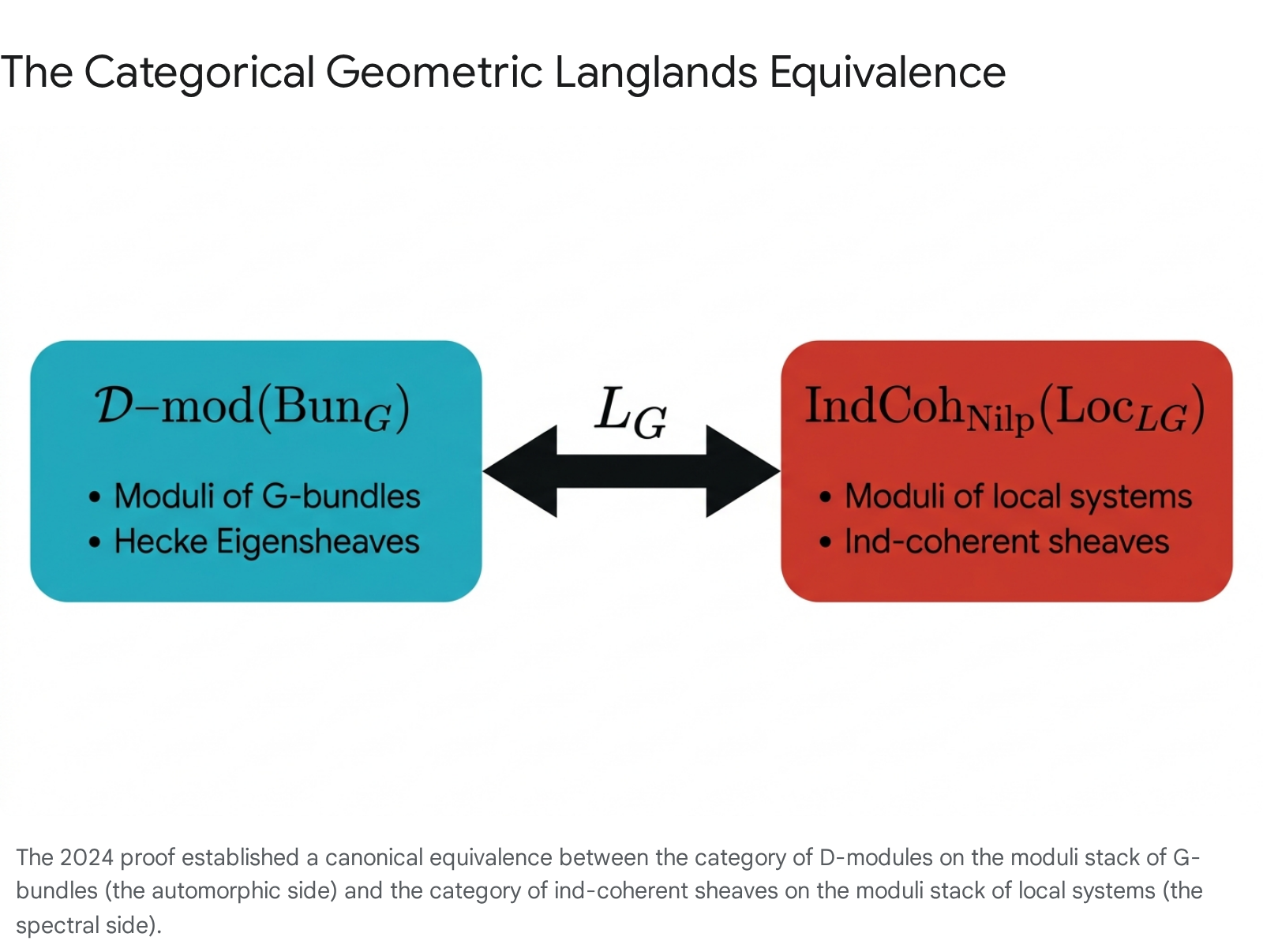
The core of the proof lies in the explicit construction of the Langlands functor $\mathbb{L}G$ in one direction: from the automorphic side to the spectral side 313840. The team rigorously established the equivalence: $$\mathbb{L}_G: \text{D-mod}(Bun_G) \xrightarrow{\sim} \text{IndCoh}{Nilp}(Loc_{^L G})$$ where $\text{IndCoh}{Nilp}(Loc{^L G})$ is the category of ind-coherent sheaves on the stack of local systems, with singular support restricted to the global nilpotent cone 3137.
The proof utilizes a host of highly technical innovations developed over three decades. Gaitsgory and Arinkin had previously provided a rigorous formulation of the conjecture in 2015, refining the informal best hope intuition initially put forward by Alexander Beilinson and Vladimir Drinfeld 22141. For his foundational work culminating in this proof, Gaitsgory was awarded the 2025 Breakthrough Prize in Mathematics 354441.
A critical intuition driving the proof was the conceptualization of the vacuum Poincaré sheaf 240. Drawing an analogy from signal processing, if classical Fourier analysis decomposes a signal into sine waves, the Poincaré sheaf acts as mathematical white noise - a superposition of all possible frequencies at equal amplitude 2. The Gaitsgory-Raskin team proved that every Hecke eigensheaf contributes equally to this Poincaré sheaf, and that the representations of the fundamental group correctly assign frequency labels to these eigensheaves 2. The proof verifies that various forms of the conjecture, including de Rham versus Betti contexts, and restricted versus non-restricted forms, are logically equivalent 313840.
Geometrization of the Local Langlands Correspondence
While the global geometric Langlands program operates over complete curves, another frontier is the local Langlands correspondence, which deals with representations of algebraic groups over local fields, such as the $p$-adic fields $\mathbb{Q}_p$ 337. The local arithmetic theory faces the profound difficulty of wild ramification - irregular singularities that dramatically complicate the representation theory and Galois data 37.
To address this, Laurent Fargues and Peter Scholze introduced an expansive framework to geometrize the local Langlands correspondence over $p$-adic fields 67424348. Their approach transplants the categorical methodologies of geometric Langlands back into the arithmetic domain by replacing the complex algebraic curve with an entirely new arithmetic object: the Fargues-Fontaine curve 743.
Perfectoid Spaces and the Fargues-Fontaine Curve
The geometrization relies heavily on the theory of perfectoid spaces, introduced by Scholze 424348. Perfectoid spaces are highly ramified, fractal-like $p$-adic geometric objects that allow mathematicians to seamlessly pass between characteristic 0 (like $\mathbb{Q}_p$) and characteristic $p$ via an algebraic process called tilting 4348.
Fargues and Scholze defined $Bun_G$ not as an ordinary algebraic stack, but as a small v-stack or diamond assigning the groupoid of $G$-bundles on the relative Fargues-Fontaine curve $X_S$ to any affinoid perfectoid space $S$ in characteristic $p$ 74249. Because the relative Fargues-Fontaine curve lacks a traditional structure morphism, they analyze it using the moduli space of Cartier divisors 43.
By developing a category of $\ell$-adic sheaves on this v-stack, Fargues and Scholze constructed a geometric Satake equivalence over the Fargues-Fontaine curve 74243. They then utilized excursion operators - adapting Vincent Lafforgue's methods from the function field setting - to generate semisimple local Langlands parameters for arbitrary irreducible smooth representations of $p$-adic groups 742. This formulation successfully provides a geometric, categorical local Langlands conjecture parallel to the global geometric conjecture, significantly advancing $p$-adic Hodge theory and representation theory 743. For his work, Scholze has been recognized with the Fields Medal, the Clay Research Award, and the Breakthrough Prize 48.
Quantum Field Theory and S-Duality
One of the most striking developments in the Langlands program is its deep, structural intersection with theoretical physics. In a seminal 2007 paper, physicists Anton Kapustin and Edward Witten demonstrated that the geometric Langlands correspondence can be understood directly as a mathematical manifestation of Montonen-Olive S-duality in four-dimensional $\mathcal{N}=4$ supersymmetric Yang-Mills (SYM) theory 32444546.
Montonen-Olive S-Duality
In quantum field theory, S-duality relates a physical theory at strong coupling - where standard perturbative calculations are intractably difficult - to an equivalent, weakly coupled theory where calculations are possible 44. Montonen-Olive duality specifically asserts a strict physical equivalence between a gauge theory with gauge group $G$ and coupling constant $g$, and a dual theory with the Langlands dual group $^L G$ and a coupling constant proportional to $1/g$ 4453.
Topological Twisting and Branes
Kapustin and Witten achieved their connection to pure mathematics by applying a procedure called topological twisting to the $\mathcal{N}=4$ SYM theory defined on a four-manifold of the form $M = \Sigma \times C$, where $C$ is the Riemann surface of interest and $\Sigma$ is a topological surface 83446. The twist relies on the theory's supercharges and introduces a complex parameter $t$.
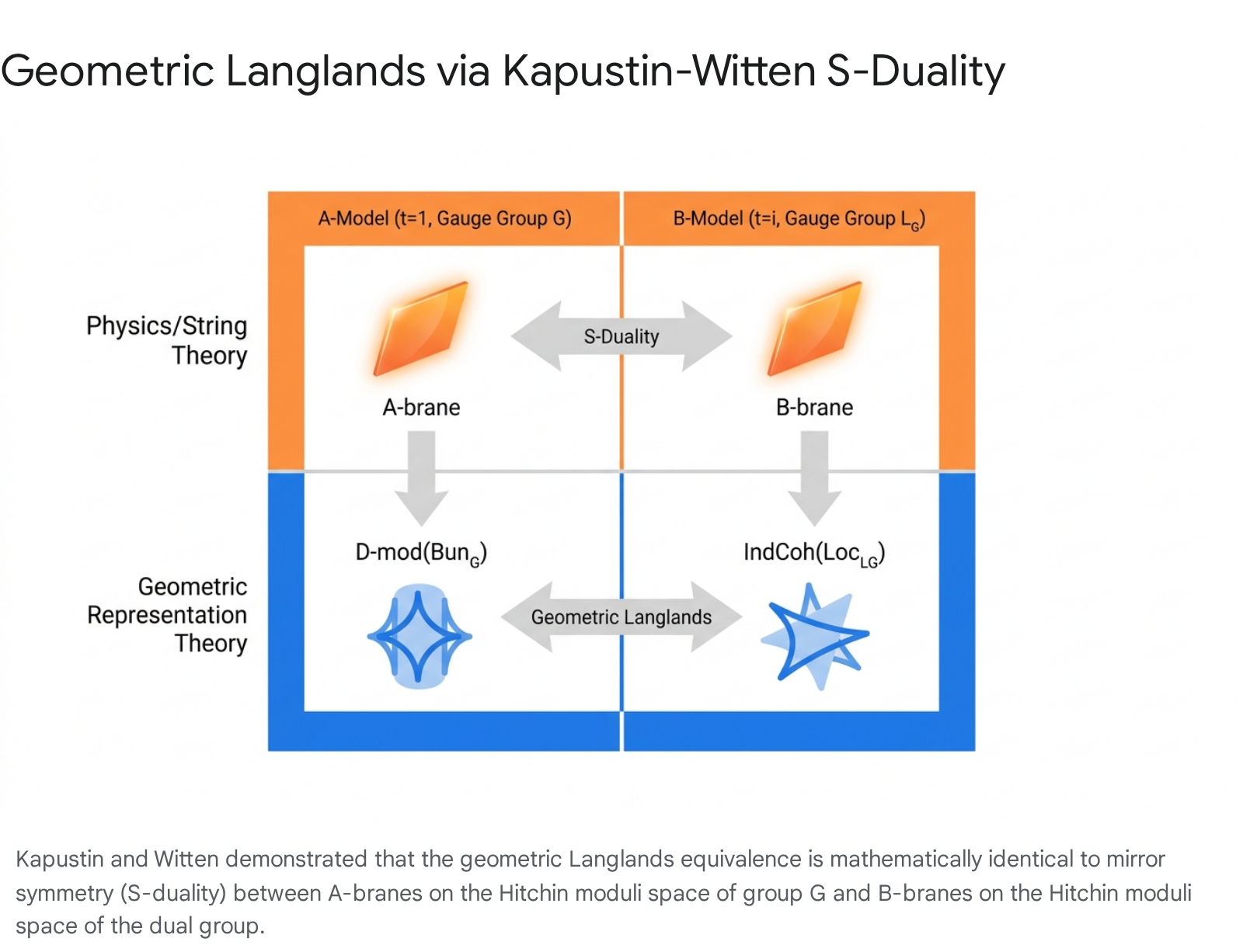
By taking the size of the Riemann surface $C$ to be small compared to $\Sigma$, the four-dimensional theory compactifies down to a two-dimensional effective field theory on $\Sigma$. This resulting theory is a topological sigma model whose target space is the Hitchin moduli space $M_H(G)$ of stable Higgs bundles on $C$ 344654. Kapustin and Witten identified the two sides of the geometric Langlands correspondence with the two respective boundary conditions of mirror symmetry in this physical model 344654.
| Geometric Langlands Element | Physics / S-Duality Equivalent |
|---|---|
| Langlands Group $G$ | Gauge Group $G$ (Twist parameter $t=i$) |
| Langlands Dual Group $^L G$ | Dual Gauge Group $^L G$ (Twist parameter $t=1$) |
| Moduli Stack $Bun_G$ | A-model Target Space $M_H(G)$ in complex structure $K$ |
| Moduli Stack $Loc_{^L G}$ | B-model Target Space $M_H(^L G)$ in complex structure $J$ |
| Category of D-modules on $Bun_G$ | Category of A-branes on $M_H(G)$ |
| Category of Sheaves on $Loc_{^L G}$ | Category of B-branes (zerobranes) on $M_H(^L G)$ |
| Geometric Hecke Operators | 't Hooft Operators (Magnetic defects) |
| Local Systems (Galois side) | Wilson Loop Operators (Electric defects) |
- The Automorphic Side ($A$-model): When the twist parameter $t=1$, the S-dual theory yields an $A$-model whose boundary conditions are modeled by $A$-branes on the hyperkähler Hitchin moduli space $M_H(G)$ 344647. Upon hyperkähler rotation, these $A$-branes mathematically correspond to the derived category of $D$-modules on $Bun_G$, establishing the automorphic side 34464748.
- The Spectral Side ($B$-model): When the twist parameter $t=i$, the theory yields a $B$-model with the Langlands dual gauge group $^L G$. Its boundary conditions are $B$-branes (specifically zerobranes) on $M_H(^L G)$, which correspond mathematically to the category of quasi-coherent sheaves on the moduli space of flat connections $Loc_{^L G}$ 464748.
In this physical framework, the core operations defining the Langlands correspondence manifest strictly as physical observables. The 't Hooft operators (magnetic line defects) in the gauge theory act on the $A$-branes and precisely replicate the geometric action of Hecke operators on $D$-modules 344649. Conversely, Wilson loop operators (electric line defects) act on the $B$-branes, completing the symmetry of the dictionary 344649. Montonen-Olive S-duality therefore provides a natural, physical explanation for why these two drastically different geometric spaces must possess equivalent categories of boundary conditions, tying modern quantum physics inextricably to the study of prime numbers and geometry 84446.
Conclusion
The Langlands program continues to function as an unprecedented engine for mathematical unification. From its origins as a set of conjectures linking prime numbers to automorphic representations over adèle rings, it has evolved into a multi-faceted discipline encompassing number fields, function fields, and Riemann surfaces.
Recent years have seen historic, paradigm-shifting milestones. The 2024 proof of the unramified geometric Langlands conjecture by Gaitsgory, Raskin, and their collaborative team provides a complete structural understanding of the third column of Weil's Rosetta stone, cementing the categorical relationship between automorphic $D$-modules and spectral sheaves 2. Simultaneously, the work of Fargues and Scholze has successfully pushed the advanced tools of geometrization into the highly complex terrain of $p$-adic local fields, redefining local Langlands through the lens of perfectoid spaces 748. Finally, the infusion of topological quantum field theory and S-duality has not only provided a physical rationale for why these geometric equivalences exist, but has also supplied mathematicians with entirely novel invariants to study 83246.
While the ultimate goal of proving global functoriality for general number fields remains an open challenge, the gradual resolution of these distinct theoretical blocks ensures that the Langlands program will remain the central driving force in mathematics and mathematical physics for the foreseeable future 350.