Mathematical Challenges of Quantum Chromodynamics Confinement
Theoretical Foundations of the Strong Interaction
Quantum Chromodynamics (QCD) is the foundational quantum field theory that describes the strong interaction, one of the four fundamental forces of nature. Operating under the non-abelian $SU(3)$ gauge group, QCD dictates the dynamics between quarks and gluons, the elementary constituents of hadronic matter. The theory is defined by two emergent, scale-dependent phenomenological properties that dominate the observable universe: asymptotic freedom at high energy scales and color confinement at low energy scales 12.
While the underlying Lagrangian of QCD is formulated in terms of essentially massless quarks and gluons, these elementary degrees of freedom are never observed in isolation 13. The absolute restriction of color-charged particles to composite, color-neutral bound states is known as the confinement problem, representing one of the most profound unresolved phenomena in modern theoretical physics.
Asymptotic Freedom and the Running Coupling Constant
The strength of the interaction between quarks and gluons is parameterized by the strong coupling constant, $\alpha_s$. Unlike abelian gauge theories such as Quantum Electrodynamics (QED), where the intermediate photons carry no electric charge, the non-abelian nature of QCD permits gluons to carry color charge and interact directly with one another 2. This gluonic self-interaction yields a negative beta function for the theory. Consequently, as the characteristic energy scale ($Q^2$) of a given interaction increases, the effective coupling constant logarithmically decreases 24.
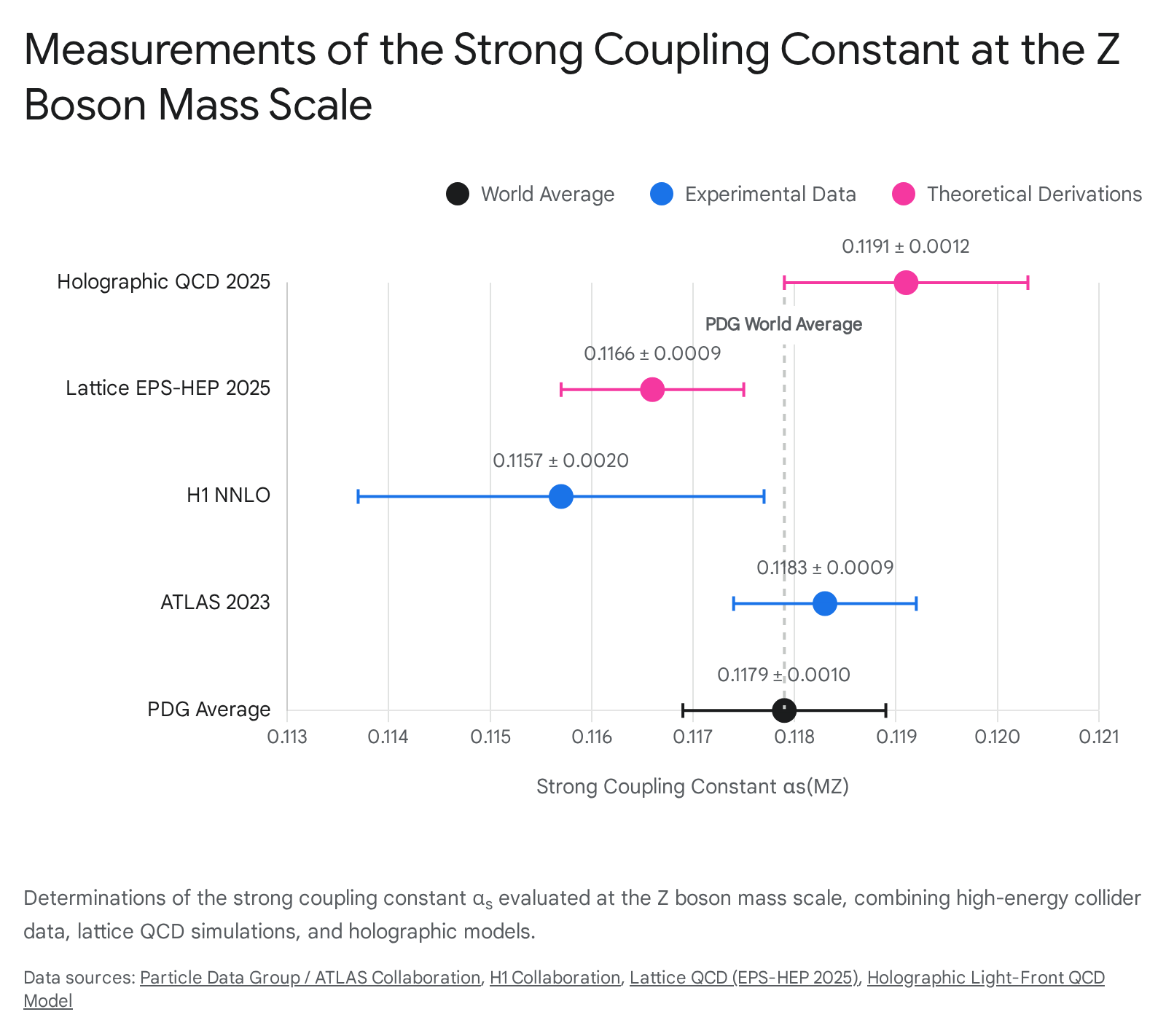
This phenomenon, known as asymptotic freedom, establishes that at highly energetic, short-distance limits, quarks and gluons behave asymptotically as free particles. The validity of perturbation theory (pQCD) is restricted to this regime. The baseline value of the strong coupling constant is typically evaluated at the reference scale of the Z boson mass ($M_Z \approx 91.2$ GeV). Extensive empirical and theoretical efforts - spanning deep-inelastic scattering, lattice QCD, and hadronic tau decays - have constrained $\alpha_s(M_Z)$ to highly precise intervals 25.
| Methodology / Experiment | $\alpha_s(M_Z)$ Value | Uncertainty | Source |
|---|---|---|---|
| Particle Data Group (2020 World Average) | $0.1179$ | $\pm 0.0010$ | 2 |
| ATLAS Experiment (2023 Measurement) | $0.1183$ | $\pm 0.0009$ | 2 |
| Lattice QCD (EPS-HEP 2025, 3-loop R-evolution) | $0.1166$ | $\pm 0.0009$ | 6 |
| Light-Front Holographic QCD (2025 Prediction) | $0.1191$ | $\pm 0.0012$ | 7 |
| H1 Jet Cross Sections (NNLO Fit) | $0.1157$ | $\pm 0.0020$ | 8 |
Conversely, as the energy scale decreases toward the infrared regime ($Q^2 \to 0$), the coupling constant diverges, approaching the fundamental QCD scale, $\Lambda_{\text{QCD}}$, which resides in the range of 200 - 300 MeV 29. In this strongly coupled domain, standard perturbative expansion techniques fail entirely 29.
Soft, Collinear, and Regge Kinematic Limits
To bridge the gap between perturbative calculations and non-perturbative dynamics, theorists utilize frameworks such as Soft-Collinear Effective Theory (SCET). SCET systematically isolates the fundamental kinematic limits of QCD, separating the physics of highly energetic collinear partons (forming jets) from the soft, wide-angle gluon emissions 10.
By analyzing transverse momentum dependent (TMD) distributions in semi-inclusive deep inelastic scattering (SIDIS), researchers derive all-order factorization theorems that describe the transition from hard scattering events to the strongly coupled hadronization phase 1011. When amplitudes are evaluated in the Regge limit - characterized by high-energy, small-angle scattering - the exchange of multiple Glauber gluons in the $t$-channel provides closed-form renormalization group equations. These equations recover classical frameworks like the BFKL equation purely from a collinear perspective, organizing non-planar QCD amplitudes and offering a systematic method to track gluonic behavior approaching the confinement threshold 10.
The Mechanics of Color Confinement
The physical manifestation of a diverging strong coupling constant in the infrared limit is color confinement. To investigate this, theoretical models study the potential energy mapping of static color charges embedded in the QCD vacuum.
Chromoelectric Flux Tubes and the String Tension
The canonical probe of confinement involves analyzing the potential energy $V(r)$ of a static quark and anti-quark pair separated by a spatial distance $r$ 1213. In the theoretical limit of pure Yang-Mills theory - which models gauge bosons without dynamical light quark fields - the potential energy grows linearly at asymptotically large separations.
Unlike electromagnetism, where the electric field of a dipole expands radially and diminishes in strength with distance, the chromoelectric field lines of QCD self-interact. This self-interaction causes the field lines to collimate into a narrow, tightly bound flux tube, often referred to as a "string" 13. The constant rate of energy increase per unit length of this flux tube is defined as the string tension, $\sigma$. As long as dynamical quarks are absent, this linear potential dictates that infinite energy is required to separate the color charges to an infinite distance, ensuring permanent imprisonment 1213.
String Breaking and Vacuum Pair Creation
In the physical universe governed by full QCD, the vacuum contains fluctuating dynamical light quarks (typically modeled on the lattice with $N_f = 2+1$ flavors). Under these realistic conditions, the linear rise in potential energy does not continue indefinitely 1214. As the separation between the static heavy quark sources increases, the chromoelectric flux tube stretches, and the potential energy stored within it grows. Once this stored energy exceeds the $2M_{\text{meson}}$ threshold - the invariant mass required to spontaneously create a light quark-antiquark pair from the QCD vacuum - the configuration of the system abruptly changes 1213.
The vacuum generates the required light quarks, severing the flux tube and capping the free ends of the severed string. This process transitions the system from a single bound heavy-quark state into two distinct, color-neutral static-light mesons 1215. After this string breaking distance is surpassed, the attractive force between the original static sources is effectively screened by the newly created dynamical quarks, causing the potential energy $V(r)$ to saturate and become constant 1213.
Temperature Dependence and the Dual Superconductor Model
The critical distance at which string breaking occurs is highly sensitive to the thermal properties of the QCD medium. Evaluations of the string-breaking distance at finite temperatures are executed by calculating the string tension against the rate of light meson production within the chromoelectric field 16.
Theoretical models analyzing this meson production rate differentiate between Gaussian dependencies - suggested by the standard Schwinger formula for pair production - and exponential dependencies. Lattice QCD data aligns exceptionally well with an exponential fall-off corresponding to the "London limit" of the dual superconductor model 16. In this dual superconductor paradigm, the QCD vacuum is modeled as a condensate of magnetic monopoles. The introduction of a chromoelectric field between quarks forces the vacuum to expel the field (analogous to the Meissner effect in standard superconductivity), naturally compressing it into the defining one-dimensional flux tube 1617.
The Yang-Mills Existence and Mass Gap Problem
While confinement and the emergence of hadronic mass are empirically established and heavily supported by numerical lattice simulations, a rigorous analytical foundation explaining these phenomena within the strict mathematical confines of four-dimensional interacting quantum field theory does not currently exist. Recognizing this profound gap in theoretical physics, the Clay Mathematics Institute designated the "Yang-Mills Existence and Mass Gap" as one of its seven Millennium Prize Problems in the year 2000, offering a one million US dollar award for its resolution 191819.
Axiomatic Quantum Field Theory Constraints
The Millennium Prize problem is explicitly phrased to demand mathematical rigor far beyond the functional approximations utilized by practicing phenomenologists. The challenge requires a formal proof that, for any compact simple gauge group $G$ (such as the $SU(3)$ group underlying the strong nuclear force), a non-trivial quantum Yang-Mills theory mathematically exists on four-dimensional Euclidean spacetime ($\mathbb{R}^4$) 19.
Existence, in this mathematical context, is not merely deriving a working Lagrangian. The proof must establish axiomatic properties at least as robust as those defined in the Streater & Wightman axioms or the Osterwalder-Schrader axioms 1920. These frameworks require the mathematically exact demonstration of relativistic covariance, reflection positivity, local commutativity, and the formulation of a rigorously defined probability measure 1920. Constructive quantum field theory has historically failed to meet these standards for interacting field theories in four dimensions due to the intrinsic difficulty of regulating the non-perturbative deep infrared regime and safely taking the continuum limit without encountering ill-defined singularities 320.
The Spectral Gap and Glueball Mass Spectrum
The second, equally critical component of the Millennium Problem is proving that the constructed theory inherently possesses a mass gap, denoted mathematically as $\Delta > 0$ 1919. In quantum field theory, the mass gap represents the lowest energy eigenvalue of the Hamiltonian above the vacuum state (which carries zero energy). Because relativistic mass is equivalent to rest energy, demonstrating a strictly positive mass gap proves that the lightest particle predicted by the theory must carry mass 1919.
The classical formulation of the Yang-Mills equations features massless gauge bosons. If quantized naively without confinement, the theory predicts massless gluons mediating long-range forces 1918. However, the physical reality of the strong force is strictly short-range. Proving the mass gap is theoretically synonymous with proving that massless gluons cannot exist as free asymptotic states. Instead, they must bind into massive, color-neutral composite particles known as glueballs 1919. For the $SU(3)$ strong interaction, the mass gap proof requires demonstrating that the glueball spectrum has a strict lower bound - often estimated phenomenologically near 1.7 GeV - ensuring that the energy spectrum is decisively bounded away from zero 1920.
Undecidability and Unverified Analytical Claims
From a computational mathematics perspective, the general problem of determining the presence of a mass gap (a specific instance of a spectral gap) in a generic many-body quantum system is known to be formally undecidable. No universal algorithmic approach can definitively calculate the answer programmatically for all potential inputs 19. This highlights the necessity for a profound, bespoke analytical leap rather than computational exhaustion.
The prestige of the Millennium Prize continuously attracts attempts at resolution. Recent preprints circulating in 2025 and 2026 have proposed novel entropic paradigms, such as frameworks termed "Harmonic Coherence" and extensions of "Hanners Theorem" 23. These preprints argue that non-Abelian gauge fields naturally align along paths of minimized informational entropy, forcing the fields to stabilize into discrete, confined energy configurations with non-zero mass gaps 23. While these concepts attempt to link entropic stabilization directly with gauge invariance and the cluster decomposition principle, they currently represent unverified mathematical claims. As of the current consensus in mathematical physics, such manuscripts have not satisfied the rigorous peer-review constraints established by the Clay Mathematics Institute, and the Yang-Mills mass gap problem remains officially unsolved 1820.
Non-Perturbative Analytical Approaches
Given the breakdown of perturbative expansions and the lack of exact mathematical proofs, physicists rely on sophisticated non-perturbative formalisms to approximate the deep infrared limits of QCD.
Schwinger-Dyson Equations and Vertex Truncation
The Schwinger-Dyson Equations (SDEs) represent the full quantum equations of motion for a given field theory. They form an infinite hierarchy of coupled, non-linear integral equations that recursively relate $n$-point Green's functions to higher-order $(n+1)$-point correlation functions 921. In principle, if the entire infinite tower of equations could be solved simultaneously, it would provide an exact, non-perturbative description of QCD dynamics, completely mapping dynamical chiral symmetry breaking (DCSB) and confinement without relying on the small coupling assumption 19.
However, achieving a complete analytical solution is mathematically intractable. To extract physical information, theorists must truncate the infinite hierarchy to form a closed system of equations 922. The precision of an SDE analysis is entirely dependent on the quality of the selected truncation ansatz. Advanced frameworks utilize models such as the Kızılersü - Pennington three-point vertex. This specific ansatz is mathematically designed to satisfy multiplicative renormalizability in unquenched systems 22.
Gauge Covariance and Generalised Ward-Takahashi Identities
A primary difficulty in SDE truncation is maintaining gauge invariance across the calculated propagators. When evaluating the mass generation of fermions in various dimensions, the gauge covariance of the propagators is strictly checked using momentum-space formulations of the Landau-Khalatnikov-Fradkin (LKF) transformations 2223.
To further constrain the transverse parts of the required vertices, researchers apply Generalised Ward-Takahashi identities. Solving these constrained SDE hierarchies in momentum space - often utilizing methodologies like the Bender-Milton-Savage approach - reveals specific limiting behaviors. Under low-energy limits, the non-local QCD interactions governed by instanton liquid profiles drive a phase transition that effectively reduces the theory to a Nambu-Jona-Lasinio (NJL) model, wherein chiral condensates mathematically compel quark confinement 2123.
Holographic QCD and the AdS/CFT Correspondence
An alternative analytical approach is Holographic QCD, derived from the Anti-de Sitter/Conformal Field Theory (AdS/CFT) correspondence. This framework maps strongly coupled gauge theories in flat four-dimensional spacetime into weakly coupled gravity or string theories operating in higher-dimensional curved spaces 17.
Holography is uniquely equipped to explore scenarios where the phenomenological scales of confinement and chiral symmetry breaking are decoupled 17. The onset of non-perturbative physics in these models is often associated with scales where the Breitenlohner-Freedman (BF) bound is violated by the running anomalous dimensions of adjoint or fundamental fermions 17. By adjusting warp factors and bulk geometries, dynamic holographic models successfully generate complex phase diagrams charting the precise boundaries of standard confinement/deconfinement transitions, as well as mapping out critical end points (CEPs) and expansive supercritical regions 27.
Critical Electric Fields and the Schwinger Effect
Holographic models provide unique access to dynamical probes of confinement that bypass the notorious sign problem encountered by lattice simulations at finite baryon densities. One such probe is the Schwinger effect - the spontaneous non-perturbative production of particle-antiparticle pairs from the vacuum induced by highly intense external electric fields 27.
In strongly coupled holographic plasmas, tracking the Schwinger threshold fields acts as a sensitive diagnostic for vacuum instability. The models predict distinct threshold electric field dependencies across specious confined phases and beyond the critical end point. Analyzing these thresholds in tandem with thermodynamic observables, such as specific heat capacity and the squared speed of sound, permits theorists to trace distinct crossover lines that physically separate confined-like and deconfined-like matter at high densities 27.
Lattice Gauge Theory and Computational Breakthroughs
Numerical Lattice Quantum Chromodynamics is widely regarded as the only comprehensive, first-principles method capable of resolving non-perturbative QCD interactions quantitatively 24. By discretizing continuous four-dimensional Euclidean spacetime into a lattice grid with spacing $a$, the infinite-dimensional path integrals of quantum mechanics are reduced to finite, high-dimensional statistical partition functions. These can then be evaluated computationally using sophisticated Monte Carlo sampling algorithms 1223.
Discretization and Critical Slowing Down
To reliably extract physical observables from the lattice, researchers must perform extrapolations to the continuum limit ($a \to 0$) and adjust the bare quark masses to mirror physical reality 25. However, pushing simulations toward the physical light quark mass limit introduces a severe algorithmic bottleneck known as "critical slowing down."
As the bare mass parameters decrease to physical values, the smallest eigenvalues of the fundamental Dirac matrix approach zero. This causes the mathematical condition number of the system to diverge exponentially. Consequently, traditional iterative Krylov subspace methods, such as the mixed-precision conjugate gradient (CG) algorithm typically used to compute Highly Improved Staggered Quarks (HISQ) propagators, stall out completely 25.
To bypass critical slowing down, modern lattice collaborations employ advanced algebraic interventions, including multigrid algorithms and sophisticated eigenvector deflation techniques 2526. Multi-deflation explicitly isolates and projects out the troublesome low-lying eigenmodes using reduced-precision (sloppy) eigenvectors, drastically reducing the required number of solver iterations and enabling stable simulations on exceptionally fine lattices (down to $a \approx 0.04$ fm) 2527.
Exascale Computing and the FLAG Averages
The resolution of critical slowing down, combined with the advent of exascale supercomputing facilities (such as the Frontier and JUPITER architectures), has ushered in an era of sub-percent precision for fundamental QCD parameters 262829. Exascale clusters allow for the generation of massive gauge field configurations over diverse light-to-strange quark mass ratios, storing petabytes of data for phenomenological extraction 2830.
The Flavour Lattice Averaging Group (FLAG) provides periodic, rigorous syntheses of these global lattice efforts. The 2024 and 2025 FLAG reports document unprecedented precision in the determination of light quark masses, the strong coupling constant, and the Cabibbo-Kobayashi-Maskawa (CKM) matrix elements ($|V_{ud}|, |V_{us}|, |V_{cb}|$) 353132. A critical application of these highly resolved lattice parameters is the evaluation of neutral kaon mixing constraints.
| Lattice QCD Parameter / Matrix Element | Primary Physics Application | Recent Observation / Discrepancy |
|---|---|---|
| $\hat{B}_K$ ($N_f = 2+1$) | Kaon mixing / CP Violation | Sub-percent precision achieved; establishes strict SM baseline |
| $ | V_{cb} | $ (Exclusive extraction) |
| $ | V_{cb} | $ (Inclusive extraction) |
| $\eta_i$ ($u-t$ unitarity via BGS method) | Perturbative matching | Heightens the SM deviation to $4.2\sigma - 5.7\sigma$ |
The precise lattice determination of the $\hat{B}K$ parameter, combined with exclusively derived $|V{cb}|$ values, has illuminated a severe anomaly in the Standard Model. Current lattice-informed predictions for the indirect CP-violation parameter in kaon decays ($|\epsilon_K|$) account for only roughly 65% of the experimentally observed value 3233. This establishes a persistent $4.1\sigma$ to $5.1\sigma$ tension between the Standard Model theory and experimental reality. Interestingly, incorporating the Brod-Gorbahn-Stamou (BGS) method for unitarity exacerbates this tension up to $5.7\sigma$, though the anomaly diminishes if inclusive heavy quark expansion parameters are utilized instead 3233.
Resolving Scalar Glueball Form Factors
Lattice QCD is uniquely equipped to explore hadrons composed entirely of gluons. However, isolating the signal of a glueball with dynamical quarks is a monumental challenge. The extraction requires disentangling the specific glueball mass states from a heavily populated background spectrum of two-meson, three-meson, and four-meson scattering states, demanding costly timeslice-to-timeslice propagators 34.
Despite these hurdles, theoretical advances in 2024 and 2025 using variationally optimized operators and Generalized Eigenvalue Problems (GEVP) have successfully extracted the energy-momentum tensor metrics of the scalar glueball ($J^{PC} = 0^{++}$) 3536. The calculation of these gravitational form factors (GFFs) predicts a remarkably small mass radius of $0.263 \pm 0.031$ fm for the scalar glueball 35. This establishes that purely gluonic bound states are significantly more compact than conventional valence-quark hadrons, providing a distinct phenomenological signature for experimental searches targeting the mass gap threshold 3435.
Experimental Probes of Confinement
Verifying the mechanics of confinement and identifying exotic gluonic degrees of freedom necessitates high-luminosity particle accelerators capable of tracking precision fragmentation events and isolating exceptionally rare decay channels.
Photoproduction of Hybrid Mesons at GlueX
The standard constituent quark model classifies mesons as $q\bar{q}$ pairs, strictly limiting their total angular momentum ($J$), parity ($P$), and charge conjugation ($C$) to specific combinations. Observing a meson that exhibits "spin-exotic" quantum numbers (such as $0^{--}, 0^{+-}, 1^{-+}$, or $2^{+-}$) provides unequivocal proof of an exotic structural configuration, such as a hybrid meson where the inter-quark gluonic field itself exists in an excited state 373844.
The GlueX experiment, situated at the Thomas Jefferson National Accelerator Facility (JLab), was explicitly designed to search for these elusive hybrid states. Utilizing the Continuous Electron Beam Accelerator Facility (CEBAF), GlueX creates coherent bremsstrahlung by impinging 12 GeV electrons onto a diamond wafer, producing a highly precise, linearly polarized photon beam directed at a proton target 3940. The polarized nature of the 8 - 10 GeV photons provides critical angular distributions necessary to apply specific parity exchange symmetries during data analysis 3844.
The primary focus of the GlueX collaboration is the $\pi_1(1600)$ state, an isospin-1 particle and the leading candidate for the lightest exotic hybrid meson featuring $J^{PC} = 1^{-+}$ 373841.
| Investigated Final State | Predicted Contribution (Lattice) | GlueX Experimental Status |
|---|---|---|
| $\omega\pi\pi$ | Dominant partial decay width ($b_1\pi$) | First rigorous upper limits on photoproduction established |
| $\eta\pi$ | Minor branching fraction | Candidate phase mapping and background suppression ongoing |
| $\eta'\pi$ | Significant branching fraction | Identified as the optimal sensitivity channel for $1^{-+}$ isolation |
| $\gamma\pi^+\pi^-\eta'$ | Relevant for $X(2370)$ ($0^{-+}$ glueball) | Independently observed by BESIII with $>11.7\sigma$ significance |
Recent data analyses have successfully determined the maximum boundary limits for the photoproduction cross-sections of the charged and neutral $\pi_1(1600)$ components in the $\omega\pi\pi$ decay channel 4142. By combining these rigid upper limits with lattice QCD decay width predictions, the collaboration established that the $\eta'\pi$ final state possesses the highest intrinsic sensitivity for isolating the $\pi_1(1600)$ signal from overwhelming conventional backgrounds (like the interfering $a_2(1320)$ meson) 384243. Pinpointing this state is a foundational step in physically mapping the hybrid meson nonet and understanding how excited gluons contribute to the bounding mass gap 3839.
SuperKEKB Luminosity and Belle II Precision
In parallel to fixed-target experiments, asymmetric-energy $e^+e^-$ colliders provide exceptionally clean environments to probe confinement via quark hadronization. The Belle II experiment, operating at the SuperKEKB facility in Tsukuba, Japan, leads these efforts 5044.
SuperKEKB recently achieved a staggering world-record instantaneous luminosity of $5.24 \times 10^{34}$ cm$^{-2}$s$^{-1}$, generated by an innovative "nano-beam" collision scheme that compresses the electron and positron streams to highly focused intersections 4546. With a target dataset of 50 ab$^{-1}$ extending through the 2030s, Belle II is uniquely positioned to evaluate billions of $B$ meson, charm, and tau decays to test lepton-flavor universality and execute high-precision evaluations of the CKM unitarity triangle 444748.
Quark Fragmentation and Exotic Hadron Spectroscopy
Because quarks are strictly confined, high-energy quarks generated in collider events immediately fragment into showers of composite hadrons. The probability distributions governing this process are mapped by fragmentation functions (FFs). Belle II is executing critical measurements of Di-hadron fragmentation functions (DiFFs), which describe how a polarized quark fragments into a specific pair of hadrons 11. Analyzing the transverse momentum decorrelation in these jets allows researchers to isolate time-reversal-odd (T-odd) components, which survive exclusively due to the non-perturbative confinement effects of the QCD vacuum 11.
Belle II also advances the study of multi-quark bound states directly above standard confinement thresholds. Recent energy scans executed near 10.75 GeV (between the $\Upsilon(4S)$ and $\Upsilon(5S)$ thresholds) have conclusively verified the existence of the anomalous $\Upsilon(10753)$ state 4950. This state exhibits drastically enhanced transition rates to lower bottomonia, violating standard Heavy Quark Spin Symmetry expectations. Such anomalous transitions strongly indicate that the $\Upsilon(10753)$ is not a conventional $b\bar{b}$ meson, but rather a compact tetraquark configuration or an extended hadronic molecule, shedding light on the complex multi-quark architectures permitted by the strong force 4950.
Synthesis of Theoretical and Experimental Frontiers
The confinement of color charge and the generation of a strictly positive mass gap represent the defining characteristics of Quantum Chromodynamics in the low-energy regime. While a pure, axiomatic mathematical proof satisfying the Millennium Prize standards for four-dimensional Yang-Mills theory remains an unsolved, highly complex open problem, the phenomenological and computational frameworks describing the force have reached unprecedented maturity.
Theoretical approximations via Schwinger-Dyson equations and holographic mappings have successfully decoupled the mechanisms of chiral symmetry breaking from confinement, revealing intricate phase transitions and critical bounds. Simultaneously, the deployment of exascale computing networks has empowered Lattice QCD to resolve the structural properties of pure-gauge glueballs and establish stringent baseline parameters that expose highly significant anomalies within the Standard Model. Augmented by record-breaking luminosity and precision photoproduction at facilities like Belle II and GlueX, the global physics community continues to isolate the exotic signatures of excited gluons and tetraquarks, steadily uncovering the physical mechanisms that ensure quarks remain forever imprisoned.