
Longitudinal effects of volunteering on well-being
The relationship between prosocial behavior and subjective well-being has been a focal point of sociological, psychological, and public health research for decades. Early cross-sectional surveys consistently demonstrated that individuals who engage in formal or informal volunteering report higher levels of happiness, life satisfaction, and physical health than those who do not volunteer. However, cross-sectional designs are inherently limited by their inability to determine causality. It is plausible that volunteering increases well-being, but it is equally plausible that individuals with higher baseline well-being, greater socioeconomic resources, and better physical health are simply more likely to self-select into volunteer roles.
Recent advancements in longitudinal panel studies and data analysis techniques have permitted researchers to observe intra-individual changes in well-being before, during, and after engagement in voluntary activities. These longitudinal datasets, combined with biometric indicators and cross-cultural samples, reveal a complex framework in which volunteering serves as a potent, though highly contextual, driver of human flourishing.
Analytical Approaches to Causality
The primary challenge in assessing the impact of volunteering on subjective well-being is the "healthy volunteer" effect. This phenomenon represents a form of self-selection bias where individuals possessing robust physical health, high psychological resilience, and extensive social capital are disproportionately represented in volunteer populations 12. To isolate the true effect of volunteering, researchers rely on longitudinal household panels that apply strict econometric controls.
Overcoming Self-Selection Bias
Longitudinal research applies fixed-effects models and first-difference estimations to account for unobserved time-invariant personality traits and prior levels of well-being. An analysis of the British Household Panel Survey (BHPS) and the Understanding Society panel datasets utilized data spanning ten waves over approximately twenty years to address reverse causality 34. By running panel analyses that controlled for prior higher or lower levels of subjective well-being, the researchers ensured that the observed outcomes were associated with a positive change in well-being rather than just a high baseline. The analysis established a robust quasi-causal estimate, demonstrating a statistically significant relationship between volunteering and increased life satisfaction 4.
To quantify this impact, the study generated an equivalent well-being valuation, estimating that it would take an average of £911 per volunteer per year in financial compensation to match the subjective well-being increase derived from volunteering 34. This conservative valuation underscores the tangible psychological dividends of prosocial behavior when stripped of selection biases. Furthermore, the analysis highlighted that the positive association relies on the current experience of volunteering rather than its historical persistence; well-being gains were observed primarily when individuals actively volunteered and often ceased when the volunteering stopped 45.
Bidirectional Feedback Loops
While fixed-effects models isolate the impact of volunteering on well-being, other models investigate the reciprocal nature of the relationship. A longitudinal study utilizing data from the Survey of Health, Ageing and Retirement in Europe (SHARE), tracking nearly 20,000 middle-aged and older adults across 15 countries from 2011 to 2020, applied both outcome-wide and exposure-wide generalized estimating equations 6. The findings confirmed a bidirectional feedback loop. Participation in voluntary or charity activities almost every week was prospectively associated with greater emotional well-being and reduced risks of limitations in activities of daily living 6.
Conversely, the study found positive reverse associations: higher baseline emotional well-being predicted future participation in volunteering. Specific health barriers - such as increased loneliness, high blood cholesterol, hypertension, and chronic lung disease - significantly impeded subsequent participation 6. The existence of this feedback loop validates the "healthy volunteer" hypothesis while simultaneously confirming that volunteering independently acts as a catalyst for further health and well-being enhancements.
Neurological and Biological Substrates of Altruism
The psychological benefits of volunteering are anchored in observable physiological changes. While survey data capture the subjective experience of well-being, neurological and biomarker studies map the physiological correlates of prosocial behavior, revealing that human biology is wired to reward altruism.
The Mesolimbic Reward Pathway
Acts of generosity and community service activate the brain's reward centers, producing a neurochemical cascade colloquially referred to as the "helper's high" 789. Functional magnetic resonance imaging (fMRI) studies demonstrate that making charitable donations or engaging in cooperative behavior stimulates the mesolimbic pathway, specifically activating regions associated with pleasure and reward - the same neural networks activated by primary rewards such as food 1011.
This activation is mediated by neurotransmitters including dopamine, which generates feelings of euphoria and satisfaction, and oxytocin, which promotes social bonding and trust 1213. Neuroscience research highlights that human evolutionary survival relied heavily on cooperation; consequently, the brain assigns an inherent value to generosity and fairness 1014. Repeated acts of kindness, intrinsic to sustained volunteer work, have been shown to increase activity in brain regions involved in emotion regulation and social cognition 10. Furthermore, providing peer support allows volunteers to shift away from patterns of negative self-reference and rumination, breaking cycles of depression and anxiety 81115.
Epigenetic Aging and Biomarkers
Longitudinal research links volunteering to delays in biological and cognitive aging. An analysis utilizing data from the US Health and Retirement Study observed that sustained volunteering reduces the rate of epigenetic age acceleration 16. By analyzing DNA methylation patterns, researchers established that volunteers age at a demonstrably slower biological rate compared to non-volunteers. This effect is largely attributed to the routine social interaction, physical activity, and purposeful engagement inherent in volunteer work, which collectively buffer the physiological wear and tear associated with chronic stress 16.
These protective mechanisms extend to cognitive preservation. A 20-year longitudinal study following over 30,000 U.S. adults revealed that individuals who engaged in regular formal volunteering or informal helping experienced 15% to 20% less cognitive decline associated with aging 1718. Furthermore, volunteering has been shown to buffer the adverse effects of chronic stress on systemic inflammation, a known biological pathway linked to cognitive decline and dementia 17. Consequently, volunteering acts as a multidimensional health intervention, operating on neurochemical, cellular, and cognitive levels.
Psychological Frameworks and Mediating Variables
To contextualize why volunteering yields such profound biological and psychological dividends, researchers frequently employ advanced structural modeling alongside established paradigms such as Self-Determination Theory (SDT) and Role Theory.
Self-Determination Theory in Volunteer Contexts
Self-Determination Theory posits that human well-being is heavily dependent on the satisfaction of three basic psychological needs: autonomy, competence, and relatedness 1920. Volunteering is a quintessential autonomous behavior; it is an elective commitment of time and energy driven by intrinsic rather than extrinsic motivations 21.
Longitudinal data demonstrate that the well-being derived from volunteering relies heavily on how well these three needs are met within the volunteer role. A study examining end-of-life care volunteers found that eudaimonic well-being was positively associated with autonomous motivation (volunteering to enact personal values or gain understanding) and negatively associated with controlled motivation (volunteering out of social pressure or career enhancement) 22. When volunteers feel effective in their roles (competence) and experience genuine connection with beneficiaries or peer volunteers (relatedness), they report significantly higher life satisfaction and lower burnout 2023. Interventions that mandate volunteering or frame it solely around external rewards fail to produce optimal psychological benefits, precisely because they strip the activity of its autonomy 23.
Meaning-Oriented Behavior and Non-Linear Dynamics
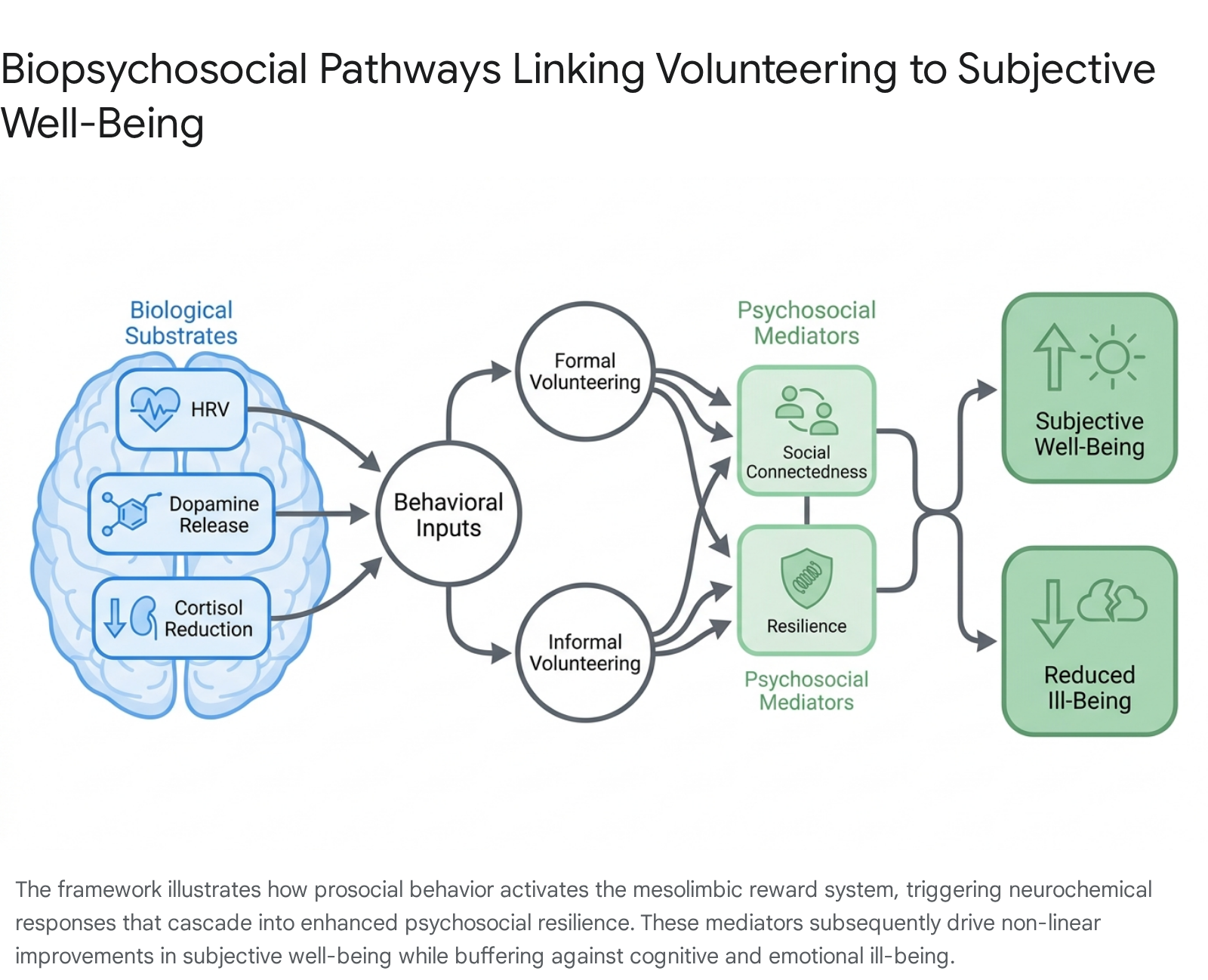
Recent analyses challenge the assumption that subjective well-being and psychological ill-being exist on a single linear continuum. A 2025 study utilizing data from 8,047 participants in the UK Biobank constructed a partial least squares structural equation model (PLS-SEM) to map the pathways between Meaning-Oriented Behavior (MOB) - a category encompassing volunteering and prosocial acts - and psychological outcomes 2425.
The analysis identified MOB as the strongest direct predictor of both increased well-being and reduced ill-being. Crucially, Bayesian regression modeling revealed that the relationship between MOB and subjective well-being is best described by a cubic function, indicating complex thresholds where the strength of the psychological reward changes dynamically based on the intensity of the behavior 24. The study also demonstrated that Heart Rate Variability (HRV), an upstream physiological marker of autonomic nervous system regulation, directly influences an individual's capacity to engage in MOB, which subsequently initiates a serial mediation pathway 2425. By enhancing social connectedness and resilience, volunteering effectively regulates both the presence of positive affect and the mitigation of distress through distinct, non-linear mechanisms.
Role Theory and Identity Formulation
Role Theory, particularly relevant in gerontological research, suggests that psychological well-being is tied to the accumulation of meaningful social roles. In later life, events such as retirement or the loss of a spouse can lead to a sudden deficit in role identity, prompting feelings of uselessness and social isolation.
Analyses of the English Longitudinal Study of Ageing (ELSA) illustrate that volunteering serves as a critical role-substitute for older adults 5. By substituting employment with formal volunteering, retired individuals counteract the loss of power and social status, maintaining a structured schedule, social networks, and a sense of societal contribution 5. ELSA data indicate that volunteers post-State Pension Age experience significant improvements in quality of life and reductions in depression compared to non-volunteers, emphasizing the protective nature of maintaining an active role identity through prosocial engagement 5.
Dosage Effects and Engagement Thresholds
While the benefits of volunteering are well-documented, longitudinal research reveals that these benefits are not strictly linear. Instead, they follow a dose-response curve characterized by optimal thresholds, beyond which the positive effects plateau or, in cases of extreme commitment without adequate support, become detrimental.
Optimal Frequencies for Psychological Benefit
Multiple large-scale longitudinal analyses have converged on an optimal "dosage" for maximizing the health and well-being benefits of volunteering. An analysis of the Health and Retirement Study determined that the most robust reductions in epigenetic age acceleration and cognitive decline occur among individuals who volunteer between 50 and 199 hours per year, equating to approximately one to four hours per week 1617. A parallel study verified that volunteering for at least 100 hours annually significantly lowers the risk of mortality and the development of physical limitations in adults over 50 26.
The frequency and consistency of engagement are equally critical. Sudden, abrupt reductions in volunteering time have been associated with sharp declines in cognitive function and well-being, whereas gradual reductions mitigate these negative outcomes 26. Furthermore, engaging in multiple different types of activities yields compounding benefits. The ELSA study found that participating in three or more different volunteering activities produced larger beneficial effects on well-being than participating in just one or two 5.
| Dosage Metric / Threshold | Target Population | Primary Longitudinal Outcome Observed | Primary Data Source |
|---|---|---|---|
| 1 - 4 hours per week (50 - 199 hours annually) | Middle-aged and older adults (US) | 15 - 20% slower age-related cognitive decline; reduced epigenetic age acceleration. | Health and Retirement Study 161718 |
| >100 hours per year (~2 hours per week) | Adults aged 50+ (US) | Substantially reduced mortality risk; delayed onset of physical limitations. | American Journal of Preventive Medicine 26 |
| At least 2 hours per week | General adult population | Reductions in depressive symptoms; higher baseline optimism and life purpose. | Journal of Happiness Studies 2728 |
| 3+ distinct volunteer roles | Retired adults (UK) | Compounding reductions in depression and social isolation; maximal life satisfaction. | English Longitudinal Study of Ageing 5 |
Volunteer Burnout and Role Overload
The relationship between volunteer hours and well-being frequently takes an inverted U-shape. High-intensity volunteering, particularly in emotionally demanding sectors such as hospice care, crisis support, or frontline emergency services, can trigger volunteer burnout 2930.
Applying the Job Demands-Resources (JD-R) model to volunteering, longitudinal studies demonstrate that when the demands of a volunteer role exceed the individual's emotional and structural resources, it leads to role overload, emotional exhaustion, and cynicism 30. A corporate volunteering climate can sometimes exert undue pressure, causing employees to perceive volunteering as an obligation rather than an autonomous choice, thereby increasing work-family conflict and depleting personal energy reserves 29.
In non-profit environments, lack of supervisory support, ambiguity in roles, and poor integration into the organization are stronger predictors of attrition and declining well-being than the sheer number of hours worked 3031. The perception of reciprocity is paramount; longitudinal models reveal that the well-being improvements associated with volunteering are entirely nullified if the volunteer does not feel appreciated for their efforts 5.
Lifecourse Dynamics and Cohort Variations
The impact of volunteering on subjective well-being is not uniform across all demographics. Longitudinal life-course analyses indicate that the developmental stage of the individual heavily influences the magnitude of the psychological benefits received.
Impacts During Early and Middle Adulthood
The most pronounced and consistent well-being gains from volunteering are observed in older adulthood, whereas findings for younger demographics are more complex. Data from the British Household Panel Survey (BHPS) tracking individuals from 1996 to 2008 demonstrated that while volunteering showed little to no protective effect on mental health during early adulthood, a clear positive association emerged after age 40 and strengthened significantly into old age 3233.
Generational cohort analyses reveal nuanced differences in how volunteering impacts well-being. An evaluation of ten years of data from the UK Household Longitudinal Study stratified participants into four cohorts: pre-1945, Baby Boomers, Generation X, and Millennials 34. Fixed-effects regressions showed that volunteering was associated with significantly reduced mental distress and improved health-related quality of life among the older generations (pre-1945 and Baby Boomers). However, these specific psychological benefits did not reach statistical significance among Generation X and Millennials 34.
Researchers hypothesize that these differences stem from evolving socio-economic pressures and differing motivations. Younger cohorts often volunteer instrumentally - to build resumes or gain career skills - which represents controlled rather than autonomous motivation, leading to muted well-being outcomes 1922. Younger adults frequently volunteer alongside demanding full-time education or gig-economy employment, minimizing the protective buffering effects of the activity.
Post-Retirement and Older Adulthood
For older adults, volunteering reliably compensates for the loss of primary social networks and professional identities 35. Older volunteers report higher scores in mental wellness and motivation when compared directly to younger volunteers engaging in the exact same tasks, suggesting that the psychological framing of the activity shifts with age 7. As individuals exit the workforce, the discretionary time dedicated to helping others provides a structured routine, physical activity, and status preservation that is inherently protective against age-related decline 516.
Cross-Cultural and Demographic Perspectives
While the bulk of longitudinal research on volunteering originates in North America and Western Europe, massive-scale data collection efforts illuminate how cultural dimensions influence prosocial behavior and its psychological rewards.
Volunteering Rates Across Demographic Indicators
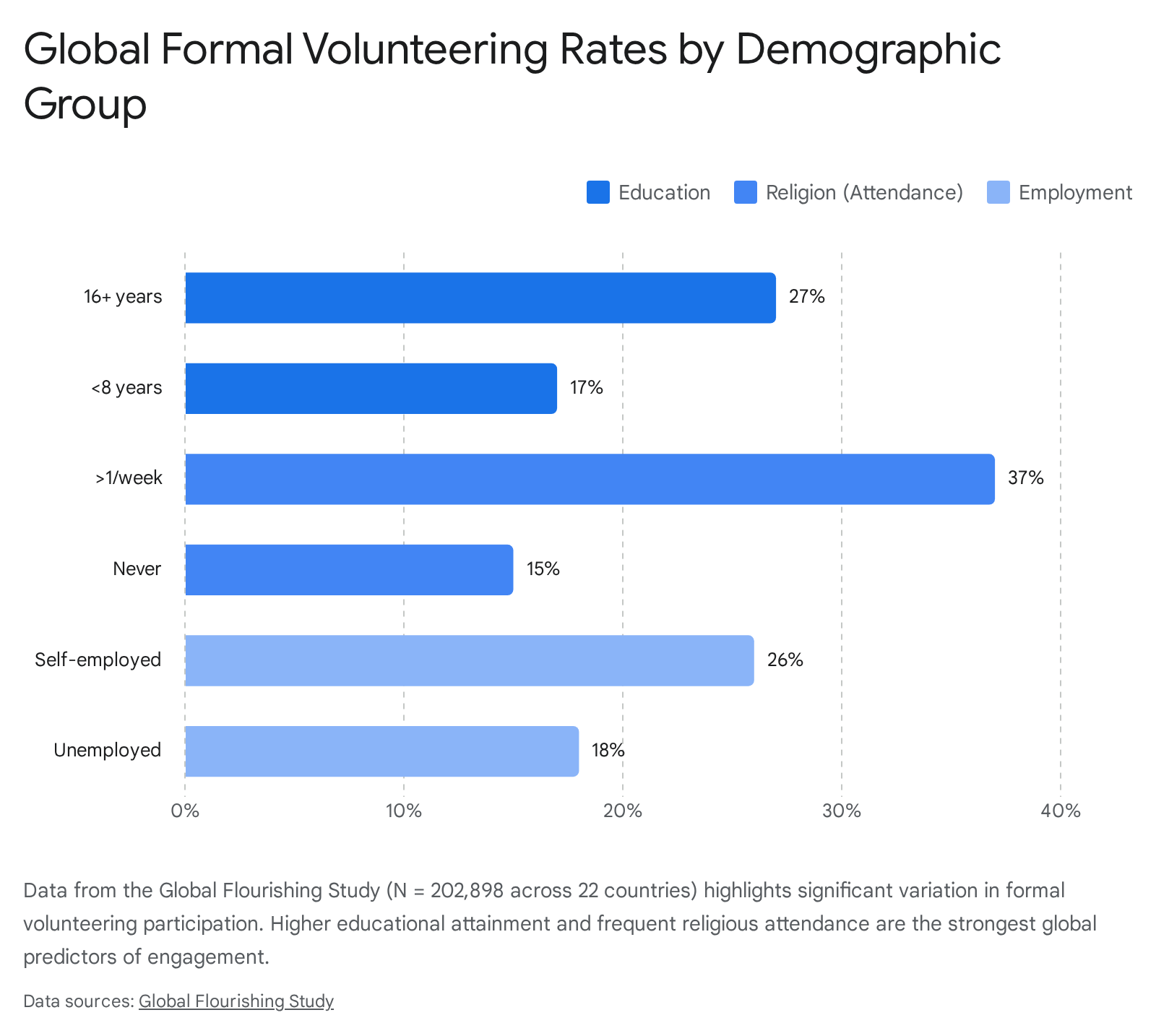
Cross-cultural studies indicate that the structure and frequency of volunteering vary significantly depending on national wealth, institutional frameworks, and cultural values. Data from the 2025 Global Flourishing Study (GFS), which analyzed over 202,000 individuals across 22 nations, revealed stark variations in formal volunteering rates based on demographics 36.
The GFS data established that educational attainment and religious attendance are the strongest global predictors of formal volunteering. Individuals with 16 or more years of education volunteered at a rate of 0.27 compared to 0.17 for those with under 8 years, while those attending religious services more than once a week volunteered at a rate of 0.37 compared to 0.15 for those who never attend 36.
Cultural Context and Institutional Trust
Geographic mapping of the GFS data demonstrated the highest unadjusted proportions of formal volunteering in Nigeria (0.51), Indonesia (0.46), and Kenya (0.40), while significantly lower rates were recorded in Japan (0.09), Poland (0.08), and Egypt (0.04) 36. The robust rates of volunteering in several Global South nations challenge the traditional paradigm that formal volunteering is predominantly a luxury of affluent Western societies.
However, studies investigating the link between volunteering and well-being across differing cultures yield complex results. A cross-national analysis of the European Social Survey demonstrated that individuals in nations with historically low frequencies of volunteering actually report higher relative levels of happiness when they do volunteer, compared to their counterparts in high-volunteering nations. This suggests that the rarity of the behavior may amplify its psychological reward 3738. Furthermore, in non-Western contexts such as Saudi Arabia, empirical studies show that volunteering significantly boosts social connectedness but does not consistently yield direct, significant impacts on overall subjective well-being or loneliness, implying that cultural definitions of civic duty alter the psychological return on investment 1939.
To analyze these complex phenomena, researchers rely on a diverse array of longitudinal datasets, each offering distinct methodological advantages:
| Longitudinal Dataset | Primary Geographic Focus | Key Methodological Contributions to Prosocial Research |
|---|---|---|
| English Longitudinal Study of Ageing (ELSA) | United Kingdom | Tracks post-retirement populations; differentiates between formal and informal volunteering impacts 5. |
| Health and Retirement Study (HRS) | United States | Integrates biomarker data (epigenetic clocks) with self-reported helping behaviors over a 20-year span 1617. |
| UK Biobank | United Kingdom | Combines genetic, physiological (HRV), and psychosocial data to map non-linear pathways of well-being and ill-being 2425. |
| Survey of Health, Ageing and Retirement (SHARE) | 15 European Nations | Utilizes generalized estimating equations to confirm bidirectional feedback loops between health and volunteering 6. |
| British Household Panel Survey (BHPS) | United Kingdom | Provides vast multi-decade data allowing for first-difference estimations to strictly control for reverse causality 33233. |
The Impact of Systemic Disruptions
The COVID-19 pandemic provided an unprecedented natural experiment for longitudinal researchers studying prosocial behavior. The crisis disrupted traditional, formal volunteering pathways while simultaneously catalyzing informal, mutual-aid networks.
Pandemic-Induced Shifts in Prosociality
Data from the German Ageing Survey and other panel studies revealed that the proportion of older adults engaging in formal volunteering dropped significantly during the pandemic 4140. Despite this reduction, those who managed to initiate or maintain volunteering during lockdowns experienced a protective buffering effect against the severe spikes in loneliness and social exclusion that characterized the period 41.
The Avon Longitudinal Study of Parents and Children (ALSPAC) and similar cohorts documented that while negative well-being increased broadly across populations, prosocial behavior acted as a mitigant 41. However, the pandemic context also severely tested the limits of the helper's high. In nations with disjointed public health responses, community volunteers and informal caregivers often faced extreme role overload and exposure to trauma, leading to high rates of burnout and eroding the typical well-being benefits associated with service 424344. This systemic disruption reinforced the premise that the psychological benefits of volunteering are highly dependent on the stability and safety of the environment in which the service is rendered.
Clinical Integration and Policy Applications
Given the robust longitudinal evidence linking volunteering to physical and psychological flourishing, public health systems are increasingly integrating community service into clinical practice.
The Efficacy of Social Prescribing
Social prescribing is a person-centered healthcare framework wherein medical professionals refer patients to non-clinical, community-based services - including volunteering - to address the social determinants of health 4546. By recognizing that loneliness, lack of purpose, and social isolation are primary drivers of chronic disease, social prescribing operationalizes the findings of longitudinal volunteering research.
A nationwide longitudinal analysis in the UK of patients referred to social prescribing programs (which frequently feature volunteer placements) demonstrated sizeable and consistent improvements in well-being. Within one to six months following referral, patients exhibited a 3.31-point increase on the short Warwick-Edinburgh Mental Wellbeing Scale (SWEMWBS), alongside significant decreases in clinical anxiety 47. The economic implications are equally compelling; improvements in life satisfaction derived from social prescribing interventions generate a conservative monetary equivalent of £4,252 per individual over 2.5 months, representing an estimated return on investment of £9 for every £1 invested by the healthcare system 4750.
Structuring Sustainable Community Interventions
Social prescribing mitigates systemic healthcare burdens. Participants in community-based prescribing programs, particularly older adults, exhibit lower hospital admission rates and a higher likelihood of maintaining physical independence 48. By formalizing volunteering as a medical intervention, health systems not only support the operational capacity of the non-profit sector but systematically deploy the neurobiological and psychological benefits of altruism to combat the modern epidemics of loneliness and cognitive decline.
However, the longitudinal data suggests that policymakers must approach volunteer integration with caution. Mandating volunteer hours for employment benefits or educational requirements risks undermining the autonomy that generates eudaimonic well-being 2223. Sustainable interventions must focus on removing the physical and socioeconomic barriers to volunteering - such as transportation constraints or lack of flexible scheduling - while ensuring that roles are meaningful, manageable, and adequately supported to prevent burnout 3052.
Conclusion
The assertion that volunteering is a "secret to happiness" transcends anecdotal optimism; it is grounded in a vast, rigorously verified body of longitudinal data. By employing sophisticated econometric models to adjust for self-selection bias, researchers have established a clear, quasi-causal pathway linking prosocial behavior to enhanced subjective well-being, reduced depressive symptoms, and prolonged physical and cognitive vitality.
The mechanisms driving this phenomenon are deeply rooted in human biology and psychology. Volunteering activates the mesolimbic reward system, buffers the inflammatory effects of chronic stress, and fulfills the basic psychological needs of autonomy, competence, and relatedness. However, the data also provides a crucial caveat: volunteering is not a panacea. Its benefits are subject to strict dosage thresholds, lifecourse variations, and organizational contexts. When pursued in moderation - approximately two to four hours a week - within a supportive environment that fosters genuine connection and appreciation, volunteering serves as a profound catalyst for human flourishing. When demanded without resources, it leads to burnout. Ultimately, longitudinal evidence confirms that the human imperative to assist others is inextricably linked to our own psychological and physiological resilience.