Long-Term Societal Effects of Pandemic Isolation
Introduction to the Post-Pandemic Social Landscape
More than half a decade after the onset of the COVID-19 pandemic, sociological, epidemiological, and educational data indicates that global populations are grappling with a persistent, multifaceted deficit in social capital and mental well-being. While macroeconomic indicators in several developed nations suggest a robust economic recovery, the social and psychological metrics outline a vastly different reality. The pandemic operated not merely as a temporary disruption, but as an exogenous shock that fractured institutional trust, accelerated the digitization of human interaction, and imposed prolonged social isolation. The consequences of this rupture have crystallized into what researchers increasingly identify as a structural condition rather than a temporary behavioral anomaly.
Sociologists differentiate between a "normal crisis," characterized by cyclical, structural patterns that yield incremental change, and a "singular crisis," marked by eruptive ruptures to the prevailing social order 1. As a singular crisis, the pandemic fundamentally altered the baseline of human connection 1. Social isolation, chronic loneliness, and associated mental health disorders have not receded to their pre-2020 baselines; instead, they have plateaued at elevated levels, fundamentally altering the fabric of communities, workplaces, and educational institutions 23. The prevailing analytical framework in medical sociology has shifted accordingly, moving from viewing isolation as an acute, individual pathology to recognizing it as an entrenched, structural feature of the modern social environment shaped by public policy, urban infrastructure, and digital saturation 456.
Divergence of Economic and Social Recovery Trajectories
To understand the long-term effects of the pandemic, it is necessary to contrast economic resiliency with the concurrent social and emotional recessions. In terms of economic output, aggressive fiscal stimulus packages allowed several nations to avoid the persistent economic scarring that followed previous global crises, such as the 2008 financial crisis 7. The United States, for instance, experienced strong labor participation and investment rebounds relative to its G10 peers, actively preserving payrolls and providing generous financial support to households 7.
The COVID Economic Recovery Index (CERI), which assesses absorptive capacity, economic agility, and health resilience across 122 nations, illustrates this rapid macroeconomic stabilization 89.
| Global Rank | Country | CERI Score | Absorptive Capacity | Economic Agility | Health Resilience |
|---|---|---|---|---|---|
| 1 | Finland | 79.03 | 73.18 | 81.38 | 82.52 |
| 2 | Norway | 77.30 | 72.83 | 81.46 | 77.61 |
| 3 | Germany | 76.28 | 72.78 | 78.75 | 77.31 |
| 7 | United States | 73.71 | 66.95 | 78.98 | 75.20 |
| 10 | Sweden | 72.84 | 65.56 | 80.76 | 72.19 |
| 13 | United Kingdom | 71.79 | 61.98 | 77.01 | 76.36 |
| 14 | New Zealand | 71.75 | 74.47 | 76.66 | 64.13 |
Despite high rankings in economic agility, the populations within these nations face a documented decline in social integration. The rapid economic recovery did not translate into a restoration of community health or social trust 310. A global analysis tracking adults across 166 countries from 2019 to 2024 documented an "emotional recession," identifying a nearly 6% decline in global emotional intelligence scores and a 5% drop in overall subjective well-being 3. This divergence suggests that while gross domestic product and employment figures have normalized, the psychological and relational infrastructure of the population remains heavily damaged.
Global Prevalence of Social Isolation and Loneliness
The empirical tracking of global social isolation indicates that the disruptions of 2020 acted as an accelerant for an already simmering crisis. The World Health Organization (WHO) and various international public health bodies have formally recognized loneliness and isolation as pressing global health threats, elevating them to the level of epidemiological emergencies 89.
Longitudinal Trends in Objective Social Isolation
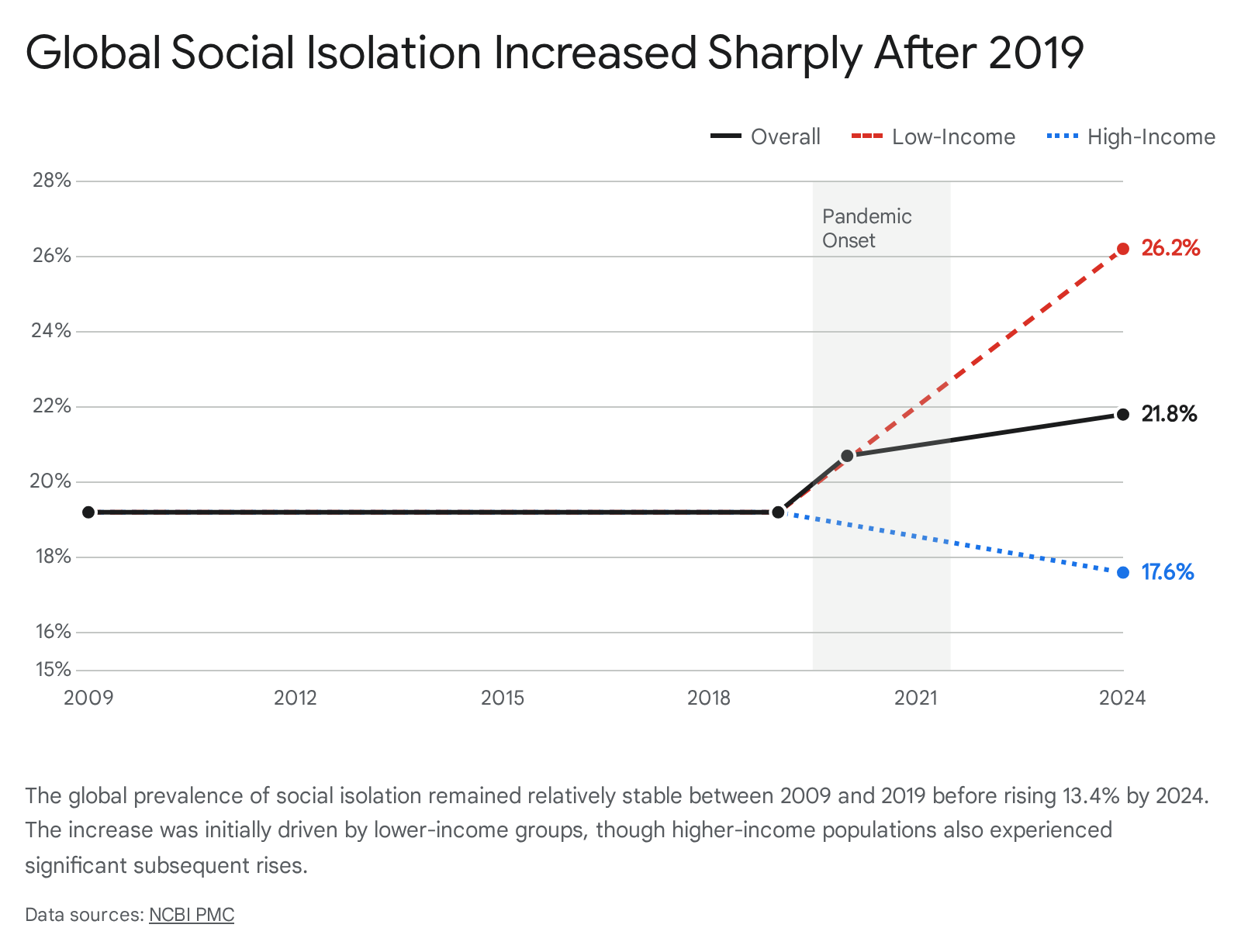
Prior to the pandemic, between 2009 and 2019, the global mean prevalence of social isolation - defined rigorously in longitudinal studies as the proportion of respondents who lack relatives or friends available to help in times of trouble - remained stable at approximately 19.2% 2. However, this stability was shattered post-2019. The entire increase in contemporary global social isolation occurred after 2019 2.
By 2024, the global prevalence of social isolation had climbed to 21.8%, representing a 13.4% relative increase from 2009 baseline levels 2. This trajectory reveals significant socioeconomic disparities. Between 2019 and 2020, the initial spike in isolation (a 7.7% relative increase) was driven primarily by lower-income demographic groups, who experienced an 11% surge in isolation prevalence 2. As the decade progressed into 2024, the phenomenon broadened across all socioeconomic strata, with higher-income groups eventually recording a steep 12.3% increase in their isolation levels 2.
Despite the eventual broadening of the trend, a substantial socio-economic gap remains entrenched. As of 2024, 26.2% of lower-income individuals report experiencing social isolation, compared to 17.6% of higher-income individuals, maintaining an 8.6 percentage point income disparity in social connectivity 2.
Subjective Loneliness and Global Health Burden
While social isolation measures objective connectivity, loneliness reflects the subjective, painful experience of a deficit in desired social contact 10. Organization for Economic Co-operation and Development (OECD) data from 2025 indicates a complex reality: while most people (95%) report at least one interaction with nearby friends or family weekly, high interaction frequency does not necessarily correlate with lower loneliness 11. On average, 6% of the population across 25 OECD countries reported experiencing loneliness "most or all of the time," with rates ranging from 3% to 11% depending on the country (e.g., 8.3% in Mexico) 11. Among those experiencing loneliness in Europe, 43% characterized the feeling as "very intense" 11.
The WHO Commission on Social Connection reported in 2025 that approximately one in six people worldwide experienced severe loneliness over the prior decade 91015. The health implications are severe. The U.S. Surgeon General and the WHO equate the mortality impact of persistent loneliness to smoking 15 cigarettes a day, noting that isolated individuals face a twofold risk of mortality compared to well-connected peers 812. Globally, loneliness is linked to an estimated 871,000 deaths annually - roughly 100 deaths every hour 81015. Chronic loneliness increases the risk of type 2 diabetes, coronary heart disease, stroke, dementia, and substance use disorders 81015.
Demographic Disparities in Loneliness
The demographic distribution of loneliness counters historical assumptions that it is primarily an affliction of the elderly. While 11.8% of older adults experience loneliness, rates are significantly higher among youth and young adults 910. A 2026 cross-national study of eight countries revealed that nearly 40% of all adults reported feeling lonely; however, among those aged 18 to 24, the figure approached 50%, compared to approximately 30% for adults aged 55 and older 12.
Furthermore, prevalence varies sharply by geography and economic status. Approximately 24% of populations in low-income countries reported feeling lonely, which is double the rate observed in high-income countries (11%) 10. Women, unmarried individuals, urban residents, and those with lower educational attainment also reported disproportionately higher levels of loneliness 812.
Projections and Prevalence of Mental Health Disorders
The downstream consequences of chronic isolation and loneliness manifest in surging rates of clinical mental health disorders. The correlation is robust: individuals reporting loneliness exhibit almost three times the odds of meeting the screening criteria for clinical depression and nearly four times the odds for generalized anxiety 12.
The Surge in Anxiety and Depressive Disorders
Analyses of the Global Burden of Disease (GBD) study reveal profound temporal shifts in psychiatric epidemiology. Between 1990 and 2021, the age-standardized disability-adjusted life years (DALY) rate for anxiety disorders increased globally by 18.2%, and for depressive disorders by 13.4% 13. The pandemic triggered a sharp inflection point within this timeline. In 2020 alone, researchers estimated an additional 53.2 million cases of anxiety and 76.2 million cases of major depressive disorder worldwide, strongly associated with decreased human mobility and high infection rates 14.
By 2021, the global prevalence of anxiety and depressive disorders had reached 359.2 million and 332.4 million cases, respectively, accounting for 63.1% of all mental health disorders and 9.1% of all diseases globally 13.
Sociodemographic Disparities in Mental Health Burdens
The burden of these disorders is not distributed equally. Epidemiological trends emphasize significant disparities across demographic and socioeconomic dimensions.
- Age: The prevalence of anxiety disorders peaks sharply among adolescents and young adults aged 10 - 24, while depression tends to peak slightly later, often in the 30 - 39 age bracket within higher-income nations, and 20 - 29 in lower-income nations 131415.
- Gender: Females consistently carry a higher disease burden than males for both anxiety and depressive disorders. During the first year of the pandemic, women accounted for almost 52 million of the additional anxiety cases and over 35 million of the additional depression cases globally 1415161718.
- Socioeconomic Status (SDI): Middle and low Socio-Demographic Index (SDI) regions contribute the majority of global cases and DALYs 13. High-SDI regions record the highest age-standardized rates for anxiety, whereas low-SDI regions experience the highest rates for depression 18.
Forecasting the 2040 Global Mental Health Burden
The trajectory of these disorders indicates that the world is not simply recovering to pre-2019 levels. Using Autoregressive Integrated Moving Average modeling on historical GBD data, researchers forecast continuous growth in mental health morbidity 13. Projections indicate that by 2040, global cases will exceed 515 million for anxiety and 466 million for depressive disorders 13. Population growth and aging account for a substantial portion of this increase, but the underlying epidemiological changes - driven by persistent isolation and structural social deficits - remain a critical accelerating factor 13.
The Erosion of Social Capital and Friendship Networks
The macroscopic epidemiological data regarding isolation is mirrored by granular shifts in personal relationships, resulting in what researchers term a "friendship recession" 19. The fundamental architecture of human connection has undergone a profound contraction over the last three decades, permanently altering the volume and quality of close interpersonal ties. The pandemic accelerated this contraction, and subsequent measurements in 2024 and 2025 demonstrate no aggregate recovery in network size 24.
The Contraction of Close Friendships
Longitudinal survey data, primarily from the United States, highlights a dramatic shrinking of personal social networks. In 1990, 33% of U.S. adults reported having 10 or more close friends; by 2024/2025, that figure had fallen to 13% 1925. Most critically, the percentage of adults reporting zero close friends quadrupled over the same period. While only 3% of Americans reported having no close friends in 1990, the figure climbed to 12% in 2021, and expanded further to 17% in 2024 (when explicitly excluding close relatives from the definition) 192425.
Globally, the average person maintains 4 to 5 close friends. However, in the U.S., the average has fallen to roughly 3.8, with recent surveys indicating the median is now heavily weighted between 3 and 5 252027. While individuals may navigate through their lives making an average of 29 friends over time, only around 6 stand the test of time, and the average lifespan of a friendship is roughly 17 years 25. The modern social environment appears less conducive to maintaining these long-term bonds.
Gender and Educational Disparities in Social Networks
The contraction in friendship networks displays stark variations across gender and educational attainment, illuminating the structural nature of the decline.
| Demographic Group | Metric (Survey Year vs. Historic Baseline) | Data Point |
|---|---|---|
| Men (U.S.) | 6 or more close friends (1990 vs. 2024) | Dropped from 55% to 27% 20. |
| Men (U.S.) | Zero close friends (Recent) | 15% report no close friends 20. |
| Young Men (<30) | Zero close friends (Recent) | 28% report no close friends 20. |
| Women (U.S.) | 6 or more close friends (1990 vs. 2024) | Dropped from 41% to 24% 20. |
| Education Level | Zero close friends (High School or less) | 24% report no close friends 24. |
| Education Level | Zero close friends (College Graduates) | 10% report no close friends 24. |
The collapse in male friendships is particularly acute. Over half of American men in 1990 reported maintaining six or more close friendships; today, fewer than three in ten say the same 20. Younger men under 30 face the highest rates of total isolation, with 28% reporting zero close friends 20.
Furthermore, an educational disparity has emerged that was virtually non-existent three decades ago. In 1990, nearly half (49%) of Americans with a high school degree or less reported having at least six close friends, slightly higher than those with a college degree 24. Today, the trend has reversed dramatically. Americans without college degrees are now over twice as likely to have zero close friends (24%) compared to college graduates (10%) 24. This shift highlights how social capital is increasingly tied to economic and educational privilege in the post-pandemic era.
The Loss of Incidental Contact and Weak Ties
The mechanisms driving this social contraction extend beyond the direct restrictions of the pandemic lockdowns. Researchers point to a severe, long-term reduction in time spent socializing in person. From 2014 to 2019, the time Americans spent with friends dropped from a long-standing historical average of 6.5 hours per week to just 4 hours per week 19. Among teenagers, the decline is precipitous: down to 40 minutes a day outside of school hours, compared to 140 minutes two decades ago 19. Simultaneously, the average time spent at home by American adults rose by 1 hour and 39 minutes per day between 2003 and 2022 19.
Sociologists attribute the mental health consequences of this withdrawal to the loss of "bridging capital" and "weak ties" - the low-stakes, face-to-face interactions with acquaintances, neighbors, and strangers 28. The decay of "third spaces" (community centers, local commerce, public parks) and the rise of the gig economy have stripped away the physical infrastructure required for organic social interactions 19. While digital platforms facilitate connections within insular, like-minded groups, they fail to replicate the "ontological security" - a fundamental sense of world stability - provided by continuous, low-stakes community interactions 28.
Structural Shifts in the Workplace and Emotional Recession
The pandemic forced an unprecedented transition to remote and hybrid work models. Initially heralded as an expansion of worker autonomy and flexibility, the long-term evaluation of telework reveals significant psychosocial costs. The normalization of the remote workplace has contributed heavily to a broader societal "emotional recession" - defined as a sustained, measurable global decline in emotional intelligence, empathy, and internal motivation 3.
Telework and the Erosion of Professional Socialization
The absence of physical interaction and structured social environments in remote work settings exacerbates feelings of detachment, contributing to emotional strain and reduced job performance 21. The psychological consequences of professional isolation are profound, with remote workers frequently experiencing higher risks of depression, anxiety, stress, and burnout 2122. A 2025 analysis indicated that loneliness is the leading challenge for 28% of remote workers, translating to almost one in three professionals quietly struggling with disconnection despite the presence of constant digital communication, screen time, and productivity applications 22.
Prolonged physical distance from the workplace removes the spontaneous social interactions that traditionally buffered emotional exhaustion 21. When these seemingly insignificant interactions disappear, workers lose a critical layer of emotional safety, leading to occupational conditions such as burnout (exhaustion from overinvestment) or boreout (exhaustion from under-stimulation and boredom) 2122. Consequently, 67% of all workers recently reported experiencing at least one outcome associated with workplace burnout within the last month, such as a lack of interest, motivation, energy, or effort at work 23.
The Generational Paradox of Workplace Isolation
An examination of workplace loneliness reveals a complex demographic paradox between the absolute frequency of stress and the relative perception of social loss.
In absolute terms, younger workers report the highest levels of loneliness and stress. According to a 2024 American Psychological Association workplace survey, younger workers are significantly more likely to feel lonely while working compared to older generations: 45% of workers aged 18 - 25 report feeling lonely, compared to 33% of those aged 26 - 43, and only 14% for workers aged 65 and older 23. Similarly, 48% of the youngest cohort typically feel tense or stressed during the workday, a figure that drops to 17% for the oldest cohort 23. Younger workers also report acute feelings of being undervalued, with 48% of the 18 - 25 cohort stating that older colleagues do not see value in their ideas 23.
However, when measuring the subjective impact and the perceived loss of social connectivity due to remote work, older employees suffer disproportionately. Studies focusing on the transition to remote work indicate that employees over the age of 55 are nearly twice as likely as those aged 16 to 24 to state they felt the social loss of teleworking 24. For aging populations, the workplace historically served as a primary social hub. The loss of this environment carries extra weight for older adults who already face dwindling social networks outside of work, heightened financial challenges, and increased vulnerability to the health risks associated with sedentary habits 24. Thus, while younger workers experience higher absolute stress in the modern work environment, older remote workers experience the sharpest deprivation of previously established social capital.
The Broader Decline in Global Emotional Intelligence
The erosion of workplace connectivity runs parallel to a wider societal trend. Data tracked from 28,000 adults across 166 countries from 2019 to 2024 showed a near 6% decline in global emotional intelligence scores 3. This emotional fog manifests as an erosion of trust, empathy, and the ability to navigate life collaboratively. The 2026 Edelman Trust Barometer highlights this fracture, noting that 70% of people globally now hold an "insular mindset," meaning they are hesitant to trust individuals with different values, problem-solving approaches, or cultural backgrounds 328.
Educational Disruption and the Stall in Academic Recovery
Perhaps the most universally acknowledged structural consequence of the pandemic is the massive disruption to global education. Five years after the onset of school closures, the anticipated "catch-up" of student achievement has failed to materialize at the necessary scale, resulting in a persistent educational deficit 252627. The academic toll remains widespread, characterized by modest gains in reading and even slower progress in mathematics 25.
Plateauing Academic Achievement and Widening Gaps
Data drawn from over 11 million K - 8 students in the 2024 - 2025 school year confirms that national academic progress has essentially stalled. Achievement levels have remained flat since the spring of 2023, with only a slight uptick observed by spring 2025 2526. The average American student remains nearly half a grade level behind in both math and reading compared to pre-pandemic benchmarks 28.
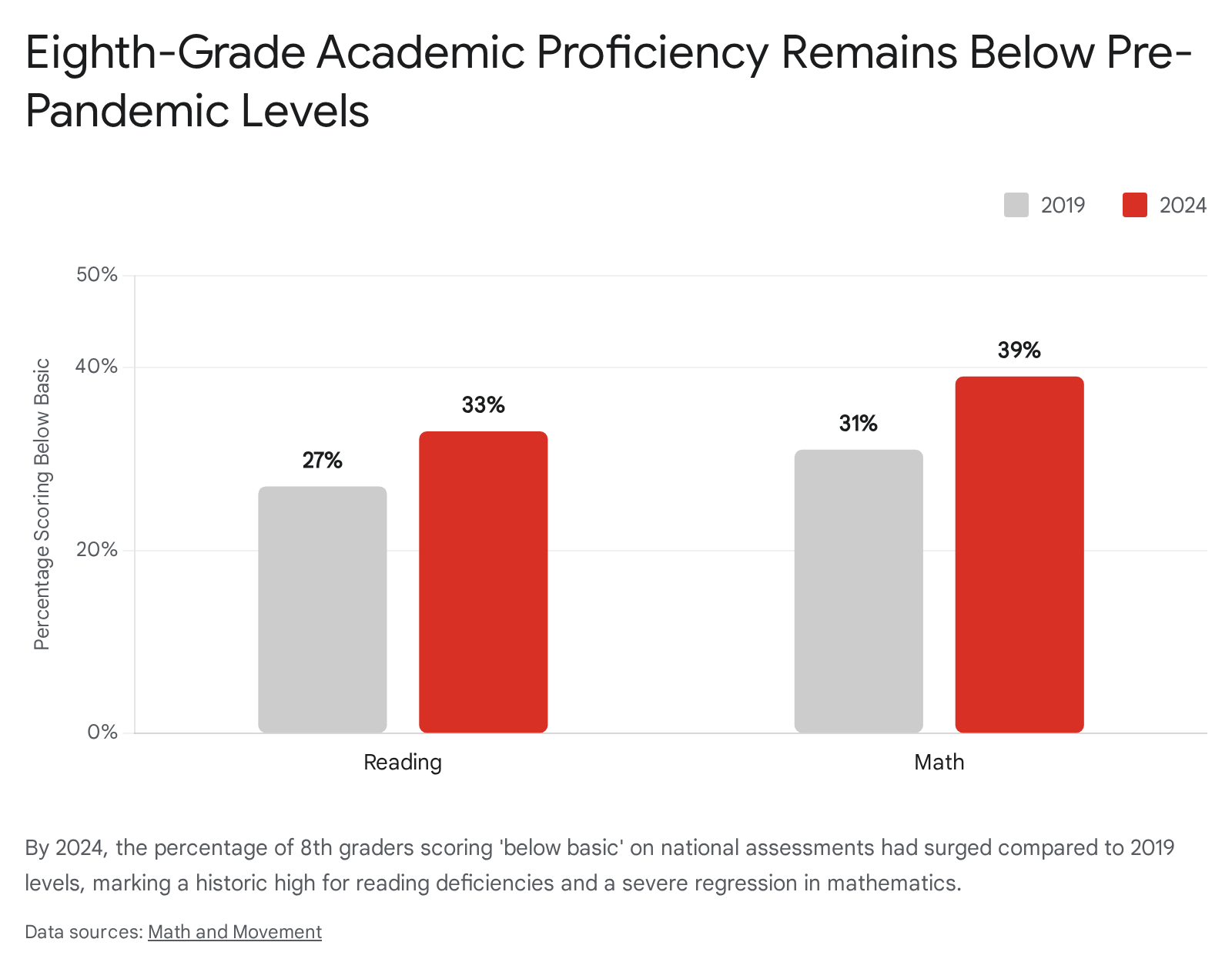
The recovery has been highly uneven, exacerbating historical inequities. High-performing students have largely recovered or even surpassed their 2019 baselines; conversely, students in the bottom percentiles, particularly those historically underserved, continue to fall further behind 2629. National Assessment of Educational Progress (NAEP) data from 2024 revealed that 33% of eighth graders scored "below basic" in reading - the highest percentage in the test's 30-year history - while math saw 39% score "below basic," an eight-point increase from 2019 28.
Younger cohorts were severely impacted: students who were in kindergarten and first grade during the school closures exhibited the largest drops in achievement, hindered during the critical developmental window for foundational literacy 2628. A 2025 report assessing recovery state-by-state revealed that only 8% of states have fully recovered their math scores, while in English Language Arts, more than one-third of states showed minimal change and another 19% experienced continued decline 29.
Chronic Absenteeism as a Structural Barrier
A primary driver of stalled academic recovery is the unprecedented surge in chronic absenteeism, which fundamentally alters the efficacy of any educational intervention 2830. Between the 2018 - 2019 and 2021 - 2022 school years, national absenteeism rates nearly doubled across 11,000 U.S. school districts, jumping from 16% to 30% 28. Fully remote learners were disproportionately affected, with absenteeism rates significantly higher than in-person students 28. The crisis was most severe in high-poverty areas, where the rate of extreme chronic absenteeism nearly tripled 30.
While rates have slightly declined from their pandemic peak, they remain elevated far above historical norms. In California, for example, the chronic absenteeism rate remains highly concerning, imposing a calculated economic burden of $5,630 per chronically absent student on the broader community 31. The causes are multifaceted, rooted in socio-emotional challenges, poverty, lowered parental engagement, and a fundamental detachment from the institutional routine of schooling 30.
Efficacy Limitations of Catch-Up Interventions
In response to the educational crisis, governments deployed unprecedented funding - such as the $190 billion in federal COVID-19 relief aid in the U.S. - directed toward "learning acceleration" strategies 2527. The evaluation of these interventions by 2025 and 2026 reveals a severe limitation in scalability and long-term efficacy.
Meta-analyses of post-pandemic catch-up programs show that highly targeted, subject-specific tutoring can yield positive short-term results. Participants in specific tutoring programs achieved significantly higher grades compared to non-participants (Hedges' g = 0.21) 32. Furthermore, a meta-analysis of out-of-school learning settings demonstrated a statistically significant, medium-to-large effect (g = 0.529) on student achievement, particularly in elementary science and social sciences 33.
However, the impact of high-intensity interventions dilutes significantly when applied at a mass district scale. Challenges in implementation fidelity, staffing shortages, and low student participation rates meant the recovery efforts were rarely intensive enough to bridge the massive learning gaps 2734. More concerningly, a 2026 longitudinal meta-analysis of the widespread "Reading Recovery" intervention found negligible and statistically insignificant long-term effect sizes. For assessments taken more than four years after the intervention, the mean effect size was actually negative (-0.29), suggesting the approach is not currently an effective long-term strategy for literacy intervention at scale 35. As federal pandemic aid (such as ESSER funds) expires, schools are reverting to pre-pandemic practices while still grappling with persistent learning losses and newly inflated absenteeism 2729.
The Paradox of Digital Connectivity
The sociological impact of the pandemic cannot be evaluated without accounting for the concurrent explosion in digital networking. The "new normal" of 2025 and 2026 relies profoundly on digital infrastructure to mediate human connection 36. However, the data reveals a stark paradox: as digital connectivity reaches total global saturation, subjective social isolation has simultaneously peaked.
The Unprecedented Scale of Social Media Adoption
The scale of digital networking is historically unprecedented. By April 2026, global active internet users reached 5.79 billion, with social media penetration hitting 69.9% of the world's total population and roughly 94.7% of the world's internet users 374638. The growth rate, while slowing compared to the mid-2010s, continues to add hundreds of millions of new users annually, largely driven by expanding smartphone access in developing regions 3739.
The average social media user engages with roughly 6.5 different platforms monthly and spends an average of 7 hours and 5 minutes per week on these networks 37464940. However, the nature of this digital engagement is shifting away from peer-to-peer connection. Video-first applications - such as TikTok, YouTube Shorts, and Instagram Reels - now account for 58% of the time spent on social media 40. These platforms function primarily as algorithmic entertainment and news broadcasting channels rather than facilitators of reciprocal social interaction 3841.
Limitations of Digital Bonding and Tele-Everything
Despite an infrastructure engineered for constant connection, digital ties are failing to replace the psychosocial benefits of physical interaction. Sociological surveys demonstrate clear age-based preferences for digital versus in-person friendships.
| Age Group | % Reporting Online Friends | % Preferring In-Person Friendship |
|---|---|---|
| Teens (13 - 17) | 57% | 43% |
| Young Adults (18 - 29) | 48% | 52% |
| Adults (30 - 49) | 32% | 68% |
| Adults (50+) | 17% | 83% |
As the survey data 20 indicates, while digital ties dominate among youth, they remain secondary to in-person friendships regarding emotional fulfillment, and the preference for in-person ties increases dramatically with age. Furthermore, nearly 40% of Americans now maintain online-only friendships, yet these relationships require vastly different social behaviors and do not offer the same protective health benefits as physical proximity 19.
The Pew Research Center's early pandemic predictions regarding a "tele-everything" world accurately foresaw the broad adoption of remote processes, but also correctly anticipated the downside: a society sharply divided by access, characterized by diminished in-person contact, constricted real-world support systems, and deteriorated social cohesion 36. Digital networks, by facilitating hyper-specific "bonding" among identical demographics, have actively eroded the diverse "bridging" capital required for a cohesive, trusting society 28.
Social Network Diversity and Infection Risk Tradeoffs
The tension between digital safety and physical interaction is perfectly encapsulated by epidemiological data regarding Social Network Diversity (SND). A large-scale longitudinal cohort study from Japan (JACSIS) conducted between 2020 and 2023 demonstrated a complex relationship between maintaining diverse social networks and health risks during a pandemic 4243.
Predictably, higher social network diversity naturally increased the objective risk of COVID-19 infection; individuals with the highest SND scores had a relative risk of 2.49 for contracting the virus compared to those with the lowest scores 4243. However, the association between SND and disease severity followed a U-shaped pattern. Individuals with moderate network diversity exhibited the lowest risk of severe disease (defined as oxygen-requiring admission) 4243. This highlights a fundamental public health paradox: while physical social contact carries infectious risks, the complete absence of social support carries severe physical morbidity risks, suggesting a complex biological trade-off between exposure and the immunological benefits of social integration 43.
Sociological Frameworks and Policy Responses
The persistence of pandemic-era social deficits requires a shift in how institutions conceptualize and treat isolation. Historically, medical sociology viewed isolation through an individualized, pathological lens - diagnosing the isolated individual as lacking social skills, enjoying solitude to a fault, or possessing personal psychological deficits 4544. However, the current landscape demands a structural approach.
Moving from Pathological to Structural Conceptualizations
Foundational research in medical sociology demonstrates that health outcomes and social integration are heavily determined by structural forces, including access to resources, neighborhood infrastructure, social class, and policy decisions 46. The ethnographic study of highly isolated populations reveals a tension between a deep individual desire for social integration and an environment dense with physical and economic obstacles 6.
Chronic isolation is therefore increasingly understood not as an individual failing, but as a byproduct of environmental and structural barriers. The decline of physical third spaces, the economic necessity of remote work, suburban sprawl, and underfunded community infrastructure are the root causes of the modern isolation epidemic 619. Treating isolation requires looking beyond individual therapy to the structural environments that dictate daily human interaction.
The Emergence of Social Prescribing as a Systemic Intervention
In response to the structural nature of modern isolation, global healthcare systems are increasingly adopting "social prescribing." Social prescribing is a non-clinical intervention where healthcare professionals refer patients to community-based activities - such as arts initiatives, walking groups, men's sheds, language classes, or volunteering opportunities - specifically designed to address the social determinants of health 45564647.
By 2025, social prescribing models had expanded to over 30 countries across Europe, Asia, Australia, and North America 56. In the United Kingdom, it is already integrated into the universal healthcare system, and initiatives like the ASPIRE collaborative in Australia are working to build scalable, culturally responsive social prescribing ecosystems 46. The approach acknowledges that clinicians cannot simply medicate loneliness; they must actively connect patients to community infrastructure 4648.
Evidence indicates that integrating social prescriptions into care plans can improve quality of life, reduce the economic pressures of chronic disease on healthcare systems, and actively foster the bridging social capital that digital networks fail to provide 5646. However, researchers note that the success of social prescribing is highly dependent on addressing systemic equity; without robust funding, adequate workforce training, and accessible community programs, social prescribing risks benefiting only resource-rich demographics, unintentionally excluding those who might benefit the most 56.
Conclusion
The evidence aggregated across sociological, educational, and epidemiological research unequivocally demonstrates that global society is still struggling to recover from the long-term effects of pandemic-era isolation. While economic indicators in several nations may project resilience, the social infrastructure remains deeply fractured. The transition to a highly digitized, remote-oriented "new normal" has precipitated a structural emotional recession, marked by shrinking friendship networks, stalled academic achievement, and historically high rates of global loneliness and mental health disorders.
The data confirms that the isolation born of the pandemic was not a temporary aberration that resolved upon the lifting of lockdowns, but rather a singular crisis that fundamentally lowered the baseline of human connection. The resulting deficits in social capital, educational attainment, and emotional intelligence have proven resistant to short-term, small-scale interventions. Moving forward, reversing these trends will require policymakers, educators, and healthcare providers to fully shift away from viewing isolation as a private pathology. Recovery depends on recognizing social connection as a critical, structural public health infrastructure that requires deliberate, large-scale investment, systemic reform in workplaces and schools, and a concerted effort to rebuild the physical and social bridges that digital connectivity has failed to replace.