
LinkedIn algorithm mechanics and content distribution in 2026
The landscape of professional content distribution underwent a fundamental restructuring between late 2024 and early 2026. Previously, organic visibility on LinkedIn was governed by social proximity - the principle that a user's feed was primarily populated by the activities of their immediate network connections. By 2026, organic reach metrics shifted dramatically as the platform transitioned toward an interest-based distribution model powered by a unified large language model ranking system 123.
This report details the architectural changes to the LinkedIn algorithm in 2026, the specific weighting of engagement signals, the platform's handling of content formats, the mechanics of suppression and penalties, the performance divide between personal profiles and company pages, and regional distribution variances.
Algorithm Architecture and the 360Brew Model
The most significant structural change to LinkedIn's algorithmic distribution in 2026 is the deployment of a system internally referenced as 360Brew 134. Prior to this update, LinkedIn utilized thousands of specialized, siloed ranking models running in parallel to populate feeds, recommend jobs, and suggest connections 34. These legacy systems included separate infrastructures for chronological network activity, geography-filtered trending content, collaborative filtering, and embedding-based retrieval 4.
The 360Brew model replaced these parallel pipelines with a unified, 150-billion-parameter decoder-only transformer system 36. Trained extensively on LinkedIn's proprietary professional networking data, this large language model translates user profiles and individual posts into dense mathematical representations within a shared semantic space 4.
This transition fundamentally altered how content is matched to users. Rather than relying on simple keyword overlap or chronological recency, the algorithm utilizes GPU-accelerated semantic search to pair posts with members based on deep contextual relevance 4. As a result, the feed functions more like an interest-based discovery engine. Content is distributed to users who consistently engage with specific professional niches, regardless of whether they follow the author or exist within the author's first-degree network 75.
The practical outcome of this architectural shift is the migration from a "Social Graph" to an "Interest Graph" 1. The algorithm calculates distribution based on a user's "Topic DNA" 6. The system processes historical interaction data - evaluating over 1,000 recent actions per member - to ascertain the specific sub-topics a user reads, comments on, and saves 47. Content is then pushed to professional cohorts exhibiting interest in those precise subjects 7. Consequently, average organic reach for broad, generic content dropped by approximately 50%, while engagement per post for highly specialized, niche content rose by 12% to 39% due to superior audience targeting 14.
The Four-Stage Content Distribution Lifecycle
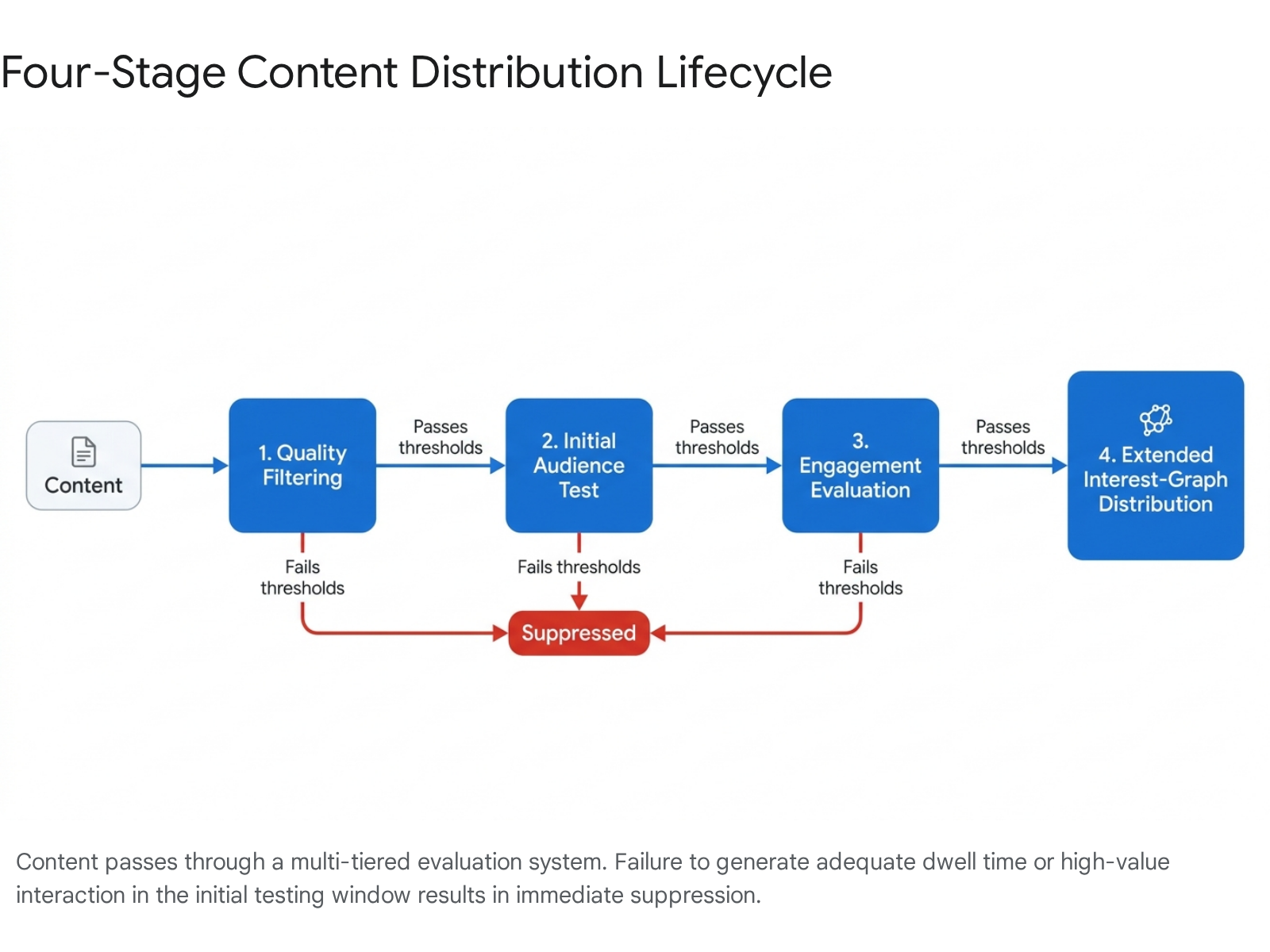
Under the 360Brew architecture, content does not immediately broadcast to a creator's entire follower base. Instead, every post undergoes a strict, sequential evaluation process to determine its ultimate reach. This systematic gating ensures that only content demonstrating measurable professional utility achieves widespread distribution 18.
Stage One: Quality Classification and Semantic Auditing
Immediately upon publication, the algorithm performs an automated quality check. The system scans for spam indicators, prohibited behaviors, and excessive external link usage 89. Furthermore, the model assesses the "Knowledge Depth Score," a metric that evaluates whether the post contains original insight, proprietary frameworks, or structured data 13. Surface-level commentary and heavily recycled advice are flagged at this stage, preventing them from progressing to broader distribution networks.
Crucially, the 360Brew model also cross-references the semantic meaning of the post against the author's own profile. The system reviews the author's headline, summary, and work experience to verify their topical authority 13510. If the algorithm detects a mismatch - such as a marketing professional posting technical advice on medical devices - reach is systematically limited 10.
Stage Two: The Initial Audience Test
Posts that pass the quality classification are pushed to an initial testing cohort, typically comprising just 2% to 5% of the author's network 611. The composition of this test group is not random; the algorithm prioritizes users who have historically demonstrated a high affinity for the author's content or the specific subject matter discussed in the post 812.
Stage Three: Engagement Velocity and The Golden Hour
The performance of the post within the initial test group determines its subsequent scaling potential. This evaluation period, commonly referred to as the "Golden Hour," encompasses the first 60 to 90 minutes after publication 461314. During this window, the algorithm scrutinizes both the volume and the qualitative depth of the engagement. Active creator participation is heavily weighted; authors who respond to comments within the first 15 to 60 minutes generate an algorithmic visibility boost estimated between 30% and 90% by signaling active community management 141115. Analytical models indicate that only 5% of posts that fail to meet baseline engagement thresholds during this initial phase ever recover to reach extended audiences 6.
Stage Fourth: Relevance Scaling and Cohort Expansion
If the initial engagement signals are strong, the algorithm scales the post to second and third-degree connections 111621. Distribution at this stage relies on the aforementioned "Interest Graph." The platform maps the professional demographics - such as job titles, seniority levels, and industry sectors - of the users who engaged during the testing phase, and subsequently surfaces the post to similar cohorts across the broader network 7811. Because relevance is prioritized over recency, highly targeted posts that maintain engagement momentum can resurface in user feeds weeks after their initial publication 517.
Core Ranking Signals and Engagement Valuations
The 2026 algorithm fundamentally realigned the weighting of interaction metrics. Passive vanity metrics, such as generic likes and simple reactions, have been severely devalued. The system now prioritizes indicators of sustained attention and conversational depth 111416.
Dwell Time Analysis
Dwell time - the active duration a user spends consuming a post - has become the foundational proxy for content quality 11213. The system measures viewport time, scroll depth, and interaction rates with "see more" expansion links 812.
Data indicates a stark correlation between dwell time and algorithmic distribution. Posts that hold a reader's attention for 61 seconds or more achieve an average engagement rate of 15.6% 147. Conversely, posts that generate 0 to 3 seconds of attention - even if accompanied by a quick "like" - are classified as "click bounces." These bounces receive a baseline engagement rate of merely 1.2%, signaling to the algorithm that the content is engagement bait, which results in immediate feed suppression 16.
Content Saves and Direct Sends
The most heavily weighted active engagement signals in the 2026 algorithm are "Saves" (bookmarking a post for later reference) and "Sends" (sharing a post via private direct message) 101718. Analytical datasets covering over 3 million posts reveal that a single "Save" drives approximately 5 times more organic reach than a standard like, and roughly 2 times more reach than a basic comment 3.
The algorithm interprets saves as a definitive indicator of high-utility, evergreen content. Frameworks, checklists, and proprietary data visualizations frequently command high save rates. Because these signals are so potent, the algorithm actively resurrects highly saved content, delivering it to new interest-matched cohorts long after the original chronological publication date 510.
Comment Quality and Thread Generation
While saves secure long-term viability, comments remain the primary mechanism for immediate network expansion. However, the algorithm differentiates between comment types through natural language processing. Thoughtful, multi-sentence comments carry an estimated 8 to 15 times more algorithmic weight than passive likes 1419.
Generic or single-word comments (e.g., "Great post!", "Following", or simple emojis) are actively flagged as low-value and contribute minimally to distribution 1116. The algorithm actively rewards posts that prompt debate, structured questions, and peer-to-peer knowledge exchange. When an author's post generates a nested comment thread - where multiple users reply to a single comment - the algorithmic weight compounds, signaling deep topical resonance 1620.
Comparative Weighting of Engagement Signals
The following table summarizes the comparative value of different interaction types under the 2026 ranking model, illustrating the stark divide between active utility metrics and passive vanity metrics.
| Engagement Signal | Algorithmic Weighting | Strategic Implication |
|---|---|---|
| Saves / Bookmarks | Highest (5x reach vs. likes) | Signals evergreen utility; extends post lifespan by weeks 31018. |
| Dwell Time (>60s) | Highest (15.6% engagement baseline) | Acts as the primary proxy for content quality and reading depth 147. |
| Direct Sends (DMs) | Very High (3x reach vs. likes) | Indicates high professional relevance and triggers direct conversions 18. |
| Multi-Sentence Comments | High (8-15x reach vs. likes) | Sparks nested threads; critical during the first 60-minute evaluation window 1411. |
| Contextual Reshares | Medium | Reshares with added commentary perform nearly 3x better than identical mass-reshares 411. |
| Standard Likes/Reactions | Low | Devalued as passive vanity metrics; insufficient for scaling distribution 131416. |
| Click Bounces (<3s Dwell) | Negative | Generates algorithmic suppression, limiting post reach to immediate connections 16. |
Content Formats and Performance Benchmarks
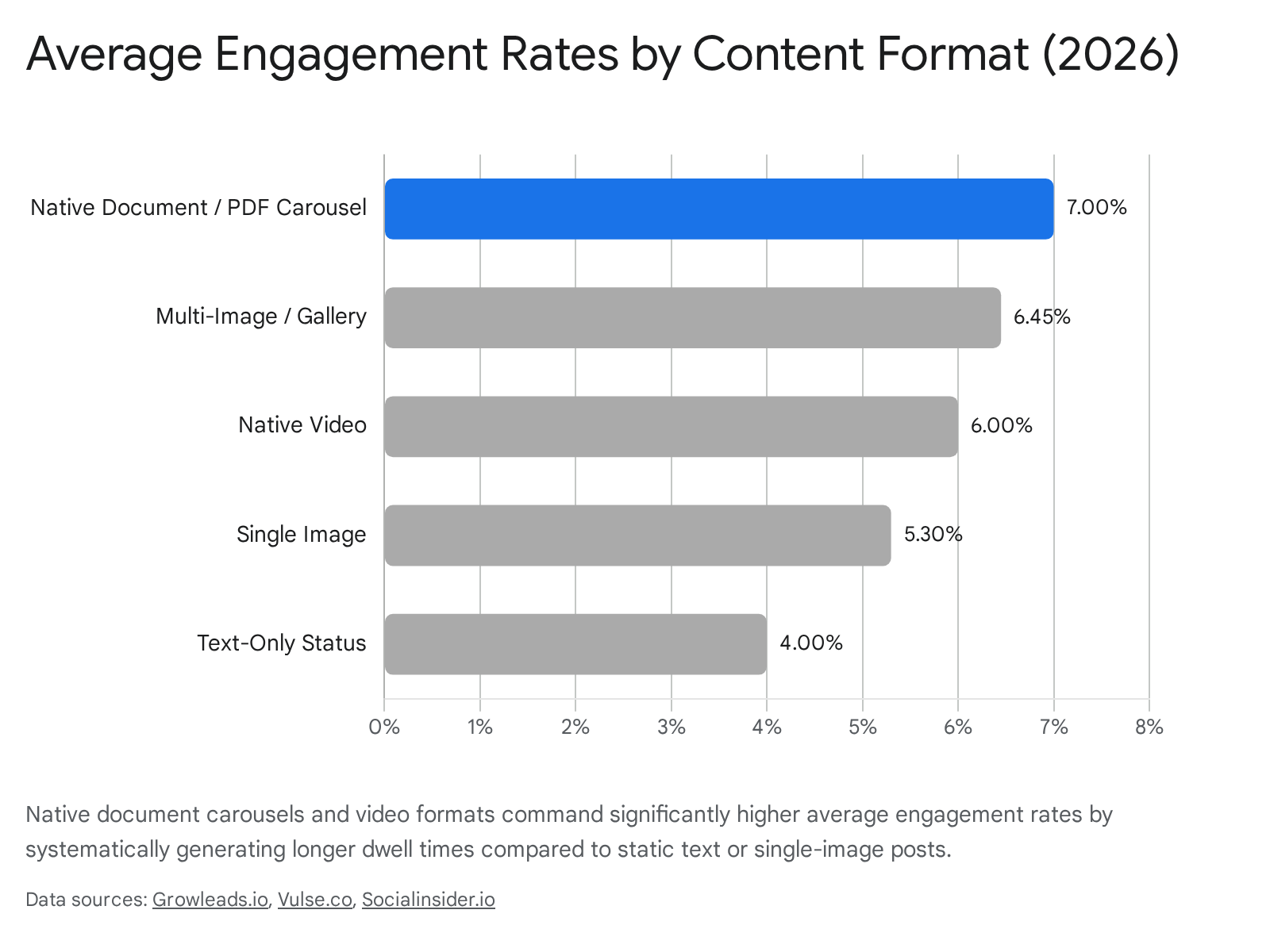
The LinkedIn algorithm demonstrates distinct preferences for certain content formats, driven by the platform's overarching goal to maximize user retention and onsite time. A comprehensive analysis of over 1.3 million posts across industries highlights the growing performance gap between rich media and static text 2122.
Native Documents and Carousels
Native document uploads, particularly PDF carousels, currently register as the highest-performing content format on the platform 61122. Benchmark reports establish that native documents yield an average engagement rate of 6.6% to 7.0%, reflecting a 14% year-over-year increase 62122.
Carousels are structurally favored by the 360Brew model because they naturally engineer prolonged dwell time. The physical act of swiping or clicking through multiple slides registers as sustained active engagement. This format forces users to consume information sequentially, satisfying the algorithm's primary retention metric while simultaneously presenting dense, structured knowledge that frequently triggers the highly valued "Save" function 4212829.
Short-Form Native Video
Video distribution experienced significant acceleration, with LinkedIn reporting a 36% year-over-year increase in video views platform-wide, reaching an estimated 154 billion views 213023. Native video uploads deliver a 69% performance improvement over other dynamic formats, particularly when branding or core insights are established within the first four seconds 415.
The algorithm explicitly favors vertical, mobile-native video formatting, which is associated with 34% higher engagement and 34% longer dwell times compared to traditional square formats 30. Completion rate is prioritized over raw view counts. Videos under 30 seconds achieve completion rates of up to 89%, compared to 31% for videos exceeding 60 seconds. Consequently, the algorithm aggressively distributes concise, insight-dense video clips that deliver immediate professional value without requiring prolonged attention spans 71112.
Text Posts and Static Imagery
Static single-image posts and text-only updates have seen relative performance declines in broad top-of-funnel reach, though they continue to serve specific functions. Single-image posts underperform text-only content by approximately 30% in algorithmic weighting, reversing trends seen in previous years 11.
While text-only posts yield lower overall impression counts compared to video or documents, they remain highly effective for driving substantive comments within warm networks. Because text posts look unpromotional and inherently conversational, they frequently trigger deeper dialogue, serving as relationship-building assets rather than primary discovery tools 1124. The algorithm dictates strict formatting for text: walls of prose are penalized via low dwell times, whereas posts utilizing strong hooks, 150-character limits before "see more" tags, and scannable paragraph breaks generate optimal returns 11.
Long-Form Newsletters
Newsletters present a unique distribution anomaly. As of 2026, LinkedIn newsletters reach over 450 million platform subscribers and boast an average open rate of 41.24% 2526. Because newsletters are delivered directly to member inboxes and notifications, they partially bypass the traditional feed algorithm 6. This format represents one of the few mechanisms on the platform to build an owned-audience distribution channel that is relatively immune to day-to-day algorithmic volatility, provided the content remains strictly educational and avoids excessive promotional messaging 26.
Algorithmic Suppression and Content Penalties
Alongside new amplification metrics, LinkedIn introduced stringent suppression rules in 2026 to penalize behaviors that extract users from the platform, artificially manipulate engagement signals, or flood feeds with synthetic material. Understanding these penalties is essential, as tactics that drove growth in 2024 now actively trigger shadowbans.
The Outbound Link Penalty
The 2026 algorithm aggressively penalizes content containing external outbound links 6716. Posts harboring links to external websites experience an immediate reach reduction of 60% to 68% compared to identical posts without links 6111216. The economic rationale is straightforward: LinkedIn seeks to maximize internal session times to support its advertising inventory, which commands a high B2B return on ad spend (ROAS) 4. Content that redirects user attention away from the platform directly conflicts with this business objective.
Historically, creators circumvented link penalties by publishing text-only posts and placing the external link in the first comment. By early 2026, the 360Brew model successfully patched this vulnerability. The algorithm now identifies "bridge behavior" - content explicitly designed to funnel users to a linked comment - and applies identical reach dampening to the parent post 67.
Detection of Artificial Engagement Pods
In previous iterations of the algorithm, early engagement velocity could be easily manipulated. Users formed "engagement pods" - reciprocal groups where members systematically liked and commented on one another's posts to simulate early traction and force the algorithm to scale the content 1311.
LinkedIn has since deployed advanced AI detection systems specifically targeting this behavior. In 2026, the pod detection systems operate at an estimated 97% accuracy rate 12. The algorithm analyzes engagement networks over time, identifying unnatural patterns such as identical accounts interacting within minutes of publication, reciprocal engagement occurring regardless of content relevance, and sudden, unnatural spikes in engagement velocity from disconnected profiles 1111216. Once identified, the platform applies permanent reach suppression to the participating accounts, rendering traditional engagement hacks highly detrimental 312.
Machine-Generated Content Filtration
The proliferation of generative AI tools led to a deluge of synthetic content on the professional network. While LinkedIn does not strictly penalize all AI-assisted writing, the LLM-powered algorithm assesses the semantic novelty and stylistic markers of every post 4. Unedited AI output is frequently recognized and suppressed.
The system identifies specific "banned lexicons" - overused generative AI vocabulary such as "delve," "robust," "seamlessly," and "tapestry" - flagging the content as low-effort engagement bait 27. Furthermore, the algorithm evaluates if a post contributes original thought leadership or merely synthesizes widely available information 413.
Industry studies comparing AI-generated content to human-authored content in B2B contexts indicate that while AI can optimize structure and posting consistency, entirely synthetic posts generate lower dwell times and fewer meaningful comments because they lack narrative authenticity and vulnerability 3637. The highest-performing strategy in 2026 utilizes a hybrid workflow: leveraging AI for research, structuring data, and optimizing headlines, while relying on human authorship for narrative voice, specific niche insights, and contextual relevance 363738.
Entity Dynamics: Personal Profiles Versus Company Pages
The structural disparity between personal profiles and corporate entities widened significantly following the 2026 updates. The platform explicitly prioritizes human voices and peer-to-peer interaction over corporate broadcasting, forcing marketing departments to entirely rethink organic distribution 1328.
The Contraction of Organic Corporate Reach
Organic distribution for standard LinkedIn Company Pages has effectively collapsed. Algorithmic data reveals that organic company page posts reach an average of only 1.6% to 4.0% of their total follower base 131428. Across the platform, company page content commands roughly 1% to 5% of total feed allocation 4112428. The remaining 95% of feed inventory is heavily dominated by personal profiles (accounting for approximately 65%) and sponsored advertisements (accounting for roughly 30%) 41124.
Consequently, standard B2B company pages generate a median engagement rate of 1.3% to 5.72%, compared to personal thought leadership posts which average upwards of 10.7% engagement 2629. Company pages are increasingly treated by the algorithm - and the user base - as static destination hubs. They function as critical infrastructure for establishing corporate credibility, hosting job listings, evaluating partnerships, and issuing formal announcements, but they are no longer viable as primary engines for organic discovery 2830.
Employee Advocacy as the Primary Growth Lever
Due to the suppression of corporate pages, B2B organic visibility in 2026 is almost entirely dependent on employee advocacy. Algorithmic mechanics heavily favor content shared by individuals. Research spanning 500,000 employee posts demonstrates that personal posts yield 9 times more total engagement, 8.8 times more reactions, and 17 times more comments than curated company content 424.
Furthermore, executive thought leadership is disproportionately rewarded. Content published directly by a CEO generates roughly 4 times more engagement than the average company page update 7. The economics of this algorithmic bias are compelling: strategic employee advocacy programs deliver equivalent reach at a cost-per-click (CPC) of $0.25 to $1.00, compared to traditional LinkedIn Ads which average $5.00 to $10.00 CPC 4. Furthermore, B2B lead generation through targeted LinkedIn engagement costs 28% less than equivalent paid search campaigns due to the platform's precision targeting 26.
Premium Subscriptions and Platform Visibility
LinkedIn offers various Premium subscription tiers, but their impact on algorithmic visibility is highly specific. Subscriptions such as Premium Career or Sales Navigator provide enhanced search capabilities, unlimited browsing, and InMail credits 4243. However, these personal Premium tiers do not confer any algorithmic advantage for organic feed visibility; a post from a free account and a Premium Career account are subjected to the exact same 360Brew evaluation criteria 4243.
Conversely, "Premium Company Pages," a monetization tier introduced to offset declining organic reach, provides structural benefits. Priced starting at approximately $76.99 per month, this tier equips businesses with tools to artificially boost visibility without traditional ad spend 44. Premium Company Page features include the ability to deploy custom call-to-action (CTA) buttons directly in the feed, access advanced visitor insights to identify anonymous traffic, display prominent client testimonials, and utilize automated auto-invite capabilities to rapidly scale follower counts by targeting users who follow competitors 44314632. While Premium Company Pages do not rewrite the rules of the algorithm, they provide the necessary conversion infrastructure to capture the limited traffic the page receives 30.
The Ubiquity of Creator Mode
In previous years, users manually activated "Creator Mode" to access specific analytical tools and alter their profile button from "Connect" to "Follow" 2833. By 2026, LinkedIn integrated the core tenets of Creator Mode directly into the general user experience, effectively blurring the line between standard professionals and content creators 2849. The algorithm now inherently treats any user who consistently publishes topic-specific content as a creator, rewarding sustained publishing cadences (optimally 3 to 5 times weekly) with increased authority verification during the initial quality filtering stage 12333435.
| Entity Type | Feed Allocation | Avg. Organic Reach | Primary Strategic Function in 2026 |
|---|---|---|---|
| Personal Profiles | ~65% | 8% - 12% | Organic discovery, thought leadership, lead generation, community building 4111328. |
| Standard Company Page | ~1% - 5% | 1.6% - 4.0% | Trust validation, credibility hosting, recruitment, formal announcements 13142428. |
| Premium Company Page | Boosted Features | 1.6% - 4.0% | Accelerated follower growth via auto-invites, direct conversions via custom CTAs 4446. |
Global Rollout and Regional Market Variations
While the 360Brew algorithm operates globally as the foundational ranking system, its execution and impact exhibit notable regional variations. Europe and Asia combined account for over half of LinkedIn's total user base (approximately 314 million in Europe and 343 million in Asia-Pacific), demanding localized approaches to content strategy that account for both regulatory environments and behavioral timelines 36.
Regulatory Influences in Europe and North America
In Europe, the implementation of the Digital Services Act (DSA), alongside strict state-level privacy laws in the United States (active in 18 states by 2026), forced LinkedIn to restrict certain B2B targeting capabilities and enforce rigorous sponsored content disclosure requirements in April 2026 13.
These regulatory guardrails prompted the algorithm to tighten its "Promotional Content Dampener." To prevent unpaid commercial broadcasts from bypassing advertising transparency standards, the algorithm severely penalizes organic posts that utilize explicit sales language, overt product-focused CTAs, or excessive outbound linking 13.
Furthermore, LinkedIn instituted a strict 30% promotional threshold for Newsletters. If more than 30% of a newsletter's trailing ten editions are classified as promotional, the publication faces reduced organic distribution, ineligibility for algorithmic recommendation, and a visible 'Frequently Promotional' label 13. As a result, European feeds in particular prioritize educational, highly credible content over promotional marketing, requiring organizations to pivot strictly to value-driven thought leadership 2.
Audience Timing and Geotargeting Differences
Because the 2026 algorithm relies heavily on the "Golden Hour" of immediate engagement to determine a post's viability, publishing at optimal times is vital. Generic North American benchmarking (e.g., posting at 8:00 AM EST) results in heavily suppressed reach for creators targeting global or non-US markets, simply because the target audience is not awake to provide the necessary early engagement velocity 1112. To trigger algorithmic amplification in APAC or EMEA markets, publishers must utilize regional online-activity data, ensuring content goes live precisely when local professional networks are active to generate immediate dwell time and conversational volume 12.
Conclusion
The 2026 LinkedIn algorithm represents a sophisticated maturation of the platform, pivoting away from broad social networking toward high-density, interest-based knowledge distribution. The implementation of the 150-billion-parameter 360Brew model has neutralized traditional growth tactics - such as link dropping, engagement pods, and unedited AI generation - replacing them with deep semantic evaluation and strict profile authority auditing.
To achieve sustained visibility, content must be optimized for depth rather than superficial virality. This requires publishing native formats like document carousels and short-form video that maximize reader dwell time, fostering meaningful, multi-sentence comment threads during the critical first hour of publication, and producing evergreen insights that prompt users to save and share content privately. Furthermore, as corporate page reach has systematically diminished to below 4%, B2B organizations are forced to decentralize their distribution. Success on the platform now relies heavily on executive thought leadership and structured employee advocacy programs to satisfy the algorithm's overwhelming preference for authentic, human-authored expertise.